
Exodus 25:6

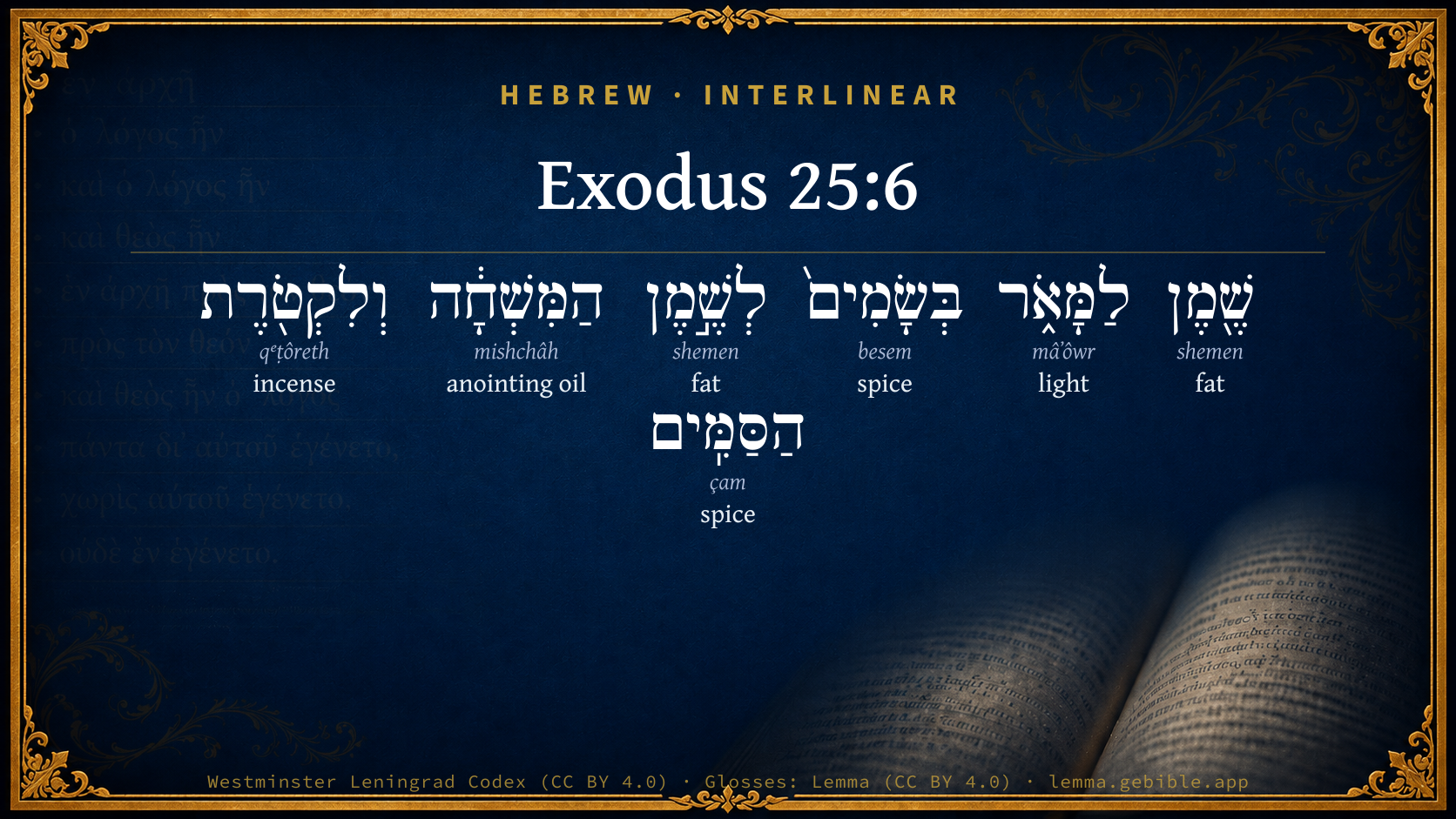
Hebrew (Westminster Leningrad Codex) Exodus 25:6 appears in the Hebrew Old Testament. The text above is from the Westminster Leningrad Codex. Each word links to its Strong’s number, a concise gloss, and parsing drawn from the Open Scriptures Hebrew Bible morphology. Click any word for its full Brown-Driver-Briggs (BDB) entry.
Download image
Cite this verse

Exodus 25:6 (World English Bible). Public Domain. Lemma interlinear Bible study tool, https://lemma.gebible.app/v/exodus/25/6.

Show BibTeX & RIS
BibTeX
RIS
English Translation
oil for the light, spices for the anointing oil and for the sweet incense,
World English Bible · Public Domain
Highlights
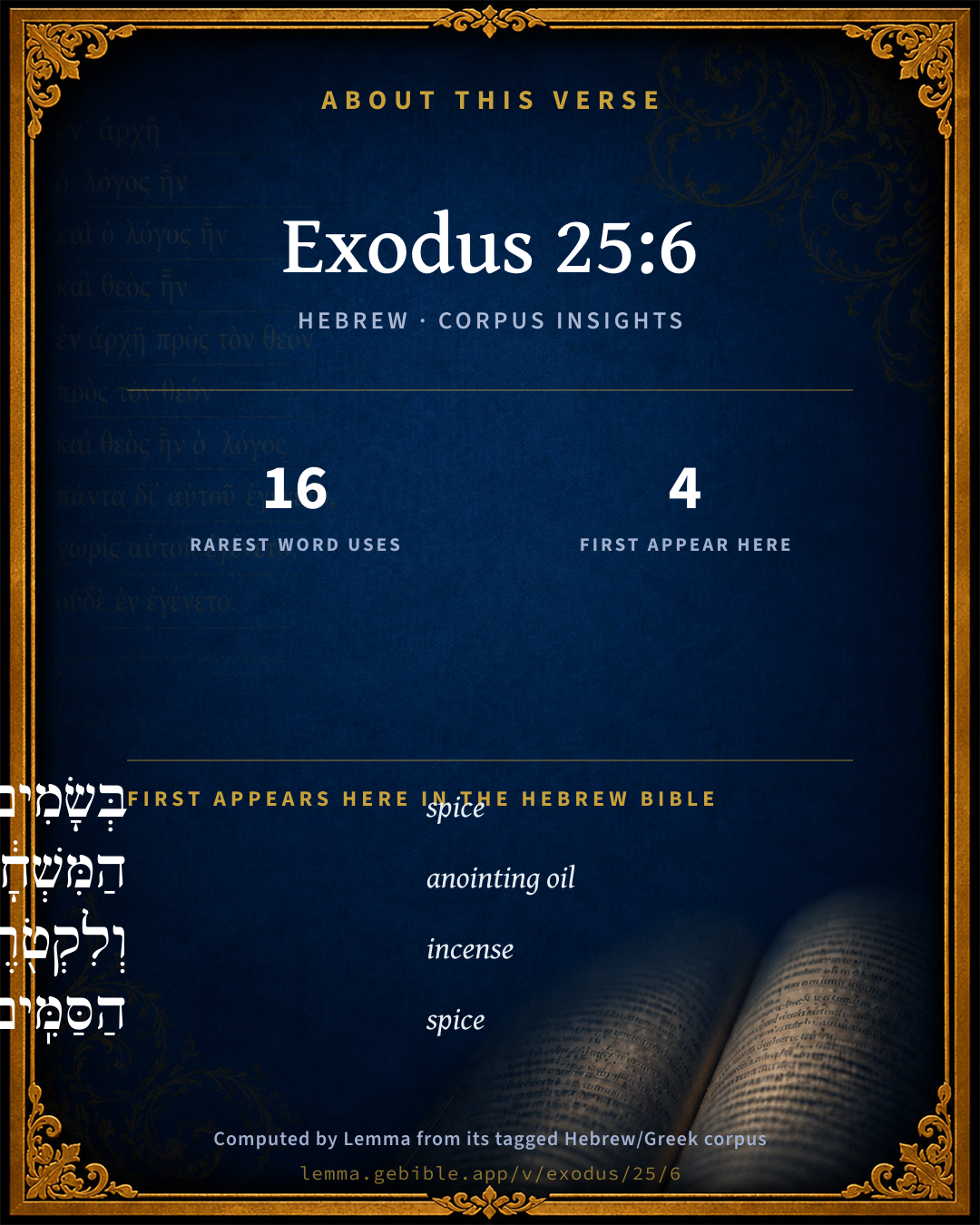
  • 4 first appearances in the Hebrew Bible
Full analysis ↓
Download a study sheet

One document with this verse’s original text, its word-by-word gloss line, the meaning frame, cross-references with their text, attributed commentary, and full source and license credits — printable, and it pastes into notes with its structure intact.

This verse Autodidact and up

Study sheet (.html) Plain text (.txt)

A passage Seminary Student

Up to 50 verses in one chapter. A passage sheet keeps up to 6 commentary sources and 12 cross-references per verse, in the order this page ranks them, and says so on the sheet whenever that leaves anything out. Ask for a single verse and you get the Autodidact verse sheet above.

Everything on this page stays free to read, with no account — the sheet is a download of what is already on screen, not access to it.

Want to remove ads? Support Godless Engineer
Compare translations 3

The same verse in 3 English versions, stacked beneath the original-language interlinear above. Click any original word for its lexicon entry.

Each is an independent rendering of the whole verse — the interlinear is not word-aligned to these translations.

Highlighted words mark where these versions differ — a whole-verse word diff, not a word-by-word alignment.

  • World English Bible Public Domain
    oil for the light, spices for the anointing oil and for the sweet incense,
  • King James Version Public Domain
    Oil for the light, spices for anointing oil, and for sweet incense,
  • unfoldingWord Literal Text CC BY-SA 4.0
    oil for the light; spices for the oil of anointing and for the incense of fragrance;

unfoldingWord Literal Text — © unfoldingWord, licensed CC BY-SA 4.0. Word-aligned USFM3 via Door43 (git.door43.org/unfoldingWord/en_ult).

Versions to compare (up to 4)

3 of 4 selected

Show all 18 translations

Every available English version of this verse, each an independent rendering of the whole verse.

  • World English Bible Public Domain
    oil for the light, spices for the anointing oil and for the sweet incense,
  • Berean Standard Bible Public Domain
    olive oil for the light; spices for the anointing oil and for the fragrant incense;
  • Majority Standard Bible Public Domain
    olive oil for the light; spices for the anointing oil and for the fragrant incense;
  • King James Version Public Domain
    Oil for the light, spices for anointing oil, and for sweet incense,
  • American Standard Version (1901) Public Domain
    oil for the light, spices for the anointing oil, and for the sweet incense,
  • Revised Version (1885) Public Domain
    oil for the light, spices for the anointing oil, and for the sweet incense;
  • Geneva Bible (1599) Public Domain
    Oyle for the light, spices for anoynting oyle, and for the perfume of sweete sauour,
  • Douay-Rheims (1899) Public Domain
    Oil to make lights: spices for ointment, and for sweetsmelling incense:
  • Young's Literal Translation Public Domain
    oil for the light, spices for the anointing oil, and for the perfume of the spices,
  • Literal Standard Version CC BY-SA 4.0
    oil for the light, spices for the anointing oil, and for the incense of the spices,
  • Unlocked Literal Bible CC BY-SA 4.0
    oil for the sanctuary lamps; spices for the anointing oil and the fragrant incense;
  • unfoldingWord Literal Text CC BY-SA 4.0
    oil for the light; spices for the oil of anointing and for the incense of fragrance;
  • Darby Bible Public Domain
    oil for the light; spices for the anointing oil, and for the incense of fragrant drugs;
  • World Messianic Bible Public Domain
    oil for the light, spices for the anointing oil and for the sweet incense,
  • Webster's Bible Public Domain
    Oil for the light, spices for anointing oil, and for sweet incense,
  • Free Bible Version CC BY-SA 4.0
    olive oil for the lamps; spices for the olive oil used in anointing and for the fragrant incense;
  • Bible in Basic English Public Domain
    Oil for the light, spices for the sweet-smelling oil, sweet perfumes for burning;
  • JPS Tanakh (1917) Public Domain
    oil for the light, spices for the anointing oil, and for the sweet incense;

Literal Standard Version (2020), Covenant Press — licensed CC BY-SA 4.0. Text via the HelloAO Bible API (eBible.org). Unlocked Literal Bible (unfoldingWord) — licensed CC BY-SA 4.0. Text via the HelloAO Bible API (eBible.org). unfoldingWord Literal Text — © unfoldingWord, licensed CC BY-SA 4.0. Word-aligned USFM3 via Door43 (git.door43.org/unfoldingWord/en_ult). Free Bible Version, Dr. Jonathan Gallagher — licensed CC BY-SA 4.0. Text via the HelloAO Bible API (eBible.org).

Word by word

More ways to search: Search by grammar → Find every occurrence → Compare this word →

Practice this passage: Drill this verse → Learn its vocabulary →

About this verse

These counts appear in no published source. They are computed here, from the morphology-tagged text and Lemma’s own curated glosses. What Lemma adds →

7
words
6
distinct lemmas
Pentateuch
section

Notable vocabulary

The rarest word here is הַסַּמִּֽים spice H5561 — appearing just 16 times in the whole Hebrew Bible.

First appearance in Scripture

These words make their first canonical appearance in the Hebrew Bible here:

  • בְּשָׂמִים֙ spice H1314
  • הַמִּשְׁחָ֔ה anointing oil H4888
  • וְלִקְטֹ֖רֶת incense H7004
  • הַסַּמִּֽים spice H5561

Shared distinctive vocabulary

הַסַּמִּֽים spice H5561 occurs in 15 verses of the Hebrew Bible. Also found in:

Grammatical profile

  • 7 nouns

Repetition

A word recurs within this verse — often emphatic in Hebrew:

  • שֶׁ֖מֶן fat H8081 ×2

Hebrew & Septuagint length

In English translation the verse runs 14 words from the Hebrew and 15 from the Septuagint (LXX English) — closely comparable.

A rough comparison of the two English renderings, which tokenize alike — not a word-level alignment.

Word counts can differ between the Hebrew and the Greek without any difference in meaning — e.g. the Hebrew direct-object marker אֵת has no separate Greek word, and Greek often adds the article ὁ.

Cross-references

4

Topical passages linked to Exodus 25:6 in the Treasury of Scripture Knowledge — connected by theme and wording, ordered by reader-vote popularity; previews shown in the World English Bible.

  • Exodus 27:20 "You shall command the children of Israel, that they bring to you pure olive oil beaten for the light, to cause a lamp to burn continually.
  • Exodus 25:37 You shall make its lamps seven, and they shall light its lamps to give light to the space in front of it.
  • Exodus 30:23–38 "Also take fine spices: of liquid myrrh, five hundred shekels; and of fragrant cinnamon half as much, even two hundred and fifty; and of fragrant cane, two hundred and fifty;
  • Exodus 40:24–25 He put the lampstand in the tent of meeting, opposite the table, on the side of the tent southward.

Cross-references courtesy of OpenBible.info (CC BY 4.0).

Hebrew and Greek witnesses Masoretic Hebrew ↔ Greek Septuagint

The same verse in the two great witnesses to the Old Testament, shown verse-for-verse.

These are two independent witnesses, not word-aligned to each other, and the Septuagint is shown in lemma (dictionary) form.

Hebrew Exodus 25:6 Masoretic · Westminster Leningrad Codex

שֶׁ֖מֶן לַמָּאֹ֑ר בְּשָׂמִים֙ לְשֶׁ֣מֶן הַמִּשְׁחָ֔ה וְלִקְטֹ֖רֶת הַסַּמִּֽים

oil for the light, spices for the anointing oil and for the sweet incense,

World English Bible · Public Domain

Greek LXX Exodus 25:6 Septuagint · lemma form
and oil for the light, incense for anointing oil, and for the composition of incense,

LXX2012 (modern English Septuagint) · Public Domain

Hebrew: Westminster Leningrad Codex (CC BY 4.0). Greek: Septuagint (public domain); English from LXX2012 (modern English Septuagint) (Public Domain). How the Septuagint differs from the Hebrew →

Targum (Aramaic paraphrase)

2

The Targum is the ancient Jewish Aramaic paraphrase of the Hebrew Scriptures — an interpretive translation, not the Hebrew text itself. Onkelos (literal) and Pseudo-Jonathan (expansive) render the Torah, and Jonathan the Prophets. Coverage is partial: where no permissively-licensed English translation exists for a verse, only the Aramaic is shown. This is verse-level text, not a word-by-word alignment to the Hebrew.

  1. Targum Onkelos Torah (Genesis–Deuteronomy)
    מִשְׁחָא לְאַנְהָרוּתָא בּוּסְמַיָא לְמִשְׁחָא דִרְבוּתָא וְלִקְטוֹרֶת בּוּסְמַיָא:

    (no public-domain English translation for this verse)

    Targum Onkelos — Aramaic: “Onkelos Genesis” (public domain); “Onkelos Exodus” (public domain); “Onkelos Leviticus” (public domain); “Onkelos Numbers” (public domain); “Onkelos Deuteronomy” (public domain). English: “Sefaria Community Translation” (CC0 1.0 (public-domain dedication)); “J.W. Etheridge. The Targums of Onkelos and Jonathan Ben Uzziel on the Pentateuch. London: Longmans, Green, 1862” (public domain). Text via Sefaria.

  2. Targum Pseudo-Jonathan Torah (Genesis–Deuteronomy)
    וּמְשַׁח זֵיתָא לְאַנְהָרָא וּבוּסְמַיָא לְפִיטוּמָא דִמְשַׁח רְבוּתָא וּלְפִיטוּמָא דִקְטוֹרֶת בּוּסְמַיָא

    and olive oil for the light, and aromatics for the confection of the pure anointing oil, and of the fragrant incense;

    Targum Pseudo-Jonathan — Aramaic: “Targum Jonathan on Genesis” (public domain); “Targum Jonathan on Exodus” (public domain); “Targum Jonathan on Leviticus” (public domain); “Targum Jonathan on Numbers” (public domain); “Targum Jonathan on Deuteronomy” (public domain). English: “The Targum of Jonathan ben Uzziel, trans. J. W. Etheridge, London, 1862” (public domain). Text via Sefaria.

Commentary

Notes on Exodus 25:6 from classic Christian and Jewish commentators (each source and its license shown beneath its notes). The classic Christian expositions comment on the surrounding passage and are grouped to its opening verse, so a note may address several verses; the Jewish commentaries on the Tanakh (Rashi and others) are per-verse, so they appear only where the commentator wrote on this verse.

Lemma curates 59 commentaries, every one of them public domain or Creative Commons licensed, each selected and text-cleaned for this edition rather than reprinted as found. About our sources →

Trapp's Complete Commentary

John Trapp

Exo 25:6 Oil for the light, spices for anointing oil, and for sweet incense,

Ver. 6. Spices.] As cinnamon; which in Galen’s time was very rare, and hard to be found but in princes’ storehouses. {a}

{a} Antidit. Gal., lib. i.

John Trapp, A Commentary or Exposition upon All the Books of the Old and New Testament (1647–1656) — public domain. Text from a community e-Sword module.

Geneva Bible (1599)

Geneva Bible translators

Ordained for the Priests.

Geneva Bible (1599) marginal notes — public domain. Text via Bolls.life.

Adam Clarke's Commentary

Verse 6. Oil for the light] This they must have brought with them from Egypt, for they could not get any in the wilderness where there were no olives; but it is likely that this and some other directions refer more to what was to be done when in their fixed and settled residence, than while wandering in the wilderness.

Spices] To make a confection for sweet incense, abounded in different parts of these countries.

Adam Clarke's Commentary on the Bible (1810–1826) — public domain. Text from a community e-Sword/MySword module.

Ellicott's Commentary for English Readers

(6) Oil for the light.—It is assumed that the “sanctuary,” which is to be built (Exo_25:8), will need to be lighted. Oil therefore is to be provided for the lighting. Later on (Exo_27:20) it is laid down that the oil must be “pure olive oil beaten.”

Spices for anointing oil.—Rather, for the anointing oil. Here, again, there is an assumption that anointing oil will be needed, and that spices will be a necessary ingredient in such oil. We find afterwards that the Tabernacle itself, all its vessels, and the priests appointed to serve in it, had to be consecrated by anointing (Exo_29:7; Exo_29:36; Exo_30:26-30). The particular spices to be mixed with the “anointing oil” are enumerated in Exo_30:23-24.

And for sweet incense.—Rather, for the sweet incense—the incense, i.e., which would have to be burnt. (See Exo_30:1-8; and for the composition of the incense, Exo_30:34.)

A Bible Commentary for English Readers, edited by Charles John Ellicott (1878–1897) — public domain. Text from a community e-Sword module.

The Cambridge Bible for Schools and Colleges

gen. ed. J. J. S. Perowne

6. Oil and spices. For the reason of the verse being assigned to P3[199], see pp. 296, 328: cf. pp. 378 f., and xi f.

[199] Secondary strata of P (see p. xii top; pp. 328f., 378).

oil for the light] See on Exo_27:20.

spices for the anointing oil] Exo_30:22 ff.

and for the incense of fragrant powders] Exo_30:34 ff.

The Cambridge Bible for Schools and Colleges (gen. ed. J. J. S. Perowne; Cambridge University Press, 1878–1918) — public domain. Text from a community e-Sword module.

John Gill's Exposition

Oil for the light,.... For the light of the lamps in the candlestick: this was oil olive, as the Targum of Jonathan, and so Jarchi, see Exo 27:20,

spices for anointing oil; for the anointing of Aaron and his sons, and the tabernacle and its vessels, such as pure myrrh, sweet cinnamon, sweet calamus, and cassia:

and for sweet incense; as stacte, onycha, and galbanum; from whence they had this oil and these spices, it is not easy to say, unless they brought them out of Egypt with them; which is likely, since the deserts of Arabia could not furnish them with them.

John Gill's Exposition of the Whole Bible (1746–1763) — public domain (CC PDM 1.0). Text via the HelloAO Bible API.

Matthew Poole's English Annotations

Oil for the light; for the lamps or candlesticks, Exo 25:37.

Anointing oil, wherewith the priests, and the tabernacle, and the utensils thereof, were to be anointed. Sweet

incense; Heb. incense of spices, or sweet odours; so called to distinguish it from the incense of the fat of sacrifices, which was burnt upon the altar.

Matthew Poole's English Annotations on the Holy Bible (1683–1685) — public domain. Text from a community e-Sword/MySword module.

Whedon's Commentary on the Bible

Daniel D. Whedon

6. Oil for the light — This, according to Exo_27:20, was to be pure olive oil and beaten.

Spices — Such as are more fully described in Exo_30:22-25. The various things for which the anointing oil was used are mentioned in Exo_30:26-33.

Sweet incense — See more fully Exo_30:34-38.

Daniel D. Whedon (gen. ed.), Commentary on the Old and New Testaments (1874–1909) — public domain. Text from a community e-Sword module.

The Pulpit Commentary

Oil for the light. That the sanctuary to be erected would require to be artificially lighted is assumed. Later, a "candlestick" is ordered (vers. 31-37). The people were to provide the oil which was to be burnt in the "candlestick." in Exo_27:20, we are told that the oil was to be "pure oil olive beaten." Spices for anointing oil. Anointing oil would be needed for the sanctification of the Tabernacle, the ark, and all the holy vessels, as also for the consecration of Aaron and his sons to the priesthood. The spices required are enumerated in Exo_30:23, Exo_30:24. They consisted of pure myrrh, sweet cinnamon, sweet calamus, and cassia. And for sweet incense. The spices needed for the incense were, according to our translators, stacte, onycha, galbanum and frankincense (ib, 34).

The Pulpit Commentary (1880–1919), ed. H.D.M. Spence-Jones & Joseph S. Exell — public domain. Text from a community e-Sword module.

Rashi

Rabbi Shlomo Yitzchaki (Rashi)

שמן למאר OIL FOR THE LIGHT — “clear olive-oil … to make the flame ascend continually”).

בשמים לשמן המשחה SPICES FOR THE ANOINTING OIL which was made for the purpose of anointing the vessels of the Tabernacle and the Tabernacle itself in order to sanctify it. For this oil spices were required as is set forth in the section כי תשא (Exodus 30:23 ff.).

ולקטרת הסמים AND FOR INCENSE OF AROMATIC SPICES that were burnt every evening and morning, as is set forth in the section ואתה תצוה (Exodus 30:7). The word קטרת signifies raising vapour (קיטור) and a column of smoke.

Rashi on the Tanakh — English translations: “The Judaica Press complete Tanach with Rashi, translated by A. J. Rosenberg” (CC BY 4.0); “Pentateuch with Rashi's commentary by M. Rosenbaum and A.M. Silbermann, 1929-1934” (public domain); “The Metsudah Tanach series, Lakewood, N.J” (CC BY 4.0); and “The Book of Joshua, Metsudah Publications, 1997” (CC BY 4.0). Text via Sefaria.

Ramban (Nachmanides)

Rabbi Moshe ben Nachman (Ramban / Nachmanides)

SPICES FOR ANOINTING OIL AND FOR INCENSE OF ‘HASAMIM’ (AROMATICS). Some scholars say that this is an elliptical verse, (spices) and hasamim (aromatics) are two different terms. And since it says further on that for the incense take unto thee ‘samim’ (aromatics) (30:34), the word b’samim cannot refer also to the incense mentioned here. Hence they complete the sentence thus: “spices for anointing oil, and aromatics for incense and aromatics.” the sense being: “spices for anointing oil and aromatics for incense of aromatics.” And other scholars say that the verse is to be understood as if it were inverted: “and for incense of aromatics they shall bring aromatics.” Scripture mentions them with the definite article [hasamim], in order to indicate that it is referring to those aromatics that are good as incense, for there also [i.e., further in the section of the Torah dealing with the incense — 30:34] He did not explain [fully the compound forming the incense]. — the aromatics that are known. See Ramban further 30:34 for full discussion of this subject. And Rabbi Abraham ibn Ezra wrote that the verse is to be taken in its simple sense, that spices be taken for both — for the anointing oil and for the incense, for included in the compound of the incense were these spices: spikenard and saffron and cinnamon, according to the words of our Rabbis. It was not necessary for Scripture to mention “spices and aromatics for the incense,” because it said the incense of aromatics, just as it did not say “oil for the anointing oil.” This is the correct interpretation.All these opinions are necessary because according to the view of the linguists [samim and b’samim connote two different things]: samim are curative herbs which are not edible, such as frankincense and galbanum, while b’samim are those that are edible, and are called mis’adim (props). because they have a strengthening power by their fragrant odor.However, in the opinion of Rashi samim is identical with b’samim. And such is the meaning of our Rabbis in the Midrash in saying: “Eleven samonin (ingredients) were told to Moses on Mount Sinai” [which form the incense, and among them were spikenard and saffron and cinnamon which are b’samim, thus proving that they are all called by the term samim]. Onkelos also translates in both cases busmin [“busmaya for the anointing oil, and for incense of busmaya”]. This is correct in the understanding of this verse. But because Scripture changed the terms [calling one b’samim and the other samim] we might possibly say that the most important of aromatics and spices are called b’samim, a term which signifies the choicest and most famous of the spices, just as He said, ‘b’samim rosh’ (the chief spices). ‘b’rosh kol bosem’ (with chief of all spieces). We are also correct in saying that the words b’samim and bosem are composite words: bo sem, bo samim (“in it is spice,” “in it are spices”). Proof to the words of the Rabbis [that the term b’samim includes also samim] is the verse, Take thou unto thee ‘b’samim rosh’ (the chief spices) of flowing myrrh, and myrrh, is counted among the samim since it is a curative, not an edible herb. Scripture further says, Spikenard and saffron, calamus and cinnamon, with all trees of frankincense, and the verse there continues: myrrh and aloes, with all the chief ‘b’samim’ (spices). And with reference to all of these Scripture says, Awake, O north wind; and come, thou south; blow upon my garden, that ‘b’samov’ (the spices thereof) may flow out., Verse 16. Thus it is clear that the term b’samim (spices) includes also samim (aromatics), since it speaks of all of them as b’samim and lists amongst them myrrh, which is one of the samim. A further proof [to the opinion of the Rabbis that b’samim includes also samim] is the verse, and the princes brought… the ‘bosem’ and the oil for the light and for the annointing oil and the incense of aromatics, but it does not mention that they brought samim, from which we may conclude that they are all included in the bosem.

Ramban (Nachmanides) on the Tanakh — English translation: “Commentary on the Torah by Ramban (Nachmanides). Translated and annotated by Charles B. Chavel. New York, Shilo Pub. House, 1971-1976” (CC BY 4.0). Text via Sefaria.

Lesson kit

Teaching starters — assembled from the data on this page, not authored interpretation. Every prompt links to the verse data it draws on. Edit before teaching.

Exodus, in the Pentateuch, opens this verse with 7 words (6 distinct Hebrew lemmas). Its most distinctive word is çam (“spice”). A historical commentator’s framing appears above. Read the whole chapter for the surrounding context.

Discussion questions

  1. How does “spice” (çam) shape what this verse is saying?
  2. 4 words make their first appearance in Scripture here. What does this debut establish?
  3. How does Exodus 30:7, which shares the word «spice», read alongside this verse?
  4. What does the repetition of “fat” (2× in this one verse) do in this verse?
  5. These translations render this verse differently. What is at stake in choosing one wording over another?
  6. Compare how Trapp's Complete Commentary and Geneva Bible (1599) read this verse. Where do they agree or differ?

Things to notice

  • 4 words make their first canonical appearance in Scripture here.
  • These translations choose different wording for 2 words in this verse.
  • “fat” occurs 2× in this single verse.
  • 6 distinct Hebrew lemmas span 7 words in this verse.

Reading settings

Reading text

Shown beneath each verse's original-language words.

Old Testament
Old Testament edition

Read the OT as the Masoretic Hebrew (MT) or the Greek Septuagint (LXX).

English shown for the Greek Septuagint (in the Hebrew ↔ Greek comparison).

Comparing translations? Open the Compare panel on any verse page to stack up to four side by side.