
1 Kings 6:32

Hebrew (Westminster Leningrad Codex) 1 Kings 6:32 appears in the Hebrew Old Testament. The text above is from the Westminster Leningrad Codex. Each word links to its Strong’s number, a concise gloss, and parsing drawn from the Open Scriptures Hebrew Bible morphology. Click any word for its full Brown-Driver-Briggs (BDB) entry.
Download image
Cite this verse

1 Kings 6:32 (World English Bible). Public Domain. Lemma interlinear Bible study tool, https://lemma.gebible.app/v/1-kings/6/32.

Show BibTeX & RIS
BibTeX
RIS
English Translation
So [he made] two doors of olive-wood; and he carved on them carvings of cherubim and palm trees and open flowers, and overlaid them with gold; and he spread the gold on the cherubim, and on the palm trees.
World English Bible · Public Domain
Download a study sheet

One document with this verse’s original text, its word-by-word gloss line, the meaning frame, cross-references with their text, attributed commentary, and full source and license credits — printable, and it pastes into notes with its structure intact.

This verse Autodidact and up

Study sheet (.html) Plain text (.txt)

A passage Seminary Student

Up to 50 verses in one chapter. A passage sheet keeps up to 6 commentary sources and 12 cross-references per verse, in the order this page ranks them, and says so on the sheet whenever that leaves anything out. Ask for a single verse and you get the Autodidact verse sheet above.

Everything on this page stays free to read, with no account — the sheet is a download of what is already on screen, not access to it.

Want to remove ads? Support Godless Engineer
Compare translations 3

The same verse in 3 English versions, stacked beneath the original-language interlinear above. Click any original word for its lexicon entry.

Each is an independent rendering of the whole verse — the interlinear is not word-aligned to these translations.

Highlighted words mark where these versions differ — a whole-verse word diff, not a word-by-word alignment.

  • World English Bible Public Domain
    So [he made] two doors of olive-wood; and he carved on them carvings of cherubim and palm trees and open flowers, and overlaid them with gold; and he spread the gold on the cherubim, and on the palm trees.
  • King James Version Public Domain
    The two doors also were of olive tree; and he carved upon them carvings of cherubim and palm trees and open flowers, and overlaid them with gold, and spread gold upon the cherubim, and upon the palm trees.
  • unfoldingWord Literal Text CC BY-SA 4.0
    And the two of the doors wood of oil, and he carved on them carvings of cherubs and palm trees and opened ones of flowers, and he overlaid them gold. And he beat out the gold on the cherubs and on the palm trees.

unfoldingWord Literal Text — © unfoldingWord, licensed CC BY-SA 4.0. Word-aligned USFM3 via Door43 (git.door43.org/unfoldingWord/en_ult).

Versions to compare (up to 4)

3 of 4 selected

Show all 18 translations

Every available English version of this verse, each an independent rendering of the whole verse.

  • World English Bible Public Domain
    So [he made] two doors of olive-wood; and he carved on them carvings of cherubim and palm trees and open flowers, and overlaid them with gold; and he spread the gold on the cherubim, and on the palm trees.
  • Berean Standard Bible Public Domain
    The double doors were made of olive wood, and he carved into them cherubim, palm trees, and open flowers and overlaid the cherubim and palm trees with hammered gold.
  • Majority Standard Bible Public Domain
    The double doors were made of olive wood, and he carved into them cherubim, palm trees, and open flowers and overlaid the cherubim and palm trees with hammered gold.
  • King James Version Public Domain
    The two doors also were of olive tree; and he carved upon them carvings of cherubim and palm trees and open flowers, and overlaid them with gold, and spread gold upon the cherubim, and upon the palm trees.
  • American Standard Version (1901) Public Domain
    So `he made' two doors of olive-wood; and he carved upon them carvings of cherubim and palm-trees and open flowers, and overlaid them with gold; and he spread the gold upon the cherubim, and upon the palm-trees.
  • Revised Version (1885) Public Domain
    So he made two doors of olive wood; and he carved upon them carvings of cherubim and palm trees and open flowers, and overlaid them with gold; and he spread the gold upon the cherubim, and upon the palm trees.
  • Geneva Bible (1599) Public Domain
    The two doores also were of oliue tree, and he graued them with grauing of Cherubims and palme trees, and grauen floures, and couered them with golde, and layed thin golde vpon the Cherubims and vpon the palme trees.
  • Douay-Rheims (1899) Public Domain
    And the floor of the house he also overlaid with gold within and without.
  • Young's Literal Translation Public Domain
    And the two doors `are' of the oil-tree, and he hath carved upon them carvings of cherubs, and palm-trees, and openings of flowers, and overlaid with gold, and he causeth the gold to go down on the cherubs and on the palm-trees.
  • Literal Standard Version CC BY-SA 4.0
    And the two doors [are] of the oil-tree, and he has carved on them carvings of cherubim, and palm-trees, and openings of flowers, and overlaid with gold, and he causes the gold to go down on the cherubim and on the palm-trees.
  • Unlocked Literal Bible CC BY-SA 4.0
    So he made two doors of olivewood, and he made on them carvings of cherubim, palm trees, and open flowers. He overlaid them with gold and he spread the gold on the cherubim and palm trees.
  • unfoldingWord Literal Text CC BY-SA 4.0
    And the two of the doors wood of oil, and he carved on them carvings of cherubs and palm trees and opened ones of flowers, and he overlaid them gold. And he beat out the gold on the cherubs and on the palm trees.
  • Darby Bible Public Domain
    The two doors were of olive-wood; and he carved on them carvings of cherubim, and palm-trees and half-open flowers, and overlaid them with gold, and spread gold on the cherubim and on the palm-trees.
  • World Messianic Bible Public Domain
    So he made two doors of olive wood; and he carved on them carvings of cherubim, palm trees, and open flowers, and overlaid them with gold. He spread the gold on the cherubim and on the palm trees.
  • Webster's Bible Public Domain
    The two doors also were of olive tree; and he carved upon them carvings of cherubim, and palm trees, and open flowers, and overlaid them with gold, and spread gold upon the cherubim, and upon the palm trees.
  • Free Bible Version CC BY-SA 4.0
    These olive wood double doors had carved into them designs of cherubim, palm trees, and open flowers. The cherubim and palm trees carvings were covered with beaten gold.
  • Bible in Basic English Public Domain
    On the olive-wood doors were cut designs of winged ones and palm-trees and open flowers, all of them, with the doors, plated with gold.
  • JPS Tanakh (1917) Public Domain
    And as for the two doors of olive-wood, he carved upon them carvings of cherubim and palm-trees and open flowers, and overlaid them with gold; and he spread the gold upon the cherubim, and upon the palm-trees.

Literal Standard Version (2020), Covenant Press — licensed CC BY-SA 4.0. Text via the HelloAO Bible API (eBible.org). Unlocked Literal Bible (unfoldingWord) — licensed CC BY-SA 4.0. Text via the HelloAO Bible API (eBible.org). unfoldingWord Literal Text — © unfoldingWord, licensed CC BY-SA 4.0. Word-aligned USFM3 via Door43 (git.door43.org/unfoldingWord/en_ult). Free Bible Version, Dr. Jonathan Gallagher — licensed CC BY-SA 4.0. Text via the HelloAO Bible API (eBible.org).

Word by word

More ways to search: Search by grammar → Find every occurrence → Compare this word →

Practice this passage: Drill this verse → Learn its vocabulary →

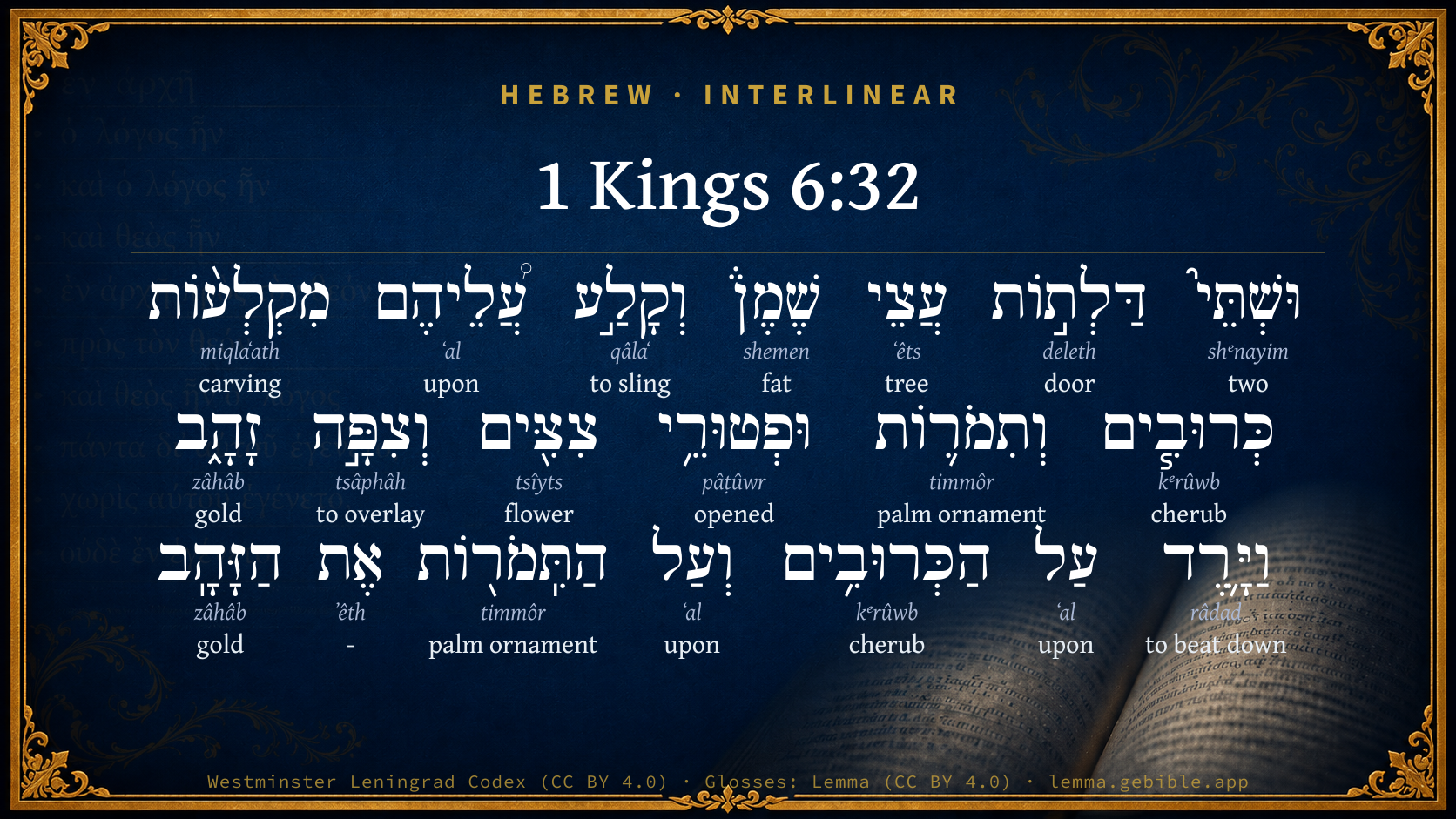
מִקְלְע֨וֹת
miqlaʻath
H4734
“carvings of”
Noun, Common, Feminine, Plural, Construct
Part of Speech
Noun
Type
Common
Gender
Feminine
Number
Plural
State
Construct
Full BDB Definition

Origin: from H7049

TWOT: 2031a

carving
  1. וּשְׁתֵּי֮ shᵉnayim H8147 “and · two” Conjunction + Adjective, Cardinal number, Feminine, Dual, Construct
  2. דַּלְת֣וֹת deleth H1817 “doors of” Noun, Common, Feminine, Plural, Construct
  3. עֲצֵי ʻêts H6086 “trees of” Noun, Common, Masculine, Plural, Construct
  4. שֶׁמֶן֒ shemen H8081 “fat” Noun, Common, Masculine, Singular, Absolute
  5. וְקָלַ֣ע qâlaʻ H7049 “and · to sling” Conjunction + Verb, Qal, Perfect, 3rd Person, Masculine, Singular
  6. עֲ֠לֵיהֶם ʻal H5921 “upon · them” Preposition + Suffix, Personal, 3rd Person, Masculine, Plural
  7. כְּרוּבִ֧ים kᵉrûwb H3742 “cherubim” Noun, Common, Masculine, Plural, Absolute
  8. וְתִמֹר֛וֹת timmôr H8561 “and · palm ornaments” Conjunction + Noun, Common, Feminine, Plural, Absolute
  9. וּפְטוּרֵ֥י pâṭûwr H6358 “and · opened” Conjunction + Verb, Qal, Participle Passive, Masculine, Plural, Construct
  10. צִצִּ֖ים tsîyts H6731 “flowers” Noun, Common, Masculine, Plural, Absolute
  11. וְצִפָּ֣ה tsâphâh H6823 “and · to overlay” Conjunction + Verb, Piel, Perfect, 3rd Person, Masculine, Singular
  12. זָהָ֑ב zâhâb H2091 “gold” Noun, Common, Masculine, Singular, Absolute
  13. וַיָּ֛רֶד râdad H7286 “and · to beat down” Conjunction + Verb, Hiphil, Sequential Imperfect, 3rd Person, Masculine, Singular
  14. עַל ʻal H5921 “upon” Preposition
  15. הַכְּרוּבִ֥ים kᵉrûwb H3742 “the · cherubim” Particle, Definite Article + Noun, Common, Masculine, Plural, Absolute
  16. וְעַל ʻal H5921 “and · upon” Conjunction + Preposition
  17. הַתִּֽמֹר֖וֹת timmôr H8561 “the · palm ornaments” Particle, Definite Article + Noun, Common, Feminine, Plural, Absolute
  18. אֶת ʼêth H853 “-” Particle, Direct Object
  19. הַזָּהָֽב zâhâb H2091 “the · gold” Particle, Definite Article + Noun, Common, Masculine, Singular, Absolute

About this verse

These counts appear in no published source. They are computed here, from the morphology-tagged text and Lemma’s own curated glosses. What Lemma adds →

20
words
15
distinct lemmas
Historical
section

Notable vocabulary

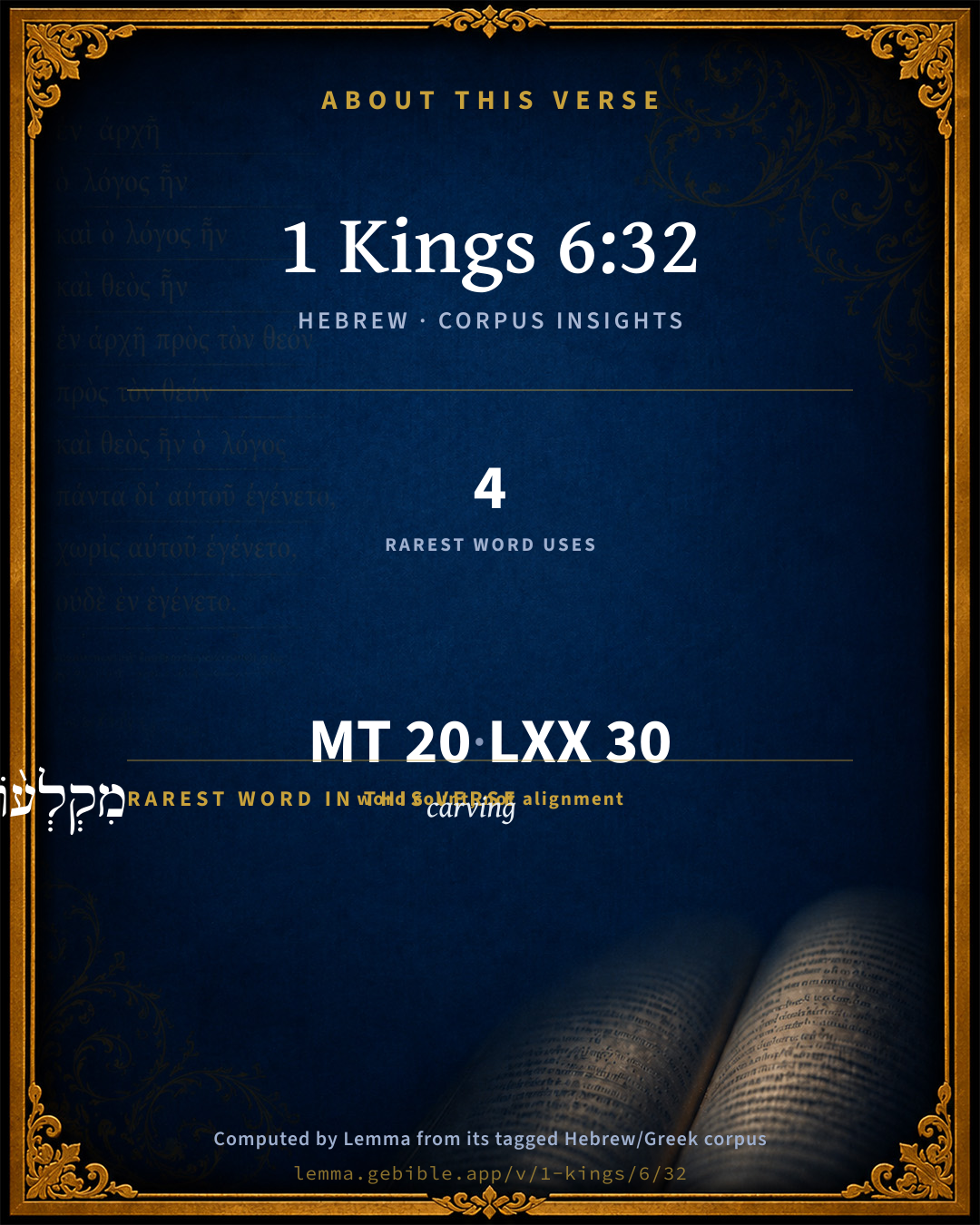
The rarest word here is מִקְלְע֨וֹת carving H4734 — appearing just 4 times in the whole Hebrew Bible.

Shared distinctive vocabulary

מִקְלְע֨וֹת carving H4734 occurs in 4 verses of the Hebrew Bible. Also found in:

Grammatical profile

  • 4 verbs
  • 11 nouns
  • 1 adjective
  • 3 prepositions
  • 1 particle

Verb forms

  • וְקָלַ֣ע Qal · Perfect
  • וּפְטוּרֵ֥י Qal · Participle Passive
  • וְצִפָּ֣ה Piel · Perfect
  • וַיָּ֛רֶד Hiphil · Sequential Imperfect

Repetition

Words recur within this verse — often emphatic in Hebrew:

  • עֲ֠לֵיהֶם upon H5921 ×3
  • כְּרוּבִ֧ים cherub H3742 ×2
  • וְתִמֹר֛וֹת palm ornament H8561 ×2
  • זָהָ֑ב gold H2091 ×2

Hebrew & Septuagint length

In the original languages it is 20 Hebrew tokens and 30 Greek tokens — but the two are counted differently (Hebrew bundles its prefixes and suffixes into one token; the Greek is in lemma form), so that isn’t a like-for-like length.

Cross-references

2

Topical passages linked to 1 Kings 6:32 in the Treasury of Scripture Knowledge — connected by theme and wording, ordered by reader-vote popularity; previews shown in the World English Bible.

  • 1 Kings 6:18 There was cedar on the house within, carved with buds and open flowers: all was cedar; there was no stone seen.
  • 1 Kings 6:29 He carved all the walls of the house round about with carved figures of cherubim and palm trees and open flowers, inside and outside.

Cross-references courtesy of OpenBible.info (CC BY 4.0).

Hebrew and Greek witnesses Masoretic Hebrew ↔ Greek Septuagint

The same verse in the two great witnesses to the Old Testament, shown verse-for-verse.

These are two independent witnesses, not word-aligned to each other, and the Septuagint is shown in lemma (dictionary) form.

Hebrew 1 Kings 6:32 Masoretic · Westminster Leningrad Codex

וּשְׁתֵּי֮ דַּלְת֣וֹת עֲצֵי שֶׁמֶן֒ וְקָלַ֣ע עֲ֠לֵיהֶם מִקְלְע֨וֹת כְּרוּבִ֧ים וְתִמֹר֛וֹת וּפְטוּרֵ֥י צִצִּ֖ים וְצִפָּ֣ה זָהָ֑ב וַיָּ֛רֶד עַל הַכְּרוּבִ֥ים וְעַל הַתִּֽמֹר֖וֹת אֶת הַזָּהָֽב

So [he made] two doors of olive-wood; and he carved on them carvings of cherubim and palm trees and open flowers, and overlaid them with gold; and he spread the gold on the cherubim, and on the palm trees.

World English Bible · Public Domain

Greek LXX 1 Kings 6:32 Septuagint · lemma form

καί δύο θύρα ξύλον πεύκινος καί ἐνκολάπτω ἐπί αὐτός ἐνκολάπτω χερουβιν καί φοῖνιξ καί πέταλον διαπετάζω καί περιἔχω χρυσίον καί καταβαίνω ἐπί ὁ χερουβιν καί ἐπί ὁ φοῖνιξ ὁ χρυσίον

No English rendering of this Greek verse — the small residue in the structurally divergent books.

Hebrew: Westminster Leningrad Codex (CC BY 4.0). Greek: Septuagint (public domain); English from a public-domain English Septuagint. How the Septuagint differs from the Hebrew →

Targum (Aramaic paraphrase)

1

The Targum is the ancient Jewish Aramaic paraphrase of the Hebrew Scriptures — an interpretive translation, not the Hebrew text itself. Onkelos (literal) and Pseudo-Jonathan (expansive) render the Torah, and Jonathan the Prophets. Coverage is partial: where no permissively-licensed English translation exists for a verse, only the Aramaic is shown. This is verse-level text, not a word-by-word alignment to the Hebrew.

  1. Targum Jonathan Prophets (Joshua–Malachi)
    וְתַרְתֵּין דָשִׁין דַאֲעֵי זֵיתָא וּגְלַף עֲלֵיהוֹן קְלִיעַן כְּרוּבִין וְצוּרַת דִקְלִין וְאַטוּנִין שׁוֹשַׁנִין וַחֲפָא דַהֲבָא וְנַסִיךְ עַל כְּרוּבַיָא וְעַל צוּרַת דִקְלִין יַת דַהֲבָא:

    (no public-domain English translation for this verse)

    Targum Jonathan — Aramaic: “Mikraot Gedolot” (public domain). English: “Sefaria Community Translation” (CC0 1.0 (public-domain dedication)); “London "Chaldee Paraphrase," 1871” (public domain). Text via Sefaria.

Commentary

Notes on 1 Kings 6:32 from classic Christian and Jewish commentators (each source and its license shown beneath its notes). The classic Christian expositions comment on the surrounding passage and are grouped to its opening verse, so a note may address several verses; the Jewish commentaries on the Tanakh (Rashi and others) are per-verse, so they appear only where the commentator wrote on this verse.

Lemma curates 59 commentaries, every one of them public domain or Creative Commons licensed, each selected and text-cleaned for this edition rather than reprinted as found. About our sources →

Trapp's Complete Commentary

John Trapp

1Ki 6:32 The two doors also [were of] olive tree; and he carved upon them carvings of cherubims and palm trees and open flowers, and overlaid [them] with gold, and spread gold upon the cherubims, and upon the palm trees.

Ver. 32. Carvings of cherubims.] But far less than those two forementioned, though of a like signification.

And palm trees and open flowers] Showing the variety of virtues which shine in the faithful.

John Trapp, A Commentary or Exposition upon All the Books of the Old and New Testament (1647–1656) — public domain. Text from a community e-Sword module.

Joseph Benson's Commentary

1Ki 6:32. The two doors also were of olive-tree — Or, The leaves of the doors; signifying what sort of doors they were, namely, folding-doors, as is more particularly observed 1Ki 6:34. He carved upon them carvings of cherubims, &c., and overlaid them with gold — When the veil, which covered this whole partition, with the doors of it, was drawn aside to give entrance to the high-priest into the holy of holies on the great day of atonement, then these beautiful doors of olive-tree, thus overlaid with gold, and curiously engraved, were displayed to his view, and the view of such priests as might be in the holy place; but otherwise they were seldom seen, and never but by the priests only.

Joseph Benson's Commentary on the Old and New Testaments (1811–1818) — public domain. Text from a community e-Sword module.

Geneva Bible (1599)

Geneva Bible translators

So that the fashion of the carved work might still appear.

Geneva Bible (1599) marginal notes — public domain. Text via Bolls.life.

Ellicott's Commentary for English Readers

(32) The two doors.—Those into the Holy place from the porch, of cypress wood, were naturally made larger. The posts were a fourth of the wall. Hence, according as the wall is taken to be 20 cubits square, or 30 cubits high by 20 wide, the height would be 5 cubits (7½ feet), or 7½ cubits (11¼ feet). The width is not given; possibly it is taken to be the same as that of the other doors. As these doors would be much heavier, and more frequently opened and shut, each leaf was made to fold again upon itself.

A Bible Commentary for English Readers, edited by Charles John Ellicott (1878–1897) — public domain. Text from a community e-Sword module.

The Cambridge Bible for Schools and Colleges

gen. ed. J. J. S. Perowne

32. The two doors also were] As there is nothing to make the noun here definite, it is better to understand the verb ‘he made.’ Render ‘so he made two doors of olive-wood.’

and spread gold] Better, and made necessary by the text, ‘and he spread the gold.’ Here a different process is described. The walls and floors were covered with flat plates of gold nailed on (see 2Ch_3:9), but to cover the carved work the gold must be beaten to fit. The verb employed here gives the idea of pressure exerted to force the metal into the needful shapes.

The Cambridge Bible for Schools and Colleges (gen. ed. J. J. S. Perowne; Cambridge University Press, 1878–1918) — public domain. Text from a community e-Sword module.

John Gill's Exposition

And he built the inner court,.... The court of the priests, Ch2 4:9; so called to distinguish it from the outer court, where the people assembled: this was built

with three rows of hewed stone, and a row of cedar beams; the rows of stones were one upon another, topped with a row of cedar beams; or rather the cedar was a lining to the stones; and the whole is supposed to be about three cubits high, and was so low, that the people in the outward court might see priests ministering for them, and could converse with them; under the second temple, as Maimonides (h) says, the court of the priests was higher than that of the court of Israel two cubits and an half, called the great court, for which doors were made, and those overlaid with brass, Ch2 4:9.

(h) Hilchot Beth Habechirah, c. 6. sect. 3.

John Gill's Exposition of the Whole Bible (1746–1763) — public domain (CC PDM 1.0). Text via the HelloAO Bible API.

Albert Barnes' Notes on the Bible

The two doors - i. e., two leaves which met in the middle, as in the Assyrian gate-ways generally.

Spread gold - The doors were not simply sheeted with gold, like the floors 1Ki 6:30, but had the gold hammered to fit the forms of the palms, cherubs, and flowers carved upon them. 1Ki 6:35. Such hammered metal-work, generally in bronze, has been found in tolerable abundance among the Assyrian remains.

Albert Barnes' Notes on the Bible (1834–1885) — public domain. Text from a community e-Sword/MySword module.

Haydock's Catholic Bible Commentary

And carvings, &c. Hebrew, "and flowers full-blown." The term anaglypha, denotes a sculpture in relievo, (Calmet) or projecting. (Haydock)

George Leo Haydock (1774–1849), Haydock's Catholic Family Bible and Commentary, 1859 edition — public domain. Excludes Psalms (Douay-Rheims chapter numbering differs from Protestant) and Deuterocanonical books (Catholic canon only).

Whedon's Commentary on the Bible

Daniel D. Whedon

32. The two doors — The doors of the oracle seem to have been merely a double door, the two parts closing towards each other, and therefore not so complicated as the outer door of the temple. 1Ki_6:34. They moved on hinges of gold. 1Ki_7:50. In Italy the church doors usually stand open, but the doorway in closed over with a heavy curtain, and such seems to have been the usage in the case of these doors to the oracle.

Daniel D. Whedon (gen. ed.), Commentary on the Old and New Testaments (1874–1909) — public domain. Text from a community e-Sword module.

The Pulpit Commentary

The two doors also wore Rather, perhaps, "And he made" is to be supplied from ver. 31, as Keil. Rawlinson remarks that such doors as these are characteristic of Assyrian gateways of olive tree: and he carved upon them carvings of cherubims and palm trees and open flowers, and overlaid them with gold, and spread drYw Hiph. of ddr gold Heb. the gold upon the cherubims and upon the palm trees The writer means, not that the carving alone was gilded as Thenius thinks, who remarks on the effective contrast which the dark red cedar and the bright gold would furnish) but that the gilding did not conceal the character of the carvings. It is clear from ver. 22 that "all the house" blazed with gold in every part. If the floors were covered with gold, we may be sure both walls and doors would not be without their coating of the precious metal. Our author does not mention the curtain it is clear that the doors would not dispense with the necessity for a vail but the chronicler does. (2Ch_3:14) It was necessary in order to cover the ark; (Exo_40:3, Exo_40:21) hence it was sometimes called "the vail of the covering." But for this, when the doors were opened on the day of atonement, the priest in the holy place might have gazed into the oracle. 1Ki_8:8. The doors opened outwardly (into the house) The vail was suspended within the oracle.

The Pulpit Commentary (1880–1919), ed. H.D.M. Spence-Jones & Joseph S. Exell — public domain. Text from a community e-Sword module.

Rashi

Rabbi Shlomo Yitzchaki (Rashi)

He hammered upon the cherubim. He spread the gold in thin sheets [in order] to sink them into the engraved forms, so that it be recessed into the engraved places and protrude on the protrusions, so that the gold does not ruin the figures, and so that the figures in the wood are distinguishable under the gold.

Rashi on the Tanakh — English translations: “The Judaica Press complete Tanach with Rashi, translated by A. J. Rosenberg” (CC BY 4.0); “Pentateuch with Rashi's commentary by M. Rosenbaum and A.M. Silbermann, 1929-1934” (public domain); “The Metsudah Tanach series, Lakewood, N.J” (CC BY 4.0); and “The Book of Joshua, Metsudah Publications, 1997” (CC BY 4.0). Text via Sefaria.

Lesson kit

Teaching starters — assembled from the data on this page, not authored interpretation. Every prompt links to the verse data it draws on. Edit before teaching.

1 Kings, in the Historical, opens this verse with 20 words (15 distinct Hebrew lemmas). Its most distinctive word is miqlaʻath (“carving”). A historical commentator’s framing appears above. Read the whole chapter for the surrounding context.

Discussion questions

  1. What does “carving” (miqlaʻath) contribute to the verse as a whole?
  2. 1 Kings 6:18 shares the word «carving» with this verse. How do the two illuminate each other?
  3. “upon” occurs 3× in this one verse. What is the effect of the repetition?
  4. The translations on this page render this verse differently — a whole-verse word diff, not a word-by-word alignment. What might account for the different wordings?
  5. The verb «וְקָלַ֣ע» is Qal Perfect. How does its form color the action?
  6. Reading how Trapp's Complete Commentary and Joseph Benson's Commentary read this verse, where do the two commentators agree and where do they part?

Things to notice

Reading settings

Reading text

Shown beneath each verse's original-language words.

Old Testament
Old Testament edition

Read the OT as the Masoretic Hebrew (MT) or the Greek Septuagint (LXX).

English shown for the Greek Septuagint (in the Hebrew ↔ Greek comparison).

Comparing translations? Open the Compare panel on any verse page to stack up to four side by side.