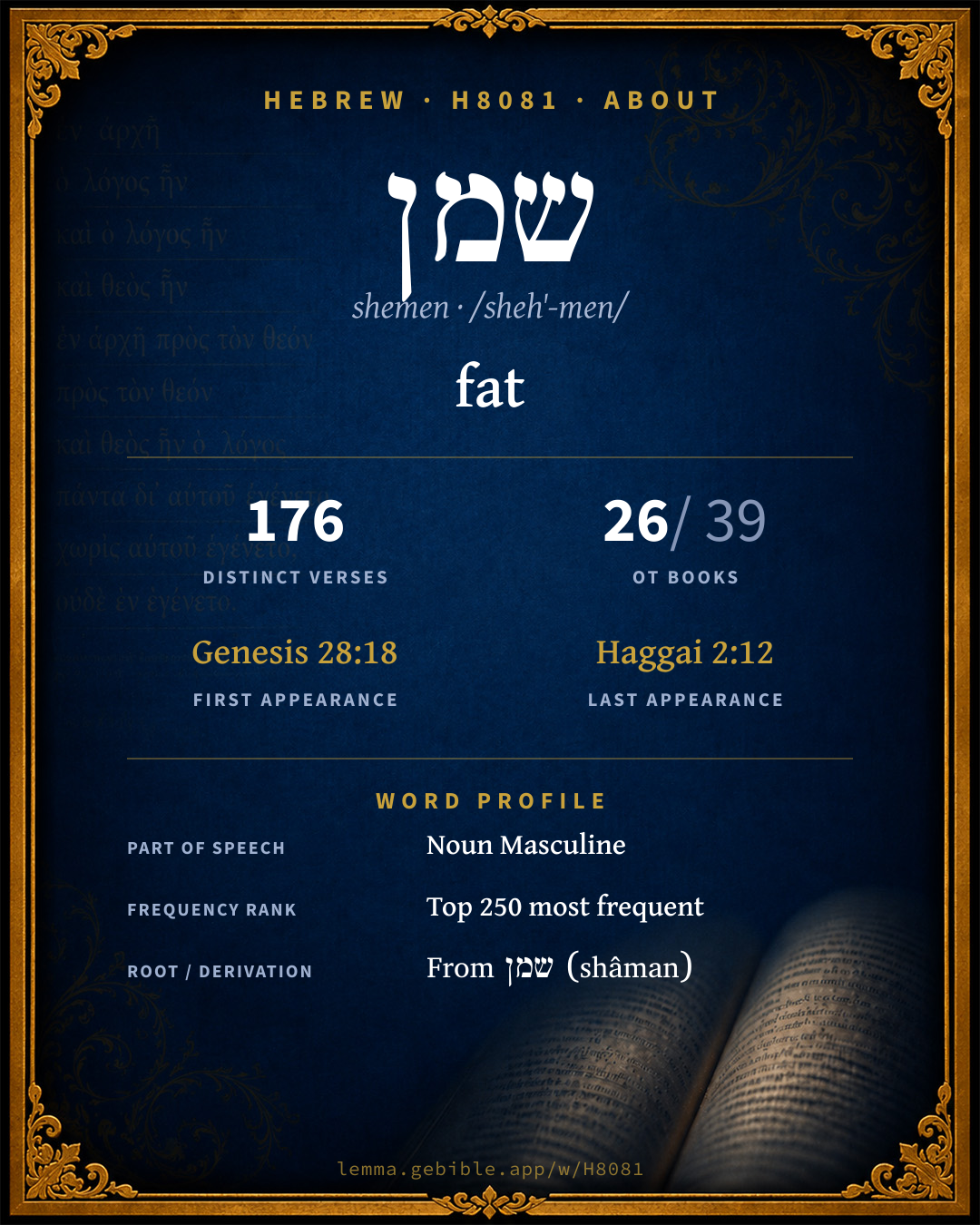
שֶׁ֫מֶן
fat
‘fat’ is one of 4 main senses fuller range ↓
Full lexicon entry — Brown-Driver-Briggs (BDB)
From Brown-Driver-Briggs (BDB)
Where this word appears
See every Absolute-state word in the Hebrew Bible →
Grammar key — what these labels mean
Part of speech
- Noun
- A naming word — a person, place, thing, or idea.
Noun type
- Common
- A common noun — a general class of person, place, or thing (“king,” “city,” “water”), not a specific name.
State
- Absolute
- The independent form of a noun, not bound to a following word.
- Construct
- A noun bound to a following noun in a possessive / “of” relationship (the construct chain).
Gender
- Masculine
- Grammatically masculine.
Number
- Singular
- One.
- Plural
- More than one (in Hebrew, generally three or more).
Every verse where H8081 appears in the Book of 2 Kings — 7 distinct verses. Click any verse to open its interlinear word-by-word view. Verse text shown in the World English Bible for context — . Each verse’s Hebrew form is shown with its reference; the English is not keyword-highlighted, since the data carries no word-level English alignment. Use “Compare translations” on any verse to read it across multiple English versions. This concordance covers the Hebrew Bible; Septuagint (Greek Old Testament) occurrences are not indexed here.
2 Kings
- 2 Kings 4:2 שָֽׁמֶן n c ms Elisha said to her, What shall I do for you? tell me; what have you in the house? She said, Your handmaid has nothing in the house, except a pot of oil.
- 2 Kings 4:6 הַ/שָּֽׁמֶן ptcl def.art + n c ms It happened, when the vessels were full, that she said to her son, Bring me yet a vessel. He said to her, There isn't another vessel. The oil stayed.
- 2 Kings 4:7 הַ/שֶּׁ֔מֶן ptcl def.art + n c ms Then she came and told the man of God. He said, Go, sell the oil, and pay your debt, and live you and your sons of the rest.
- 2 Kings 9:1 הַ/שֶּׁ֤מֶן ptcl def.art + n c ms Elisha the prophet called one of the sons of the prophets, and said to him, Gird up your loins, and take this vial of oil in your hand, and go to Ramoth-gilead.
- 2 Kings 9:3 הַ/שֶּׁ֨מֶן֙ ptcl def.art + n c ms Then take the vial of oil, and pour it on his head, and say, Thus says Yahweh, I have anointed you king over Israel. Then open the door, and flee, and don't wait.
- 2 Kings 9:6 הַ/שֶּׁ֖מֶן ptcl def.art + n c ms He arose, and went into the house; and he poured the oil on his head, and said to him, Thus says Yahweh, the God of Israel, I have anointed you king over the people of Yahweh, even over Israel.
- 2 Kings 20:13 שֶׁ֣מֶן n c ms cs Hezekiah listened to them, and shown them all the house of his precious things, the silver, and the gold, and the spices, and the precious oil, and the house of his armor, and all that was found in his treasures: there was nothing in his house, nor in all his dominion, that Hezekiah didn't show them.
About this entry
At a glance — auto-summarized from this page’s data, not written by a person. Every figure links to its source below. This summary describes the numbers; it doesn’t interpret them.
שמן (shemen) is a Hebrew noun most often rendered “fat.” Not a single-sense word: explore its full sense range. It turns up in 176 verses across 26 books, a common footprint. Scripture first uses it in Genesis 28:18. It clusters with שמן, משמן and שמן under a shared root. For the data behind this summary, explore the sense tree and the renderings breakdown below.
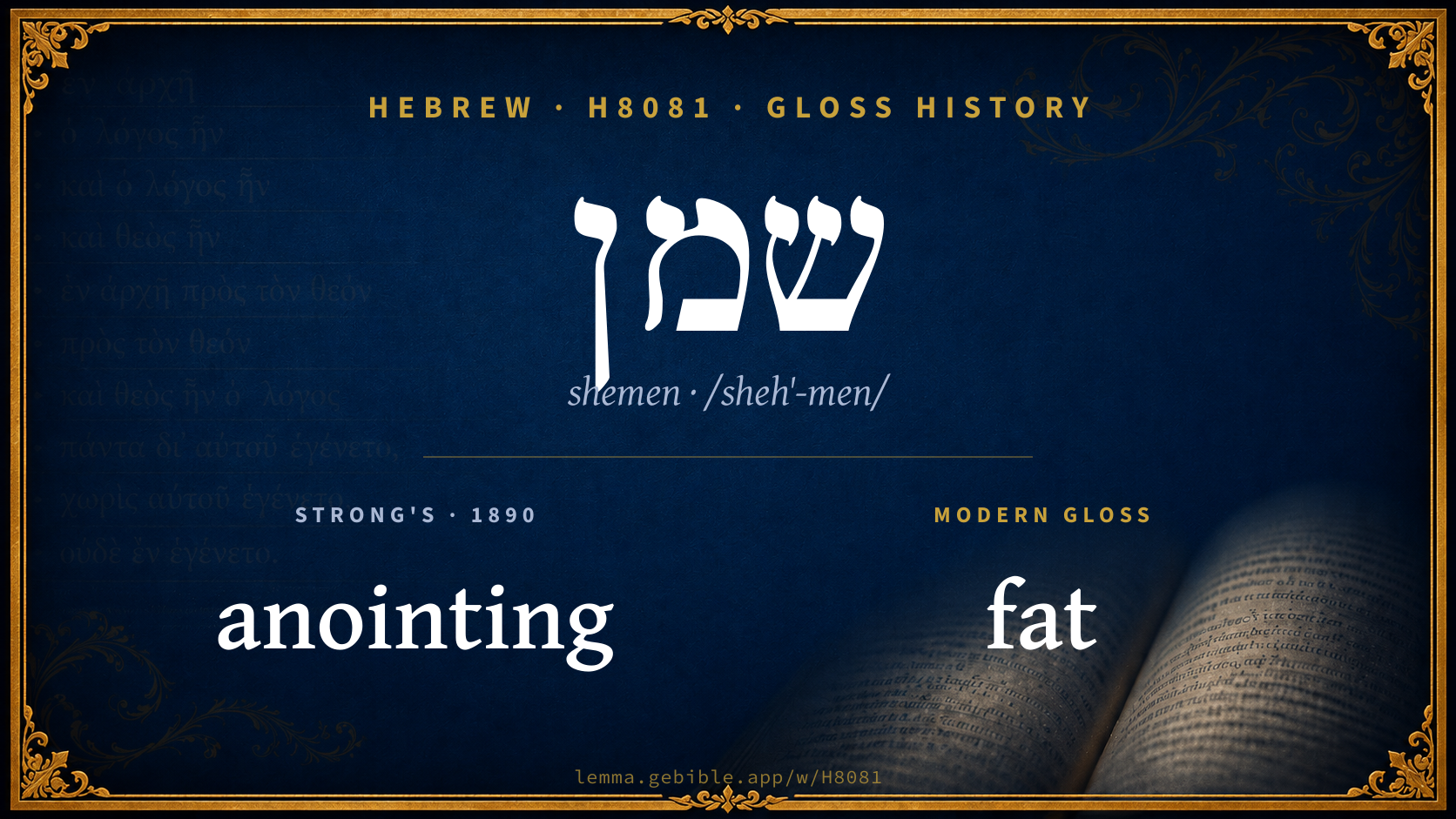
Gloss history
Strong's 1890 vs modern scholarship
About this word
Strong's H8081 catalogs a Hebrew word from the Hebrew Old Testament.
These counts are not copied from any lexicon or concordance. They are computed here, from the morphology-tagged Hebrew Old Testament. What Lemma adds →
- 176
- distinct verses
- The word appears in 176 distinct verses.
- 26 / 39
- OT books
- The word appears in 26 of 39 Old Testament books.
- #243
- by frequency
- Top 250 most frequent Hebrew words (rank 243 of 8,640 Hebrew words by occurrence).
View all 176 occurrences in the concordance →
By section of the Old Testament
By traditional corpus
Conventional, traditional groupings — biblical authorship is debated, so this is a traditional corpus grouping, not an authorship claim. Each share is this word’s portion of its verses in that division of the Hebrew canon. Each figure is a share of the word’s 176 distinct verses.
- Torah (Pentateuch) 92 verses · 52%
- Prophets (Nevi'im) 54 verses · 31%
- Writings (Ketuvim) 30 verses · 17%
How translations render this word
Counts come from each version’s own published word-to-Strong’s tagging or interlinear alignment — an approximate guide to how each version renders this word, not a word-level alignment the data otherwise carries. Because each total is that version’s own tagged count, the per-version totals vary from one another and need not match the appearance or distinct-verse counts above. These counts may also differ from a printed concordance because Lemma counts each distinctly tagged rendering and does not collapse phrase taggings into a single head-word total. This is a fixed set of word-tagged versions (KJV, ASV, BSB, ULT) and does not change with the reading translation you choose elsewhere. Each version’s license is shown beside its name below (and on Sources).
- King James Version: Oil 147×, Ointment 9×, Ointments 3×
- American Standard Version: Oil 150×, Olive-wood 4×, Oils 3×
- Berean Standard Bible: Oil 139×, Olive oil 22×, Olive 4×
- unfoldingWord Literal Text: Oil 142×, Oil of 27×, With 5×
King James Version Public Domain
Renders H8081 across 192 tagged occurrences — most commonly:
Plus 18 renderings that appear only once — usually multi-word phrases or single function words the recovered tagging swept in, not distinct renderings. Not rendered by a distinct English word in 1 further occurrence.
American Standard Version Public Domain
Renders H8081 across 192 tagged occurrences — most commonly:
Plus 21 renderings that appear only once — usually multi-word phrases or single function words the recovered tagging swept in, not distinct renderings.
Berean Standard Bible Public Domain
Renders H8081 across 191 tagged occurrences — most commonly:
Plus 15 renderings that appear only once — usually multi-word phrases or single function words the recovered tagging swept in, not distinct renderings. Not rendered by a distinct English word in 2 further occurrences.
unfoldingWord Literal Text CC BY-SA 4.0
Renders H8081 across 210 tagged occurrences — most commonly:
Plus 15 renderings that appear only once — usually multi-word phrases or single function words the recovered tagging swept in, not distinct renderings.
11 senses and sub-senses in the full BDB
What do BDB’s symbols mean?
BDB uses these scholarly abbreviations:
| Symbol | Meaning |
|---|---|
| 𝔊 | the Septuagint (the ancient Greek translation, LXX) |
| 𝔙 | the Vulgate (the Latin translation) |
| 𝔖 | the Syriac version (the Peshitta) |
| 𝔗 | the Targum (the Aramaic translation) |
| ψ | the Psalms |
| √ | root (the underlying root or stem) |
| ‖ | parallel passage (a synonymous or contrasted parallel) |
| † | the dagger: every passage where the word occurs is cited |
The 11 senses and sub-senses the full Brown-Driver-Briggs lexicon distinguishes for this word, in lexicon order (not ranked by frequency), with BDB’s own verbatim wording and sub-sense lettering. Shown in Hebrew script with BDB’s own scholarly abbreviations. The condensed entry is in the Lexicon Entry tab. See also the Forms in the corpus table below.
- 1. fat, fatness: קֶרֶן בֶּן־שׁ׳ Is 5:1 (of fertile slope); pl. גֵּיא־שְׁמָנִים 28:1, 4; of food (in fig.) 25:6(×2); lit. בְּשָׂרִי כַּחַשׁ מִשָּׁ֑מֶן ψ 109:24 (cf. צוֹם v a), cf. מִפְּנֵי שׁ׳ Is 10:27 (in fig., si vera l., meaning obscure; most now emend by conjecture; RSJPh xiii (1885), 62 עָלָה מִצָּפוֹן שֹׁדֵד [v. also II. חבל], joining to v 28; Du Marti has gone up from Pene-Rimmon [??], cf. Di-Kit). e.g. Isaiah 5:1
- 2.
- a. oil, specif. olive-oil, as rich product Dt 8:8 + (v. זַיִת); hence עֵץ שׁ׳ Is 41:19 oil-tree, usually explained as wild olive, oleaster, so Ne 8:15 (‖ זַיִת), עֲצֵי שׁ׳ oleaster-wood 1 K 6:23, 31, 32, 33; once שׁ׳ הַמֹּר Est 2:2 (v. מֹר p. 600b; מ׳ also in holy anointing oil Ex 30:23). e.g. Deuteronomy 8:8
- b. שׁ׳ as staple (condiment) Nu 11:8 (J; v. לשׁד), of value 1 K 17:12, 14, 16; 2 K 2:4, 6, 7 + 4 times; symb. of plenty Dt 32:13; 33:24; Jb 29:6; ascribed (falsely) to gift of Baals Ho 2:7; as royal treasure 2 K 20:13 = Is 39:2, cf. 1 K 5:25 (שׁ׳ כָּתִית, v. כ׳) = 2 Ch 2:9, 14 + 3 times; tribute Ho 12:2, art. of trade Ez 27:17; odoriferous Pr 27:9; Ct 1:3; 4:10, שׁ׳ רוֹקֵחַ Ec 10:1, so (fig.) Ct 1:3; Ec 7:1; Pr. 27:16 is corrupt, v. Toy; sign of luxury Ez 16:13; Pr 21:17, of prosperity Ez 16:20. e.g. Numbers 11:8
- c. שׁ׳ as medicament Is 1:6; as unguent, for shield 2 S 1:21, person Am 6:6; Mi 6:15; Dt 28:40; Ez 16:9; Est 2:12 ψ 92:11; 104:15, not for mourner 2 S 14:2; on head, token of happiness Ec 9:8, of hospitality, דִּשַּׁנְתָּ בַּשּׁ׳ רֹאשִׁי ψ 23:5 (fig.), in sim. 133:2; 141:5. e.g. Isaiah 1:6
- d. for anointing king, פַּךְ הַשּׁ׳ 1 S 10:1; 2 K 9:1, 3, cf. v 6, c. קֶרֶן 1 S 16:1, 13; 1 K 1:39; cf. בְּשׁ׳ קָדְשִׁי מְשַׁחְתִּיו ψ 89:21. e.g. 1 Samuel 10:1
- e. in various figs., of joy שׁ׳ שָׂשׂוֹן Is 61:3 ψ 45:8; soft words 55:22 Pr 5:3; as penetrating 109:18; as clear, transparent Ez 32:14. e.g. Isaiah 61:3
- f. used in primitive worship, poured on stone Gn 28:18 (E), 35:14 (J). e.g. Genesis 28:18
- g. in later ritual: for anointing priests, tabern., altar utensils, etc. (P), made of various ingred., שׁ׳ זַיִת among them, Ex 30:24, שׁ׳ הָמִּשְׁחָה 25:6 Lv 8:2, 10, 12 + 11 times; שׁ׳ מִשְׁחַת־קֹדֶשׁ Ex 30:25(×2) + 2 times; שׁ׳ מ׳ י׳ Lv 10:7, שׁ׳ מ׳ אֱלֹהָיו 21:12; שׁ׳ הַקּ׳ Nu 35:25; שׁ׳ alone Lv 14:10 + 12 times Lv 14; for lighting Ex 25:6 + 6 times + שׁ׳ זַיִת זָךְ כָּתִית Ex 27:20; Lv 24:2 (v. כָּתִית); poured upon מִנְחָה Lv 2:1 + 5 times, cf. 5:11 Nu 5:15; smeared (v. מָשַׁח) upon wafers Ex 29:2; Lv 2:4 +, and cakes (or mixed in the making? cf. בָּלַל) Ex 29:2; Lv 2:4, 5 +, so סֹלֶת בַּשׁ׳ Lv 2:7, etc. (c. 45 times in all), חַלַּת לֶחֶם שׁ׳ Ex 29:23; Lv 8:26. e.g. Exodus 30:24
- h. for use in temple 1 Ch 9:29. e.g. 1 Chronicles 9:29
- i. for תְּרוּמָה in Ezekiel’s temple Ez 45:14(×2) + 7 times 45, 46. e.g. Ezekiel 45:14
- j. efficacy denied Mi 6:7. †k. offered to idols Is 57:9; Ez 16:18, 19; 23:41.—Vid. MacalisterHastDB Oil ARS KennedyEncy. Bib. Oil. e.g. Micah 6:7
Senses from the full Brown-Driver-Briggs lexicon (Brown, Driver, Briggs; Oxford 1906 — public domain), digitized via Sefaria, supplemented by the OpenScriptures HebrewLexicon (CC BY 4.0). Full attribution on Sources.
Word origin
n.m. 2 K 20:13 (on appar. f. Ct 1:3 cf. AlbrZAW xvi (1896), 99, 106) fat, oil;—שׁ׳ abs. Gn 28:18 +, cstr. Lv 8:2 +; שָׁ֑׳ 2 K 4:6 +; sf. שַׁמְנִי Ho 2:7 +, etc.; pl. שְׁמָנִים Am 6:6 +; sf. שְׁמָנֶיךָ Ct 1:3, -נַיִךְ 4:10;—
— Brown-Driver-Briggs (Oxford 1906, public domain), digitized via Sefaria, supplemented by the OpenScriptures HebrewLexicon (CC BY 4.0). See Sources.
Derived from שמן (shâman) (H8080) — to be fat.
Jastrow Dictionary
A second Hebrew/Aramaic lexicon for comparison, covering Aramaic and post-biblical (Talmudic, Targumic, Midrashic) usage that the biblical-Hebrew BDB does not. Matched by lemma rather than by Strong’s number, so a lemma may carry more than one Jastrow headword (shown separately below), and the entries cover usage well beyond the Bible.
שֶׁמֶן
- preced. wds.) oil, fat. Sabb. II, 1 ש׳ שרפה oil of T’rumah which is condemned to be burnt on account of contamination; ש׳ קיק, v. קִיק. Ib. 2 ש׳ דגים fish-oil; ש׳ אגוזים nut-oil &c. Ib. 17ᵇ שׁמְנָן their oil, manufactured by gentiles; Ab. Zar. 36ᵃ. Ib. ש׳ רב יהודה וכ׳ as to gentiles’ oil, R. Judah and his court voted on it and permitted it. Pes. 83ᵇ; Ḥull. 91ᵃ; 92ᵇ שַׁמְנוֹ the fat surrounding the nervus ischiadicus, v. שׁוּמָן; a. fr.—עֵץ ש׳ pine-wood, v. עֵץ.—Pl. שְׁמָנִים, שְׁמָנִין. Sabb. II, 2 מתירין בכל הש׳ allow all kinds of oil to be used for Sabbath lights. Ib. 26ᵃ כל הש׳ יפין וכ׳ all oils are good for ink, but olive oil is the best. Y. Bicc. I, 64ᵇ top; a. fr.
מִן
- (b. h.) from, of; more (or less) than. Ab. Zar. 18ᵃ מן השמים ירחמו from heaven they will have mercy (on me), i.e. I trust in God. Sabb. 21ᵇ המהדרין מן המהדרין v. הָדַר.—מן המובחר, v. בָּחַר; מן המומחה, v. מוּמְחֶה.—Tem. 28ᵃ מן הבהמה להוציא וכ׳ ‘of the cattle’ (Lev. I, 2) intimates the exclusion of &c.; a. v. fr.—Prefix מִ־, מָי־, מֵ־, מֵי־ q. v.—מִנַּיִן, מִנַּיִין, מִינַּיִין (= b. h. מֵאַיִן, v. אַיִן) whence?, whence is it proven?—Yoma 32ᵃ מ׳ לחמש וכ׳ whence is derived the regulation about five immersions &c.? Ib. ומ׳ שכל טבילה וכ׳ and whence is the rule derived that each immersion requires &c.? Ib. 44ᵃ אין לי אלא … מ׳ this would prove to me only in favor of …, whence do you derive that the same applies to …?; a. v. fr. e.g. Leviticus 1:2
מִן ²
- Targ. Gen. I, 2; a. v. fr.—With suffixes of pers. pron. מִנִּי, מִי׳ from me; מִנָּךְ, מִי׳ from thee; מִנֵּיה, מִי׳ from him, it &c. Ib. XXII, 12. Ib. III, 3; a. fr.—Y. Ber. II, 5ᵃ bot. מן הן דסלק to where he had come from. Sabb. 80ᵇ מן דיליה דא ליה this came to him from his own doing. Sot. 40ᵃ ומאי נפקא ליך מִינָּהּ and what difference does it make? מִנִּי ומִנֵּיה יתקלס וכ׳ through myself and him the Most High is exalted. B. Kam. 18ᵃ קאזיל מיניה מיניה it was lost through its (the chicken’s) action alone. Y. Peah VII, 20ᵇ מיניה וביה הוא (the sweetness) is entirely its own (no honey has been added). Snh. 39ᵇ, v. אִבָּא; a. fr.—לא כולא מיניה, לא כל כמיניה it is not at all in his power; v. כּוֹלָא.—מן ד־ from the time that, after; from the fact that; when; because. Lam. R. to II, 2 מן דאכלון after they had eaten; a. v. fr.; v. מִדְּ־.
מָן I
- portion, food. Num. R. s. 12 (play on א̇ר̇ג̇מ̇ן̇) the sun שיצרו הקב"ה לארוג מן וכ׳ whom the Lord has created to weave (ripen) food for creatures; ואין מן אלא פירות וכ׳ man means fruits and food (with ref. to וימן, Dan. I, 5).—Esp. מָּן(הַ) the manna of the desert. Ex. R. s. 25. Tanḥ. B’shall. 20; Mekh. ib., Vayassa, s. 2 אוכלי המן those eating manna (not troubling themselves about to-morrow). Yoma 75ᵃ; a. fr. e.g. Daniel 1:5
מַן I
- (a day’s) support. Succ. 39ᵇ בכדי מן for as much only as is needed for the day. Ib. דהאי מ׳ וכ׳ that man means support, v. preced.—Esp. מַנָּא the manna. Targ. Ex. XVI, 31. Targ. Y. ib. 27; a. e. (some ed. מָנָא).
מַן
- who?, what?, v. מַאן. Targ. Gen. XXIV, 23. Ib. XXXIII, 8 (ed. Berl. מָא; oth. ed. מאן); a. fr.—Emphatic. (מָנָא) מְנָא. Targ. Ps. XXXIX, 5. Targ. Prov. IV, 19; a. fr.
מָן III
- thing, vessel, garment; coulter, v. מָאן.
שָׁמֵן I
- (b. h.) [to be smooth,] to be fat.
- to grow fat, improve. Y. B. Kam. IX, beg. 6ᵈ גזל כחושה והִשְׁמִינָה if he took forcibly a lean animal, and it grew fat (in his possession); Tosef. B. Kam. VII, 17; Bab. B. Kam. 65ᵃ; a. e.
- to become smooth, bright; to glisten. Gen. R. s. 34 כל שהוא … היא מִשְׁתַּמֶּנֶת the more he beats it (the flax), the more it will glisten; Yalk. ib. 95; Yalk. Ps. 654.
- 1. (denom. of (denom. of שֶׁמֶן) to oil. Men. 23ᵃ קומץ … שׁשִׁמְּנוֹ וכ׳ the handful of the sinner’s meal-offering on which he (the priest) put oil, … has become unfit for the altar; Yalk. Lev. 474.
- 2. to smooth, level; ש׳ בין to compromise to average. B. Mets. 87ᵃ השוכר … מְשַׁמְּנִין ביניהם if one hires a laborer, saying, I will pay you as much as one or two of the inhabitants of the place get: he may pay him the lowest wages …; the scholars say, you compromise between them, i.e. you make him pay the average wages. B. Bath. VII, 4 האומר … משמנין ביניהם וכ׳ if one says to his neighbor, I sell thee one-half of my field (and one part is better than the other), we compromise between them, i.e. the field is divided into two portions of equal value, but the purchaser must take whichever portion the seller may assign to him; חציה בדרום … משמנין וכ׳ if he says, I sell thee half of the field on the south side, we compromise between them, and he gets his portion on the south side; expl. ib. 107ᵇ משמנין … לדמי ‘we compromise’ means according to value. Bekh. II, 6, sq. משמנין ביניהם we compromise between them, i.e. the priest takes the inferior of the twin animals, and the difference in value remains under litigation; expl. ib. 18ᵃ מהו משמנין שומן יהא ביניהן m’shamm’nin means, the fat one (the difference of value) remains to be decided &c., v. שׁוּמָן.
שָׁמֵן
- preced.) fat, rich. Keth. 61ᵃ בשר ש׳ fat meat. Pes. 42ᵃ. Ḥull. 45ᵇ גדי שמן Rashi (ed. גדי שמינה, v. Rabb. D. S. a. l. note 8) a fat kid. Y. B. Kam. IX, beg. 6ᵈ גזל ש׳ והכחישה וכ׳ if he took by force a fat animal, and it became lean &c., v. שׁוּמָן; a. fr.—Pl. שְׁמֵנִים, שְׁמֵי׳; שְׁמֵנוֹת, שְׁמֵי׳. Gen. R. s. 66 דגים ש׳ יתיר מדאי exceedingly fat fish. Num. R. s. 1612 אם … אם ש׳ whether its fruits are light or rich; ib. אם של צונמא … ש׳, v. צוֹנָם; Tanḥ. Sh’laḥ 6; a. fr.
שְׁמַן
- (preced. wds.)
- 1. cream. Targ. O. Gen. XVIII, 8 (Y. לוואי שָׁמִין; h. text חמאה). Targ. Ps. LV, 22 ש׳ דגובנין (h. text מחמאות).
- 2. fat. Targ. Is. XXX, 23. Targ. Y. Gen. XVIII, 7 שְׁמֵין.—V. שׁוּמְנָא.
שִׁמָּן
- Shimmon, v. שִׁמְעוֹן.
A Dictionary of the Targumim, the Talmud Babli and Yerushalmi, and the Midrashic Literature (Marcus Jastrow; London, Luzac, 1903) — Public Domain. Digitized via Sefaria. Digitized via Sefaria. Full attribution on Sources.
Forms in the corpus
The 75 distinct written forms H8081 takes in the Hebrew Bible, most frequent first — each parse links to that state’s occurrences in the concordance. Hebrew forms include their vowel points and cantillation, so a single lemma takes many written forms.
The 60 most common forms are shown; 15 rarer forms follow in the full concordance.
Same root — word family
Other BDB entries built from the same root as H8081, grouped by Strong’s listed origin. These share a root / origin per the lexicon — not necessarily a shared meaning. Each links to that word’s own entry.
Derives from
Shares the same root
Derived from this word
Proper names from this root
People and places named from this root — a name, not an additional meaning of the word.
Compare all same-root words → Showing 4 of 6 — not the complete family. 1 of the same-root words is a proper name (a person or place). They share a root, not necessarily a meaning.
Septuagint verse parallels
This word appears in 164 verses that also exist in the Greek Old Testament (Septuagint), out of the 176 Hebrew verses it occurs in. You can read those verses in Greek by switching the Old Testament edition to the Septuagint.
Read these verses in the Septuagint
- Genesis 28:18
- Exodus 27:20
- Leviticus 2:1
- Numbers 4:9
- Deuteronomy 8:8
- 1 Samuel 10:1
- 2 Samuel 1:21
- 1 Kings 1:39
- 2 Kings 4:2
- 1 Chronicles 9:29
- 2 Chronicles 2:10
- Ezra 3:7
This is a verse-level parallel only — the same verses exist in both the Hebrew and Greek Old Testaments. No word-level Hebrew↔Greek correspondence is claimed: the data carries no such alignment, so no Greek word is shown as this Hebrew word’s translation. Coverage is not total — the Septuagint omits the deuterocanon and renumbers the Psalms, so some Hebrew verses have no direct Greek parallel.