
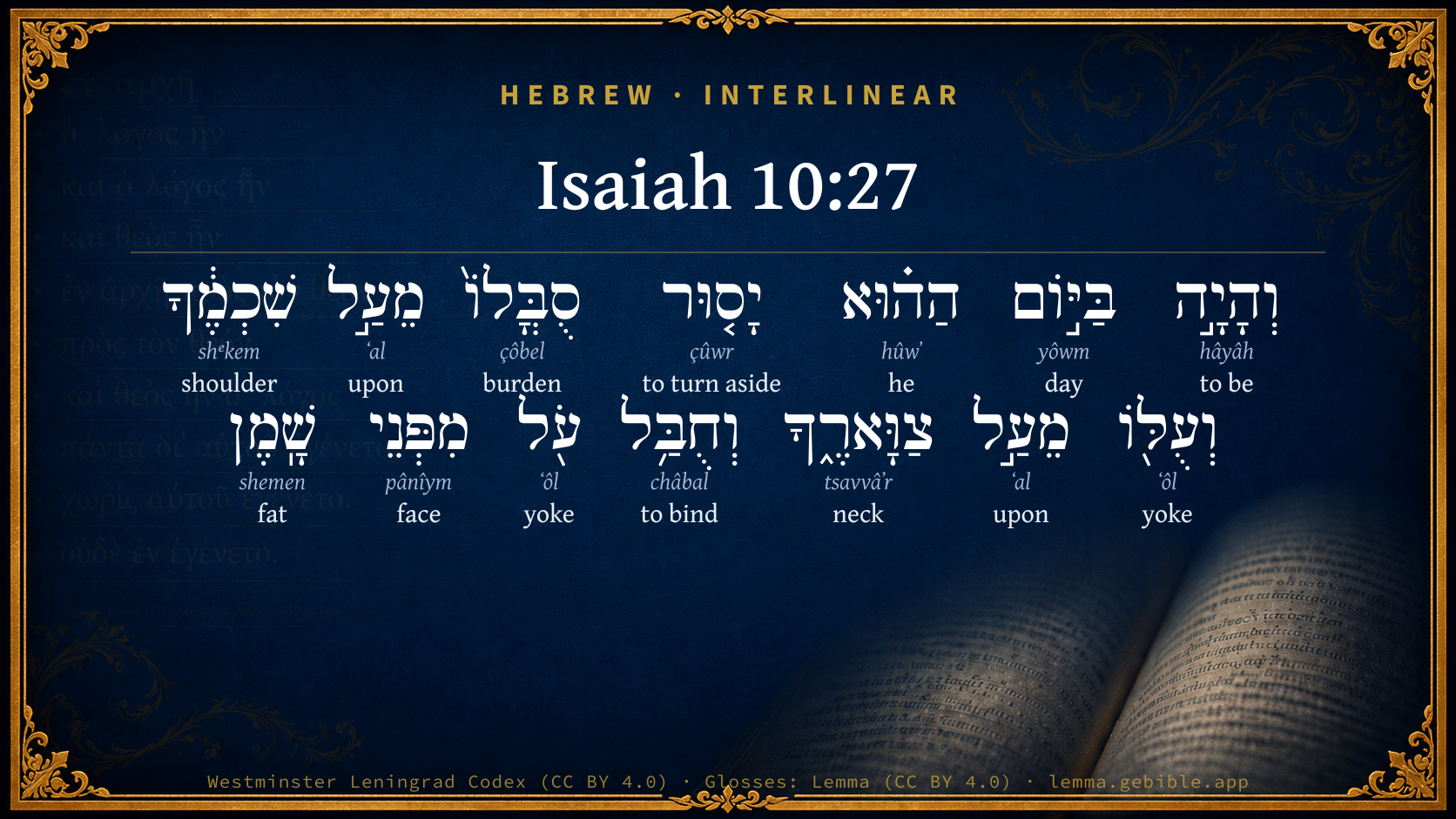
Isaiah 10:27

Hebrew (Westminster Leningrad Codex) Isaiah 10:27 appears in the Hebrew Old Testament. The text above is from the Westminster Leningrad Codex. Each word links to its Strong’s number, a concise gloss, and parsing drawn from the Open Scriptures Hebrew Bible morphology. Click any word for its full Brown-Driver-Briggs (BDB) entry.
Download image
Cite this verse

Isaiah 10:27 (World English Bible). Public Domain. Lemma interlinear Bible study tool, https://lemma.gebible.app/v/isaiah/10/27.

Show BibTeX & RIS
BibTeX
RIS
English Translation
It shall happen in that day, that his burden shall depart from off your shoulder, and his yoke from off your neck, and the yoke shall be destroyed by reason of fatness.
World English Bible · Public Domain
Download a study sheet

One document with this verse’s original text, its word-by-word gloss line, the meaning frame, cross-references with their text, attributed commentary, and full source and license credits — printable, and it pastes into notes with its structure intact.

This verse Autodidact and up

Study sheet (.html) Plain text (.txt)

A passage Seminary Student

Up to 50 verses in one chapter. A passage sheet keeps up to 6 commentary sources and 12 cross-references per verse, in the order this page ranks them, and says so on the sheet whenever that leaves anything out. Ask for a single verse and you get the Autodidact verse sheet above.

Everything on this page stays free to read, with no account — the sheet is a download of what is already on screen, not access to it.

Want to remove ads? Support Godless Engineer
Compare translations 3

The same verse in 3 English versions, stacked beneath the original-language interlinear above. Click any original word for its lexicon entry.

Each is an independent rendering of the whole verse — the interlinear is not word-aligned to these translations.

Highlighted words mark where these versions differ — a whole-verse word diff, not a word-by-word alignment.

  • World English Bible Public Domain
    It shall happen in that day, that his burden shall depart from off your shoulder, and his yoke from off your neck, and the yoke shall be destroyed by reason of fatness.
  • King James Version Public Domain
    And it shall come to pass in that day, that his burden shall be taken away from off thy shoulder, and his yoke from off thy neck, and the yoke shall be destroyed because of the anointing.
  • unfoldingWord Literal Text CC BY-SA 4.0
    And it will happen on that day, his burden will turn away from upon your shoulder, and his yoke, from upon your neck, indeed, the yoke will be destroyed from the face of fatness. q1

unfoldingWord Literal Text — © unfoldingWord, licensed CC BY-SA 4.0. Word-aligned USFM3 via Door43 (git.door43.org/unfoldingWord/en_ult).

Versions to compare (up to 4)

3 of 4 selected

Show all 18 translations

Every available English version of this verse, each an independent rendering of the whole verse.

  • World English Bible Public Domain
    It shall happen in that day, that his burden shall depart from off your shoulder, and his yoke from off your neck, and the yoke shall be destroyed by reason of fatness.
  • Berean Standard Bible Public Domain
    On that day the burden will be lifted from your shoulders, and the yoke from your neck. The yoke will be broken because your neck will be too large.
  • Majority Standard Bible Public Domain
    On that day the burden will be lifted from your shoulders, and the yoke from your neck. The yoke will be broken because your neck will be too large.
  • King James Version Public Domain
    And it shall come to pass in that day, that his burden shall be taken away from off thy shoulder, and his yoke from off thy neck, and the yoke shall be destroyed because of the anointing.
  • American Standard Version (1901) Public Domain
    And it shall come to pass in that day, that his burden shall depart from off thy shoulder, and his yoke from off thy neck, and the yoke shall be destroyed by reason of fatness.
  • Revised Version (1885) Public Domain
    And it shall come to pass in that day, that his burden shall depart from off thy shoulder, and his yoke from off thy neck, and the yoke shall be destroyed because of the anointing.
  • Geneva Bible (1599) Public Domain
    And at that day shall his burden be taken away from off thy shoulder, and his yoke from off thy necke: and the yoke shalbe destroied because of the anoynting.
  • Douay-Rheims (1899) Public Domain
    And it shall come to pass in that day, that his burden shall be taken away from off thy shoulder, and his yoke from off thy neck, and the yoke shall putrify at the presence of the oil.
  • Young's Literal Translation Public Domain
    And it hath come to pass, in that day, Turned is his burden from off thy shoulder, And his yoke from off thy neck, And destroyed hath been the yoke, because of prosperity.
  • Literal Standard Version CC BY-SA 4.0
    And it has come to pass in that day, || His burden is turned from off your shoulder, || And his yoke from off your neck, || And the yoke has been destroyed, because of prosperity.
  • Unlocked Literal Bible CC BY-SA 4.0
    On that day, his burden is lifted from your shoulder and his yoke from off your neck, and the yoke will be destroyed because of fatness.
  • unfoldingWord Literal Text CC BY-SA 4.0
    And it will happen on that day, his burden will turn away from upon your shoulder, and his yoke, from upon your neck, indeed, the yoke will be destroyed from the face of fatness. q1
  • Darby Bible Public Domain
    And it shall come to pass in that day, [that] his burden shall be taken away from off thy shoulder, and his yoke from off thy neck; and the yoke shall be destroyed because of the anointing....
  • World Messianic Bible Public Domain
    It will happen in that day that his burden will depart from off your shoulder, and his yoke from off your neck, and the yoke shall be destroyed because of the anointing oil.
  • Webster's Bible Public Domain
    And it shall come to pass in that day, that his burden shall be taken away from off thy shoulder, and his yoke from off thy neck, and the yoke shall be destroyed because of the anointing.
  • Free Bible Version CC BY-SA 4.0
    At that time he will remove the burden from your shoulders and the yoke from your neck. The yoke will be broken because of the anointing with oil.
  • Bible in Basic English Public Domain
    And in that day the weight which he put on your back will be taken away, and his yoke broken from off your neck.
  • JPS Tanakh (1917) Public Domain
    And it shall come to pass in that day, that his burden shall depart from off thy shoulder, and his yoke from off thy neck, and the yoke shall be destroyed by reason of fatness.

Literal Standard Version (2020), Covenant Press — licensed CC BY-SA 4.0. Text via the HelloAO Bible API (eBible.org). Unlocked Literal Bible (unfoldingWord) — licensed CC BY-SA 4.0. Text via the HelloAO Bible API (eBible.org). unfoldingWord Literal Text — © unfoldingWord, licensed CC BY-SA 4.0. Word-aligned USFM3 via Door43 (git.door43.org/unfoldingWord/en_ult). Free Bible Version, Dr. Jonathan Gallagher — licensed CC BY-SA 4.0. Text via the HelloAO Bible API (eBible.org).

Word by word

More ways to search: Search by grammar → Find every occurrence → Compare this word →

Practice this passage: Drill this verse → Learn its vocabulary →

סֻבֳּלוֹ֙
çôbel
H5448
“burden · his”
Noun, Common, Masculine, Singular, Construct + Suffix, Personal, 3rd Person, Masculine, Singular
Part of Speech
Noun
Type
Common
Gender
Masculine
Number
Singular
State
Construct
Full BDB Definition

Origin: from H5445

TWOT: 1458a

burden, load
  1. וְהָיָ֣ה hâyâh H1961 “and · to be” Conjunction + Verb, Qal, Sequential Perfect, 3rd Person, Masculine, Singular
  2. בַּיּ֣וֹם yôwm H3117 “in/at the · day” Preposition, Determined + Noun, Common, Masculine, Singular, Absolute
  3. הַה֗וּא hûwʼ H1931 “the · he” Particle, Definite Article + Pronoun, Personal, 3rd Person, Masculine, Singular
  4. יָס֤וּר çûwr H5493 “to turn aside” Verb, Qal, Imperfect, 3rd Person, Masculine, Singular
  5. מֵעַ֣ל ʻal H5921 “from · upon” Preposition + Preposition
  6. שִׁכְמֶ֔ךָ shᵉkem H7926 “shoulder · your” Noun, Common, Masculine, Singular, Construct + Suffix, Personal, 2nd Person, Masculine, Singular
  7. וְעֻלּ֖וֹ ʻôl H5923 “and · yoke · his” Conjunction + Noun, Common, Masculine, Singular, Construct + Suffix, Personal, 3rd Person, Masculine, Singular
  8. מֵעַ֣ל ʻal H5921 “from · upon” Preposition + Preposition
  9. צַוָּארֶ֑ךָ tsavvâʼr H6677 “neck · your” Noun, Common, Masculine, Singular, Construct + Suffix, Personal, 2nd Person, Masculine, Singular
  10. וְחֻבַּ֥ל châbal H2254 “and · to bind” Conjunction + Verb, Pual, Sequential Perfect, 3rd Person, Masculine, Singular
  11. עֹ֖ל ʻôl H5923 “yoke” Noun, Common, Masculine, Singular, Absolute
  12. מִפְּנֵי pânîym H6440 “from · face(s) of” Preposition + Noun, Common, Both, Plural, Construct
  13. שָֽׁמֶן shemen H8081 “fat” Noun, Common, Masculine, Singular, Absolute

About this verse

These counts appear in no published source. They are computed here, from the morphology-tagged text and Lemma’s own curated glosses. What Lemma adds →

14
words
12
distinct lemmas
Prophets
section

Notable vocabulary

The rarest word here is סֻבֳּלוֹ֙ burden H5448 — appearing just 3 times in the whole Hebrew Bible.

Shared distinctive vocabulary

סֻבֳּלוֹ֙ burden H5448 occurs in 3 verses of the Hebrew Bible. Also found in:

Grammatical profile

  • 3 verbs
  • 8 nouns
  • 1 pronoun
  • 2 prepositions

Verb forms

  • וְהָיָ֣ה Qal · Sequential Perfect
  • יָס֤וּר Qal · Imperfect
  • וְחֻבַּ֥ל Pual · Sequential Perfect

Repetition

Words recur within this verse — often emphatic in Hebrew:

  • מֵעַ֣ל upon H5921 ×2
  • וְעֻלּ֖וֹ yoke H5923 ×2

Hebrew & Septuagint length

In English translation the verse runs 32 words from the Hebrew and 34 from the Septuagint (LXX English) — closely comparable.

A rough comparison of the two English renderings, which tokenize alike — not a word-level alignment.

Word counts can differ between the Hebrew and the Greek without any difference in meaning — e.g. the Hebrew direct-object marker אֵת has no separate Greek word, and Greek often adds the article ὁ.

Cross-references

21

Topical passages linked to Isaiah 10:27 in the Treasury of Scripture Knowledge — connected by theme and wording, ordered by reader-vote popularity; previews shown in the World English Bible.

  • Isaiah 9:4 For the yoke of his burden, and the staff of his shoulder, the rod of his oppressor, you have broken as in the day of Midian.
  • Luke 4:18 "The Spirit of the Lord is on me, Because he has anointed me to preach good news to the poor. He has sent me to heal the brokenhearted, To proclaim release to the captives, Recovering of sight to the blind, To deliver those who are crushed,
  • Isaiah 14:25 that I will break the Assyrian in my land, and on my mountains tread him under foot: then shall his yoke depart from off them, and his burden depart from off their shoulder.
  • Psalms 105:15 "Don't touch my anointed ones! Do my prophets no harm!"
  • 1 John 2:20 You have an anointing from the Holy One, and you know the truth.
  • Psalms 45:7 You have loved righteousness, and hated wickedness. Therefore God, your God, has anointed you with the oil of gladness above your fellows.
  • Psalms 20:6 Now I know that Yahweh saves his anointed. He will answer him from his holy heaven, With the saving strength of his right hand.
  • Nahum 1:9–13 What do you plot against Yahweh? He will make a full end. Affliction won't rise up the second time.
  • 1 John 2:27 As for you, the anointing which you received from him remains in you, and you don't need for anyone to teach you. But as his anointing teaches you concerning all things, and is true, and is no lie, and even as it taught you, you will remain in him.
  • Psalms 2:1–3 Why do the nations rage, And the peoples plot a vain thing?
  • Psalms 132:17–18 There I will make the horn of David to bud. I have ordained a lamp for my anointed.
  • 2 Samuel 1:21 You mountains of Gilboa, Let there be no dew nor rain on you, neither fields of offerings: For there the shield of the mighty was vilely cast away, The shield of Saul, not anointed with oil.
  • Psalms 84:9 Behold, God our shield, Look at the face of your anointed.
  • Psalms 89:20–52 I have found David, my servant. I have anointed him with my holy oil,
  • 2 Kings 18:13–14 Now in the fourteenth year of king Hezekiah did Sennacherib king of Assyria come up against all the fortified cities of Judah, and took them.
  • Psalms 132:10 For your servant David's sake, Don't turn away the face of your anointed one.
  • Isaiah 37:35 For I will defend this city to save it, for my own sake, and for my servant David's sake.
  • Acts 4:27 For truly, in this city against your holy servant, Jesus, whom you anointed, both Herod and Pontius Pilate, with the Gentiles and the people of Israel, were gathered together
  • Daniel 9:24–26 Seventy weeks are decreed on your people and on your holy city, to finish disobedience, and to make an end of sins, and to make reconciliation for iniquity, and to bring in everlasting righteousness, and to seal up vision and prophecy, and to anoint the most holy.
  • Psalms 2:6 "Yet I have set my king on my holy hill of Zion."
  • John 1:41 He first found his own brother, Simon, and said to him, "We have found the Messiah!" (which is, being interpreted, Christ).

Cross-references courtesy of OpenBible.info (CC BY 4.0).

Hebrew and Greek witnesses Masoretic Hebrew ↔ Greek Septuagint

The same verse in the two great witnesses to the Old Testament, shown verse-for-verse.

These are two independent witnesses, not word-aligned to each other, and the Septuagint is shown in lemma (dictionary) form.

Hebrew Isaiah 10:27 Masoretic · Westminster Leningrad Codex

וְהָיָ֣ה בַּיּ֣וֹם הַה֗וּא יָס֤וּר סֻבֳּלוֹ֙ מֵעַ֣ל שִׁכְמֶ֔ךָ וְעֻלּ֖וֹ מֵעַ֣ל צַוָּארֶ֑ךָ וְחֻבַּ֥ל עֹ֖ל מִפְּנֵי שָֽׁמֶן

It shall happen in that day, that his burden shall depart from off your shoulder, and his yoke from off your neck, and the yoke shall be destroyed by reason of fatness.

World English Bible · Public Domain

Greek LXX Isaiah 10:27 Septuagint · lemma form

καί εἰμί ἐν ὁ ἡμέρα ἐκεῖνος ἀποαἱρέω ὁ φόβος αὐτός ἀπό σύ καί ὁ ζυγός αὐτός ἀπό ὁ ὦμος σύ καί καταφθείρω ὁ ζυγός ἀπό ὁ ὦμος σύ

And it shall come to pass in that day, that his yoke shall be taken away from your shoulder, and his fear from you, and the yoke shall be destroyed from off your shoulders.

LXX2012 (modern English Septuagint) · Public Domain

On this verse, Adam Clarke's Commentary discusses the Septuagint’s reading. Read the note in Commentary ↓

Hebrew: Westminster Leningrad Codex (CC BY 4.0). Greek: Septuagint (public domain); English from LXX2012 (modern English Septuagint) (Public Domain). How the Septuagint differs from the Hebrew →

Targum (Aramaic paraphrase)

1

The Targum is the ancient Jewish Aramaic paraphrase of the Hebrew Scriptures — an interpretive translation, not the Hebrew text itself. Onkelos (literal) and Pseudo-Jonathan (expansive) render the Torah, and Jonathan the Prophets. Coverage is partial: where no permissively-licensed English translation exists for a verse, only the Aramaic is shown. This is verse-level text, not a word-by-word alignment to the Hebrew.

  1. Targum Jonathan Prophets (Joshua–Malachi)
    וִיהֵי בְּעִדָנָא הַהִיא תֶּעְדֵי מַרְוָתֵיהּ מִנָךְ וְנִירֵיהּ מֵעַל צַוְרָךְ וְיִתְּבְרוּן עַמְמַיָא מִן קֳדָם מְשִׁיחָא:

    And it shall come to pass at that time, that his dominion shall depart from you, and his yoke from off thy neck, and the nations shall be broken from before the Messiah.

    Targum Jonathan — Aramaic: “Mikraot Gedolot” (public domain). English: “Sefaria Community Translation” (CC0 1.0 (public-domain dedication)); “London "Chaldee Paraphrase," 1871” (public domain). Text via Sefaria.

Commentary

Notes on Isaiah 10:27 from classic Christian and Jewish commentators (each source and its license shown beneath its notes). The classic Christian expositions comment on the surrounding passage and are grouped to its opening verse, so a note may address several verses; the Jewish commentaries on the Tanakh (Rashi and others) are per-verse, so they appear only where the commentator wrote on this verse.

Lemma curates 59 commentaries, every one of them public domain or Creative Commons licensed, each selected and text-cleaned for this edition rather than reprinted as found. About our sources →

Trapp's Complete Commentary

John Trapp

Isa 10:27 And it shall come to pass in that day, [that] his burden shall be taken away from off thy shoulder, and his yoke from off thy neck, and the yoke shall be destroyed because of the anointing.

Ver. 27. And the yoke shall be destroyed, because of the anointing.] That is, because or for the sake of Messiah the Prince, {Dan 9:25} the Lord Christ, our Sωτηρ and Sospitator, the foundation of all the Church’s deliverances. The whole chapter following is a comment on this sweet promise.

John Trapp, A Commentary or Exposition upon All the Books of the Old and New Testament (1647–1656) — public domain. Text from a community e-Sword module.

The Biblical Illustrator

Joseph S. Exell

Isa_10:27-34

His burden shall be taken away from off thy shoulder

A picturesque representation of the invasion of Judah

(Isa_10:28-34):--The description here given, when looked at aesthetically, is one of the most picturesque and magnificent representations that human poetry has ever produced.

He comes upon Ayyath, marches through Migron, in Michmash he leaves his baggage. They march right across the ravine;--let Geba be our night quarters! Ramah trembles; Gibeah of Saul flees; scream loud, O daughter of Gallim! O only listen, Laysha! Poor Anathoth! Hurries Madmena, the inhabitants of Gebim rescue. Today he still makes a halt in Nob,--swings his hand over the mountain of the daughter of Zion, the hill of Jerusalem. Behold, the All-Lord, Jehovah of hosts, lops down the branches with terrible force, and those of towering growth are hewn down, and the lofty are laid low. And He fells the thickets of the forest with the iron; and Lebanon, by a majestic One it falls. (F. Delitzsch.)

The actualities of faith

The prophetic confidence in a Divine must be leads to the description of it as an actuality. Faith sees not the difficulties that reason emphasises; but laughs at impossibilities, saying, It shall be done. (B. Blake, B. D.)

Gods providence critical and retributive

This is the providence, then, under which we live. Facts prove it. We are under law and criticism of a moral kind: our conduct is examined, our motives are inquired into and pronounced upon by the just One; every morning is as a white throne set in the heavens; every noonday is as an eye of fire watching the ways of men; every night is a pavilion of rest, or an image of despair. The axe of heaven is lifted up against all the thick trees that suppose themselves to be independent of God. All moral loveliness is cherished as the pearl greater in value than all others. This is the economy under which we live! We are not left without law, judgment, supervision, criticism; every one of us must give an account of himself to God. Let us hear the conclusion of the whole matter: Fear God, and keep His commandments: for this is the whole duty of man. For God shall bring every work into judgment, with every secret thing. If for a few years we grow towards strength, we soon turn the growing point, and go down into old age and weakness, that we may know ourselves to be but men. Life is a great triumph up to middle age, because the man may be always wen; he may grow in strength and in prosperity, and he may represent himself as a successful fowler; but after that grey hairs are here and there upon him, and he knoweth it not, and presently men may say as he passes by, He stoops a little more; his memory will begin to be a little blurred and clouded, and though he can keep good reckoning, yet he must trust to paper more than he ever trusted before. If we plant vineyards and forests, and subdue wildernesses by generous culture, we die whilst we gaze on our success, and are buried under the very flowers which have rewarded our toil. This is the economy under which the nations have ever lived, and under which every little life works out its little day. (J. Parker, D. D.)

.

The Biblical Illustrator, edited by Joseph S. Exell (c. 1880s–1900s) — public domain. Text from a community e-Sword module.

Joseph Benson's Commentary

Isa 10:27. In that day his burden shall be taken away, &c. — The burden imposed on the Jews by the Assyrian. They shall not only be eased of the Assyrian army, now quartered upon them, and which was a grievous yoke and burden on them; but they shall no more pay that tribute to the king of Assyria which, before this invasion, he had exacted from them, 2Ki 18:14; shall no longer be at his service, nor lie at his mercy, as they had done; nor shall he ever again put the country under contribution. Perhaps, as some think, the promise may look to the deliverance of the Jews from the captivity of Babylon, if not also to the redemption of believers from the tyranny of sin and Satan. Because of the anointing — Hebrew, מפני שׁמן, literally, Because of, from before, or, from the presence of, the oil, ointment, or fatness. Leigh says, “Est nomen generale ad omnem pinguedinem sive naturalem, sive conditam: It is a general name for every kind of fatness, whether natural or artificial.” Hence some translate the sentence, “The yoke shall be loosed because of the fatness;” supposing the meaning to be, that the affairs of the Jews would be in so good a condition, signified by fatness, after this destruction of the Assyrian army, that the Assyrians would not pretend any longer to lay any burden of tribute, or any impositions upon them, as they had done, ever since Ahaz put himself under their protection, and, as it were, made a surrender of himself and people to them, to become tributary to them. But the common interpretation given of the text seems preferable, namely, The yoke shall be destroyed, because of the (oil, unction, or) anointing — That is, out of regard to the holy unction, which God had established among his people. Or, for the preservation of the priesthood and kingdom, priests and kings being both initiated into their offices by the ceremony of anointing. The Jews, therefore, and some others, apply this to Hezekiah, who was the anointed of the Lord, an active reformer, and very dear to God, and in answer to whose prayers, as we read, (Isa 37:15,) God gave this deliverance. But possibly it might be better understood of David, who is often mentioned in Scripture by the name of God’s anointed; and for whose sake God gave many deliverances to the succeeding kings and ages, as is expressly affirmed 1Ki 11:32; 1Ki 11:34. And, which is more considerable, God declares that he would give this very deliverance from the Assyrian for David’s sake, 2Ki 19:34; 2Ki 20:6. But the Messiah is principally intended, of whom David was but a type; and who was in a particular manner anointed above his fellows, as is said Psa 45:7. For he is the foundation of all the promises, (2Co 1:20,) and of all the deliverances and mercies granted to God’s people in all ages. Vitringa is of opinion, that “the prophet, in this last passage, rises in his ideas; and, having expressed the temporal deliverance of the church in the preceding clauses, here seals up the period with a consolatory clause, admonishing the pious of their deliverance from a spiritual yoke, that is, from all the power of sin and Satan, and their vindication into the full and perfect liberty of the sons of God, through Jesus Christ, the king of his church, who, for this purpose, would communicate an abundance of the anointing spirit of wisdom, knowledge, prayer, liberty, and adoption: see Zec 4:6.” The reader may see an explication and defence of this interpretation in Vitringa on the place.

Joseph Benson's Commentary on the Old and New Testaments (1811–1818) — public domain. Text from a community e-Sword module.

Keil & Delitzsch

C. F. Keil & F. Delitzsch

The yoke of the imperial power would then burst asunder. "And it will come to pass in that day, its burden will remove from thy shoulder, and its yoke from thy neck; and the yoke will be destroyed from the pressure of the fat." We have here two figures: in the first (cessabit onus ejus a cervice tua) Israel is represented as a beast of burden; in the second (et jugum ejus a collo tuo), as a beast of draught. And this second figure is divided again into two fields. For yâsūr merely affirms that the yoke, like the burden, will be taken away from Israel; but chubbal, that the yoke itself will snap, from the pressure of his fat strong neck against it. Knobel, who alters the text, objects to this on the ground that the yoke was a cross piece of wood, and not a collar. And no doubt the simple yoke is a cross piece of wood, which is fastened to the forehead of the ox (generally of two oxen yoked together: jumenta = jugmenta, like jugum, from jungere); but the derivation of the name itself, ‛ol, from ‛âlal, points to the connection of the cross piece of wood with a collar, and here the yoke is expressly described as lying round the neck (and not merely fastened against the forehead). There is no necessity, therefore, to read chebel (chablo), as Knobel proposes; chubbal (Arabic chubbila) indicates her a corrumpi consequent upon a disrumpi. (On p'nē, vid., Job 41:5; and for the application of the term mippenē to energy manifesting itself in its effects, compare Psa 68:3 as an example.) Moreover, as Kimchi has observed, in most instances the yoke creates a wound in the fat flesh of the ox by pressure and friction; but here the very opposite occurs, and the fatness of the ox leads to the destruction of the yoke (compare the figure of grafting employed in Rom 11:17, to which Paul gives a turn altogether contrary to nature). Salvation, as the double turn in the second figure affirms, comes no less from within (Isa 10:27) than from without (Isa 10:27). It is no less a consequence of the world-conquering grace at work in Isaiah, than a miracle wrought for Israel upon their foes.

The prophet now proceeds to describe how the Assyrian army advances steadily towards Jerusalem, spreading terror on every hand, and how, when planted there like a towering forest, it falls to the ground before the irresistible might of Jehovah. Eichhorn and Hitzig pronounce this prophecy a vaticinium post eventum, because of its far too special character; but Knobel regards it as a prophecy, because no Assyrian king ever did take the course described; in other words, as a mere piece of imagination, as Ewald maintains. Now, no doubt the Assyrian army, when it marched against Jerusalem, came from the southwest, namely, from the road to Egypt, and not directly from the north. Sennacherib had conquered Lachish; he then encamped before Libnah, and it was thence that he advanced towards Jerusalem. But the prophet had no intention of giving a fragment out of the history of the war: all that he meant to do was to give a lively representation of the future fact, that after devastating the land of Judah, the Assyrian would attack Jerusalem. There is no necessity whatever to contend, as Drechsler does, against calling the description an ideal one. There is all the difference in the world between idea and imagination. Idea is the essential root of the real, and the reality is its historical form. This form, its essential manifestation, may be either this or that, so far as individual features are concerned, without any violation of its essential character. What the prophet here predicts has, when properly interpreted, been all literally fulfilled. The Assyrian did come from the north with the storm-steps of a conqueror, and the cities named were really exposed to the dangers and terrors of war. And this was what the prophet depicted, looking as he did from a divine eminence, and drawing from the heart of the divine counsels, and then painting the future with colours which were but the broken lights of those counsels as they existed in his own mind.

Keil & Delitzsch — Biblical Commentary on the Old Testament (1861–1891) — public domain (CC PDM 1.0). Text via the HelloAO Bible API. (Old Testament only.)

Tyndale Open Study Notes

Tyndale Open Resources

10:27 Israel’s bondage ended in 539 BC with a new exodus from exile.

Tyndale Open Study Notes — © Tyndale Open Resources, licensed CC BY-SA 4.0. Text via the HelloAO Bible API.

Geneva Bible (1599)

Geneva Bible translators

Because of the promise made to that kingdom, whereby Christ’s kingdom was prefigured.

Geneva Bible (1599) marginal notes — public domain. Text via Bolls.life.

Jamieson, Fausset & Brown

Robert Jamieson, A. R. Fausset & David Brown

his burden--the Assyrians' oppression (Isa 9:3). Judah was still tributary to Assyria; Hezekiah had not yet revolted, as he did in the beginning of Sennacherib's reign.

because of-- (Hos 10:15).

the anointing--namely, "Messiah" (Dan 9:24). Just as in Isa 9:4-6, the "breaking of the yoke of" the enemies' "burden and staff" is attributed to Messiah, "For unto us a child is born," &c., so it is here. MAURER not so well translates, "Because of the fatness"; an image of the Assyrians fierce and wanton pride drawn from a well-fed bull tossing off the yoke (Deu 32:15). So Isa 10:16 above, and Isa 5:17, "fat ones."

Jamieson, Fausset & Brown — Commentary Critical and Explanatory on the Whole Bible (1871) — public domain (CC PDM 1.0). Text via the HelloAO Bible API.

Adam Clarke's Commentary

Verse 27. From off thy shoulder] Bishop Lowth translates the whole verse thus: -

"And it shall come to pass in that day,

His burden shall be removed from off thy shoulder;

And his yoke off thy neck:

Yea, the yoke shall perish from off your shoulders."

On which he gives us the following note: I follow here the Septuagint, who for מפני שמן mippeney shamen read משכמיכם mishshichmeychem, απο των ωμων ὑμων, from your shoulders, not being able to make any good sense out of the present reading. I will add here the marginal conjectures of Archbishop Secker, who appears, like all others, to have been at a loss for a probable interpretation of the text as it now stands. "o. leg. שכם shakam; forte legend. מבני שמן mibbeney shamen, vide cap. Isa 5:1. Zec 4:14: Et possunt intelligi Judaei uncti Dei, Ps 105:15, vel Assyrii, משמנים mishmannim, hic Isa 10:16, ut dicat propheta depulsum iri jugum ab his impositum: sed hoc durius. Vel potest legi מפני שמי mippeney shami."

Adam Clarke's Commentary on the Bible (1810–1826) — public domain. Text from a community e-Sword/MySword module.

Ellicott's Commentary for English Readers

(27) The yoke shall be destroyed because of the anointing . . .—The English, as it stands, is scarcely intelligible, but suggests the idea that the “anointing” was that which marked out the kings and priests of Judah as a consecrated people, and the remembrance of which would lead Jehovah to liberate them from bondage. Most commentators, however, render “by reason of the fat,” the implied figure being that of a bullock which grows so fat that the yoke will no longer go round his neck, as the symbol of a people waxing strong and asserting its freedom. Comp. “Jeshurun waxed fat and kicked” (Deu_32:15).

A Bible Commentary for English Readers, edited by Charles John Ellicott (1878–1897) — public domain. Text from a community e-Sword module.

John Gill's Exposition

He is come to Aiath,.... In this and the following verses is prophetically described the expedition of Sennacherib to Jerusalem, when he either went from Assyria, or returned from Egypt thither; and the several places are mentioned, through or by which he passed, or near to which he came, the tidings of which greatly distressed the inhabitants of them; and the first that is named is Ajath, thought to be the same with Ai, which was beside Bethaven, and on the east side of Bethel, Jos 7:2 and though it was burnt, and made desolate by Joshua, Jos 8:28 yet it was afterwards rebuilt, for it was in being in Nehemiah's time; or at least there was a place of this name, which was upon or near the spot where this stood, since it is mentioned with Geba, Michmash, and Bethel, Neh 11:31 according to the ancient Jewish writers (w), it lay three miles from Jericho. Jerom (x) calls it Agai, and says that in his time there was scarce any remains of it, only the place was shown.

He is passed to Migron; this place, as the former, was in the tribe of Benjamin; mention is made of it, as in the uttermost part of Gibeah, Sa1 14:2. Sennacherib seems not to have stayed either in this, or the former place:

at Michmash he hath laid up his carriages; here was a passage, called the passage of Michmash, where was the garrison of the Philistines; and on each side of it were two rocks, one called Bozez, and the other Seneh; one of which fronted Michmash to the north, and the other Gibeah to the south, Sa1 13:23 by Josephus (y) it is called Mechmas, a city; and so it is in the Apocrypha:

"Thus the sword ceased from Israel: but Jonathan dwelt at Machmas, and began to govern the people; and he destroyed the ungodly men out of Israel.'' (1 Maccabees 9:73)

In Jerom's time it was a very large village, who says it was nine miles from Jerusalem (z): mention is made of it in the Misna (a), as famous for the best fine flour; and this the king of Assyria made his magazine, and in it laid up his provisions and warlike stores, from whence he might be supplied upon occasion. The words may be rendered, "he hath laid up his arms"; and Kimchi thinks he left the greatest part of his arms here, and went in haste to Jerusalem, imagining he should have no occasion for them, but should easily take it. The Targum is,

"at Micmas he shall appoint the princes of his army;''

the generals of it: perhaps the sense is, that here he made a muster of his army, examined the arms of his soldiers, appointed the proper officers, and gave them their instructions.

(w) Shemot Rabba, sect. 32. fol. 135. 2. (x) De locis Hebraicis, fol. 87. E. (y) Antiqu. l. 6. c. 6. sect. 1. & l. 13. c. 1. sect. 6. (z) De locis Hebraicis, fol. 93. F. (a) Menachot, c. 8. sect. 1.

John Gill's Exposition of the Whole Bible (1746–1763) — public domain (CC PDM 1.0). Text via the HelloAO Bible API.

Albert Barnes' Notes on the Bible

His burden shall be taken away - The oppressions and exactions of the Assyrian.

From off thy shoulder - We bear a burden on the shoulder; and hence, any grievous exaction or oppression is represented as borne upon the shoulder.

And his yoke ... - Another image denoting deliverance from oppression and calamity.

And the yoke shall be destroyed because of the anointing - In the interpretation of these words, expositors have greatly differed. The Hebrew is literally, ‘From the face of oil,’ מפני-שׁמן mı̂peney-shāmen. The Vulgate renders it, literally, a facie olei. The Septuagint, ‘His fear shall be taken from thee, and his yoke from thy shoulders.’ The Syraic, ‘His yoke shall be broken before the oxen.’ The Chaldee Paraphrase, ‘The people shall be broken before the Messiah?’ Lowth renders it, ‘The yoke shall perish from off our shoulders;’ following the Septuagint. Grotius suggests that it means that the yoke which the Assyrians had imposed upon the Jews would be broken by Hezekiah, the king who had been annointed with oil. Jarchi also supposes that it refers to one who was anointed - to the king; and many interpreters have referred it to the Messiah, as the anointed of God. Vitringa supposes that the Holy Spirit is here intended.

Kimchi supposes, that the figure is derived from the effect of oil on wood in destroying its consistency, and loosening its fibres; and that the expression means, that the yoke would be broken or dissolved as if it were penetrated with oil. But this is ascribing a property to oil which it does not possess. Dr. Seeker supposes that, instead of “oil,” the text should read “shoulder,” by a slight change in the Hebrew. But for this conjectural reading there is no authority. Cocceius supposes, that the word “oil” here means “fatness,” and is used to denote prosperity and wealth, and that the prophet means to say, that the Assyrian would be corrupted and destroyed by the great amount of wealth which he would amass. The rabbis say, that this deliverance was performed on account of the great quantity of oil which Hezekiah caused to be consumed in the synagogues for the study of the law - a striking instance of the weak and puerile methods of interpretation which they have everywhere evinced. I confess that none of these explanations seem to me to be satisfactory, and that I do not know what is the meaning of the expression.

Albert Barnes' Notes on the Bible (1834–1885) — public domain. Text from a community e-Sword/MySword module.

Haydock's Catholic Bible Commentary

Oil. That is, by the sweet unction of divine mercy. (Challoner) --- Chaldean, "before the anointed," in consideration of Ezechias and Isaias. In the higher sense, it denotes the victory of Christ over the devil. (Calmet)

George Leo Haydock (1774–1849), Haydock's Catholic Family Bible and Commentary, 1859 edition — public domain. Excludes Psalms (Douay-Rheims chapter numbering differs from Protestant) and Deuterocanonical books (Catholic canon only).

Matthew Poole's English Annotations

His burden; the burden of the Assyrian: for so it was actively, because imposed by him; though passively it was Israel’s burden, as being laid upon him. Because of the anointing; out of the respect which I bear to that holy unction which I have established amongst you. And so this may relate either,

1. To the body of the people, who were in some sort anointed, being made by God a kingdom of priests, and a holy nation, Exo 19:6; or,

2. To that sacred kingdom which God had, by his positive precept and solemn covenant, established in David and his posterity for ever. The Jews therefore, and some others, understand this of Hezekiah, to whom God had a singular respect, and upon whose prayers God gave this deliverance, as we read, Isa 37:15, &c. Possibly it might be better understood of David, who is oft mentioned in Scripture by the name of God’s anointed, as Psa 20:6; 89:20; 132:17, and elsewhere; and for whose sake God gave many deliverances to the succeeding kings and ages, as is expressly affirmed, 1Ki 11:32,34; 2Ki 8:19. And, which is more considerable, God declareth that he would give this very deliverance from the Assyrian for David’s sake, 2Ki 19:34; 20:6. But the Messiah, I doubt not, is here principally intended, of whom David was but a type, and who was in a peculiar manner anointed above all his fellows, as is said, Psa 45:7. For he is the foundation of all the promises, 2Co 1:20, and of all the deliverances and mercies granted to God’s people in all ages; whence this very prophet makes use of this great promise of the Messiah, as an assurance that God would make good his promises of particular deliverances from their present or approaching calamities, as Isa 7:14, &c.; Isa 9:4, &c. And therefore the prophet might well say, that God would grant this deliverance for Christ’s sake; especially if it be considered, that this was the very reason why God had promised, and did so constantly perform, his mercy promised unto the tribe of Judah, and unto the house of David, until the coming of the Messiah, because the Messiah was to come of the tribe of Judah, and of the posterity of David, and was to succeed David in his throne and kingdom; and he was to be known by this character; and therefore this tribe, and house, and kingdom were to continue, and that in a visible manner, till Christ came.

Matthew Poole's English Annotations on the Holy Bible (1683–1685) — public domain. Text from a community e-Sword/MySword module.

Whedon's Commentary on the Bible

Daniel D. Whedon

27. In that day — That is, the day when this prediction, uttered in ideal time, shall be actually fulfilled.

His burden — The imperial subjection on the true Israel.

His yoke — The yoke, as borne by oxen, is always in Scripture a metaphor for subjection.

Shall be taken away — Shall depart as if spontaneously.

Shall be destroyed — Or, shall vanish, as into nonexistence.

Because of the anointing — Literally, from before the oil:— in the presence of an anointed new king of Israel, of whom David was the type. Chap. 11 treats of these times in more glorious fulness.

Daniel D. Whedon (gen. ed.), Commentary on the Old and New Testaments (1874–1909) — public domain. Text from a community e-Sword module.

The Pulpit Commentary

The yoke shall be destroyed because of the anointing; literally, before the oil; i.e. "the Anointed One primarily Hezekiah, "the anointed of the Lord" (2Sa_19:21 2Ki_11:12 Lam_4:20) for the time being, but with a further refer-once to the Messiah, who breaks all the bands of the wicked asunder, and casts away their cords from; (Psa_2:2, Psa_2:3) and who is represented by each prince of the house of David, as he was by David himself.

Blessings through the anointing.

Blessings come to men through the anointing" in a twofold way:

(1) indirectly, through the anointing of Jesus;

(2) directly, through their own anointing.

I THROUGH THE ANOINTING OF JESUS. The anointing of Jesus was that complete sanctification of his human nature by the Holy Spirit, which resulted from his most close and perfect union with the other Persons of the ever-blessed Trinity, whereby his human nature was never left an instant without the Spirit"s gracious influence, but was ever, as it developed itself, sanctified in every part to the highest degree possible.

1. Hence comes to us the blessing of having a perfect Pattern, and that a personal one. Abstract standards of virtue are all more or less imperfect, and are weak to move us; they create no enthusiasm; they draw forth no love. We need a personal standard an example whom we may imitate, a master whom we may admire, a friend whom we may cherish in our heart of hearts. Ancient philosophers told men who were striving to be good, to look out for the most virtuous man whom they could find, and then imitate him. But every merely human model was imperfect; each led his followers more or less astray. It is our happiness to have a perfect Model a real Person; One whose character is so clearly depicted that we cannot mistake it; One whom we may feel to be indeed a Friend; One whom we may at once revere and love.

2. We have, further, through the anointing of Jesus, the blessing of a full and complete satisfaction and atonement for all our sins. No atonement for the sins of others could be made but by a spotless sacrifice. Jesus was spotless, "through the anointing." It is thus "through the anointing" only that we have our perfect confidence in reconciliation having been made for us, our sins blotted out, and our pardon obtained from an offended God, who will receive us in his Son and for his Sons merits.

II THROUGH MEN"S OWN ANOINTING. "We have an unction from the Holy One", (1Jn_2:20) if we are Christians at all, and through that unction obtain more blessings than we can enumerate; as

(1) comfort and encouragement from him who is "the Comforter", (Joh_14:26) who encourages humble souls, and cheers up those who are depressed, and infuses hope into those who are ready to despair of their salvation;

(2) strength from One who is stronger than man, who can enter into our hearts, and give us the power both to will and to do of his good pleasure;

(3) release from the bondage of sin through the free Spirit," who is able to overcome Satan, and release us from slavery to evil habits, and make us free and willing servants of God;

(4) light and knowledge of the truth from him who is the Spirit of truth," among whose gifts are wisdom, and knowledge, and faith, and discerning of spirits, and prophecy; (1Co_12:8-10)

(5) holiness from "the Sanctifier," the Holy Spirit the "Spirit of holiness". (Rom_1:4) The anointing of the Holy Spirit once received through the mercy of God, naturally and almost necessarily, unless we grieve and vex the Spirit by our perversity, abides in us, (1Jn_2:27) and teaches us, and guides us, and strengthens and sustains us, and purifies our hearts and lives, and enables us to grow in grace, and press on ever towards the mark of our high calling in Christ, and become more and more conformed to the image of him to whom God gave not his Spirit by measure". (Joh_3:34)

The power of the anointing.

This verse is an exceedingly difficult one, because containing a poetical figure which modern associations do not readily explain. Literally, it seems to read, "The yoke shall be destroyed from before the oil," or "the fat." For various explanations see the Expository portion of the Commentary. What is clear is, that the yoke referred to is the bondage of Assyria laid on the house of David. This yoke shall be presently removed. The deep reason for the removal is that on the house of David lies the oil, the anointing oil which consecrated it to Jehovah. Jehovah will surely deliver those who are in covenant relations with him. (comp. Isa_37:35) The reference may be

(1) for Hezekiah"s sake;

(2) for David"s sake;

(3) for his people"s sake;

(4) for Messiah"s sake.

The passage which best explains the figure of the text is 1Jn_2:27: But the anointing which ye have received of him abideth in you, and ye need not that any man teach you: but as the same anointing teacheth you of all things, and is truth, and is no lie, and even as it hath taught you, ye shall abide in him." Taking the above as the view of the passage, the subject set before us is this: A man"s consecration to God is a constant consideration shaping the Divine dealings. Israel was an anointed race, the house of David was an anointed family, therefore for them no calamity could be overwhelming; all must be subject to gracious Divine mitigations, and all must be made remedial in their influence.

I TO THE "ANOINTED" BURDENS AND YOKES MUST COME.

1. Because they are not perfect.

2. Because they are being perfected.

3. Because such burdens and yokes are precise and efficient moral agencies in the work of perfecting. (For the Christian setting of this truth, see Heb_12:4-11)

II ON THE "ANOINTED" BURDENS AND YOKES CANNOT STAY, Because, having a definite object, they have also a limited time. They would become unmitigated and useless evils if they remained after their moral purpose had been wrought. This may be applied to all the calamities and afflictions of life. The degree, the time, the form, are all in strict Divine control. In fact, all affliction is but for a moment.

III FOR THE "ANOINTED" THERE IS HELP IN BEARING BURDENS AND YOKES WHILE THEY MUST STAY. God is with all loyal Hebrew youths when they are in the fires. "When thou passest through the water, I will be with thee." When thorns pierce, "my grace is sufficient for thee." "Therefore we may boldly say, The Lord is my Helper; I will not fear what man can do unto me. R.T.

The Pulpit Commentary (1880–1919), ed. H.D.M. Spence-Jones & Joseph S. Exell — public domain. Text from a community e-Sword module.

John Wesley's Explanatory Notes

Burden - The burden of the Assyrian. The anointing - Possibly this may be understood of David, who is often mentioned in scripture by the name of God's anointed; and for whose sake, God gave many deliverances to the succeeding kings and ages, as is expressly affirmed, 1 Kings xi, 32, 34. God declares that he would give this very deliverance from the Assyrian, for David's sake, 2 Kings xix, 34; xx, 6. But the Messiah is principally intended, of whom David was but a type; and who was in a particular manner anointed above his fellows, as is said, Psalm xlv, 7. For he is the foundation of all the promises, 2Cor i, 20, and of all the deliverances and mercies granted to God's people in all ages.

John Wesley, Explanatory Notes Upon the Whole Bible (1754–1765) — public domain. Text via the GEBible commentary corpus.

J. A. Alexander on Isaiah

Joseph Addison Alexander

“And it shall be (happen or come to pass) in that day (when this prediction is fulfilled) that his burden (the burden imposed by him; the heavy load of Assyrian oppression, perhaps with special reference to the tribute imposed upon Hezekiah) shall depart (be removed) from thy shoulder, and his yoke (a poetical equivalent to burden)from thy neck,(oh Israel!) and the yoke (itself) shall be destroyed (or broken off) because of (literally, from the face of) oil (or fatness or anointing).” The only difficulty lies in the concluding words, which have been variously understood. Some suppose an allusion to the softening of the yoke with oil, or to its preservation by it. But in this interpretation, the explanatory fact is arbitrarily assumed. Others take the word in the sense of fat or fitness, and suppose an allusion to the rejection of the yoke by a fat bullock (Deu 32:15: Hos 4:16; Hos 10:11), or to the bursting of the yoke by the increasing fatness of the bullock’s neck, or to the wearing away of the yoke by the neck, instead of the neck by the yoke. The general meaning of the verse is plain, as a prediction of deliverance from Assyrian bondage.

Joseph Addison Alexander, The Prophecies of Isaiah (1846–1847; New York: Scribner, 1870–1878) — public domain. Text from a community e-Sword module.

Rashi

Rabbi Shlomo Yitzchaki (Rashi)

and the yoke shall be destroyed The yoke of Sennacherib shall be destroyed because of Hezekiah, who was mild to his generation, as oil. Our Rabbis, however, explained [that Sennacherib’s yoke would be destroyed] because of Hezekiah’s oil which burnt in the synagogues and in the study-halls, for he persuaded them to engage in Torah, after the matter that is written (Proverbs 25: 1): “Which the men of Hezekiah strengthened.”

Rashi on the Tanakh — English translations: “The Judaica Press complete Tanach with Rashi, translated by A. J. Rosenberg” (CC BY 4.0); “Pentateuch with Rashi's commentary by M. Rosenbaum and A.M. Silbermann, 1929-1934” (public domain); “The Metsudah Tanach series, Lakewood, N.J” (CC BY 4.0); and “The Book of Joshua, Metsudah Publications, 1997” (CC BY 4.0). Text via Sefaria.

Ibn Ezra

Rabbi Abraham ibn Ezra

His burden. The burden imposed by the King of Assyria.

Thy neck. Judah’s neck. וחבל.

And shall be destroyed. Comp. וְחִבֵּל, And he will destroy (Eccl. 5:5). The yoke is broken, when the neck has become very fat; it is a figurative expression for, Judah will become mighty.

Ibn Ezra on the Tanakh — English translations: “Sefaria Community Translation” (CC0 1.0 (public-domain dedication)); “Yalkut, Sifsei Chachomim Chumash, Metsudah Publications, 2009” (CC BY 4.0); and “Commentary of Ibn Ezra on Isaiah - trans. by M. Friedlander, 1873” (public domain). Text via Sefaria.

Lesson kit

Teaching starters — assembled from the data on this page, not authored interpretation. Every prompt links to the verse data it draws on. Edit before teaching.

Isaiah, in the Prophets, opens this verse with 14 words (12 distinct Hebrew lemmas). Its most distinctive word is çôbel (“burden”). A historical commentator’s framing appears above. Read the whole chapter for the surrounding context.

Discussion questions

  1. What does “burden” (çôbel) contribute to the verse as a whole?
  2. How does Isaiah 9:4, which shares the word «burden», read alongside this verse?
  3. What does the repetition of “upon” (2× in this one verse) do in this verse?
  4. These translations render this verse differently. What is at stake in choosing one wording over another?
  5. «וְהָיָ֣ה» is a Qal Sequential Perfect verb. How does that grammatical form shape the action described?
  6. Compare how Trapp's Complete Commentary and The Biblical Illustrator read this verse. Where do they agree or differ?

Things to notice

Reading settings

Reading text

Shown beneath each verse's original-language words.

Old Testament
Old Testament edition

Read the OT as the Masoretic Hebrew (MT) or the Greek Septuagint (LXX).

English shown for the Greek Septuagint (in the Hebrew ↔ Greek comparison).

Comparing translations? Open the Compare panel on any verse page to stack up to four side by side.