
Numbers 28:9

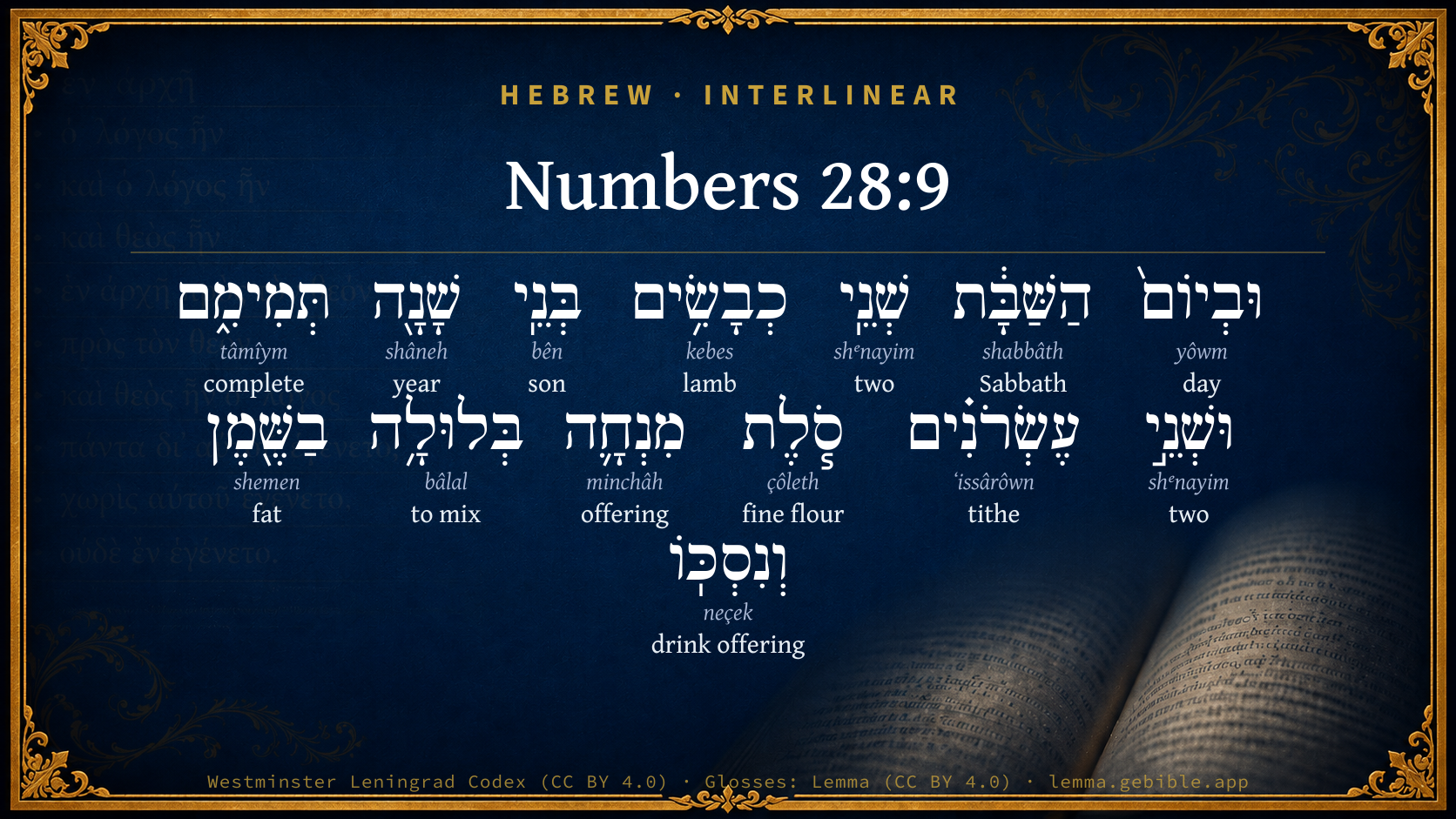
Hebrew (Westminster Leningrad Codex) Numbers 28:9 appears in the Hebrew Old Testament. The text above is from the Westminster Leningrad Codex. Each word links to its Strong’s number, a concise gloss, and parsing drawn from the Open Scriptures Hebrew Bible morphology. Click any word for its full Brown-Driver-Briggs (BDB) entry.
Download image
Cite this verse

Numbers 28:9 (World English Bible). Public Domain. Lemma interlinear Bible study tool, https://lemma.gebible.app/v/numbers/28/9.

Show BibTeX & RIS
BibTeX
RIS
English Translation
On the Sabbath day two he-lambs a year old without blemish, and two tenth parts [of an ephah] of fine flour for a meal-offering, mixed with oil, and the drink-offering of it:
World English Bible · Public Domain
Download a study sheet

One document with this verse’s original text, its word-by-word gloss line, the meaning frame, cross-references with their text, attributed commentary, and full source and license credits — printable, and it pastes into notes with its structure intact.

This verse Autodidact and up

Study sheet (.html) Plain text (.txt)

A passage Seminary Student

Up to 50 verses in one chapter. A passage sheet keeps up to 6 commentary sources and 12 cross-references per verse, in the order this page ranks them, and says so on the sheet whenever that leaves anything out. Ask for a single verse and you get the Autodidact verse sheet above.

Everything on this page stays free to read, with no account — the sheet is a download of what is already on screen, not access to it.

Want to remove ads? Support Godless Engineer
Compare translations 3

The same verse in 3 English versions, stacked beneath the original-language interlinear above. Click any original word for its lexicon entry.

Each is an independent rendering of the whole verse — the interlinear is not word-aligned to these translations.

Highlighted words mark where these versions differ — a whole-verse word diff, not a word-by-word alignment.

  • World English Bible Public Domain
    On the Sabbath day two he-lambs a year old without blemish, and two tenth parts [of an ephah] of fine flour for a meal-offering, mixed with oil, and the drink-offering of it:
  • King James Version Public Domain
    And on the sabbath day two lambs of the first year without spot, and two tenth deals of flour for a meat offering, mingled with oil, and the drink offering thereof:
  • unfoldingWord Literal Text CC BY-SA 4.0
    And on the Sabbath day: two unblemished male lambs, sons of a year, and two-tenths fine flour as a grain offering mixed with the oil, and its drink offering

unfoldingWord Literal Text — © unfoldingWord, licensed CC BY-SA 4.0. Word-aligned USFM3 via Door43 (git.door43.org/unfoldingWord/en_ult).

Versions to compare (up to 4)

3 of 4 selected

Show all 18 translations

Every available English version of this verse, each an independent rendering of the whole verse.

  • World English Bible Public Domain
    On the Sabbath day two he-lambs a year old without blemish, and two tenth parts [of an ephah] of fine flour for a meal-offering, mixed with oil, and the drink-offering of it:
  • Berean Standard Bible Public Domain
    On the Sabbath day, present two unblemished year-old male lambs, accompanied by a grain offering of two-tenths of an ephah of fine flour mixed with oil, as well as a drink offering.
  • Majority Standard Bible Public Domain
    On the Sabbath day, present two unblemished year-old male lambs, accompanied by a grain offering of two-tenths of an ephah of fine flour mixed with oil, as well as a drink offering.
  • King James Version Public Domain
    And on the sabbath day two lambs of the first year without spot, and two tenth deals of flour for a meat offering, mingled with oil, and the drink offering thereof:
  • American Standard Version (1901) Public Domain
    And on the sabbath day two he-lambs a year old without blemish, and two tenth parts `of an ephah' of fine flour for a meal-offering, mingled with oil, and the drink-offering thereof:
  • Revised Version (1885) Public Domain
    And on the sabbath day two he-lambs of the first year without blemish, and two tenth parts of an ephah of fine flour for a meal offering, mingled with oil, and the drink offering thereof:
  • Geneva Bible (1599) Public Domain
    But on the Sabbath day ye shall offer two lambes of a yere old, without spot, and two tenth deales of fine floure for a meate offring mingled with oyle, and the drinke offring thereof.
  • Douay-Rheims (1899) Public Domain
    And on the sabbath day you shall offer two lambs of a year old without blemish, and two tenths of flour tempered with oil in sacrifice, and the libations,
  • Young's Literal Translation Public Domain
    `And on the sabbath-day, two lambs, sons of a year, perfect ones, and two-tenth deals of flour, a present, mixed with oil, and its libation;
  • Literal Standard Version CC BY-SA 4.0
    And on the Sabbath day, two lambs, sons of a year, perfect ones, and two-tenth parts of flour, a present mixed with oil, and its drink-offering—
  • Unlocked Literal Bible CC BY-SA 4.0
    On the Sabbath day you must offer two male lambs, each a year old without blemish, and two-tenths of an ephah of fine flour as a grain offering, mixed with oil, and the drink offering with it.
  • unfoldingWord Literal Text CC BY-SA 4.0
    And on the Sabbath day: two unblemished male lambs, sons of a year, and two-tenths fine flour as a grain offering mixed with the oil, and its drink offering
  • Darby Bible Public Domain
    And on the sabbath day two yearling lambs without blemish, and two tenth parts of fine flour as an oblation, mingled with oil, and the drink-offering thereof:
  • World Messianic Bible Public Domain
    “‘On the Sabbath day, you shall offer two male lambs a year old without defect, and two tenths of an efah of fine flour for a meal offering mixed with oil, and its drink offering:
  • Webster's Bible Public Domain
    And on the sabbath-day two lambs of the first year without spot, and two tenth-parts of flour for a meat-offering, mingled with oil, and its drink-offering.
  • Free Bible Version CC BY-SA 4.0
    On the Sabbath day, present male lambs two years old, without defects, along with a grain offering of two-tenths of an ephah of the best flour mixed with olive oil, and its drink offering.
  • Bible in Basic English Public Domain
    And on the Sabbath day, two he-lambs of the first year, without any mark, and two tenth parts of the best meal for a meal offering mixed with oil, and its drink offering:
  • JPS Tanakh (1917) Public Domain
    And on the sabbath day two he-lambs of the first year without blemish, and two tenth parts of an ephah of fine flour for a meal-offering, mingled with oil, and the drink-offering thereof.

Literal Standard Version (2020), Covenant Press — licensed CC BY-SA 4.0. Text via the HelloAO Bible API (eBible.org). Unlocked Literal Bible (unfoldingWord) — licensed CC BY-SA 4.0. Text via the HelloAO Bible API (eBible.org). unfoldingWord Literal Text — © unfoldingWord, licensed CC BY-SA 4.0. Word-aligned USFM3 via Door43 (git.door43.org/unfoldingWord/en_ult). Free Bible Version, Dr. Jonathan Gallagher — licensed CC BY-SA 4.0. Text via the HelloAO Bible API (eBible.org).

Word by word

More ways to search: Search by grammar → Find every occurrence → Compare this word →

Practice this passage: Drill this verse → Learn its vocabulary →

עֶשְׂרֹנִ֗ים
ʻissârôwn
H6241
“tithes”
Noun, Common, Masculine, Plural, Absolute
Part of Speech
Noun
Type
Common
Gender
Masculine
Number
Plural
State
Absolute
Full BDB Definition

Origin: from H6235

TWOT: 1711h

tenth part, tithe
  1. וּבְיוֹם֙ yôwm H3117 “and · in/at · day of” Conjunction + Preposition + Noun, Common, Masculine, Singular, Construct
  2. הַשַּׁבָּ֔ת shabbâth H7676 “the · Sabbath” Particle, Definite Article + Noun, Common, Both, Singular, Absolute
  3. שְׁנֵֽי shᵉnayim H8147 “two” Adjective, Cardinal number, Masculine, Dual, Construct
  4. כְבָשִׂ֥ים kebes H3532 “lambs” Noun, Common, Masculine, Plural, Absolute
  5. בְּנֵֽי bên H1121 “sons of” Noun, Common, Masculine, Plural, Construct
  6. שָׁנָ֖ה shâneh H8141 “year” Noun, Common, Feminine, Singular, Absolute
  7. תְּמִימִ֑ם tâmîym H8549 “complete” Adjective, Adjective, Masculine, Plural, Absolute
  8. וּשְׁנֵ֣י shᵉnayim H8147 “and · two” Conjunction + Adjective, Cardinal number, Masculine, Dual, Construct
  9. סֹ֧לֶת çôleth H5560 “fine flour” Noun, Common, Feminine, Singular, Absolute
  10. מִנְחָ֛ה minchâh H4503 “offering” Noun, Common, Feminine, Singular, Absolute
  11. בְּלוּלָ֥ה bâlal H1101 “mixed” Verb, Qal, Participle Passive, Feminine, Singular, Absolute
  12. בַשֶּׁ֖מֶן shemen H8081 “in/at the · fat” Preposition, Determined + Noun, Common, Masculine, Singular, Absolute
  13. וְנִסְכּֽוֹ neçek H5262 “and · drink offering · his” Conjunction + Noun, Common, Masculine, Singular, Construct + Suffix, Personal, 3rd Person, Masculine, Singular

About this verse

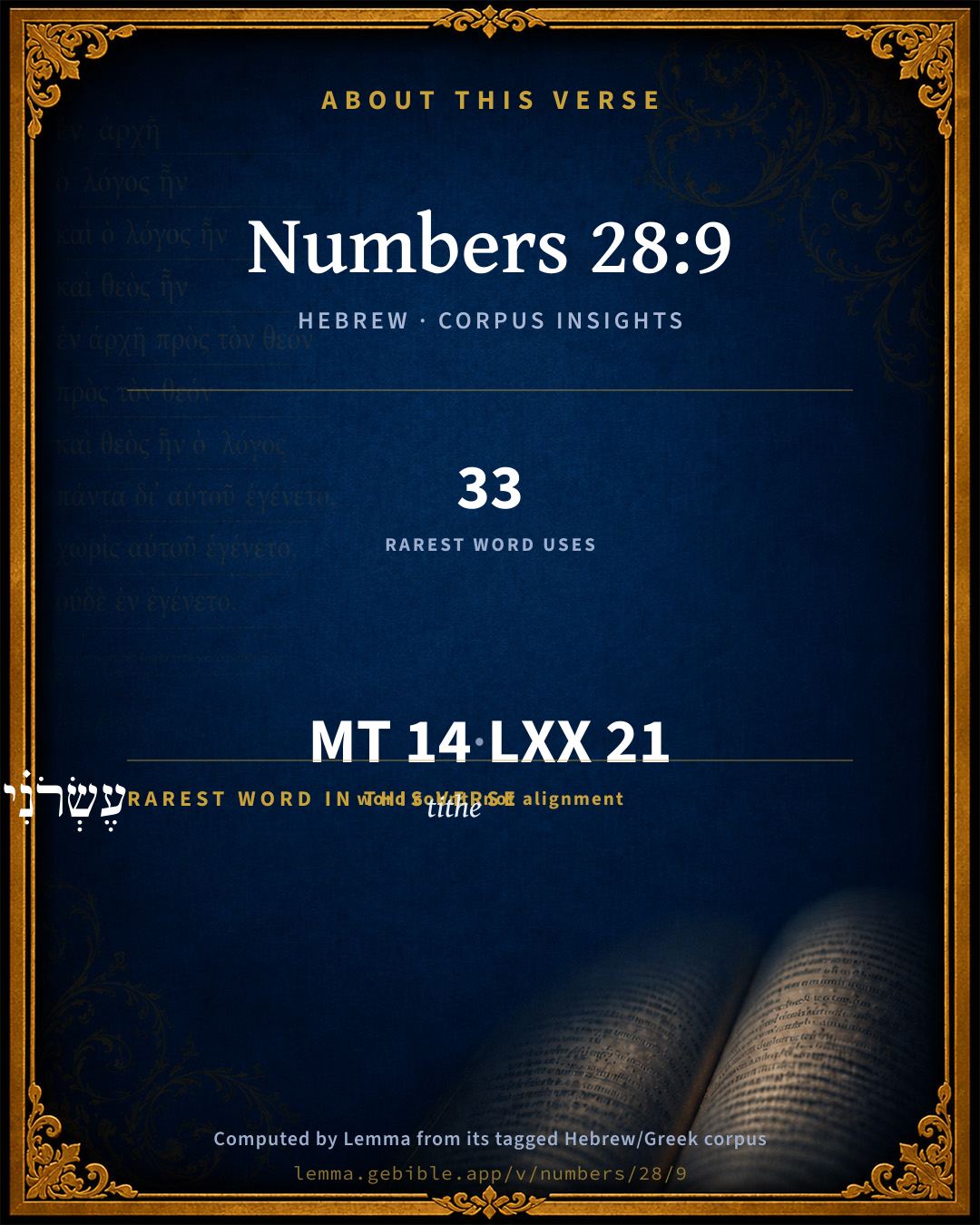
These counts appear in no published source. They are computed here, from the morphology-tagged text and Lemma’s own curated glosses. What Lemma adds →

14
words
13
distinct lemmas
Pentateuch
section

Shared distinctive vocabulary

עֶשְׂרֹנִ֗ים tithe H6241 occurs in 22 verses of the Hebrew Bible. Also found in:

Grammatical profile

  • 1 verb
  • 10 nouns
  • 3 adjectives

Verb forms

  • בְּלוּלָ֥ה Qal · Participle Passive

Repetition

A word recurs within this verse — often emphatic in Hebrew:

  • שְׁנֵֽי two H8147 ×2

Hebrew & Septuagint length

In English translation the verse runs 32 words from the Hebrew and 31 from the Septuagint (LXX English) — closely comparable.

A rough comparison of the two English renderings, which tokenize alike — not a word-level alignment.

Word counts can differ between the Hebrew and the Greek without any difference in meaning — e.g. the Hebrew direct-object marker אֵת has no separate Greek word, and Greek often adds the article ὁ.

In the original languages it is 14 Hebrew tokens and 21 Greek tokens — but the two are counted differently (Hebrew bundles its prefixes and suffixes into one token; the Greek is in lemma form), so that isn’t a like-for-like length.

Cross-references

5

Topical passages linked to Numbers 28:9 in the Treasury of Scripture Knowledge — connected by theme and wording, ordered by reader-vote popularity; previews shown in the World English Bible.

  • Isaiah 58:13 If you turn away your foot from the Sabbath, from doing your pleasure on my holy day; and call the Sabbath a delight, [and] the holy of Yahweh honorable; and shall honor it, not doing your own ways, nor finding your own pleasure, nor speaking [your own] words:
  • Exodus 20:8–11 "Remember the Sabbath day, to keep it holy.
  • Psalms 92:1–4 It is a good thing to give thanks to Yahweh, To sing praises to your name, Most High;
  • Ezekiel 20:12 Moreover also I gave them my Sabbaths, to be a sign between me and them, that they might know that I am Yahweh who sanctifies them.
  • Revelation 1:10 I was in the Spirit on the Lord's day, and I heard behind me a loud voice, like a trumpet

Cross-references courtesy of OpenBible.info (CC BY 4.0).

Hebrew and Greek witnesses Masoretic Hebrew ↔ Greek Septuagint

The same verse in the two great witnesses to the Old Testament, shown verse-for-verse.

These are two independent witnesses, not word-aligned to each other, and the Septuagint is shown in lemma (dictionary) form.

Hebrew Numbers 28:9 Masoretic · Westminster Leningrad Codex

וּבְיוֹם֙ הַשַּׁבָּ֔ת שְׁנֵֽי כְבָשִׂ֥ים בְּנֵֽי שָׁנָ֖ה תְּמִימִ֑ם וּשְׁנֵ֣י עֶשְׂרֹנִ֗ים סֹ֧לֶת מִנְחָ֛ה בְּלוּלָ֥ה בַשֶּׁ֖מֶן וְנִסְכּֽוֹ

On the Sabbath day two he-lambs a year old without blemish, and two tenth parts [of an ephah] of fine flour for a meal-offering, mixed with oil, and the drink-offering of it:

World English Bible · Public Domain

Greek LXX Numbers 28:9 Septuagint · lemma form

καί ὁ ἡμέρα ὁ σάββατον προςἄγω δύο ἀμνός ἐνιαύσιος ἄμωμος καί δύο δέκατος σεμίδαλις ἀναποιέω ἐν ἔλαιον εἰς θυσία καί σπονδή

And on the sabbath-day you⌃ shall offer two lambs of a year old without blemish, and two tenth deals of fine flour mingled with oil for a meat-offering, and a drink-offering.

LXX2012 (modern English Septuagint) · Public Domain

Hebrew: Westminster Leningrad Codex (CC BY 4.0). Greek: Septuagint (public domain); English from LXX2012 (modern English Septuagint) (Public Domain). How the Septuagint differs from the Hebrew →

Targum (Aramaic paraphrase)

2

The Targum is the ancient Jewish Aramaic paraphrase of the Hebrew Scriptures — an interpretive translation, not the Hebrew text itself. Onkelos (literal) and Pseudo-Jonathan (expansive) render the Torah, and Jonathan the Prophets. Coverage is partial: where no permissively-licensed English translation exists for a verse, only the Aramaic is shown. This is verse-level text, not a word-by-word alignment to the Hebrew.

  1. Targum Onkelos Torah (Genesis–Deuteronomy)
    וּבְיוֹמָא דְשַׁבַּתָּא תְּרֵין אִימְרִין בְּנֵי שְׁנָא שַׁלְמִין וּתְרֵין עִשְׂרוֹנִין סוּלְתָּא דְמִנְחָתָא דְפִילָא בִּמְשַׁח וְנִסְכֵּיהּ

    (no public-domain English translation for this verse)

    Targum Onkelos — Aramaic: “Onkelos Genesis” (public domain); “Onkelos Exodus” (public domain); “Onkelos Leviticus” (public domain); “Onkelos Numbers” (public domain); “Onkelos Deuteronomy” (public domain). English: “Sefaria Community Translation” (CC0 1.0 (public-domain dedication)); “J.W. Etheridge. The Targums of Onkelos and Jonathan Ben Uzziel on the Pentateuch. London: Longmans, Green, 1862” (public domain). Text via Sefaria.

  2. Targum Pseudo-Jonathan Torah (Genesis–Deuteronomy)
    וּבְיוֹמָא דְשַׁבַּתָּא תְּרֵין אִמְרִין בְּנֵי שָׁנָה שַׁלְמִין וּתְרֵין עֶשְרוֹנִין סְמִידָא לְמִנְחָתָא פְּתִיכָא בִּמְשַׁח זֵיתָא וְנִיסוּכָהּ

    but on the day of Shabbatha two lambs of the year without blemish, and two-tenths of flour mixed with olive oil for the mincha and its libation.

    Targum Pseudo-Jonathan — Aramaic: “Targum Jonathan on Genesis” (public domain); “Targum Jonathan on Exodus” (public domain); “Targum Jonathan on Leviticus” (public domain); “Targum Jonathan on Numbers” (public domain); “Targum Jonathan on Deuteronomy” (public domain). English: “The Targum of Jonathan ben Uzziel, trans. J. W. Etheridge, London, 1862” (public domain). Text via Sefaria.

Commentary

Notes on Numbers 28:9 from classic Christian and Jewish commentators (each source and its license shown beneath its notes). The classic Christian expositions comment on the surrounding passage and are grouped to its opening verse, so a note may address several verses; the Jewish commentaries on the Tanakh (Rashi and others) are per-verse, so they appear only where the commentator wrote on this verse.

Lemma curates 59 commentaries, every one of them public domain or Creative Commons licensed, each selected and text-cleaned for this edition rather than reprinted as found. About our sources →

Matthew Henry's Commentary

The new moons and the sabbaths are often spoken of together, as great solemnities in the Jewish church, very comfortable to the saints then, and typical of gospel grace. Now we have here the sacrifices appointed, 1. For the sabbaths. Every sabbath day the offering must be doubled; besides the two lambs offered for the daily burnt-offering, there must be two more offered, one (it is probable) added to the morning sacrifice, and the other to the evening, Num 28:9, Num 28:10. This teaches us to double our devotions on sabbath days, for so the duty of the day requires. The sabbath rest is to be observed, in order to a more close application to the sabbath work, which ought to fill up sabbath time. In Ezekiel's temple-service, which points at gospel times, the sabbath offerings were to be six lambs and a ram, with their meat-offerings, and drink-offerings (Eze 46:4, Eze 46:5), to intimate not only the continuance, but the advancement, of sabbath sanctification in the days of the Messiah. This is the burnt-offering of the sabbath in his sabbath, so it is in the original, v. 10. We must do every sabbath day's work in its day, studying to redeem every minute of sabbath time as those that believe it precious; and not thinking to put off one sabbath's work to another, for sufficient to every sabbath is the service thereof. 2. For the new moons. Some suggest that, as the sabbath was kept with an eye to the creation of the world, so the new moons were sanctified with an eye to the divine providence, which appoints the moon for seasons, guiding the revolutions of time by its changes, and governing sublunary bodies (as many think) by its influences. Though we observe not any feast of new moons, yet we must not forget to give God the glory of all the precious things put forth by the moon which he has established for ever, a faithful witness in heaven, Psa 89:37. The offerings in the new moons were very considerable, two bullocks, a ram, and seven lambs, with the meat-offerings and drink-offerings that were to attend them (Num 28:11, etc.), besides a sin-offering, Num 28:15. For, when we give glory to God by confessing his mercies, we must give glory to him likewise by confessing our own sins; and, when we rejoice in the gifts of common providence, we must make the sacrifice of Christ, that great gift of special grace, the fountain and spring-head of our joy. Some have questioned whether the new moons were to be reckoned among their feasts; but why should they not, when, besides the special sacrifices which were then to be offered, they rested from servile works (Amo 8:5), blew the trumpets (Num 10:10), and went to the prophets to hear the word? Kg2 4:23. And the worship performed in the new moons is made typical of gospel solemnities, Isa 66:23.

Matthew Henry's Commentary on the Whole Bible (1708–1710) — public domain (CC PDM 1.0). Text via the HelloAO Bible API.

Trapp's Complete Commentary

John Trapp

Num 28:9 And on the sabbath day two lambs of the first year without spot, and two tenth deals of flour [for] a meat offering, mingled with oil, and the drink offering thereof:

Ver. 9. And on the Sabbath day.] Every day should be a Sabbath to the saints, in regard of ceasing to do evil, learning to do well; but on the seventh day Sabbath our devotion should be doubled. Debet totus dies festivus a Christiano expendi in operibus sanctis, said Robert Grosthead, Bishop of Lincoln, long since. {a} The whole Sabbath should be spent in God’s service. Psa 92:1, titled, A Psalm for the Sabbath, mentions morning and evening performances. {Psa 92:2} Variety of duties may very well take up the whole day with delight. Besides, God gives us six whole days. Now, to sell by one measure and buy by another, is the way to a curse.

{a} In Decalog. Praecep., 30.

John Trapp, A Commentary or Exposition upon All the Books of the Old and New Testament (1647–1656) — public domain. Text from a community e-Sword module.

Joseph Benson's Commentary

Num 28:9. On the sabbath two lambs — The second stated and national sacrifice was weekly. On this day the burnt-offerings and meat-offerings are ordered to be double.

Joseph Benson's Commentary on the Old and New Testaments (1811–1818) — public domain. Text from a community e-Sword module.

Whedon's Commentary on the Bible

Daniel D. Whedon

THE SABBATH OFFERING, Num_28:9-10.

9. Sabbath day — Greek, in the plural, the day of sabbaths. Thus the New Testament, Luk_4:16 : Act_13:14; Act_16:13.

Two lambs — In addition to the regular daily sacrifice. The Sabbath was instituted in memory of the creation, (Exo_20:11,) of the exode from Egypt, (Deu_5:15,) as a sign of Israel’s consecration to the Lord, (Eze_20:12,) and as an emblem of soul-rest in Christ here, and of heavenly rest hereafter. Heb_4:3; Heb_4:9. Ezekiel, predicting that service under the Gospel, glad and free in the fulness of the Spirit, says that in the sabbath day the prince shall offer six perfect lambs. Eze_46:4-5.

Tenth deals — Leviticus xxiii, 13, note.

Meat offering — Leviticus 2, notes.

Daniel D. Whedon (gen. ed.), Commentary on the Old and New Testaments (1874–1909) — public domain. Text from a community e-Sword module.

Tyndale Open Study Notes

Tyndale Open Resources

28:9-10 Special days called for additional offerings. The Sabbath day required a sacrifice over and above the regular burnt offering and its accompanying liquid offering. Other passages highlight the importance of the Sabbath (e.g., Exod 20:8-11; Lev 23:3; Deut 5:12-15).

Tyndale Open Study Notes — © Tyndale Open Resources, licensed CC BY-SA 4.0. Text via the HelloAO Bible API.

Geneva Bible (1599)

Geneva Bible translators

Of the measure Ephah.

Geneva Bible (1599) marginal notes — public domain. Text via Bolls.life.

Jamieson, Fausset & Brown

Robert Jamieson, A. R. Fausset & David Brown

This is the burnt offering of every sabbath--There is no previous mention of a Sabbath burnt offering, which was additional to the daily sacrifices.

Jamieson, Fausset & Brown — Commentary Critical and Explanatory on the Whole Bible (1871) — public domain (CC PDM 1.0). Text via the HelloAO Bible API.

Ellicott's Commentary for English Readers

(9) And on the sabbath day two lambs . . . —The Sabbath offering which was to be added to the daily sacrifice is here enjoined for the first time. The rule respecting the drink offering which was to accompany the burnt offering is laid down in Num_15:5. The law of the Sabbath is laid down in Exo_20:8-11, and Lev_23:3.

A Bible Commentary for English Readers, edited by Charles John Ellicott (1878–1897) — public domain. Text from a community e-Sword module.

John Gill's Exposition

And on the sabbath day two lambs of the first year without spot,.... Just such as were appointed for the daily sacrifice:

and two tenth deals of flour for a meat offering, mingled with oil; that is, two tenth parts of an ephah of flour mixed with two fourth parts of an hin of oil; of oil olive, as the Targum of Jonathan expresses it, which is always meant, wherever oil is mentioned; which made one meat offering to them doubled for both lambs, or two meat offerings of the same quantity with those of the daily sacrifice, one for one lamb, and the other for the other:

and the drink offering thereof: which was of a like quantity of wine doubled, in proportion to the meat offering; when these lambs, with the meat and drink offerings, were offered up, is not said, whether the one in the morning after, and the other in the evening before the daily sacrifice, which is not improbable, or both together.

John Gill's Exposition of the Whole Bible (1746–1763) — public domain (CC PDM 1.0). Text via the HelloAO Bible API.

Albert Barnes' Notes on the Bible

The Sabbath-offering, not previously enjoined, consisted of two lambs, properly accompanied, in addition to the regular daily offering.

Albert Barnes' Notes on the Bible (1834–1885) — public domain. Text from a community e-Sword/MySword module.

Matthew Poole's English Annotations

Two lambs, besides that for the daily sacrifice, Num 28:10.

Matthew Poole's English Annotations on the Holy Bible (1683–1685) — public domain. Text from a community e-Sword/MySword module.

The Pulpit Commentary

And on the sabbath day. The special offering for the sabbath is ordered here for the first time. It does not say when the two lambs were to be slain, but in practice it was immediately after the morning sacrifice of the day.

Vers. 9, 10. The sabbath offering.

I THE LESSON ON THE SPECIAL OFFERING. Special blessings belonged to the sabbath, over and above those of the ordinary day, and it became a duty to recognize them. The sabbath offerings represented what Israel had gained by the rest of the sabbath. We make our gains not only by the food we eat and the work we do, but also by the intervals of rest in the midst of labour. Moreover, by this offering God indicated that the sabbath was to have its own appropriate occupation. Most emphatically, by precept, (Exo_20:10) and by punitive example, (Num_15:32-36) God had commanded to Israel the cessation from ordinary work. Here he indicates that the most effectual way of providing for cessation is to find a holy work to do. We cannot be too earnest in finding such a positive use of the day of rest as will please God and promote our own spiritual advancement. Surely, in the judgment, many who have reckoned themselves Christians will be convicted of a sore misuse of the weekly opportunity. We may be very precise and even punctilious in our abstentions, but what will this avail by itself? The mind that is not earnestly and comfortably occupied with Divine things will assuredly be occupied in thinking of things that belong to the ordinary day. As it is now, instead of the Sunday casting its brightness on the week-day, the weekday too often casts its shadow on the Sunday. God is able to make the appropriate occupation of his day, if we enter on it in a right spirit, a joy all the day long. In the world, and through the week, we have to deal with all sorts of men. There is the strain, the discord, and the suspicion that must belong to all human relations in this mixed and sinful state. The week-day is the world"s day, wherein we cannot get away from the world. The Lord"s day ought to be what the name suggests, the day for us to feel that we have not only to do with the hard conditions of a selfish world, but with One in heaven, who is most considerate, and most able to satisfy us with all good things.

II THE LESSON OF THE DAILY OFFERING WHICH WAS NOT TO BE OMITTED. The sabbath, in respect of God"s gifts and dealings in nature, was the same as an ordinary day, and therefore had to be acknowledged as such. So far as God"s operations in nature are concerned all goes on without a break, Sunday and week-day alike. The sun rises as on other days, the clouds gather and the rain falls, the rivers run, and the tides flow and ebb. It is as true, Sunday as week-day, that in God we live and move and have our being. The great difference is that while God in nature is making all to go on just as usual, man, if he be in harmony with the will of God in Christ Jesus, is resting from his toils. God needs not rest in the sense in which we need it. He rested from the exercise of his creative energy, but not because of exhaustion. We, who have to eat our bread in the sweat of our face till we return to the ground, need that regular and frequent interval of rest which he has so graciously provided. And thus, coming as we sometimes do to the close of the week, utterly spent and exhausted, ready to welcome the brief respite from toil, we have the joy of recollection, as we see God continuing on the sabbath his work in the natural world, that he is indeed the everlasting God, the Lord, the Creator of the ends of the earth, he who fainteth not, neither is weary. "He giveth power to the faint; and to them that have no might he increaseth strength". Y. (Isa_40:28-31)

The Pulpit Commentary (1880–1919), ed. H.D.M. Spence-Jones & Joseph S. Exell — public domain. Text from a community e-Sword module.

Keil & Delitzsch

C. F. Keil & F. Delitzsch

The Sabbath-offering, which was to be added to the daily sacrifice (על, upon it), consisted of two yearling lambs as a burnt-offering, with the corresponding meat-offering and drink-offering, according to the general rule laid down in Num 15:3., and is appointed here for the first time; whereas the sabbatical feast had already been instituted at Exo 20:8-11 and Lev 23:3. "The burnt-offering of the Sabbath on its Sabbath," i.e., as often as the Sabbath occurred, every Sabbath.

Keil & Delitzsch — Biblical Commentary on the Old Testament (1861–1891) — public domain (CC PDM 1.0). Text via the HelloAO Bible API. (Old Testament only.)

unfoldingWord translationNotes

Door43 World Missions Community

General Information:

Yahweh continues telling Moses what the people must do.

two-tenths of an ephah

"Two-tenths" means two parts out of ten equal parts. This can be written in modern measurements. AT: "four and a half liters" or "two tenths of an ephah (which is about 4.5 liters)" (See: Fractions and Biblical Volume)

mixed with oil

This can be stated in active form. AT: "which you have mixed with oil" (See: Active or Passive)

the drink offering with it

Many offerings had a drink offering that was required to be offered with them. The full meaning of the can be made clear. AT: "the drink offering that accompanies it" (See: Assumed Knowledge and Implicit Information)

translationWords

Sabbath

year

blemish

grain offering

oil

drink offering

burnt offering

unfoldingWord translationNotes — © Distant Shores Media and the Door43 World Missions Community, licensed CC BY-SA 4.0. Source: git.door43.org/Door43/en_tn.

Lesson kit

Teaching starters — assembled from the data on this page, not authored interpretation. Every prompt links to the verse data it draws on. Edit before teaching.

Numbers, in the Pentateuch, opens this verse with 14 words (13 distinct Hebrew lemmas). Its most distinctive word is ʻissârôwn (“tithe”). A historical commentator’s framing appears above. Read the whole chapter for the surrounding context.

Discussion questions

  1. The word ʻissârôwn carries the sense “tithe.” How does it shape the verse?
  2. How does Exodus 29:40, which shares the word «tithe», read alongside this verse?
  3. What does the repetition of “two” (2× in this one verse) do in this verse?
  4. The translations on this page render this verse differently — a whole-verse word diff, not a word-by-word alignment. What might account for the different wordings?
  5. «בְּלוּלָ֥ה» is a Qal Participle Passive verb. How does that grammatical form shape the action described?
  6. Compare how Matthew Henry's Commentary and Trapp's Complete Commentary read this verse. Where do they agree or differ?

Things to notice

Reading settings

Reading text

Shown beneath each verse's original-language words.

Old Testament
Old Testament edition

Read the OT as the Masoretic Hebrew (MT) or the Greek Septuagint (LXX).

English shown for the Greek Septuagint (in the Hebrew ↔ Greek comparison).

Comparing translations? Open the Compare panel on any verse page to stack up to four side by side.