
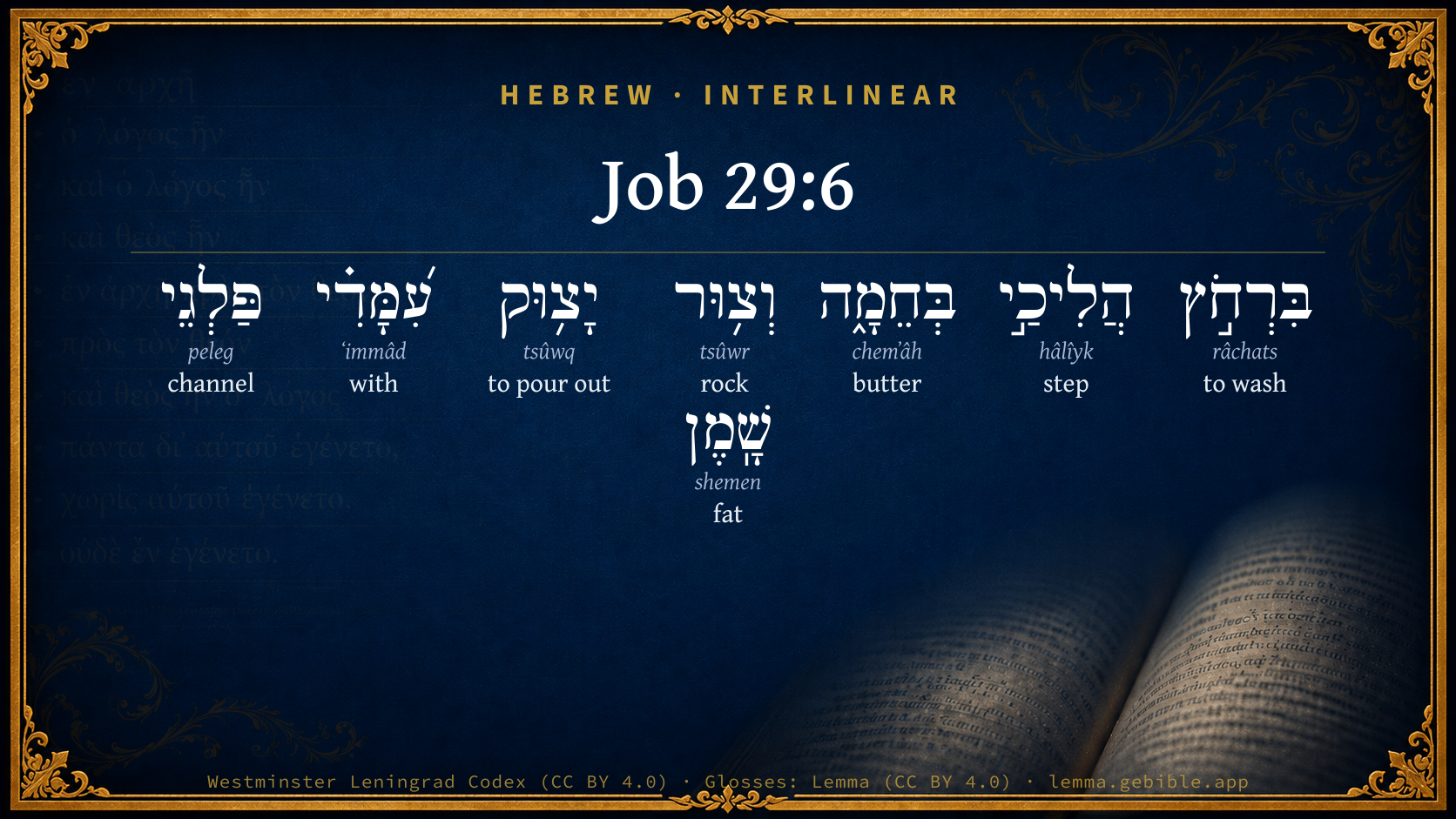
Job 29:6

Hebrew (Westminster Leningrad Codex) Job 29:6 appears in the Hebrew Old Testament. The text above is from the Westminster Leningrad Codex. Each word links to its Strong’s number, a concise gloss, and parsing drawn from the Open Scriptures Hebrew Bible morphology. Click any word for its full Brown-Driver-Briggs (BDB) entry.
Download image
Cite this verse

Job 29:6 (World English Bible). Public Domain. Lemma interlinear Bible study tool, https://lemma.gebible.app/v/job/29/6.

Show BibTeX & RIS
BibTeX
RIS
English Translation
When my steps were washed with butter, And the rock poured out streams of oil for me!
World English Bible · Public Domain
Highlights
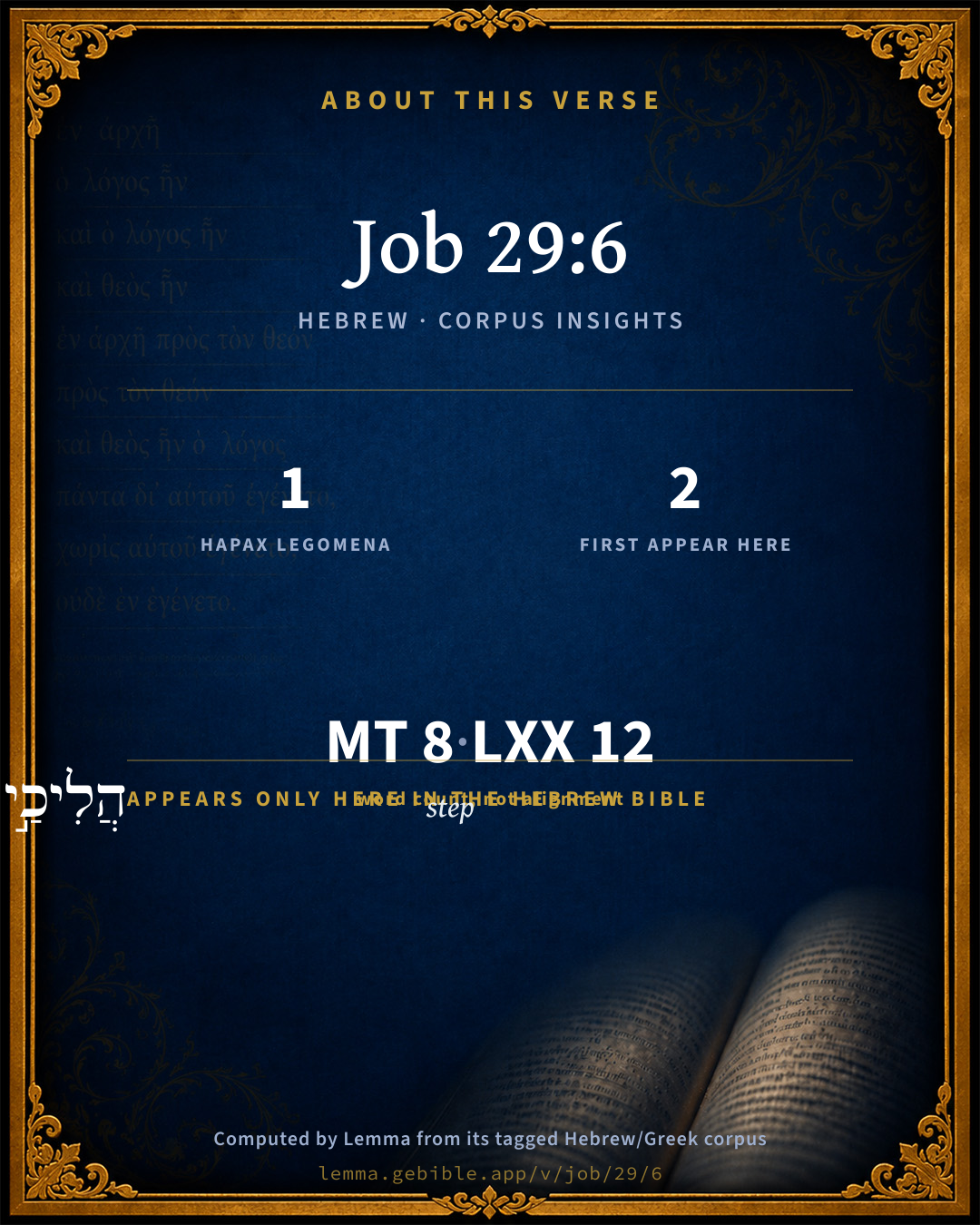
  • 1 hapax legomenon — only here in the Hebrew Bible
  • 2 first appearances in the Hebrew Bible
Full analysis ↓
Download a study sheet

One document with this verse’s original text, its word-by-word gloss line, the meaning frame, cross-references with their text, attributed commentary, and full source and license credits — printable, and it pastes into notes with its structure intact.

This verse Autodidact and up

Study sheet (.html) Plain text (.txt)

A passage Seminary Student

Up to 50 verses in one chapter. A passage sheet keeps up to 6 commentary sources and 12 cross-references per verse, in the order this page ranks them, and says so on the sheet whenever that leaves anything out. Ask for a single verse and you get the Autodidact verse sheet above.

Everything on this page stays free to read, with no account — the sheet is a download of what is already on screen, not access to it.

Want to remove ads? Support Godless Engineer
Compare translations 3

The same verse in 3 English versions, stacked beneath the original-language interlinear above. Click any original word for its lexicon entry.

Each is an independent rendering of the whole verse — the interlinear is not word-aligned to these translations.

Highlighted words mark where these versions differ — a whole-verse word diff, not a word-by-word alignment.

  • World English Bible Public Domain
    When my steps were washed with butter, And the rock poured out streams of oil for me!
  • King James Version Public Domain
    When I washed my steps with butter, and the rock poured me out rivers of oil;
  • unfoldingWord Literal Text CC BY-SA 4.0
    when my steps were bathed in butter and the rock poured out streams of oil for me!

unfoldingWord Literal Text — © unfoldingWord, licensed CC BY-SA 4.0. Word-aligned USFM3 via Door43 (git.door43.org/unfoldingWord/en_ult).

Versions to compare (up to 4)

3 of 4 selected

Show all 18 translations

Every available English version of this verse, each an independent rendering of the whole verse.

  • World English Bible Public Domain
    When my steps were washed with butter, And the rock poured out streams of oil for me!
  • Berean Standard Bible Public Domain
    when my steps were bathed in cream and the rock poured out for me streams of oil!
  • Majority Standard Bible Public Domain
    when my steps were bathed in cream and the rock poured out for me streams of oil!
  • King James Version Public Domain
    When I washed my steps with butter, and the rock poured me out rivers of oil;
  • American Standard Version (1901) Public Domain
    When my steps were washed with butter, And the rock poured me out streams of oil!
  • Revised Version (1885) Public Domain
    When my steps were washed with butter, and the rock poured me out rivers of oil!
  • Geneva Bible (1599) Public Domain
    When I washed my pathes with butter, and when the rocke powred me out riuers of oyle:
  • Douay-Rheims (1899) Public Domain
    When I washed my feet with butter, and the rock poured me out rivers of oil?
  • Young's Literal Translation Public Domain
    When washing my goings with butter, And the firm rock `is' with me rivulets of oil.
  • Literal Standard Version CC BY-SA 4.0
    When washing my goings with butter, || And the firm rock [is] with me—streams of oil.
  • Unlocked Literal Bible CC BY-SA 4.0
    when my way was covered with cream, and the rock poured out for me streams of oil!
  • unfoldingWord Literal Text CC BY-SA 4.0
    when my steps were bathed in butter and the rock poured out streams of oil for me!
  • Darby Bible Public Domain
    When my steps were bathed in milk, and the rock poured out beside me rivers of oil!...
  • World Messianic Bible Public Domain
    when my steps were washed with butter, and the rock poured out streams of oil for me,
  • Webster's Bible Public Domain
    When I washed my steps with butter, and the rock poured me out rivers of oil;
  • Free Bible Version CC BY-SA 4.0
    My herds produced much milk, and oil flowed freely from my olive presses.
  • Bible in Basic English Public Domain
    When my steps were washed with milk, and rivers of oil were flowing out of the rock for me.
  • JPS Tanakh (1917) Public Domain
    When my steps were washed with butter, and the rock poured me out rivers of oil!

Literal Standard Version (2020), Covenant Press — licensed CC BY-SA 4.0. Text via the HelloAO Bible API (eBible.org). Unlocked Literal Bible (unfoldingWord) — licensed CC BY-SA 4.0. Text via the HelloAO Bible API (eBible.org). unfoldingWord Literal Text — © unfoldingWord, licensed CC BY-SA 4.0. Word-aligned USFM3 via Door43 (git.door43.org/unfoldingWord/en_ult). Free Bible Version, Dr. Jonathan Gallagher — licensed CC BY-SA 4.0. Text via the HelloAO Bible API (eBible.org).

Word by word

More ways to search: Search by grammar → Find every occurrence → Compare this word →

Practice this passage: Drill this verse → Learn its vocabulary →

About this verse

These counts appear in no published source. They are computed here, from the morphology-tagged text and Lemma’s own curated glosses. What Lemma adds →

8
words
8
distinct lemmas
Wisdom
section

Notable vocabulary

1 hapax legomenon — a word that appears only here in the entire Hebrew Bible:

  • הֲלִיכַ֣י step H1978

First appearance in Scripture

These words make their first canonical appearance in the Hebrew Bible here:

  • הֲלִיכַ֣י step H1978
  • פַּלְגֵי channel H6388

Shared distinctive vocabulary

יָצ֥וּק to pour out H6694 occurs in 3 verses of the Hebrew Bible. Also found in:

Grammatical profile

  • 2 verbs
  • 5 nouns
  • 1 preposition

Verb forms

  • בִּרְחֹ֣ץ Qal · Infinitive Construct
  • יָצ֥וּק Qal · Imperfect

Hebrew & Septuagint length

In English translation the verse runs 17 words from the Hebrew and 15 from the Septuagint (LXX English) — closely comparable.

A rough comparison of the two English renderings, which tokenize alike — not a word-level alignment.

Word counts can differ between the Hebrew and the Greek without any difference in meaning — e.g. the Hebrew direct-object marker אֵת has no separate Greek word, and Greek often adds the article ὁ.

In the original languages it is 8 Hebrew tokens and 12 Greek tokens — but the two are counted differently (Hebrew bundles its prefixes and suffixes into one token; the Greek is in lemma form), so that isn’t a like-for-like length.

Cross-references

5

Topical passages linked to Job 29:6 in the Treasury of Scripture Knowledge — connected by theme and wording, ordered by reader-vote popularity; previews shown in the World English Bible.

  • Psalms 81:16 But he would have also fed them with the finest of the wheat. I will satisfy you with honey out of the rock."
  • Job 20:17 He shall not look at the rivers, The flowing streams of honey and butter.
  • Deuteronomy 32:13–14 He made him ride on the high places of the earth, He ate the increase of the field; He made him to suck honey out of the rock, Oil out of the flinty rock;
  • Deuteronomy 33:24 Of Asher he said, Blessed be Asher with children; Let him be acceptable to his brothers, Let him dip his foot in oil.
  • Genesis 49:11 Binding his foal to the vine, His donkey's colt to the choice vine; He has washed his garments in wine, His robes in the blood of grapes:

Cross-references courtesy of OpenBible.info (CC BY 4.0).

Hebrew and Greek witnesses Masoretic Hebrew ↔ Greek Septuagint

The same verse in the two great witnesses to the Old Testament, shown verse-for-verse.

These are two independent witnesses, not word-aligned to each other, and the Septuagint is shown in lemma (dictionary) form.

Hebrew Job 29:6 Masoretic · Westminster Leningrad Codex

בִּרְחֹ֣ץ הֲלִיכַ֣י בְּחֵמָ֑ה וְצ֥וּר יָצ֥וּק עִ֝מָּדִ֗י פַּלְגֵי שָֽׁמֶן

When my steps were washed with butter, And the rock poured out streams of oil for me!

World English Bible · Public Domain

Greek LXX Job 29:6 Septuagint · lemma form

ὅτε χέω ἐγώ ὁ ὁδός βούτυρον ὁ δέ ὄρος ἐγώ χέω γάλα

when my ways were moistened with butter, and the mountains flowed for me with milk.

LXX2012 (modern English Septuagint) · Public Domain

On this verse, Albert Barnes' Notes on the Bible discusses the Septuagint’s reading. Read the note in Commentary ↓

Hebrew: Westminster Leningrad Codex (CC BY 4.0). Greek: Septuagint (public domain); English from LXX2012 (modern English Septuagint) (Public Domain). How the Septuagint differs from the Hebrew →

Commentary

Notes on Job 29:6 from classic Christian and Jewish commentators (each source and its license shown beneath its notes). The classic Christian expositions comment on the surrounding passage and are grouped to its opening verse, so a note may address several verses; the Jewish commentaries on the Tanakh (Rashi and others) are per-verse, so they appear only where the commentator wrote on this verse.

Lemma curates 59 commentaries, every one of them public domain or Creative Commons licensed, each selected and text-cleaned for this edition rather than reprinted as found. About our sources →

Trapp's Complete Commentary

John Trapp

Job 29:6 When I washed my steps with butter, and the rock poured me out rivers of oil;

Ver. 6. When I washed my steps with butter] When I had of everything God’s plenty, as they call it. Butter enough to have washed my feet in, had I been so proud and profuse. And oil great store, insomuch as that rivers thereof seemed to flow for me from those rocks and craggy mountains in Arabia Petraea, where some say Job dwelt. Lavater, upon the text, tells us of rocks that yield oil, and of petroleum or petrelaeum , a sovereign ointment (very good against various diseases) that issueth out of rocks, whence also it hath its name (not unlike that berry which the French call, Uva de Spine, the grape of a thorn); but this whole verse seemeth to be a hyperbole (not unlike that of Zophar, Job 20:17, and that of Moses, Deu 32:13; confer Gen 49:11 Psa 80:15), importing the very great abundance of all outward comforts and contentments that Job once enjoyed. He had the reward of humility and the fear of the Lord, even riches, and honour, and life, Pro 22:4. Riches he had quantas optare nullus auderet (as Austin saith of Constantine the Great), more than heart could wish (De Civ. Dei, 1.5, c. 25). What honour he had with his wealth (and that is to be chosen before riches, Pro 22:1) he setteth forth at large in the following verses. And what long life he promised himself, not without the continuance of both the former, see Job 29:18-20; Job 42:12; Job 42:16-17.

John Trapp, A Commentary or Exposition upon All the Books of the Old and New Testament (1647–1656) — public domain. Text from a community e-Sword module.

Geneva Bible (1599)

Geneva Bible translators

By these similitudes he declareth the great prosperity that he was in, so that he had none occasion to be such a sinner as they accused him.

Geneva Bible (1599) marginal notes — public domain. Text via Bolls.life.

Jamieson, Fausset & Brown

Robert Jamieson, A. R. Fausset & David Brown

butter--rather, "cream," literally, "thick milk." Wherever I turned my steps, the richest milk and oil flowed in to me abundantly. Image from pastoral life.

When I washed my steps--Literal washing of the feet in milk is not meant, as the second clause shows; Margin, "with me," that is, "near" my path, wherever I walked (Deu 32:13). Olives amidst rocks yield the best oil. Oil in the East is used for food, light, anointing, and medicine.

Jamieson, Fausset & Brown — Commentary Critical and Explanatory on the Whole Bible (1871) — public domain (CC PDM 1.0). Text via the HelloAO Bible API.

Adam Clarke's Commentary

Verse 6. Washed my steps with butter] See Clarke on Job 20:17.

Adam Clarke's Commentary on the Bible (1810–1826) — public domain. Text from a community e-Sword/MySword module.

The Cambridge Bible for Schools and Colleges

gen. ed. J. J. S. Perowne

6. The second, though a less, element of his happiness was his overflowing abundance.

when I washed my steps] Or, when my steps were washed in butter, i. e. bathed—a figure for the overflowing abundance amidst which he walked.

the rock poured me out] As marg., poured out with me or beside me. The unfruitful rock poured out rivers of oil beside him; his blessings were so abundant that they came unsought and seemed above nature.

The Cambridge Bible for Schools and Colleges (gen. ed. J. J. S. Perowne; Cambridge University Press, 1878–1918) — public domain. Text from a community e-Sword module.

John Gill's Exposition

When I washed my steps with butter,.... Not the steps of his house or palace; for to have done this, or his servants by his orders, as it would have been a very great impropriety, so a piece of great prodigality, which Job could never have been guilty of; but either his footsteps, the prints of his feet; and the sense be, that his cattle produced such a vast quantity of milk, that when his servants brought it from the fields to the dairy, their milk pails ran over in such abundance, that Job could not step out of his house, and take a walk in his fields, but he stepped into puddles of milk, of which butter was made: this is an exaggerated phrase, like that by which the land of Canaan is described as "flowing with milk and honey"; or rather this is to be understood of the washing of his feet, which are the instruments of stepping or walking. It was usual in those times, in the eastern countries, to wash their feet upon travelling, or at festivals; but then this was commonly done with water, not with butter, see Gen 18:4; and the meaning can only be, that Job had such abundance of milk, or butter made of it, that he could, if he would, have washed his feet in it; indeed, they had used to anoint the feet with ointment; but whether cream or butter was any ingredient in it, and so the part is put for the whole, is not certain, see Luk 7:38, Job 12:3; besides, that would have been more properly expressed by anointing than washing; it seems to be an hyperbole, an expression like that of Zophar, in Job 20:17; signifying the vast abundance of the increase and produce of Job's kine; who is said to wash his feet in milk or butter, as Asher is said to dip his feet in oil, because of the great plenty of it, Deu 33:24; the spiritual meditation upon the words may be this; the feet of the best of saints need washing, there being many failings and infirmities in their walk and conversation; in which they gather much pollution and faith daily; the proper wash for this is the blood of Christ, of which the layer in the tabernacle and temple was a type, at which the priests washed their hands and feet; but the word of God, called the sincere milk of the word, is the instrument or means of washing, or of directing souls to the fountain opened to wash in; so that with respect to that, the feet of saints, as the eyes of Christ, may be said to be washed with milk:

and the rock poured me out rivers of oil; another hyperbolical expression, like that in Deu 32:13, where honey is said to be sucked out of the rock, and oil out of the flinty rock; as honey may be got out of a rock, because bees may make their nests and hives there, where it is laid up by them; so oil, in like manner, may be had from the flinty rock, olive trees growing on hills, mountains, and rocks, which yield oil in great abundance; near Jerusalem was a mount called Olivet, from thence: the land of Edom, or Idumea, where Job lived, abounded with cragged mountains and rocks; and there might be in Job's estate such on which olive trees grew in great plenty, as to produce vast quantities of oil: it is a very fanciful thought of Bolducius, that this rock was no other than a stone vessel, in which was oil, somewhat like the alabaster box in Mat 26:7; and which was plentifully poured on Job, when he was anointed high priest; and another learned man (u), though he rejects the notion of its being a vessel for sacred use, yet is willing to allow it was an oil vessel for common use: as to the spiritual sense, it may be observed, that a rock in Scripture often signifies a divine Person, Co1 10:4; it is an emblem of Christ, as oil also is of the Spirit of God and his grace, Mat 25:3; and which flows from Christ, who is full thereof, and that in such great abundance, as to be expressed by rivers; see Joh 1:14.

(u) Fortunat. Schacch. Elaeochrysm. Myroth. l. 2. c. 79. p. 715.

John Gill's Exposition of the Whole Bible (1746–1763) — public domain (CC PDM 1.0). Text via the HelloAO Bible API.

Albert Barnes' Notes on the Bible

When I washed my steps with butter - On the word rendered “butter,” see the notes at Isa 7:15. It properly means curdled milk. Umbreit renders it, Sahne; cream. Noyes, milk, and so Wemyss. The Septuagint, “When my ways flowed with butter” - βουτύρῳ bouturō. So Coverdale, “When my ways ran over with butter.” Herder, “And where I went a stream of milk flowed on.” The sense may be, that cream or butter was so plenty that he was able to make use of it for the most common purposes - even for that of washing his feet. That butter was sometimes used for the purpose of anointing the feet - probably for comfort and health - as oil was for the head, is mentioned by Oriental travelers. Hassilquist (Travels in Palestine, p. 58), speaking of the ceremonies of the priests at Magnesia on holy Thursday, says, “The priest washed and dried the feet, and afterward besmeared them with butter, which it was alleged was made from the first milk of a young cow.” Bruce says that the king of Abyssinia daily anointed his head with butter. Burder in Rosenmuller’s alte u. neue Morgenland, in loc. It is possible that this use of butter was as ancient as the time of Job, and that he here alludes to it, but it seems more probable that the image is designed to denote superfluity or abundance; and that where he trod, streams of milk or cream flowed - so abundant was it round him. The word rendered “steps” הליכם hâlı̂ykam) does not properly denote “the feet” but “the tread, the going, the stepping.” This sense corresponds with that of the other member of the parallelism.

And the rock poured me out rivers of oil - Margin, “with me.” The idea is, that the very rock near which he stood, seemed to pour forth oil. Instead of water gushing out, such seemed to be the abundance with which he was blessed, that the very rock poured out a running stream of oil. Oil was of great value among the Orientals. It was used as an article of food, for light, for anointing the body, and as a valuable medicine. To say, then, that one had abundance of oil, was the same as to say that he had ample means of comfort and of luxury. Perhaps by the word “rock” here, there is an allusion to file places where olives grew. It is said that those which produced the best oil grew upon rocky mountains. There may be, also, an allusion to this in Deu 32:13 : “He made him to suck honey out of the rock, and oil out of the flinty rock.” Prof. Lee, and some others, however, understand here by the rock, the press where oil was extracted from olives, and which it is supposed was sometimes made of stone.

Albert Barnes' Notes on the Bible (1834–1885) — public domain. Text from a community e-Sword/MySword module.

Haydock's Catholic Bible Commentary

Butter. Many understand "cream." But butter was used to anoint the body, as well as oil. Non omittendum in eo (butyro) olei vim esse, & Barbaros omnes infantesque nostros ita ungi. (Pliny, [Natural History?] ix. 41.) --- Oil. These hyperbolical expressions denote the utmost fertility, Genesis xlix. 11. (Calmet) --- Septuagint have "milk." On all sides, Job could behold his rich pastures and cattle, (Haydock) so that he might have washed his feet in butter and milk. The rocks also were covered with olive trees; (Menochius) or the stone used for a press made the oil gush forth. (Cajetan) (Sa)

George Leo Haydock (1774–1849), Haydock's Catholic Family Bible and Commentary, 1859 edition — public domain. Excludes Psalms (Douay-Rheims chapter numbering differs from Protestant) and Deuterocanonical books (Catholic canon only).

Matthew Poole's English Annotations

i.e. When I abounded in all sorts of blessings; which is oft signified by this or the like phrases, as Gen 49:11; Deu 33:24; Job 20:17; Psa 81:16; when I had such numerous herds of cattle, and consequently such plenty of butter, that if I had needed it, or been pleased so to use it, I might have washed my feet with it; when not only fruitful fields, but even barren and rocky places, (such as that part of Arabia was where Job lived,) yielded me olive trees and oil in great plenty. See Poole "Deu 32:13".

Matthew Poole's English Annotations on the Holy Bible (1683–1685) — public domain. Text from a community e-Sword/MySword module.

Whedon's Commentary on the Bible

Daniel D. Whedon

6. When I washed, etc. — Rather, when my steps were bathed in cream.

Butter — Milk, probably curdled; according to others, cream. See note Job_20:17. So plentiful is butter in the East, that it is considered at Kerak, says Burckhardt, an unpardonable meanness to sell butter, or to exchange it for any necessary or convenience of life.… “Seller of butter” is the most insulting epithet that can be applied to a man of Kerak. — Syria, p. 385.

The rock — In ancient times oil-presses, with their floors, gutters, troughs, and cisterns, were all hewn out of solid rock, and thus it literally poured out rivers of oil. — THOMSON, Land and Book, 1:71. Umbreit understands the expression figuratively; instead of water, their usual outflow, the rocks poured forth oil. The great lawgiver, when about to die, said of Asher, “He shall dip his foot in oil,” (Deu_33:24,) and the rabbis say, “In Asher oil flows like a river.”

Me — By or near me.

Blessings were so near and abundant that they flowed along his path like a stream.

Daniel D. Whedon (gen. ed.), Commentary on the Old and New Testaments (1874–1909) — public domain. Text from a community e-Sword module.

The Pulpit Commentary

When I washed my steps with butter. Trod, as it were, upon fatness, moved amid all that was gladsome, joyful, and delicious. And the rock poured me out rivers of oil. "The rock" is probably the ground, rugged and stony, on which his olives grew. "Olives," says Dr. Cunningham Geikie, "flourish best on sandy or stony soil" ("The Holy Land and the Bible" vol. 1. p. 138) They brought him in so great a quantity of oil that the rock seemed to him to flow with rivers of it.

The Pulpit Commentary (1880–1919), ed. H.D.M. Spence-Jones & Joseph S. Exell — public domain. Text from a community e-Sword module.

Rashi

Rabbi Shlomo Yitzchaki (Rashi)

my feet Heb. הליכי, my feet.

with cream Heb. בְּחֵמָה, like בחמאה.

and the rock that was with me would pour forth rivulets of oil i.e., all the desires of my heart, which are as pleasing as rivulets of oil.

would pour as in (Lev. 2:6), “and you shall pour.”

Rashi on the Tanakh — English translations: “The Judaica Press complete Tanach with Rashi, translated by A. J. Rosenberg” (CC BY 4.0); “Pentateuch with Rashi's commentary by M. Rosenbaum and A.M. Silbermann, 1929-1934” (public domain); “The Metsudah Tanach series, Lakewood, N.J” (CC BY 4.0); and “The Book of Joshua, Metsudah Publications, 1997” (CC BY 4.0). Text via Sefaria.

Lesson kit

Teaching starters — assembled from the data on this page, not authored interpretation. Every prompt links to the verse data it draws on. Edit before teaching.

Job, in the Wisdom, opens this verse with 8 words (8 distinct Hebrew lemmas). Its most distinctive word is hâlîyk (“step”). A historical commentator’s framing appears above. Read the whole chapter for the surrounding context.

Discussion questions

  1. What does “step” (hâlîyk) contribute to the verse as a whole?
  2. This verse holds 1 word here found nowhere else in the Hebrew Bible. What might the rare word draw attention to?
  3. 2 words here appear for the first time in Scripture. What is being introduced at this debut?
  4. Job 28:2 shares the word «to pour out» with this verse. How do the two illuminate each other?
  5. These translations render this verse differently. What is at stake in choosing one wording over another?
  6. The verb «בִּרְחֹ֣ץ» is Qal Infinitive Construct. How does its form color the action?
  7. Reading how Trapp's Complete Commentary and Geneva Bible (1599) read this verse, where do the two commentators agree and where do they part?

Things to notice

Reading settings

Reading text

Shown beneath each verse's original-language words.

Old Testament
Old Testament edition

Read the OT as the Masoretic Hebrew (MT) or the Greek Septuagint (LXX).

English shown for the Greek Septuagint (in the Hebrew ↔ Greek comparison).

Comparing translations? Open the Compare panel on any verse page to stack up to four side by side.