Numbers 15:6

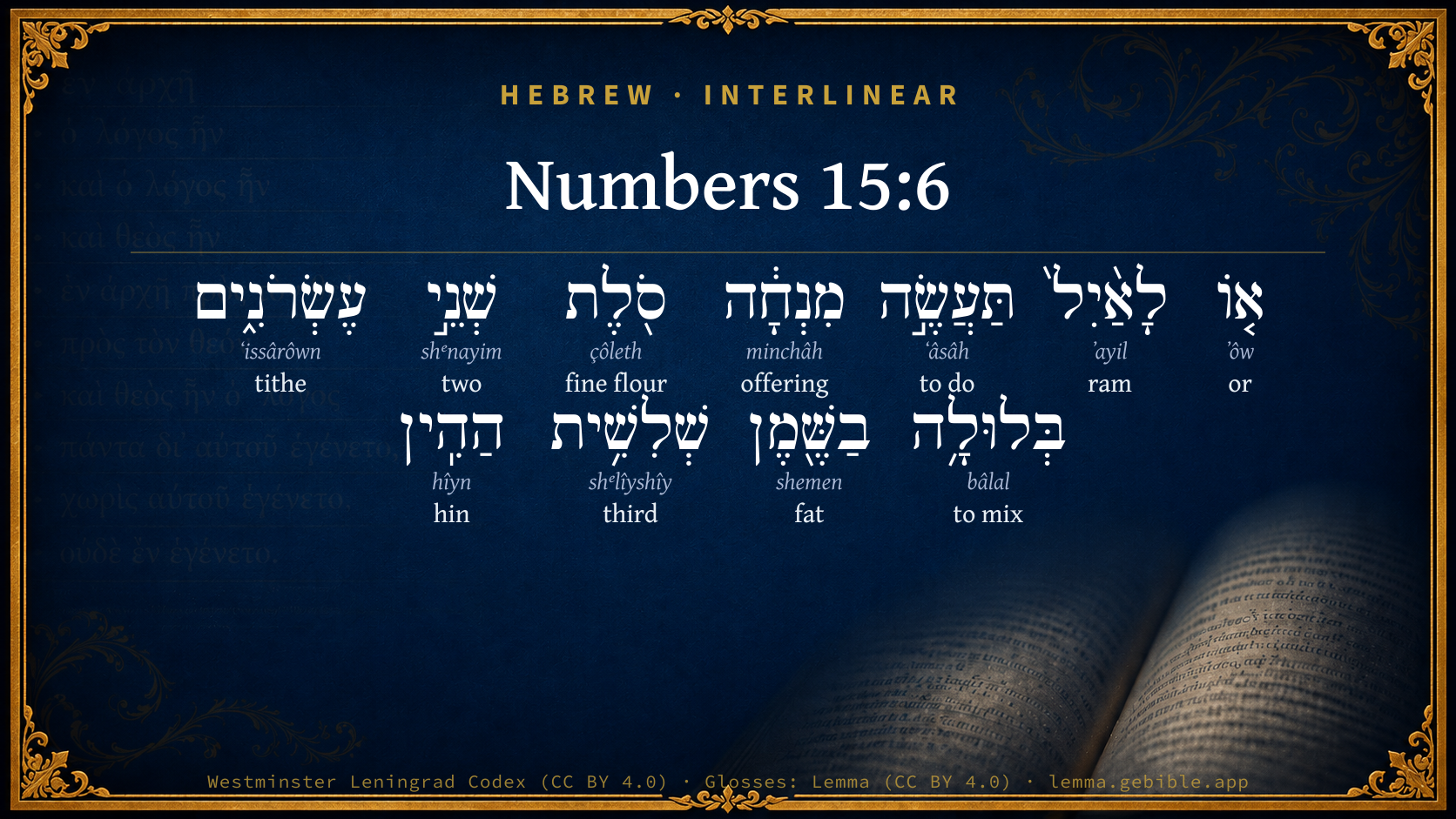
Hebrew (Westminster Leningrad Codex) Numbers 15:6 appears in the Hebrew Old Testament. The text above is from the Westminster Leningrad Codex. Each word links to its Strong’s number, a concise gloss, and parsing drawn from the Open Scriptures Hebrew Bible morphology. Click any word for its full Brown-Driver-Briggs (BDB) entry.
Download image
Cite this verse

Numbers 15:6 (World English Bible). Public Domain. Lemma interlinear Bible study tool, https://lemma.gebible.app/v/numbers/15/6.

Show BibTeX & RIS
BibTeX
RIS
English Translation
Or for a ram, you shall prepare for a meal-offering two tenth parts [of an ephah] of fine flour mixed with the third part of a hin of oil:
World English Bible · Public Domain
Download a study sheet

One document with this verse’s original text, its word-by-word gloss line, the meaning frame, cross-references with their text, attributed commentary, and full source and license credits — printable, and it pastes into notes with its structure intact.

This verse Autodidact and up

Study sheet (.html) Plain text (.txt)

A passage Seminary Student

Up to 50 verses in one chapter. A passage sheet keeps up to 6 commentary sources and 12 cross-references per verse, in the order this page ranks them, and says so on the sheet whenever that leaves anything out. Ask for a single verse and you get the Autodidact verse sheet above.

Everything on this page stays free to read, with no account — the sheet is a download of what is already on screen, not access to it.

Want to remove ads? Support Godless Engineer
Compare translations 3

The same verse in 3 English versions, stacked beneath the original-language interlinear above. Click any original word for its lexicon entry.

Each is an independent rendering of the whole verse — the interlinear is not word-aligned to these translations.

Highlighted words mark where these versions differ — a whole-verse word diff, not a word-by-word alignment.

  • World English Bible Public Domain
    Or for a ram, you shall prepare for a meal-offering two tenth parts [of an ephah] of fine flour mixed with the third part of a hin of oil:
  • King James Version Public Domain
    Or for a ram, thou shalt prepare for a meat offering two tenth deals of flour mingled with the third part of an hin of oil.
  • unfoldingWord Literal Text CC BY-SA 4.0
    Or for the ram you shall make a grain offering, two tenths of flour mixed with a third of the hin of the oil,

unfoldingWord Literal Text — © unfoldingWord, licensed CC BY-SA 4.0. Word-aligned USFM3 via Door43 (git.door43.org/unfoldingWord/en_ult).

Versions to compare (up to 4)

3 of 4 selected

Show all 18 translations

Every available English version of this verse, each an independent rendering of the whole verse.

  • World English Bible Public Domain
    Or for a ram, you shall prepare for a meal-offering two tenth parts [of an ephah] of fine flour mixed with the third part of a hin of oil:
  • Berean Standard Bible Public Domain
    With a ram you are to prepare a grain offering of two-tenths of an ephah of fine flour mixed with a third of a hin of olive oil,
  • Majority Standard Bible Public Domain
    With a ram you are to prepare a grain offering of two-tenths of an ephah of fine flour mixed with a third of a hin of olive oil,
  • King James Version Public Domain
    Or for a ram, thou shalt prepare for a meat offering two tenth deals of flour mingled with the third part of an hin of oil.
  • American Standard Version (1901) Public Domain
    Or for a ram, thou shalt prepare for a meal-offering two tenth parts `of an ephah' of fine flour mingled with the third part of a hin of oil:
  • Revised Version (1885) Public Domain
    Or for a ram, thou shalt prepare for a meal offering two tenth parts of an ephah of fine flour mingled with the third part of an hin of oil:
  • Geneva Bible (1599) Public Domain
    And for a ram, thou shalt for a meat offring, prepare two tenth deales of fine floure, mingled with the third part of an Hin of oyle.
  • Douay-Rheims (1899) Public Domain
    And for every ram there shall be a sacrifice of hour of two tenths, which shall be tempered with the third part of a hin of oil:
  • Young's Literal Translation Public Domain
    or for a ram thou dost prepare a present of flour, two-tenth deals, mixed with oil, a third of the hin;
  • Literal Standard Version CC BY-SA 4.0
    or for a ram you prepare a present of two-tenth parts of flour mixed with a third of the hin of oil;
  • Unlocked Literal Bible CC BY-SA 4.0
    If you are offering a ram, you must prepare as a grain offering two-tenths of an ephah of fine flour mixed with a third of a hin of oil.
  • unfoldingWord Literal Text CC BY-SA 4.0
    Or for the ram you shall make a grain offering, two tenths of flour mixed with a third of the hin of the oil,
  • Darby Bible Public Domain
    And for a ram thou shalt offer as oblation two tenth parts of fine flour mingled with oil, a third part of a hin,
  • World Messianic Bible Public Domain
    “‘For a ram, you shall prepare for a meal offering two tenths of an efah of fine flour mixed with the third part of a hin of oil;
  • Webster's Bible Public Domain
    Or for a ram, thou shalt prepare for a meat-offering two tenth parts of flour mingled with the third part of a hin of oil.
  • Free Bible Version CC BY-SA 4.0
    When it comes to a ram, present a grain offering of two tenths of an ephah of the best flour mixed with a third of a hin of olive oil,
  • Bible in Basic English Public Domain
    Or for a male sheep, give as a meal offering two tenth parts of a measure of the best meal mixed with a third part of a hin of oil:
  • JPS Tanakh (1917) Public Domain
    Or for a ram, thou shalt prepare for a meal-offering two tenth parts of an ephah of fine flour mingled with the third part of a hin of oil;

Literal Standard Version (2020), Covenant Press — licensed CC BY-SA 4.0. Text via the HelloAO Bible API (eBible.org). Unlocked Literal Bible (unfoldingWord) — licensed CC BY-SA 4.0. Text via the HelloAO Bible API (eBible.org). unfoldingWord Literal Text — © unfoldingWord, licensed CC BY-SA 4.0. Word-aligned USFM3 via Door43 (git.door43.org/unfoldingWord/en_ult). Free Bible Version, Dr. Jonathan Gallagher — licensed CC BY-SA 4.0. Text via the HelloAO Bible API (eBible.org).

Word by word

More ways to search: Search by grammar → Find every occurrence → Compare this word →

Practice this passage: Drill this verse → Learn its vocabulary →

הַהִֽין
hîyn
H1969
“the · hin”
Particle, Definite Article + Noun, Common, Masculine, Singular, Absolute
Part of Speech
Particle + Noun
Type
Common
Gender
Masculine
Number
Singular
State
Absolute
Full BDB Definition

Origin: probably of Egyptian origin

TWOT: 494

hin - a unit of measure, about 5 quarts (6 liters) - a vessel holding a hin of liquid
  1. א֤וֹ ʼôw H176 “or” Conjunction
  2. לָאַ֨יִל֙ ʼayil H352 “to/for the · ram” Preposition, Determined + Noun, Common, Masculine, Singular, Absolute
  3. תַּעֲשֶׂ֣ה ʻâsâh H6213 “to do” Verb, Qal, Imperfect, 2nd Person, Masculine, Singular
  4. מִנְחָ֔ה minchâh H4503 “offering” Noun, Common, Feminine, Singular, Absolute
  5. סֹ֖לֶת çôleth H5560 “fine flour” Noun, Common, Feminine, Singular, Absolute
  6. שְׁנֵ֣י shᵉnayim H8147 “two” Adjective, Cardinal number, Masculine, Dual, Construct
  7. עֶשְׂרֹנִ֑ים ʻissârôwn H6241 “tithes” Noun, Common, Masculine, Plural, Absolute
  8. בְּלוּלָ֥ה bâlal H1101 “mixed” Verb, Qal, Participle Passive, Feminine, Singular, Absolute
  9. בַשֶּׁ֖מֶן shemen H8081 “in/at the · fat” Preposition, Determined + Noun, Common, Masculine, Singular, Absolute
  10. שְׁלִשִׁ֥ית shᵉlîyshîy H7992 “third” Adjective, Ordinal number, Feminine, Singular, Absolute

About this verse

These counts appear in no published source. They are computed here, from the morphology-tagged text and Lemma’s own curated glosses. What Lemma adds →

11
words
11
distinct lemmas
Pentateuch
section

Notable vocabulary

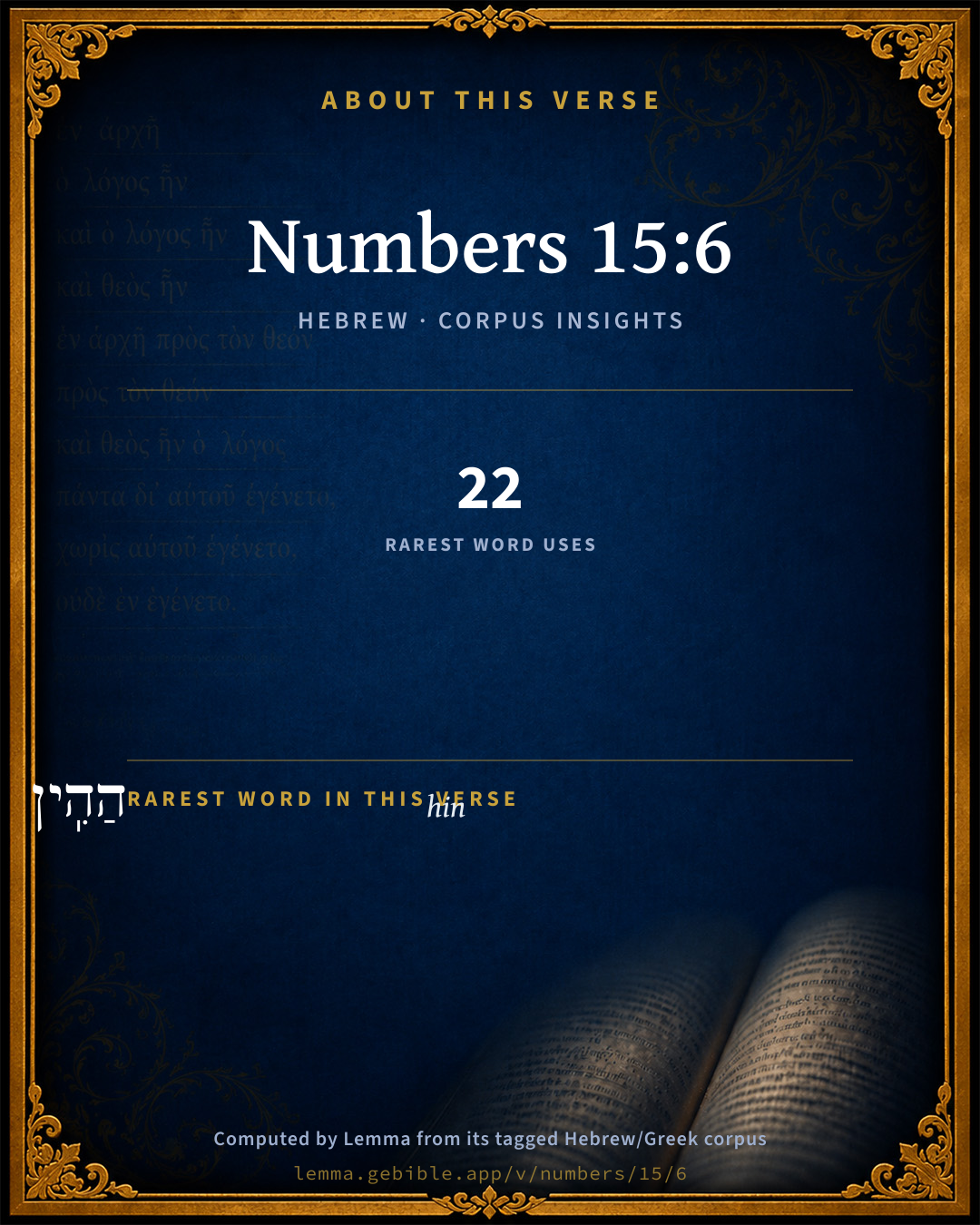
The rarest word here is הַהִֽין hin H1969 — appearing just 22 times in the whole Hebrew Bible.

Shared distinctive vocabulary

הַהִֽין hin H1969 occurs in 19 verses of the Hebrew Bible. Also found in:

Grammatical profile

  • 2 verbs
  • 6 nouns
  • 2 adjectives
  • 1 conjunction

Verb forms

  • תַּעֲשֶׂ֣ה Qal · Imperfect
  • בְּלוּלָ֥ה Qal · Participle Passive

Hebrew & Septuagint length

In English translation the verse runs 29 words from the Hebrew and 37 from the Septuagint (LXX English) — closely comparable.

A rough comparison of the two English renderings, which tokenize alike — not a word-level alignment.

Word counts can differ between the Hebrew and the Greek without any difference in meaning — e.g. the Hebrew direct-object marker אֵת has no separate Greek word, and Greek often adds the article ὁ.

Cross-references

2

Topical passages linked to Numbers 15:6 in the Treasury of Scripture Knowledge — connected by theme and wording, ordered by reader-vote popularity; previews shown in the World English Bible.

  • Numbers 28:12–14 and three tenth parts [of an ephah] of fine flour for a meal-offering, mixed with oil, for each bull; and two tenth parts of fine flour for a meal-offering, mixed with oil, for the one ram;
  • Numbers 15:4 then shall he who offers his offering offer to Yahweh a meal-offering of a tenth part [of an ephah] of fine flour mixed with the fourth part of a hin of oil:

Cross-references courtesy of OpenBible.info (CC BY 4.0).

Hebrew and Greek witnesses Masoretic Hebrew ↔ Greek Septuagint

The same verse in the two great witnesses to the Old Testament, shown verse-for-verse.

These are two independent witnesses, not word-aligned to each other, and the Septuagint is shown in lemma (dictionary) form.

Hebrew Numbers 15:6 Masoretic · Westminster Leningrad Codex

א֤וֹ לָאַ֨יִל֙ תַּעֲשֶׂ֣ה מִנְחָ֔ה סֹ֖לֶת שְׁנֵ֣י עֶשְׂרֹנִ֑ים בְּלוּלָ֥ה בַשֶּׁ֖מֶן שְׁלִשִׁ֥ית הַהִֽין

Or for a ram, you shall prepare for a meal-offering two tenth parts [of an ephah] of fine flour mixed with the third part of a hin of oil:

World English Bible · Public Domain

Greek LXX Numbers 15:6 Septuagint · lemma form

καί ὁ κριός ὅταν ποιέω αὐτός ἤ εἰς ὁλοκαύτωμα ἤ εἰς θυσία ποιέω θυσία σεμίδαλις δύο δέκατος ἀναποιέω ἐν ἔλαιον ὁ τρίτος ὁ ιν

And for a ram, when you⌃ offer it as a whole burnt offering or as a sacrifice, you shall prepare as a meat-offering two tenths of fine flour mingled with oil, the third part of a hin.

LXX2012 (modern English Septuagint) · Public Domain

Hebrew: Westminster Leningrad Codex (CC BY 4.0). Greek: Septuagint (public domain); English from LXX2012 (modern English Septuagint) (Public Domain). How the Septuagint differs from the Hebrew →

Targum (Aramaic paraphrase)

2

The Targum is the ancient Jewish Aramaic paraphrase of the Hebrew Scriptures — an interpretive translation, not the Hebrew text itself. Onkelos (literal) and Pseudo-Jonathan (expansive) render the Torah, and Jonathan the Prophets. Coverage is partial: where no permissively-licensed English translation exists for a verse, only the Aramaic is shown. This is verse-level text, not a word-by-word alignment to the Hebrew.

  1. Targum Onkelos Torah (Genesis–Deuteronomy)
    אוֹ לְדִכְרָא תַּעְבֵּד מִנְחָתָא סֻלְתָּא תְּרֵין עַשְׂרוֹנִין דְפִילָא בִמְשַׁח תַּלְתּוּת הִינָא

    (no public-domain English translation for this verse)

    Targum Onkelos — Aramaic: “Onkelos Genesis” (public domain); “Onkelos Exodus” (public domain); “Onkelos Leviticus” (public domain); “Onkelos Numbers” (public domain); “Onkelos Deuteronomy” (public domain). English: “Sefaria Community Translation” (CC0 1.0 (public-domain dedication)); “J.W. Etheridge. The Targums of Onkelos and Jonathan Ben Uzziel on the Pentateuch. London: Longmans, Green, 1862” (public domain). Text via Sefaria.

  2. Targum Pseudo-Jonathan Torah (Genesis–Deuteronomy)
    אוֹ לְדִכְרָא תַעֲבֵּיד מִנְחָתָא תְּרֵין עֶשְרוֹנִין סְמִידָא פְּתִיכָא בִּמְשַׁח זֵיתָא תַּלְתוּת הִינָא

    Or for a ram, let him perform a mincha of two tenths of flour mingled with the third of a hin of olive oil,

    Targum Pseudo-Jonathan — Aramaic: “Targum Jonathan on Genesis” (public domain); “Targum Jonathan on Exodus” (public domain); “Targum Jonathan on Leviticus” (public domain); “Targum Jonathan on Numbers” (public domain); “Targum Jonathan on Deuteronomy” (public domain). English: “The Targum of Jonathan ben Uzziel, trans. J. W. Etheridge, London, 1862” (public domain). Text via Sefaria.

Commentary

Notes on Numbers 15:6 from classic Christian and Jewish commentators (each source and its license shown beneath its notes). The classic Christian expositions comment on the surrounding passage and are grouped to its opening verse, so a note may address several verses; the Jewish commentaries on the Tanakh (Rashi and others) are per-verse, so they appear only where the commentator wrote on this verse.

Lemma curates 59 commentaries, every one of them public domain or Creative Commons licensed, each selected and text-cleaned for this edition rather than reprinted as found. About our sources →

Jamieson, Fausset & Brown

Robert Jamieson, A. R. Fausset & David Brown

two tenth deals--The quantity of flour was increased because the sacrifice was of superior value to the former. The accessory sacrifices were always increased in proportion to the greater worth and magnitude of its principal.

Jamieson, Fausset & Brown — Commentary Critical and Explanatory on the Whole Bible (1871) — public domain (CC PDM 1.0). Text via the HelloAO Bible API.

John Gill's Exposition

Or for a ram,.... Whether for a burnt offering or a peace offering; or rather and for a ram (g), as many versions:

thou shalt prepare for a meat offering two tenth deals of flour mingled with the third part of an hin of oil: which was the quantity of six quarts of fine flour, and about three pints and a quarter of a pint of oil.

(g) Vid. Nold. Concord. Ebr. part. p. 4. No. 24. so R. Jonah in Ben Melech in loc.

John Gill's Exposition of the Whole Bible (1746–1763) — public domain (CC PDM 1.0). Text via the HelloAO Bible API.

Haydock's Catholic Bible Commentary

Oil. Greater libations are required for a ram, as it is larger than the former victim, which was accompanied with only half the quantity of fine flour. (Haydock) --- Part of the wine and oil was poured on the flour, and burnt on the altar; the rest was given to the priests.

George Leo Haydock (1774–1849), Haydock's Catholic Family Bible and Commentary, 1859 edition — public domain. Excludes Psalms (Douay-Rheims chapter numbering differs from Protestant) and Deuterocanonical books (Catholic canon only).

Matthew Poole's English Annotations

Two tenth deals; because this belonged to a better sacrifice than the former; and therefore in the next sacrfice of a bullock there are three tenth deals. So the accessory sacrifice grows proportionably with the principal.

Matthew Poole's English Annotations on the Holy Bible (1683–1685) — public domain. Text from a community e-Sword/MySword module.

The Pulpit Commentary

Or for a ram. The meat and drink offerings were to be proportionate in amount to the size of the victim.

The Pulpit Commentary (1880–1919), ed. H.D.M. Spence-Jones & Joseph S. Exell — public domain. Text from a community e-Sword module.

John Wesley's Explanatory Notes

Two tenth-deals - Because this belonged to a better sacrifice than the former; and therefore in the next sacrifice of a bullock, there are three tenth deals. So the accessory sacrifice grows proportionably with the principal.

John Wesley, Explanatory Notes Upon the Whole Bible (1754–1765) — public domain. Text via the GEBible commentary corpus.

unfoldingWord translationNotes

Door43 World Missions Community

two-tenths of an ephah

An ephah is a unit of volume equal to about 22 liters. AT: "4 liters" or "four and a half liters" (See: Biblical Volume)

a third of a hin

A hin is a unit of volume equal to about 3.7 liters. AT: "one liter" (See: Biblical Volume)

It will produce a sweet aroma for Yahweh

"It will produce a smell that pleases Yahweh." The Lord's pleasure with the aroma represents his pleasure with the person who burns the offering. AT: "You will please Yahweh by offering it" (See: Metaphor)

translationWords

ewe

unfoldingWord translationNotes — © Distant Shores Media and the Door43 World Missions Community, licensed CC BY-SA 4.0. Source: git.door43.org/Door43/en_tn.

Rashi

Rabbi Shlomo Yitzchaki (Rashi)

או לאיל OR FOR A RAM [THOU SHALT PREPARE etc.] — This means: and if it be a ram [thou shalt prepare, etc.]”. Our Rabbis, however, have interpreted the word "או," “or”, as being intended to bring also the פלגס (a lamb beyond the age of a כבש and below that of an איל) under the law of the drink-offerings prescribed for a ram (i.e. that the animal in its intermediate age is regarded as full grown as regards the נסכים) (Chullin 23a; Menachot 91b).

Rashi on the Tanakh — English translations: “The Judaica Press complete Tanach with Rashi, translated by A. J. Rosenberg” (CC BY 4.0); “Pentateuch with Rashi's commentary by M. Rosenbaum and A.M. Silbermann, 1929-1934” (public domain); “The Metsudah Tanach series, Lakewood, N.J” (CC BY 4.0); and “The Book of Joshua, Metsudah Publications, 1997” (CC BY 4.0). Text via Sefaria.

Lesson kit

Teaching starters — assembled from the data on this page, not authored interpretation. Every prompt links to the verse data it draws on. Edit before teaching.

Numbers, in the Pentateuch, opens this verse with 11 words (11 distinct Hebrew lemmas). Its most distinctive word is hîyn (“hin”). A historical commentator’s framing appears above. Read the whole chapter for the surrounding context.

Discussion questions

  1. The word hîyn carries the sense “hin.” How does it shape the verse?
  2. Exodus 29:40 shares the word «hin» with this verse. How do the two illuminate each other?
  3. The translations on this page render this verse differently — a whole-verse word diff, not a word-by-word alignment. What might account for the different wordings?
  4. The verb «תַּעֲשֶׂ֣ה» is Qal Imperfect. How does its form color the action?
  5. Reading how Jamieson, Fausset & Brown and John Gill's Exposition read this verse, where do the two commentators agree and where do they part?

Things to notice

Reading settings

Reading text

Shown beneath each verse's original-language words.

Old Testament
Old Testament edition

Read the OT as the Masoretic Hebrew (MT) or the Greek Septuagint (LXX).

English shown for the Greek Septuagint (in the Hebrew ↔ Greek comparison).

Comparing translations? Open the Compare panel on any verse page to stack up to four side by side.