
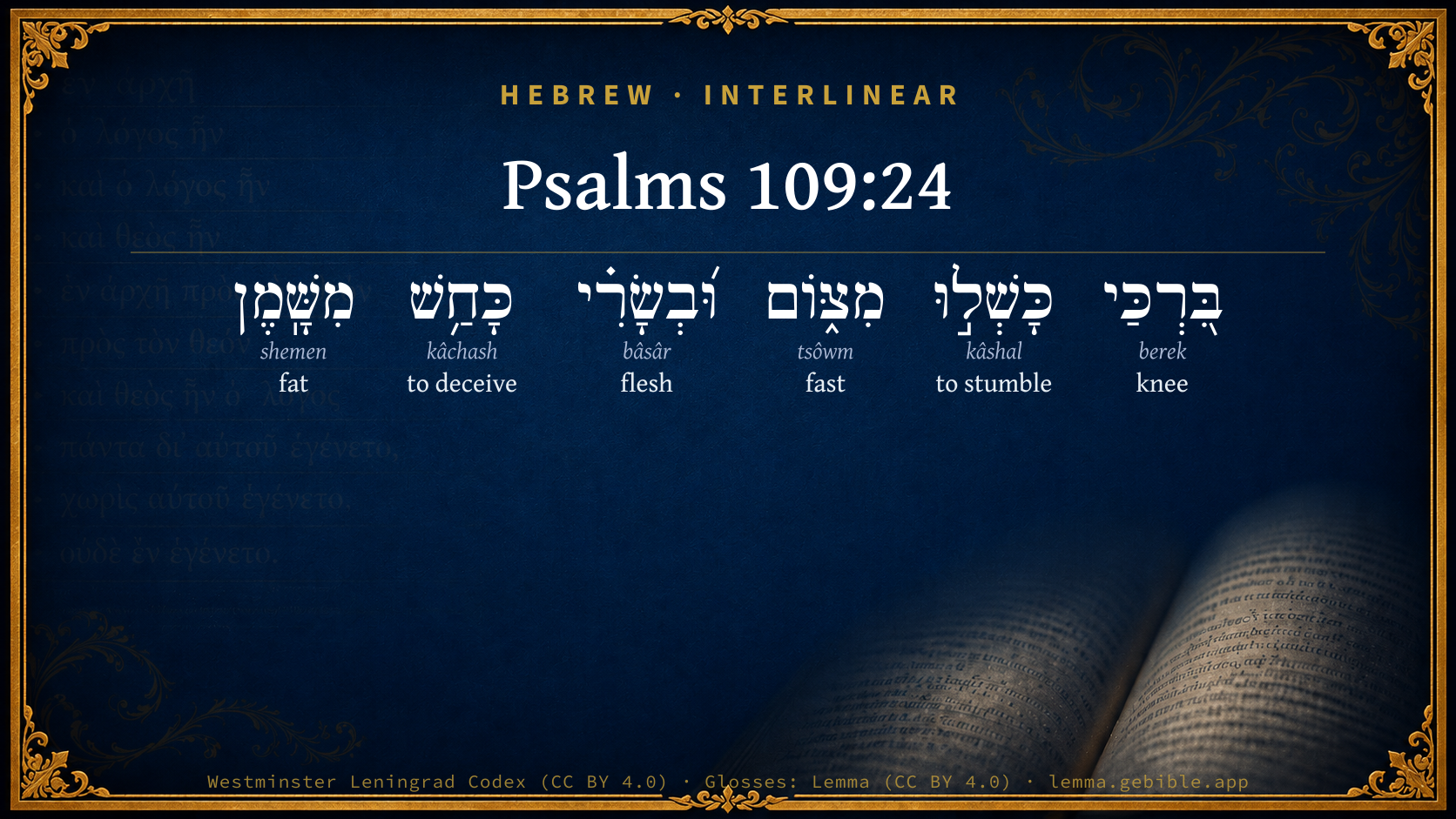
Psalms 109:24

Hebrew (Westminster Leningrad Codex) Psalms 109:24 appears in the Hebrew Old Testament. The text above is from the Westminster Leningrad Codex. Each word links to its Strong’s number, a concise gloss, and parsing drawn from the Open Scriptures Hebrew Bible morphology. Click any word for its full Brown-Driver-Briggs (BDB) entry.
Download image
Cite this verse

Psalms 109:24 (World English Bible). Public Domain. Lemma interlinear Bible study tool, https://lemma.gebible.app/v/psalms/109/24.

Show BibTeX & RIS
BibTeX
RIS
English Translation
My knees are weak through fasting. My body is thin and lacks fat.
World English Bible · Public Domain
Download a study sheet

One document with this verse’s original text, its word-by-word gloss line, the meaning frame, cross-references with their text, attributed commentary, and full source and license credits — printable, and it pastes into notes with its structure intact.

This verse Autodidact and up

Study sheet (.html) Plain text (.txt)

A passage Seminary Student

Up to 50 verses in one chapter. A passage sheet keeps up to 6 commentary sources and 12 cross-references per verse, in the order this page ranks them, and says so on the sheet whenever that leaves anything out. Ask for a single verse and you get the Autodidact verse sheet above.

Everything on this page stays free to read, with no account — the sheet is a download of what is already on screen, not access to it.

Want to remove ads? Support Godless Engineer
Compare translations 3

The same verse in 3 English versions, stacked beneath the original-language interlinear above. Click any original word for its lexicon entry.

Each is an independent rendering of the whole verse — the interlinear is not word-aligned to these translations.

Highlighted words mark where these versions differ — a whole-verse word diff, not a word-by-word alignment.

  • World English Bible Public Domain
    My knees are weak through fasting. My body is thin and lacks fat.
  • King James Version Public Domain
    My knees are weak through fasting; and my flesh faileth of fatness.
  • unfoldingWord Literal Text CC BY-SA 4.0
    My knees are weak from fasting and my flesh is gaunt from fatness.

unfoldingWord Literal Text — © unfoldingWord, licensed CC BY-SA 4.0. Word-aligned USFM3 via Door43 (git.door43.org/unfoldingWord/en_ult).

Versions to compare (up to 4)

3 of 4 selected

Show all 18 translations

Every available English version of this verse, each an independent rendering of the whole verse.

  • World English Bible Public Domain
    My knees are weak through fasting. My body is thin and lacks fat.
  • Berean Standard Bible Public Domain
    My knees are weak from fasting, and my body grows lean and gaunt.
  • Majority Standard Bible Public Domain
    My knees are weak from fasting, and my body grows lean and gaunt.
  • King James Version Public Domain
    My knees are weak through fasting; and my flesh faileth of fatness.
  • American Standard Version (1901) Public Domain
    My knees are weak through fasting; And my flesh faileth of fatness.
  • Revised Version (1885) Public Domain
    My knees are weak through fasting; and my flesh faileth of fatness.
  • Geneva Bible (1599) Public Domain
    My knees are weake through fasting, and my flesh hath lost all fatnes.
  • Douay-Rheims (1899) Public Domain
    My knees are weakened through fasting: and my flesh is changed for oil.
  • Young's Literal Translation Public Domain
    My knees have been feeble from fasting, And my flesh hath failed of fatness.
  • Literal Standard Version CC BY-SA 4.0
    My knees have been feeble from fasting, || And my flesh has failed of fatness.
  • Unlocked Literal Bible CC BY-SA 4.0
    My knees are weak from fasting; I am turning to skin and bones.
  • unfoldingWord Literal Text CC BY-SA 4.0
    My knees are weak from fasting and my flesh is gaunt from fatness.
  • Darby Bible Public Domain
    My knees are failing through fasting, and my flesh hath lost its fatness;
  • World Messianic Bible Public Domain
    My knees are weak through fasting. My body is thin and lacks fat.
  • Webster's Bible Public Domain
    My knees are weak through fasting; and my flesh faileth of fatness.
  • Free Bible Version CC BY-SA 4.0
    I am so weak from lack of food that my legs give way; my body is just skin and bones.
  • Bible in Basic English Public Domain
    My knees are feeble for need of food; there is no fat on my bones.
  • JPS Tanakh (1917) Public Domain
    My knees totter through fasting; and my flesh is lean, and hath no fatness.

Literal Standard Version (2020), Covenant Press — licensed CC BY-SA 4.0. Text via the HelloAO Bible API (eBible.org). Unlocked Literal Bible (unfoldingWord) — licensed CC BY-SA 4.0. Text via the HelloAO Bible API (eBible.org). unfoldingWord Literal Text — © unfoldingWord, licensed CC BY-SA 4.0. Word-aligned USFM3 via Door43 (git.door43.org/unfoldingWord/en_ult). Free Bible Version, Dr. Jonathan Gallagher — licensed CC BY-SA 4.0. Text via the HelloAO Bible API (eBible.org).

Word by word

More ways to search: Search by grammar → Find every occurrence → Compare this word →

Practice this passage: Drill this verse → Learn its vocabulary →

כָּחַ֥שׁ
kâchash
H3584
“to deceive”
Verb, Qal, Perfect, 3rd Person, Masculine, Singular
Part of Speech
Verb
Stem
Qal
Form
Perfect
Person
3rd Person
Gender
Masculine
Number
Singular
Full BDB Definition

Origin: a primitive root

TWOT: 975

to deceive, lie, fail, grow lean, be disappointing, be untrue, be insufficient, be found liars, belie, deny, dissemble, deal falsely - (Qal) to become lean - (Niphal) to cringe, feign obedience - (Piel) - to deceive, deny falsely - to act deceptively - to cringe - to disappoint, fail - (Hithpael) to cringe, feign obedience
  1. בִּ֭רְכַּי berek H1290 “knees · my” Noun, Common, Feminine, Dual, Construct + Suffix, Personal, 1st Person, Common, Singular
  2. כָּשְׁל֣וּ kâshal H3782 “to stumble” Verb, Qal, Perfect, 3rd Person, Common, Plural
  3. מִצּ֑וֹם tsôwm H6685 “from · fast” Preposition + Noun, Common, Masculine, Singular, Absolute
  4. וּ֝בְשָׂרִ֗י bâsâr H1320 “and · flesh · my” Conjunction + Noun, Common, Masculine, Singular, Construct + Suffix, Personal, 1st Person, Common, Singular
  5. מִשָּֽׁמֶן shemen H8081 “from · fat” Preposition + Noun, Common, Masculine, Singular, Absolute

About this verse

These counts appear in no published source. They are computed here, from the morphology-tagged text and Lemma’s own curated glosses. What Lemma adds →

6
words
6
distinct lemmas
Wisdom
section

Notable vocabulary

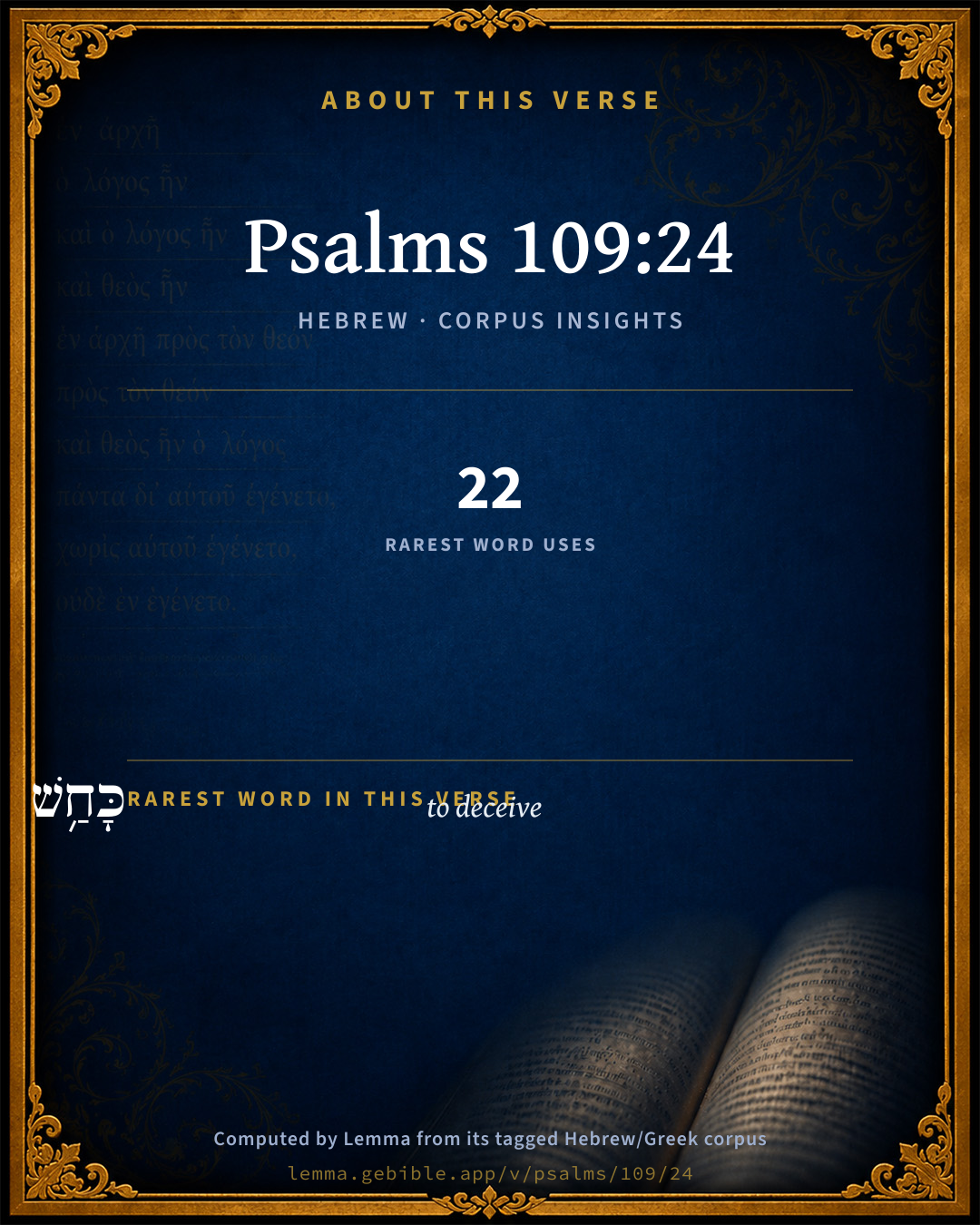
The rarest word here is כָּחַ֥שׁ to deceive H3584 — appearing just 22 times in the whole Hebrew Bible.

Shared distinctive vocabulary

כָּחַ֥שׁ to deceive H3584 occurs in 22 verses of the Hebrew Bible. Also found in:

Grammatical profile

  • 2 verbs
  • 4 nouns

Verb forms

  • כָּשְׁל֣וּ Qal · Perfect
  • כָּחַ֥שׁ Qal · Perfect

Hebrew & Septuagint length

In English translation the verse runs 13 words from the Hebrew and 18 from the Septuagint (LXX English) — closely comparable.

A rough comparison of the two English renderings, which tokenize alike — not a word-level alignment.

Word counts can differ between the Hebrew and the Greek without any difference in meaning — e.g. the Hebrew direct-object marker אֵת has no separate Greek word, and Greek often adds the article ὁ.

Cross-references

10

Topical passages linked to Psalms 109:24 in the Treasury of Scripture Knowledge — connected by theme and wording, ordered by reader-vote popularity; previews shown in the World English Bible.

  • Psalms 22:14 I am poured out like water. All my bones are out of joint. My heart is like wax; It is melted within me.
  • Psalms 32:3–4 When I kept silence, my bones wasted away through my groaning all day long.
  • Matthew 4:2 When he had fasted forty days and forty nights, he was hungry afterward.
  • Hebrews 12:12 Therefore, lift up the hands that hang down and the feeble knees,
  • Job 19:20 My bones stick to my skin and to my flesh. I have escaped by the skin of my teeth.
  • Psalms 35:13–14 But as for me, when they were sick, my clothing was sackcloth. I afflicted my soul with fasting. My prayer returned into my own bosom.
  • Psalms 38:5–8 My wounds are loathsome and corrupt, Because of my foolishness.
  • Psalms 69:10 When I wept and I fasted, That was to my reproach.
  • Psalms 102:4–5 My heart is blighted like grass, and withered, For I forget to eat my bread.
  • 2 Corinthians 11:27 in labor and travail, in watchings often, in hunger and thirst, in fastings often, and in cold and nakedness.

Cross-references courtesy of OpenBible.info (CC BY 4.0).

Hebrew and Greek witnesses Masoretic Hebrew ↔ Greek Septuagint

The same verse in the two great witnesses to the Old Testament, shown verse-for-verse.

You’re reading Greek Psalm 108 (Hebrew Psalm 109). The Septuagint counts the superscription, so verse numbers can differ from the Hebrew — chapter-level alignment, not verse-by-verse. Numbering follows Rahlfs.

These are two independent witnesses, not word-aligned to each other, and the Septuagint is shown in lemma (dictionary) form.

Hebrew Psalms 109:24 Masoretic · Westminster Leningrad Codex

בִּ֭רְכַּי כָּשְׁל֣וּ מִצּ֑וֹם וּ֝בְשָׂרִ֗י כָּחַ֥שׁ מִשָּֽׁמֶן

My knees are weak through fasting. My body is thin and lacks fat.

World English Bible · Public Domain

Greek LXX Greek Psalm 108:24 Septuagint · lemma form

ὁ γόνυ ἐγώ ἀσθενέω ἀπό νηστεία καί ὁ σάρξ ἐγώ ἀλλοιόω διά ἔλιον

My knees are weakened through fasting, and my flesh is changed by reason of the lack of oil.

LXX2012 (modern English Septuagint) · Public Domain

Hebrew: Westminster Leningrad Codex (CC BY 4.0). Greek: Septuagint (public domain); English from LXX2012 (modern English Septuagint) (Public Domain). How the Septuagint differs from the Hebrew →

Commentary

Notes on Psalms 109:24 from classic Christian and Jewish commentators (each source and its license shown beneath its notes). The classic Christian expositions comment on the surrounding passage and are grouped to its opening verse, so a note may address several verses; the Jewish commentaries on the Tanakh (Rashi and others) are per-verse, so they appear only where the commentator wrote on this verse.

Lemma curates 59 commentaries, every one of them public domain or Creative Commons licensed, each selected and text-cleaned for this edition rather than reprinted as found. About our sources →

Trapp's Complete Commentary

John Trapp

Psa 109:24 My knees are weak through fasting; and my flesh faileth of fatness.

Ver. 24. My knees are weak through fasting] Either for lack of meat or stomach to it; genua labant, my knees buckle under me, the strong men bow themselves, Ecc 12:3.

My flesh faileth of fatness] I am lean and low brought. Christ might well cry out, "My leanness, my leanness"; so busy he was for his Father, and so worn out, that they judged him well nigh fifty, when he was not much over thirty, Joh 8:57.

John Trapp, A Commentary or Exposition upon All the Books of the Old and New Testament (1647–1656) — public domain. Text from a community e-Sword module.

Joseph Benson's Commentary

Psa 109:24-25. My knees are weak through fasting — Either through forced fasting for want of food, when he was persecuted, or for want of appetite when he was sick, or through voluntary fasting, which the frequency and long continuance of his sufferings induced him to use. I became also a reproach unto them — Instead of that pity, which either religion or humanity should have taught them to exercise toward a person in extreme misery, they loaded me with reproaches and scorns. They shaked their heads — By way of contempt and derision. In all this David was a type of Christ, who, in his humiliation, was thus wounded, thus weakened, thus reproached, and at whom they thus shook their heads, saying, Thou that destroyest the temple, and buildest it in three days, save thyself. He was also a type of the church, which is often afflicted, tossed with tempests, and not comforted.

Joseph Benson's Commentary on the Old and New Testaments (1811–1818) — public domain. Text from a community e-Sword module.

Geneva Bible (1599)

Geneva Bible translators

For hunger, that came of sorrow, he was lean, and his natural moisture failed him.

Geneva Bible (1599) marginal notes — public domain. Text via Bolls.life.

Adam Clarke's Commentary

Verse 24. My knees are weak through fasting] That hunger is as soon felt in weakening the knees, as in producing an uneasy sensation in the stomach, is known by all who have ever felt it. Writers in all countries have referred to this effect of hunger. Thus Tryphioderus Il. Excid. ver 155: -

Τειρομενου βαρυθειεν ατερπεΐ γουνατα λιμῳ.

"Their knees might fail, by hunger's force subdued;

And sink, unable to sustain their load."

MERRICK.

SO PLAUTUS, Curcul, act. ii., scen. 3: -

Tenebrae oboriuntur, genua inedia succidunt.

"My eyes grow dim; my knees are weak with hunger."

And LUCRETIUS, lib. iv. ver. 950: -

Brachia, palpebraeque cadunt, poplitesque procumbunt.

"The arms, the eyelids fall; the knees give way." Both the knees and the sight are particularly affected by hunger.

Adam Clarke's Commentary on the Bible (1810–1826) — public domain. Text from a community e-Sword/MySword module.

John Calvin's Commentaries

24 My knees are become feeble. Though David had the necessaries of life, yet he emaciated himself by voluntary abstinence, to which, as well as to prayer, he gave himself, and therefore we may regard this verse as expressive of his sorrow and sadness. We may also understand it as expressive of his having no relish for meat or drink, knowing, as we do, that persons who are in sorrow and sadness have no appetite for food; even life itself is burdensome to them. Should any one prefer restricting the interpretation to David’s being in want of the necessaries of life, when he hid himself in the dens of wild beasts, to escape the fury of his enemies, and was then subjected to hunger and thirst, he may do so. It appears to me, however, that by this language he intends to point out the extreme anguish which he felt, because, with death staring him in the face, he loathed all food; and this is in accordance with the next clause, in which he says, my flesh faileth of fatness; because “a sorrowful spirit drieth up the bones,” (Proverbs 17:22) By the term, fatness, some understand delicacies; meaning that he was deprived of all that food which is pleasing to the palate. The more natural way is to consider it as denoting his becoming emaciated by reason of grief and fasting, inasmuch as the natural moisture was wasted. Another proof of his sad situation arises from this, that, according to what he states in Psalm 22:7, he was held in scorn by all. It is, indeed, a sad and bitter thing which God’s children endure, when they are made to feel that the curse which he denounces against the transgressors of his law is directed against themselves; for the law says to the despisers of it,

“Thou shalt become an astonishment, a proverb, and laughing-stock,” (Deuteronomy 28:37)

With this species of temptation David was assailed; and he declares that he was not only regarded as a condemned person, but also cruelly derided; God at the same time coming in for a share of it; for it is usual with the ungodly to conduct themselves with insolence and pride towards us when they see us oppressed under afflictions, and, at the same time, to rail at our faith and piety, because God renders us no help in our miseries.

John Calvin's Commentaries (1540-1563) — public domain. Text from the Calvin Translation Society English edition (1840s-50s) via the Christian Classics Ethereal Library (ccel.org). Calvin's coverage is partial (roughly two-thirds of the Bible); uncommented books and verses are honest gaps, never fabricated. The 19th-century editor's footnotes and remarks are omitted so the notes are faithfully Calvin's own voice.

Ellicott's Commentary for English Readers

(24) Faileth of fatness.—Literally, has failed me from fat, i.e., has dwindled away.

A Bible Commentary for English Readers, edited by Charles John Ellicott (1878–1897) — public domain. Text from a community e-Sword module.

The Cambridge Bible for Schools and Colleges

gen. ed. J. J. S. Perowne

24. faileth of fatness] Hath grown lean and lost fatness may be the meaning. But more probably, is shrunken for want of oil. In his distress he had no appetite for food (Psa_102:4), and like a mourner (2Sa_14:2) abstained from the use of oil.

The Cambridge Bible for Schools and Colleges (gen. ed. J. J. S. Perowne; Cambridge University Press, 1878–1918) — public domain. Text from a community e-Sword module.

John Gill's Exposition

I became also a reproach unto them,.... Or they reproached him; not only in life, traducing his conversation, blaspheming his miracles, calling him a Samaritan, saying he had a devil, and charging him with sedition; but at the time of his death they reviled him, and treated him in the most opprobrious manner.

When they looked upon me, they shaked their heads; which was verified in the Jews as they passed by the cross of Christ, whither they came to stare upon him and scoff at him, Mat 27:39.

John Gill's Exposition of the Whole Bible (1746–1763) — public domain (CC PDM 1.0). Text via the HelloAO Bible API.

Albert Barnes' Notes on the Bible

My knees are weak through fasting - Hunger; want of food. Strength to stand is connected with firmness in the knee-joints, and hence, weakness and feebleness are denoted by the giving way of the knees. Compare Heb 12:12.

And my flesh faileth of fatness - I am lean and weak. There is not the proper supply for my strength. The idea seems to have been that fatness (Hebrew, oil) was necessary to strength.

Albert Barnes' Notes on the Bible (1834–1885) — public domain. Text from a community e-Sword/MySword module.

Matthew Poole's English Annotations

Through fasting; either with voluntary fasts, to which the frequency and long continuance of my calamities obliged me; or with forced fasts, sometimes through want of necessary provisions, but most commonly from that loathing of meat, which was occasioned by his excessive sorrows and terrors. See Poole "Psa 58:8".

Of fatness; or, for want of fatness. See the like Hebrew phrases Gen 18:26; Jer 48:45; Lam 4:9.

Matthew Poole's English Annotations on the Holy Bible (1683–1685) — public domain. Text from a community e-Sword/MySword module.

The Treasury of David

Charles H. Spurgeon

Ver. 24. My knees are weak through fasting; either religious fasting, to which he resorted in the dire extremity of his grief, or else through loss of appetite occasioned by distress of mind. Who can eat when every morsel is soured by envy? This is the advantage of the slanderer, that he feels nothing himself, while his sensitive victim can scarcely eat a morsel of bread because of his sensitiveness. However, the good God knoweth all this, and will succour his afflicted. The Lord who bids us confirm the feeble knees will assuredly do it himself. "And my flesh faileth of fatness." He was wasted to a skeleton, and as his body was emaciated, so was his soul bereft of comfort: he was pining away, and all the while his enemies saw it and laughed at his distress. How pathetically he states his case; this is one of the truest forms of prayer, the setting forth of our sorrow before the Lord. Weak knees are strong with God, and failing flesh has great power in pleading.

Psalms 109:25*

Charles H. Spurgeon's The Treasury of David (1869–1885) — public domain. Psalms only. Text from a community e-Sword/MySword module.

Whedon's Commentary on the Bible

Daniel D. Whedon

24. Fasting— “The word is never used of that want of eating which proceeds from want of appetite, but always of the exercise of penitence, as practised by men when overwhelmed, or when threatened, with severe suffering.”—Hengstenberg.

Daniel D. Whedon (gen. ed.), Commentary on the Old and New Testaments (1874–1909) — public domain. Text from a community e-Sword module.

The Pulpit Commentary

My knees are weak through fasting. I have brought myself down to extreme weakness by penitential fasting for my sins. (comp. Psa_35:13 Psa_69:10) And my flesh faileth of fatness; literally, of oil. In my state of mourning and penitence I have abstained from anointing myself, (2Sa_14:2) which has still further weakened me.

The Pulpit Commentary (1880–1919), ed. H.D.M. Spence-Jones & Joseph S. Exell — public domain. Text from a community e-Sword module.

unfoldingWord translationNotes

Door43 World Missions Community

My knees are weak

This means that he is weak and it is difficult for him to stand. AT: "I have difficulty standing" or "My body is weak" (See: Assumed Knowledge and Implicit Information)

from fasting

"because I am not eating any food"

I am turning to skin and bones

This means that he has lost a lot of weight. AT: "my body has become very thin" (See: Idiom)

I am disdained by my accusers

This can be stated in active form. AT: "My accusers ridicule me" (See: Active or Passive)

shake their heads

This is an act of disapproval.

translationWords

fast

accuse

unfoldingWord translationNotes — © Distant Shores Media and the Door43 World Missions Community, licensed CC BY-SA 4.0. Source: git.door43.org/Door43/en_tn.

Lesson kit

Teaching starters — assembled from the data on this page, not authored interpretation. Every prompt links to the verse data it draws on. Edit before teaching.

Psalms, in the Wisdom, opens this verse with 6 words (6 distinct Hebrew lemmas). Its most distinctive word is kâchash (“to deceive”). A historical commentator’s framing appears above. Read the whole chapter for the surrounding context.

Discussion questions

  1. How does “to deceive” (kâchash) shape what this verse is saying?
  2. Genesis 18:15 shares the word «to deceive» with this verse. How do the two illuminate each other?
  3. These translations render this verse differently. What is at stake in choosing one wording over another?
  4. The verb «כָּשְׁל֣וּ» is Qal Perfect. How does its form color the action?
  5. Reading how Trapp's Complete Commentary and Joseph Benson's Commentary read this verse, where do the two commentators agree and where do they part?

Things to notice

Reading settings

Reading text

Shown beneath each verse's original-language words.

Old Testament
Old Testament edition

Read the OT as the Masoretic Hebrew (MT) or the Greek Septuagint (LXX).

English shown for the Greek Septuagint (in the Hebrew ↔ Greek comparison).

Comparing translations? Open the Compare panel on any verse page to stack up to four side by side.