
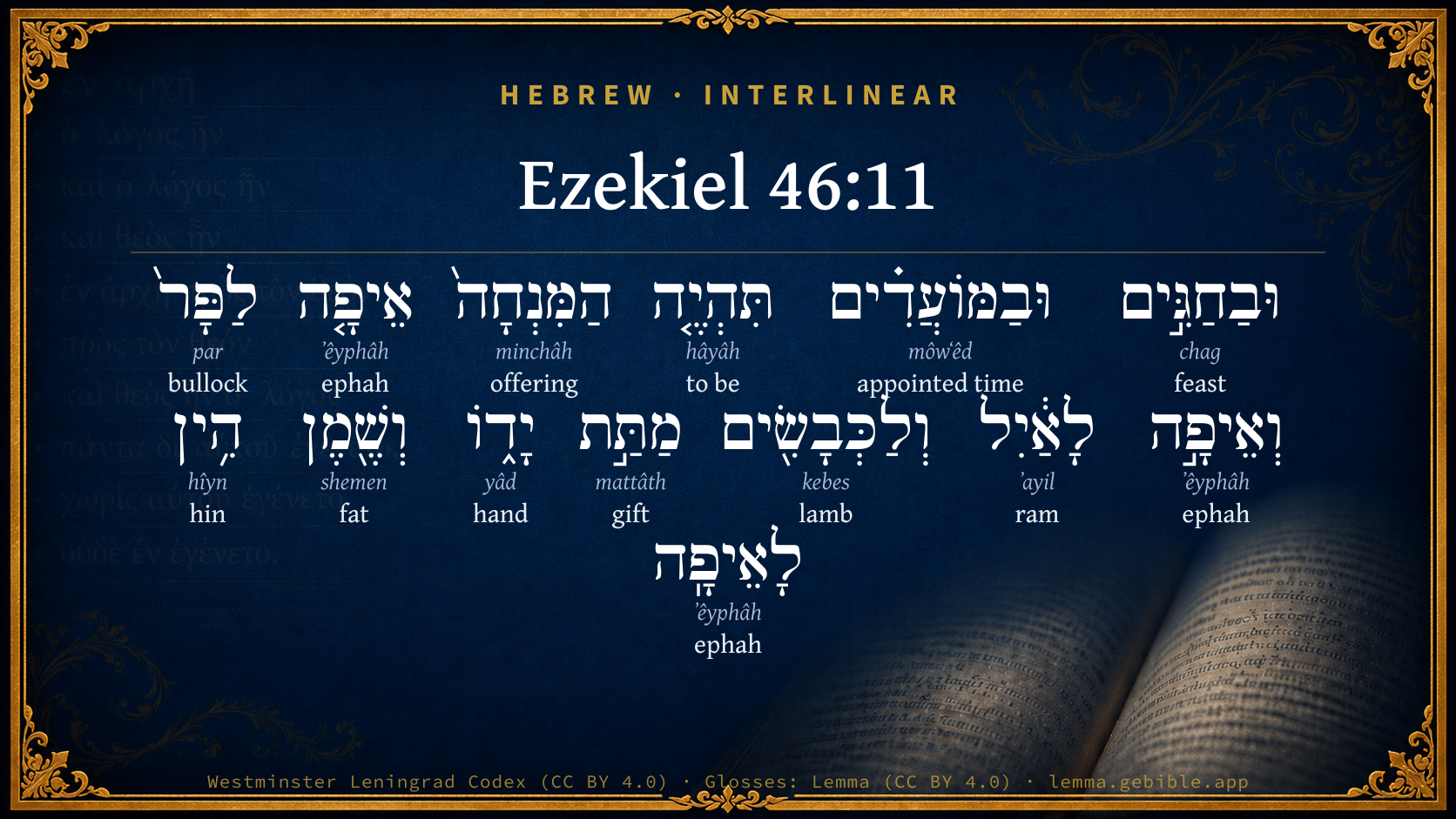
Ezekiel 46:11

Hebrew (Westminster Leningrad Codex) Ezekiel 46:11 appears in the Hebrew Old Testament. The text above is from the Westminster Leningrad Codex. Each word links to its Strong’s number, a concise gloss, and parsing drawn from the Open Scriptures Hebrew Bible morphology. Click any word for its full Brown-Driver-Briggs (BDB) entry.
Download image
Cite this verse

Ezekiel 46:11 (World English Bible). Public Domain. Lemma interlinear Bible study tool, https://lemma.gebible.app/v/ezekiel/46/11.

Show BibTeX & RIS
BibTeX
RIS
English Translation
In the feasts and in the solemnities the meal-offering shall be an ephah for a bull, and an ephah for a ram, and for the lambs as he is able to give, and a hin of oil to an ephah.
World English Bible · Public Domain
Download a study sheet

One document with this verse’s original text, its word-by-word gloss line, the meaning frame, cross-references with their text, attributed commentary, and full source and license credits — printable, and it pastes into notes with its structure intact.

This verse Autodidact and up

Study sheet (.html) Plain text (.txt)

A passage Seminary Student

Up to 50 verses in one chapter. A passage sheet keeps up to 6 commentary sources and 12 cross-references per verse, in the order this page ranks them, and says so on the sheet whenever that leaves anything out. Ask for a single verse and you get the Autodidact verse sheet above.

Everything on this page stays free to read, with no account — the sheet is a download of what is already on screen, not access to it.

Want to remove ads? Support Godless Engineer
Compare translations 3

The same verse in 3 English versions, stacked beneath the original-language interlinear above. Click any original word for its lexicon entry.

Each is an independent rendering of the whole verse — the interlinear is not word-aligned to these translations.

Highlighted words mark where these versions differ — a whole-verse word diff, not a word-by-word alignment.

  • World English Bible Public Domain
    In the feasts and in the solemnities the meal-offering shall be an ephah for a bull, and an ephah for a ram, and for the lambs as he is able to give, and a hin of oil to an ephah.
  • King James Version Public Domain
    And in the feasts and in the solemnities the meat offering shall be an ephah to a bullock, and an ephah to a ram, and to the lambs as he is able to give, and an hin of oil to an ephah.
  • unfoldingWord Literal Text CC BY-SA 4.0
    At the festivals, the grain offering must be an ephah of grain for the bull and an ephah for the ram, and whatever he wishes to give with the lambs, and a hin of oil for every ephah.

unfoldingWord Literal Text — © unfoldingWord, licensed CC BY-SA 4.0. Word-aligned USFM3 via Door43 (git.door43.org/unfoldingWord/en_ult).

Versions to compare (up to 4)

3 of 4 selected

Show all 18 translations

Every available English version of this verse, each an independent rendering of the whole verse.

  • World English Bible Public Domain
    In the feasts and in the solemnities the meal-offering shall be an ephah for a bull, and an ephah for a ram, and for the lambs as he is able to give, and a hin of oil to an ephah.
  • Berean Standard Bible Public Domain
    At the festivals and appointed feasts, the grain offering shall be an ephah with a bull, an ephah with a ram, and as much as one is able to give with the lambs, along with a hin of oil per ephah.
  • Majority Standard Bible Public Domain
    At the festivals and appointed feasts, the grain offering shall be an ephah with a bull, an ephah with a ram, and as much as one is able to give with the lambs, along with a hin of oil per ephah.
  • King James Version Public Domain
    And in the feasts and in the solemnities the meat offering shall be an ephah to a bullock, and an ephah to a ram, and to the lambs as he is able to give, and an hin of oil to an ephah.
  • American Standard Version (1901) Public Domain
    And in the feasts and in the solemnities the meal-offering shall be an ephah for a bullock, and an ephah for a ram, and for the lambs as he is able to give, and a hin of oil to an ephah.
  • Revised Version (1885) Public Domain
    And in the feasts and in the solemnities the meal offering shall be an ephah for a bullock, and an ephah for a ram, and for the lambs as he is able to give, and an hin of oil to an ephah.
  • Geneva Bible (1599) Public Domain
    And in the feastes, and in the solemnities the meat offring shalbe an Ephah to a bullocke, and an Ephah to a ram, and to the lambes, the gift of his hand, and an Hin of oyle to an Ephah.
  • Douay-Rheims (1899) Public Domain
    And in the fairs, and in the solemnities there shall be the sacrifice of an ephi to a calf, and an ephi to a ram: and to the lambs, the sacrifice shall be as his hand shall find: and a hin of oil to every ephi.
  • Young's Literal Translation Public Domain
    `And in feasts, and in appointed times, the present is an ephah for a bullock, and an ephah for a ram, and for lambs the gift of his hand, and of oil a hin for an ephah.
  • Literal Standard Version CC BY-SA 4.0
    And in celebrations, and in appointed times, the present is an ephah for a bullock, and an ephah for a ram, and for lambs the gift of his hand, and a hin of oil for an ephah.
  • Unlocked Literal Bible CC BY-SA 4.0
    At the festivals, the grain offering must be an ephah of grain for the bull and an ephah for the ram, and whatever he wishes to give with the lambs, and a hin of oil for every ephah.
  • unfoldingWord Literal Text CC BY-SA 4.0
    At the festivals, the grain offering must be an ephah of grain for the bull and an ephah for the ram, and whatever he wishes to give with the lambs, and a hin of oil for every ephah.
  • Darby Bible Public Domain
    And on the feast-days, and in the solemnities, the oblation shall be an ephah for a bullock and an ephah for a ram, and for the lambs as he is able to give; and oil, a hin for an ephah.
  • World Messianic Bible Public Domain
    “‘“In the feasts and in the appointed holidays, the meal offering shall be an efah for a bull, and an efah for a ram, and for the lambs as he is able to give, and a hin of oil to an efah.
  • Webster's Bible Public Domain
    And in the feasts and in the solemnities the meat-offering shall be an ephah to a bullock, and an ephah to a ram, and to the lambs as he is able to give, and a hin of oil to an ephah.
  • Free Bible Version CC BY-SA 4.0
    At the religious festivals and regular meetings, the grain offering will be an ephah with a bull, an ephah with a ram, and as much as people choose with the lambs, together with a hin of olive oil for every ephah of grain.
  • Bible in Basic English Public Domain
    At the feasts and the fixed meetings the meal offerings are to be an ephah for an ox, and an ephah for a male sheep, and for the lambs whatever he is able to give, and a hin of oil to an ephah.
  • JPS Tanakh (1917) Public Domain
    And in the feasts and in the appointed seasons the meal-offering shall be an ephah for a bullock, and an ephah for a ram, and for the lambs as he is able to give, and a hin of oil to an ephah.

Literal Standard Version (2020), Covenant Press — licensed CC BY-SA 4.0. Text via the HelloAO Bible API (eBible.org). Unlocked Literal Bible (unfoldingWord) — licensed CC BY-SA 4.0. Text via the HelloAO Bible API (eBible.org). unfoldingWord Literal Text — © unfoldingWord, licensed CC BY-SA 4.0. Word-aligned USFM3 via Door43 (git.door43.org/unfoldingWord/en_ult). Free Bible Version, Dr. Jonathan Gallagher — licensed CC BY-SA 4.0. Text via the HelloAO Bible API (eBible.org).

Word by word

More ways to search: Search by grammar → Find every occurrence → Compare this word →

Practice this passage: Drill this verse → Learn its vocabulary →

מַתַּ֣ת
mattâth
H4991
“gift of”
Noun, Common, Feminine, Singular, Construct
Part of Speech
Noun
Type
Common
Gender
Feminine
Number
Singular
State
Construct
Full BDB Definition

Origin: from H4976 abbrev. form

TWOT: 1443d

gift, reward
  1. וּבַחַגִּ֣ים chag H2282 “and · in/at the · feasts” Conjunction + Preposition, Determined + Noun, Common, Masculine, Plural, Absolute
  2. וּבַמּוֹעֲדִ֗ים môwʻêd H4150 “and · in/at the · appointed times” Conjunction + Preposition, Determined + Noun, Common, Masculine, Plural, Absolute
  3. תִּהְיֶ֤ה hâyâh H1961 “to be” Verb, Qal, Imperfect, 3rd Person, Feminine, Singular
  4. הַמִּנְחָה֙ minchâh H4503 “the · offering” Particle, Definite Article + Noun, Common, Feminine, Singular, Absolute
  5. אֵיפָ֤ה ʼêyphâh H374 “ephah” Noun, Common, Feminine, Singular, Absolute
  6. לַפָּר֙ par H6499 “to/for the · bullock” Preposition, Determined + Noun, Common, Masculine, Singular, Absolute
  7. וְאֵיפָ֣ה ʼêyphâh H374 “and · ephah” Conjunction + Noun, Common, Feminine, Singular, Absolute
  8. לָאַ֔יִל ʼayil H352 “to/for the · ram” Preposition, Determined + Noun, Common, Masculine, Singular, Absolute
  9. וְלַכְּבָשִׂ֖ים kebes H3532 “and · to/for the · lambs” Conjunction + Preposition, Determined + Noun, Common, Masculine, Plural, Absolute
  10. יָד֑וֹ yâd H3027 “hand · his” Noun, Common, Both, Singular, Construct + Suffix, Personal, 3rd Person, Masculine, Singular
  11. וְשֶׁ֖מֶן shemen H8081 “and · fat” Conjunction + Noun, Common, Masculine, Singular, Absolute
  12. הִ֥ין hîyn H1969 “hin” Noun, Common, Masculine, Singular, Absolute
  13. לָאֵיפָֽה ʼêyphâh H374 “to/for the · ephah” Preposition, Determined + Noun, Common, Feminine, Singular, Absolute

About this verse

These counts appear in no published source. They are computed here, from the morphology-tagged text and Lemma’s own curated glosses. What Lemma adds →

14
words
12
distinct lemmas
Prophets
section

Notable vocabulary

The rarest word here is מַתַּ֣ת gift H4991 — appearing just 6 times in the whole Hebrew Bible.

Shared distinctive vocabulary

מַתַּ֣ת gift H4991 occurs in 6 verses of the Hebrew Bible. Also found in:

Grammatical profile

  • 1 verb
  • 13 nouns

Verb forms

  • תִּהְיֶ֤ה Qal · Imperfect

Repetition

A word recurs within this verse — often emphatic in Hebrew:

  • אֵיפָ֤ה ephah H374 ×3

Hebrew & Septuagint length

In English translation the verse runs 40 words from the Hebrew and 43 from the Septuagint (LXX English) — closely comparable.

A rough comparison of the two English renderings, which tokenize alike — not a word-level alignment.

Word counts can differ between the Hebrew and the Greek without any difference in meaning — e.g. the Hebrew direct-object marker אֵת has no separate Greek word, and Greek often adds the article ὁ.

Cross-references

6

Topical passages linked to Ezekiel 46:11 in the Treasury of Scripture Knowledge — connected by theme and wording, ordered by reader-vote popularity; previews shown in the World English Bible.

  • Ezekiel 46:5 and the meal-offering shall be an ephah for the ram, and the meal-offering for the lambs as he is able to give, and a hin of oil to an ephah.
  • Ezekiel 46:7 and he shall prepare a meal-offering, an ephah for the bull, and an ephah for the ram, and for the lambs according as he is able, and a hin of oil to an ephah.
  • Leviticus 23:1–44 Yahweh spoke to Moses, saying,
  • Numbers 15:1–41 Yahweh spoke to Moses, saying,
  • Numbers 28:1–29 Yahweh spoke to Moses, saying,
  • Deuteronomy 16:1–22 Observe the month of Abib, and keep the Passover to Yahweh your God; for in the month of Abib Yahweh your God brought you forth out of Egypt by night.

Cross-references courtesy of OpenBible.info (CC BY 4.0).

Hebrew and Greek witnesses Masoretic Hebrew ↔ Greek Septuagint

The same verse in the two great witnesses to the Old Testament, shown verse-for-verse.

These are two independent witnesses, not word-aligned to each other, and the Septuagint is shown in lemma (dictionary) form.

Hebrew Ezekiel 46:11 Masoretic · Westminster Leningrad Codex

וּבַחַגִּ֣ים וּבַמּוֹעֲדִ֗ים תִּהְיֶ֤ה הַמִּנְחָה֙ אֵיפָ֤ה לַפָּר֙ וְאֵיפָ֣ה לָאַ֔יִל וְלַכְּבָשִׂ֖ים מַתַּ֣ת יָד֑וֹ וְשֶׁ֖מֶן הִ֥ין לָאֵיפָֽה

In the feasts and in the solemnities the meal-offering shall be an ephah for a bull, and an ephah for a ram, and for the lambs as he is able to give, and a hin of oil to an ephah.

World English Bible · Public Domain

Greek LXX Ezekiel 46:11 Septuagint · lemma form

καί ἐν ὁ ἑορτή καί ἐν ὁ πανήγυρις εἰμί ὁ μαναα πέμμα ὁ μόσχος καί πέμμα ὁ κριός καί ὁ ἀμνός καθώς ἄν ἐκποιέω ὁ χείρ αὐτός καί ἔλαιον ὁ ιν ὁ πέμμα

And in the feasts and in the general assemblies the free will oblation shall be a meat-offering for the calf, and a meat-offering for the ram, and for the lambs, as his hand can furnish, and a hin of oil for the meat-offering.

LXX2012 (modern English Septuagint) · Public Domain

Hebrew: Westminster Leningrad Codex (CC BY 4.0). Greek: Septuagint (public domain); English from LXX2012 (modern English Septuagint) (Public Domain). How the Septuagint differs from the Hebrew →

Targum (Aramaic paraphrase)

1

The Targum is the ancient Jewish Aramaic paraphrase of the Hebrew Scriptures — an interpretive translation, not the Hebrew text itself. Onkelos (literal) and Pseudo-Jonathan (expansive) render the Torah, and Jonathan the Prophets. Coverage is partial: where no permissively-licensed English translation exists for a verse, only the Aramaic is shown. This is verse-level text, not a word-by-word alignment to the Hebrew.

  1. Targum Jonathan Prophets (Joshua–Malachi)
    וּבְחַגַיָא וּבְמוֹעֲדַיָא תְּהֵי מִנְחָתָא מְכִלְתָּא לְתוֹרָא וּמְכִלְתָּא לְדִיכְרָא וּלְאִימְרַיָא דְתַדְבֵּיק יְדֵיהּ וּמִשְׁחָא מְלֵי הִינָא לִמְכִלְתָּא:

    (no public-domain English translation for this verse)

    Targum Jonathan — Aramaic: “Mikraot Gedolot” (public domain). English: “Sefaria Community Translation” (CC0 1.0 (public-domain dedication)); “London "Chaldee Paraphrase," 1871” (public domain). Text via Sefaria.

Commentary

Notes on Ezekiel 46:11 from classic Christian and Jewish commentators (each source and its license shown beneath its notes). The classic Christian expositions comment on the surrounding passage and are grouped to its opening verse, so a note may address several verses; the Jewish commentaries on the Tanakh (Rashi and others) are per-verse, so they appear only where the commentator wrote on this verse.

Lemma curates 59 commentaries, every one of them public domain or Creative Commons licensed, each selected and text-cleaned for this edition rather than reprinted as found. About our sources →

Trapp's Complete Commentary

John Trapp

Eze 46:11 And in the feasts and in the solemnities the meat offering shall be an ephah to a bullock, and an ephah to a ram, and to the lambs as he is able to give, and an hin of oil to an ephah.

Ver. 11. An ephah to a bullock, and a hin of oil.] A whole ephah, and a whole hin, whereas in the Mosaical service there was required but a certain part only of either; because the Jewish Church was but of a part of mankind, but the Church Christian is universal. {a}

{a} Polan.

John Trapp, A Commentary or Exposition upon All the Books of the Old and New Testament (1647–1656) — public domain. Text from a community e-Sword module.

Whedon's Commentary on the Bible

Daniel D. Whedon

11, 12. When the prince, in addition to the sacrifices required by law, brings a personal “freewill offering” (compare Exo_35:29; Lev_22:23) he shall enter the temple just as on the Sabbath and new moons, but the gate shall be closed immediately upon his departure, instead of remaining open until evening, as in the other cases (Eze_46:2), for the accommodation of other worshipers interested in the sacrifices. (See note preceding; in regard to the offerings in Eze_46:11, see note on Eze_46:4-7.)

Daniel D. Whedon (gen. ed.), Commentary on the Old and New Testaments (1874–1909) — public domain. Text from a community e-Sword module.

Ellicott's Commentary for English Readers

(11) And in the solemnities.—The new rules for the proportion of the meat offering, as laid down in Eze_46:5; Eze_46:7, Eze_45:24, are here repeated for the feast days; and it is added that the same is to hold for all established seasons, a different proportion being prescribed only for the daily sacrifice (Eze_46:14).

A Bible Commentary for English Readers, edited by Charles John Ellicott (1878–1897) — public domain. Text from a community e-Sword module.

The Cambridge Bible for Schools and Colleges

gen. ed. J. J. S. Perowne

11. General regulation in regard to the meal-offering, it shall be the same both at the feasts proper (Eze_45:21; Eze_45:25) and at the solemnities or stated seasons, such as new moons, &c.

The Cambridge Bible for Schools and Colleges (gen. ed. J. J. S. Perowne; Cambridge University Press, 1878–1918) — public domain. Text from a community e-Sword module.

John Gill's Exposition

Now when the prince shall prepare a voluntary burnt offering, or peace offerings voluntarily unto the Lord,.... That is, on week days, distinct from sabbath days, new moons, feasts, and solemnities, of which before; and seems to have respect to week day lectures, in distinction from the weekly and monthly stated times, for the ministry of the word and administration of the Lord's supper; in which lectures the principal thing insisted on must be the atoning sacrifice of Christ, and peace and reconciliation made by his blood; for the Gospel, which is to be preached in season and out of season, is the ministry of reconciliation, or the word preaching peace by Jesus Christ; and which should at all times be held forth, to the faith of God's people; which is meant by the preparation of these offerings: and being voluntary ones show not only that Christ's sacrifice was a willing one, and offered without any reluctance, with all readiness and cheerfulness; but also that week day lectures are voluntary things, which men are not under necessary obligation to attend unto, either ministers or people, but is a matter of free choice, as their circumstances will admit; and yet are acceptable to God, and agreeable to the will of Christ, the Prince, said to prepare these free will offerings:

one shall then open him the gate that looketh toward the east: the place where he stood and worshipped on the sabbath day; on the evening of which it was shut, and remained so the six days of the week, Eze 46:1 only when it was the prince's pleasure to offer a sacrifice, or to have the word preached, it was opened by one of the porters of the gates; or there was an open exercise of the ministry of the word, by one of the preachers of it:

and he shall prepare his burnt offerings, and his peace offerings, as he did on the sabbath day; the same doctrine, respecting the sacrifice and satisfaction of Christ, must be delivered at such times, as on Lord's days:

then he shall go forth; and after his going forth one shall shut the gate; on the sabbath day, or the Lord's day, it was not to be shut till the evening, because that day is wholly to be devoted to the service of God; men are not to find their own ways, nor do their own work, nor seek their own pleasure; but on week days, when the lecture is over, the gate is shut immediately, and persons may return to their worldly business directly.

John Gill's Exposition of the Whole Bible (1746–1763) — public domain (CC PDM 1.0). Text via the HelloAO Bible API.

Haydock's Catholic Bible Commentary

Solemnities. Hebrew, "on feasts and on days of meeting." (Calmet) --- Sacrifice: mincha, ver. 7., and chap. xlv. 24. (Haydock)

George Leo Haydock (1774–1849), Haydock's Catholic Family Bible and Commentary, 1859 edition — public domain. Excludes Psalms (Douay-Rheims chapter numbering differs from Protestant) and Deuterocanonical books (Catholic canon only).

Matthew Poole's English Annotations

See Eze 46:5,7.

Matthew Poole's English Annotations on the Holy Bible (1683–1685) — public domain. Text from a community e-Sword/MySword module.

The Pulpit Commentary

Verse 11 specifies the meat (or, meal) offering which should be presented in the feasts ( or high festivals, as the Passover and Feast of Tabernacles, and in the solemnities ( or appointed feasts generally, viz. an ephah to a bullock, and an ephah to a ram, and to the lambs as he is able to give (comp. vers. 5, 7), with a hin of oil to an ephah. This is the same meat offering as was appointed for the new moons (see ver. 7), but slightly different in quantity from, though the same in principle as, that stipulated for the seven days of the Passover. (Eze_45:24)

Feasts and solemnities.

In all religions there are instituted festivals and public functions, which serve to manifest and to sustain the religious life of the community. This was especially the case with Judaism, which prescribed many stated solemnities. Even the Christian religion has its appointed sacraments, and, in addition to these, which were instituted by the Divine Founder, the Church has at various periods set apart times and seasons for certain public observances, participation in which has been found conducive to religious earnestness and vitality, as well as to ecclesiastical prosperity.

I RELIGIOUS FESTIVALS AND SOLEMNITIES ARE JUSTIFIED AS HARMONIZING WITH THE VERY NATURE OF THE HUMAN MIND. It is not in human nature to proceed in one undeviating and monotonous course. Life is best lived when the regular and stated order of things is varied by occasional diversities. As in ordinary existence, so in the religious life, it is well that there should be variety, and that men should be invited to special engagements of a spiritual nature, whether of humiliation or of rejoicing, whether commemorative or anticipatory. Men do not cease to be men because they are Christians, and Christianity is not only compatible with, it is promoted by, special sacred festivals, fasts, and other observances.

II RELIGIOUS FESTIVALS AND SOLEMNITIES ARE JUSTIFIED BY THE NATURE OF DIVINE INTERPOSITIONS WHICH ARE OCCASIONAL AND SPECIAL. The Jews had, in the course of their national history, experienced wonderful interventions of Divine mercy upon their behalf. And it is evident that the solemnities, which formed so beautiful a feature of the Jewish religion, were for the most part designed to celebrate the great things which God had done for his chosen people. The treatment of the nation by God had not been of a uniform and regular character; and it was natural that there should be a correspondence between the national history and the national religion, between what Jehovah had effected on behalf of his chosen people, and what that people did in acknowledgment of the Divine mercy. Similarly with our Christmas, Easter, and Whitsuntide; we celebrate the special mercy of God in the advent, the death, and the resurrection of our Savior, and in the fulfillment of "the promise of the Father" in the outpouring of the Holy Spirit.

III RELIGIOUS FESTIVALS AND SOLEMNITIES ARE JUSTIFIED BY THE SUCCESSIVE GENERATIONS WHO NEED TO BE IMPRESSED BY THE SAME GREAT SPIRITUAL TRUTHS. With reference to the Jewish Passover, we are expressly assured that one purpose of its observance was to train the rising generation in the reverent memory of the signal favors of God. When the son of the household asked, "What mean ye by this service?" the answer was given that it commemorated the loving-kindness and faithfulness of the God of the Hebrews, who had delivered his chosen people from destruction and assured to them his lasting protection. How much more powerfully was such a lesson taught by such ordinances than by words! The youthful mind is especially impressed by sacred solemnities, and by their observance provision is made that the attention of successive generations shall be directed to the glorious truth that God has visited and redeemed his people. T.

The Pulpit Commentary (1880–1919), ed. H.D.M. Spence-Jones & Joseph S. Exell — public domain. Text from a community e-Sword module.

unfoldingWord translationNotes

Door43 World Missions Community

the gate facing east will be opened for him

This can be stated in active form. AT: "the Levites will open the gate facing east for him" (See: Active or Passive)

the gate facing east

"the eastern gate" or "the gate on the east side of the courtyard"

translationWords

festival

freewill offering

unfoldingWord translationNotes — © Distant Shores Media and the Door43 World Missions Community, licensed CC BY-SA 4.0. Source: git.door43.org/Door43/en_tn.

Lesson kit

Teaching starters — assembled from the data on this page, not authored interpretation. Every prompt links to the verse data it draws on. Edit before teaching.

Ezekiel, in the Prophets, opens this verse with 14 words (12 distinct Hebrew lemmas). Its most distinctive word is mattâth (“gift”). A historical commentator’s framing appears above. Read the whole chapter for the surrounding context.

Discussion questions

  1. How does “gift” (mattâth) shape what this verse is saying?
  2. How does 1 Kings 13:7, which shares the word «gift», read alongside this verse?
  3. What does the repetition of “ephah” (3× in this one verse) do in this verse?
  4. The translations on this page render this verse differently — a whole-verse word diff, not a word-by-word alignment. What might account for the different wordings?
  5. «תִּהְיֶ֤ה» is a Qal Imperfect verb. How does that grammatical form shape the action described?
  6. Compare how Trapp's Complete Commentary and Whedon's Commentary on the Bible read this verse. Where do they agree or differ?

Things to notice

Reading settings

Reading text

Shown beneath each verse's original-language words.

Old Testament
Old Testament edition

Read the OT as the Masoretic Hebrew (MT) or the Greek Septuagint (LXX).

English shown for the Greek Septuagint (in the Hebrew ↔ Greek comparison).

Comparing translations? Open the Compare panel on any verse page to stack up to four side by side.