
Leviticus 8:12

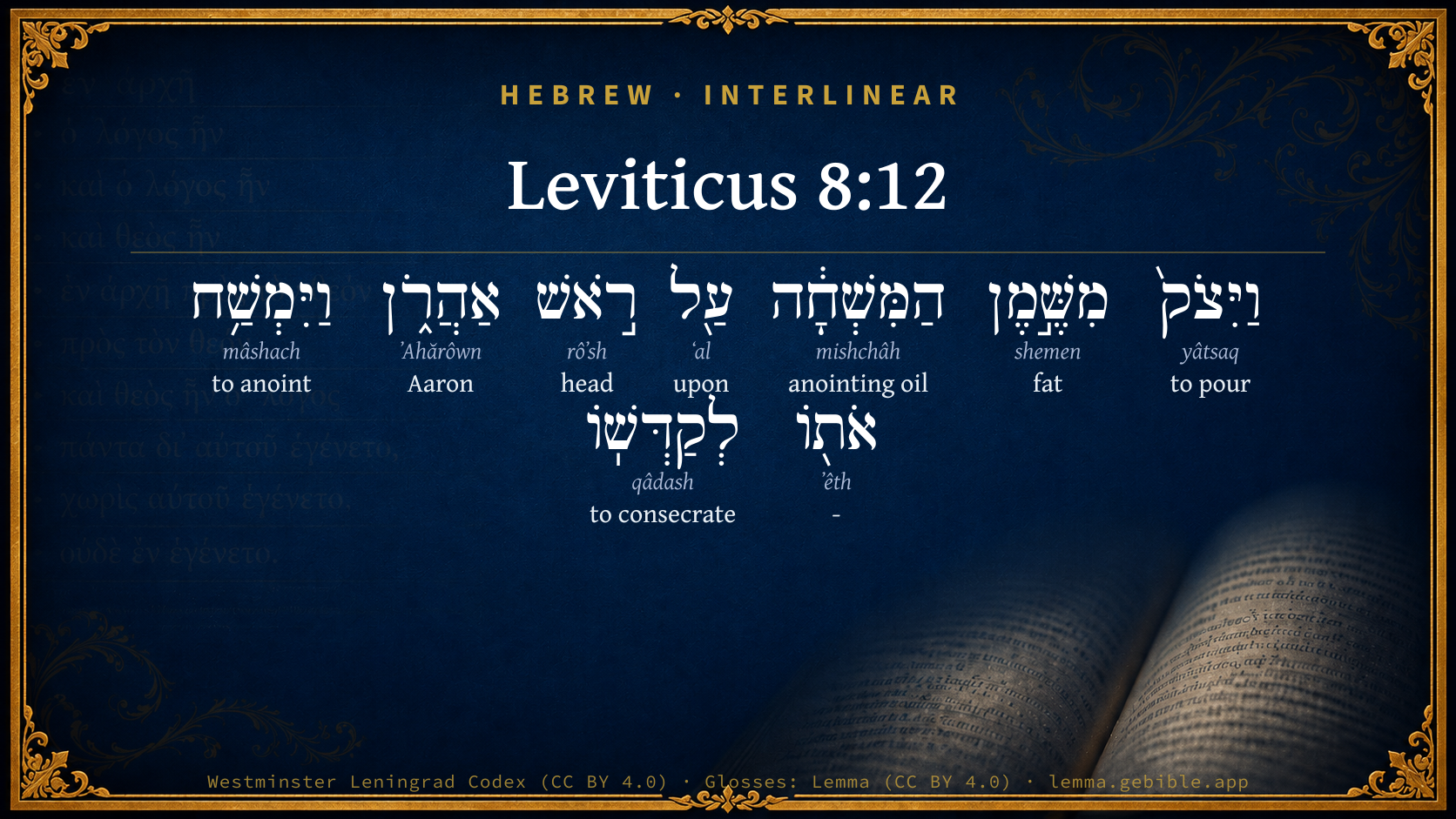
Hebrew (Westminster Leningrad Codex) Leviticus 8:12 appears in the Hebrew Old Testament. The text above is from the Westminster Leningrad Codex. Each word links to its Strong’s number, a concise gloss, and parsing drawn from the Open Scriptures Hebrew Bible morphology. Click any word for its full Brown-Driver-Briggs (BDB) entry.
Download image
Cite this verse

Leviticus 8:12 (World English Bible). Public Domain. Lemma interlinear Bible study tool, https://lemma.gebible.app/v/leviticus/8/12.

Show BibTeX & RIS
BibTeX
RIS
English Translation
He poured some of the anointing oil on Aaron's head, and anointed him, to sanctify him.
World English Bible · Public Domain
Download a study sheet

One document with this verse’s original text, its word-by-word gloss line, the meaning frame, cross-references with their text, attributed commentary, and full source and license credits — printable, and it pastes into notes with its structure intact.

This verse Autodidact and up

Study sheet (.html) Plain text (.txt)

A passage Seminary Student

Up to 50 verses in one chapter. A passage sheet keeps up to 6 commentary sources and 12 cross-references per verse, in the order this page ranks them, and says so on the sheet whenever that leaves anything out. Ask for a single verse and you get the Autodidact verse sheet above.

Everything on this page stays free to read, with no account — the sheet is a download of what is already on screen, not access to it.

Want to remove ads? Support Godless Engineer
Compare translations 3

The same verse in 3 English versions, stacked beneath the original-language interlinear above. Click any original word for its lexicon entry.

Each is an independent rendering of the whole verse — the interlinear is not word-aligned to these translations.

Highlighted words mark where these versions differ — a whole-verse word diff, not a word-by-word alignment.

  • World English Bible Public Domain
    He poured some of the anointing oil on Aaron's head, and anointed him, to sanctify him.
  • King James Version Public Domain
    And he poured of the anointing oil upon Aaron's head, and anointed him, to sanctify him.
  • unfoldingWord Literal Text CC BY-SA 4.0
    And he poured some of the oil of anointing on the head of Aaron, and he anointed him to consecrate him.

unfoldingWord Literal Text — © unfoldingWord, licensed CC BY-SA 4.0. Word-aligned USFM3 via Door43 (git.door43.org/unfoldingWord/en_ult).

Versions to compare (up to 4)

3 of 4 selected

Show all 18 translations

Every available English version of this verse, each an independent rendering of the whole verse.

  • World English Bible Public Domain
    He poured some of the anointing oil on Aaron's head, and anointed him, to sanctify him.
  • Berean Standard Bible Public Domain
    He also poured some of the anointing oil on Aaron’s head and anointed him to consecrate him.
  • Majority Standard Bible Public Domain
    He also poured some of the anointing oil on Aaron’s head and anointed him to consecrate him.
  • King James Version Public Domain
    And he poured of the anointing oil upon Aaron's head, and anointed him, to sanctify him.
  • American Standard Version (1901) Public Domain
    And he poured of the anointing oil upon Aaron's head, and anointed him, to sanctify him.
  • Revised Version (1885) Public Domain
    And he poured of the anointing oil upon Aaron’s head, and anointed him, to sanctify him.
  • Geneva Bible (1599) Public Domain
    And he powred of the anointing oyle vpon Aarons head, and anointed him, to sanctifie him.
  • Douay-Rheims (1899) Public Domain
    And he poured it upon Aaron's head, and he anointed and consecrated him:
  • Young's Literal Translation Public Domain
    and he poureth of the anointing oil on the head of Aaron, and anointeth him to sanctify him.
  • Literal Standard Version CC BY-SA 4.0
    and he pours of the anointing oil on the head of Aaron, and anoints him to sanctify him.
  • Unlocked Literal Bible CC BY-SA 4.0
    He poured some of the anointing oil on Aaron's head and anointed him to set him apart.
  • unfoldingWord Literal Text CC BY-SA 4.0
    And he poured some of the oil of anointing on the head of Aaron, and he anointed him to consecrate him.
  • Darby Bible Public Domain
    And he poured of the anointing oil on Aaron's head, and anointed him, to hallow him.
  • World Messianic Bible Public Domain
    He poured some of the anointing oil on Aaron’s head, and anointed him, to sanctify him.
  • Webster's Bible Public Domain
    And he poured of the anointing oil upon Aaron's head, and anointed him, to sanctify him.
  • Free Bible Version CC BY-SA 4.0
    Moses poured some of the anointing oil on Aaron's head to anoint him and to dedicate him.
  • Bible in Basic English Public Domain
    And some of the oil he put on Aaron's head, to make him holy.
  • JPS Tanakh (1917) Public Domain
    And he poured of the anointing oil upon Aaron's head, and anointed him, to sanctify him.

Literal Standard Version (2020), Covenant Press — licensed CC BY-SA 4.0. Text via the HelloAO Bible API (eBible.org). Unlocked Literal Bible (unfoldingWord) — licensed CC BY-SA 4.0. Text via the HelloAO Bible API (eBible.org). unfoldingWord Literal Text — © unfoldingWord, licensed CC BY-SA 4.0. Word-aligned USFM3 via Door43 (git.door43.org/unfoldingWord/en_ult). Free Bible Version, Dr. Jonathan Gallagher — licensed CC BY-SA 4.0. Text via the HelloAO Bible API (eBible.org).

Word by word

More ways to search: Search by grammar → Find every occurrence → Compare this word →

Practice this passage: Drill this verse → Learn its vocabulary →

הַמִּשְׁחָ֔ה
mishchâh
H4888
“the · anointing oil”
Particle, Definite Article + Noun, Common, Feminine, Singular, Absolute
Part of Speech
Particle + Noun
Type
Common
Gender
Feminine
Number
Singular
State
Absolute
Full BDB Definition

Origin: from H4886

TWOT: 1255a , 1255b

consecrated portion, anointing oil, portion, ointment, anointing portion - ointment (used to consecrate by anointing) - anointing portion
  1. וַיִּצֹק֙ yâtsaq H3332 “and · to pour” Conjunction + Verb, Qal, Sequential Imperfect, 3rd Person, Masculine, Singular
  2. מִשֶּׁ֣מֶן shemen H8081 “from · fat of” Preposition + Noun, Common, Masculine, Singular, Construct
  3. עַ֖ל ʻal H5921 “upon” Preposition
  4. רֹ֣אשׁ rôʼsh H7218 “head of” Noun, Common, Masculine, Singular, Construct
  5. אַהֲרֹ֑ן ʼAhărôwn H175 “Aaron” Noun, Proper
  6. וַיִּמְשַׁ֥ח mâshach H4886 “and · to anoint” Conjunction + Verb, Qal, Sequential Imperfect, 3rd Person, Masculine, Singular
  7. אֹת֖וֹ ʼêth H853 “- · him” Particle, Direct Object + Suffix, Personal, 3rd Person, Masculine, Singular
  8. לְקַדְּשֽׁוֹ qâdash H6942 “to consecrate · him” Preposition + Verb, Piel, Infinitive Construct + Suffix, Personal, 3rd Person, Masculine, Singular

About this verse

These counts appear in no published source. They are computed here, from the morphology-tagged text and Lemma’s own curated glosses. What Lemma adds →

9
words
9
distinct lemmas
Pentateuch
section

Shared distinctive vocabulary

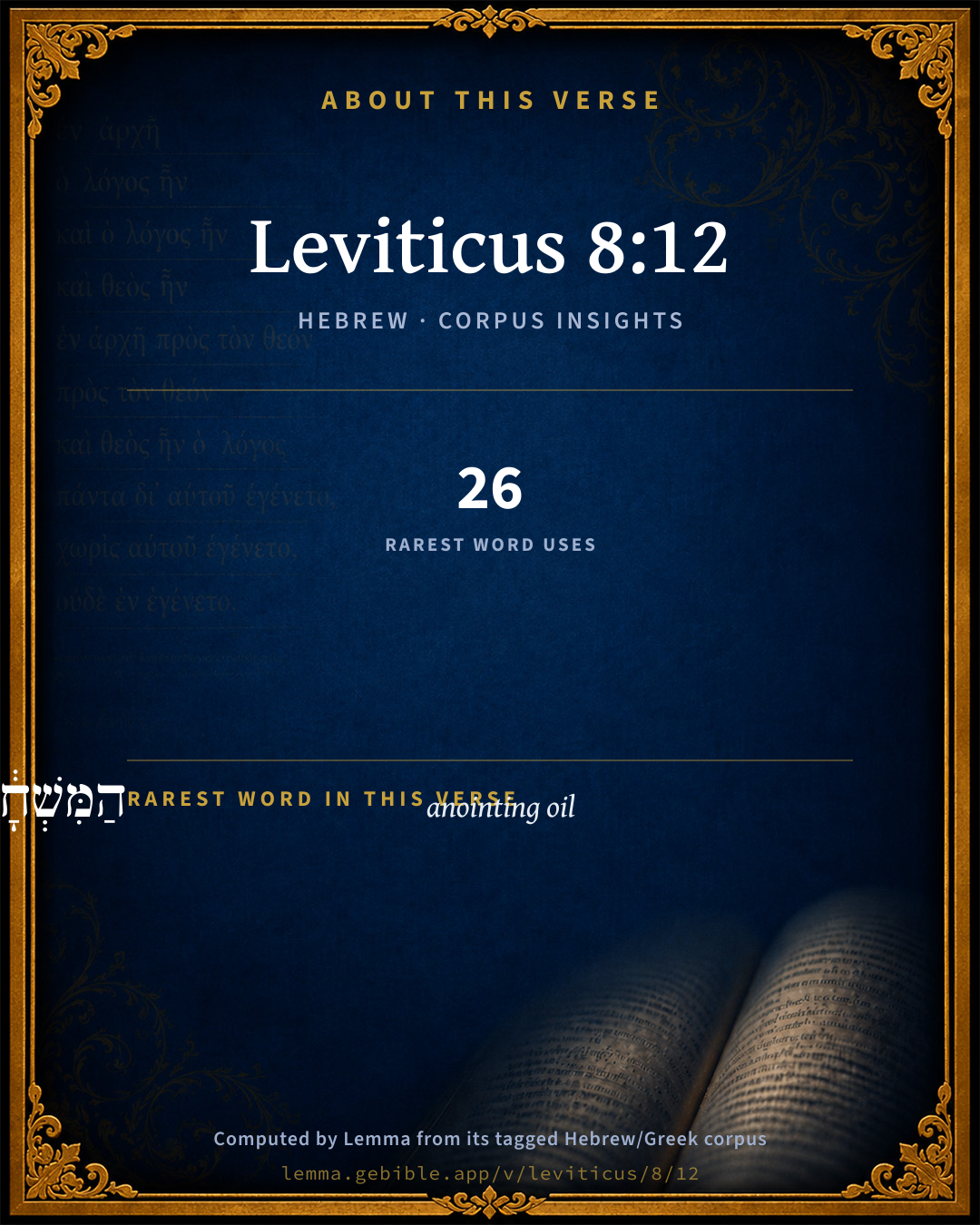
הַמִּשְׁחָ֔ה anointing oil H4888 occurs in 24 verses of the Hebrew Bible. Also found in:

Grammatical profile

  • 3 verbs
  • 4 nouns
  • 1 preposition
  • 1 particle

Verb forms

  • וַיִּצֹק֙ Qal · Sequential Imperfect
  • וַיִּמְשַׁ֥ח Qal · Sequential Imperfect
  • לְקַדְּשֽׁוֹ Piel · Infinitive Construct

Hebrew & Septuagint length

In English translation the verse runs 16 words from the Hebrew and 19 from the Septuagint (LXX English) — closely comparable.

A rough comparison of the two English renderings, which tokenize alike — not a word-level alignment.

Word counts can differ between the Hebrew and the Greek without any difference in meaning — e.g. the Hebrew direct-object marker אֵת has no separate Greek word, and Greek often adds the article ὁ.

Cross-references

6

Topical passages linked to Leviticus 8:12 in the Treasury of Scripture Knowledge — connected by theme and wording, ordered by reader-vote popularity; previews shown in the World English Bible.

  • Exodus 30:30 You shall anoint Aaron and his sons, and sanctify them, that they may minister to me in the priest's office.
  • Psalms 133:2 It is like the precious oil on the head, That ran down on the beard, Even Aaron's beard; That came down on the edge of his robes;
  • Exodus 29:7 Then you shall take the anointing oil, and pour it on his head, and anoint him.
  • Exodus 28:41 You shall put them on Aaron your brother, and on his sons with him, and shall anoint them, and consecrate them, and sanctify them, that they may minister to me in the priest's office.
  • Leviticus 4:3 if the anointed priest sins so as to bring guilt on the people, then let him offer for his sin, which he has sinned, a young bull without blemish to Yahweh for a sin offering.
  • Leviticus 21:10–12 "'He who is the high priest among his brothers, upon whose head the anointing oil is poured, and that is consecrated to put on the garments, shall not let the hair of his head hang loose, nor tear his clothes;

Cross-references courtesy of OpenBible.info (CC BY 4.0).

Hebrew and Greek witnesses Masoretic Hebrew ↔ Greek Septuagint

The same verse in the two great witnesses to the Old Testament, shown verse-for-verse.

These are two independent witnesses, not word-aligned to each other, and the Septuagint is shown in lemma (dictionary) form.

Hebrew Leviticus 8:12 Masoretic · Westminster Leningrad Codex

וַיִּצֹק֙ מִשֶּׁ֣מֶן הַמִּשְׁחָ֔ה עַ֖ל רֹ֣אשׁ אַהֲרֹ֑ן וַיִּמְשַׁ֥ח אֹת֖וֹ לְקַדְּשֽׁוֹ

He poured some of the anointing oil on Aaron's head, and anointed him, to sanctify him.

World English Bible · Public Domain

Greek LXX Leviticus 8:12 Septuagint · lemma form

καί ἐπιχέω μωυσῆς ἀπό ὁ ἔλαιον ὁ χρῖσις ἐπί ὁ κεφαλή ἀαρών καί χρίω αὐτός καί ἁγιάζω αὐτός

And Moses poured of the anointing oil on the head of Aaron; and he anointed him and sanctified him.

LXX2012 (modern English Septuagint) · Public Domain

Hebrew: Westminster Leningrad Codex (CC BY 4.0). Greek: Septuagint (public domain); English from LXX2012 (modern English Septuagint) (Public Domain). How the Septuagint differs from the Hebrew →

Targum (Aramaic paraphrase)

2

The Targum is the ancient Jewish Aramaic paraphrase of the Hebrew Scriptures — an interpretive translation, not the Hebrew text itself. Onkelos (literal) and Pseudo-Jonathan (expansive) render the Torah, and Jonathan the Prophets. Coverage is partial: where no permissively-licensed English translation exists for a verse, only the Aramaic is shown. This is verse-level text, not a word-by-word alignment to the Hebrew.

  1. Targum Onkelos Torah (Genesis–Deuteronomy)
    וַאֲרֵיק מִמִשְׁחָא דִרְבוּתָא עַל רֵישָׁא דְאַהֲרֹן וְרַבִּי יָתֵהּ לְקַדָשׁוּתֵהּ

    (no public-domain English translation for this verse)

    Targum Onkelos — Aramaic: “Onkelos Genesis” (public domain); “Onkelos Exodus” (public domain); “Onkelos Leviticus” (public domain); “Onkelos Numbers” (public domain); “Onkelos Deuteronomy” (public domain). English: “Sefaria Community Translation” (CC0 1.0 (public-domain dedication)); “J.W. Etheridge. The Targums of Onkelos and Jonathan Ben Uzziel on the Pentateuch. London: Longmans, Green, 1862” (public domain). Text via Sefaria.

  2. Targum Pseudo-Jonathan Torah (Genesis–Deuteronomy)
    וְאָרִיק מִן מִשְׁחָא דִרְבוּתָא עַל רֵישׁ אַהֲרן וְרַבֵּי יָתֵיהּ בָּתַר דְאַלְבְּשֵׁיהּ מְטוֹל לְקַדָשׁוּתֵיהּ

    And he poured of the oil of consecration upon Aharon's head, and anointed him after he had invested him, to sanctify him.

    Targum Pseudo-Jonathan — Aramaic: “Targum Jonathan on Genesis” (public domain); “Targum Jonathan on Exodus” (public domain); “Targum Jonathan on Leviticus” (public domain); “Targum Jonathan on Numbers” (public domain); “Targum Jonathan on Deuteronomy” (public domain). English: “The Targum of Jonathan ben Uzziel, trans. J. W. Etheridge, London, 1862” (public domain). Text via Sefaria.

Commentary

Notes on Leviticus 8:12 from classic Christian and Jewish commentators (each source and its license shown beneath its notes). The classic Christian expositions comment on the surrounding passage and are grouped to its opening verse, so a note may address several verses; the Jewish commentaries on the Tanakh (Rashi and others) are per-verse, so they appear only where the commentator wrote on this verse.

Lemma curates 59 commentaries, every one of them public domain or Creative Commons licensed, each selected and text-cleaned for this edition rather than reprinted as found. About our sources →

Joseph Benson's Commentary

Lev 8:12. He poured the oil upon Aaron’s head — In a plentiful manner, as appears from Psa 133:2, whereas other persons and things were only sprinkled with it; because his unction was to typify the anointing of Christ with the Spirit, which was not given by measure to him. A measure of the same anointing is given to all believers, to all the members of Christ’s mystical body, who, by virtue of their union with their living head, partake of those gifts and graces of the Holy Spirit which were in him. Reader, hast thou received a measure of them? Remember, If any man have not the Spirit of Christ he is none of his.

Joseph Benson's Commentary on the Old and New Testaments (1811–1818) — public domain. Text from a community e-Sword module.

Ellicott's Commentary for English Readers

(12) And he poured of the anointing oil upon Aaron’s head.—In the anointing of Aaron, the oil was poured upon his head. (See also Lev_21:10-12; Exo_29:7; Psa_133:2.) This profuse pouring of oil was repeated at the consecration of every successor to the high-priesthood, whilst the common priests were simply anointed, or were simply marked with the finger on the forehead on their first installation, and this anointing descended with them for all futurity. (See Lev_6:3.) Tradition informs us that during the second Temple, the person who anointed the high priest first threw the oil upon his head, and then drew with his finger the sign of the letter Caph, being the initial of Cohen, i.e., priest, between the eyebrows of the newly-consecrated pontiff.

A Bible Commentary for English Readers, edited by Charles John Ellicott (1878–1897) — public domain. Text from a community e-Sword module.

John Gill's Exposition

And he poured of the anointing oil upon Aaron's head,.... Which ran down to his beard, and to the collar of his coat, the robe of the ephod, but not to the skirts of his garments, as we wrongly render it, Psa 133:2. Jarchi says it was first poured on his head, and after that he put it between his eyebrows, and drew it with his finger here and there, or from one eyebrow to another: Maimonides (w) gives a like account, with some addition; he says, the oil was poured on his head, and he was anointed between the eyebrows, in the form of the Greek letter "chi": a greater profusion of oil was used in the anointing of Aaron than of the tabernacle, altar, and laver, and their vessels, he being so eminent a type of Christ, our high priest, anointed with the oil of gladness above his fellows:

and anointed him to sanctify him; to signify that he was set apart and devoted to the sacred office of the priesthood. The Targum of Jonathan observes, that this anointing was after he had clothed him; though some have thought it was done before the mitre and holy crown were put on: but if they were put on to complete the investiture, they might be taken off while the ceremony of anointing was performed.

(w) In Misn. Ceritot, c. 1. sect. 1.

John Gill's Exposition of the Whole Bible (1746–1763) — public domain (CC PDM 1.0). Text via the HelloAO Bible API.

Albert Barnes' Notes on the Bible

As investing the priest with official garments was a recognition before men of the official position of the person (see Exo 28:3 note), so the anointing him with oil was an acknowledgment that all fitness for his office, all the powers with which he would rightly fulfill its duties, must come from the Lord.

So, again, with the sanctification of the holy things. Each of them was intended by divine wisdom to convey a spiritual meaning to the mind of man. They were means of grace to the devout worshipper. The oil poured upon them was a recognition of this fact, and at the same time it made them holy and set them apart from all profane and ordinary uses. On kindred grounds, though to express another idea, the altar was to be sanctified also by blood. See Lev 8:15 note.

Albert Barnes' Notes on the Bible (1834–1885) — public domain. Text from a community e-Sword/MySword module.

Haydock's Catholic Bible Commentary

Head. To shew that he was the fountain of the priesthood, and that power was derived from him.

George Leo Haydock (1774–1849), Haydock's Catholic Family Bible and Commentary, 1859 edition — public domain. Excludes Psalms (Douay-Rheims chapter numbering differs from Protestant) and Deuterocanonical books (Catholic canon only).

Matthew Poole's English Annotations

He poured of the anointing oil in a plentiful manner, as appears from Psa 133:2, whereas other persons and things were only anointed or sprinkled with it.

Matthew Poole's English Annotations on the Holy Bible (1683–1685) — public domain. Text from a community e-Sword/MySword module.

Whedon's Commentary on the Bible

Daniel D. Whedon

12. He poured… the… oil — This expresses a copious unction. See Psa_133:2. The same Hebrew word is used in Isa_44:3, to indicate the copious effusion of the Spirit in the latter days. Aaron’s sons were only sprinkled with oil and blood, (Lev_8:30,) but in Lev_7:35, they are spoken of as anointed. The fact that Aaron alone was arrayed in his robes of office, and anointed before the blood was shed, beautifully typifies Christ in his peerless excellency and dignity anointed by the Holy Spirit before he accomplished his atoning work. Before the anointing of the sons of Aaron (Lev_8:30) all the acts recorded in Lev_8:13-29 were performed — the blood is shed, the breast waved before Jehovah, and the fat is consumed on the altar, its sweet odour ascending as a type of the ascension of Jesus, who was slain as a victim, and who ascended as a priest to appear in the holy place for us.

Daniel D. Whedon (gen. ed.), Commentary on the Old and New Testaments (1874–1909) — public domain. Text from a community e-Sword module.

The Pulpit Commentary

He poured of the anointing oil upon Aaron"s head. The change of the verb poured for sprinkled, indicates that the amount of "the precious ointment" poured "upon the head, that ran down unto the beard, and went down to the skirts of his garments", (Psa_133:2) was far greater than that with which the furniture of the tabernacle had been anointed. The oil sprinkled on the holy things sanctified them as means of grace. The oil poured upon Aaron represents the grace of the Holy Spirit, coming from without, but diffusing itself over and throughout the whole consecrated man.

The Pulpit Commentary (1880–1919), ed. H.D.M. Spence-Jones & Joseph S. Exell — public domain. Text from a community e-Sword module.

John Wesley's Explanatory Notes

He poured - In a plentiful manner, as appears from Psalm 1xxxiii, 2, whereas other persons and things were only sprinkled with it: because his unction was to typify the anointing of Christ with the Spirit, which was not given by measure to him. A measure of the same anointing is given to all believers.

John Wesley, Explanatory Notes Upon the Whole Bible (1754–1765) — public domain. Text via the GEBible commentary corpus.

Scofield Reference Notes

C. I. Scofield

poured of the anointing oil

Two important distinctions are made in the case of the high priest, thus confirming his typical relation to Christ the anti-type:

(1) Aaron is anointed before the sacrifices are slain, while in the case of the priests the application of blood precedes the anointing. Christ the sinless One required no preparation for receiving the anointing oil, symbol of the Holy Spirit;

(2) upon the high priest only was the anointing oil poured. "God giveth not the Spirit by measure unto him" Joh 3:34. "Thy God hath anointed Thee with the oil of gladness above Thy fellows." Heb 1:9.

The Scofield Reference Bible (1917 edition), notes by C. I. Scofield — public domain. Text from a community e-Sword module.

unfoldingWord translationNotes

Door43 World Missions Community

He poured

"Moses poured"

sashes

This is the plural form of "sash." See how you translated this in Leviticus 8:7.

translationWords

anoint

oil

Aaron

set apart

Yahweh

Moses

son

tunic

command

unfoldingWord translationNotes — © Distant Shores Media and the Door43 World Missions Community, licensed CC BY-SA 4.0. Source: git.door43.org/Door43/en_tn.

Rashi

Rabbi Shlomo Yitzchaki (Rashi)

וימשח … ‎‏ ויצק‎ AND HE POURED [THE ANOINTING OIL UPON AARON'S HEAD] AND ANOINTED |HIM| — First he poured some oil upon his head and afterwards he put a drop between his eyebrows, and he drew the oil with his finger from this place to that (this drawing the oil from one place to the other was the anointing here spoken of) (Keritot 5b; Horayot 12a; cf. also Rashi on Exodus 29:7).

Rashi on the Tanakh — English translations: “The Judaica Press complete Tanach with Rashi, translated by A. J. Rosenberg” (CC BY 4.0); “Pentateuch with Rashi's commentary by M. Rosenbaum and A.M. Silbermann, 1929-1934” (public domain); “The Metsudah Tanach series, Lakewood, N.J” (CC BY 4.0); and “The Book of Joshua, Metsudah Publications, 1997” (CC BY 4.0). Text via Sefaria.

Lesson kit

Teaching starters — assembled from the data on this page, not authored interpretation. Every prompt links to the verse data it draws on. Edit before teaching.

Leviticus, in the Pentateuch, opens this verse with 9 words (9 distinct Hebrew lemmas). Its most distinctive word is mishchâh (“anointing oil”). A historical commentator’s framing appears above. Read the whole chapter for the surrounding context.

Discussion questions

  1. The word mishchâh carries the sense “anointing oil.” How does it shape the verse?
  2. How does Exodus 25:6, which shares the word «anointing oil», read alongside this verse?
  3. These translations render this verse differently. What is at stake in choosing one wording over another?
  4. «וַיִּצֹק֙» is a Qal Sequential Imperfect verb. How does that grammatical form shape the action described?
  5. Compare how Joseph Benson's Commentary and Ellicott's Commentary for English Readers read this verse. Where do they agree or differ?

Things to notice

Reading settings

Reading text

Shown beneath each verse's original-language words.

Old Testament
Old Testament edition

Read the OT as the Masoretic Hebrew (MT) or the Greek Septuagint (LXX).

English shown for the Greek Septuagint (in the Hebrew ↔ Greek comparison).

Comparing translations? Open the Compare panel on any verse page to stack up to four side by side.