1 Kings 6:31

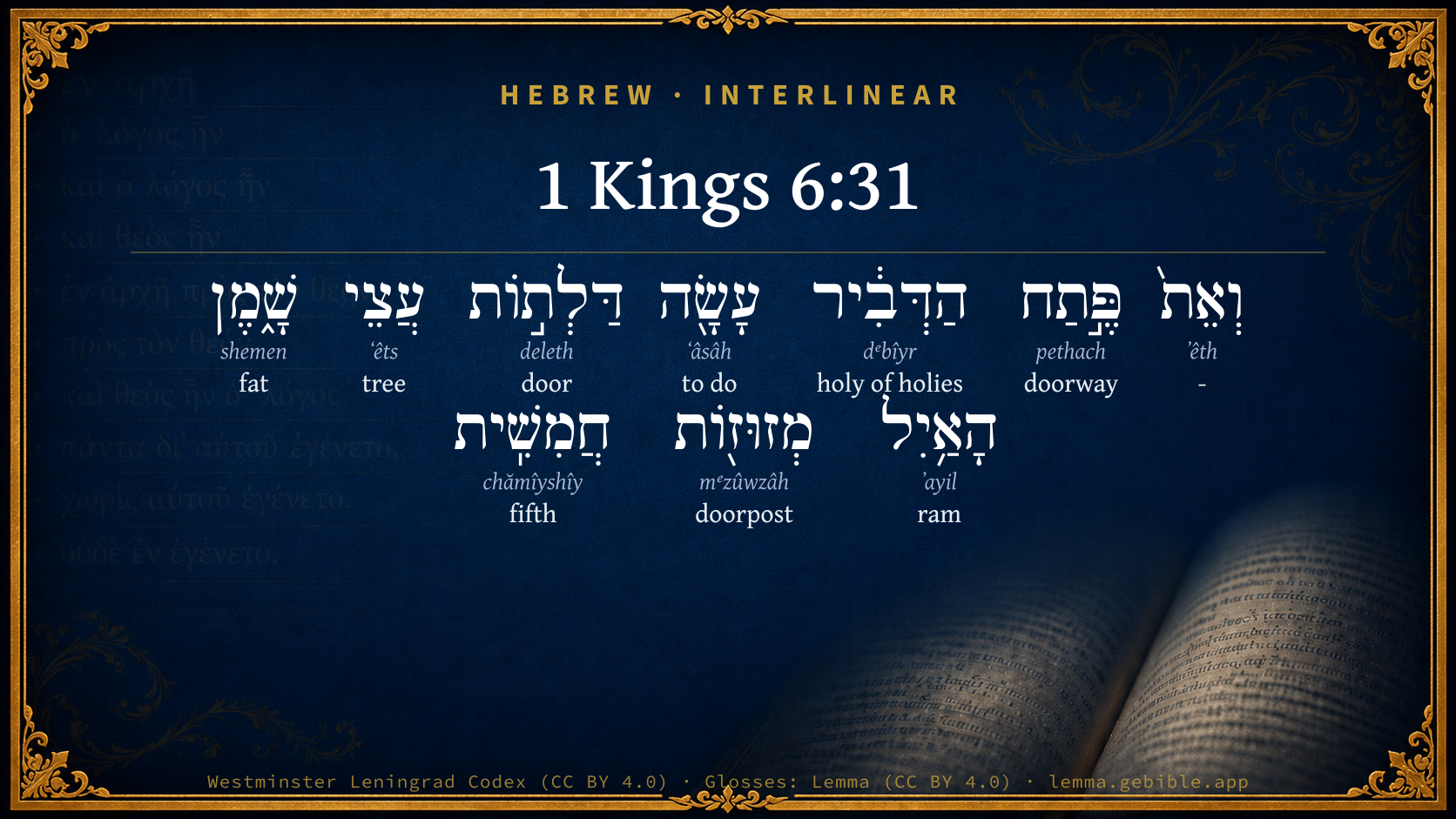
Hebrew (Westminster Leningrad Codex) 1 Kings 6:31 appears in the Hebrew Old Testament. The text above is from the Westminster Leningrad Codex. Each word links to its Strong’s number, a concise gloss, and parsing drawn from the Open Scriptures Hebrew Bible morphology. Click any word for its full Brown-Driver-Briggs (BDB) entry.
Download image
Cite this verse

1 Kings 6:31 (World English Bible). Public Domain. Lemma interlinear Bible study tool, https://lemma.gebible.app/v/1-kings/6/31.

Show BibTeX & RIS
BibTeX
RIS
English Translation
For the entrance of the oracle he made doors of olive-wood: the lintel [and] door-posts were a fifth part [of the wall].
World English Bible · Public Domain
Download a study sheet

One document with this verse’s original text, its word-by-word gloss line, the meaning frame, cross-references with their text, attributed commentary, and full source and license credits — printable, and it pastes into notes with its structure intact.

This verse Autodidact and up

Study sheet (.html) Plain text (.txt)

A passage Seminary Student

Up to 50 verses in one chapter. A passage sheet keeps up to 6 commentary sources and 12 cross-references per verse, in the order this page ranks them, and says so on the sheet whenever that leaves anything out. Ask for a single verse and you get the Autodidact verse sheet above.

Everything on this page stays free to read, with no account — the sheet is a download of what is already on screen, not access to it.

Want to remove ads? Support Godless Engineer
Compare translations 3

The same verse in 3 English versions, stacked beneath the original-language interlinear above. Click any original word for its lexicon entry.

Each is an independent rendering of the whole verse — the interlinear is not word-aligned to these translations.

Highlighted words mark where these versions differ — a whole-verse word diff, not a word-by-word alignment.

  • World English Bible Public Domain
    For the entrance of the oracle he made doors of olive-wood: the lintel [and] door-posts were a fifth part [of the wall].
  • King James Version Public Domain
    And for the entering of the oracle he made doors of olive tree: the lintel and side posts were a fifth part of the wall.
  • unfoldingWord Literal Text CC BY-SA 4.0
    And the entrance of the inner sanctuary, he made doors of wood of oil. The lintel, the doorposts, a fifth.

unfoldingWord Literal Text — © unfoldingWord, licensed CC BY-SA 4.0. Word-aligned USFM3 via Door43 (git.door43.org/unfoldingWord/en_ult).

Versions to compare (up to 4)

3 of 4 selected

Show all 18 translations

Every available English version of this verse, each an independent rendering of the whole verse.

  • World English Bible Public Domain
    For the entrance of the oracle he made doors of olive-wood: the lintel [and] door-posts were a fifth part [of the wall].
  • Berean Standard Bible Public Domain
    For the entrance to the inner sanctuary, Solomon constructed doors of olive wood with five-sided doorposts.
  • Majority Standard Bible Public Domain
    For the entrance to the inner sanctuary, Solomon constructed doors of olive wood with five-sided doorposts.
  • King James Version Public Domain
    And for the entering of the oracle he made doors of olive tree: the lintel and side posts were a fifth part of the wall.
  • American Standard Version (1901) Public Domain
    And for the entrance of the oracle he made doors of olive-wood: the lintel `and' door-posts were a fifth part `of the wall'.
  • Revised Version (1885) Public Domain
    And for the entering of the oracle he made doors of olive wood: the lintel and door posts were a fifth part of the wall.
  • Geneva Bible (1599) Public Domain
    And in the entring of the oracle he made two doores of oliue tree: and the vpper post and side postes were fiue square.
  • Douay-Rheims (1899) Public Domain
    And all the walls of the temple round about he carved with divers figures and carvings: and he made in them cherubims and palm trees, and divers representations, as it were standing out, and coming forth from the wall.
  • Young's Literal Translation Public Domain
    as to the opening of the oracle, he made doors of the oil-tree; the lintel, side-posts, a fifth.
  • Literal Standard Version CC BY-SA 4.0
    as for the opening of the oracle, he made doors of the oil-tree; the lintel [and] doorposts [are] a fifth [of the wall].
  • Unlocked Literal Bible CC BY-SA 4.0
    Solomon made doors of olivewood for the entrance to the inner room. The lintel and doorposts had five indented sections.
  • unfoldingWord Literal Text CC BY-SA 4.0
    And the entrance of the inner sanctuary, he made doors of wood of oil. The lintel, the doorposts, a fifth.
  • Darby Bible Public Domain
    And for the entrance of the oracle he made doors of olive-wood: the lintel [and] side posts were the fifth part [of the breadth of the house].
  • World Messianic Bible Public Domain
    For the entrance of the inner sanctuary, he made doors of olive wood. The lintel and door posts were a fifth part of the wall.
  • Webster's Bible Public Domain
    And for the entrance of the oracle he made doors of olive tree: the lintel and side-posts were a fifth part of the wall.
  • Free Bible Version CC BY-SA 4.0
    He had doors of olive wood made for the entrance to the inner sanctuary, together with a lintel and doorposts that had five sides.
  • Bible in Basic English Public Domain
    For the way into the inmost room he made doors of olive-wood, the arch and the door supports forming a five-sided opening.
  • JPS Tanakh (1917) Public Domain
    And for the entrance of the Sanctuary he made doors of olive-wood, the door-posts within the frame having five angles.

Literal Standard Version (2020), Covenant Press — licensed CC BY-SA 4.0. Text via the HelloAO Bible API (eBible.org). Unlocked Literal Bible (unfoldingWord) — licensed CC BY-SA 4.0. Text via the HelloAO Bible API (eBible.org). unfoldingWord Literal Text — © unfoldingWord, licensed CC BY-SA 4.0. Word-aligned USFM3 via Door43 (git.door43.org/unfoldingWord/en_ult). Free Bible Version, Dr. Jonathan Gallagher — licensed CC BY-SA 4.0. Text via the HelloAO Bible API (eBible.org).

Word by word

More ways to search: Search by grammar → Find every occurrence → Compare this word →

Practice this passage: Drill this verse → Learn its vocabulary →

הַדְּבִ֔יר
dᵉbîyr
H1687
“the · holy of holies”
Particle, Definite Article + Noun, Common, Masculine, Singular, Absolute
Part of Speech
Particle + Noun
Type
Common
Gender
Masculine
Number
Singular
State
Absolute
Full BDB Definition

Origin: from H1696 (apparently in the sense of oracle)

TWOT: 399g

the holy of holies, the innermost room of the temple or tabernacle - hindmost chamber, innermost room of the temple of Solomon, most holy place, holy of holies - (TWOT) oracle
  1. וְאֵת֙ ʼêth H853 “and · -” Conjunction + Particle, Direct Object
  2. פֶּ֣תַח pethach H6607 “doorway of” Noun, Common, Masculine, Singular, Construct
  3. עָשָׂ֖ה ʻâsâh H6213 “to do” Verb, Qal, Perfect, 3rd Person, Masculine, Singular
  4. דַּלְת֣וֹת deleth H1817 “doors of” Noun, Common, Feminine, Plural, Construct
  5. עֲצֵי ʻêts H6086 “trees of” Noun, Common, Masculine, Plural, Construct
  6. שָׁ֑מֶן shemen H8081 “fat” Noun, Common, Masculine, Singular, Absolute
  7. הָאַ֥יִל ʼayil H352 “the · ram” Particle, Definite Article + Noun, Common, Masculine, Singular, Absolute
  8. מְזוּז֖וֹת mᵉzûwzâh H4201 “doorposts of” Noun, Common, Feminine, Plural, Construct
  9. חֲמִשִֽׁית chămîyshîy H2549 “fifth” Adjective, Ordinal number, Feminine, Singular, Absolute

About this verse

These counts appear in no published source. They are computed here, from the morphology-tagged text and Lemma’s own curated glosses. What Lemma adds →

10
words
10
distinct lemmas
Historical
section

Notable vocabulary

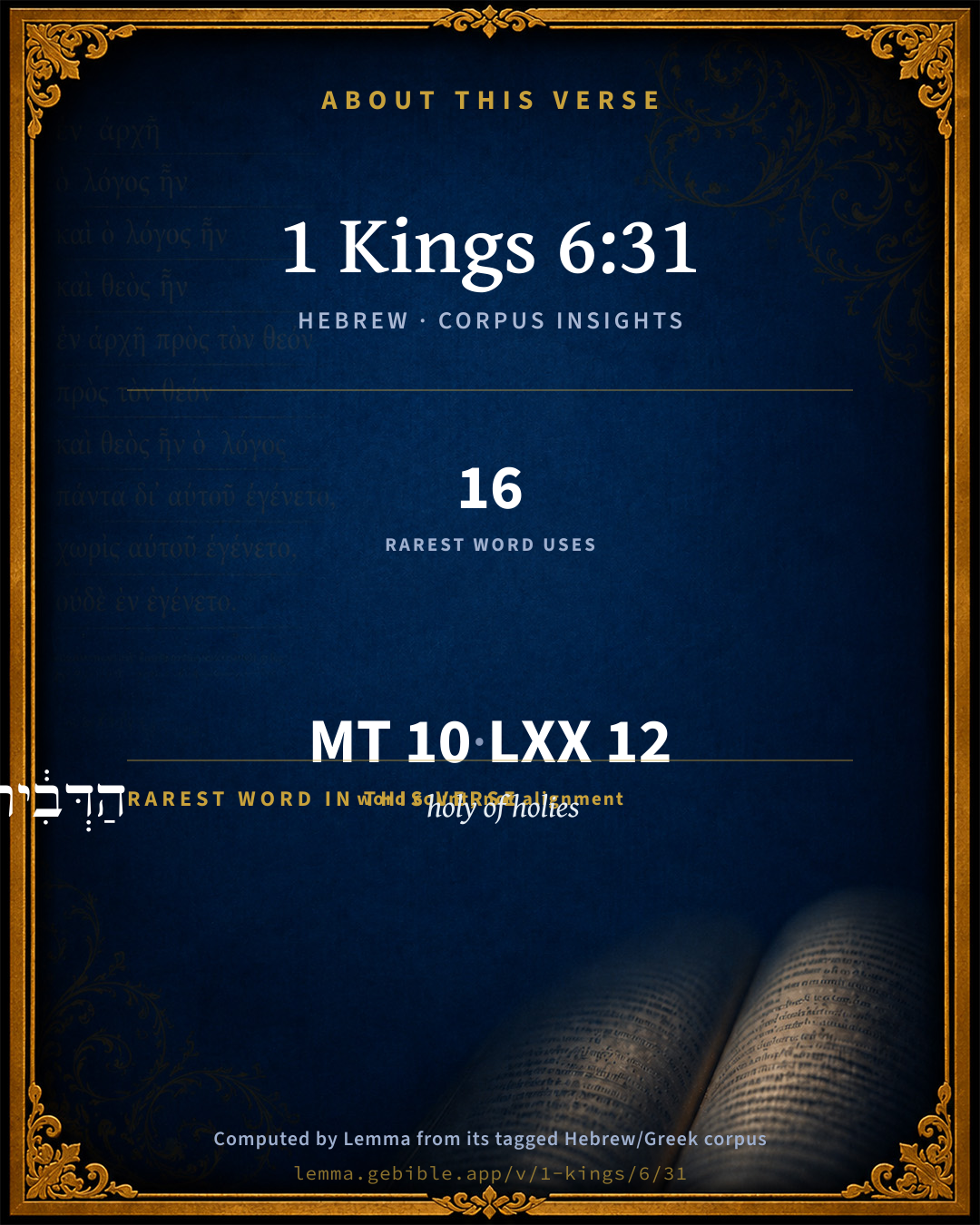
The rarest word here is הַדְּבִ֔יר holy of holies H1687 — appearing just 16 times in the whole Hebrew Bible.

Shared distinctive vocabulary

הַדְּבִ֔יר holy of holies H1687 occurs in 16 verses of the Hebrew Bible. Also found in:

Grammatical profile

  • 1 verb
  • 7 nouns
  • 1 adjective
  • 1 particle

Verb forms

  • עָשָׂ֖ה Qal · Perfect

Hebrew & Septuagint length

In English translation the verse runs 22 words from the Hebrew and 20 from the Septuagint (LXX English) — closely comparable.

A rough comparison of the two English renderings, which tokenize alike — not a word-level alignment.

Word counts can differ between the Hebrew and the Greek without any difference in meaning — e.g. the Hebrew direct-object marker אֵת has no separate Greek word, and Greek often adds the article ὁ.

In the original languages it is 10 Hebrew tokens and 12 Greek tokens — but the two are counted differently (Hebrew bundles its prefixes and suffixes into one token; the Greek is in lemma form), so that isn’t a like-for-like length.

Cross-references

4

Topical passages linked to 1 Kings 6:31 in the Treasury of Scripture Knowledge — connected by theme and wording, ordered by reader-vote popularity; previews shown in the World English Bible.

  • Hebrews 10:19–20 Having therefore, brothers, boldness to enter into the holy place by the blood of Jesus,
  • John 10:9 I am the door. If anyone enters in by me, he will be saved, and will go in and go out, and will find pasture.
  • John 14:6 Jesus said to him, "I am the way, the truth, and the life. No one comes to the Father, except through me.
  • Ephesians 3:18 may be strengthened to comprehend with all the saints what is the breadth and length and height and depth,

Cross-references courtesy of OpenBible.info (CC BY 4.0).

Hebrew and Greek witnesses Masoretic Hebrew ↔ Greek Septuagint

The same verse in the two great witnesses to the Old Testament, shown verse-for-verse.

These are two independent witnesses, not word-aligned to each other, and the Septuagint is shown in lemma (dictionary) form.

Hebrew 1 Kings 6:31 Masoretic · Westminster Leningrad Codex

וְאֵת֙ פֶּ֣תַח הַדְּבִ֔יר עָשָׂ֖ה דַּלְת֣וֹת עֲצֵי שָׁ֑מֶן הָאַ֥יִל מְזוּז֖וֹת חֲמִשִֽׁית

For the entrance of the oracle he made doors of olive-wood: the lintel [and] door-posts were a fifth part [of the wall].

World English Bible · Public Domain

Greek LXX 1 Kings 6:31 Septuagint · lemma form

καί ὁ θύρωμα ὁ δαβιρ ποιέω θύρα ξύλον ἀρκεύθινος καί φλιά πενταπλοῦς

And for the door-way of the oracle he made doors of juniper wood, there were porches in a four-fold way.

LXX2012 (modern English Septuagint) · Public Domain

Hebrew: Westminster Leningrad Codex (CC BY 4.0). Greek: Septuagint (public domain); English from LXX2012 (modern English Septuagint) (Public Domain). How the Septuagint differs from the Hebrew →

Targum (Aramaic paraphrase)

1

The Targum is the ancient Jewish Aramaic paraphrase of the Hebrew Scriptures — an interpretive translation, not the Hebrew text itself. Onkelos (literal) and Pseudo-Jonathan (expansive) render the Torah, and Jonathan the Prophets. Coverage is partial: where no permissively-licensed English translation exists for a verse, only the Aramaic is shown. This is verse-level text, not a word-by-word alignment to the Hebrew.

  1. Targum Jonathan Prophets (Joshua–Malachi)
    וְלִתְרַע בֵּית כַּפּוֹרֵי עֲבַד דָשִׁין דַאֲעֵי זֵיתָא אֵלָהִי וְסִפּוֹהִי מְטַקְסִין:

    (no public-domain English translation for this verse)

    Targum Jonathan — Aramaic: “Mikraot Gedolot” (public domain). English: “Sefaria Community Translation” (CC0 1.0 (public-domain dedication)); “London "Chaldee Paraphrase," 1871” (public domain). Text via Sefaria.

Commentary

Notes on 1 Kings 6:31 from classic Christian and Jewish commentators (each source and its license shown beneath its notes). The classic Christian expositions comment on the surrounding passage and are grouped to its opening verse, so a note may address several verses; the Jewish commentaries on the Tanakh (Rashi and others) are per-verse, so they appear only where the commentator wrote on this verse.

Lemma curates 59 commentaries, every one of them public domain or Creative Commons licensed, each selected and text-cleaned for this edition rather than reprinted as found. About our sources →

Trapp's Complete Commentary

John Trapp

1Ki 6:31 And for the entering of the oracle he made doors [of] olive tree: the lintel [and] side posts [were] a fifth part [of the wall].

Ver. 31. Doors of olive tree.] Which kind of wood is hard, firm, and lasting: fit for posts and doors.

John Trapp, A Commentary or Exposition upon All the Books of the Old and New Testament (1647–1656) — public domain. Text from a community e-Sword module.

Joseph Benson's Commentary

1Ki 6:31. The lintel and side-posts were a fifth part of the wall — The original text here is very obscure, there being nothing in it for the words, of the wall; but only, The lintel and side-posts were a fifth, which may be understood to signify, that they held the proportion of a fifth part of the doors. But some think the meaning is, that this gate was the fifth in number belonging to the house. The first, they say, was that which led into the court of the people; the second, that which led into the court of the priests; the third was the door of the porch; the fourth, that of the holy place; and this fifth, of the oracle, or most holy. And in this way they interpret a similar expression, (1Ki 6:33,) which we render a fourth part of the wall, the words, of the wall, being not in the Hebrew, they understand it of the fourth gate; namely, that of the holy place. But the most probable meaning is, as our translators have understood it to be, that the doors, including the lintel and side-posts, here mentioned, as well as the valves, took up a fifth part of the wall or partition, being four cubits in breadth.

Joseph Benson's Commentary on the Old and New Testaments (1811–1818) — public domain. Text from a community e-Sword module.

Jamieson, Fausset & Brown

Robert Jamieson, A. R. Fausset & David Brown

for the entering of the oracle--The door of the most holy place was made of solid olive tree and adorned with figures. The door of the holy place was made of cypress wood, the sides being of olive wood.

Jamieson, Fausset & Brown — Commentary Critical and Explanatory on the Whole Bible (1871) — public domain (CC PDM 1.0). Text via the HelloAO Bible API.

Ellicott's Commentary for English Readers

(31) Doors.—The two doors of olive wood, from the Holy place into the Oracle, which as a rule stood open, showing the veil and the golden chains, were of moderate size. If our version (as is probable) is correct, the outside measure of the lintel and post was a fifth part of the wall, that is, four cubits, or six feet. Each door, therefore, would be something less than six feet by three. The description of the gilding states with minute accuracy that in overlaying the whole of these doors with gold, gold was “spread,” that is, made to cover the carvings in relief (the cherubim of 1Ki_6:35); in the other doors the gold was fitted, probably beaten into shape, over the carved work.

A Bible Commentary for English Readers, edited by Charles John Ellicott (1878–1897) — public domain. Text from a community e-Sword module.

The Cambridge Bible for Schools and Colleges

gen. ed. J. J. S. Perowne

31–36. The doors for the oracle and for the Temple. The building of the inner court (Not in Chronicles)

31. the lintel and side posts] There is no conjunction between these words, and the former seems from other places in O. T. to apply to the whole framework in which the doors were fixed, the latter is used regularly of the part to which the hinges were attached. The idea meant to be conveyed here is of the whole structure of the doorway, the framework with its posts.

were a fifth part of the wall] The expansion indicated by the italics of A. V. is no doubt correct both here and in 1Ki_6:33. As the partition wall of the oracle was 20 cubits in height and the same in breadth the opening filled by the framework of the doorway would be 4 cubits high by 4 cubits broad.

The Cambridge Bible for Schools and Colleges (gen. ed. J. J. S. Perowne; Cambridge University Press, 1878–1918) — public domain. Text from a community e-Sword module.

John Gill's Exposition

And he carved thereon cherubims, and palm trees, and open flowers,.... As upon the doors of the most holy place, Kg1 6:32; see Eze 41:25;

and covered them with gold, fitted upon the carved work; plates of gold were fitted, as to the dimensions of them, to the cherubim, palm trees, and open flowers.

John Gill's Exposition of the Whole Bible (1746–1763) — public domain (CC PDM 1.0). Text via the HelloAO Bible API.

Albert Barnes' Notes on the Bible

A fifth part - Better than the margin. The meaning seems to be that the lintel was one-fifth of the width of the wall, and each door-post one-fifth of its height. Thus the opening was a square of four cubits, or of six feet.

Albert Barnes' Notes on the Bible (1834–1885) — public domain. Text from a community e-Sword/MySword module.

Haydock's Catholic Bible Commentary

Corners, each piece being, perhaps, a cubit in length, so that the two folding-doors would contain ten cubits, or half the wall. But Ezechiel only assigns six cubits to this door, and ten to that of which opened into the holy place. Hebrew, "the lintel and the side posts, a fifth" of the wall; in which sense, the door must not have been above four cubits. So ver. 33, four-square is translated also, "a fourth part." But it does not appear to what it refers. Rebihith sometimes means four-square; and why may not chamishith here signify pentagonal? (Calmet) --- Many suppose that the gate of the sanctuary was of this form, (Haydock) ending in a point at the top; unless the posts were carved so as to have five angles, like a pillar. (Ribera, Templ. ii. 8.) (Menochius)

George Leo Haydock (1774–1849), Haydock's Catholic Family Bible and Commentary, 1859 edition — public domain. Excludes Psalms (Douay-Rheims chapter numbering differs from Protestant) and Deuterocanonical books (Catholic canon only).

Matthew Poole's English Annotations

i.e. Four cubits in height or breadth, whereas the wall was twenty cubits. Or,

a fifth part of the door now mentioned. Or rather, five-square, having five sides and five angles, which is not incongruous nor unusual in buildings,

Matthew Poole's English Annotations on the Holy Bible (1683–1685) — public domain. Text from a community e-Sword/MySword module.

Whedon's Commentary on the Bible

Daniel D. Whedon

31. The entering of the oracle — The doorway, or place of entrance. It appears that the oracle had no other opening than this. There was no other door, and there were no windows, for Jehovah would dwell in the thick darkness, (1Ki_8:12,) and thereby indicate to his human worshippers that his ways and his being are past finding out. He makes darkness his pavilion to teach his worshippers the folly of thinking to find out the Almighty to perfection.

The lintel — איל, pilaster. “The projection which always springing, pillar-like, out of adjacent recesses on both sides, fronts toward the space where is the entrance and through passage.” — Furst. It would be better, then, to render either the pilaster of the side-posts, or, with Keil, to attach side-posts to pilaster as an explanatory apposition — the pilaster, namely, the projecting side-posts.

A fifth part — Of the doorway or entrance; not of the wall, as our translators have supplied. The meaning is, that the pilasters on each side of the doorway projected outward in bold relief, and took up one fifth of the passage between the side-posts.

Daniel D. Whedon (gen. ed.), Commentary on the Old and New Testaments (1874–1909) — public domain. Text from a community e-Sword module.

The Pulpit Commentary

And for the entering of the oracle, he made doors which hung on golden hinges (1Ki_7:50 of olive tree see on ver. 23), the lintel and side posts were a fifth part of the wall. The meaning of the Hebrew words has been much disputed. See Gesen. Thesaur, 1. pp. 43-45. Gesen. himself interprets as A.V: crepido cum postibus erat quinta pars, i.e., quintam parietis partem occupabat. The Rabbins: the "entablature with side posts and threshold formed a pentagon." But a pentagonal doorway is without example in Eastern architecture. Thenius: "the strength (lyia" is generally taken as an architectural term = crepido portae, or entablature) of the posts was a fifth." Rawlinson: "the lintel was one-fifth of wall, and each door post one-fifth of its height;" in which case the doorway would of course be a square of four cubits. But perhaps the rendering of A.V (with which Keil and Bahr also agree) is more natural. The meaning, consequently, would be that the entrance to the oracle, inclusive of the side posts which helped to form it, occupied one-fifth of the extent of the cedar partition. The entrance to the house (ver. 33) was one-fourth of the wall of the house.

The Pulpit Commentary (1880–1919), ed. H.D.M. Spence-Jones & Joseph S. Exell — public domain. Text from a community e-Sword module.

John Wesley's Explanatory Notes

Fifth part - That is, four cubits in height or breadth, whereas the wall was twenty cubits.

John Wesley, Explanatory Notes Upon the Whole Bible (1754–1765) — public domain. Text via the GEBible commentary corpus.

unfoldingWord translationNotes

Door43 World Missions Community

Solomon made ... he made ... he made ... He overlaid ... he spread

Solomon would have commanded his workers to do this work. AT: "They made ... they made ... they made ... They overlaid ... they spread" (See: Metonymy)

lintel

beam across the top of a door frame

indented sections

toothlike notches on each of five sections

overlaid

"covered." See how you translated this in 1 Kings 6:21.

translationWords

Solomon

doorpost

cherub

palm

gold

unfoldingWord translationNotes — © Distant Shores Media and the Door43 World Missions Community, licensed CC BY-SA 4.0. Source: git.door43.org/Door43/en_tn.

Rashi

Rabbi Shlomo Yitzchaki (Rashi)

Olive wood. Olive wood.

The lintel. These are the lintels [=אילי] of the entrance, these are the doorposts from each side that were made round, similar to אילים, איליו, ואילמיו (other texts: אלה' ואלון), and similarly in all of Yechezkeil’s structure[s], the doorposts at the entrance are called אילים.

The door-posts. [The door frame consisted of five parts.] The threshold is one, and the side posts on each side are two, totaling three, and the lintel which is on it was made in two, like this. Thus have I heard. But I say, מזוזות חמישית [refers to the] five sides that each of the door posts had, and it was not four-sided; and [the verse] is speaking neither about the threshold nor about the lintel, because we find neither the threshold nor the lintel called “אילים.”

Rashi on the Tanakh — English translations: “The Judaica Press complete Tanach with Rashi, translated by A. J. Rosenberg” (CC BY 4.0); “Pentateuch with Rashi's commentary by M. Rosenbaum and A.M. Silbermann, 1929-1934” (public domain); “The Metsudah Tanach series, Lakewood, N.J” (CC BY 4.0); and “The Book of Joshua, Metsudah Publications, 1997” (CC BY 4.0). Text via Sefaria.

Lesson kit

Teaching starters — assembled from the data on this page, not authored interpretation. Every prompt links to the verse data it draws on. Edit before teaching.

1 Kings, in the Historical, opens this verse with 10 words (10 distinct Hebrew lemmas). Its most distinctive word is dᵉbîyr (“holy of holies”). A historical commentator’s framing appears above. Read the whole chapter for the surrounding context.

Discussion questions

  1. How does “holy of holies” (dᵉbîyr) shape what this verse is saying?
  2. How does 1 Kings 6:5, which shares the word «holy of holies», read alongside this verse?
  3. These translations render this verse differently; the difference is in the English rendering, not the original. What questions does that raise?
  4. «עָשָׂ֖ה» is a Qal Perfect verb. How does that grammatical form shape the action described?
  5. Compare how Trapp's Complete Commentary and Joseph Benson's Commentary read this verse. Where do they agree or differ?

Things to notice

Reading settings

Reading text

Shown beneath each verse's original-language words.

Old Testament
Old Testament edition

Read the OT as the Masoretic Hebrew (MT) or the Greek Septuagint (LXX).

English shown for the Greek Septuagint (in the Hebrew ↔ Greek comparison).

Comparing translations? Open the Compare panel on any verse page to stack up to four side by side.