
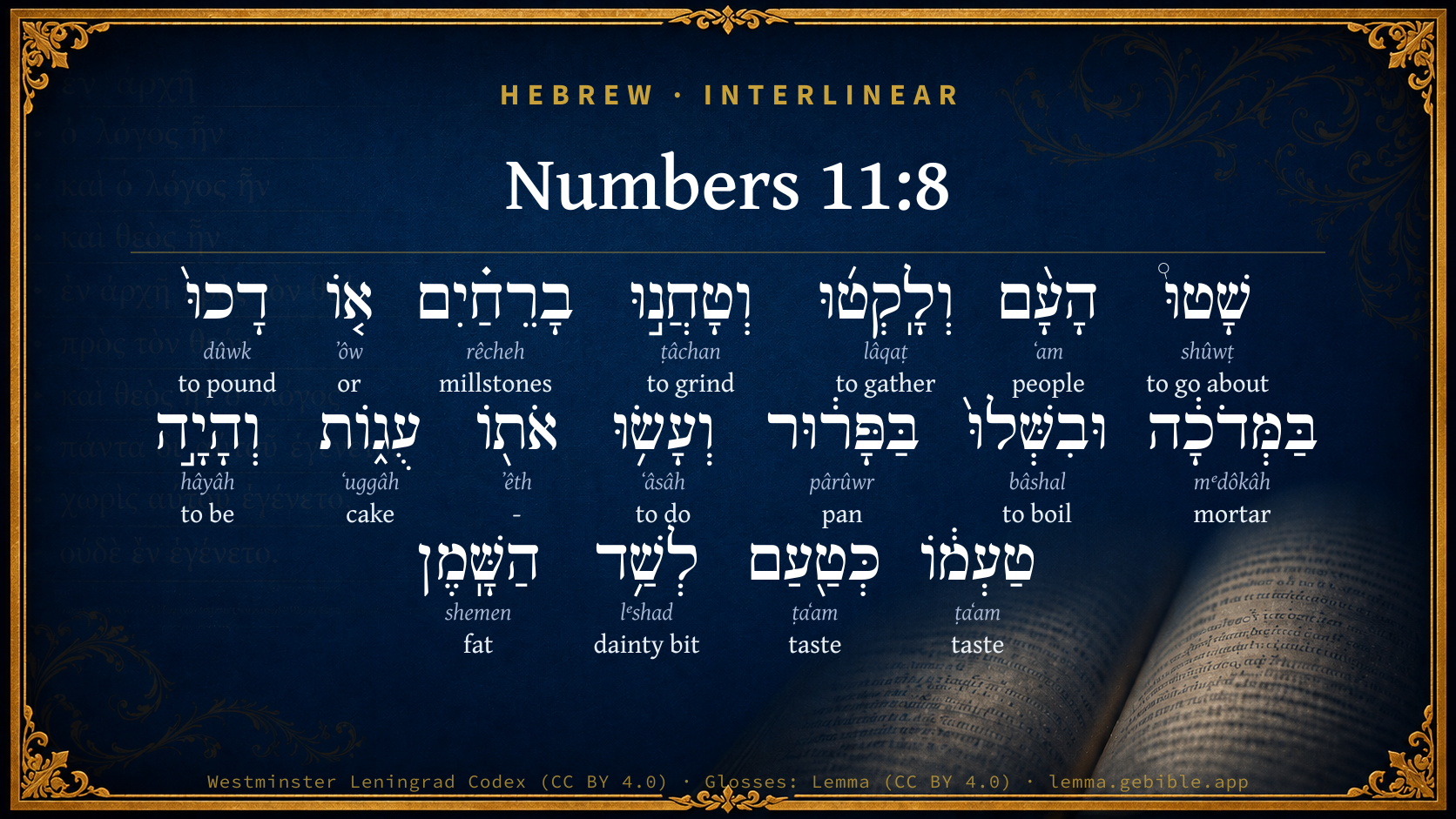
Numbers 11:8

Hebrew (Westminster Leningrad Codex) Numbers 11:8 appears in the Hebrew Old Testament. The text above is from the Westminster Leningrad Codex. Each word links to its Strong’s number, a concise gloss, and parsing drawn from the Open Scriptures Hebrew Bible morphology. Click any word for its full Brown-Driver-Briggs (BDB) entry.
Download image
Cite this verse

Numbers 11:8 (World English Bible). Public Domain. Lemma interlinear Bible study tool, https://lemma.gebible.app/v/numbers/11/8.

Show BibTeX & RIS
BibTeX
RIS
English Translation
The people went about, and gathered it, and ground it in mills, or beat it in mortars, and boiled it in pots, and made cakes of it: and the taste of it was as the taste of fresh oil.
World English Bible · Public Domain
Highlights
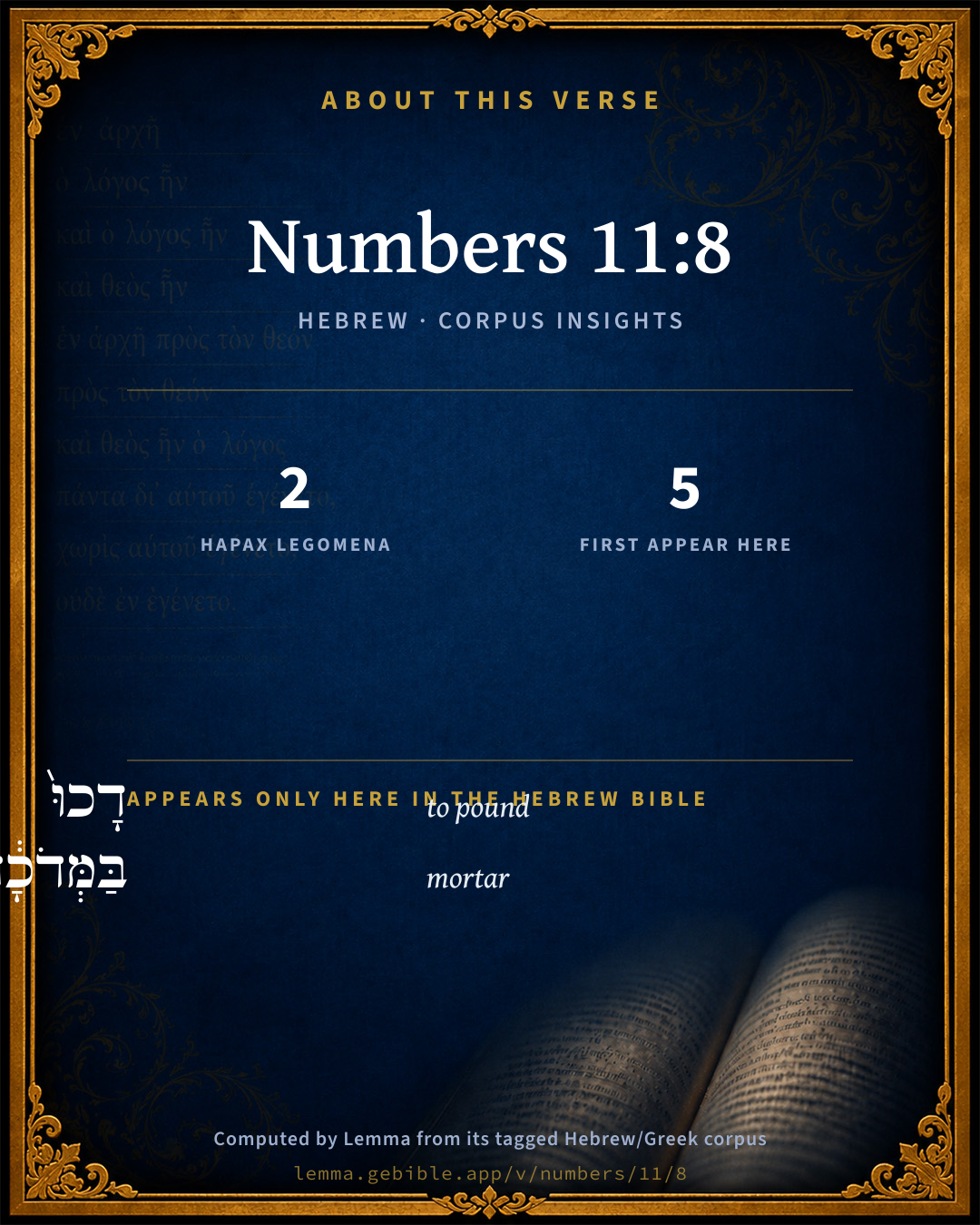
  • 2 hapax legomena — only here in the Hebrew Bible
  • 5 first appearances in the Hebrew Bible
Full analysis ↓
Download a study sheet

One document with this verse’s original text, its word-by-word gloss line, the meaning frame, cross-references with their text, attributed commentary, and full source and license credits — printable, and it pastes into notes with its structure intact.

This verse Autodidact and up

Study sheet (.html) Plain text (.txt)

A passage Seminary Student

Up to 50 verses in one chapter. A passage sheet keeps up to 6 commentary sources and 12 cross-references per verse, in the order this page ranks them, and says so on the sheet whenever that leaves anything out. Ask for a single verse and you get the Autodidact verse sheet above.

Everything on this page stays free to read, with no account — the sheet is a download of what is already on screen, not access to it.

Want to remove ads? Support Godless Engineer
Compare translations 3

The same verse in 3 English versions, stacked beneath the original-language interlinear above. Click any original word for its lexicon entry.

Each is an independent rendering of the whole verse — the interlinear is not word-aligned to these translations.

Highlighted words mark where these versions differ — a whole-verse word diff, not a word-by-word alignment.

  • World English Bible Public Domain
    The people went about, and gathered it, and ground it in mills, or beat it in mortars, and boiled it in pots, and made cakes of it: and the taste of it was as the taste of fresh oil.
  • King James Version Public Domain
    And the people went about, and gathered it, and ground it in mills, or beat it in a mortar, and baked it in pans, and made cakes of it: and the taste of it was as the taste of fresh oil.
  • unfoldingWord Literal Text CC BY-SA 4.0
    The people went about, and they gathered, and they ground in the mill or crushed in the mortar, and they boiled in the pot, and they made it cakes, and its taste was like the taste of the freshness of the oil.

unfoldingWord Literal Text — © unfoldingWord, licensed CC BY-SA 4.0. Word-aligned USFM3 via Door43 (git.door43.org/unfoldingWord/en_ult).

Versions to compare (up to 4)

3 of 4 selected

Show all 18 translations

Every available English version of this verse, each an independent rendering of the whole verse.

  • World English Bible Public Domain
    The people went about, and gathered it, and ground it in mills, or beat it in mortars, and boiled it in pots, and made cakes of it: and the taste of it was as the taste of fresh oil.
  • Berean Standard Bible Public Domain
    The people walked around and gathered it, ground it on a handmill or crushed it in a mortar, then boiled it in a cooking pot or shaped it into cakes. It tasted like pastry baked with fine oil.
  • Majority Standard Bible Public Domain
    The people walked around and gathered it, ground it on a handmill or crushed it in a mortar, then boiled it in a cooking pot or shaped it into cakes. It tasted like pastry baked with fine oil.
  • King James Version Public Domain
    And the people went about, and gathered it, and ground it in mills, or beat it in a mortar, and baked it in pans, and made cakes of it: and the taste of it was as the taste of fresh oil.
  • American Standard Version (1901) Public Domain
    The people went about, and gathered it, and ground it in mills, or beat it in mortars, and boiled it in pots, and made cakes of it: and the taste of it was as the taste of fresh oil.
  • Revised Version (1885) Public Domain
    The people went about, and gathered it, and ground it in mills, or beat it in mortars, and seethed it in pots, and made cakes of it: and the taste of it was as the taste of fresh oil.
  • Geneva Bible (1599) Public Domain
    The people went about and gathered it, and ground it in milles, or beat it in morters, and baked it in a cauldron, and made cakes of it, and the taste of it was like vnto the taste of fresh oyle.
  • Douay-Rheims (1899) Public Domain
    And the people went about, and gathering it, ground it in a mill, or beat it in a mortar, and boiled it in a pot, and made cakes thereof of the taste of bread tempered with oil.
  • Young's Literal Translation Public Domain
    the people have turned aside and gathered `it', and ground `it' with millstones, or beat `it' in a mortar, and boiled `it' in a pan, and made it cakes, and its taste hath been as the taste of the moisture of oil.
  • Literal Standard Version CC BY-SA 4.0
    the people have turned aside and gathered [it], and ground [it] with millstones, or beat [it] in a mortar, and boiled [it] in a pan, and made it cakes, and its taste has been as the taste of the moisture of oil.
  • Unlocked Literal Bible CC BY-SA 4.0
    The people walked around and gathered it. They ground it in mills, beat it in mortars, boiled it in pots, and made it into cakes. It tasted like fresh olive oil.
  • unfoldingWord Literal Text CC BY-SA 4.0
    The people went about, and they gathered, and they ground in the mill or crushed in the mortar, and they boiled in the pot, and they made it cakes, and its taste was like the taste of the freshness of the oil.
  • Darby Bible Public Domain
    The people went about, and gathered it, and ground it with hand-mills, or beat it in mortars, and boiled it in pots, and made cakes of it; and the taste of it was as the taste of oil-cakes.
  • World Messianic Bible Public Domain
    The people went around, gathered it, and ground it in mills, or beat it in mortars, and boiled it in pots, and made cakes of it. Its taste was like the taste of fresh oil.
  • Webster's Bible Public Domain
    And the people went about, and gathered it and ground it in mills, or beat it in a mortar, and baked it in pans, and made cakes of it: and the taste of it was as the taste of fresh oil.
  • Free Bible Version CC BY-SA 4.0
    The people would go out and collect it, grind it up in a mill or crush it in a mortar. Then they would boil it in a pot and make it into flatbread. It tasted like pastries made with the best olive oil.
  • Bible in Basic English Public Domain
    The people went about taking it up from the earth, crushing it between stones or hammering it to powder, and boiling it in pots, and they made cakes of it: its taste was like the taste of cakes cooked with oil.
  • JPS Tanakh (1917) Public Domain
    The people went about, and gathered it, and ground it in mills, or beat it in mortars, and seethed it in pots, and made cakes of it; and the taste of it was as the taste of a cake baked with oil.

Literal Standard Version (2020), Covenant Press — licensed CC BY-SA 4.0. Text via the HelloAO Bible API (eBible.org). Unlocked Literal Bible (unfoldingWord) — licensed CC BY-SA 4.0. Text via the HelloAO Bible API (eBible.org). unfoldingWord Literal Text — © unfoldingWord, licensed CC BY-SA 4.0. Word-aligned USFM3 via Door43 (git.door43.org/unfoldingWord/en_ult). Free Bible Version, Dr. Jonathan Gallagher — licensed CC BY-SA 4.0. Text via the HelloAO Bible API (eBible.org).

Word by word

More ways to search: Search by grammar → Find every occurrence → Compare this word →

Practice this passage: Drill this verse → Learn its vocabulary →

דָכוּ֙
dûwk
H1743
“to pound”
Verb, Qal, Perfect, 3rd Person, Common, Plural
Part of Speech
Verb
Stem
Qal
Form
Perfect
Person
3rd Person
Gender
Common
Number
Plural
Full BDB Definition

Origin: a primitive root

TWOT: 413

(Qal) to pound, beat (in mortar)
  1. שָׁטוּ֩ shûwṭ H7751 “to go about” Verb, Qal, Perfect, 3rd Person, Common, Plural
  2. הָעָ֨ם ʻam H5971 “the · people” Particle, Definite Article + Noun, Common, Masculine, Singular, Absolute
  3. וְלָֽקְט֜וּ lâqaṭ H3950 “and · to gather” Conjunction + Verb, Qal, Sequential Perfect, 3rd Person, Common, Plural
  4. וְטָחֲנ֣וּ ṭâchan H2912 “and · to grind” Conjunction + Verb, Qal, Sequential Perfect, 3rd Person, Common, Plural
  5. בָרֵחַ֗יִם rêcheh H7347 “in/at the · millstones” Preposition, Determined + Noun, Common, Masculine, Dual, Absolute
  6. א֤וֹ ʼôw H176 “or” Conjunction
  7. בַּמְּדֹכָ֔ה mᵉdôkâh H4085 “in/at the · mortar” Preposition, Determined + Noun, Common, Feminine, Singular, Absolute
  8. וּבִשְּׁלוּ֙ bâshal H1310 “and · to boil” Conjunction + Verb, Piel, Sequential Perfect, 3rd Person, Common, Plural
  9. בַּפָּר֔וּר pârûwr H6517 “in/at the · pan” Preposition, Determined + Noun, Common, Masculine, Singular, Absolute
  10. וְעָשׂ֥וּ ʻâsâh H6213 “and · to do” Conjunction + Verb, Qal, Sequential Perfect, 3rd Person, Common, Plural
  11. אֹת֖וֹ ʼêth H853 “- · him” Particle, Direct Object + Suffix, Personal, 3rd Person, Masculine, Singular
  12. עֻג֑וֹת ʻuggâh H5692 “cakes” Noun, Common, Feminine, Plural, Absolute
  13. וְהָיָ֣ה hâyâh H1961 “and · to be” Conjunction + Verb, Qal, Sequential Perfect, 3rd Person, Masculine, Singular
  14. טַעְמ֔וֹ ṭaʻam H2940 “taste · his” Noun, Common, Masculine, Singular, Construct + Suffix, Personal, 3rd Person, Masculine, Singular
  15. כְּטַ֖עַם ṭaʻam H2940 “like/as · taste of” Preposition + Noun, Common, Masculine, Singular, Construct
  16. לְשַׁ֥ד lᵉshad H3955 “dainty bit of” Noun, Common, Masculine, Singular, Construct
  17. הַשָּֽׁמֶן shemen H8081 “the · fat” Particle, Definite Article + Noun, Common, Masculine, Singular, Absolute

About this verse

These counts appear in no published source. They are computed here, from the morphology-tagged text and Lemma’s own curated glosses. What Lemma adds →

18
words
17
distinct lemmas
Pentateuch
section

Notable vocabulary

2 hapax legomena — words that appear only here in the entire Hebrew Bible:

  • דָכוּ֙ to pound H1743
  • בַּמְּדֹכָ֔ה mortar H4085

First appearance in Scripture

These words make their first canonical appearance in the Hebrew Bible here:

  • שָׁטוּ֩ to go about H7751
  • דָכוּ֙ to pound H1743
  • בַּמְּדֹכָ֔ה mortar H4085
  • בַּפָּר֔וּר pan H6517
  • לְשַׁ֥ד dainty bit H3955

Shared distinctive vocabulary

לְשַׁ֥ד dainty bit H3955 occurs in 2 verses of the Hebrew Bible. Also found in:

Grammatical profile

  • 7 verbs
  • 9 nouns
  • 1 conjunction
  • 1 particle

Verb forms

  • שָׁטוּ֩ Qal · Perfect
  • וְלָֽקְט֜וּ Qal · Sequential Perfect
  • וְטָחֲנ֣וּ Qal · Sequential Perfect
  • דָכוּ֙ Qal · Perfect
  • וּבִשְּׁלוּ֙ Piel · Sequential Perfect
  • וְעָשׂ֥וּ Qal · Sequential Perfect
  • וְהָיָ֣ה Qal · Sequential Perfect

Repetition

A word recurs within this verse — often emphatic in Hebrew:

  • טַעְמ֔וֹ taste H2940 ×2

Hebrew & Septuagint length

In English translation the verse runs 39 words from the Hebrew and 46 from the Septuagint (LXX English) — closely comparable.

A rough comparison of the two English renderings, which tokenize alike — not a word-level alignment.

Word counts can differ between the Hebrew and the Greek without any difference in meaning — e.g. the Hebrew direct-object marker אֵת has no separate Greek word, and Greek often adds the article ὁ.

Cross-references

5

Topical passages linked to Numbers 11:8 in the Treasury of Scripture Knowledge — connected by theme and wording, ordered by reader-vote popularity; previews shown in the World English Bible.

  • Exodus 16:31 The house of Israel called the name of it Manna, and it was like coriander seed, white; and its taste was like wafers with honey.
  • Exodus 16:16–18 This is the thing which Yahweh has commanded: "Gather of it everyone according to his eating; an omer a head, according to the number of your persons, shall you take it, every man for those who are in his tent."
  • Exodus 16:23 He said to them, "This is that which Yahweh has spoken, 'Tomorrow is a solemn rest, a holy Sabbath to Yahweh. Bake that which you want to bake, and boil that which you want to boil; and all that remains over lay up for yourselves to be kept until the morning."
  • John 6:27 Don't work for the food which perishes, but for the food which remains to eternal life, which the Son of Man will give to you. For God the Father has sealed him."
  • John 6:33–58 For the bread of God is that which comes down out of heaven, and gives life to the world."

Cross-references courtesy of OpenBible.info (CC BY 4.0).

Hebrew and Greek witnesses Masoretic Hebrew ↔ Greek Septuagint

The same verse in the two great witnesses to the Old Testament, shown verse-for-verse.

These are two independent witnesses, not word-aligned to each other, and the Septuagint is shown in lemma (dictionary) form.

Hebrew Numbers 11:8 Masoretic · Westminster Leningrad Codex

שָׁטוּ֩ הָעָ֨ם וְלָֽקְט֜וּ וְטָחֲנ֣וּ בָרֵחַ֗יִם א֤וֹ דָכוּ֙ בַּמְּדֹכָ֔ה וּבִשְּׁלוּ֙ בַּפָּר֔וּר וְעָשׂ֥וּ אֹת֖וֹ עֻג֑וֹת וְהָיָ֣ה טַעְמ֔וֹ כְּטַ֖עַם לְשַׁ֥ד הַשָּֽׁמֶן

The people went about, and gathered it, and ground it in mills, or beat it in mortars, and boiled it in pots, and made cakes of it: and the taste of it was as the taste of fresh oil.

World English Bible · Public Domain

Greek LXX Numbers 11:8 Septuagint · lemma form

καί διαπορεύομαι ὁ λαός καί συνλέγω καί ἀλήθω αὐτός ἐν ὁ μύλος καί τρίβω ἐν ὁ θυεία καί ἕψω αὐτός ἐν ὁ χύτρᾳ καί ποιέω αὐτός ἐγκρυφίας καί εἰμί ὁ ἡδονή αὐτός ὡσεί γεῦμα ἐγκρίς ἐκ ἔλαιον

And the people went through the field, and gathered, and ground it in the mill, or pounded it in a mortar, and baked it in a pan, and made cakes of it; and the sweetness of it was as the taste of wafer made with oil.

LXX2012 (modern English Septuagint) · Public Domain

On this verse, The Cambridge Bible for Schools and Colleges discusses the Septuagint’s reading. Read the note in Commentary ↓

Hebrew: Westminster Leningrad Codex (CC BY 4.0). Greek: Septuagint (public domain); English from LXX2012 (modern English Septuagint) (Public Domain). How the Septuagint differs from the Hebrew →

Targum (Aramaic paraphrase)

2

The Targum is the ancient Jewish Aramaic paraphrase of the Hebrew Scriptures — an interpretive translation, not the Hebrew text itself. Onkelos (literal) and Pseudo-Jonathan (expansive) render the Torah, and Jonathan the Prophets. Coverage is partial: where no permissively-licensed English translation exists for a verse, only the Aramaic is shown. This is verse-level text, not a word-by-word alignment to the Hebrew.

  1. Targum Onkelos Torah (Genesis–Deuteronomy)
    שַׁיְטִין עַמָא וְלָקְטִין דְצָבֵי טָחִין בְּרֵיחַיָא אוֹ דְצָבֵי דָאִיךְ בִּמְדֻכְתָּא וּמְבַשְׁלִין לֵהּ בְּקִדְרָא וְעָבְדִין יָתֵהּ גְרִיצָן וַהֲוָה טַּעֲמֵהּ כִּטְעֵם דְלִישׁ בְּמִשְׁחָא

    (no public-domain English translation for this verse)

    Targum Onkelos — Aramaic: “Onkelos Genesis” (public domain); “Onkelos Exodus” (public domain); “Onkelos Leviticus” (public domain); “Onkelos Numbers” (public domain); “Onkelos Deuteronomy” (public domain). English: “Sefaria Community Translation” (CC0 1.0 (public-domain dedication)); “J.W. Etheridge. The Targums of Onkelos and Jonathan Ben Uzziel on the Pentateuch. London: Longmans, Green, 1862” (public domain). Text via Sefaria.

  2. Targum Pseudo-Jonathan Torah (Genesis–Deuteronomy)
    חַפְסִין רַשִׁיעֵי עַמָא וּמְלַקְטִין וְטַחְנִין בְּרֵיחוּתָא וּמַן דַהֲוָה צָבֵי הֲוָה שָׁחֵיק בְּדִיכוּתָא וּמְבַשְׁלִין לֵיהּ בְּלָאפוּסְיָא וְעַבְדִין מִנֵיהּ חֲרָרָן וְהַוֵי טַעֲמֵיהּ כְטַעַם בִּיזָא דִמְסַרְבְּלָא בְּשׁוּמְנָא

    And the wicked people looked about, and collected, and ground it in the mill. But he who would, bruised it in the mortar, or dressed it in the pot, or made cakes of it; and the taste of it was like the taste of cream covered with oil.

    Targum Pseudo-Jonathan — Aramaic: “Targum Jonathan on Genesis” (public domain); “Targum Jonathan on Exodus” (public domain); “Targum Jonathan on Leviticus” (public domain); “Targum Jonathan on Numbers” (public domain); “Targum Jonathan on Deuteronomy” (public domain). English: “The Targum of Jonathan ben Uzziel, trans. J. W. Etheridge, London, 1862” (public domain). Text via Sefaria.

Commentary

Notes on Numbers 11:8 from classic Christian and Jewish commentators (each source and its license shown beneath its notes). The classic Christian expositions comment on the surrounding passage and are grouped to its opening verse, so a note may address several verses; the Jewish commentaries on the Tanakh (Rashi and others) are per-verse, so they appear only where the commentator wrote on this verse.

Lemma curates 59 commentaries, every one of them public domain or Creative Commons licensed, each selected and text-cleaned for this edition rather than reprinted as found. About our sources →

Trapp's Complete Commentary

John Trapp

Num 11:8 [And] the people went about, and gathered [it], and ground [it] in mills, or beat [it] in a mortar, and baked [it] in pans, and made cakes of it: and the taste of it was as the taste of fresh oil.

Ver. 8. And the people went about.] Or, "Went to and fro," as men ought still to "increase knowledge," {Dan 12:4} "labouring for the meat that endureth to eternal life." {Joh 6:27} God might have saved them this labour, by raining manna into their mouths; but he would not, for the trial of their diligence; and that they might not think that worth nothing, that cost them nothing.

And ground it in mills.] So was Jesus Christ ground and pounded with passion, baked and dried up in the oven of his Father’s displeasure, before he became fit food, and a Saviour to his Church.

As the taste of fresh oil.] Or, Wafers baked with honey. {Exo 16:31} The sweet promises of grace are sweeter than honey. {Psa 19:10} No fresh and sweet oil can so cherish the face, as they do the heart of a believer.

John Trapp, A Commentary or Exposition upon All the Books of the Old and New Testament (1647–1656) — public domain. Text from a community e-Sword module.

Ellicott's Commentary for English Readers

(8) As the taste of fresh oil.—Or, of a fat cake of oil. In Exo_16:31 the taste of the manna is said to have been “like wafers made with honey.” The ancients used flour cakes mixed with oil and honey.

A Bible Commentary for English Readers, edited by Charles John Ellicott (1878–1897) — public domain. Text from a community e-Sword module.

The Cambridge Bible for Schools and Colleges

gen. ed. J. J. S. Perowne

8. fresh oil] a dainty prepared with oil. The word rendered ‘dainty’ denotes something juicy. LXX. has ἐνκρίς, which was a cake made with oil and honey; cf. ‘like wafers made with honey’ (Exod.).

The Cambridge Bible for Schools and Colleges (gen. ed. J. J. S. Perowne; Cambridge University Press, 1878–1918) — public domain. Text from a community e-Sword module.

John Gill's Exposition

And the people went about and gathered it,.... Went about the camp on all sides, where it fell in plenty; this they did every morning, and this was all the trouble they were at; they had it for gathering, without any expense to them:

and ground it in mills: in hand mills, as Aben Ezra; for though it melted through the heat of the sun, and became a liquid, yet, when gathered in the morning, it was hard like grains of corn, or other seeds, and required to be ground in mills:

or beat it in a mortar; with a pestle, as spices are beaten and bruised:

and baked it in pans; or rather boiled it in a pot, as the Targums of Jonathan and Jerusalem, since it follows:

and made cakes of it; which were baked on the hearth; all which may denote the sufferings of Christ, who was beaten, and bruised, and broken, that he might become fit food for faith, Isa 53:4,

and the taste of it was as the taste of fresh oil; which is very grateful and pleasant, as well as very fattening and nourishing; so that the Israelites had no reason to complain of their being dried away by continual eating of it; See Gill on Exo 16:31.

John Gill's Exposition of the Whole Bible (1746–1763) — public domain (CC PDM 1.0). Text via the HelloAO Bible API.

Haydock's Catholic Bible Commentary

Oil; or, when unprepared, like flour and honey, Exodus xvi. 31. (Calmet)

George Leo Haydock (1774–1849), Haydock's Catholic Family Bible and Commentary, 1859 edition — public domain. Excludes Psalms (Douay-Rheims chapter numbering differs from Protestant) and Deuterocanonical books (Catholic canon only).

Matthew Poole's English Annotations

Or, of the most excellent oil; or, of the flour of oil; or, as others, of cakes or paste made with the best oil, the word cakes being easily supplied out of the foregoing member of the verse; or, which is not much differing, like wafers made with honey, as it is said Exo 16:31. The nature and use of manna is here thus particularly described to show the greatness of their sin in despising such excellent food as this was.

Matthew Poole's English Annotations on the Holy Bible (1683–1685) — public domain. Text from a community e-Sword/MySword module.

Whedon's Commentary on the Bible

Daniel D. Whedon

8. Ground it in mills — These probably differed but little from the Syrian mills of the present time. The mortar is still used by the Arabs to pound wheat for kibby, their national dish.

Pans — R.V., “seethed it in pots.” The same Hebrew word is rendered pot in Jdg_6:19, and 1Sa_2:14.

As the taste of fresh oil — Olive oil. In Exo_16:31, manna is said to have the taste of honey. Olive-oil and honey entered largely into the diet of the Hebrews in Canaan; they are also prominent articles of food to the Easterns at this day.

Daniel D. Whedon (gen. ed.), Commentary on the Old and New Testaments (1874–1909) — public domain. Text from a community e-Sword module.

The Pulpit Commentary

And the people... ground it in mills. This information as to the preparation of the manna is new. It may be supposed that at first the people ate it in its natural state, but that afterwards they found out how to prepare it in different ways for the sake of variety. Small handmills and mortars for the preparation of grain they would have brought with them from their Egyptian homes. As the taste of fresh oil. In Exo_16:31 it is said to have tasted like wafers made with honey. Nothing is more impossible adequately to describe than a fresh taste. It is sufficient to note that the two things suggested by the taste of the manna, honey and oil, present the greatest possible contrast to the heavy or savoury food which they remembered in Egypt.

The Pulpit Commentary (1880–1919), ed. H.D.M. Spence-Jones & Joseph S. Exell — public domain. Text from a community e-Sword module.

John Wesley's Explanatory Notes

Fresh oil - Or, of the most excellent oil; or of cakes made with the best oil, the word cakes being easily supplied out of the foregoing member of the verse; or, which is not much differing, like wafers made with honey, as it is said Exod. xvi, 31. The nature and use of Manna is here thus particularly described, to shew the greatness of their sin in despising such excellent food.

John Wesley, Explanatory Notes Upon the Whole Bible (1754–1765) — public domain. Text via the GEBible commentary corpus.

Rashi

Rabbi Shlomo Yitzchaki (Rashi)

שטו [AND THE PEOPLE] WENT ABOUT — The term שיוט (i. e. any form of the root שוט) denotes strolling about; esbanoyer in O. F., English to walk about leisurely — they got the manna without exertion (cf. however, Yoma 75a and thereon s. v. ירד המן עליו).

וטחנו ברחים וגו׳ AND THE PEOPLE GROUND IT WITH MILL STONES [OR POUNDED IT IN THE MORTAR, AND BAKED IT IN PANS] — As a matter of fact it (the manna) never went into a mill, nor a pot, nor a mortar, but its taste changed, according to one’s desire, into that of ground or pounded or cooked grain (Sifrei Bamidbar 89).

בפרור — means [IN] A POT.

לשד השמן [AND ITS TASTE WAS AS THE TASTE OF] — לשד השמן i. e. moisture of oil. Thus did Dunash ibn Labrat explain it. Similar to it is, (Psalms 32:4) נהפך לשדי בחרבוני קיץ, where the ל in the word לשד is a root-letter, the meaning being: “my sap (לשדי) is turned by the drought of summer”. Our Rabbis (Sifrei Bamidbar 89) explained it as meaning “breasts’ (i. e. just as the suckling imbibes, so to speak, every possible flavor with the mother-milk. so the Israelites found all flavors in the manna; cf. Sifrei), but really the subject of “breasts” has nothing to do with oil. One cannot, however, in order to justify the explanation of our Rabbis say that השמן in לשד השמן has a meaning similar to (Deuteronomy 32:15) וישמן ישורון, “But Jeshurun waxed fat (וישמן)” (when the meaning would be: “And the taste of it was similar to that of a fat breast”), for then the מ ought to be punctuated with Kametz (our Tséré: הַשָּׁמֵן) and the accent ought to be on the last syllable, beneath the מ. Now, however, that the מ is punctuated with Patach Katon (our Segol) and the accent is on the ש, it can only have a sense connected with שמן “oil”. As to the ש which is punctuated with Kametz Gadol (שָׁמן) and not with Segol (since the noun “oil” is שֶׁמן,) this is so because the word is at the end of the verse (and in the pausal form שֶׁמֶן becomes שָׁמֶן). — Another explanation is that לשד is an acrostic of ליש, “kneading”, שמן “oil”, דבש “honey”, i. e. that the manna was like “dough kneaded with oil, and smeared with honey” (קטף literally means “to tear”, and when used of dough it means “to tear a lump of dough into pieces for which purpose the kneader moistens his hands with some liquid; here with honey) (Sifrei Bamidbar 89). The rendering of Onkelos who translates the phrase by דליש במשחא, “[as the taste] of dough with oil”, inclines to the meaning given by Dunash, because dough which is kneaded with oil has in it some moisture of oil.

Rashi on the Tanakh — English translations: “The Judaica Press complete Tanach with Rashi, translated by A. J. Rosenberg” (CC BY 4.0); “Pentateuch with Rashi's commentary by M. Rosenbaum and A.M. Silbermann, 1929-1934” (public domain); “The Metsudah Tanach series, Lakewood, N.J” (CC BY 4.0); and “The Book of Joshua, Metsudah Publications, 1997” (CC BY 4.0). Text via Sefaria.

Lesson kit

Teaching starters — assembled from the data on this page, not authored interpretation. Every prompt links to the verse data it draws on. Edit before teaching.

Numbers, in the Pentateuch, opens this verse with 18 words (17 distinct Hebrew lemmas). Its most distinctive word is dûwk (“to pound”). A historical commentator’s framing appears above. Read the whole chapter for the surrounding context.

Discussion questions

  1. What does “to pound” (dûwk) contribute to the verse as a whole?
  2. This verse holds 2 words here found nowhere else in the Hebrew Bible. What might the rare words draw attention to?
  3. 5 words here appear for the first time in Scripture. What is being introduced at this debut?
  4. Psalms 32:4 shares the word «dainty bit» with this verse. How do the two illuminate each other?
  5. “taste” occurs 2× in this one verse. What is the effect of the repetition?
  6. The translations on this page render this verse differently — a whole-verse word diff, not a word-by-word alignment. What might account for the different wordings?
  7. The verb «שָׁטוּ֩» is Qal Perfect. How does its form color the action?
  8. Reading how Trapp's Complete Commentary and Ellicott's Commentary for English Readers read this verse, where do the two commentators agree and where do they part?

Things to notice

  • 2 words in this verse appear nowhere else in the Hebrew Bible.
  • 5 words make their first canonical appearance in Scripture here.
  • These translations choose different wording for 14 words in this verse.
  • “taste” occurs 2× in this single verse.
  • 17 distinct Hebrew lemmas span 18 words in this verse.

Reading settings

Reading text

Shown beneath each verse's original-language words.

Old Testament
Old Testament edition

Read the OT as the Masoretic Hebrew (MT) or the Greek Septuagint (LXX).

English shown for the Greek Septuagint (in the Hebrew ↔ Greek comparison).

Comparing translations? Open the Compare panel on any verse page to stack up to four side by side.