1 Chronicles 27:28

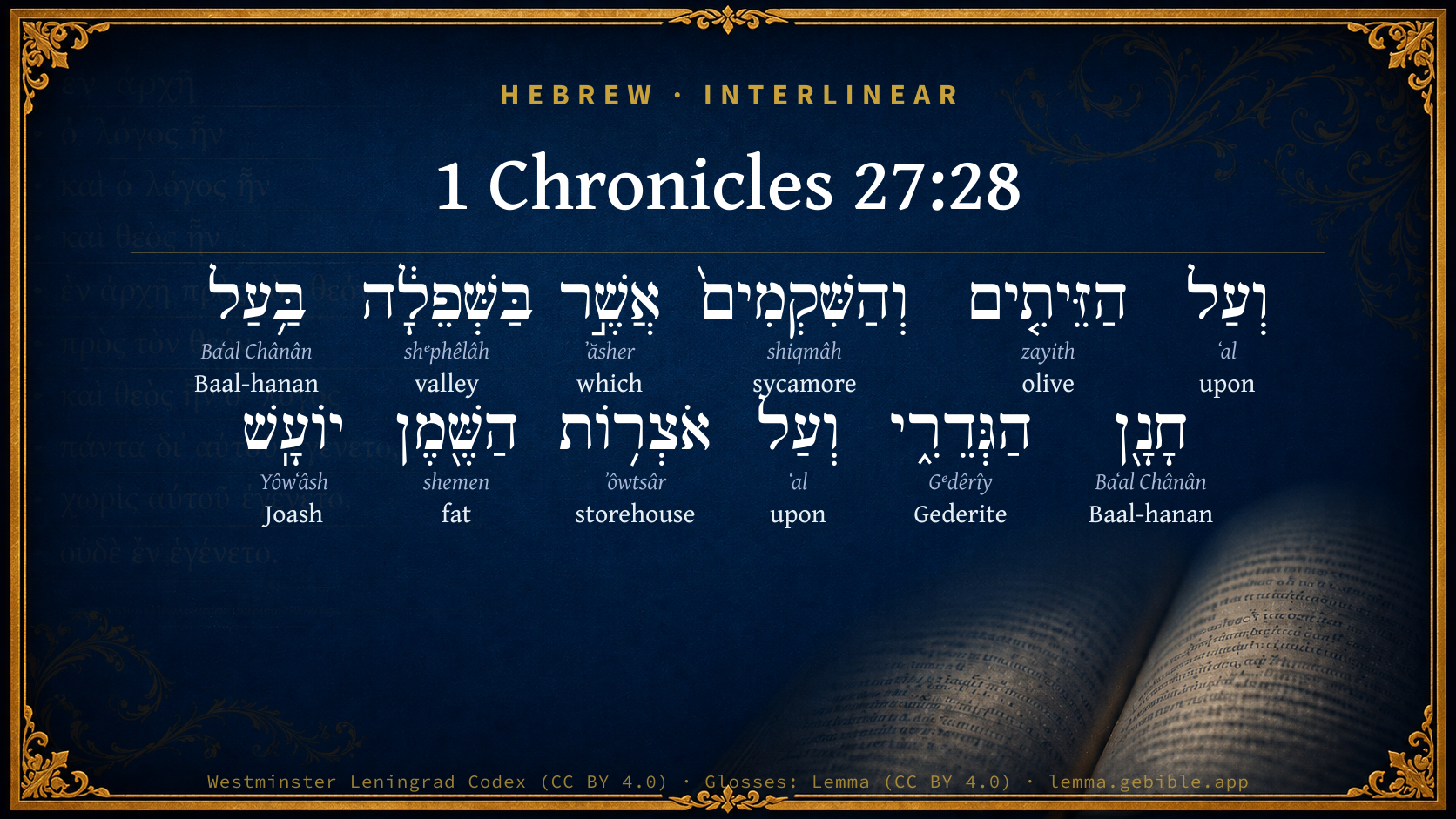
Hebrew (Westminster Leningrad Codex) 1 Chronicles 27:28 appears in the Hebrew Old Testament. The text above is from the Westminster Leningrad Codex. Each word links to its Strong’s number, a concise gloss, and parsing drawn from the Open Scriptures Hebrew Bible morphology. Click any word for its full Brown-Driver-Briggs (BDB) entry.
Download image
Cite this verse

1 Chronicles 27:28 (World English Bible). Public Domain. Lemma interlinear Bible study tool, https://lemma.gebible.app/v/1-chronicles/27/28.

Show BibTeX & RIS
BibTeX
RIS
English Translation
and over the olive trees and the sycamore trees that were in the lowland was Baal Hanan the Gederite: and over the cellars of oil was Joash:
World English Bible · Public Domain
Highlights
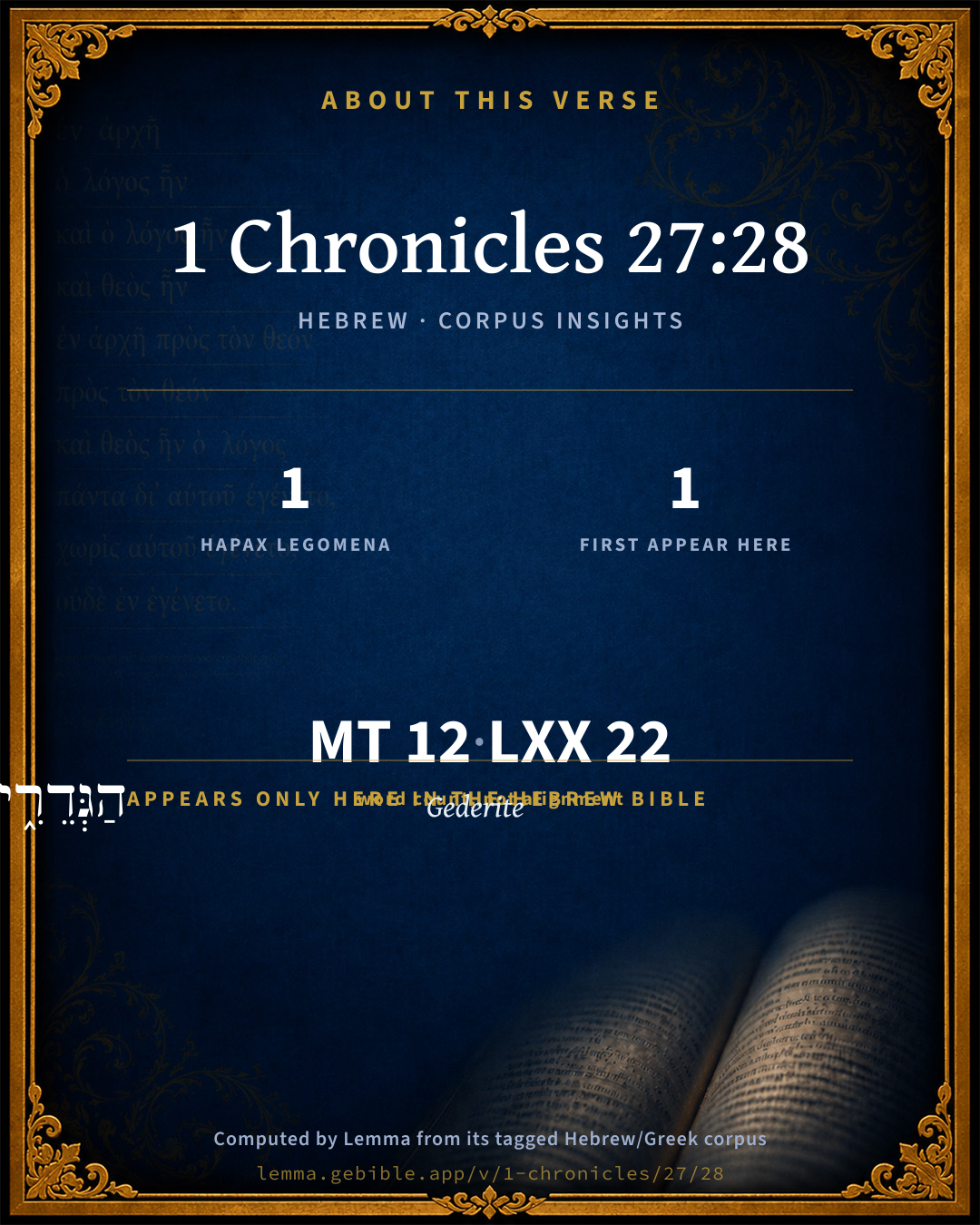
  • 1 hapax legomenon — only here in the Hebrew Bible
  • 1 first appearance in the Hebrew Bible
Full analysis ↓
Download a study sheet

One document with this verse’s original text, its word-by-word gloss line, the meaning frame, cross-references with their text, attributed commentary, and full source and license credits — printable, and it pastes into notes with its structure intact.

This verse Autodidact and up

Study sheet (.html) Plain text (.txt)

A passage Seminary Student

Up to 50 verses in one chapter. A passage sheet keeps up to 6 commentary sources and 12 cross-references per verse, in the order this page ranks them, and says so on the sheet whenever that leaves anything out. Ask for a single verse and you get the Autodidact verse sheet above.

Everything on this page stays free to read, with no account — the sheet is a download of what is already on screen, not access to it.

Want to remove ads? Support Godless Engineer
Compare translations 3

The same verse in 3 English versions, stacked beneath the original-language interlinear above. Click any original word for its lexicon entry.

Each is an independent rendering of the whole verse — the interlinear is not word-aligned to these translations.

Highlighted words mark where these versions differ — a whole-verse word diff, not a word-by-word alignment.

  • World English Bible Public Domain
    and over the olive trees and the sycamore trees that were in the lowland was Baal Hanan the Gederite: and over the cellars of oil was Joash:
  • King James Version Public Domain
    And over the olive trees and the sycamore trees that were in the low plains was Baalhanan the Gederite: and over the cellars of oil was Joash:
  • unfoldingWord Literal Text CC BY-SA 4.0
    And over the olive trees and the sycamore trees that in the Shephelah Baal Hanan the Gederite. And over the treasuries of oil Joash.

unfoldingWord Literal Text — © unfoldingWord, licensed CC BY-SA 4.0. Word-aligned USFM3 via Door43 (git.door43.org/unfoldingWord/en_ult).

Versions to compare (up to 4)

3 of 4 selected

Show all 18 translations

Every available English version of this verse, each an independent rendering of the whole verse.

  • World English Bible Public Domain
    and over the olive trees and the sycamore trees that were in the lowland was Baal Hanan the Gederite: and over the cellars of oil was Joash:
  • Berean Standard Bible Public Domain
    Baal-hanan the Gederite was in charge of the olive and sycamore trees in the foothills. Joash was in charge of the stores of olive oil.
  • Majority Standard Bible Public Domain
    Baal-hanan the Gederite was in charge of the olive and sycamore trees in the foothills. Joash was in charge of the stores of olive oil.
  • King James Version Public Domain
    And over the olive trees and the sycamore trees that were in the low plains was Baalhanan the Gederite: and over the cellars of oil was Joash:
  • American Standard Version (1901) Public Domain
    and over the olive-trees and the sycomore-trees that were in the lowland was Baal-hanan the Gederite: and over the cellars of oil was Joash:
  • Revised Version (1885) Public Domain
    and over the olive trees and the sycomore trees that were in the lowland was Baal-hanan the Gederite: and over the cellars of oil was Joash:
  • Geneva Bible (1599) Public Domain
    And ouer the oliue trees and mulberie trees that were in the valleys, was Baal Hanan the Gederite: and ouer the store of the oyle was Ioash:
  • Douay-Rheims (1899) Public Domain
    And over the oliveyards and the fig groves, which were in the plains, was Balanam a Gederite: and over the oil cellars, Joas.
  • Young's Literal Translation Public Domain
    and over the olives, and the sycamores, that `are' in the low country, `is' Baal-Hanan the Gederite; and over the treasures of oil `is' Joash;
  • Literal Standard Version CC BY-SA 4.0
    and Ba‘al-Hanan the Gederite [is] over the olives and the sycamores that [are] in the low country; and Joash [is] over the treasures of oil;
  • Unlocked Literal Bible CC BY-SA 4.0
    Over the olive trees and the sycamore trees that were in the lowlands was Baal-Hanan from Geder, and over the storehouses of oil was Joash.
  • unfoldingWord Literal Text CC BY-SA 4.0
    And over the olive trees and the sycamore trees that in the Shephelah Baal Hanan the Gederite. And over the treasuries of oil Joash.
  • Darby Bible Public Domain
    and over the olive-trees and the sycamore-trees that were in the lowland was Baal-hanan the Gederite; and over the cellars of oil was Joash.
  • World Messianic Bible Public Domain
    Over the olive trees and the sycamore trees that were in the lowland was Baal Hanan the Gederite. Over the cellars of oil was Joash.
  • Webster's Bible Public Domain
    And over the olive trees and the sycamore trees that were in the low plains was Baal-hanan the Gederite: and over the cellars of oil was Joash:
  • Free Bible Version CC BY-SA 4.0
    Baal-Hanan the Gederite was in charge of the olive and sycamore-fig trees in the foothills. Joash was in charge of the stores of olive oil.
  • Bible in Basic English Public Domain
    Baal-hanan the Gederite was responsible for the olive-trees and the sycamore-trees in the lowlands; and Joash for the stores of oil;
  • JPS Tanakh (1917) Public Domain
    and over the olive-trees and the sycomore-trees that were in the Lowland was Baal-hanan the Gederite; and over the cellars of oil was Joash;

Literal Standard Version (2020), Covenant Press — licensed CC BY-SA 4.0. Text via the HelloAO Bible API (eBible.org). Unlocked Literal Bible (unfoldingWord) — licensed CC BY-SA 4.0. Text via the HelloAO Bible API (eBible.org). unfoldingWord Literal Text — © unfoldingWord, licensed CC BY-SA 4.0. Word-aligned USFM3 via Door43 (git.door43.org/unfoldingWord/en_ult). Free Bible Version, Dr. Jonathan Gallagher — licensed CC BY-SA 4.0. Text via the HelloAO Bible API (eBible.org).

Word by word

More ways to search: Search by grammar → Find every occurrence → Compare this word →

Practice this passage: Drill this verse → Learn its vocabulary →

הַגְּדֵרִ֑י
Gᵉdêrîy
H1451
“the · Gederite”
Particle, Definite Article + Noun, Gentilic, Masculine, Singular, Absolute
Part of Speech
Particle + Noun
Type
Gentilic
Gender
Masculine
Number
Singular
State
Absolute
Full BDB Definition

Origin: patrial from H1445

TWOT: None

Gederite = "a wall" - an inhabitant of Geder
  1. וְעַל ʻal H5921 “and · upon” Conjunction + Preposition
  2. הַזֵּיתִ֤ים zayith H2132 “the · olives” Particle, Definite Article + Noun, Common, Masculine, Plural, Absolute
  3. וְהַשִּׁקְמִים֙ shiqmâh H8256 “and · the · sycamores” Conjunction + Particle, Definite Article + Noun, Common, Feminine, Plural, Absolute
  4. אֲשֶׁ֣ר ʼăsher H834 “which” Particle, Relative
  5. בַּשְּׁפֵלָ֔ה shᵉphêlâh H8219 “in/at the · valley” Preposition, Determined + Noun, Common, Feminine, Singular, Absolute
  6. בַּ֥עַל Baʻal Chânân H1177 “Baal-hanan” Noun, Proper
  7. חָנָ֖ן Baʻal Chânân H1177 “Baal-hanan” Noun, Proper
  8. וְעַל ʻal H5921 “and · upon” Conjunction + Preposition
  9. אֹצְר֥וֹת ʼôwtsâr H214 “storehouses of” Noun, Common, Masculine, Plural, Construct
  10. הַשֶּׁ֖מֶן shemen H8081 “the · fat” Particle, Definite Article + Noun, Common, Masculine, Singular, Absolute
  11. יוֹעָֽשׁ Yôwʻâsh H3135 “Joash” Noun, Proper

About this verse

These counts appear in no published source. They are computed here, from the morphology-tagged text and Lemma’s own curated glosses. What Lemma adds →

12
words
10
distinct lemmas
Historical
section

Notable vocabulary

1 hapax legomenon — a word that appears only here in the entire Hebrew Bible:

  • הַגְּדֵרִ֑י Gederite H1451

First appearance in Scripture

This word makes its first canonical appearance in the Hebrew Bible here:

  • הַגְּדֵרִ֑י Gederite H1451

Shared distinctive vocabulary

יוֹעָֽשׁ Joash H3135 occurs in 2 verses of the Hebrew Bible. Also found in:

Grammatical profile

  • 9 nouns
  • 2 prepositions
  • 1 particle

Repetition

Words recur within this verse — often emphatic in Hebrew:

  • וְעַל upon H5921 ×2
  • בַּ֥עַל Baal-hanan H1177 ×2

Hebrew & Septuagint length

In English translation the verse runs 27 words from the Hebrew and 25 from the Septuagint (LXX English) — closely comparable.

A rough comparison of the two English renderings, which tokenize alike — not a word-level alignment.

Word counts can differ between the Hebrew and the Greek without any difference in meaning — e.g. the Hebrew direct-object marker אֵת has no separate Greek word, and Greek often adds the article ὁ.

In the original languages it is 12 Hebrew tokens and 22 Greek tokens — but the two are counted differently (Hebrew bundles its prefixes and suffixes into one token; the Greek is in lemma form), so that isn’t a like-for-like length.

Cross-references

4

Topical passages linked to 1 Chronicles 27:28 in the Treasury of Scripture Knowledge — connected by theme and wording, ordered by reader-vote popularity; previews shown in the World English Bible.

  • 1 Kings 10:27 The king made silver to be in Jerusalem as stones, and cedars made he to be as the sycamore trees that are in the lowland, for abundance.
  • 2 Chronicles 1:15 The king made silver and gold to be in Jerusalem as stones, and cedars made he to be as the sycamore trees that are in the lowland, for abundance.
  • 1 Kings 4:7 Solomon had twelve officers over all Israel, who provided food for the king and his household: each man had to make provision for a month in the year.
  • 1 Kings 20:27 The children of Israel were mustered, and were provisioned, and went against them: and the children of Israel encamped before them like two little flocks of kids; but the Syrians filled the country.

Cross-references courtesy of OpenBible.info (CC BY 4.0).

Hebrew and Greek witnesses Masoretic Hebrew ↔ Greek Septuagint

The same verse in the two great witnesses to the Old Testament, shown verse-for-verse.

These are two independent witnesses, not word-aligned to each other, and the Septuagint is shown in lemma (dictionary) form.

Hebrew 1 Chronicles 27:28 Masoretic · Westminster Leningrad Codex

וְעַל הַזֵּיתִ֤ים וְהַשִּׁקְמִים֙ אֲשֶׁ֣ר בַּשְּׁפֵלָ֔ה בַּ֥עַל חָנָ֖ן הַגְּדֵרִ֑י וְעַל אֹצְר֥וֹת הַשֶּׁ֖מֶן יוֹעָֽשׁ

and over the olive trees and the sycamore trees that were in the lowland was Baal Hanan the Gederite: and over the cellars of oil was Joash:

World English Bible · Public Domain

Greek LXX 1 Chronicles 27:28 Septuagint · lemma form

καί ἐπί ὁ ἐλαιών καί ἐπί ὁ συκάμινος ὁ ἐν ὁ πεδεινός βαλανας ὁ γεδωρίτη ἐπί δέ ὁ θησαυρός ὁ ἔλαιον ιωας

And over the olive yards, and over the sycamores in the plain country was Ballanan the Gedorite; and over the stores of oil was Joas.

LXX2012 (modern English Septuagint) · Public Domain

On this verse, The Pulpit Commentary discusses the Septuagint’s reading. Read the note in Commentary ↓

Hebrew: Westminster Leningrad Codex (CC BY 4.0). Greek: Septuagint (public domain); English from LXX2012 (modern English Septuagint) (Public Domain). How the Septuagint differs from the Hebrew →

Commentary

Notes on 1 Chronicles 27:28 from classic Christian and Jewish commentators (each source and its license shown beneath its notes). The classic Christian expositions comment on the surrounding passage and are grouped to its opening verse, so a note may address several verses; the Jewish commentaries on the Tanakh (Rashi and others) are per-verse, so they appear only where the commentator wrote on this verse.

Lemma curates 59 commentaries, every one of them public domain or Creative Commons licensed, each selected and text-cleaned for this edition rather than reprinted as found. About our sources →

Jamieson, Fausset & Brown

Robert Jamieson, A. R. Fausset & David Brown

olive trees and the sycamore trees . . . in the low plains--that is, the Shephela, the rich, low-lying ground between the Mediterranean and the mountains of Judah.

Jamieson, Fausset & Brown — Commentary Critical and Explanatory on the Whole Bible (1871) — public domain (CC PDM 1.0). Text via the HelloAO Bible API.

Adam Clarke's Commentary

Verse 28. 1Ch 27:25.

Adam Clarke's Commentary on the Bible (1810–1826) — public domain. Text from a community e-Sword/MySword module.

Ellicott's Commentary for English Readers

(28) Olive trees.—The same word (zéthîm) is rendered “olive yards” in Jos_24:13; 1Sa_8:14, and elsewhere in the Authorised version.

The sycamore trees that were in the low plains.—The sycomores that were in the Shephelah or lowland of Judah, between the hills and the sea (Jos_15:33). The Ficus sycomorus, or fig-mulberry, a beautiful evergreen tree, indigenous to Egypt, was once abundant in Palestine, as appears from 1Ki_10:27; 2Ch_1:15. Its small sweet figs were much eaten by the poor. (Comp. Amo_7:14.)

Baal-hanan (“The Lord bestowed” ).—An older form of Jehohanan. (Comp. the Phœnician Hannibal.)

The Gederite.—Of Geder, or Gedor, a town in the hill-country of Judah (Jos_12:13; Jos_15:58).

Over the cellars of oil.—Heb., treasures, or stores of oil. The oil was that of the olives. (Comp. Jdg_9:9.)

A Bible Commentary for English Readers, edited by Charles John Ellicott (1878–1897) — public domain. Text from a community e-Sword module.

The Cambridge Bible for Schools and Colleges

gen. ed. J. J. S. Perowne

28. sycomore] The fig-mulberry, a tree having leaves like mulberry-leaves, and bearing a fruit resembling figs. Cp. 2Ch_1:15; Amo_7:14.

in the low plains] R.V. in the lowland. Heb. Shephelah. See note on 2Ch_1:15 (“vale”).

Gederite] i.e. inhabitant of “Geder” (Jos_12:13), perhaps another form of “Gederah” (ib. Jos_15:36). A place in the south of Judah is intended in any case.

The Cambridge Bible for Schools and Colleges (gen. ed. J. J. S. Perowne; Cambridge University Press, 1878–1918) — public domain. Text from a community e-Sword module.

The Pulpit Commentary

A similar couple of officers to those of the last verse are described here. By the low plains here in the Authorized Version is translated what had been better left untranslated, i.e. the Shephelah, one of the five divisions of Judaea (Conder"s" Bible Handbook," 2nd edit., 1880, p. 257). It comprised the low-lying tract of land on the coast and, roughlyspeaking, stretching from Joppa to Gaza. The sycamore tree a plural masculine, and once twOmqvi a plural feminine, (Ps 78 Ps 87) is to be distinguished from the sycamine, being that kind of mulberry tree called fig mulberry. The Septuagint, however, does not observe the distinction, and always translates sukaminov. It was a common tree, and useful to the poor. It is the same with the black mulberry of Egypt, and abounded in Palestine. (1Ki_10:27) Its fruit was eatable, and its wood, though soft, yet valuable for enduringness (see Smith"s "Bible Dictionary," 3. p. 1394; Conder"s "Bible Handbook," 2nd edit., pp. 223, 399; Stanley"s "Sinai and Palestine," edit. 1866, pp. 146, 393). The name Baal-hanan comes first before us as that of a King of Edom (Gen_36:38, Gen_36:39; 1Ch_1:49) The place Gederah, (Jos_15:36) or Beth-gader, (1Ch_2:51) attached to the name of the present Baal-hanan, renders it not less probable that he was of similar extraction.

The Pulpit Commentary (1880–1919), ed. H.D.M. Spence-Jones & Joseph S. Exell — public domain. Text from a community e-Sword module.

unfoldingWord translationNotes

Door43 World Missions Community

Over the

This is an idiom. AT: "In charge of the" (See: Idiom)

sycamore

This is a type of tree. (See: Translate Unknowns)

Baal-Hanan ... Shitrai ... Shaphat ... Adlai

These are the names of men. (See: How to Translate Names)

Geder ... Sharon

These are the names of places. (See: How to Translate Names)

that were pastured

This can be stated in active form. AT: "that ate grass in the fields" (See: Active or Passive)

translationWords

olive

oil

Joash

flocks

Sharon

unfoldingWord translationNotes — © Distant Shores Media and the Door43 World Missions Community, licensed CC BY-SA 4.0. Source: git.door43.org/Door43/en_tn.

Rashi

Rabbi Shlomo Yitzchaki (Rashi)

And over the olive trees to plant them and gather the olives.

Rashi on the Tanakh — English translations: “The Judaica Press complete Tanach with Rashi, translated by A. J. Rosenberg” (CC BY 4.0); “Pentateuch with Rashi's commentary by M. Rosenbaum and A.M. Silbermann, 1929-1934” (public domain); “The Metsudah Tanach series, Lakewood, N.J” (CC BY 4.0); and “The Book of Joshua, Metsudah Publications, 1997” (CC BY 4.0). Text via Sefaria.

Lesson kit

Teaching starters — assembled from the data on this page, not authored interpretation. Every prompt links to the verse data it draws on. Edit before teaching.

1 Chronicles, in the Historical, opens this verse with 12 words (10 distinct Hebrew lemmas). Its most distinctive word is Gᵉdêrîy (“Gederite”). A historical commentator’s framing appears above. Read the whole chapter for the surrounding context.

Discussion questions

  1. How does “Gederite” (Gᵉdêrîy) shape what this verse is saying?
  2. This verse holds 1 word here found nowhere else in the Hebrew Bible. What might the rare word draw attention to?
  3. The word “Gederite” first appears here in Scripture. What is being introduced at this debut?
  4. 1 Chronicles 7:8 shares the word «Joash» with this verse. How do the two illuminate each other?
  5. “upon” occurs 2× in this one verse. What is the effect of the repetition?
  6. The translations on this page render this verse differently — a whole-verse word diff, not a word-by-word alignment. What might account for the different wordings?
  7. Reading how Jamieson, Fausset & Brown and Adam Clarke's Commentary read this verse, where do the two commentators agree and where do they part?

Things to notice

  • 1 word in this verse appears nowhere else in the Hebrew Bible.
  • 1 word makes its first canonical appearance in Scripture here.
  • This verse counts 12 Hebrew ↔ 22 Greek words.
  • These translations choose different wording for 9 words in this verse.
  • “upon” occurs 2× in this single verse.

Reading settings

Reading text

Shown beneath each verse's original-language words.

Old Testament
Old Testament edition

Read the OT as the Masoretic Hebrew (MT) or the Greek Septuagint (LXX).

English shown for the Greek Septuagint (in the Hebrew ↔ Greek comparison).

Comparing translations? Open the Compare panel on any verse page to stack up to four side by side.