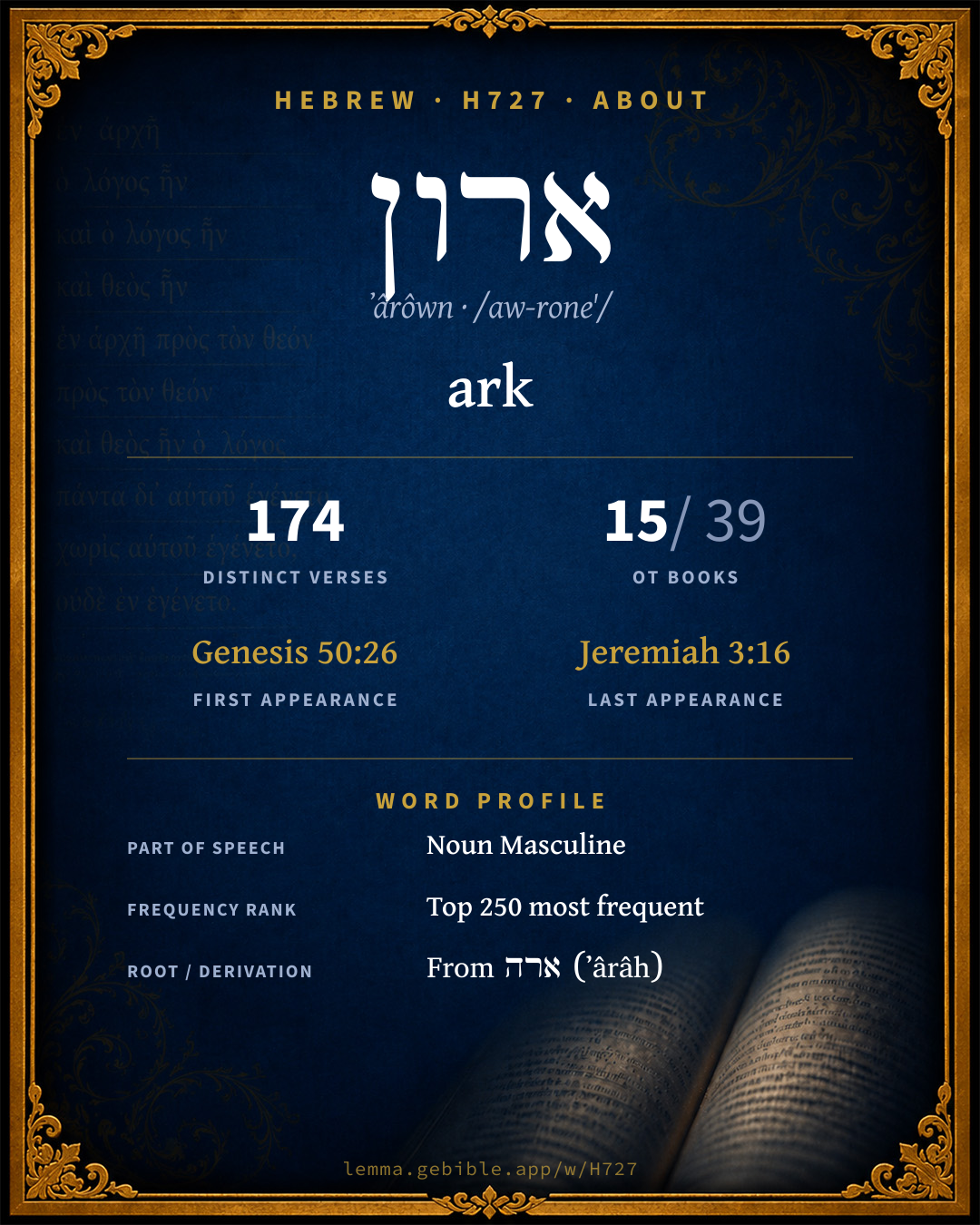
אֲרוֹן
ark
‘ark’ is one of 2 main senses fuller range ↓
Full lexicon entry — Brown-Driver-Briggs (BDB)
From Brown-Driver-Briggs (BDB)
Where this word appears
See every Construct-state word in the Hebrew Bible →
Grammar key — what these labels mean
Part of speech
- Noun
- A naming word — a person, place, thing, or idea.
Noun type
- Common
- A common noun — a general class of person, place, or thing (“king,” “city,” “water”), not a specific name.
State
- Construct
- A noun bound to a following noun in a possessive / “of” relationship (the construct chain).
- Absolute
- The independent form of a noun, not bound to a following word.
Gender
- Both
- Attested as both masculine and feminine.
Number
- Singular
- One.
Grammatical forms
- Noun, Common, Both, Singular, Construct 140 times (69%)
- Noun, Common, Both, Singular, Absolute 62 times (31%)
Parsed forms decoded from the imported morphology (morphhb / Westminster Leningrad Codex — WLC text public domain, morphhb tagging CC BY 4.0), counted across 202 parsed occurrences — not distinct verses.
Every verse where H727 appears — 174 distinct verses across 15 books. Click any verse to open its interlinear word-by-word view. Verse text shown in the World English Bible for context — . Each verse’s Hebrew form is shown with its reference; the English is not keyword-highlighted, since the data carries no word-level English alignment. Use “Compare translations” on any verse to read it across multiple English versions. This concordance covers the Hebrew Bible; Septuagint (Greek Old Testament) occurrences are not indexed here.
Genesis 1 verse
Exodus 19 verses
- Exodus 25:10 אֲר֖וֹן n c bs cs "They shall make an ark of acacia wood. Its length shall be two and a half cubits, its breadth a cubit and a half, and a cubit and a half its height.
- Exodus 25:14 הָ/אָרֹ֑ן הָ/אָרֹ֖ן ptcl def.art + n c bs ptcl def.art + n c bs You shall put the poles into the rings on the sides of the ark to carry the ark.
- Exodus 25:15 הָ/אָרֹ֔ן ptcl def.art + n c bs The poles shall be in the rings of the ark. They shall not be taken from it.
- Exodus 25:16 הָ/אָרֹ֑ן ptcl def.art + n c bs You shall put the testimony which I shall give you into the ark.
- Exodus 25:21 הָ/אָרֹ֖ן הָ֣/אָרֹ֔ן ptcl def.art + n c bs ptcl def.art + n c bs You shall put the mercy seat on top of the ark, and in the ark you shall put the testimony that I will give you.
- Exodus 25:22 אֲרֹ֣ן n c bs cs There I will meet with you, and I will tell you from above the mercy seat, from between the two cherubim which are on the ark of the testimony, all that I command you for the children of Israel.
- Exodus 26:33 אֲר֣וֹן n c bs cs You shall hang up the veil under the clasps, and shall bring the ark of the testimony in there within the veil: and the veil shall separate the holy place from the most holy for you.
- Exodus 26:34 אֲר֣וֹן n c bs cs You shall put the mercy seat on the ark of the testimony in the most holy place.
- Exodus 30:6 אֲרֹ֣ן n c bs cs You shall put it before the veil that is by the ark of the testimony, before the mercy seat that is over the testimony, where I will meet with you.
- Exodus 30:26 אֲר֥וֹן n c bs cs You shall use it to anoint the tent of meeting, the ark of the testimony,
- Exodus 31:7 הָֽ/אָרֹן֙ ptcl def.art + n c bs the tent of meeting, the ark of the testimony, the mercy seat that is on it, all the furniture of the Tent,
- Exodus 35:12 הָ/אָרֹ֥ן ptcl def.art + n c bs the ark, and its poles, the mercy seat, the veil of the screen;
- Exodus 37:1 הָ/אָרֹ֖ן ptcl def.art + n c bs Bezalel made the ark of acacia wood. Its length was two and a half cubits, and its breadth a cubit and a half, and a cubit and a half its height.
- Exodus 37:5 הָ/אָרֹ֑ן הָ/אָרֹֽן ptcl def.art + n c bs ptcl def.art + n c bs He put the poles into the rings on the sides of the ark, to bear the ark.
- Exodus 39:35 אֲרֹ֥ן n c bs cs the ark of the testimony with its poles, the mercy seat,
- Exodus 40:3 אֲר֣וֹן הָ/אָרֹ֖ן n c bs cs ptcl def.art + n c bs You shall put the ark of the testimony in it, and you shall screen the ark with the veil.
- Exodus 40:5 אֲר֣וֹן n c bs cs You shall set the golden altar for incense before the ark of the testimony, and put the screen of the door to the tent.
- Exodus 40:20 הָ֣/אָרֹ֔ן הָ/אָרֹ֑ן הָ/אָרֹ֖ן ptcl def.art + n c bs ptcl def.art + n c bs ptcl def.art + n c bs He took and put the testimony into the ark, and set the poles on the ark, and put the mercy seat above on the ark.
- Exodus 40:21 הָ/אָרֹן֮ אֲר֣וֹן ptcl def.art + n c bs n c bs cs He brought the ark into the tent, and set up the veil of the screen, and screened the ark of the testimony, as Yahweh commanded Moses.
Leviticus 1 verse
Numbers 6 verses
- Numbers 3:31 הָ/אָרֹ֤ן ptcl def.art + n c bs Their charge shall be the ark, the table, the lamp stand, the altars, the vessels of the sanctuary with which they minister, and the screen, and all its service.
- Numbers 4:5 אֲרֹ֥ן n c bs cs When the camp moves forward, Aaron shall go in, and his sons, and they shall take down the veil of the screen, and cover the ark of the Testimony with it,
- Numbers 7:89 אֲרֹ֣ן n c bs cs When Moses went into the Tent of Meeting to speak with Yahweh, he heard his voice speaking to him from above the mercy seat that was on the ark of the Testimony, from between the two cherubim: and he spoke to him.
- Numbers 10:33 וַ/אֲר֨וֹן conj + n c bs cs They set forward from the Mount of Yahweh three days' journey; and the ark of the covenant of Yahweh went before them three days' journey, to seek out a resting-place for them.
- Numbers 10:35 הָ/אָרֹ֖ן ptcl def.art + n c bs It happened, when the ark set forward, that Moses said, Rise up, Yahweh, and let your enemies be scattered; and let those who hate you flee before you.
- Numbers 14:44 וַ/אֲר֤וֹן conj + n c bs cs But they presumed to go up to the top of the mountain: nevertheless the ark of the covenant of Yahweh, and Moses, didn't depart out of the camp.
Deuteronomy 8 verses
- Deuteronomy 10:1 אֲר֥וֹן n c bs cs At that time Yahweh said to me, Hew you two tables of stone like the first, and come up to me onto the mountain, and make an ark of wood.
- Deuteronomy 10:2 בָּ/אָרֽוֹן prep det + n c bs I will write on the tables the words that were on the first tables which you broke, and you shall put them in the ark.
- Deuteronomy 10:3 אֲרוֹן֙ n c bs cs So I made an ark of acacia wood, and hewed two tables of stone like the first, and went up onto the mountain, having the two tables in my hand.
- Deuteronomy 10:5 בָּ/אָר֖וֹן prep det + n c bs I turned and came down from the mountain, and put the tables in the ark which I had made; and there they are as Yahweh commanded me.
- Deuteronomy 10:8 אֲר֣וֹן n c bs cs At that time Yahweh set apart the tribe of Levi, to bear the ark of the covenant of Yahweh, to stand before Yahweh to minister to him, and to bless in his name, to this day.
- Deuteronomy 31:9 אֲר֖וֹן n c bs cs Moses wrote this law, and delivered it to the priests the sons of Levi, who bore the ark of the covenant of Yahweh, and to all the elders of Israel.
- Deuteronomy 31:25 אֲר֥וֹן n c bs cs that Moses commanded the Levites, who bore the ark of the covenant of Yahweh, saying,
- Deuteronomy 31:26 אֲר֥וֹן n c bs cs Take this book of the law, and put it by the side of the ark of the covenant of Yahweh your God, that it may be there for a witness against you.
Joshua 25 verses
- Joshua 3:3 אֲר֤וֹן n c bs cs and they commanded the people, saying, When you see the ark of the covenant of Yahweh your God, and the priests the Levites bearing it, then you shall remove from your place, and go after it.
- Joshua 3:6 אֲר֣וֹן אֲר֣וֹן n c bs cs n c bs cs Joshua spoke to the priests, saying, Take up the ark of the covenant, and pass over before the people. They took up the ark of the covenant, and went before the people.
- Joshua 3:8 אֲרֽוֹן n c bs cs You shall command the priests who bear the ark of the covenant, saying, When you are come to the brink of the waters of the Jordan, you shall stand still in the Jordan.
- Joshua 3:11 אֲר֣וֹן n c bs cs Behold, the ark of the covenant of the Lord of all the earth passes over before you into the Jordan.
- Joshua 3:13 אֲר֨וֹן n c bs cs It shall come to pass, when the soles of the feet of the priests who bear the ark of Yahweh, the Lord of all the earth, shall rest in the waters of the Jordan, that the waters of the Jordan shall be cut off, even the waters that come down from above; and they shall stand in one heap.
- Joshua 3:14 הָ/אָר֥וֹן ptcl def.art + n c bs It happened, when the people removed from their tents, to pass over the Jordan, the priests who bore the ark of the covenant being before the people;
- Joshua 3:15 הָֽ/אָרוֹן֙ הָֽ/אָר֔וֹן ptcl def.art + n c bs ptcl def.art + n c bs and when those who bore the ark were come to the Jordan, and the feet of the priests who bore the ark were dipped in the brink of the water (for the Jordan overflows all its banks all the time of harvest),
- Joshua 3:17 הָ/אָר֨וֹן ptcl def.art + n c bs The priests who bore the ark of the covenant of Yahweh stood firm on dry ground in the midst of the Jordan; and all Israel passed over on dry ground, until all the nation were passed clean over the Jordan.
- Joshua 4:5 אֲר֧וֹן n c bs cs and Joshua said to them, Pass over before the ark of Yahweh your God into the midst of the Jordan, and take up every man of you a stone on his shoulder, according to the number of the tribes of the children of Israel;
- Joshua 4:7 אֲר֣וֹן n c bs cs then you shall tell them, Because the waters of the Jordan were cut off before the ark of the covenant of Yahweh; when it passed over the Jordan, the waters of the Jordan were cut off: and these stones shall be for a memorial to the children of Israel forever.
- Joshua 4:9 אֲר֣וֹן n c bs cs Joshua set up twelve stones in the midst of the Jordan, in the place where the feet of the priests who bore the ark of the covenant stood: and they are there to this day.
- Joshua 4:10 הָ/אָר֗וֹן ptcl def.art + n c bs For the priests who bore the ark stood in the midst of the Jordan, until everything was finished that Yahweh commanded Joshua to speak to the people, according to all that Moses commanded Joshua: and the people hurried and passed over.
- Joshua 4:11 אֲרוֹן n c bs cs It happened, when all the people had completely passed over, that the ark of Yahweh passed over, with the priests, in the presence of the people.
- Joshua 4:16 אֲר֣וֹן n c bs cs Command the priests who bear the ark of the testimony, that they come up out of the Jordan.
- Joshua 4:18 אֲר֤וֹן n c bs cs It happened, when the priests who bore the ark of the covenant of Yahweh were come up out of the midst of the Jordan, and the soles of the priests' feet were lifted up to the dry ground, that the waters of the Jordan returned to their place, and went over all its banks, as before.
- Joshua 6:4 הָ/אָר֔וֹן ptcl def.art + n c bs Seven priests shall bear seven trumpets of rams' horns before the ark: and the seventh day you shall compass the city seven times, and the priests shall blow the trumpets.
- Joshua 6:6 אֲר֣וֹן אֲר֥וֹן n c bs cs n c bs cs Joshua the son of Nun called the priests, and said to them, Take up the ark of the covenant, and let seven priests bear seven trumpets of rams' horns before the ark of Yahweh.
- Joshua 6:7 אֲר֥וֹן n c bs cs They said to the people, Pass on, and compass the city, and let the armed men pass on before the ark of Yahweh.
- Joshua 6:8 וַֽ/אֲרוֹן֙ conj + n c bs cs It was so, that when Joshua had spoken to the people, the seven priests bearing the seven trumpets of rams' horns before Yahweh passed on, and blew the trumpets: and the ark of the covenant of Yahweh followed them.
- Joshua 6:9 הָ/אָר֔וֹן ptcl def.art + n c bs The armed men went before the priests who blew the trumpets, and the rearward went after the ark, [the priests] blowing the trumpets as they went.
- Joshua 6:11 אֲרוֹן n c bs cs So he caused the ark of Yahweh to compass the city, going about it once: and they came into the camp, and lodged in the camp.
- Joshua 6:12 אֲר֥וֹן n c bs cs Joshua rose early in the morning, and the priests took up the ark of Yahweh.
- Joshua 6:13 אֲר֣וֹן אֲר֣וֹן n c bs cs n c bs cs The seven priests bearing the seven trumpets of rams' horns before the ark of Yahweh went on continually, and blew the trumpets: and the armed men went before them; and the rearward came after the ark of Yahweh, [the priests] blowing the trumpets as they went.
- Joshua 7:6 אֲר֤וֹן n c bs cs Joshua tore his clothes, and fell to the earth on his face before the ark of Yahweh until the evening, he and the elders of Israel; and they put dust on their heads.
- Joshua 8:33 לָ/אָר֡וֹן אֲר֣וֹן prep det + n c bs n c bs cs All Israel, and their elders and officers, and their judges, stood on this side of the ark and on that side before the priests the Levites, who bore the ark of the covenant of Yahweh, as well the foreigner as the native; half of them in front of Mount Gerizim, and half of them in front of Mount Ebal; as Moses the servant of Yahweh had commanded at the first, that they should bless the people of Israel.
Judges 1 verse
1 Samuel 33 verses
- 1 Samuel 3:3 אֲר֥וֹן n c bs cs and the lamp of God hadn't yet gone out, and Samuel had laid down [to sleep], in the temple of Yahweh, where the ark of God was;
- 1 Samuel 4:3 אֲרוֹן֙ n c bs cs When the people were come into the camp, the elders of Israel said, Why has Yahweh struck us today before the Philistines? Let us get the ark of the covenant of Yahweh out of Shiloh to us, that it may come among us, and save us out of the hand of our enemies.
- 1 Samuel 4:4 אֲר֧וֹן אֲרוֹן֙ n c bs cs n c bs cs So the people sent to Shiloh; and they brought from there the ark of the covenant of Yahweh of Hosts, who sits [above] the cherubim: and the two sons of Eli, Hophni and Phinehas, were there with the ark of the covenant of God.
- 1 Samuel 4:5 אֲר֤וֹן n c bs cs When the ark of the covenant of Yahweh came into the camp, all Israel shouted with a great shout, so that the earth rang again.
- 1 Samuel 4:6 אֲר֣וֹן n c bs cs When the Philistines heard the noise of the shout, they said, What means the noise of this great shout in the camp of the Hebrews? They understood that the ark of Yahweh was come into the camp.
- 1 Samuel 4:11 וַ/אֲר֥וֹן conj + n c bs cs The ark of God was taken; and the two sons of Eli, Hophni and Phinehas, were slain.
- 1 Samuel 4:13 אֲר֣וֹן n c bs cs When he came, behold, Eli was sitting on his seat by the road watching; for his heart trembled for the ark of God. When the man came into the city, and told it, all the city cried out.
- 1 Samuel 4:17 וַ/אֲר֥וֹן conj + n c bs cs He who brought the news answered, Israel is fled before the Philistines, and there has been also a great slaughter among the people, and your two sons also, Hophni and Phinehas, are dead, and the ark of God is taken.
- 1 Samuel 4:18 אֲר֣וֹן n c bs cs It happened, when he made mention of the ark of God, that [Eli] fell from off his seat backward by the side of the gate; and his neck broke, and he died: for he was an old man, and heavy. He had judged Israel forty years.
- 1 Samuel 4:19 אֲר֣וֹן n c bs cs His daughter-in-law, Phinehas' wife, was with child, near to be delivered: and when she heard the news that the ark of God was taken, and that her father-in-law and her husband were dead, she bowed herself and brought forth; for her pains came on her.
- 1 Samuel 4:21 אֲר֣וֹן n c bs cs She named the child Ichabod, saying, The glory is departed from Israel; because the ark of God was taken, and because of her father-in-law and her husband.
- 1 Samuel 4:22 אֲר֥וֹן n c bs cs She said, The glory is departed from Israel; for the ark of God is taken.
- 1 Samuel 5:1 אֲר֣וֹן n c bs cs Now the Philistines had taken the ark of God, and they brought it from Ebenezer to Ashdod.
- 1 Samuel 5:2 אֲר֣וֹן n c bs cs The Philistines took the ark of God, and brought it into the house of Dagon, and set it by Dagon.
- 1 Samuel 5:3 אֲר֣וֹן n c bs cs When they of Ashdod arose early on the next day, behold, Dagon was fallen on his face to the ground before the ark of Yahweh. They took Dagon, and set him in his place again.
- 1 Samuel 5:4 אֲר֣וֹן n c bs cs When they arose early on the next day morning, behold, Dagon was fallen on his face to the ground before the ark of Yahweh; and the head of Dagon and both the palms of his hands [lay] cut off on the threshold; only [the stump of] Dagon was left to him.
- 1 Samuel 5:7 אֲר֨וֹן n c bs cs When the men of Ashdod saw that it was so, they said, The ark of the God of Israel shall not abide with us; for his hand is sore on us, and on Dagon our god.
- 1 Samuel 5:8 לַֽ/אֲרוֹן֙ אֲר֖וֹן אֲר֖וֹן prep + n c bs cs n c bs cs n c bs cs They sent therefore and gathered all the lords of the Philistines to them, and said, What shall we do with the ark of the God of Israel? They answered, Let the ark of the God of Israel be carried about to Gath. They carried the ark of the God of Israel [there].
- 1 Samuel 5:10 אֲר֥וֹן אֲר֤וֹן אֲרוֹן֙ n c bs cs n c bs cs n c bs cs So they sent the ark of God to Ekron. It happened, as the ark of God came to Ekron, that the Ekronites cried out, saying, They have brought about the ark of the God of Israel to us, to kill us and our people.
- 1 Samuel 5:11 אֲר֨וֹן n c bs cs They sent therefore and gathered together all the lords of the Philistines, and they said, Send away the ark of the God of Israel, and let it go again to its own place, that it not kill us and our people. For there was a deadly confusion throughout all the city; the hand of God was very heavy there.
- 1 Samuel 6:1 אֲרוֹן n c bs cs The ark of Yahweh was in the country of the Philistines seven months.
- 1 Samuel 6:2 לַ/אֲר֣וֹן prep + n c bs cs The Philistines called for the priests and the diviners, saying, "What shall we do with the ark of Yahweh? Show us with which we shall send it to its place."
- 1 Samuel 6:3 אֲר֨וֹן n c bs cs They said, "If you send away the ark of the God of Israel, don't send it empty; but by all means return him a trespass-offering: then you shall be healed, and it shall be known to you why his hand is not removed from you."
- 1 Samuel 6:8 אֲר֣וֹן n c bs cs and take the ark of Yahweh, and lay it on the cart; and put the jewels of gold, which you return him for a trespass-offering, in a coffer by the side of it; and send it away, that it may go.
- 1 Samuel 6:11 אֲר֥וֹן n c bs cs and they put the ark of Yahweh on the cart, and the coffer with the mice of gold and the images of their tumors.
- 1 Samuel 6:13 הָ֣/אָר֔וֹן ptcl def.art + n c bs They of Beth-shemesh were reaping their wheat harvest in the valley; and they lifted up their eyes, and saw the ark, and rejoiced to see it.
- 1 Samuel 6:15 אֲר֣וֹן n c bs cs The Levites took down the ark of Yahweh, and the coffer that was with it, in which the jewels of gold were, and put them on the great stone: and the men of Beth-shemesh offered burnt offerings and sacrificed sacrifices the same day to Yahweh.
- 1 Samuel 6:18 אֲר֣וֹן n c bs cs and the golden mice, according to the number of all the cities of the Philistines belonging to the five lords, both of fortified cities and of country villages, even to the great stone, whereon they set down the ark of Yahweh, [which stone remains] to this day in the field of Joshua the Beth-shemite.
- 1 Samuel 6:19 בַּ/אֲר֣וֹן prep + n c bs cs He struck of the men of Beth-shemesh, because they had looked into the ark of Yahweh, he struck of the people fifty thousand seventy men; and the people mourned, because Yahweh had struck the people with a great slaughter.
- 1 Samuel 6:21 אֲר֣וֹן n c bs cs They sent messengers to the inhabitants of Kiriath Jearim, saying, The Philistines have brought back the ark of Yahweh; come you down, and bring it up to you.
- 1 Samuel 7:1 אֲר֣וֹן אֲר֥וֹן n c bs cs n c bs cs The men of Kiriath Jearim came, and fetched up the ark of Yahweh, and brought it into the house of Abinadab in the hill, and sanctified Eleazar his son to keep the ark of Yahweh.
- 1 Samuel 7:2 הָֽ/אָרוֹן֙ ptcl def.art + n c bs It happened, from the day that the ark abode in Kiriath Jearim, that the time was long; for it was twenty years: and all the house of Israel lamented after Yahweh.
- 1 Samuel 14:18 אֲר֣וֹן אֲר֧וֹן n c bs cs n c bs cs Saul said to Ahijah, Bring here the ark of God. For the ark of God was [there] at that time with the children of Israel.
2 Samuel 18 verses
- 2 Samuel 6:2 אֲר֣וֹן n c bs cs David arose, and went with all the people who were with him, from Baale Judah, to bring up from there the ark of God, which is called by the Name, even the name of Yahweh of Hosts who sits [above] the cherubim.
- 2 Samuel 6:3 אֲר֤וֹן n c bs cs They set the ark of God on a new cart, and brought it out of the house of Abinadab that was in the hill: and Uzzah and Ahio, the sons of Abinadab, drove the new cart.
- 2 Samuel 6:4 אֲר֣וֹן הָ/אָרֽוֹן n c bs cs ptcl def.art + n c bs They brought it out of the house of Abinadab, which was in the hill, with the ark of God: and Ahio went before the ark.
- 2 Samuel 6:6 אֲר֤וֹן n c bs cs When they came to the threshing floor of Nacon, Uzzah put forth [his hand] to the ark of God, and took hold of it; for the oxen stumbled.
- 2 Samuel 6:7 אֲר֥וֹן n c bs cs The anger of Yahweh was kindled against Uzzah; and God struck him there for his error; and there he died by the ark of God.
- 2 Samuel 6:9 אֲר֥וֹן n c bs cs David was afraid of Yahweh that day; and he said, How shall the ark of Yahweh come to me?
- 2 Samuel 6:10 אֲר֥וֹן n c bs cs So David would not remove the ark of Yahweh to him into the city of David; but David carried it aside into the house of Obed-edom the Gittite.
- 2 Samuel 6:11 אֲר֨וֹן n c bs cs The ark of Yahweh remained in the house of Obed-edom the Gittite three months: and Yahweh blessed Obed-edom, and all his house.
- 2 Samuel 6:12 אֲר֣וֹן אֲר֨וֹן n c bs cs n c bs cs It was told king David, saying, Yahweh has blessed the house of Obed-edom, and all that pertains to him, because of the ark of God. David went and brought up the ark of God from the house of Obed-edom into the city of David with joy.
- 2 Samuel 6:13 אֲרוֹן n c bs cs It was so, that, when those who bore the ark of Yahweh had gone six paces, he sacrificed an ox and a fattened calf.
- 2 Samuel 6:15 אֲר֣וֹן n c bs cs So David and all the house of Israel brought up the ark of Yahweh with shouting, and with the sound of the trumpet.
- 2 Samuel 6:16 אֲר֣וֹן n c bs cs It was so, as the ark of Yahweh came into the city of David, that Michal the daughter of Saul looked out at the window, and saw king David leaping and dancing before Yahweh; and she despised him in her heart.
- 2 Samuel 6:17 אֲר֣וֹן n c bs cs They brought in the ark of Yahweh, and set it in its place, in the midst of the tent that David had pitched for it; and David offered burnt offerings and peace-offerings before Yahweh.
- 2 Samuel 7:2 וַֽ/אֲרוֹן֙ conj + n c bs cs that the king said to Nathan the prophet, See now, I dwell in a house of cedar, but the ark of God dwells within curtains.
- 2 Samuel 11:11 הָ֠/אָרוֹן ptcl def.art + n c bs Uriah said to David, The ark, and Israel, and Judah, abide in booths; and my lord Joab, and the servants of my lord, are encamped in the open field; shall I then go into my house, to eat and to drink, and to lie with my wife? as you live, and as your soul lives, I will not do this thing.
- 2 Samuel 15:24 אֲרוֹן֙ אֲר֣וֹן n c bs cs n c bs cs Behold, Zadok also [came], and all the Levites with him, bearing the ark of the covenant of God; and they set down the ark of God; and Abiathar went up, until all the people had done passing out of the city.
- 2 Samuel 15:25 אֲר֥וֹן n c bs cs The king said to Zadok, Carry back the ark of God into the city: if I shall find favor in the eyes of Yahweh, he will bring me again, and show me both it, and his habitation:
- 2 Samuel 15:29 אֲר֥וֹן n c bs cs Zadok therefore and Abiathar carried the ark of God again to Jerusalem: and they abode there.
1 Kings 11 verses
- 1 Kings 2:26 אֲר֨וֹן n c bs cs To Abiathar the priest said the king, Get you to Anathoth, to your own fields; for you are worthy of death: but I will not at this time put you to death, because you bear the ark of the Lord Yahweh before David my father, and because you were afflicted in all in which my father was afflicted.
- 1 Kings 3:15 אֲר֣וֹן n c bs cs Solomon awoke; and, behold, it was a dream: and he came to Jerusalem, and stood before the ark of the covenant of Yahweh, and offered up burnt offerings, and offered peace-offerings, and made a feast to all his servants.
- 1 Kings 6:19 אֲר֖וֹן n c bs cs He prepared an oracle in the midst of the house within, to set there the ark of the covenant of Yahweh.
- 1 Kings 8:1 אֲר֧וֹן n c bs cs Then Solomon assembled the elders of Israel, and all the heads of the tribes, the princes of the fathers' [houses] of the children of Israel, to king Solomon in Jerusalem, to bring up the ark of the covenant of Yahweh out of the city of David, which is Zion.
- 1 Kings 8:3 הָ/אָרֽוֹן ptcl def.art + n c bs All the elders of Israel came, and the priests took up the ark.
- 1 Kings 8:4 אֲר֤וֹן n c bs cs They brought up the ark of Yahweh, and the tent of meeting, and all the holy vessels that were in the Tent; even these did the priests and the Levites bring up.
- 1 Kings 8:5 הָֽ/אָר֑וֹן ptcl def.art + n c bs King Solomon and all the congregation of Israel, who were assembled to him, were with him before the ark, sacrificing sheep and oxen, that could not be counted nor numbered for multitude.
- 1 Kings 8:6 אֲר֨וֹן n c bs cs The priests brought in the ark of the covenant of Yahweh to its place, into the oracle of the house, to the most holy place, even under the wings of the cherubim.
- 1 Kings 8:7 הָֽ/אָר֑וֹן הָ/אָר֥וֹן ptcl def.art + n c bs ptcl def.art + n c bs For the cherubim spread forth their wings over the place of the ark, and the cherubim covered the ark and the poles of it above.
- 1 Kings 8:9 בָּֽ/אָר֔וֹן prep det + n c bs There was nothing in the ark save the two tables of stone which Moses put there at Horeb, when Yahweh made a covenant with the children of Israel, when they came out of the land of Egypt.
- 1 Kings 8:21 לָֽ/אָר֔וֹן prep det + n c bs There have I set a place for the ark, in which is the covenant of Yahweh, which he made with our fathers, when he brought them out of the land of Egypt.
2 Kings 2 verses
- 2 Kings 12:9 אֲר֣וֹן n c bs But Jehoiada the priest took a chest, and bored a hole in the lid of it, and set it beside the altar, on the right side as one comes into the house of Yahweh: and the priests who kept the threshold put therein all the money that was brought into the house of Yahweh.
- 2 Kings 12:10 בָּֽ/אָר֑וֹן prep det + n c bs It was so, when they saw that there was much money in the chest, that the king's scribe and the high priest came up, and they put up in bags and counted the money that was found in the house of Yahweh.
1 Chronicles 31 verses
- 1 Chronicles 6:31 הָ/אָרֽוֹן ptcl def.art + n c bs These are they whom David set over the service of song in the house of Yahweh, after that the ark had rest.
- 1 Chronicles 13:3 אֲר֥וֹן n c bs cs and let us bring again the ark of our God to us: for we didn't seek it in the days of Saul.
- 1 Chronicles 13:5 אֲר֣וֹן n c bs cs So David assembled all Israel together, from the Shihor [the brook] of Egypt even to the entrance of Hamath, to bring the ark of God from Kiriath Jearim.
- 1 Chronicles 13:6 אֲר֨וֹן n c bs cs David went up, and all Israel, to Baalah, [that is], to Kiriath Jearim, which belonged to Judah, to bring up from there the ark of God Yahweh that sits [above] the cherubim, that is called by the Name.
- 1 Chronicles 13:7 אֲר֤וֹן n c bs cs They carried the ark of God on a new cart, [and brought it] out of the house of Abinadab: and Uzza and Ahio drove the cart.
- 1 Chronicles 13:9 הָ֣/אָר֔וֹן ptcl def.art + n c bs When they came to the threshing floor of Chidon, Uzza put forth his hand to hold the ark; for the oxen stumbled.
- 1 Chronicles 13:10 הָ/אָר֑וֹן ptcl def.art + n c bs The anger of Yahweh was kindled against Uzza, and he struck him, because he put forth his hand to the ark; and there he died before God.
- 1 Chronicles 13:12 אֲר֥וֹן n c bs cs David was afraid of God that day, saying, How shall I bring the ark of God home to me?
- 1 Chronicles 13:13 הָ/אָר֛וֹן ptcl def.art + n c bs So David didn't move the ark to him into the city of David, but carried it aside into the house of Obed-edom the Gittite.
- 1 Chronicles 13:14 אֲר֨וֹן n c bs cs The ark of God remained with the family of Obed-edom in his house three months: and Yahweh blessed the house of Obed-edom, and all that he had.
- 1 Chronicles 15:1 לַֽ/אֲר֣וֹן prep + n c bs cs [David] made him houses in the city of David; and he prepared a place for the ark of God, and pitched for it a tent.
- 1 Chronicles 15:2 אֲר֣וֹן אֲר֧וֹן n c bs cs n c bs cs Then David said, None ought to carry the ark of God but the Levites: for them has Yahweh chosen to carry the ark of God, and to minister to him forever.
- 1 Chronicles 15:3 אֲר֣וֹן n c bs cs David assembled all Israel at Jerusalem, to bring up the ark of Yahweh to its place, which he had prepared for it.
- 1 Chronicles 15:12 אֲר֤וֹן n c bs cs and said to them, You are the heads of the fathers' [houses] of the Levites: sanctify yourselves, both you and your brothers, that you may bring up the ark of Yahweh, the God of Israel, to [the place] that I have prepared for it.
- 1 Chronicles 15:14 אֲר֥וֹן n c bs cs So the priests and the Levites sanctified themselves to bring up the ark of Yahweh, the God of Israel.
- 1 Chronicles 15:15 אֲר֣וֹן n c bs cs The children of the Levites bore the ark of God on their shoulders with the poles thereon, as Moses commanded according to the word of Yahweh.
- 1 Chronicles 15:23 לָ/אָרֽוֹן prep det + n c bs Berechiah and Elkanah were doorkeepers for the ark.
- 1 Chronicles 15:24 אֲר֣וֹן לָ/אָרֽוֹן n c bs cs prep det + n c bs Shebaniah, and Joshaphat, and Nethanel, and Amasai, and Zechariah, and Benaiah, and Eliezer, the priests, did blow the trumpets before the ark of God: and Obed-edom and Jehiah were doorkeepers for the ark.
- 1 Chronicles 15:25 אֲר֧וֹן n c bs cs So David, and the elders of Israel, and the captains over thousands, went to bring up the ark of the covenant of Yahweh out of the house of Obed-edom with joy.
- 1 Chronicles 15:26 אֲר֣וֹן n c bs cs It happened, when God helped the Levites who bore the ark of the covenant of Yahweh, that they sacrificed seven bulls and seven rams.
- 1 Chronicles 15:27 הָ/אָר֔וֹן ptcl def.art + n c bs David was clothed with a robe of fine linen, and all the Levites who bore the ark, and the singers, and Chenaniah the master of the song [with] the singers: and David had on him an ephod of linen.
- 1 Chronicles 15:28 אֲר֣וֹן n c bs cs Thus all Israel brought up the ark of the covenant of Yahweh with shouting, and with sound of the cornet, and with trumpets, and with cymbals, sounding aloud with psalteries and harps.
- 1 Chronicles 15:29 אֲרוֹן֙ n c bs cs It happened, as the ark of the covenant of Yahweh came to the city of David, that Michal the daughter of Saul looked out at the window, and saw king David dancing and playing; and she despised him in her heart.
- 1 Chronicles 16:1 אֲר֣וֹן n c bs cs They brought in the ark of God, and set it in the midst of the tent that David had pitched for it: and they offered burnt offerings and peace-offerings before God.
- 1 Chronicles 16:4 אֲר֧וֹן n c bs cs He appointed certain of the Levites to minister before the ark of Yahweh, and to celebrate and to thank and praise Yahweh, the God of Israel:
- 1 Chronicles 16:6 אֲר֥וֹן n c bs cs and Benaiah and Jahaziel the priests with trumpets continually, before the ark of the covenant of God.
- 1 Chronicles 16:37 אֲר֣וֹן הָ/אָר֛וֹן n c bs cs ptcl def.art + n c bs So he left there, before the ark of the covenant of Yahweh, Asaph and his brothers, to minister before the ark continually, as every day's work required;
- 1 Chronicles 17:1 וַ/אֲר֥וֹן conj + n c bs cs It happened, when David lived in his house, that David said to Nathan the prophet, Behold, I dwell in a house of cedar, but the ark of the covenant of Yahweh [dwells] under curtains.
- 1 Chronicles 22:19 אֲר֣וֹן n c bs cs Now set your heart and your soul to seek after Yahweh your God; arise therefore, and build the sanctuary of Yahweh God, to bring the ark of the covenant of Yahweh, and the holy vessels of God, into the house that is to be built to the name of Yahweh.
- 1 Chronicles 28:2 לַ/אֲר֣וֹן prep + n c bs cs Then David the king stood up on his feet, and said, Hear me, my brothers, and my people: as for me, it was in my heart to build a house of rest for the ark of the covenant of Yahweh, and for the footstool of our God; and I had made ready for the building.
- 1 Chronicles 28:18 אֲר֥וֹן n c bs cs and for the altar of incense refined gold by weight; and gold for the pattern of the chariot, [even] the cherubim, that spread out [their wings], and covered the ark of the covenant of Yahweh.
2 Chronicles 16 verses
- 2 Chronicles 1:4 אֲר֤וֹן n c bs cs But David had brought the ark of God up from Kiriath Jearim to [the place] that David had prepared for it; for he had pitched a tent for it at Jerusalem.
- 2 Chronicles 5:2 אֲר֧וֹן n c bs cs Then Solomon assembled the elders of Israel, and all the heads of the tribes, the princes of the fathers' [houses] of the children of Israel, to Jerusalem, to bring up the ark of the covenant of Yahweh out of the city of David, which is Zion.
- 2 Chronicles 5:4 הָ/אָרֽוֹן ptcl def.art + n c bs All the elders of Israel came: and the Levites took up the ark;
- 2 Chronicles 5:5 הָ/אָרוֹן֙ ptcl def.art + n c bs and they brought up the ark, and the tent of meeting, and all the holy vessels that were in the Tent; these did the priests the Levites bring up.
- 2 Chronicles 5:6 הָ/אָר֑וֹן ptcl def.art + n c bs King Solomon and all the congregation of Israel, that were assembled to him, were before the ark, sacrificing sheep and oxen, that could not be counted nor numbered for multitude.
- 2 Chronicles 5:7 אֲר֨וֹן n c bs cs The priests brought in the ark of the covenant of Yahweh to its place, into the oracle of the house, to the most holy place, even under the wings of the cherubim.
- 2 Chronicles 5:8 הָ/אָר֑וֹן הָ/אָר֥וֹן ptcl def.art + n c bs ptcl def.art + n c bs For the cherubim spread forth their wings over the place of the ark, and the cherubim covered the ark and the poles of it above.
- 2 Chronicles 5:9 הָ/אָרוֹן֙ ptcl def.art + n c bs The poles were so long that the ends of the poles were seen from the ark before the oracle; but they were not seen outside: and there it is to this day.
- 2 Chronicles 5:10 בָּֽ/אָר֔וֹן prep det + n c bs There was nothing in the ark save the two tables which Moses put [there] at Horeb, when Yahweh made a covenant with the children of Israel, when they came out of Egypt.
- 2 Chronicles 6:11 הָ֣/אָר֔וֹן ptcl def.art + n c bs There have I set the ark, in which is the covenant of Yahweh, which he made with the children of Israel.
- 2 Chronicles 6:41 וַ/אֲר֣וֹן conj + n c bs cs Now therefore arise, Yahweh God, into your resting-place, you, and the ark of your strength: let your priests, Yahweh God, be clothed with salvation, and let your saints rejoice in goodness.
- 2 Chronicles 8:11 אֲר֥וֹן n c bs cs Solomon brought up the daughter of Pharaoh out of the city of David to the house that he had built for her; for he said, My wife shall not dwell in the house of David king of Israel, because the places are holy, whereunto the ark of Yahweh has come.
- 2 Chronicles 24:8 אֲר֣וֹן n c bs So the king commanded, and they made a chest, and set it outside at the gate of the house of Yahweh.
- 2 Chronicles 24:10 לָ/אָר֖וֹן prep det + n c bs All the princes and all the people rejoiced, and brought in, and cast into the chest, until they had made an end.
- 2 Chronicles 24:11 הָֽ/אָר֜וֹן הָ֣/אָר֔וֹן ptcl def.art + n c bs ptcl def.art + n c bs It was so, that whenever the chest was brought to the king's officers by the hand of the Levites, and when they saw that there was much money, the king's scribe and the chief priest's officer came and emptied the chest, and took it, and carried it to its place again. Thus they did day by day, and gathered money in abundance.
- 2 Chronicles 35:3 אֲרוֹן n c bs cs He said to the Levites who taught all Israel, who were holy to Yahweh, Put the holy ark in the house which Solomon the son of David king of Israel did build; there shall no more be a burden on your shoulders: now serve Yahweh your God, and his people Israel.
Psalms 1 verse
Jeremiah 1 verse
About this entry
At a glance — auto-summarized from this page’s data, not written by a person. Every figure links to its source below. This summary describes the numbers; it doesn’t interpret them.
The Hebrew noun ארון centers on the idea of “ark.” Its English rendering has broadened — “ark” classically, “box of” (unfoldingWord Literal Text) in modern versions; see the renderings breakdown. The Hebrew Bible uses it across 174 verses — common. Its earliest occurrence is Genesis 50:26. The lexicon spreads it across several senses; see its full sense range. Dig into 174-verse concordance and the renderings breakdown below.
Gloss history
Strong's 1890 vs modern scholarship
About this word
Strong's H727 catalogs a Hebrew word from the Hebrew Old Testament.
These counts are not copied from any lexicon or concordance. They are computed here, from the morphology-tagged Hebrew Old Testament. What Lemma adds →
- 174
- distinct verses
- The word appears in 174 distinct verses.
- 15 / 39
- OT books
- The word appears in 15 of 39 Old Testament books.
- #236
- by frequency
- Top 250 most frequent Hebrew words (rank 236 of 8,640 Hebrew words by occurrence).
View all 174 occurrences in the concordance →
Most concentrated in
- 1 Samuel 33 verses 19%
- 1 Chronicles 31 verses 18%
- Joshua 25 verses 14%
By section of the Old Testament
By traditional corpus
Conventional, traditional groupings — biblical authorship is debated, so this is a traditional corpus grouping, not an authorship claim. Each share is this word’s portion of its verses in that division of the Hebrew canon. Each figure is a share of the word’s 174 distinct verses.
- Prophets (Nevi'im) 91 verses · 52%
- Writings (Ketuvim) 48 verses · 28%
- Torah (Pentateuch) 35 verses · 20%
How translations render this word
Counts come from each version’s own published word-to-Strong’s tagging or interlinear alignment — an approximate guide to how each version renders this word, not a word-level alignment the data otherwise carries. Because each total is that version’s own tagged count, the per-version totals vary from one another and need not match the appearance or distinct-verse counts above. These counts may also differ from a printed concordance because Lemma counts each distinctly tagged rendering and does not collapse phrase taggings into a single head-word total. This is a fixed set of word-tagged versions (KJV, ASV, BSB, ULT) and does not change with the reading translation you choose elsewhere. Each version’s license is shown beside its name below (and on Sources).
- King James Version: Ark 168×, Chest 6×, Thence the ark 3×
- American Standard Version: Ark 157×, Chest 5×, Came to pass 3×
- Berean Standard Bible: Ark 181×, Chest 6×, It 2×
- unfoldingWord Literal Text: Box of 140×, Box 54×, Chest 4×
King James Version Public Domain
Renders H727 across 202 tagged occurrences — most commonly:
Plus 21 renderings that appear only once — usually multi-word phrases or single function words the recovered tagging swept in, not distinct renderings.
American Standard Version Public Domain
Renders H727 across 202 tagged occurrences — most commonly:
Plus 30 renderings that appear only once — usually multi-word phrases or single function words the recovered tagging swept in, not distinct renderings.
Berean Standard Bible Public Domain
Renders H727 across 195 tagged occurrences — most commonly:
Plus 6 renderings that appear only once — usually multi-word phrases or single function words the recovered tagging swept in, not distinct renderings. Not rendered by a distinct English word in 7 further occurrences.
unfoldingWord Literal Text CC BY-SA 4.0
Renders H727 across 208 tagged occurrences — most commonly:
Plus 5 renderings that appear only once — usually multi-word phrases or single function words the recovered tagging swept in, not distinct renderings.
12 senses and sub-senses in the full BDB
What do BDB’s symbols mean?
BDB uses these scholarly abbreviations:
| Symbol | Meaning |
|---|---|
| 𝔊 | the Septuagint (the ancient Greek translation, LXX) |
| 𝔙 | the Vulgate (the Latin translation) |
| 𝔖 | the Syriac version (the Peshitta) |
| 𝔗 | the Targum (the Aramaic translation) |
| ψ | the Psalms |
| √ | root (the underlying root or stem) |
| ‖ | parallel passage (a synonymous or contrasted parallel) |
| † | the dagger: every passage where the word occurs is cited |
The 12 senses and sub-senses the full Brown-Driver-Briggs lexicon distinguishes for this word, in lexicon order (not ranked by frequency), with BDB’s own verbatim wording and sub-sense lettering. Shown in Hebrew script with BDB’s own scholarly abbreviations. The condensed entry is in the Lexicon Entry tab. See also the Forms in the corpus table below.
- 1. chest, for money-offerings 2 K 12:10, 11 2 Ch 24:8, 10, 11(×2). e.g. 2 Kings 12:10
- 2. sarcophagus, mummy-case, of Joseph Gn 50:26 (E). e.g. Genesis 50:26
- 3. chest, ark in tabernacle & temple, containing tables of law, with cherubim above, the especially seat of י׳ among his people, only Hex (71 times) S (61 times) K (12 times) & Ch (48 times) + Ju 20:27 Je 3:16 ψ 132:8; used alone & in various combinations (cf. SeyringZAW 1891, 114 f.). e.g. Judges 20:27
- a. indef. אֲרוֹן עֲצֵי שִׁטִּים an ark of shittim-wood Ex 25:10; Dt 10:3 cf. v 1. e.g. Exodus 25:10
- b. def. הָא׳ Ex 25:14 + 54 times (Hex P, except Jos JE; S K Ch). e.g. Exodus 25:14
- c. א׳ יהוה Jos 4:11 + 32 times Jos (JED) S K Ch. e.g. Joshua 4:11
- d. א׳ אֱלֹהִים †1 S 3:3; 4:11; א׳ הָאֱלֹהִים 1 S 4:13 + 32 times S Ch (but 1 S 14:18(×2) read הָאֵפוֹד 𝔊 We Dr), cf. א׳ אֱלֹהֵינוּ †1 Ch 13:3. e.g. 1 Samuel 3:3
- e. א׳ אלהי יִשְׂרָאֵל 1 S 5:7 + 6 times S, term used only by Philistines; א׳ יהוה אלהי יִשְׂרָאֵל †1 Ch 15:12, 14; א׳ יהוה אֱלֹהֵיכֶם †Jos 4:5 (JE); א׳ אֲדֹנָי יהוה †1 K 2:26; א׳ יהוה אֲדוֹן כָּל־הָאָרֶץ †Jos 3:13 (JED) cf. אדון כל־הארץ [הברית] א׳ v 11, where הברית (c. art. is prob. interpol., v. Di, only once & late the long phrase א׳ האלהים יהוה יוֹשֵׁב הַכְּרוּבִים אֲשֶׁר נִקְרָא־שֵׁם 1 Ch 13:6. e.g. 1 Samuel 5:7
- f. in combination with בְּרִית, largely D & under D’s influence; ארון הַבְּרִית ark of the covenant †Jos 3:6(×2), 8; 4:9; 6:6 (all JED); א׳ בְּרִית יהוה Nu 10:33; 14:44 (both J) Dt 10:8; 31:9, 25; Jos 4:7, 18; 6:8; 8:33 Je 3:16 + 17 times S K Ch; once longer א׳ בְּרִית י׳ צְבָאוֹת ישֵׁב הַכְּרֻבִים †1 S 4:4; also א׳ בְּרִית הָאֱלֹהִים †Ju 20:27; 1 S 4:4; 2 S 15:24; 1 Ch 16:6; & א׳ בְּרִית י׳ אלהיכם Dt 31:26 Jos 3:3. e.g. Joshua 3:6
- g. אֲרוֹן הָעֵדוּת ark of the testimony, only in P, corresponding to א׳ בְּרִית (cf. Di on Ex 25:16), Ex 25:22 + 8 times Ex, †Nu 4:5; 7:89 Jos 4:16. e.g. Exodus 25:16
- h. †א׳ הַקֹּדֶשׁ 2 Ch 35:3. e.g. 2 Chronicles 35:3
- i. א׳ עֻזֶּךָ֑ the ark of thy strength 2 Ch 6:41 ψ 132:8.—(Cf. also tables given by Seyringl.c. & his theory as to earliest designation of ark.) e.g. 2 Chronicles 6:41
Senses from the full Brown-Driver-Briggs lexicon (Brown, Driver, Briggs; Oxford 1906 — public domain), digitized via Sefaria, supplemented by the OpenScriptures HebrewLexicon (CC BY 4.0). Full attribution on Sources.
Word origin
c. art. הָאָרוֹן, הָאָרֹן203 n.m. Ex 35, 12 (f. 1 S 4, 17; 2 Ch 8, 11) chest, ark (Ph. ארן, sarcophagus, Assyrian êrênu (& êrû) chest ZimBP 6, 22, Arabic إِرَانٌ chest, so Aramaic ܐܰܪܘܽܢܳܐ also Nab. ארנא, Vog p. 102, Ph. Mish. also pl. ארונות)—only sg.; abs. †אֲרוֹן 2 K 12:10 = 2 Ch 24:8; c. art. הָאָרוֹן Dt 10:2 + always except Ex Lv Nu where הָאָרֹן (Ex 25:14(×2) + 13 times Ex, Lv 16:2 Nu 3:31; 10:35); cstr. אֲרוֹן Ex 25:10 +, †אֲרֹן Ex 30:6 Nu 4:5; 7:89;—
— Brown-Driver-Briggs (Oxford 1906, public domain), digitized via Sefaria, supplemented by the OpenScriptures HebrewLexicon (CC BY 4.0). See Sources.
Derived from ארה (ʼârâh) (H717) — to pluck.
Jastrow Dictionary
A second Hebrew/Aramaic lexicon for comparison, covering Aramaic and post-biblical (Talmudic, Targumic, Midrashic) usage that the biblical-Hebrew BDB does not. Matched by lemma rather than by Strong’s number, so a lemma may carry more than one Jastrow headword (shown separately below), and the entries cover usage well beyond the Bible.
אָרוֹן
- c. (b. h.; [joined together,] chest, box, coffin, freq. (= אֲרוֹן הַקּוֹדֶשׁ) the Holy Ark, in the tabernacle and the Temple, or in Synagogues. Yoma V, 1 הגיע לא׳ reached the place where the Ark stood during the First Temple. Y. Ber. IV, 8ᶜ top; Gen. R. s. 55 (allegorical etymologies).—Keth. 104ᵃ א׳ הקודש (figuratively) a good and learned man’s soul; v. אֶרְאֵל.—Kel. XII, 5 א׳ של גרוסות the grits-dealer’s chest. Y. Kil. IX, 32ᵇ top; Gen. R. s. 100 אֲרוֹנִי נקובה (נקופה) וכ׳ ותהא let my coffin be perforated at the bottom. Snh. 98ᵇ אין לך כל א׳ וא׳ וכ׳ there is no coffin in Palestine in which the Median horses do not eat straw (being used as cribs); a. fr.—Pl. אֲרוֹנוֹת. Sot. 13ᵃ; a. fr. [Y. Keth. VI, 30ᵈ bot. וארון, v. אֲרִי I.]
A Dictionary of the Targumim, the Talmud Babli and Yerushalmi, and the Midrashic Literature (Marcus Jastrow; London, Luzac, 1903) — Public Domain. Digitized via Sefaria. Digitized via Sefaria. Full attribution on Sources.
Forms in the corpus
The 53 distinct written forms H727 takes in the Hebrew Bible, most frequent first — each parse links to that state’s occurrences in the concordance. Hebrew forms include their vowel points and cantillation, so a single lemma takes many written forms.
Same root — word family
Other BDB entries built from the same root as H727, grouped by Strong’s listed origin. These share a root / origin per the lexicon — not necessarily a shared meaning. Each links to that word’s own entry.
Derives from
Shares the same root
Compare all same-root words → They share a root, not necessarily a meaning.
Septuagint verse parallels
This word appears in 170 verses that also exist in the Greek Old Testament (Septuagint), out of the 174 Hebrew verses it occurs in. You can read those verses in Greek by switching the Old Testament edition to the Septuagint.
Read these verses in the Septuagint
- Genesis 50:26
- Exodus 25:10
- Leviticus 16:2
- Numbers 3:31
- Deuteronomy 10:1
- Joshua 3:3
- Judges 20:27
- 1 Samuel 3:3
- 2 Samuel 6:2
- 1 Kings 2:26
- 2 Kings 12:9
- 1 Chronicles 6:31
This is a verse-level parallel only — the same verses exist in both the Hebrew and Greek Old Testaments. No word-level Hebrew↔Greek correspondence is claimed: the data carries no such alignment, so no Greek word is shown as this Hebrew word’s translation. Coverage is not total — the Septuagint omits the deuterocanon and renumbers the Psalms, so some Hebrew verses have no direct Greek parallel.