1 Chronicles 13:10

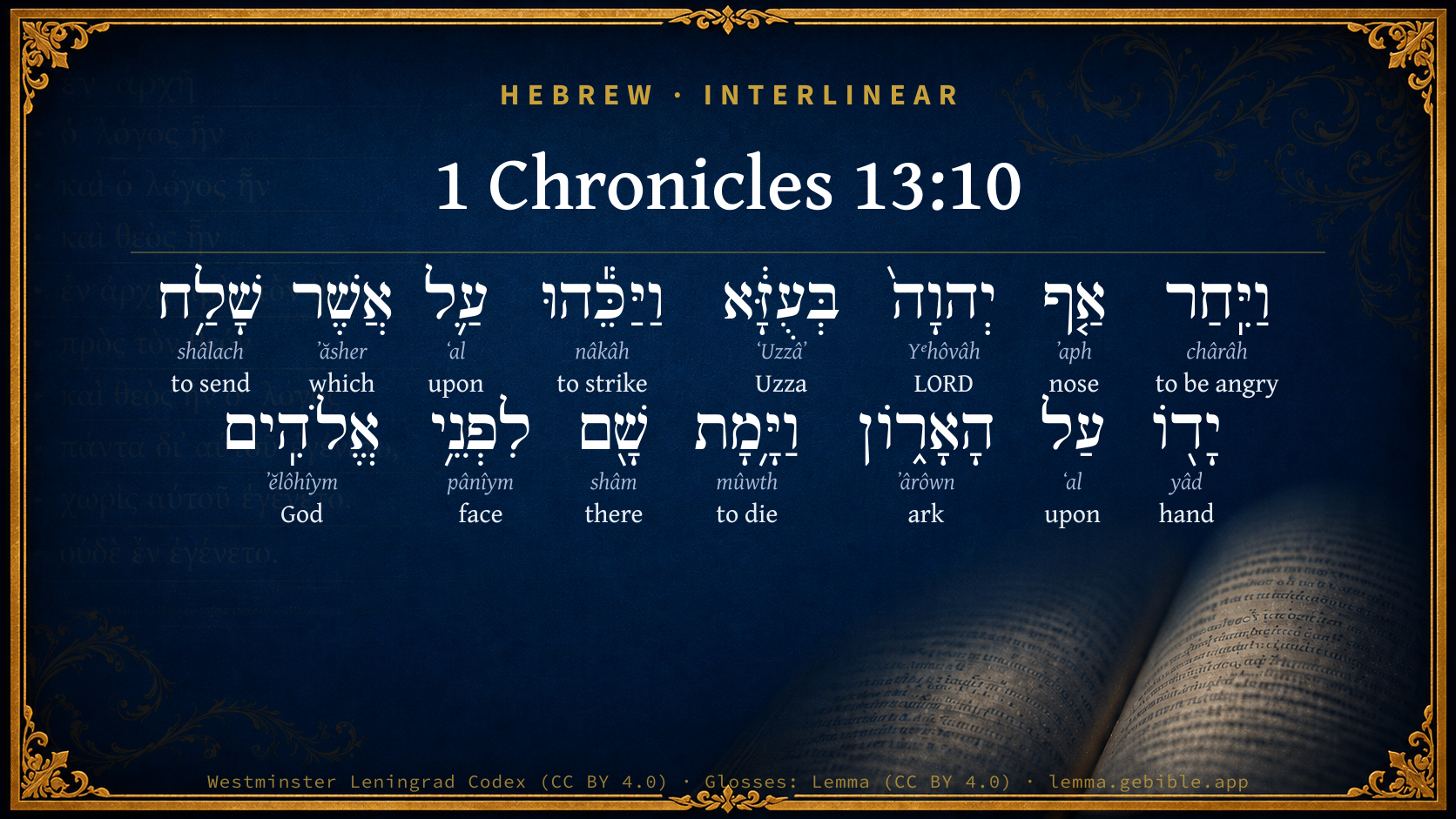
Hebrew (Westminster Leningrad Codex) 1 Chronicles 13:10 appears in the Hebrew Old Testament. The text above is from the Westminster Leningrad Codex. Each word links to its Strong’s number, a concise gloss, and parsing drawn from the Open Scriptures Hebrew Bible morphology. Click any word for its full Brown-Driver-Briggs (BDB) entry.
Download image
Cite this verse

1 Chronicles 13:10 (World English Bible). Public Domain. Lemma interlinear Bible study tool, https://lemma.gebible.app/v/1-chronicles/13/10.

Show BibTeX & RIS
BibTeX
RIS
English Translation
The anger of Yahweh was kindled against Uzza, and he struck him, because he put forth his hand to the ark; and there he died before God.
World English Bible · Public Domain
Download a study sheet

One document with this verse’s original text, its word-by-word gloss line, the meaning frame, cross-references with their text, attributed commentary, and full source and license credits — printable, and it pastes into notes with its structure intact.

This verse Autodidact and up

Study sheet (.html) Plain text (.txt)

A passage Seminary Student

Up to 50 verses in one chapter. A passage sheet keeps up to 6 commentary sources and 12 cross-references per verse, in the order this page ranks them, and says so on the sheet whenever that leaves anything out. Ask for a single verse and you get the Autodidact verse sheet above.

Everything on this page stays free to read, with no account — the sheet is a download of what is already on screen, not access to it.

Want to remove ads? Support Godless Engineer
Compare translations 3

The same verse in 3 English versions, stacked beneath the original-language interlinear above. Click any original word for its lexicon entry.

Each is an independent rendering of the whole verse — the interlinear is not word-aligned to these translations.

Highlighted words mark where these versions differ — a whole-verse word diff, not a word-by-word alignment.

  • World English Bible Public Domain
    The anger of Yahweh was kindled against Uzza, and he struck him, because he put forth his hand to the ark; and there he died before God.
  • King James Version Public Domain
    And the anger of the LORD was kindled against Uzza, and he smote him, because he put his hand to the ark: and there he died before God.
  • unfoldingWord Literal Text CC BY-SA 4.0
    And the nose of Yahweh burned against Uzzah, and he struck him because he had sent his hand upon the Box. And he died there to the face of God.

unfoldingWord Literal Text — © unfoldingWord, licensed CC BY-SA 4.0. Word-aligned USFM3 via Door43 (git.door43.org/unfoldingWord/en_ult).

Versions to compare (up to 4)

3 of 4 selected

Show all 18 translations

Every available English version of this verse, each an independent rendering of the whole verse.

  • World English Bible Public Domain
    The anger of Yahweh was kindled against Uzza, and he struck him, because he put forth his hand to the ark; and there he died before God.
  • Berean Standard Bible Public Domain
    And the anger of the LORD burned against Uzzah, and He struck him down because he had put his hand on the ark. So he died there before God.
  • Majority Standard Bible Public Domain
    And the anger of the LORD burned against Uzzah, and He struck him down because he had put his hand on the ark. So he died there before God.
  • King James Version Public Domain
    And the anger of the LORD was kindled against Uzza, and he smote him, because he put his hand to the ark: and there he died before God.
  • American Standard Version (1901) Public Domain
    And the anger of Jehovah was kindled against Uzza, and he smote him, because he put forth his hand to the ark; and there he died before God.
  • Revised Version (1885) Public Domain
    And the anger of the LORD was kindled against Uzza, and he smote him, because he put forth his hand to the ark: and there he died before God.
  • Geneva Bible (1599) Public Domain
    But the wrath of the Lord was kindled against Vzza, and he smote him, because he layed his hande vpon the Arke: so he dyed there before God.
  • Douay-Rheims (1899) Public Domain
    And the Lord was angry with Oza, and struck him, because he had touched the ark; and he died there before the Lord.
  • Young's Literal Translation Public Domain
    and the anger of Jehovah is kindled against Uzza, and He smiteth him, because that he hath put forth his hand on the ark, and he dieth there before God.
  • Literal Standard Version CC BY-SA 4.0
    and the anger of YHWH is kindled against Uzza, and He strikes him, because that he has put forth his hand on the Ark, and he dies there before God.
  • Unlocked Literal Bible CC BY-SA 4.0
    Then the anger of Yahweh burned against Uzzah, and Yahweh killed him because Uzzah had reached out with his hand to the ark. He died there before God.
  • unfoldingWord Literal Text CC BY-SA 4.0
    And the nose of Yahweh burned against Uzzah, and he struck him because he had sent his hand upon the Box. And he died there to the face of God.
  • Darby Bible Public Domain
    And the anger of Jehovah was kindled against Uzza, and he smote him, because he had put forth his hand to the ark; and there he died before God.
  • World Messianic Bible Public Domain
    The LORD’s anger burned against Uzza, and he struck him because he put his hand on the ark; and he died there before God.
  • Webster's Bible Public Domain
    And the anger of the LORD was kindled against Uzza, and he smote him, because he put his hand to the ark: and there he died before God.
  • Free Bible Version CC BY-SA 4.0
    The Lord was angry with Uzzah for daring to touch the Ark like this so he struck him down, and Uzzah died there before the Lord.
  • Bible in Basic English Public Domain
    And the wrath of the Lord, burning against Uzza, sent destruction on him because he had put his hand on the ark, and death came to him there before God.
  • JPS Tanakh (1917) Public Domain
    And the anger of the LORD was kindled against Uzza, and He smote him, because he put forth his hand to the ark; and there he died before God.

Literal Standard Version (2020), Covenant Press — licensed CC BY-SA 4.0. Text via the HelloAO Bible API (eBible.org). Unlocked Literal Bible (unfoldingWord) — licensed CC BY-SA 4.0. Text via the HelloAO Bible API (eBible.org). unfoldingWord Literal Text — © unfoldingWord, licensed CC BY-SA 4.0. Word-aligned USFM3 via Door43 (git.door43.org/unfoldingWord/en_ult). Free Bible Version, Dr. Jonathan Gallagher — licensed CC BY-SA 4.0. Text via the HelloAO Bible API (eBible.org).

Word by word

More ways to search: Search by grammar → Find every occurrence → Compare this word →

Practice this passage: Drill this verse → Learn its vocabulary →

בְּעֻזָּ֔א
ʻUzzâʼ
H5798
“in/at · Uzza”
Preposition + Noun, Proper
Part of Speech
Preposition + Noun
Type
Proper
Full BDB Definition

Origin: fem of H5797

TWOT: None

Uzza or Uzzah = "strength" - a man slain by Jehovah for touching the sacred ark (noun proper masculine) - a Benjamite of the sons of Ehud (noun proper masculine) - ancestor of a family of temple slaves who returned from exile with (noun proper masculine) - a Merarite Levite (noun proper masculine) - the garden where kings Manasseh and Amon of Judah were buried (noun proper locative)
  1. וַיִּֽחַר chârâh H2734 “and · to be angry” Conjunction + Verb, Qal, Sequential Imperfect, 3rd Person, Masculine, Singular
  2. אַ֤ף ʼaph H639 “nose” Particle, Accusative
  3. יְהוָה֙ Yᵉhôvâh H3068 “LORD” Noun, Proper
  4. וַיַּכֵּ֕הוּ nâkâh H5221 “and · to strike · him” Conjunction + Verb, Hiphil, Sequential Imperfect, 3rd Person, Masculine, Singular + Suffix, Personal, 3rd Person, Masculine, Singular
  5. עַ֛ל ʻal H5921 “upon” Preposition
  6. אֲשֶׁר ʼăsher H834 “which” Particle, Relative
  7. שָׁלַ֥ח shâlach H7971 “to send” Verb, Qal, Perfect, 3rd Person, Masculine, Singular
  8. יָד֖וֹ yâd H3027 “hand · his” Noun, Common, Both, Singular, Construct + Suffix, Personal, 3rd Person, Masculine, Singular
  9. עַל ʻal H5921 “upon” Preposition
  10. הָאָר֑וֹן ʼârôwn H727 “the · ark” Particle, Definite Article + Noun, Common, Both, Singular, Absolute
  11. וַיָּ֥מָת mûwth H4191 “and · to die” Conjunction + Verb, Qal, Sequential Imperfect, 3rd Person, Masculine, Singular
  12. שָׁ֖ם shâm H8033 “there” Adverb
  13. לִפְנֵ֥י pânîym H6440 “to/for · face(s) of” Preposition + Noun, Common, Both, Plural, Construct
  14. אֱלֹהִֽים ʼĕlôhîym H430 “God(s)” Noun, Common, Masculine, Plural, Absolute

About this verse

These counts appear in no published source. They are computed here, from the morphology-tagged text and Lemma’s own curated glosses. What Lemma adds →

15
words
14
distinct lemmas
Historical
section

Notable vocabulary

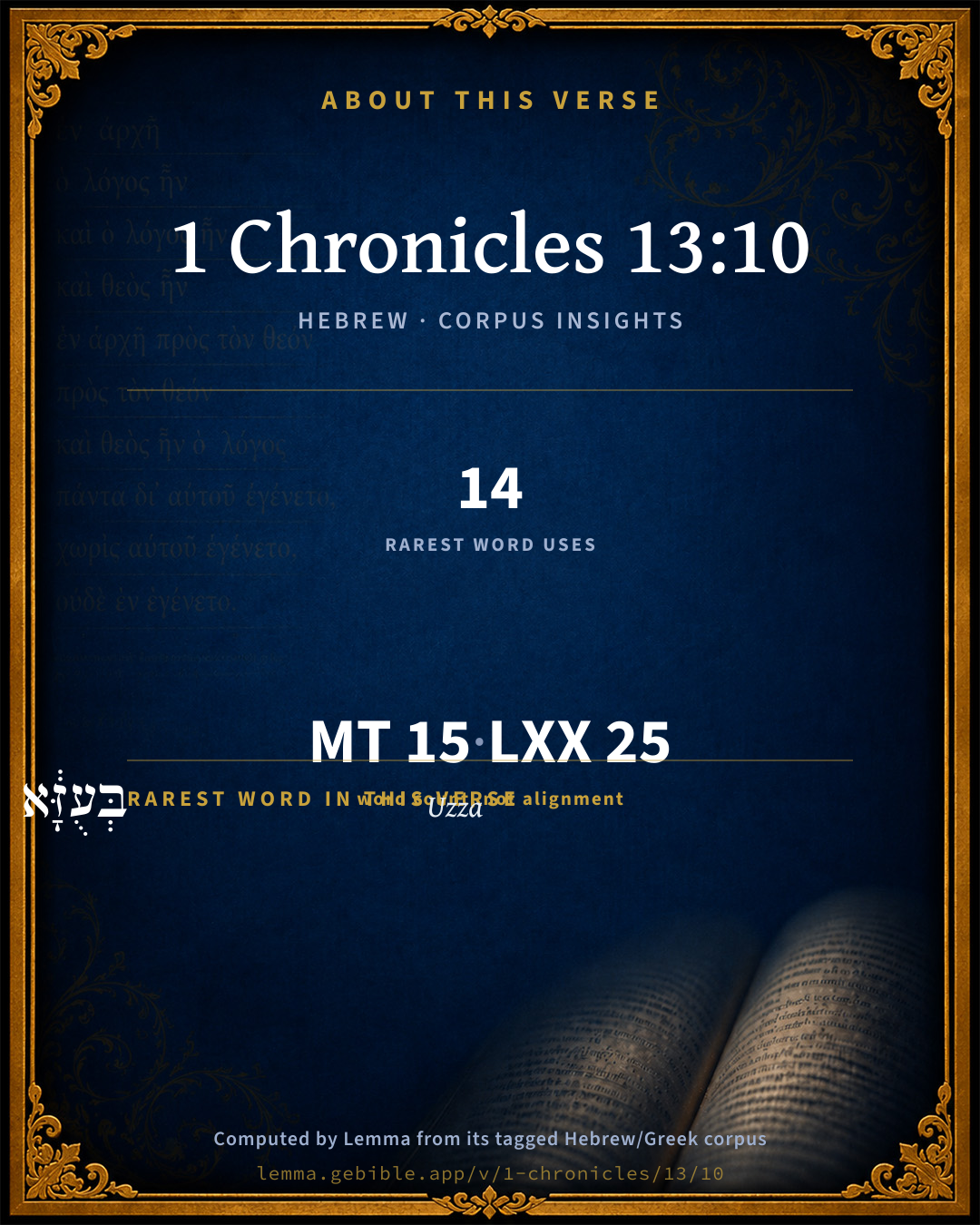
The rarest word here is בְּעֻזָּ֔א Uzza H5798 — appearing just 14 times in the whole Hebrew Bible.

Shared distinctive vocabulary

בְּעֻזָּ֔א Uzza H5798 occurs in 14 verses of the Hebrew Bible. Also found in:

Grammatical profile

  • 4 verbs
  • 6 nouns
  • 2 prepositions
  • 1 adverb
  • 2 particles

Verb forms

  • וַיִּֽחַר Qal · Sequential Imperfect
  • וַיַּכֵּ֕הוּ Hiphil · Sequential Imperfect
  • שָׁלַ֥ח Qal · Perfect
  • וַיָּ֥מָת Qal · Sequential Imperfect

Repetition

A word recurs within this verse — often emphatic in Hebrew:

  • עַ֛ל upon H5921 ×2

Hebrew & Septuagint length

In English translation the verse runs 27 words from the Hebrew and 28 from the Septuagint (LXX English) — closely comparable.

A rough comparison of the two English renderings, which tokenize alike — not a word-level alignment.

Word counts can differ between the Hebrew and the Greek without any difference in meaning — e.g. the Hebrew direct-object marker אֵת has no separate Greek word, and Greek often adds the article ὁ.

In the original languages it is 15 Hebrew tokens and 25 Greek tokens — but the two are counted differently (Hebrew bundles its prefixes and suffixes into one token; the Greek is in lemma form), so that isn’t a like-for-like length.

Cross-references

9

Topical passages linked to 1 Chronicles 13:10 in the Treasury of Scripture Knowledge — connected by theme and wording, ordered by reader-vote popularity; previews shown in the World English Bible.

  • 1 Chronicles 15:15 The children of the Levites bore the ark of God on their shoulders with the poles thereon, as Moses commanded according to the word of Yahweh.
  • 1 Chronicles 15:13 For because you didn't carry it at the first, Yahweh our God made a breach on us, because we didn't seek him according to the ordinance.
  • Numbers 4:15 "When Aaron and his sons have finished covering the sanctuary, and all the furniture of the sanctuary, as the camp moves forward; after that, the sons of Kohath shall come to carry it: but they shall not touch the sanctuary, lest they die. These things are the burden of the sons of Kohath in the Tent of Meeting.
  • 1 Samuel 6:19 He struck of the men of Beth-shemesh, because they had looked into the ark of Yahweh, he struck of the people fifty thousand seventy men; and the people mourned, because Yahweh had struck the people with a great slaughter.
  • Leviticus 10:1–3 Nadab and Abihu, the sons of Aaron, each took his censer, and put fire in it, and laid incense on it, and offered strange fire before Yahweh, which he had not commanded them.
  • Numbers 16:35 Fire came forth from Yahweh, and devoured the two hundred fifty men who offered the incense.
  • Joshua 6:6 Joshua the son of Nun called the priests, and said to them, Take up the ark of the covenant, and let seven priests bear seven trumpets of rams' horns before the ark of Yahweh.
  • 2 Chronicles 26:16–20 But when he was strong, his heart was lifted up, so that he did corruptly, and he trespassed against Yahweh his God; for he went into the temple of Yahweh to burn incense on the altar of incense.

Cross-references courtesy of OpenBible.info (CC BY 4.0).

Hebrew and Greek witnesses Masoretic Hebrew ↔ Greek Septuagint

The same verse in the two great witnesses to the Old Testament, shown verse-for-verse.

These are two independent witnesses, not word-aligned to each other, and the Septuagint is shown in lemma (dictionary) form.

Hebrew 1 Chronicles 13:10 Masoretic · Westminster Leningrad Codex

וַיִּֽחַר אַ֤ף יְהוָה֙ בְּעֻזָּ֔א וַיַּכֵּ֕הוּ עַ֛ל אֲשֶׁר שָׁלַ֥ח יָד֖וֹ עַל הָאָר֑וֹן וַיָּ֥מָת שָׁ֖ם לִפְנֵ֥י אֱלֹהִֽים

The anger of Yahweh was kindled against Uzza, and he struck him, because he put forth his hand to the ark; and there he died before God.

World English Bible · Public Domain

Greek LXX 1 Chronicles 13:10 Septuagint · lemma form

καί θυμόω ὀργή κύριος ἐπί οζα καί πατάσσω αὐτός ἐκεῖ διά ὁ ἐκτείνω ὁ χείρ αὐτός ἐπί ὁ κιβωτός καί ἀποθνήσκω ἐκεῖ ἀπέναντι ὁ θεός

And the Lord was very angry with Oza, and struck him there, because of his stretching forth his hand upon the ark: and he died there before God.

LXX2012 (modern English Septuagint) · Public Domain

On this verse, Ellicott's Commentary for English Readers discusses the Septuagint’s reading. Read the note in Commentary ↓

Hebrew: Westminster Leningrad Codex (CC BY 4.0). Greek: Septuagint (public domain); English from LXX2012 (modern English Septuagint) (Public Domain). How the Septuagint differs from the Hebrew →

Commentary

Notes on 1 Chronicles 13:10 from classic Christian and Jewish commentators (each source and its license shown beneath its notes). The classic Christian expositions comment on the surrounding passage and are grouped to its opening verse, so a note may address several verses; the Jewish commentaries on the Tanakh (Rashi and others) are per-verse, so they appear only where the commentator wrote on this verse.

Lemma curates 59 commentaries, every one of them public domain or Creative Commons licensed, each selected and text-cleaned for this edition rather than reprinted as found. About our sources →

Geneva Bible (1599)

Geneva Bible translators

Before the Ark for usurping that which did not appertain to his vocation: for this charge was given to the Priests, Num. 4:15, so that here all good intentions are condemned, except they be commanded by the word of God.

Geneva Bible (1599) marginal notes — public domain. Text via Bolls.life.

Ellicott's Commentary for English Readers

(10) And he smote him.—Abridged from “and God smote him there” (Samuel).

Because he put his hand to the ark.—“Because he put” is in the Heb., ‘al ’asher shalah. For this Samuel has ’al hashshal, an obscure phrase, occurring nowhere else in the Old Testament. The similarity of letters in the two phrases can hardly be accidental, but whether the chronicler has given the original text of the passage as he found it preserved in his source, or whether he has himself made a guess at the true reading, cannot be determined. The Syriac of Samuel reads, “because he put forth his hand;” and so the Arabic, adding, “to the ark.” The Targum, “because he sinned” (using a word like hashshal). The Vat. LXX. omits the phrase.

Before God.—Samuel, “by the ark of God.” This explains the same phrase in 1Ch_13:8. (Comp. for the event 1Sa_6:19.)

A Bible Commentary for English Readers, edited by Charles John Ellicott (1878–1897) — public domain. Text from a community e-Sword module.

The Cambridge Bible for Schools and Colleges

gen. ed. J. J. S. Perowne

10. before God] In 2Sa_6:7, by the ark of God.

The Cambridge Bible for Schools and Colleges (gen. ed. J. J. S. Perowne; Cambridge University Press, 1878–1918) — public domain. Text from a community e-Sword module.

The Pulpit Commentary

There seems some little uncertainty as to why Uzza was to blame in a desire that would appear both praiseworthy and instinctive, to steady the ark or save it from actually falling. Uzza was probably not a priest or Levite, and it is so distinctly said his sin consisted in putting his hand to the ark, that perhaps the direction of Num_4:15 may be sufficient account of the matter. Special injunction had been given (Exo_25:14, Exo_25:15) that the poles with which to bear it should not be taken out of the rings, but be always stationary there. If we suppose that it was not a question of the ark being absolutely overthrown, but simply of its riding unsteadily, his presumptuousness would not have the further defence of an instinctive impulse.

Severity of judgment.

To understand this narrative it is necessary to bear in mind the character of the older dispensation. It was an economy in which persons, things, and places were set apart as holy, doubtless in order to instil into the minds of the people ideas of spiritual purity and consecration. The ark was a holy thing, in a sense in which nothing material is holy under the Christian dispensation. But there are principles which underlie these ceremonial appointments and provisions, which are deserving of our serious and discriminating attention.

I THE HISTORICAL INCIDENT. The chronicler here relates:

1. A serious offence. When Uzza put forth his hand and touched the ark, though he did so only for the security of the sacred chest, he incurred the Divine displeasure. His act was one of officiousness ; it was not his business to interfere with the apparatus of Divine worship. He was guilty of irreverence; for he showed that he did not stand in awe of the symbol of the Divine presence. And we may discern even profanity in his conduct; it was only for the chosen tribe to minister in connection with the sanctuary and what it contained, and although the ark was in transit to its resting-place, its safe conduct should have been left to the Levites.

2. A severe punishment. "The Lord smote him there he died before God." The penalty seems at first view disproportionate. Yet it was both what might have been anticipated and what was necessary to produce a wholesome impression. That it did produce awe and trembling there can be no question. The severe judgment tempered the national rejoicing and even altered the purpose of the king as to the residence of the ark of the Lord.

II THE MORAL LESSON. AS we read this narrative we are impressed with the general lesson of:

1. Gods displeasure with disobedience. The Scriptures are full of lessons illustrating this principle; they begin on its first page and continue to its last. There is a more special lesson, viz.:

2. That unspiritual men should not meddle with spiritual things. In Christian Churches it is of the highest importance that men actuated by carnal and worldly motives should not be allowed to intrude and to influence their affairs. Let those be clean who bear the vessels of the Lord. The profane cannot with impunity discharge sacred functions.

LESSON 1 Chronicles.

1. Let God and all that is his be regarded with reverence.

2. Let sinners spared by Divine mercy adore the forbearance and loving-kindness of the Lord, and "seek him whilst he may be found, and call upon him whilst he is near. T.

The Pulpit Commentary (1880–1919), ed. H.D.M. Spence-Jones & Joseph S. Exell — public domain. Text from a community e-Sword module.

John Wesley's Explanatory Notes

Put his hand, &c. - Let the case of Uzza warn us, to take heed of presumption or rashness with regard to holy things; and not to think, that a right intention will justify a wrong action.

John Wesley, Explanatory Notes Upon the Whole Bible (1754–1765) — public domain. Text via the GEBible commentary corpus.

Rashi

Rabbi Shlomo Yitzchaki (Rashi)

and He struck him down because he stretched forth his hand upon the Ark This is what is written in II Samuel (6:7): “... and God struck him down there” עַל הַשַּׁל meaning עַל הַשֶּׁלַח, because he stretched forth to hold the Ark. Another example of this is (I Kings 21:23): “The dogs will devour Jezebel” בְּחֵל יִזְרְעֶאל. In another verse it is written: (II Kings 9:10): “בְּחֵלֶק יִזְרְעֶאל,” in the territory of Jezreel. So will we explain עַל הַשַּׁל here as הַשֶּׁלַח

and he died there before God before the Ark of God, and in (II Samuel 6:7): “...and there he died by the Ark of God.”

Rashi on the Tanakh — English translations: “The Judaica Press complete Tanach with Rashi, translated by A. J. Rosenberg” (CC BY 4.0); “Pentateuch with Rashi's commentary by M. Rosenbaum and A.M. Silbermann, 1929-1934” (public domain); “The Metsudah Tanach series, Lakewood, N.J” (CC BY 4.0); and “The Book of Joshua, Metsudah Publications, 1997” (CC BY 4.0). Text via Sefaria.

Lesson kit

Teaching starters — assembled from the data on this page, not authored interpretation. Every prompt links to the verse data it draws on. Edit before teaching.

1 Chronicles, in the Historical, opens this verse with 15 words (14 distinct Hebrew lemmas). Its most distinctive word is ʻUzzâʼ (“Uzza”). A historical commentator’s framing appears above. Read the whole chapter for the surrounding context.

Discussion questions

  1. The word ʻUzzâʼ carries the sense “Uzza.” How does it shape the verse?
  2. 2 Samuel 6:3 shares the word «Uzza» with this verse. How do the two illuminate each other?
  3. “upon” occurs 2× in this one verse. What is the effect of the repetition?
  4. The translations on this page render this verse differently — a whole-verse word diff, not a word-by-word alignment. What might account for the different wordings?
  5. The verb «וַיִּֽחַר» is Qal Sequential Imperfect. How does its form color the action?
  6. Reading how Geneva Bible (1599) and Ellicott's Commentary for English Readers read this verse, where do the two commentators agree and where do they part?

Things to notice

Reading settings

Reading text

Shown beneath each verse's original-language words.

Old Testament
Old Testament edition

Read the OT as the Masoretic Hebrew (MT) or the Greek Septuagint (LXX).

English shown for the Greek Septuagint (in the Hebrew ↔ Greek comparison).

Comparing translations? Open the Compare panel on any verse page to stack up to four side by side.