
1 Chronicles 13:5

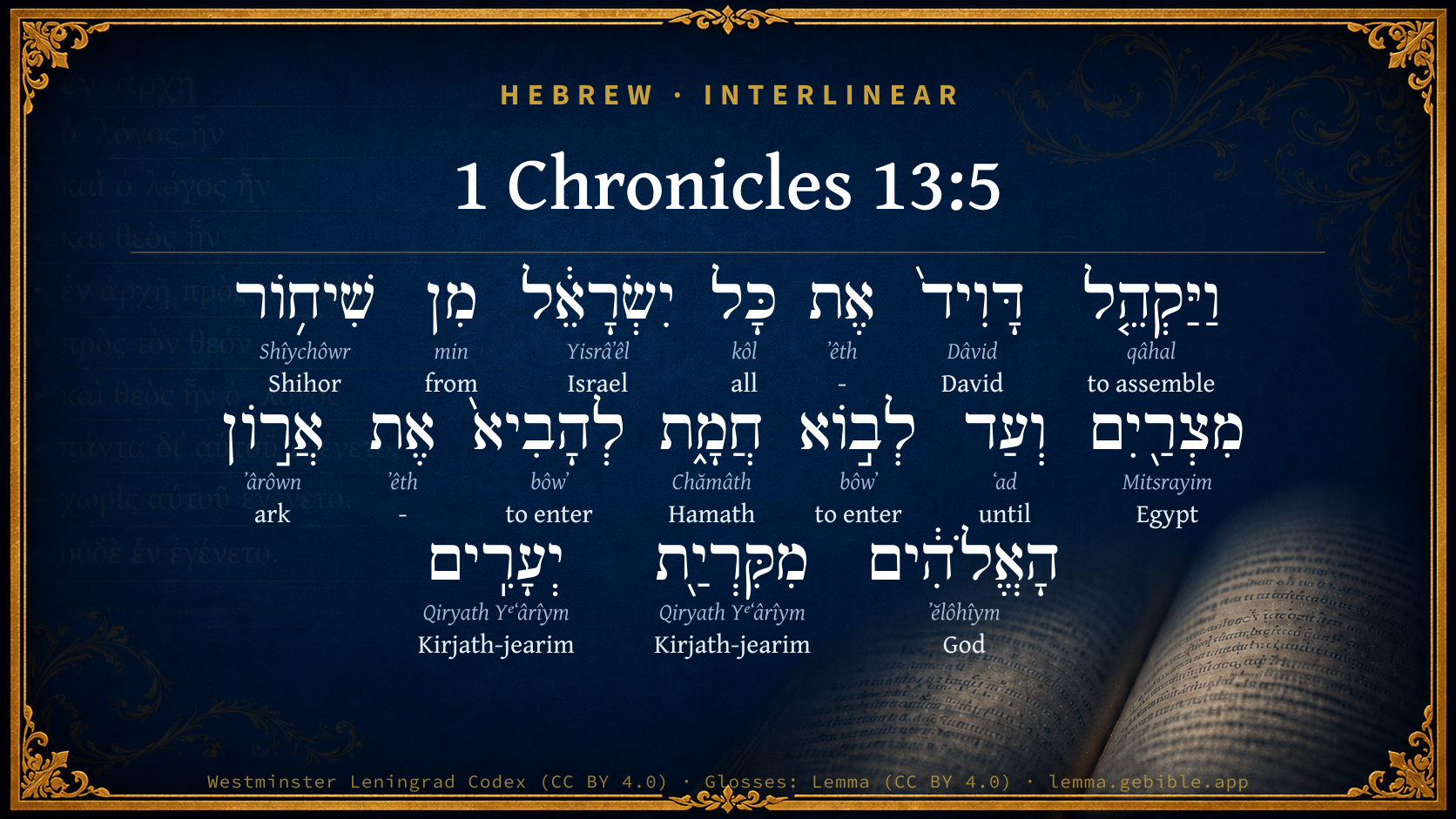
Hebrew (Westminster Leningrad Codex) 1 Chronicles 13:5 appears in the Hebrew Old Testament. The text above is from the Westminster Leningrad Codex. Each word links to its Strong’s number, a concise gloss, and parsing drawn from the Open Scriptures Hebrew Bible morphology. Click any word for its full Brown-Driver-Briggs (BDB) entry.
Download image
Cite this verse

1 Chronicles 13:5 (World English Bible). Public Domain. Lemma interlinear Bible study tool, https://lemma.gebible.app/v/1-chronicles/13/5.

Show BibTeX & RIS
BibTeX
RIS
English Translation
So David assembled all Israel together, from the Shihor [the brook] of Egypt even to the entrance of Hamath, to bring the ark of God from Kiriath Jearim.
World English Bible · Public Domain
Download a study sheet

One document with this verse’s original text, its word-by-word gloss line, the meaning frame, cross-references with their text, attributed commentary, and full source and license credits — printable, and it pastes into notes with its structure intact.

This verse Autodidact and up

Study sheet (.html) Plain text (.txt)

A passage Seminary Student

Up to 50 verses in one chapter. A passage sheet keeps up to 6 commentary sources and 12 cross-references per verse, in the order this page ranks them, and says so on the sheet whenever that leaves anything out. Ask for a single verse and you get the Autodidact verse sheet above.

Everything on this page stays free to read, with no account — the sheet is a download of what is already on screen, not access to it.

Want to remove ads? Support Godless Engineer
Compare translations 3

The same verse in 3 English versions, stacked beneath the original-language interlinear above. Click any original word for its lexicon entry.

Each is an independent rendering of the whole verse — the interlinear is not word-aligned to these translations.

Highlighted words mark where these versions differ — a whole-verse word diff, not a word-by-word alignment.

  • World English Bible Public Domain
    So David assembled all Israel together, from the Shihor [the brook] of Egypt even to the entrance of Hamath, to bring the ark of God from Kiriath Jearim.
  • King James Version Public Domain
    So David gathered all Israel together, from Shihor of Egypt even unto the entering of Hemath, to bring the ark of God from Kirjathjearim.
  • unfoldingWord Literal Text CC BY-SA 4.0
    And David assembled all of Israel, from Shihor of Egypt and unto Lebo Hamath, to bring the Box of God from Kiriath Jearim.

unfoldingWord Literal Text — © unfoldingWord, licensed CC BY-SA 4.0. Word-aligned USFM3 via Door43 (git.door43.org/unfoldingWord/en_ult).

Versions to compare (up to 4)

3 of 4 selected

Show all 18 translations

Every available English version of this verse, each an independent rendering of the whole verse.

  • World English Bible Public Domain
    So David assembled all Israel together, from the Shihor [the brook] of Egypt even to the entrance of Hamath, to bring the ark of God from Kiriath Jearim.
  • Berean Standard Bible Public Domain
    So David assembled all Israel, from the River Shihor in Egypt to Lebo-hamath, to bring the ark of God from Kiriath-jearim.
  • Majority Standard Bible Public Domain
    So David assembled all Israel, from the River Shihor in Egypt to Lebo-hamath, to bring the ark of God from Kiriath-jearim.
  • King James Version Public Domain
    So David gathered all Israel together, from Shihor of Egypt even unto the entering of Hemath, to bring the ark of God from Kirjathjearim.
  • American Standard Version (1901) Public Domain
    So David assembled all Israel together, from the Shihor `the brook' of Egypt even unto the entrance of Hamath, to bring the ark of God from Kiriath-jearim.
  • Revised Version (1885) Public Domain
    So David assembled all Israel together, from Shihor the brook of Egypt even unto the entering in of Hamath; to bring the ark of God from Kiriath-jearim.
  • Geneva Bible (1599) Public Domain
    So Dauid gathered all Israel together from Shihor in Egypt, euen vnto the entring of Hamath, to bring the Arke of God from Kiriath-iearim.
  • Douay-Rheims (1899) Public Domain
    So David assembled all Israel from Sihor of Egypt, even to the entering into Emath, to bring the ark of God from Cariathiarim.
  • Young's Literal Translation Public Domain
    And David assembleth all Israel from Shihor of Egypt even unto the entering in of Hamath, to bring in the ark of God from Kirjath-Jearim,
  • Literal Standard Version CC BY-SA 4.0
    And David assembles all Israel from Shihor of Egypt even to the entering in of Hamath, to bring in the Ark of God from Kirjath-Jearim,
  • Unlocked Literal Bible CC BY-SA 4.0
    So David assembled all Israel together, from the Shihor River in Egypt to Lebo Hamath, to bring the ark of God from Kiriath Jearim.
  • unfoldingWord Literal Text CC BY-SA 4.0
    And David assembled all of Israel, from Shihor of Egypt and unto Lebo Hamath, to bring the Box of God from Kiriath Jearim.
  • Darby Bible Public Domain
    And David assembled all Israel from the Shihor of Egypt unto the entrance of Hamath, to bring the ark of God from Kirjath-jearim.
  • World Messianic Bible Public Domain
    So David assembled all Israel together, from the Shihor River of Egypt even to the entrance of Hamath, to bring God’s ark from Kiriath Jearim.
  • Webster's Bible Public Domain
    So David assembled all Israel, from Shihor of Egypt even to the entrance of Hemath, to bring the ark of God from Kirjath-jearim.
  • Free Bible Version CC BY-SA 4.0
    So David summoned all of Israel, from the Shihor River of Egypt up to Lebo-hamath, to help bring the Ark from Kiriath-jearim.
  • Bible in Basic English Public Domain
    So David sent for all Israel to come together, from Shihor, the river of Egypt, as far as the way into Hamath, to get the ark of God from Kiriath-jearim.
  • JPS Tanakh (1917) Public Domain
    So David assembled all Israel together, from Shihor the brook of Egypt even unto the entrance of Hamath, to bring the ark of God from Kiriath-jearim.

Literal Standard Version (2020), Covenant Press — licensed CC BY-SA 4.0. Text via the HelloAO Bible API (eBible.org). Unlocked Literal Bible (unfoldingWord) — licensed CC BY-SA 4.0. Text via the HelloAO Bible API (eBible.org). unfoldingWord Literal Text — © unfoldingWord, licensed CC BY-SA 4.0. Word-aligned USFM3 via Door43 (git.door43.org/unfoldingWord/en_ult). Free Bible Version, Dr. Jonathan Gallagher — licensed CC BY-SA 4.0. Text via the HelloAO Bible API (eBible.org).

Word by word

More ways to search: Search by grammar → Find every occurrence → Compare this word →

Practice this passage: Drill this verse → Learn its vocabulary →

שִׁיח֥וֹר
Shîychôwr
H7883
“Shihor”
Noun, Proper
Part of Speech
Noun
Type
Proper
Full BDB Definition

Origin: probably from H7835

TWOT: None

Shihor or Sihor = "dark" - a river or canal on east border of Egypt and a branch of the Nile
  1. וַיַּקְהֵ֤ל qâhal H6950 “and · to assemble” Conjunction + Verb, Hiphil, Sequential Imperfect, 3rd Person, Masculine, Singular
  2. דָּוִיד֙ Dâvid H1732 “David” Noun, Proper
  3. אֶת ʼêth H853 “-” Particle, Direct Object
  4. כָּל kôl H3605 “all of” Noun, Common, Masculine, Singular, Construct
  5. יִשְׂרָאֵ֔ל Yisrâʼêl H3478 “Israel” Noun, Proper
  6. מִן min H4480 “from” Preposition
  7. מִצְרַ֖יִם Mitsrayim H4714 “Egypt” Noun, Proper
  8. וְעַד ʻad H5704 “and · until” Conjunction + Preposition
  9. לְב֣וֹא bôwʼ H935 “entrance” Noun, Proper
  10. חֲמָ֑ת Chămâth H2574 “Hamath” Noun, Proper
  11. לְהָבִיא֙ bôwʼ H935 “to enter” Preposition + Verb, Hiphil, Infinitive Construct
  12. אֶת ʼêth H853 “-” Particle, Direct Object
  13. אֲר֣וֹן ʼârôwn H727 “ark of” Noun, Common, Both, Singular, Construct
  14. הָאֱלֹהִ֔ים ʼĕlôhîym H430 “the · God(s)” Particle, Definite Article + Noun, Common, Masculine, Plural, Absolute
  15. מִקִּרְיַ֖ת Qiryath Yᵉʻârîym H7157 “from · Kirjath-jearim” Preposition + Noun, Proper
  16. יְעָרִֽים Qiryath Yᵉʻârîym H7157 “Kirjath-jearim” Noun, Proper

About this verse

These counts appear in no published source. They are computed here, from the morphology-tagged text and Lemma’s own curated glosses. What Lemma adds →

17
words
14
distinct lemmas
Historical
section

Notable vocabulary

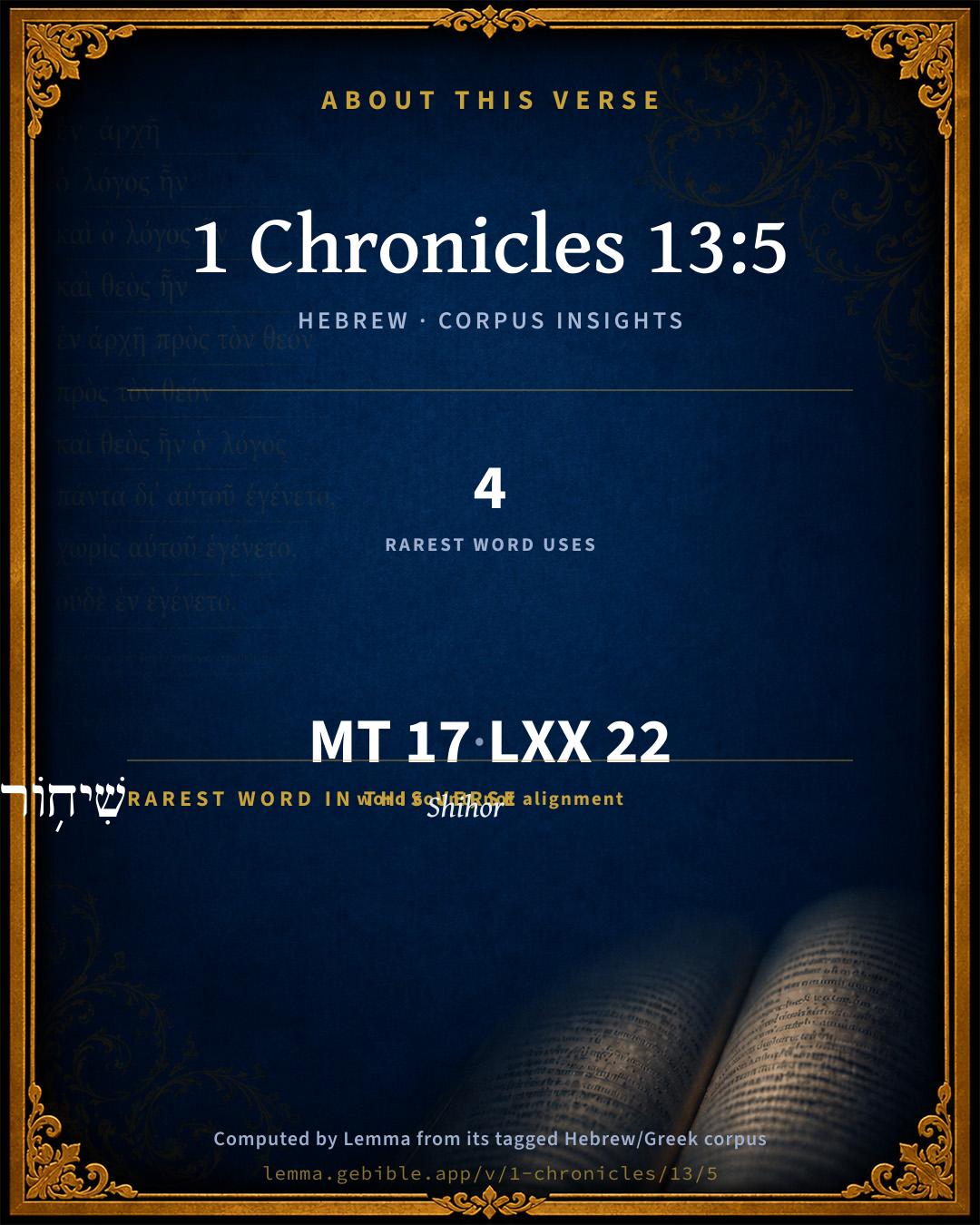
The rarest word here is שִׁיח֥וֹר Shihor H7883 — appearing just 4 times in the whole Hebrew Bible.

Shared distinctive vocabulary

שִׁיח֥וֹר Shihor H7883 occurs in 4 verses of the Hebrew Bible. Also found in:

Grammatical profile

  • 2 verbs
  • 11 nouns
  • 2 prepositions
  • 2 particles

Verb forms

  • וַיַּקְהֵ֤ל Hiphil · Sequential Imperfect
  • לְהָבִיא֙ Hiphil · Infinitive Construct

Repetition

Words recur within this verse — often emphatic in Hebrew:

  • לְב֣וֹא to enter H935 ×2
  • מִקִּרְיַ֖ת Kirjath-jearim H7157 ×2

Hebrew & Septuagint length

In English translation the verse runs 28 words from the Hebrew and 29 from the Septuagint (LXX English) — closely comparable.

A rough comparison of the two English renderings, which tokenize alike — not a word-level alignment.

Word counts can differ between the Hebrew and the Greek without any difference in meaning — e.g. the Hebrew direct-object marker אֵת has no separate Greek word, and Greek often adds the article ὁ.

In the original languages it is 17 Hebrew tokens and 22 Greek tokens — but the two are counted differently (Hebrew bundles its prefixes and suffixes into one token; the Greek is in lemma form), so that isn’t a like-for-like length.

Cross-references

10

Topical passages linked to 1 Chronicles 13:5 in the Treasury of Scripture Knowledge — connected by theme and wording, ordered by reader-vote popularity; previews shown in the World English Bible.

  • 1 Samuel 6:21–7:1 They sent messengers to the inhabitants of Kiriath Jearim, saying, The Philistines have brought back the ark of Yahweh; come you down, and bring it up to you.
  • 2 Samuel 6:1 David again gathered together all the chosen men of Israel, thirty thousand.
  • 1 Kings 8:65 So Solomon held the feast at that time, and all Israel with him, a great assembly, from the entrance of Hamath to the brook of Egypt, before Yahweh our God, seven days and seven days, even fourteen days.
  • 1 Chronicles 15:3 David assembled all Israel at Jerusalem, to bring up the ark of Yahweh to its place, which he had prepared for it.
  • Numbers 34:5–8 and the border shall turn about from Azmon to the brook of Egypt, and the goings out of it shall be at the sea.
  • Joshua 13:3–6 from the Shihor, which is before Egypt, even to the border of Ekron northward, [which] is reckoned to the Canaanites; the five lords of the Philistines; the Gazites, and the Ashdodites, the Ashkelonites, the Gittites, and the Ekronites; also the Avvim,
  • 1 Kings 4:21 Solomon ruled over all the kingdoms from the River to the land of the Philistines, and to the border of Egypt: they brought tribute, and served Solomon all the days of his life.
  • 2 Kings 25:21 The king of Babylon struck them, and put them to death at Riblah in the land of Hamath. So Judah was carried away captive out of his land.
  • 1 Chronicles 13:6 David went up, and all Israel, to Baalah, [that is], to Kiriath Jearim, which belonged to Judah, to bring up from there the ark of God Yahweh that sits [above] the cherubim, that is called by the Name.
  • Jeremiah 2:18 Now what have you to do in the way to Egypt, to drink the waters of the Shihor? or what have you to do in the way to Assyria, to drink the waters of the River?

Cross-references courtesy of OpenBible.info (CC BY 4.0).

Hebrew and Greek witnesses Masoretic Hebrew ↔ Greek Septuagint

The same verse in the two great witnesses to the Old Testament, shown verse-for-verse.

These are two independent witnesses, not word-aligned to each other, and the Septuagint is shown in lemma (dictionary) form.

Hebrew 1 Chronicles 13:5 Masoretic · Westminster Leningrad Codex

וַיַּקְהֵ֤ל דָּוִיד֙ אֶת כָּל יִשְׂרָאֵ֔ל מִן שִׁיח֥וֹר מִצְרַ֖יִם וְעַד לְב֣וֹא חֲמָ֑ת לְהָבִיא֙ אֶת אֲר֣וֹן הָאֱלֹהִ֔ים מִקִּרְיַ֖ת יְעָרִֽים

So David assembled all Israel together, from the Shihor [the brook] of Egypt even to the entrance of Hamath, to bring the ark of God from Kiriath Jearim.

World English Bible · Public Domain

Greek LXX 1 Chronicles 13:5 Septuagint · lemma form

καί ἐκἐκκλησιάζω δαυίδ ὁ πᾶς ἰσραήλ ἀπό ὅριον αἴγυπτος καί ἕως εἴσοδος ημαθ ὁ εἰςφέρω ὁ κιβωτός ὁ θεός ἐκ πόλις ιαριμ

So David assembled all Israel, from the borders of Egypt even to the entering in of Hemath, to bring in the ark of God from the city of Jarim.

LXX2012 (modern English Septuagint) · Public Domain

Hebrew: Westminster Leningrad Codex (CC BY 4.0). Greek: Septuagint (public domain); English from LXX2012 (modern English Septuagint) (Public Domain). How the Septuagint differs from the Hebrew →

Commentary

Notes on 1 Chronicles 13:5 from classic Christian and Jewish commentators (each source and its license shown beneath its notes). The classic Christian expositions comment on the surrounding passage and are grouped to its opening verse, so a note may address several verses; the Jewish commentaries on the Tanakh (Rashi and others) are per-verse, so they appear only where the commentator wrote on this verse.

Lemma curates 59 commentaries, every one of them public domain or Creative Commons licensed, each selected and text-cleaned for this edition rather than reprinted as found. About our sources →

The Cambridge Bible for Schools and Colleges

gen. ed. J. J. S. Perowne

5. from Shihor of Egypt] R.V. from Shihor the brook of Egypt. Shihor (spelt elsewhere wrongly in A.V., Sihor) was the name of the brook (now wâdy el Arish) which divided Palestine from Egypt (Jos_13:3; Jos_15:4; Jer_2:18).

the entering of Hemath] R.V. the entering in of Hamath. Hamath (now Hama) is on the Orontes. The entering in of Hamath is to be identified with the Beḳâ‘a, a broad valley between Lebanon and Anti-Libanus watered by the Orontes (Bädeker, pp. 305, 376). It is mentioned as on the northern frontier of Israel in Jos_13:5 and elsewhere.

The Cambridge Bible for Schools and Colleges (gen. ed. J. J. S. Perowne; Cambridge University Press, 1878–1918) — public domain. Text from a community e-Sword module.

Trapp's Complete Commentary

John Trapp

1Ch 13:5 So David gathered all Israel together, from Shihor of Egypt even unto the entering of Hemath, to bring the ark of God from Kirjathjearim.

Ver. 5. From Shihor of Egypt.] Called elsewhere the torrent of Egypt, {Num 34:5} which some take for a river running near to Rhinocolura; but others for Nile, that ancient river whose seven streams of old are now become four, as travellers tell us. The name Sichor hath a notion of blackness in it, from the blackness of the water, or rather of the mud and slime that it brings down with it; or the black colour of the grounds and soils it passeth through. {a}

{a} The Ethiopians called it Sius; the Greeks, Mελας; the Latins, Melo. - Richard.

John Trapp, A Commentary or Exposition upon All the Books of the Old and New Testament (1647–1656) — public domain. Text from a community e-Sword module.

Geneva Bible (1599)

Geneva Bible translators

That is, from Gibea, where the inhabitants of Kirjath Jearim had placed it in the house of Abinadab, 2 Sam. 6:3.

Or, Nile.

Geneva Bible (1599) marginal notes — public domain. Text via Bolls.life.

Jamieson, Fausset & Brown

Robert Jamieson, A. R. Fausset & David Brown

from Shihor of Egypt-- (Jos 15:4, Jos 15:47; Num 34:5; Kg1 8:65; Kg2 24:7; Ch2 7:8); a small brook flowing into the Mediterranean, near the modern El-arish, which forms the southern boundary of Palestine.

unto the entering of Hemath--the defile between the mountain ranges of Syria and the extreme limit of Palestine on the north.

Jamieson, Fausset & Brown — Commentary Critical and Explanatory on the Whole Bible (1871) — public domain (CC PDM 1.0). Text via the HelloAO Bible API.

Adam Clarke's Commentary

Verse 5. From Shihor of Egypt even unto the entering of Hemath] "Therefore David gathered all Israel, from the Nile, נילוס Nilos, of Egypt, even to the entrance of Antioch." - T.

Adam Clarke's Commentary on the Bible (1810–1826) — public domain. Text from a community e-Sword/MySword module.

Ellicott's Commentary for English Readers

(5) So David gathered all Israel.— Assembled; a different word in 1Ch_13:2.

Shihor of Egypt.—The boundary between Egypt and Canaan is elsewhere called Nahal Micrayim (Authorύsed Version, River of Egypt; Isa_27:12; 2Ch_7:8). It is the modern Wady el Arish. Jos_13:3 also calls this winter torrent the Shihor (Blackwater); but, in Isa_23:3, Shihor means the Nile.

The entering of Hemath.—Hamath.—This was the usual designation of the north boundary of Palestine, as the “torrent of Egypt” was that of the south (1Ki_8:65). Hamath was the seat of an ancient kingdom, independent of, but friendly to David. The prophet Amos (eighth century B.C. ) calls it Hamath Rabbah, Great Hamath (Amo_6:2). A revived interest attaches to Hamath in our day, owing to the discovery of five curious inscriptions at Hâmah, written in a peculiar hieroglyphic character, which has been pronounced to be Hittite, but still awaits decipherment.

A Bible Commentary for English Readers, edited by Charles John Ellicott (1878–1897) — public domain. Text from a community e-Sword module.

John Gill's Exposition

So David gathered all Israel together,.... The principal of them, even 30,000 select men, Sa2 6:1.

from Shihor of Egypt; or the Nile of Egypt, as the Targum and other Jewish writers, called Shihor from the blackness of its water, see Jer 2:18 though some think the river Rhinocurura is meant, which both lay to the south of the land of Israel:

even unto the entering of Hamath; which the Targum interprets of Antiochia, which lay to the north of the land; so that this collection of the people was made from south to north, the extreme borders of the land:

to bring the ark of God from Kirjathjearim; where it then was, and had been a long time, see Sa1 7:1, from hence to the end of the chapter the account is the same with Sa2 6:1, see the notes there; what little variations there are, are there observed. See Gill on Sa2 6:1, Sa2 6:2, Sa2 6:3, Sa2 6:4, Sa2 6:5, Sa2 6:6, Sa2 6:7, Sa2 6:8, Sa2 6:9, Sa2 6:10, Sa2 6:11

Next: 1 Chronicles Chapter 14

John Gill's Exposition of the Whole Bible (1746–1763) — public domain (CC PDM 1.0). Text via the HelloAO Bible API.

Albert Barnes' Notes on the Bible

Shihor - See the marginal reference and the 1Ki 8:65 note.

Albert Barnes' Notes on the Bible (1834–1885) — public domain. Text from a community e-Sword/MySword module.

Haydock's Catholic Bible Commentary

Emath, from "the troubled river" Nile, (Josue xiii. 3.; Calmet) or Rhinocorura, (Tirinus; Menochius) to the northern extremities of the promised land, (Haydock) near Emesa.

George Leo Haydock (1774–1849), Haydock's Catholic Family Bible and Commentary, 1859 edition — public domain. Excludes Psalms (Douay-Rheims chapter numbering differs from Protestant) and Deuterocanonical books (Catholic canon only).

Matthew Poole's English Annotations

All Israel, i.e. all the chosen men of Israel, as it is phrased, 2Sa 6:1, their elders and representatives.

Shihor of Egypt; of which see Num 34:5; Jos 13:3; Jer 2:18.

Matthew Poole's English Annotations on the Holy Bible (1683–1685) — public domain. Text from a community e-Sword/MySword module.

The Pulpit Commentary

All Israel. The parallel gives the number as thirty thousand men. (2Sa_6:1, 2Sa_6:2) Shihor of Egypt. According to Gesenius, this Shihor is from root rj meaning "to be turbid" or "black" (so Latin melo, from the Greek; Virgil, "Georg.," 4:278, 291; Catullus, 67:33). There can surely be little doubt that it is the river Nile which is here spoken of, after comparison of the following passages: Jos_13:3 Isa_23:3; Jer_2:18. Though others, quoting Jos_13:3 and 19:26, and interpreting Shihor generically as applicable to any dark, turbid stream, make it the modern Wady el-Arish, However, the parallel, n 1Ki_8:65, does not necessarily dissever the lj from rhn; of Egypt, (Gen_15:18) but rather tends to identify them. The entering of Hemath; i.e. the way to Hamath, (Hebrew tmj Num_34:7, Num_34:8)

Hamath was one of the great cities of the Orontes valley, in Upper Syria, which formed the boundary in especial of the empire of Solomon. This valley is watered by the Orontes, the river of Antioch, a river remarkable for its abundant spring (situate immediately north of the source of the Leontes), which won for it the name, among all the other springs of Syria, of "The Spring," and remarkable for "the length of its course, the volume of its waters, and the rich vegetation of its banks." It is the one of the four rivers which take their rise beneath the heights of the Lebanon and Anti-Lebanon which becomes really worthy of the name of river, the other three, viz. the Jordan, the Leontes or modern Litany of Phoeicia, and the Abana or modern Barada of Damascus, more resembling the nature of the mountain stream. This river was to the ancient Romans "the representative of Syria, as the Timings might be said to be of England, and in later times the region formed the chief point of contact between this part of Asia and the West" (Stanley"s "Sinai and Palestine," pp. 414, e,f, edit. 1866). The kingdom of Hamath comprised the tract of this valley of the Orontes, skirted by the hills separating the Leontes from the Orontes, and extending to the Pass of Daphne below Antioch. Riblah (Num_34:11 2Ki 23, 33) lies on the east bank of the Orontes, thirty-five miles north-east of Baal-bek, or Baal-gad. The people of Hamath were of the race of Ham, of the descendants of Canaan, (Gen_10:18) and are not to be reckoned as of Phoenician origin.

The Pulpit Commentary (1880–1919), ed. H.D.M. Spence-Jones & Joseph S. Exell — public domain. Text from a community e-Sword module.

Keil & Delitzsch

C. F. Keil & F. Delitzsch

So David gathered all Israel together,.... The principal of them, even 30,000 select men, Sa2 6:1.

from Shihor of Egypt; or the Nile of Egypt, as the Targum and other Jewish writers, called Shihor from the blackness of its water, see Jer 2:18 though some think the river Rhinocurura is meant, which both lay to the south of the land of Israel:

even unto the entering of Hamath; which the Targum interprets of Antiochia, which lay to the north of the land; so that this collection of the people was made from south to north, the extreme borders of the land:

to bring the ark of God from Kirjathjearim; where it then was, and had been a long time, see Sa1 7:1, from hence to the end of the chapter the account is the same with Sa2 6:1, see the notes there; what little variations there are, are there observed. See Gill on Sa2 6:1, Sa2 6:2, Sa2 6:3, Sa2 6:4, Sa2 6:5, Sa2 6:6, Sa2 6:7, Sa2 6:8, Sa2 6:9, Sa2 6:10, Sa2 6:11

Next: 1 Chronicles Chapter 14

Keil & Delitzsch — Biblical Commentary on the Old Testament (1861–1891) — public domain (CC PDM 1.0). Text via the HelloAO Bible API. (Old Testament only.)

unfoldingWord translationNotes

Door43 World Missions Community

David assembled all Israel together

Here the word "all" is a generalization. The phrase means that David assembled people from all over Israel, not that he assembled every person in Israel. AT: "David assembled people together from all Israel" (See: Hyperbole and Generalization)

Lebo Hamath ... Kiriath Jearim ... Baalah

These are the names of places. "Baalah" is another name for Kiriath Jearim. (See: How to Translate Names)

which belongs to Judah

"which is in Judah"

to bring up from there the ark of God

It is implied that they are taking the ark to Jerusalem. AT: "to take to Jerusalem the ark of God" (See: Assumed Knowledge and Implicit Information)

to bring up from there

Jerusalem is higher than almost any other place in Israel, so it was normal for Israelites to speak of going up to Jerusalem and going down from it.

which is called by Yahweh's name

This can be stated in active form. Possible meanings are 1) the idiom "called by ... name" refers to a person owning the thing. AT: "which belongs to Yahweh" or 2) the ark has Yahweh's name written on it. AT: "which bears Yahweh's name" (See: Idiom)

who sits enthroned over the cherubim

You may need to make explicit that the cherubim are those on the lid of the ark of the covenant. The biblical writers often spoke of the ark of the covenant as if it were Yahweh's footstool upon which he rested his feet as he sat on his throne in heaven above. AT: "who sits on his throne above the cherubim on the ark of the covenant" (See: Assumed Knowledge and Implicit Information)

translationWords

Egypt

Judah

name

cherub

unfoldingWord translationNotes — © Distant Shores Media and the Door43 World Missions Community, licensed CC BY-SA 4.0. Source: git.door43.org/Door43/en_tn.

Rashi

Rabbi Shlomo Yitzchaki (Rashi)

from Shihor of Egypt and until the approach to Hamath This parallels (I Kings 8:65): “from the approach to Hamath to the brook of Egypt”

Rashi on the Tanakh — English translations: “The Judaica Press complete Tanach with Rashi, translated by A. J. Rosenberg” (CC BY 4.0); “Pentateuch with Rashi's commentary by M. Rosenbaum and A.M. Silbermann, 1929-1934” (public domain); “The Metsudah Tanach series, Lakewood, N.J” (CC BY 4.0); and “The Book of Joshua, Metsudah Publications, 1997” (CC BY 4.0). Text via Sefaria.

Lesson kit

Teaching starters — assembled from the data on this page, not authored interpretation. Every prompt links to the verse data it draws on. Edit before teaching.

1 Chronicles, in the Historical, opens this verse with 17 words (14 distinct Hebrew lemmas). Its most distinctive word is Shîychôwr (“Shihor”). A historical commentator’s framing appears above. Read the whole chapter for the surrounding context.

Discussion questions

  1. How does “Shihor” (Shîychôwr) shape what this verse is saying?
  2. Joshua 13:3 shares the word «Shihor» with this verse. How do the two illuminate each other?
  3. “to enter” occurs 2× in this one verse. What is the effect of the repetition?
  4. These translations render this verse differently. What is at stake in choosing one wording over another?
  5. The verb «וַיַּקְהֵ֤ל» is Hiphil Sequential Imperfect. How does its form color the action?
  6. Reading how The Cambridge Bible for Schools and Colleges and Trapp's Complete Commentary read this verse, where do the two commentators agree and where do they part?

Things to notice

Reading settings

Reading text

Shown beneath each verse's original-language words.

Old Testament
Old Testament edition

Read the OT as the Masoretic Hebrew (MT) or the Greek Septuagint (LXX).

English shown for the Greek Septuagint (in the Hebrew ↔ Greek comparison).

Comparing translations? Open the Compare panel on any verse page to stack up to four side by side.