
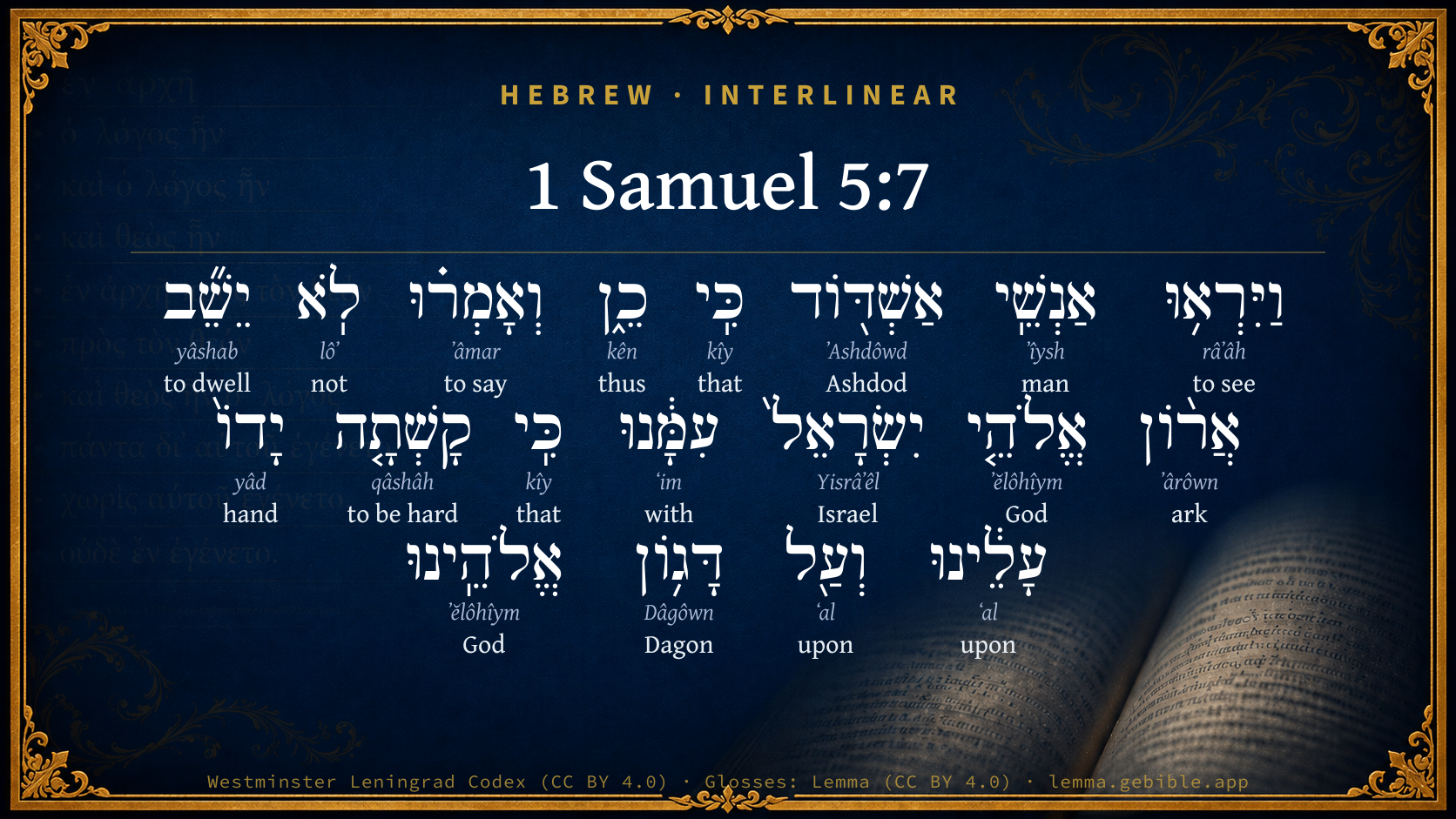
1 Samuel 5:7

Hebrew (Westminster Leningrad Codex) 1 Samuel 5:7 appears in the Hebrew Old Testament. The text above is from the Westminster Leningrad Codex. Each word links to its Strong’s number, a concise gloss, and parsing drawn from the Open Scriptures Hebrew Bible morphology. Click any word for its full Brown-Driver-Briggs (BDB) entry.
Download image
Cite this verse

1 Samuel 5:7 (World English Bible). Public Domain. Lemma interlinear Bible study tool, https://lemma.gebible.app/v/1-samuel/5/7.

Show BibTeX & RIS
BibTeX
RIS
English Translation
When the men of Ashdod saw that it was so, they said, The ark of the God of Israel shall not abide with us; for his hand is sore on us, and on Dagon our god.
World English Bible · Public Domain
Download a study sheet

One document with this verse’s original text, its word-by-word gloss line, the meaning frame, cross-references with their text, attributed commentary, and full source and license credits — printable, and it pastes into notes with its structure intact.

This verse Autodidact and up

Study sheet (.html) Plain text (.txt)

A passage Seminary Student

Up to 50 verses in one chapter. A passage sheet keeps up to 6 commentary sources and 12 cross-references per verse, in the order this page ranks them, and says so on the sheet whenever that leaves anything out. Ask for a single verse and you get the Autodidact verse sheet above.

Everything on this page stays free to read, with no account — the sheet is a download of what is already on screen, not access to it.

Want to remove ads? Support Godless Engineer
Compare translations 3

The same verse in 3 English versions, stacked beneath the original-language interlinear above. Click any original word for its lexicon entry.

Each is an independent rendering of the whole verse — the interlinear is not word-aligned to these translations.

Highlighted words mark where these versions differ — a whole-verse word diff, not a word-by-word alignment.

  • World English Bible Public Domain
    When the men of Ashdod saw that it was so, they said, The ark of the God of Israel shall not abide with us; for his hand is sore on us, and on Dagon our god.
  • King James Version Public Domain
    And when the men of Ashdod saw that it was so, they said, The ark of the God of Israel shall not abide with us: for his hand is sore upon us, and upon Dagon our god.
  • unfoldingWord Literal Text CC BY-SA 4.0
    And the men of Ashdod saw that thus, and they said, “The Box of the God of Israel should not stay with us, for his hand is severe against us and against Dagon our god.”

unfoldingWord Literal Text — © unfoldingWord, licensed CC BY-SA 4.0. Word-aligned USFM3 via Door43 (git.door43.org/unfoldingWord/en_ult).

Versions to compare (up to 4)

3 of 4 selected

Show all 18 translations

Every available English version of this verse, each an independent rendering of the whole verse.

  • World English Bible Public Domain
    When the men of Ashdod saw that it was so, they said, The ark of the God of Israel shall not abide with us; for his hand is sore on us, and on Dagon our god.
  • Berean Standard Bible Public Domain
    And when the men of Ashdod saw what was happening, they said, “The ark of the God of Israel must not stay here with us, because His hand is heavy upon us and upon our god Dagon.”
  • Majority Standard Bible Public Domain
    And when the men of Ashdod saw what was happening, they said, “The ark of the God of Israel must not stay here with us, because His hand is heavy upon us and upon our god Dagon.”
  • King James Version Public Domain
    And when the men of Ashdod saw that it was so, they said, The ark of the God of Israel shall not abide with us: for his hand is sore upon us, and upon Dagon our god.
  • American Standard Version (1901) Public Domain
    And when the men of Ashdod saw that it was so, they said, The ark of the God of Israel shall not abide with us; for his hand is sore upon us, and upon Dagon our god.
  • Revised Version (1885) Public Domain
    And when the men of Ashdod saw that it was so, they said, The ark of the God of Israel shall not abide with us: for his hand is sore upon as, and upon Dagon our god.
  • Geneva Bible (1599) Public Domain
    And when the men of Ashdod sawe this, they sayd, Let not the Arke of the God of Israel abide with vs: for his hand is sore vpon vs and vpon Dagon our god.
  • Douay-Rheims (1899) Public Domain
    And the men of Azotus seeing this kind of plague, said: The ark of the God of Israel shall not stay with us: for his hand is heavy upon us, and upon Dagon our god.
  • Young's Literal Translation Public Domain
    And the men of Ashdod see that `it is' so, and have said, `The ark of the God of Israel doth not abide with us, for hard hath been His hand upon us, and upon Dagon our god.'
  • Literal Standard Version CC BY-SA 4.0
    And the men of Ashdod see that [it is] so, and have said, “The Ark of the God of Israel does not abide with us, for His hand has been hard on us, and on our god Dagon.”
  • Unlocked Literal Bible CC BY-SA 4.0
    When the men of Ashdod realized what was happening, they said, “The ark of the God of Israel must not stay with us, because his hand is hard against us and against Dagon our god.”
  • unfoldingWord Literal Text CC BY-SA 4.0
    And the men of Ashdod saw that thus, and they said, “The Box of the God of Israel should not stay with us, for his hand is severe against us and against Dagon our god.”
  • Darby Bible Public Domain
    And when the men of Ashdod saw that it was so, they said, The ark of the God of Israel shall not abide with us; for his hand is severe upon us, and upon Dagon our god.
  • World Messianic Bible Public Domain
    When the men of Ashdod saw that it was so, they said, “The ark of the God of Israel shall not stay with us, for his hand is severe on us and on Dagon our god.”
  • Webster's Bible Public Domain
    And when the men of Ashdod saw that it was so, they said, The ark of the God of Israel shall not abide with us: for his hand is severe upon us, and upon Dagon our god.
  • Free Bible Version CC BY-SA 4.0
    When the people of Ashdod saw what was going on, they said, “We can't let the Ark of the God of Israel remain here with us, because he is punishing us and Dagon our god.”
  • Bible in Basic English Public Domain
    And when the men of Ashdod saw how it was, they said, Let not the ark of the God of Israel be with us, for his hand is hard on us and on Dagon our god.
  • JPS Tanakh (1917) Public Domain
    And when the men of Ashdod saw that it was so, they said: 'The ark of the God of Israel shall not abide with us; for His hand is sore upon us, and upon Dagon our god.'

Literal Standard Version (2020), Covenant Press — licensed CC BY-SA 4.0. Text via the HelloAO Bible API (eBible.org). Unlocked Literal Bible (unfoldingWord) — licensed CC BY-SA 4.0. Text via the HelloAO Bible API (eBible.org). unfoldingWord Literal Text — © unfoldingWord, licensed CC BY-SA 4.0. Word-aligned USFM3 via Door43 (git.door43.org/unfoldingWord/en_ult). Free Bible Version, Dr. Jonathan Gallagher — licensed CC BY-SA 4.0. Text via the HelloAO Bible API (eBible.org).

Word by word

More ways to search: Search by grammar → Find every occurrence → Compare this word →

Practice this passage: Drill this verse → Learn its vocabulary →

דָּג֥וֹן
Dâgôwn
H1712
“Dagon”
Noun, Proper
Part of Speech
Noun
Type
Proper
Full BDB Definition

Origin: from H1709

TWOT: None

Dagon = "a fish" - a Philistine deity of fertility; represented with the face and hands of a man and the tail of a fish
  1. וַיִּרְא֥וּ râʼâh H7200 “and · to see” Conjunction + Verb, Qal, Sequential Imperfect, 3rd Person, Masculine, Plural
  2. אַנְשֵֽׁי ʼîysh H376 “men of” Noun, Common, Masculine, Plural, Construct
  3. אַשְׁדּ֖וֹד ʼAshdôwd H795 “Ashdod” Noun, Proper
  4. כִּֽי kîy H3588 “that” Conjunction
  5. כֵ֑ן kên H3651 “thus” Adverb
  6. וְאָמְר֗וּ ʼâmar H559 “and · to say” Conjunction + Verb, Qal, Perfect, 3rd Person, Common, Plural
  7. לֹֽא lôʼ H3808 “not” Particle, Negative
  8. יֵשֵׁ֞ב yâshab H3427 “to dwell” Verb, Qal, Imperfect, 3rd Person, Masculine, Singular
  9. אֲר֨וֹן ʼârôwn H727 “ark of” Noun, Common, Both, Singular, Construct
  10. אֱלֹהֵ֤י ʼĕlôhîym H430 “God(s) of” Noun, Common, Masculine, Plural, Construct
  11. יִשְׂרָאֵל֙ Yisrâʼêl H3478 “Israel” Noun, Proper
  12. עִמָּ֔נוּ ʻim H5973 “with · us” Preposition + Suffix, Personal, 1st Person, Common, Plural
  13. כִּֽי kîy H3588 “that” Conjunction
  14. קָשְׁתָ֤ה qâshâh H7185 “to be hard” Verb, Qal, Perfect, 3rd Person, Feminine, Singular
  15. יָדוֹ֙ yâd H3027 “hand · his” Noun, Common, Both, Singular, Construct + Suffix, Personal, 3rd Person, Masculine, Singular
  16. עָלֵ֔ינוּ ʻal H5921 “upon · us” Preposition + Suffix, Personal, 1st Person, Common, Plural
  17. וְעַ֖ל ʻal H5921 “and · upon” Conjunction + Preposition
  18. אֱלֹהֵֽינוּ ʼĕlôhîym H430 “God(s) · our” Noun, Common, Masculine, Plural, Construct + Suffix, Personal, 1st Person, Common, Plural

About this verse

These counts appear in no published source. They are computed here, from the morphology-tagged text and Lemma’s own curated glosses. What Lemma adds →

19
words
16
distinct lemmas
Historical
section

Notable vocabulary

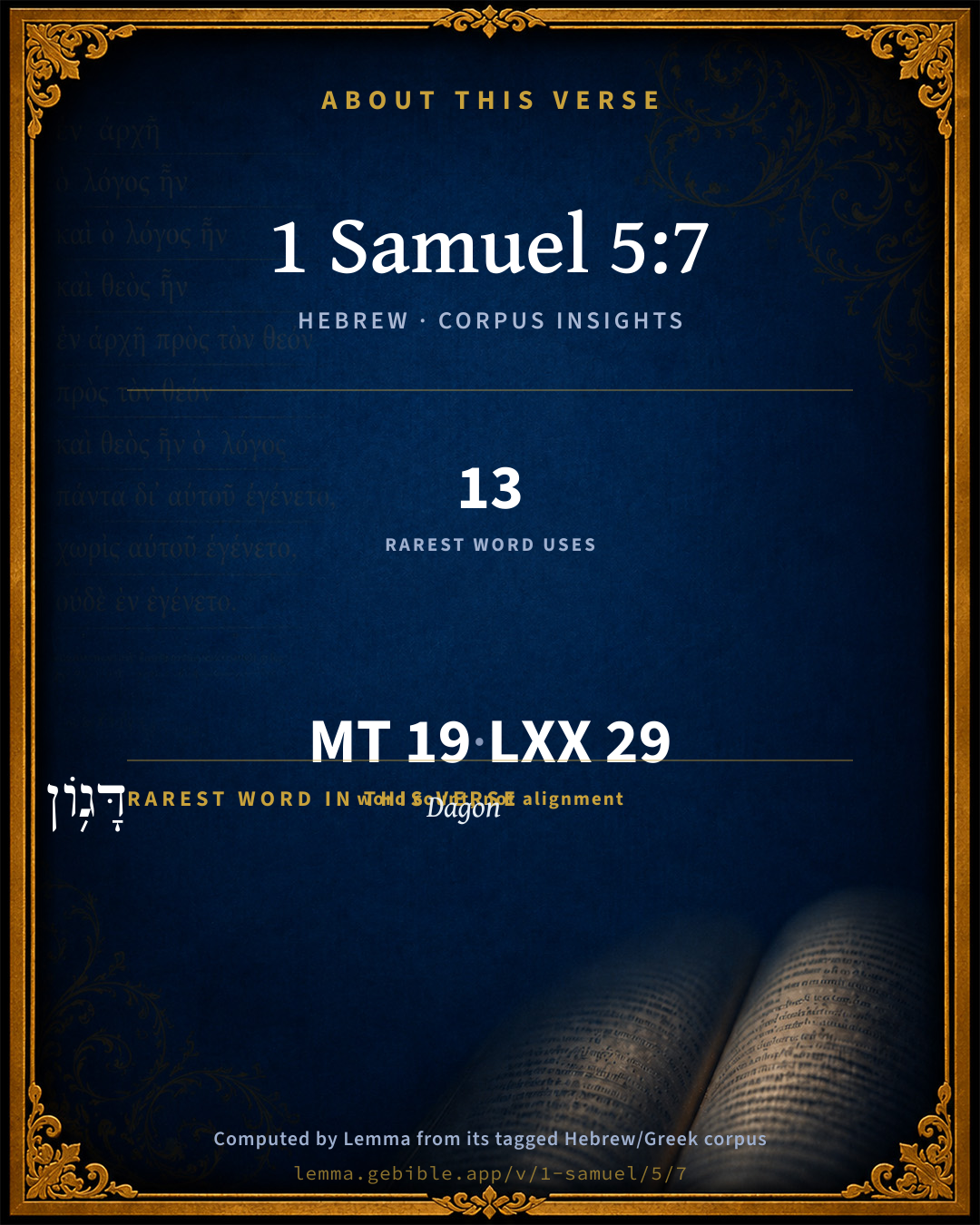
The rarest word here is דָּג֥וֹן Dagon H1712 — appearing just 13 times in the whole Hebrew Bible.

Shared distinctive vocabulary

דָּג֥וֹן Dagon H1712 occurs in 7 verses of the Hebrew Bible. Also found in:

Grammatical profile

  • 4 verbs
  • 8 nouns
  • 3 prepositions
  • 2 conjunctions
  • 1 adverb
  • 1 particle

Verb forms

  • וַיִּרְא֥וּ Qal · Sequential Imperfect
  • וְאָמְר֗וּ Qal · Perfect
  • יֵשֵׁ֞ב Qal · Imperfect
  • קָשְׁתָ֤ה Qal · Perfect

Repetition

Words recur within this verse — often emphatic in Hebrew:

  • אֱלֹהֵ֤י God H430 ×2
  • עָלֵ֔ינוּ upon H5921 ×2
  • כִּֽי that H3588 ×2

Hebrew & Septuagint length

In English translation the verse runs 36 words from the Hebrew and 37 from the Septuagint (LXX English) — closely comparable.

A rough comparison of the two English renderings, which tokenize alike — not a word-level alignment.

Word counts can differ between the Hebrew and the Greek without any difference in meaning — e.g. the Hebrew direct-object marker אֵת has no separate Greek word, and Greek often adds the article ὁ.

In the original languages it is 19 Hebrew tokens and 29 Greek tokens — but the two are counted differently (Hebrew bundles its prefixes and suffixes into one token; the Greek is in lemma form), so that isn’t a like-for-like length.

Cross-references

13

Topical passages linked to 1 Samuel 5:7 in the Treasury of Scripture Knowledge — connected by theme and wording, ordered by reader-vote popularity; previews shown in the World English Bible.

  • Exodus 12:33 The Egyptians were urgent with the people, to send them out of the land in haste, for they said, "We are all dead men."
  • 1 Chronicles 15:13 For because you didn't carry it at the first, Yahweh our God made a breach on us, because we didn't seek him according to the ordinance.
  • Jeremiah 48:7 For, because you have trusted in your works and in your treasures, you also shall be taken: and Chemosh shall go forth into captivity, his priests and his princes together.
  • Exodus 8:8 Then Pharaoh called for Moses and Aaron, and said, "Entreat Yahweh, that he take away the frogs from me, and from my people; and I will let the people go, that they may sacrifice to Yahweh."
  • Exodus 8:28 Pharaoh said, "I will let you go, that you may sacrifice to Yahweh your God in the wilderness, only you shall not go very far away. Pray for me."
  • Exodus 9:28 Pray to Yahweh; for there has been enough of mighty thunderings and hail. I will let you go, and you shall stay no longer."
  • Exodus 10:7 Pharaoh's servants said to him, "How long will this man be a snare to us? Let the men go, that they may serve Yahweh, their God. Don't you yet know that Egypt is destroyed?"
  • 1 Samuel 4:8 Woe to us! who shall deliver us out of the hand of these mighty gods? these are the gods that struck the Egyptians with all manner of plagues in the wilderness.
  • 1 Samuel 5:3–4 When they of Ashdod arose early on the next day, behold, Dagon was fallen on his face to the ground before the ark of Yahweh. They took Dagon, and set him in his place again.
  • 1 Samuel 6:20 The men of Beth-shemesh said, Who is able to stand before Yahweh, this holy God? and to whom shall he go up from us?
  • 2 Samuel 6:9 David was afraid of Yahweh that day; and he said, How shall the ark of Yahweh come to me?
  • 1 Chronicles 13:11–13 David was displeased, because Yahweh had broken forth on Uzza; and he called that place Perez Uzza, to this day.
  • Jeremiah 46:25 Yahweh of Hosts, the God of Israel, says: Behold, I will punish Amon of No, and Pharaoh, and Egypt, with her gods, and her kings; even Pharaoh, and those who trust in him:

Cross-references courtesy of OpenBible.info (CC BY 4.0).

Hebrew and Greek witnesses Masoretic Hebrew ↔ Greek Septuagint

The same verse in the two great witnesses to the Old Testament, shown verse-for-verse.

These are two independent witnesses, not word-aligned to each other, and the Septuagint is shown in lemma (dictionary) form.

Hebrew 1 Samuel 5:7 Masoretic · Westminster Leningrad Codex

וַיִּרְא֥וּ אַנְשֵֽׁי אַשְׁדּ֖וֹד כִּֽי כֵ֑ן וְאָמְר֗וּ לֹֽא יֵשֵׁ֞ב אֲר֨וֹן אֱלֹהֵ֤י יִשְׂרָאֵל֙ עִמָּ֔נוּ כִּֽי קָשְׁתָ֤ה יָדוֹ֙ עָלֵ֔ינוּ וְעַ֖ל דָּג֥וֹן אֱלֹהֵֽינוּ

When the men of Ashdod saw that it was so, they said, The ark of the God of Israel shall not abide with us; for his hand is sore on us, and on Dagon our god.

World English Bible · Public Domain

Greek LXX 1 Samuel 5:7 Septuagint · lemma form

καί ὁράω ὁ ἀνήρ ἄζωτος ὅτι οὕτως καί λέγω ὅτι οὐ καταἵημι κιβωτός ὁ θεός ἰσραήλ μετά ἐγώ ὅτι σκληρός χείρ αὐτός ἐπί ἐγώ καί ἐπί δαγων θεός ἐγώ

And the men of Azotus saw that it was so, and they said, The ark of the God of Israel shall not abide with us, for his hand is heavy upon us and upon Dagon our god.

LXX2012 (modern English Septuagint) · Public Domain

Hebrew: Westminster Leningrad Codex (CC BY 4.0). Greek: Septuagint (public domain); English from LXX2012 (modern English Septuagint) (Public Domain). How the Septuagint differs from the Hebrew →

Targum (Aramaic paraphrase)

1

The Targum is the ancient Jewish Aramaic paraphrase of the Hebrew Scriptures — an interpretive translation, not the Hebrew text itself. Onkelos (literal) and Pseudo-Jonathan (expansive) render the Torah, and Jonathan the Prophets. Coverage is partial: where no permissively-licensed English translation exists for a verse, only the Aramaic is shown. This is verse-level text, not a word-by-word alignment to the Hebrew.

  1. Targum Jonathan Prophets (Joshua–Malachi)
    וַחֲזוֹ אֱנָשֵׁי אַשְׁדוֹד אֲרֵי שַׁוְיָא עֲלֵיהוֹן מְחָתָא וְאָמְרִין לָא יִשְׁרֵי אֲרוֹן אֱלָהָא דְיִשְׂרָאֵל עִמָנָא אֲרֵי תְקִיפַת מְחָתֵיהּ עֲלָנָא וְעַל דָגוֹן טַעֲוָתָנָא:

    (no public-domain English translation for this verse)

    Targum Jonathan — Aramaic: “Mikraot Gedolot” (public domain). English: “Sefaria Community Translation” (CC0 1.0 (public-domain dedication)); “London "Chaldee Paraphrase," 1871” (public domain). Text via Sefaria.

Commentary

Notes on 1 Samuel 5:7 from classic Christian and Jewish commentators (each source and its license shown beneath its notes). The classic Christian expositions comment on the surrounding passage and are grouped to its opening verse, so a note may address several verses; the Jewish commentaries on the Tanakh (Rashi and others) are per-verse, so they appear only where the commentator wrote on this verse.

Lemma curates 59 commentaries, every one of them public domain or Creative Commons licensed, each selected and text-cleaned for this edition rather than reprinted as found. About our sources →

Trapp's Complete Commentary

John Trapp

1Sa 5:7 And when the men of Ashdod saw that [it was] so, they said, The ark of the God of Israel shall not abide with us: for his hand is sore upon us, and upon Dagon our god.

Ver. 7. The ark of the God of Israel shall not abide with us.] They should have rather parted with their sins, than with the ark: and have said unto their idols, "Get ye hence," as Isa 30:22. What have we to do any more with Dagon, who cannot save himself, much less us, from the divine vengeance? Wicked men are upon all occasions glad to be rid of God and his ark, his ordinances, which they, Philistine-like, have rather as prisoners than as privileges, rather in testimonium et ruinam quam salutem, for an utter mischief.

For his hand is sore upon us, and upon Dagon our god.] So short is the triumphing of the wicked: God can soon alter the scene, turning their mirth into mourning, their laughter into lamentation, &c.

John Trapp, A Commentary or Exposition upon All the Books of the Old and New Testament (1647–1656) — public domain. Text from a community e-Sword module.

Joseph Benson's Commentary

1Sa 5:7-8. The ark of the God of Israel shall not abide with us — Now their eyes were opened to see that, though they had vanquished the Israelites, they could not stand before the God of Israel. Let the ark be carried to Gath — They seem to have been possessed with a superstitious conceit that there was something in the place which was offensive to the God of Israel, and therefore removed the ark from Ashdod, to which and its coasts they supposed the plague, for some particular reasons, was confined. Or they thought it had come upon them by chance, or for putting the ark into Dagon’s temple, which they resolved they would not do.

Joseph Benson's Commentary on the Old and New Testaments (1811–1818) — public domain. Text from a community e-Sword module.

Jamieson, Fausset & Brown

Robert Jamieson, A. R. Fausset & David Brown

the ark of God shall not abide with us--It was removed successively to several of the large towns of the country, but the same pestilence broke out in every place and raged so fiercely and fatally that the authorities were forced to send the ark back into the land of Israel [Sa1 5:8-10].

Jamieson, Fausset & Brown — Commentary Critical and Explanatory on the Whole Bible (1871) — public domain (CC PDM 1.0). Text via the HelloAO Bible API.

Adam Clarke's Commentary

Verse 7. His hand is sore upon us, and upon Dagon our god.] Here the end was completely answered: they now saw that they had not prevailed against Israel, on account of their god being more powerful than Jehovah; and they now feel how easily this God can confound and destroy their whole nation.

Adam Clarke's Commentary on the Bible (1810–1826) — public domain. Text from a community e-Sword/MySword module.

The Cambridge Bible for Schools and Colleges

gen. ed. J. J. S. Perowne

7. is sore] i.e. severe.

The Cambridge Bible for Schools and Colleges (gen. ed. J. J. S. Perowne; Cambridge University Press, 1878–1918) — public domain. Text from a community e-Sword module.

John Gill's Exposition

And when the men of Ashdod saw that it was so,.... That many of their inhabitants were taken away by death, and others afflicted with a painful disease; all which they imputed to the ark being among them:

they said, the ark of the God of Israel shall not abide with us; like the Gergesenes, who besought Christ to depart their coasts, having more regard for their swine than for him:

for his hand is sore upon us, and upon Dagon, our god, not the hand of the ark, unless they took it for a god, but the hand of the God of Israel; in this they were right, and seem to have understood the case better than the other lords they after consulted; his hand was upon Dagon, as appeared his fall before the ark, and upon them by smiting with the haemorrhoids, the memory of which abode with the Philistines for ages afterwards; for we are told (w) that the Scythians, having plundered the temple of Venus at Ashkelon, one of their five principalities, the goddess inflicted upon them the female disease, or the haemorrhoids; which shows that it was thought to be a disease inflicted by way of punishment for sacrilege, and that it was still remembered what the Philistines suffered for a crime of the like nature.

(w) Herodot. Clio, sive, l. 1. c. 105.

John Gill's Exposition of the Whole Bible (1746–1763) — public domain (CC PDM 1.0). Text via the HelloAO Bible API.

Haydock's Catholic Bible Commentary

God. the ark was terrible to this idol, as the relics of St. Babylas were to Apollo. (Worthington)

George Leo Haydock (1774–1849), Haydock's Catholic Family Bible and Commentary, 1859 edition — public domain. Excludes Psalms (Douay-Rheims chapter numbering differs from Protestant) and Deuterocanonical books (Catholic canon only).

Whedon's Commentary on the Bible

Daniel D. Whedon

7. The ark… shall not abide with us — To idolaters, whether they be Israelitish or Philistine, Jehovah’s presence is a fearful scourge, and in idolatry they can have ease only by sending Him away.

Daniel D. Whedon (gen. ed.), Commentary on the Old and New Testaments (1874–1909) — public domain. Text from a community e-Sword module.

The Pulpit Commentary

His hand is sore upon us. The epidemic was evidently very painful, and, as appears from ver. 11, fatal in numerous instances. Connecting this outbreak with the prostrate condition and subsequent mutilation of their god, the people of Ashdod recognised in their affliction the hand, i.e. the power, of Jehovah, and determined to send away the ark, the symbol of his ill omened presence among them.

The Pulpit Commentary (1880–1919), ed. H.D.M. Spence-Jones & Joseph S. Exell — public domain. Text from a community e-Sword module.

Keil & Delitzsch

C. F. Keil & F. Delitzsch

"When the Ashdodites saw that it was so," they were unwilling to keep the ark of the God of Israel any longer, because the hand of Jehovah lay heavy upon them and their god Dagon; whereupon the princes of the Philistines (סרני, as in Jos 13:3, etc.) assembled together, and came to the resolution to "let the ark of the God of Israel turn (i.e., be taken) to Gath" (Sa1 5:8). The princes of the Philistines probably imagined that the calamity which the Ashdodites attributed to the ark of God, either did not proceed from the ark, i.e., from the God of Israel, or if actually connected with the presence of the ark, simply arose from the fact that the city itself was hateful to the God of the Israelites, or that the Dagon of Ashdod was weaker than the Jehovah of Israel: they therefore resolved to let the ark be taken to Gath in order to pacify the Ashdodites. According to our account, the city of Gath seems to have stood between Ashdod and Akron (see at Jos 13:3).

Keil & Delitzsch — Biblical Commentary on the Old Testament (1861–1891) — public domain (CC PDM 1.0). Text via the HelloAO Bible API. (Old Testament only.)

Lesson kit

Teaching starters — assembled from the data on this page, not authored interpretation. Every prompt links to the verse data it draws on. Edit before teaching.

1 Samuel, in the Historical, opens this verse with 19 words (16 distinct Hebrew lemmas). Its most distinctive word is Dâgôwn (“Dagon”). A historical commentator’s framing appears above. Read the whole chapter for the surrounding context.

Discussion questions

  1. What does “Dagon” (Dâgôwn) contribute to the verse as a whole?
  2. Judges 16:23 shares the word «Dagon» with this verse. How do the two illuminate each other?
  3. “God” occurs 2× in this one verse. What is the effect of the repetition?
  4. These translations render this verse differently. What is at stake in choosing one wording over another?
  5. The verb «וַיִּרְא֥וּ» is Qal Sequential Imperfect. How does its form color the action?
  6. Reading how Trapp's Complete Commentary and Joseph Benson's Commentary read this verse, where do the two commentators agree and where do they part?

Things to notice

Reading settings

Reading text

Shown beneath each verse's original-language words.

Old Testament
Old Testament edition

Read the OT as the Masoretic Hebrew (MT) or the Greek Septuagint (LXX).

English shown for the Greek Septuagint (in the Hebrew ↔ Greek comparison).

Comparing translations? Open the Compare panel on any verse page to stack up to four side by side.