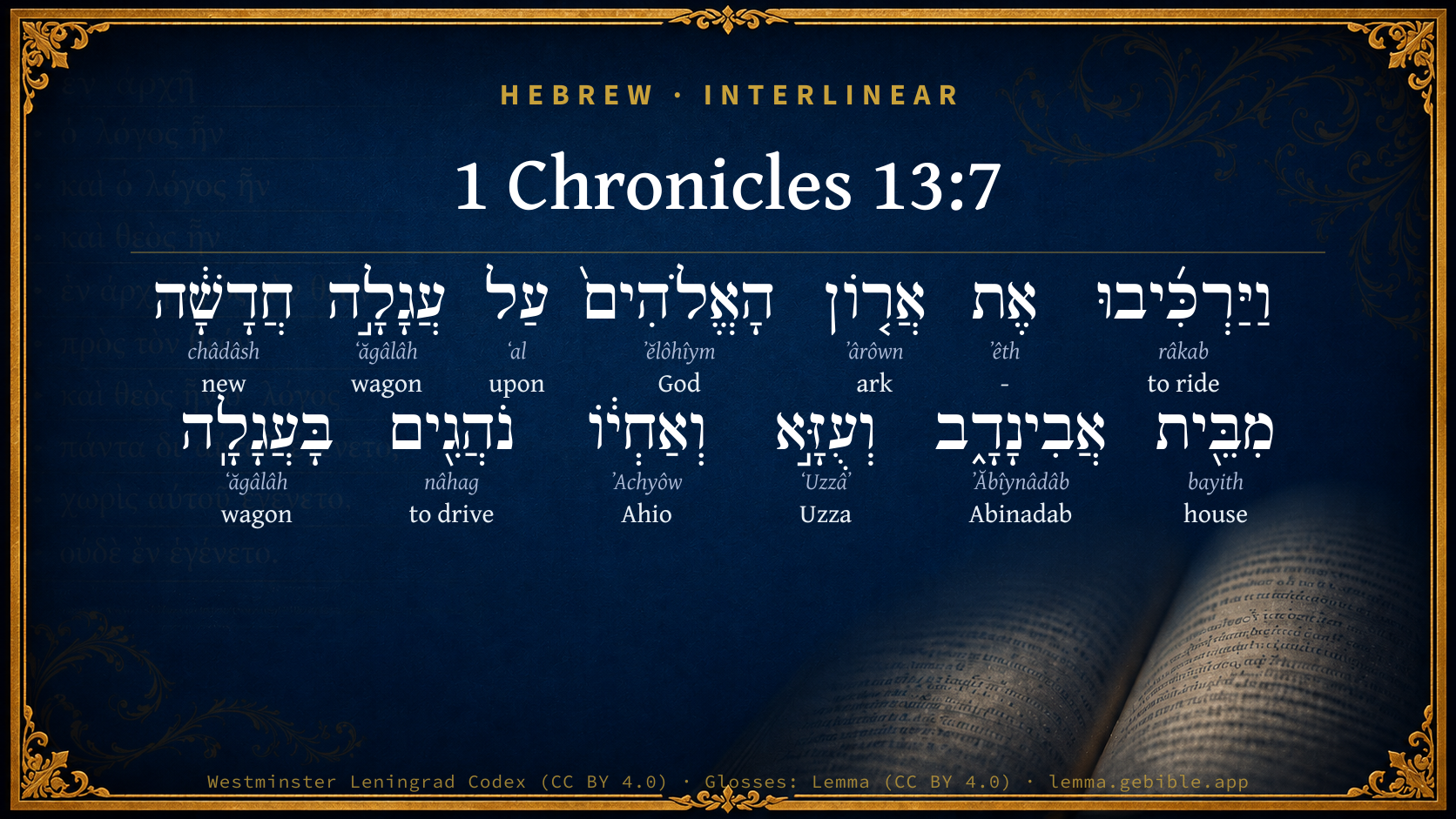
1 Chronicles 13:7

Hebrew (Westminster Leningrad Codex) 1 Chronicles 13:7 appears in the Hebrew Old Testament. The text above is from the Westminster Leningrad Codex. Each word links to its Strong’s number, a concise gloss, and parsing drawn from the Open Scriptures Hebrew Bible morphology. Click any word for its full Brown-Driver-Briggs (BDB) entry.
Download image
Cite this verse

1 Chronicles 13:7 (World English Bible). Public Domain. Lemma interlinear Bible study tool, https://lemma.gebible.app/v/1-chronicles/13/7.

Show BibTeX & RIS
BibTeX
RIS
English Translation
They carried the ark of God on a new cart, [and brought it] out of the house of Abinadab: and Uzza and Ahio drove the cart.
World English Bible · Public Domain
Download a study sheet

One document with this verse’s original text, its word-by-word gloss line, the meaning frame, cross-references with their text, attributed commentary, and full source and license credits — printable, and it pastes into notes with its structure intact.

This verse Autodidact and up

Study sheet (.html) Plain text (.txt)

A passage Seminary Student

Up to 50 verses in one chapter. A passage sheet keeps up to 6 commentary sources and 12 cross-references per verse, in the order this page ranks them, and says so on the sheet whenever that leaves anything out. Ask for a single verse and you get the Autodidact verse sheet above.

Everything on this page stays free to read, with no account — the sheet is a download of what is already on screen, not access to it.

Want to remove ads? Support Godless Engineer
Compare translations 3

The same verse in 3 English versions, stacked beneath the original-language interlinear above. Click any original word for its lexicon entry.

Each is an independent rendering of the whole verse — the interlinear is not word-aligned to these translations.

Highlighted words mark where these versions differ — a whole-verse word diff, not a word-by-word alignment.

  • World English Bible Public Domain
    They carried the ark of God on a new cart, [and brought it] out of the house of Abinadab: and Uzza and Ahio drove the cart.
  • King James Version Public Domain
    And they carried the ark of God in a new cart out of the house of Abinadab: and Uzza and Ahio drave the cart.
  • unfoldingWord Literal Text CC BY-SA 4.0
    And they made the Box of God ride on a new cart from the house of Abinadab, and Uzzah and Ahio were driving the cart.

unfoldingWord Literal Text — © unfoldingWord, licensed CC BY-SA 4.0. Word-aligned USFM3 via Door43 (git.door43.org/unfoldingWord/en_ult).

Versions to compare (up to 4)

3 of 4 selected

Show all 18 translations

Every available English version of this verse, each an independent rendering of the whole verse.

  • World English Bible Public Domain
    They carried the ark of God on a new cart, [and brought it] out of the house of Abinadab: and Uzza and Ahio drove the cart.
  • Berean Standard Bible Public Domain
    So they carried the ark of God from the house of Abinadab on a new cart, with Uzzah and Ahio guiding the cart.
  • Majority Standard Bible Public Domain
    So they carried the ark of God from the house of Abinadab on a new cart, with Uzzah and Ahio guiding the cart.
  • King James Version Public Domain
    And they carried the ark of God in a new cart out of the house of Abinadab: and Uzza and Ahio drave the cart.
  • American Standard Version (1901) Public Domain
    And they carried the ark of God upon a new cart, `and brought it' out of the house of Abinadab: and Uzza and Ahio drove the cart.
  • Revised Version (1885) Public Domain
    And they carried the ark of God upon a new cart, and brought it out of the house of Abinadab: and Uzza and Ahio drave the cart.
  • Geneva Bible (1599) Public Domain
    And they caryed the Arke of God in a newe cart out of the house of Abinadab: and Vzza and Ahio guided the cart.
  • Douay-Rheims (1899) Public Domain
    And they carried the ark of God upon a new cart, out of the house of Abinadab. And Oza and his brother drove the cart.
  • Young's Literal Translation Public Domain
    And they place the ark of God on a new cart, from the house of Abinadab, and Uzza and Ahio are leading the cart,
  • Literal Standard Version CC BY-SA 4.0
    And they place the Ark of God on a new cart from the house of Abinadab, and Uzza and Ahio are leading the cart,
  • Unlocked Literal Bible CC BY-SA 4.0
    So they set the ark of God on a new cart. They brought it out of Abinadab's house. Uzzah and Ahio were guiding the cart.
  • unfoldingWord Literal Text CC BY-SA 4.0
    And they made the Box of God ride on a new cart from the house of Abinadab, and Uzzah and Ahio were driving the cart.
  • Darby Bible Public Domain
    And they carried the ark of God on a new cart out of the house of Abinadab; and Uzza and Ahio drove the cart.
  • World Messianic Bible Public Domain
    They carried God’s ark on a new cart, and brought it out of Abinadab’s house; and Uzza and Ahio drove the cart.
  • Webster's Bible Public Domain
    And they carried the ark of God in a new cart out of the house of Abinadab: and Uzza and Ahio drove the cart.
  • Free Bible Version CC BY-SA 4.0
    They loaded the Ark of God onto a brand new cart and brought it from Adinadab's house, with Uzzah and Ahio directing it.
  • Bible in Basic English Public Domain
    And they put the ark of God on a new cart, and took it out of the house of Abinadab; and Uzza and Ahio were the drivers of the cart.
  • JPS Tanakh (1917) Public Domain
    And they set the ark of God upon a new cart, and brought it out of the house of Abinadab; and Uzza and Ahio drove the cart.

Literal Standard Version (2020), Covenant Press — licensed CC BY-SA 4.0. Text via the HelloAO Bible API (eBible.org). Unlocked Literal Bible (unfoldingWord) — licensed CC BY-SA 4.0. Text via the HelloAO Bible API (eBible.org). unfoldingWord Literal Text — © unfoldingWord, licensed CC BY-SA 4.0. Word-aligned USFM3 via Door43 (git.door43.org/unfoldingWord/en_ult). Free Bible Version, Dr. Jonathan Gallagher — licensed CC BY-SA 4.0. Text via the HelloAO Bible API (eBible.org).

Word by word

More ways to search: Search by grammar → Find every occurrence → Compare this word →

Practice this passage: Drill this verse → Learn its vocabulary →

וְאַחְי֔וֹ
ʼAchyôw
H283
“and · Ahio”
Conjunction + Noun, Proper
Part of Speech
Conjunction + Noun
Type
Proper
Full BDB Definition

Origin: prolonged from H251

TWOT: None

Ahio = "brotherly" or " fraternal" - son of Abinadab who sheltered the ark - a Benjamite - another Benjamite of Saul's ancestry
  1. וַיַּרְכִּ֜יבוּ râkab H7392 “and · to ride” Conjunction + Verb, Hiphil, Sequential Imperfect, 3rd Person, Masculine, Plural
  2. אֶת ʼêth H853 “-” Particle, Direct Object
  3. אֲר֤וֹן ʼârôwn H727 “ark of” Noun, Common, Both, Singular, Construct
  4. הָאֱלֹהִים֙ ʼĕlôhîym H430 “the · God(s)” Particle, Definite Article + Noun, Common, Masculine, Plural, Absolute
  5. עַל ʻal H5921 “upon” Preposition
  6. עֲגָלָ֣ה ʻăgâlâh H5699 “wagon” Noun, Common, Feminine, Singular, Absolute
  7. חֲדָשָׁ֔ה châdâsh H2319 “new” Adjective, Adjective, Feminine, Singular, Absolute
  8. מִבֵּ֖ית bayith H1004 “from · house of” Preposition + Noun, Common, Masculine, Singular, Construct
  9. אֲבִינָדָ֑ב ʼĂbîynâdâb H41 “Abinadab” Noun, Proper
  10. וְעֻזָּ֣א ʻUzzâʼ H5798 “and · Uzza” Conjunction + Noun, Proper
  11. נֹהֲגִ֖ים nâhag H5090 “driving” Verb, Qal, Participle Active, Masculine, Plural, Absolute
  12. בָּעֲגָלָֽה ʻăgâlâh H5699 “in/at the · wagon” Preposition, Determined + Noun, Common, Feminine, Singular, Absolute

About this verse

These counts appear in no published source. They are computed here, from the morphology-tagged text and Lemma’s own curated glosses. What Lemma adds →

13
words
12
distinct lemmas
Historical
section

Notable vocabulary

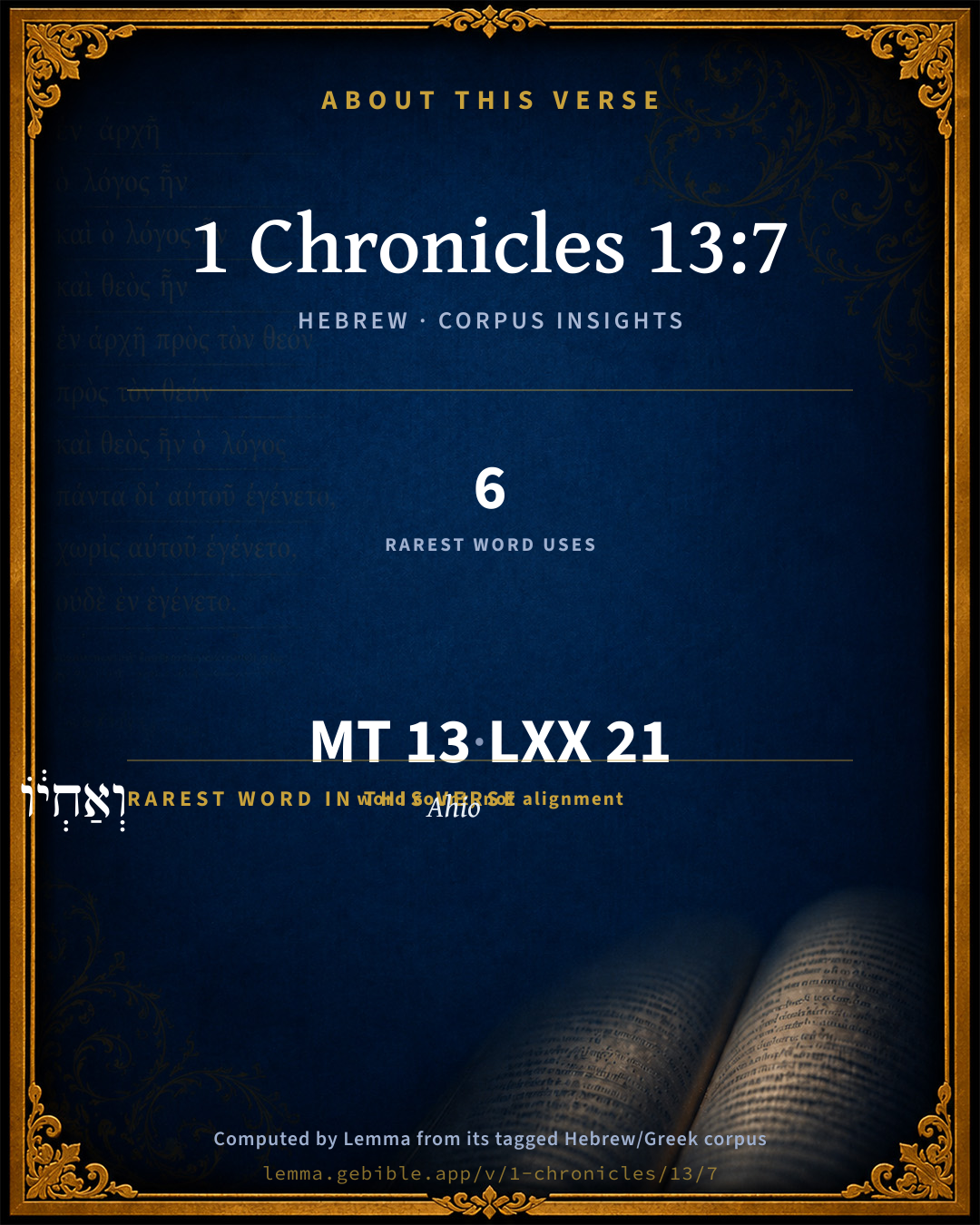
The rarest word here is וְאַחְי֔וֹ Ahio H283 — appearing just 6 times in the whole Hebrew Bible.

Shared distinctive vocabulary

וְאַחְי֔וֹ Ahio H283 occurs in 6 verses of the Hebrew Bible. Also found in:

Grammatical profile

  • 2 verbs
  • 8 nouns
  • 1 adjective
  • 1 preposition
  • 1 particle

Verb forms

  • וַיַּרְכִּ֜יבוּ Hiphil · Sequential Imperfect
  • נֹהֲגִ֖ים Qal · Participle Active

Repetition

A word recurs within this verse — often emphatic in Hebrew:

  • עֲגָלָ֣ה wagon H5699 ×2

Hebrew & Septuagint length

In English translation the verse runs 26 words from the Hebrew and 26 from the Septuagint (LXX English) — the same length.

A rough comparison of the two English renderings, which tokenize alike — not a word-level alignment.

Word counts can differ between the Hebrew and the Greek without any difference in meaning — e.g. the Hebrew direct-object marker אֵת has no separate Greek word, and Greek often adds the article ὁ.

In the original languages it is 13 Hebrew tokens and 21 Greek tokens — but the two are counted differently (Hebrew bundles its prefixes and suffixes into one token; the Greek is in lemma form), so that isn’t a like-for-like length.

Cross-references

6

Topical passages linked to 1 Chronicles 13:7 in the Treasury of Scripture Knowledge — connected by theme and wording, ordered by reader-vote popularity; previews shown in the World English Bible.

  • Numbers 4:15 "When Aaron and his sons have finished covering the sanctuary, and all the furniture of the sanctuary, as the camp moves forward; after that, the sons of Kohath shall come to carry it: but they shall not touch the sanctuary, lest they die. These things are the burden of the sons of Kohath in the Tent of Meeting.
  • 1 Samuel 6:7 Now therefore take and prepare yourselves a new cart, and two milk cattle, on which there has come no yoke; and tie the cattle to the cart, and bring their calves home from them;
  • 1 Samuel 7:1–2 The men of Kiriath Jearim came, and fetched up the ark of Yahweh, and brought it into the house of Abinadab in the hill, and sanctified Eleazar his son to keep the ark of Yahweh.
  • 2 Samuel 6:3 They set the ark of God on a new cart, and brought it out of the house of Abinadab that was in the hill: and Uzzah and Ahio, the sons of Abinadab, drove the new cart.
  • 1 Chronicles 15:2 Then David said, None ought to carry the ark of God but the Levites: for them has Yahweh chosen to carry the ark of God, and to minister to him forever.
  • 1 Chronicles 15:13 For because you didn't carry it at the first, Yahweh our God made a breach on us, because we didn't seek him according to the ordinance.

Cross-references courtesy of OpenBible.info (CC BY 4.0).

Hebrew and Greek witnesses Masoretic Hebrew ↔ Greek Septuagint

The same verse in the two great witnesses to the Old Testament, shown verse-for-verse.

These are two independent witnesses, not word-aligned to each other, and the Septuagint is shown in lemma (dictionary) form.

Hebrew 1 Chronicles 13:7 Masoretic · Westminster Leningrad Codex

וַיַּרְכִּ֜יבוּ אֶת אֲר֤וֹן הָאֱלֹהִים֙ עַל עֲגָלָ֣ה חֲדָשָׁ֔ה מִבֵּ֖ית אֲבִינָדָ֑ב וְעֻזָּ֣א וְאַחְי֔וֹ נֹהֲגִ֖ים בָּעֲגָלָֽה

They carried the ark of God on a new cart, [and brought it] out of the house of Abinadab: and Uzza and Ahio drove the cart.

World English Bible · Public Domain

Greek LXX 1 Chronicles 13:7 Septuagint · lemma form

καί ἐπιτίθημι ὁ κιβωτός ὁ θεός ἐπί ἅμαξα καινός ἐκ οἶκος αμιναδαβ καί οζα καί ὁ ἀδελφός αὐτός ἄγω ὁ ἅμαξα

And they set the ark of God on a new wagon brought out of the house of Aminadab: and Oza and his brethren drove the wagon.

LXX2012 (modern English Septuagint) · Public Domain

On this verse, Ellicott's Commentary for English Readers discusses the Septuagint’s reading. Read the note in Commentary ↓

Hebrew: Westminster Leningrad Codex (CC BY 4.0). Greek: Septuagint (public domain); English from LXX2012 (modern English Septuagint) (Public Domain). How the Septuagint differs from the Hebrew →

Commentary

Notes on 1 Chronicles 13:7 from classic Christian and Jewish commentators (each source and its license shown beneath its notes). The classic Christian expositions comment on the surrounding passage and are grouped to its opening verse, so a note may address several verses; the Jewish commentaries on the Tanakh (Rashi and others) are per-verse, so they appear only where the commentator wrote on this verse.

Lemma curates 59 commentaries, every one of them public domain or Creative Commons licensed, each selected and text-cleaned for this edition rather than reprinted as found. About our sources →

Trapp's Complete Commentary

John Trapp

1Ch 13:7 And they carried the ark of God in a new cart out of the house of Abinadab: and Uzza and Ahio drave the cart.

Ver. 7. In a new cart.] This was ill done by such a holy convention. Councils may err.

John Trapp, A Commentary or Exposition upon All the Books of the Old and New Testament (1647–1656) — public domain. Text from a community e-Sword module.

Geneva Bible (1599)

Geneva Bible translators

The sons of Abinadab.

Geneva Bible (1599) marginal notes — public domain. Text via Bolls.life.

Adam Clarke's Commentary

Verse 7. In a new cart] Lest it should be profaned by being placed on any carriage that had been employed about common uses.

Uzza and Ahio] All the versions understand אחיו achyo as signifying brother or brothers; so does Jarchi, who observes, from 2Sa 6:3, that these were the sons of Abinadab.

Adam Clarke's Commentary on the Bible (1810–1826) — public domain. Text from a community e-Sword/MySword module.

Ellicott's Commentary for English Readers

(7) Abridged form of the fuller text preserved in 2Sa_6:3 (see Notes there).

Drave.—Were driving. 2Sa_6:4, is wholly omitted by the Chronicles. “Ahio” may mean his brother, or, with different points, his brothers (so LXX. and Syriac).

A Bible Commentary for English Readers, edited by Charles John Ellicott (1878–1897) — public domain. Text from a community e-Sword module.

The Cambridge Bible for Schools and Colleges

gen. ed. J. J. S. Perowne

7. a new cart] A new cart was chosen as one which had not been profaned by common work. So (Jdg_16:11-12) new ropes “wherewith no work hath been done” were used in the attempt to bind the consecrated man, Samson. So also (Mar_11:2; Mar_11:7) our Lord rode into Jerusalem on a colt “whereon no man ever yet sat.”

the house of Abinadab] Here the ark had been for at least twenty years under the charge of a man sanctified to keep it (1Sa_7:1-2)

The Cambridge Bible for Schools and Colleges (gen. ed. J. J. S. Perowne; Cambridge University Press, 1878–1918) — public domain. Text from a community e-Sword module.

Haydock's Catholic Bible Commentary

Brother. Hebrew, "Acho," which has the same meaning. (Tirinus) --- Septuagint, Syriac, &c., "his brethren." (Calmet)

George Leo Haydock (1774–1849), Haydock's Catholic Family Bible and Commentary, 1859 edition — public domain. Excludes Psalms (Douay-Rheims chapter numbering differs from Protestant) and Deuterocanonical books (Catholic canon only).

The Pulpit Commentary

They carried; the Authorized Version of the parallel "they set" But the verb is the Hiph. of bkr; a word carrying more of majesty in its (Deu_33:26; Job_30:22; Psa_18:11 Psa_68:3-7; Isa_19:1) A new cart . The stress laid on the newness of this cart, the term being twice repeated in the parallel passage, may justly remind of Mar_11:2; Mat_27:60. (see "Speaker"s Commentary" on 2Sa_6:3) The house of Abinadab. There is no mention of Abinadab that would indicate that he still lived, even when twenty years before, the ark was placed in his house. Eleazar was his eldest son, (1Sa_7:1) and was "sanctified to keep the ark of the Lord." Uzza and Ahio were possibly sons of Eleazar, and not sons of Abinadab, and Eleazar"s younger brothers. The Septuagint translates Ahio, and accordingly reads, "Uzza and his brethren drave the cart.

Vers. 7-13.

The imperfections of human service.

We cannot read this story of the first attempt to bring the ark to the capital without being impressed, if not depressed, with a sense of the weakness and imperfection characterizing our human service. We learn

I THAT A SLIGHT DEPARTURE FROM THE DIVINE WILL MAY LEAD TO SERIOUS CONSEQUENCES. David, in a moment of thoughtlessness or presumption, decreed that the ark of God should be "made to ride" (ver. 7, marginal reading) "in a new cart." This was not the way prescribed in "the Book of the Law of the Lord". (see Num_4:15) This irregularity led to the act of Uzza (ver. 9), and this to the stroke of Divine wrath which so sadly and seriously interrupted the day"s proceedings (vers. 10-13). We are not now called upon to conform our ritual to any prescribed order. The commandment of Christ does not go into the details of outward observance. But it is nevertheless true that any actual departure from his will, though it may seem to be but slight, may lead on and down to a most serious breach. This may apply to his revealed will in regard to

(1) the temper and spirit we should cherish,

(2) the attitude we should assume,

(3) the relations we should enter upon, in our various spheres.

II THAT IT IS A MATTER OF GREAT MOMENT TO KNOW OUR PLACE IN THE SPHERE OF THE SACRED, AND TO KEEP IT. Uzza was not entitled to lay his hand on the ark of God; he exceeded his right; he intruded into a position for which he was not qualified, and he paid for his presumption the last penalty of sudden death at the hand of God. Those who now attempt a work for which God did not design them and to which Christ does not summon them, whether that of the Christian ministry, of missions, or any other sacred calling, will find that they have committed themselves to duties and responsibilities, the faulty and (perhaps) mechanical, the uncongenial and therefore unspiritual discharge of which will redound to their own serious if not mortal injury. We must take care to keep within the sphere for which our Lord designed us, in the realm of the sacred as well as the secular.

III THAT OUR BRIGHT AND HOLY JOYS MAY BE MOST UNEXPECTEDLY DASHED. The eighth verse gives us a picture of a company of men in the full enjoyment of sacred pleasure; they were exulting before God in the act of service they were rendering. Sacred joy had reached its very summit, and in the very midst of it, without a moment"s interval of preparation, there occurred the transgression and the punishment. Song was turned into lamentation, dancing into weeping, gladness into perplexity and sorrow, day into night. So may it be with us at any hour in this lower earthly sphere. We cannot reckon on the continuance of any present good. Even our joy in God, our delight in his service, may suffer sudden and sad eclipse, and our noon of devout exultation descend at once into the midnight of discomfiture and grief.

IV THAT GOOD MEN MAY BE MUCH PERPLEXED AT DIVINE DISPOSALS. We read that David was "displeased" (ver. 11), and also that he was "afraid" (ver. 12). We also often find ourselves both perplexed and alarmed at the dealings of God with us. God"s way is often "in the sea, his path in the great waters, and his footsteps are not known." He is sometimes "terrible in his doings toward the children of men." Why he lets the assassin do his deadly work so well, the storm wreck the vessel which is carrying missionaries to their post, the father of the family catch the fatal fever, the irreplaceable minister perish in the railway accident, etc., we do not know and cannot think. Our hearts are saddened, perplexed, troubled, awed. Let us feel that we are but very little children trying to understand a Divine Father, whose wisdom and love must be unfathomably deep, must go down far lower than our poor plummet will sound. "Blessed are they who do not see, and yet believe." We "walk by faith, not by sight. C.

Vers. 7, 9-12.

Uzza and the ark.

Since the ark was last heard of it had been in Baalah, or Kirjath-jearim. For upwards of fifty years, since it had been in the hands of the Philistines, it had been in the house of Abinadab of Gibeah, under the charge of his two sons, Uzza and Ahio, who were Levites, and who had been consecrated for the office. For the purpose of removing the ark to Jerusalem it was set upon a new cart, he was instantly smitten of God, and "there he died by the (2Sa_7:7) "before God" (ver. 10). David was grieved at this, and, instead of proceeding further and carrying the ark as he had intended to Jerusalem, he left it in the house of Obed-edom the Gittite, where it remained three months (ver. 14). The setting of the ark on a cart was a hasty and inconsiderate procedure, in direct violation of the command of God. (see Num_4:14, 15 7:9 18:3) Setting it upon a cart instead of having it carried upon the shoulders may seem to be a very small mistake. Touching it against an express command may seem to admit of extenuation, especially as it seemed to be falling. To the eye of man the fault, under such circumstances, may seem only to require a mitigated punishment. But it is not so with God. The entire act betrayed a forgetfulness of the majesty and holiness of Jehovah"s presence. It was also a departure from the Word. Such departures from the Word, to us who are accustomed to estimate evil by quantity and degree rather than by principle, may seem light things; but God looks at the motive, the principle, the underlying spirit. W.

The Pulpit Commentary (1880–1919), ed. H.D.M. Spence-Jones & Joseph S. Exell — public domain. Text from a community e-Sword module.

unfoldingWord translationNotes

Door43 World Missions Community

Abinadab ... Uzzah and Ahio

These are the names of men. (See: How to Translate Names)

David and all Israel

Here the word "all" is a generalization. AT: "David and all of the Israelites who were present" (See: Hyperbole and Generalization)

singing with stringed instruments

"singing while playing stringed instruments"

tambourines

hand drums with pieces of metal around the side that sound when the instruments are shaken (See: Translate Unknowns)

cymbals

two thin, round metal plates that are hit together to make a loud sound (See: Translate Unknowns)

translationWords

might

trumpet

unfoldingWord translationNotes — © Distant Shores Media and the Door43 World Missions Community, licensed CC BY-SA 4.0. Source: git.door43.org/Door43/en_tn.

Rashi

Rabbi Shlomo Yitzchaki (Rashi)

And they set the Ark of God on a new cart Why did David see fit to set it on a new cart rather than to have it borne by the Levites, as he did when he finally brought it from there to Zion? Because David said, “Corresponding to the way it came to me when the Philistines returned it on a new cart, as it is written (I Sam. 6:11): And they placed the Ark of the Lord on the cart, etc.” Therefore, he was punished.

and Uzza and Ahio They were the sons of Abinadab, as is written in II Samuel (6:3).

drove the cart as is the custom of cart drivers, one walks in front of the cart and directs it in a straight way, and one is alongside the cart, so that it does not turn over and fall. And so it is written (II Sam. 6: 4): “... and Ahio went before the Ark,” and Uzza was alongside the cart; therefore, Uzza stretched forth his hand to take hold of the Ark when the oxen swayed it, and therefore, he was punished.

Rashi on the Tanakh — English translations: “The Judaica Press complete Tanach with Rashi, translated by A. J. Rosenberg” (CC BY 4.0); “Pentateuch with Rashi's commentary by M. Rosenbaum and A.M. Silbermann, 1929-1934” (public domain); “The Metsudah Tanach series, Lakewood, N.J” (CC BY 4.0); and “The Book of Joshua, Metsudah Publications, 1997” (CC BY 4.0). Text via Sefaria.

Lesson kit

Teaching starters — assembled from the data on this page, not authored interpretation. Every prompt links to the verse data it draws on. Edit before teaching.

1 Chronicles, in the Historical, opens this verse with 13 words (12 distinct Hebrew lemmas). Its most distinctive word is ʼAchyôw (“Ahio”). A historical commentator’s framing appears above. Read the whole chapter for the surrounding context.

Discussion questions

  1. How does “Ahio” (ʼAchyôw) shape what this verse is saying?
  2. 2 Samuel 6:3 shares the word «Ahio» with this verse. How do the two illuminate each other?
  3. “wagon” occurs 2× in this one verse. What is the effect of the repetition?
  4. The translations on this page render this verse differently — a whole-verse word diff, not a word-by-word alignment. What might account for the different wordings?
  5. The verb «וַיַּרְכִּ֜יבוּ» is Hiphil Sequential Imperfect. How does its form color the action?
  6. Reading how Trapp's Complete Commentary and Geneva Bible (1599) read this verse, where do the two commentators agree and where do they part?

Things to notice

Reading settings

Reading text

Shown beneath each verse's original-language words.

Old Testament
Old Testament edition

Read the OT as the Masoretic Hebrew (MT) or the Greek Septuagint (LXX).

English shown for the Greek Septuagint (in the Hebrew ↔ Greek comparison).

Comparing translations? Open the Compare panel on any verse page to stack up to four side by side.