
Joshua 3:15

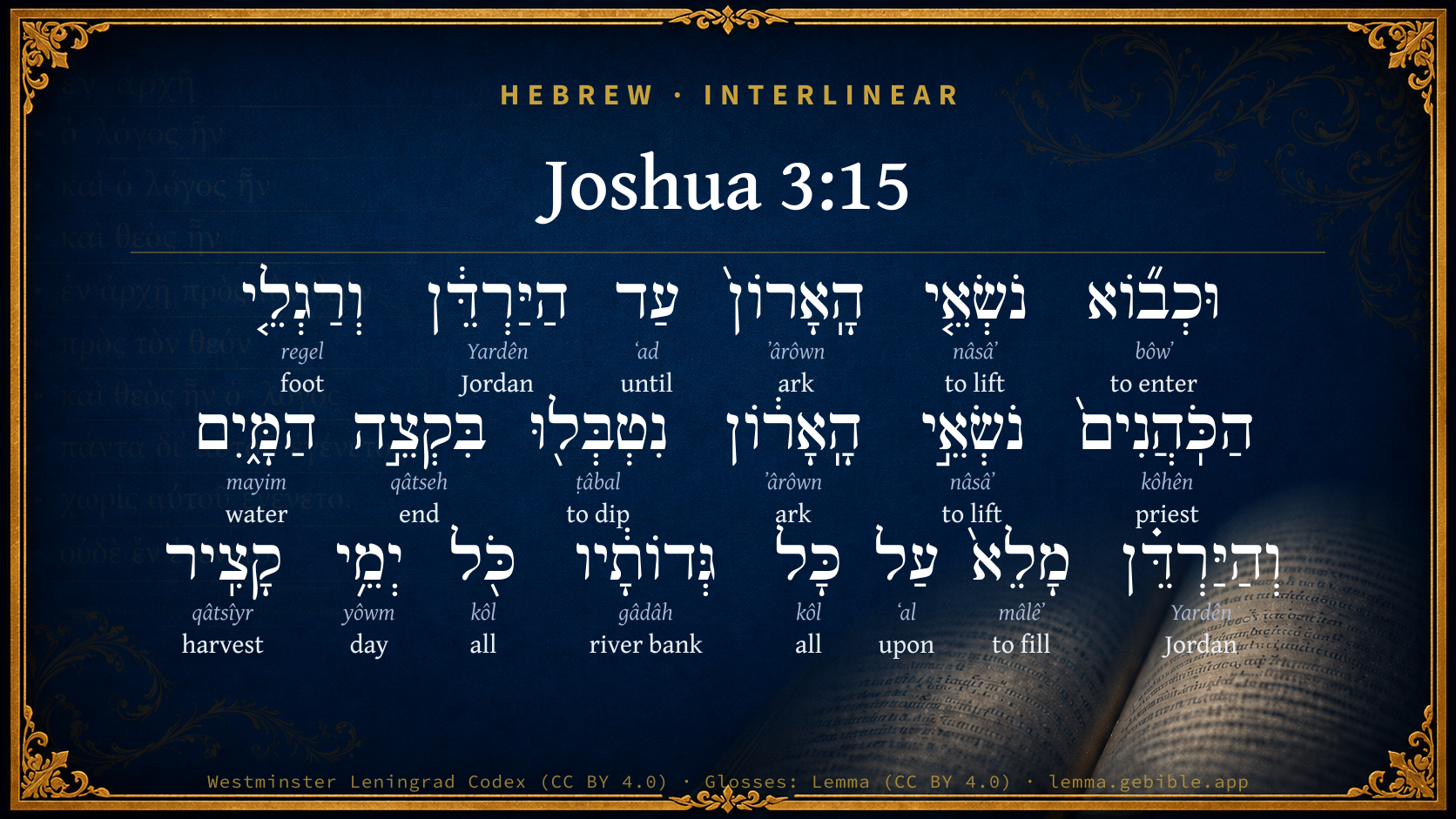
Hebrew (Westminster Leningrad Codex) Joshua 3:15 appears in the Hebrew Old Testament. The text above is from the Westminster Leningrad Codex. Each word links to its Strong’s number, a concise gloss, and parsing drawn from the Open Scriptures Hebrew Bible morphology. Click any word for its full Brown-Driver-Briggs (BDB) entry.
Download image
Cite this verse

Joshua 3:15 (World English Bible). Public Domain. Lemma interlinear Bible study tool, https://lemma.gebible.app/v/joshua/3/15.

Show BibTeX & RIS
BibTeX
RIS
English Translation
and when those who bore the ark were come to the Jordan, and the feet of the priests who bore the ark were dipped in the brink of the water (for the Jordan overflows all its banks all the time of harvest),
World English Bible · Public Domain
Highlights
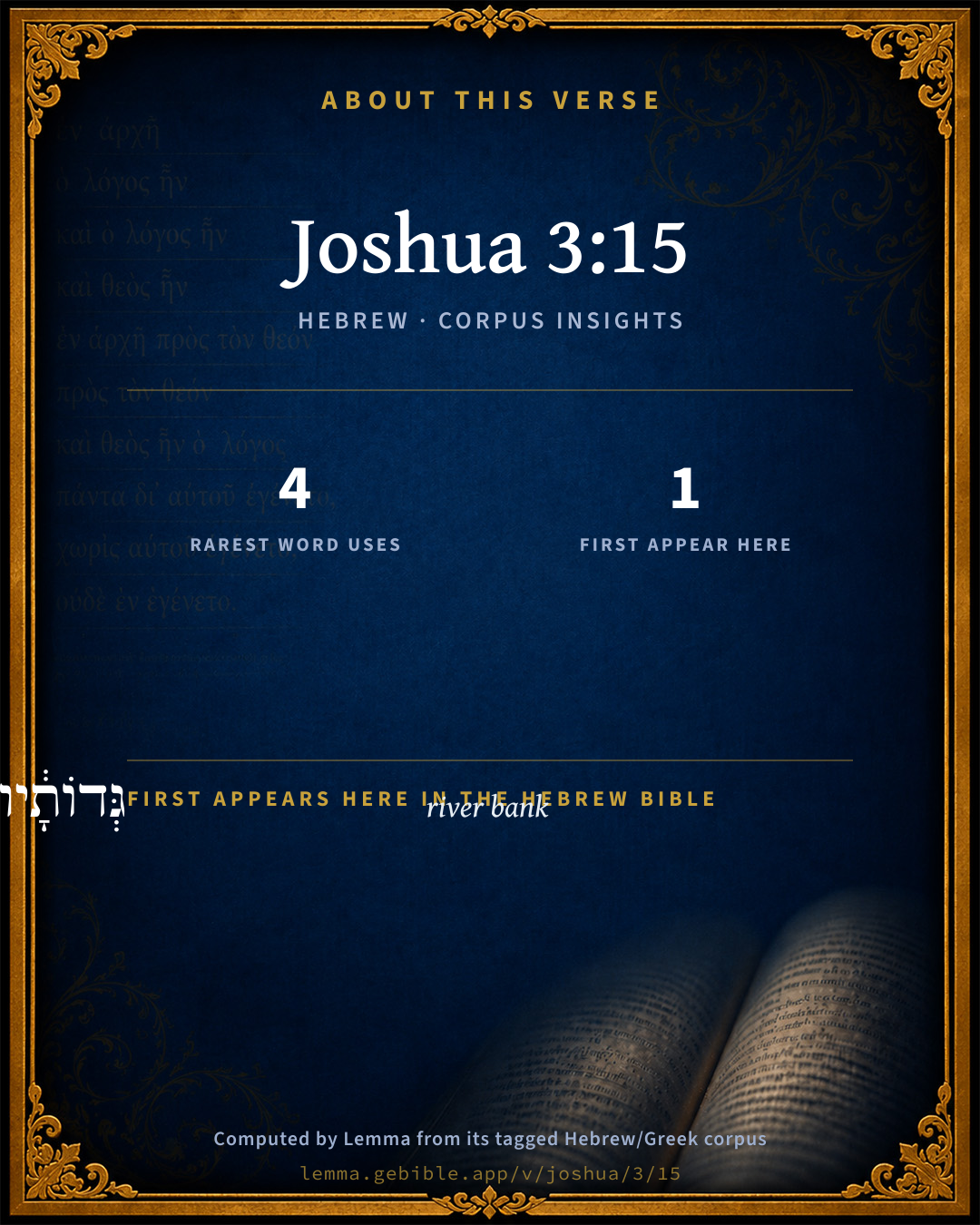
  • 1 first appearance in the Hebrew Bible
Full analysis ↓
Download a study sheet

One document with this verse’s original text, its word-by-word gloss line, the meaning frame, cross-references with their text, attributed commentary, and full source and license credits — printable, and it pastes into notes with its structure intact.

This verse Autodidact and up

Study sheet (.html) Plain text (.txt)

A passage Seminary Student

Up to 50 verses in one chapter. A passage sheet keeps up to 6 commentary sources and 12 cross-references per verse, in the order this page ranks them, and says so on the sheet whenever that leaves anything out. Ask for a single verse and you get the Autodidact verse sheet above.

Everything on this page stays free to read, with no account — the sheet is a download of what is already on screen, not access to it.

Want to remove ads? Support Godless Engineer
Compare translations 3

The same verse in 3 English versions, stacked beneath the original-language interlinear above. Click any original word for its lexicon entry.

Each is an independent rendering of the whole verse — the interlinear is not word-aligned to these translations.

Highlighted words mark where these versions differ — a whole-verse word diff, not a word-by-word alignment.

  • World English Bible Public Domain
    and when those who bore the ark were come to the Jordan, and the feet of the priests who bore the ark were dipped in the brink of the water (for the Jordan overflows all its banks all the time of harvest),
  • King James Version Public Domain
    And as they that bare the ark were come unto Jordan, and the feet of the priests that bare the ark were dipped in the brim of the water, (for Jordan overfloweth all his banks all the time of harvest,)
  • unfoldingWord Literal Text CC BY-SA 4.0
    And as the carriers of the Box came unto the Jordan then the feet of the priests, the carriers of the Box, were dipped into the edge of the water. (Now the Jordan was full over all of its banks all of the days of the harvest.)

unfoldingWord Literal Text — © unfoldingWord, licensed CC BY-SA 4.0. Word-aligned USFM3 via Door43 (git.door43.org/unfoldingWord/en_ult).

Versions to compare (up to 4)

3 of 4 selected

Show all 18 translations

Every available English version of this verse, each an independent rendering of the whole verse.

  • World English Bible Public Domain
    and when those who bore the ark were come to the Jordan, and the feet of the priests who bore the ark were dipped in the brink of the water (for the Jordan overflows all its banks all the time of harvest),
  • Berean Standard Bible Public Domain
    Now the Jordan overflows its banks throughout the harvest season. But as soon as the priests carrying the ark reached the Jordan and their feet touched the water’s edge,
  • Majority Standard Bible Public Domain
    Now the Jordan overflows its banks throughout the harvest season. But as soon as the priests carrying the ark reached the Jordan and their feet touched the water’s edge,
  • King James Version Public Domain
    And as they that bare the ark were come unto Jordan, and the feet of the priests that bare the ark were dipped in the brim of the water, (for Jordan overfloweth all his banks all the time of harvest,)
  • American Standard Version (1901) Public Domain
    and when they that bare the ark were come unto the Jordan, and the feet of the priests that bare the ark were dipped in the brink of the water (for the Jordan overfloweth all its banks all the time of harvest,)
  • Revised Version (1885) Public Domain
    and when they that bare the ark were come unto Jordan, and the feet of the priests that bare the ark were dipped in the brink of the water, (for Jordan overfloweth all its banks all the time of harvest,)
  • Geneva Bible (1599) Public Domain
    And as they that bare the Arke came vnto Iorden, and the feete of the Priestes that bare the Arke were dipped in the brinke of the water, (for Iorden vseth to fill all his bankes all the time of haruest)
  • Douay-Rheims (1899) Public Domain
    And as soon as they came into the Jordan, and their feet were dipped in part of the water, (now the Jordan, it being harvest time, had filled the banks of its channel,)
  • Young's Literal Translation Public Domain
    and at those bearing the ark coming in unto the Jordan, and the feet of the priests bearing the ark have been dipped in the extremity of the waters (and the Jordan is full over all its banks all the days of harvest) --
  • Literal Standard Version CC BY-SA 4.0
    and at those carrying the Ark coming to the Jordan, and the feet of the priests carrying the Ark have been dipped in the extremity of the waters (and the Jordan is full over all its banks all the days of harvest)—
  • Unlocked Literal Bible CC BY-SA 4.0
    As soon as those who were carrying the ark had come to the Jordan, and the feet of those who carried the chest were dipped in the edge of the water (now the Jordan overflows all its banks throughout the time of the harvest),
  • unfoldingWord Literal Text CC BY-SA 4.0
    And as the carriers of the Box came unto the Jordan then the feet of the priests, the carriers of the Box, were dipped into the edge of the water. (Now the Jordan was full over all of its banks all of the days of the harvest.)
  • Darby Bible Public Domain
    and when they that bore the ark were come to the Jordan, and the feet of the priests who bore the ark dipped in the edge of the water (and the Jordan is full over all its banks throughout the days of harvest),
  • World Messianic Bible Public Domain
    and when those who bore the ark had come to the Jordan, and the feet of the priests who bore the ark had dipped in the edge of the water (for the Jordan overflows all its banks all the time of harvest),
  • Webster's Bible Public Domain
    And as they that bore the ark had come to Jordan, and the feet of the priests that bore the ark were dipped in the brim of the water, (for Jordan overfloweth all its banks all the time of harvest,)
  • Free Bible Version CC BY-SA 4.0
    As it was harvest season, the Jordan was full of water, overflowing its banks. But at the very moment the priests carrying the Ark stepped into the water, the river stopped flowing.
  • Bible in Basic English Public Domain
    And when those who took up the ark came to Jordan, and the feet of the priests who took up the ark were touching the edge of the water (for the waters of Jordan are overflowing all through the time of the grain-cutting),
  • JPS Tanakh (1917) Public Domain
    and when they that bore the ark were come unto the Jordan, and the feet of the priests that bore the ark were dipped in the brink of the water — for the Jordan overfloweth all its banks all the time of harvest —

Literal Standard Version (2020), Covenant Press — licensed CC BY-SA 4.0. Text via the HelloAO Bible API (eBible.org). Unlocked Literal Bible (unfoldingWord) — licensed CC BY-SA 4.0. Text via the HelloAO Bible API (eBible.org). unfoldingWord Literal Text — © unfoldingWord, licensed CC BY-SA 4.0. Word-aligned USFM3 via Door43 (git.door43.org/unfoldingWord/en_ult). Free Bible Version, Dr. Jonathan Gallagher — licensed CC BY-SA 4.0. Text via the HelloAO Bible API (eBible.org).

Word by word

More ways to search: Search by grammar → Find every occurrence → Compare this word →

Practice this passage: Drill this verse → Learn its vocabulary →

גְּדוֹתָ֔יו
gâdâh
H1415
“river banks · his”
Noun, Common, Feminine, Plural, Construct + Suffix, Personal, 3rd Person, Masculine, Singular
Part of Speech
Noun
Type
Common
Gender
Feminine
Number
Plural
State
Construct
Full BDB Definition

Origin: from an unused root (meaning to cut off)

TWOT: 314a

a river bank
  1. וּכְב֞וֹא bôwʼ H935 “and · like/as · to enter” Conjunction + Preposition + Verb, Qal, Infinitive Construct
  2. נֹשְׂאֵ֤י nâsâʼ H5375 “lifting” Verb, Qal, Participle Active, Masculine, Plural, Construct
  3. הָֽאָרוֹן֙ ʼârôwn H727 “the · ark” Particle, Definite Article + Noun, Common, Both, Singular, Absolute
  4. עַד ʻad H5704 “until” Preposition
  5. הַיַּרְדֵּ֔ן Yardên H3383 “the · Jordan” Particle, Definite Article + Noun, Proper
  6. וְרַגְלֵ֤י regel H7272 “and · feet of” Conjunction + Noun, Common, Feminine, Dual, Construct
  7. הַכֹּֽהֲנִים֙ kôhên H3548 “the · priests” Particle, Definite Article + Noun, Common, Masculine, Plural, Absolute
  8. נֹשְׂאֵ֣י nâsâʼ H5375 “lifting” Verb, Qal, Participle Active, Masculine, Plural, Construct
  9. הָֽאָר֔וֹן ʼârôwn H727 “the · ark” Particle, Definite Article + Noun, Common, Both, Singular, Absolute
  10. נִטְבְּל֖וּ ṭâbal H2881 “to dip” Verb, Niphal, Perfect, 3rd Person, Common, Plural
  11. בִּקְצֵ֣ה qâtseh H7097 “in/at · end of” Preposition + Noun, Common, Both, Singular, Construct
  12. הַמָּ֑יִם mayim H4325 “the · water(s)” Particle, Definite Article + Noun, Common, Masculine, Plural, Absolute
  13. וְהַיַּרְדֵּ֗ן Yardên H3383 “and · the · Jordan” Conjunction + Particle, Definite Article + Noun, Proper
  14. מָלֵא֙ mâlêʼ H4390 “to fill” Verb, Qal, Perfect, 3rd Person, Masculine, Singular
  15. עַל ʻal H5921 “upon” Preposition
  16. כָּל kôl H3605 “all of” Noun, Common, Masculine, Singular, Construct
  17. כֹּ֖ל kôl H3605 “all of” Noun, Common, Masculine, Singular, Construct
  18. יְמֵ֥י yôwm H3117 “days of” Noun, Common, Masculine, Plural, Construct
  19. קָצִֽיר qâtsîyr H7105 “harvest” Noun, Common, Masculine, Singular, Absolute

About this verse

These counts appear in no published source. They are computed here, from the morphology-tagged text and Lemma’s own curated glosses. What Lemma adds →

20
words
16
distinct lemmas
Historical
section

Notable vocabulary

The rarest word here is גְּדוֹתָ֔יו river bank H1415 — appearing just 4 times in the whole Hebrew Bible.

First appearance in Scripture

This word makes its first canonical appearance in the Hebrew Bible here:

  • גְּדוֹתָ֔יו river bank H1415

Shared distinctive vocabulary

גְּדוֹתָ֔יו river bank H1415 occurs in 4 verses of the Hebrew Bible. Also found in:

Grammatical profile

  • 5 verbs
  • 13 nouns
  • 2 prepositions

Verb forms

  • וּכְב֞וֹא Qal · Infinitive Construct
  • נֹשְׂאֵ֤י Qal · Participle Active
  • נֹשְׂאֵ֣י Qal · Participle Active
  • נִטְבְּל֖וּ Niphal · Perfect
  • מָלֵא֙ Qal · Perfect

Repetition

Words recur within this verse — often emphatic in Hebrew:

  • נֹשְׂאֵ֤י to lift H5375 ×2
  • הָֽאָרוֹן֙ ark H727 ×2
  • הַיַּרְדֵּ֔ן Jordan H3383 ×2
  • כָּל all H3605 ×2

Hebrew & Septuagint length

In English translation the verse runs 42 words from the Hebrew and 54 from the Septuagint (LXX English) — closely comparable.

A rough comparison of the two English renderings, which tokenize alike — not a word-level alignment.

Word counts can differ between the Hebrew and the Greek without any difference in meaning — e.g. the Hebrew direct-object marker אֵת has no separate Greek word, and Greek often adds the article ὁ.

Cross-references

9

Topical passages linked to Joshua 3:15 in the Treasury of Scripture Knowledge — connected by theme and wording, ordered by reader-vote popularity; previews shown in the World English Bible.

  • 1 Chronicles 12:15 These are those who went over the Jordan in the first month, when it had overflowed all its banks; and they put to flight all them of the valleys, both toward the east, and toward the west.
  • Joshua 3:13 It shall come to pass, when the soles of the feet of the priests who bear the ark of Yahweh, the Lord of all the earth, shall rest in the waters of the Jordan, that the waters of the Jordan shall be cut off, even the waters that come down from above; and they shall stand in one heap.
  • Joshua 4:18 It happened, when the priests who bore the ark of the covenant of Yahweh were come up out of the midst of the Jordan, and the soles of the priests' feet were lifted up to the dry ground, that the waters of the Jordan returned to their place, and went over all its banks, as before.
  • Jeremiah 12:5 If you have run with the footmen, and they have wearied you, then how can you contend with horses? and though in a land of peace you are secure, yet how will you do in the pride of the Jordan?
  • Jeremiah 49:19 Behold, he shall come up like a lion from the pride of the Jordan against the strong habitation: for I will suddenly make them run away from it; and whoever is chosen, him will I appoint over it: for who is like me? and who will appoint me a time? and who is the shepherd who will stand before me?
  • Deuteronomy 16:1–9 Observe the month of Abib, and keep the Passover to Yahweh your God; for in the month of Abib Yahweh your God brought you forth out of Egypt by night.
  • Joshua 5:10–12 The children of Israel encamped in Gilgal; and they kept the Passover on the fourteenth day of the month at even in the plains of Jericho.
  • Isaiah 26:6 The foot shall tread it down; even the feet of the poor, and the steps of the needy.
  • Leviticus 23:10–16 "Speak to the children of Israel, and tell them, 'When you have come into the land which I give to you, and shall reap its the harvest, then you shall bring the sheaf of the first fruits of your harvest to the priest:

Cross-references courtesy of OpenBible.info (CC BY 4.0).

Hebrew and Greek witnesses Masoretic Hebrew ↔ Greek Septuagint

The same verse in the two great witnesses to the Old Testament, shown verse-for-verse.

These are two independent witnesses, not word-aligned to each other, and the Septuagint is shown in lemma (dictionary) form.

Hebrew Joshua 3:15 Masoretic · Westminster Leningrad Codex

וּכְב֞וֹא נֹשְׂאֵ֤י הָֽאָרוֹן֙ עַד הַיַּרְדֵּ֔ן וְרַגְלֵ֤י הַכֹּֽהֲנִים֙ נֹשְׂאֵ֣י הָֽאָר֔וֹן נִטְבְּל֖וּ בִּקְצֵ֣ה הַמָּ֑יִם וְהַיַּרְדֵּ֗ן מָלֵא֙ עַל כָּל גְּדוֹתָ֔יו כֹּ֖ל יְמֵ֥י קָצִֽיר

and when those who bore the ark were come to the Jordan, and the feet of the priests who bore the ark were dipped in the brink of the water (for the Jordan overflows all its banks all the time of harvest),

World English Bible · Public Domain

Greek LXX Joshua 3:15 Septuagint · lemma form

ὡς δέ εἰςπορεύομαι ὁ ἱερεύς ὁ αἴρω ὁ κιβωτός ὁ διαθήκη ἐπί ὁ ἰορδάνης καί ὁ πούς ὁ ἱερεύς ὁ αἴρω ὁ κιβωτός ὁ διαθήκη κύριος βάπτω εἰς μέρος ὁ ὕδωρ ὁ ἰορδάνης ὁ δέ ἰορδάνης πληρόω κατά ὅλος ὁ κρηπίς αὐτός ὡσεί ἡμέρα θερισμός πυρά

And when the priests that bore the ark of the covenant of the Lord entered upon Jordan, and the feet of the priests that bore the ark of the covenant of the Lord were dipped in part of the water of Jordan; (now Jordan overflowed all its banks about the time of wheat harvest:)

LXX2012 (modern English Septuagint) · Public Domain

On this verse, Matthew Poole's English Annotations discusses the Septuagint’s reading. Read the note in Commentary ↓

Hebrew: Westminster Leningrad Codex (CC BY 4.0). Greek: Septuagint (public domain); English from LXX2012 (modern English Septuagint) (Public Domain). How the Septuagint differs from the Hebrew →

Targum (Aramaic paraphrase)

1

The Targum is the ancient Jewish Aramaic paraphrase of the Hebrew Scriptures — an interpretive translation, not the Hebrew text itself. Onkelos (literal) and Pseudo-Jonathan (expansive) render the Torah, and Jonathan the Prophets. Coverage is partial: where no permissively-licensed English translation exists for a verse, only the Aramaic is shown. This is verse-level text, not a word-by-word alignment to the Hebrew.

  1. Targum Jonathan Prophets (Joshua–Malachi)
    וּכְמִמְטֵי נַטְלֵי אֲרוֹנָא עַד יַרְדְנָא וְרַגְלֵי כַהֲנַיָא נַטְלֵי אֲרוֹנָא טְבִילָא בִּקְצַת מַיָא וְיַרְדְנָא מְלִי עַל כָּל כַּפּוֹהִי כֹּל יוֹמֵי חֲצָדָא:

    (no public-domain English translation for this verse)

    Targum Jonathan — Aramaic: “Mikraot Gedolot” (public domain). English: “Sefaria Community Translation” (CC0 1.0 (public-domain dedication)); “London "Chaldee Paraphrase," 1871” (public domain). Text via Sefaria.

Commentary

Notes on Joshua 3:15 from classic Christian and Jewish commentators (each source and its license shown beneath its notes). The classic Christian expositions comment on the surrounding passage and are grouped to its opening verse, so a note may address several verses; the Jewish commentaries on the Tanakh (Rashi and others) are per-verse, so they appear only where the commentator wrote on this verse.

Lemma curates 59 commentaries, every one of them public domain or Creative Commons licensed, each selected and text-cleaned for this edition rather than reprinted as found. About our sources →

Trapp's Complete Commentary

John Trapp

Jos 3:15 And as they that bare the ark were come unto Jordan, and the feet of the priests that bare the ark were dipped in the brim of the water, (for Jordan overfloweth all his banks all the time of harvest,)

Ver. 15. For Jordan overfloweth his banks.] Ordinarily every year; either ex fiuminis natura, {a} by the nature of this river, {see 1Ch 12:15} as it is also of the Nile, {b} or else by the melting of the snow from the mountains: the like whereunto befalleth Tigris and Euphrates.

At the time of harvest.] Barley harvest. Compare Lev 23:10. So that the Israelites were brought into the land at the best time. And "herein is that saying true, One soweth, and another reapeth." {Joh 4:37}

{a} Tremell.

{b} Perinde at Nilus messis tempore alveos excedens et exundans maltum terrae irrigat . - Aristeas.

John Trapp, A Commentary or Exposition upon All the Books of the Old and New Testament (1647–1656) — public domain. Text from a community e-Sword module.

Joseph Benson's Commentary

Jos 3:15. The feet of the priests were dipped in the brim of the water — The stream stopped immediately, as if a sluice had been let down to dam it up; so that the waters above swelled, stood on a heap, and ran back, and yet, it seems, did not spread themselves over the adjacent lands. When they passed through the Red sea, the waters were a wall on either hand; here only on the right hand. Thus the God of nature, when he pleaseth, can change the course of nature, and alter any of its properties; can “turn waters into rocks, and rocks into waters,” to serve his own purposes. What can he not do? What will he not do for the perfecting of the salvation of his people? Hear the psalmist celebrate this work of wonder, in most beautiful and striking language: “When Israel went out of Egypt — Judah was his sanctuary. The sea saw it and fled: Jordan was driven back. What ailed thee, O thou sea, that thou fleddest? thou Jordan, that thou wast driven back?” Well might he add, “Tremble, thou earth, at the presence of Jehovah, who turneth the rock into a standing water, the flint into a fountain of waters.” Jordan overfloweth all the time of harvest — This is meant, not of wheat-harvest, but of the barley-harvest, as is manifest from their keeping the passover at their first entrance, (Jos 5:10,) which was kept on the fourteenth day of the first month, when they were to bring a sheaf of their first-fruits, which were of barley. So that this harvest, in those hot countries, fell very early in the spring, when rivers used to swell most; partly because of the rains which had fallen all the winter, partly because of the snows which melted and came into the rivers. And this time God chose that the miracle might be more glorious, more amazing and terrible to the Canaanites; and that the Israelites might be entertained at their first entrance with plentiful and comfortable provisions.

Joseph Benson's Commentary on the Old and New Testaments (1811–1818) — public domain. Text from a community e-Sword module.

Tyndale Open Study Notes

Tyndale Open Resources

3:15 The Jordan was overflowing its banks as a result of the spring runoff of the winter’s rainfall and snowfall, especially from Mount Hermon.

Tyndale Open Study Notes — © Tyndale Open Resources, licensed CC BY-SA 4.0. Text via the HelloAO Bible API.

Geneva Bible (1599)

Geneva Bible translators

Because the river was accustomed at this time to be full, the miracle is so much the greater.

Geneva Bible (1599) marginal notes — public domain. Text via Bolls.life.

Adam Clarke's Commentary

Verse 15. And the feet of the priests - were dipped in the brim of the water] Thus we find that every thing occurred exactly in the way in which Joshua had foretold it. This must have greatly increased his credit among the people.

For Jordan overfloweth all his banks, c.] It has often been remarked that there was no need of a miracle in crossing Jordan, as it is but an inconsiderable stream, easily fordable, being but about twenty yards in breadth. But the circumstance marked here by the sacred historian proves that there was a time in the year, viz., in the harvest, that this said river overflowed its banks and this is confirmed by another place in Scripture, 1Ch 12:15. As the miracle reported here took place about the beginning of April, a time in which rivers in general are less than in winter, it may be asked how there could be such an increase of waters at this time? The simple fact is, that the Jordan, as we have already seen, has its origin at the foot of Mount Lebanon, which mountain is always covered with snow during the winter months; in those months therefore the river is low: but when the summer's sun has melted these snows, there is consequently a prodigious increase of waters, so that the old channel is not capable of containing them; this accounts for the statement in the text that the Jordan overfloweth his banks all the time of harvest; and this was the time which God chose they should pass over it, that a miraculous interposition might be necessary, and that by the miracle they should be convinced of his omnipotence, who was not only their guide, but had promised to put them in possession of this good land.

Adam Clarke's Commentary on the Bible (1810–1826) — public domain. Text from a community e-Sword/MySword module.

John Calvin's Commentaries

15. And as they that bare the ark, etc The valor of the priests in proceeding boldly beyond the bed into the water itself, was deserving of no mean praise, since they might have been afraid of being instantly drowned. For what could they expect on putting in their feet, but immediately to find a deep pool in which they would be engulfed? In not being afraid on reaching the stream, and in continuing to move firmly forward to the appointed place, they gave a specimen of rare alacrity, founded on confidence.

To the general danger was added the special one, that the Jordan had then overflowed its banks, as it is wont to do at the commencement of every summer. As the plain was covered, it was impossible to observe the line of the banks or the ford, and the slime spread far and wide, increased their fear and anxiety. God was pleased that his people, and especially the priests, should contend with these obstacles, in order that the victory of their faith and constancy might be more illustrious. At the same time, the difficulty thus presented tended to magnify the glory of the miracle when the waters, which had overflowed their banks, retired at the divine command, and were gathered together into a solid heap. First, Joshua explains the nature of the miracle for the purpose of removing doubt, and preventing profane men from denying the divine interposition by a subtle searching for other causes. It is not, indeed, impossible that the flowing of the water might have been restrained for a short time, and that some portion of the channel might thus have appeared dry, or that the course might have changed and taken some other direction. But it was certainly neither a natural nor fortuitous event, when the waters stood gathered up into a heap. It is therefore said that the waters which previously flowed from the higher ground, seeking in their descent a continuous outlet, stood still.

There cannot be a doubt that this wonderful sight must have been received with feelings of fear, leading the Israelites more distinctly to acknowledge that they were saved in the midst of death. For what was that collected heap but a grave in which the whole multitude would have been buried, had the waters resumed their naturally liquid state? Had they walked upon the waters their faith might have served them as a kind of bridge. But now, while mountains of water hung over their heads, it is just as if they had found an open and level path beneath them. The locality is marked out as situated between two cities, that the remembrance of it might never be lost; and, in like manner, God ordered stones to be set up as a perpetual memorial, that this distinguished mercy might be celebrated by posterity in all ages.

John Calvin's Commentaries (1540-1563) — public domain. Text from the Calvin Translation Society English edition (1840s-50s) via the Christian Classics Ethereal Library (ccel.org). Calvin's coverage is partial (roughly two-thirds of the Bible); uncommented books and verses are honest gaps, never fabricated. The 19th-century editor's footnotes and remarks are omitted so the notes are faithfully Calvin's own voice.

The Cambridge Bible for Schools and Colleges

gen. ed. J. J. S. Perowne

15. for Jordan overfloweth all his banks all the time of harvest] In the deeply sunken, tropical valley of the Jordan, the harvest had already commenced, and the snow on Hermon having begun to melt, the “yellow” water of the river stood high and had overflowed its lower bank. “We were on the banks of the Jordan.… Muddy, swollen, and turbid, the stream was far too formidable and rapid for the most adventurous to attempt their intended bathe.… Had we arrived a few days sooner, we could not have approached the river at all; for it had been overflowing its banks and filling the lower level, to which we had descended from the plain, and which was still a deep slimy ooze. Under our tree, however, the drift had formed a sandbank, on which we could sit. By measurement we found that the river had lately been fourteen feet higher than its present margin, and yet it was still many feet above its ordinary level.” Tristram’s Land of Israel, p. 223.

Observe: (a) The feet of the priests were dipped in the brim of the water. This is explained by the season being that of a periodical inundation of the Jordan, which overflowed its banks all the time of harvest;

(b) The barley harvest is here meant, for the wheat harvest was not fully completed till Pentecost, or fifty days later in the year, and the Israelites crossed the Jordan on the 10th day of Abib or Nisan, i.e. four days before the Passover;

(c) Now in Exodus we learn that at the Plague of Hail, which was but a day or two before the Passover, “the flax and the barley were smitten, for the barley was in the ear and the flax was boiled. But the wheat and the rye were not smitten, for they were not grown up;”

(d) It would seem then that the flax and the barley were crops which ripened about the same time in Egypt, and as the climate of Canaan did not differ materially from that of Egypt, especially in the sunken Ghôr of the Jordan, this was, no doubt, the case in Canaan too; there also these two crops would come in at the same time, and this also must have been the season of the flax harvest;

(e) Now Rahab hid the spies in the stalks of flax (Jos_2:6) laid on the roof doubtless to steep and season. Here we have a strikingly undesigned coincidence in the passage of the Israelites at the time of harvest, and that the barley harvest, which coincides with the Passover, and the ripening of the flax harvest. Blunt’s Undesigned Coincidences, pp. 105–107.

The Cambridge Bible for Schools and Colleges (gen. ed. J. J. S. Perowne; Cambridge University Press, 1878–1918) — public domain. Text from a community e-Sword module.

John Gill's Exposition

And as they that bare the ark were come unto Jordan,.... Not to the bank, which was overflowed, but to the extremity of the water overflowing:

and the feet of the priests that bare the ark were dipped in the brim of the water; which was doubtless the first they came to, and not the brim or extremity of it on the other side:

for Jordan overfloweth all its banks all the time of harvest; that is, of barley harvest, as appears from the time of year; for it was in the first month, the month Nisan, or Abib, which answers to part of March, and April, it used to overflow, Ch1 12:15; and it was now the tenth day of that month, Jos 4:19; on the sixteenth of which, at the time of the passover, the sheaf of the firstfruits of barley harvest was offered up, Lev 23:10; the inundation continued all the time of harvest; and so Aristeas (w) testifies, that"the river being filled, it overflows as the Nile in the time of harvest, and waters much of the country:''it overflows its banks both on the one side and on the other, the eastern and western shores. This overflow is supposed to be occasioned either by the latter rains, which fell about this time; or rather by the snow on Mount Lebanon melting at this time of the year, when the sun has great strength in those parts, and which poured down in great quantities into this river, that took its rise from thence. Josephus (x) speaks of Mount Lebanon and of the fountains of Jordan together; and says they have their rise from the mountain; and of the snow of Lebanon see Jer 18:14. This river continued to overflow at this season in the times of David, Ch1 12:15; and in the times of Aristeas, who lived in the reign of Ptolemy Philadelphus, king of Egypt, as before observed; and some late travellers (y) observe,"it generally happens in the month Nisan; that is, from the middle of March to the middle of April, the time of the first harvest;''but Mr. Maundrell (z), who was upon the spot in 1697, and at the proper time of its overflowing, perceived nothing of it. He says,"there is a small descent, which you may fitly call the, first and outermost bank of Jordan, as far as which it may be supposed the river does, or at least did anciently, overflow; but at present (whether it was because the river has by its rapidity of current worn its channel deeper than it was formerly, or whether because its waters are diverted some other way) it seems to have forgot its ancient greatness; for we could discern no sign or probability of such overflowings when we were there, which was the thirtieth of March, being the proper time for these inundations; nay, so far was the river from overflowing, that it ran at least two yards below the brink of the channel.''However, at this time of the passage of the children of Israel through it, it was overflowing; which made the miracle the greater.

(w) Hist. de 72. Interpret. p. 41. (x) Antiqu. l. 5. c. 1. sect. 22. (y) Egmont and Heyman's Travels, vol. 1. p. 335, 336. (z) Journey from Aleppo to Jerusalem, p. 81, 82.

John Gill's Exposition of the Whole Bible (1746–1763) — public domain (CC PDM 1.0). Text via the HelloAO Bible API.

Albert Barnes' Notes on the Bible

Jordan overfloweth all his banks - Rather “is full up to all his banks,” i. e. “brim-full.” This remark strikingly illustrates the suddenness and completeness, not less than the greatness, of the marvel. The Jordan River flows at the bottom of a deep valley, which descends to the water’s edge on either side in two, occasionally in three, terraces. Within the lowest of these the stream, ordinarily less than 100 feet wide in this lower part of its course, is confined. The margin is overgrown with a jungle of tamarisks and willows, which in the spring is reached by the rising waters (compare the figure in Jer 49:19; Jer 50:44); and the river, occasionally at least, fills the ravine which forms its proper bed to the brim. Its highest rise takes place about the time when Joshua had to cross it. By the middle of April the river cannot be forded; and, if passed at all, can only be so by swimming. This, however, was a hazardous feat (compare 1Ch 12:15); and though no doubt performed by the two spies, was utterly out of the power of the mixed multitude that followed Joshua. The mere fact that the whole vast host crossed the stream of Jordan at this season, is no small proof of the miracle here recorded. No human agency then known and available could have transported them speedily and safely from bank to bank.

Albert Barnes' Notes on the Bible (1834–1885) — public domain. Text from a community e-Sword/MySword module.

Haydock's Catholic Bible Commentary

Water. Thus they manifested the strength of their faith. (Calmet) --- Immediately the obedient waters divided, and the gravel or sand was left dry, ver. 17. (Haydock) --- Channel. The barley harvest was ready about the 30th of April, Leviticus xxiii. 10. On other occasions this overflowing of the Jordan is noticed, 1 Paralipomenon xii. 15., and Ecclesiasticus xxiv. 36. Doubdan says that when he visited these parts, at the same season of the year, the Jordan was quite full, on account of the melted snow, and ready to leave its banks. It was about a stone throw across, and very rapid. See chap. i. 2. The rains which fall in spring, serve to increase the inundation, (Deuteronomy xi. 14,) as well as the snow which melts at that time on Libanus, though a great part resists the violent heats. Mirum dictu, says Tacitus v., tantos inter ardores opacum fidumque nivibus. (Jeremias xviii. 14., and xlix. 19.

George Leo Haydock (1774–1849), Haydock's Catholic Family Bible and Commentary, 1859 edition — public domain. Excludes Psalms (Douay-Rheims chapter numbering differs from Protestant) and Deuterocanonical books (Catholic canon only).

Matthew Poole's English Annotations

Which is also noted 1Ch 12:15; Sir 24:26, and by Aristoeas in the History of the LXX. Interpreters. This is meant not of the wheat harvest, but of the barley harvest, (which was before it, Rth 1:22; 2Sa 21:9) as is manifest from their keeping of the passover at their first entrance, Jos 5:10, which feast was kept on the fourteenth day of their first month, when they were to bring a sheaf of their first-fruits, Lev 23:10; Deu 16:9,10, which were of barley, as Josephus affirms, and is evident from the thing itself. So that this harvest in those hot countries fell very early in the spring, when rivers used to swell most, partly because of the rains which have fallen all the winter, and partly because of the snows, which then melt into water and come into the rivers; for which reasons the same overflowing of water which is here ascribed to Jordan, is by other authors ascribed to Euphrates, and Tigris, and the Rhine, and Maine, &c. And this time God chose for this work, partly that the miracle might be more glorious in itself, more obliging to the Israelites, and more amazing and terrible to the Canaanites; and partly that the Israelites might be entertained at their first entrance with more plentiful and comfortable provisions.

Matthew Poole's English Annotations on the Holy Bible (1683–1685) — public domain. Text from a community e-Sword/MySword module.

The Pulpit Commentary

Brim. The water"s edge is meant here, as in ver. 8, where the same word is translated brink (see note on ver. 17, and on Jos_4:19). Jordan overfloweth all his banks. Some commentators translate here, filleth all his banks (eplhrouto , LXX). But this rendering is contrary

(1) to the Hebrew, and

(2) contrary to fact.

The literal rendering here is, "filleth out (or upon) all its banks." In Jos_4:18 we read that Jordan goeth over all its banks And that the Jordan is not merely full, but full to overflowing, at the harvest season, is proved by the statements of many travellers. Take, for instance, Canon Tristram ("Land of Israel," p. 223), who describes his visit to the Jordan as occurring just after it had been overflowing its banks, and the lower level of the valley as filled with "a deep slimy ooze." He adds that, by measure merit, the river was found to have been fourteen feet above the level at which he found it, and it was then quite full. Bartlett ("From Egypt to Palestine," p. 451) remarks, "We were fortunate enough to see it in the state in which it is described in Joshua, "overflowing all its banks that is, the whole line of its banks. The turbid stream rushed along like a mill race, and though it had fallen from its greatest height, the proper banks of the channel were invisible, and indicated only by lines of oleanders and other shrubs and trees." This was on the 22nd of March. This overflowing is caused by the melting of the snows of Hermon, which then rush down, fill Lake Huleh and its marshes, as well as Gennesareth, and cause the "swelling of Jordan", (Jer_12:5 Jer_49:19) which drives the wild beasts from their retreats on its banks. (see also 1Ch_12:15) Some travellers have boldly asserted, in spite of this concurrent testimony, that Jordan does not overflow its banks at the time of harvest. But they have mistaken the wheat for the barley harvest, forgetting that in Palestine the latter precedes the former by six or seven weeks. By the time of wheat harvest Jordan has returned to its normal condition, and all traces of the inundation have passed away (see Thomson, "Land and the Book," pp. 618-621). The time of harvest, i.e., the barley harvest, which took place about the 10th Nisan, or Abib, when the Israelites crossed. The wheat harvest was about Pentecost, or seven weeks later. (Exo_34:22) An important argument for the genuineness of the narrative (and much the more important as its chief incident is miraculous) is drawn from this passage by Blunt in his "Undesigned Coincidences." He remarks that in Exo_9:31, 33 the barley and flax are said to have ripened together. Therefore the time of the barley and flax harvest would be identical. Accordingly we have Rahab, three days before the event here recorded, in possession of the as yet undried stalks of flax which had just been cut. Nothing could be a more satisfactory proof that the narrative we have before us comes from persons who were accurately and minutely informed concerning the circumstances of which they tell us.

The Pulpit Commentary (1880–1919), ed. H.D.M. Spence-Jones & Joseph S. Exell — public domain. Text from a community e-Sword module.

John Wesley's Explanatory Notes

All the time of harvest - This is meant not of wheat-harvest, but of the barley-harvest, as is manifest from their keeping the passover at their first entrance, chap. v, 10, which was kept on the fourteenth day of the first month, when they were to bring a sheaf of their first-fruits, which were of barley. So that this harvest in those hot countries fell very early in the spring, when rivers used to swell most; partly because of the rains which have fallen all the winter, partly because of the snows which melt and come into the rivers. And this time God chose that the miracle might be more glorious, more amazing and terrible to the Canaanites; and that the Israelites might be entertained at their first entrance with plentiful and comfortable provisions.

John Wesley, Explanatory Notes Upon the Whole Bible (1754–1765) — public domain. Text via the GEBible commentary corpus.

Rashi

Rabbi Shlomo Yitzchaki (Rashi)

Its banks. This is an expression of a high edge.

During the entire harvest time. The days of Nissan coincide with the harvest. says this increase of the flood level of the Jordan naturally increased the magnitude of the miracle of its waters being cut off.

Rashi on the Tanakh — English translations: “The Judaica Press complete Tanach with Rashi, translated by A. J. Rosenberg” (CC BY 4.0); “Pentateuch with Rashi's commentary by M. Rosenbaum and A.M. Silbermann, 1929-1934” (public domain); “The Metsudah Tanach series, Lakewood, N.J” (CC BY 4.0); and “The Book of Joshua, Metsudah Publications, 1997” (CC BY 4.0). Text via Sefaria.

Lesson kit

Teaching starters — assembled from the data on this page, not authored interpretation. Every prompt links to the verse data it draws on. Edit before teaching.

Joshua, in the Historical, opens this verse with 20 words (16 distinct Hebrew lemmas). Its most distinctive word is gâdâh (“river bank”). A historical commentator’s framing appears above. Read the whole chapter for the surrounding context.

Discussion questions

  1. How does “river bank” (gâdâh) shape what this verse is saying?
  2. This is the first place “river bank” appears in Scripture (first appears here). What does its debut here establish?
  3. How does Joshua 4:18, which shares the word «river bank», read alongside this verse?
  4. What does the repetition of “to lift” (2× in this one verse) do in this verse?
  5. The translations on this page render this verse differently — a whole-verse word diff, not a word-by-word alignment. What might account for the different wordings?
  6. «וּכְב֞וֹא» is a Qal Infinitive Construct verb. How does that grammatical form shape the action described?
  7. Compare how Trapp's Complete Commentary and Joseph Benson's Commentary read this verse. Where do they agree or differ?

Things to notice

  • 1 word makes its first canonical appearance in Scripture here.
  • These translations choose different wording for 20 words in this verse.
  • “to lift” occurs 2× in this single verse.
  • 16 distinct Hebrew lemmas span 20 words in this verse.

Reading settings

Reading text

Shown beneath each verse's original-language words.

Old Testament
Old Testament edition

Read the OT as the Masoretic Hebrew (MT) or the Greek Septuagint (LXX).

English shown for the Greek Septuagint (in the Hebrew ↔ Greek comparison).

Comparing translations? Open the Compare panel on any verse page to stack up to four side by side.