
Numbers 10:33

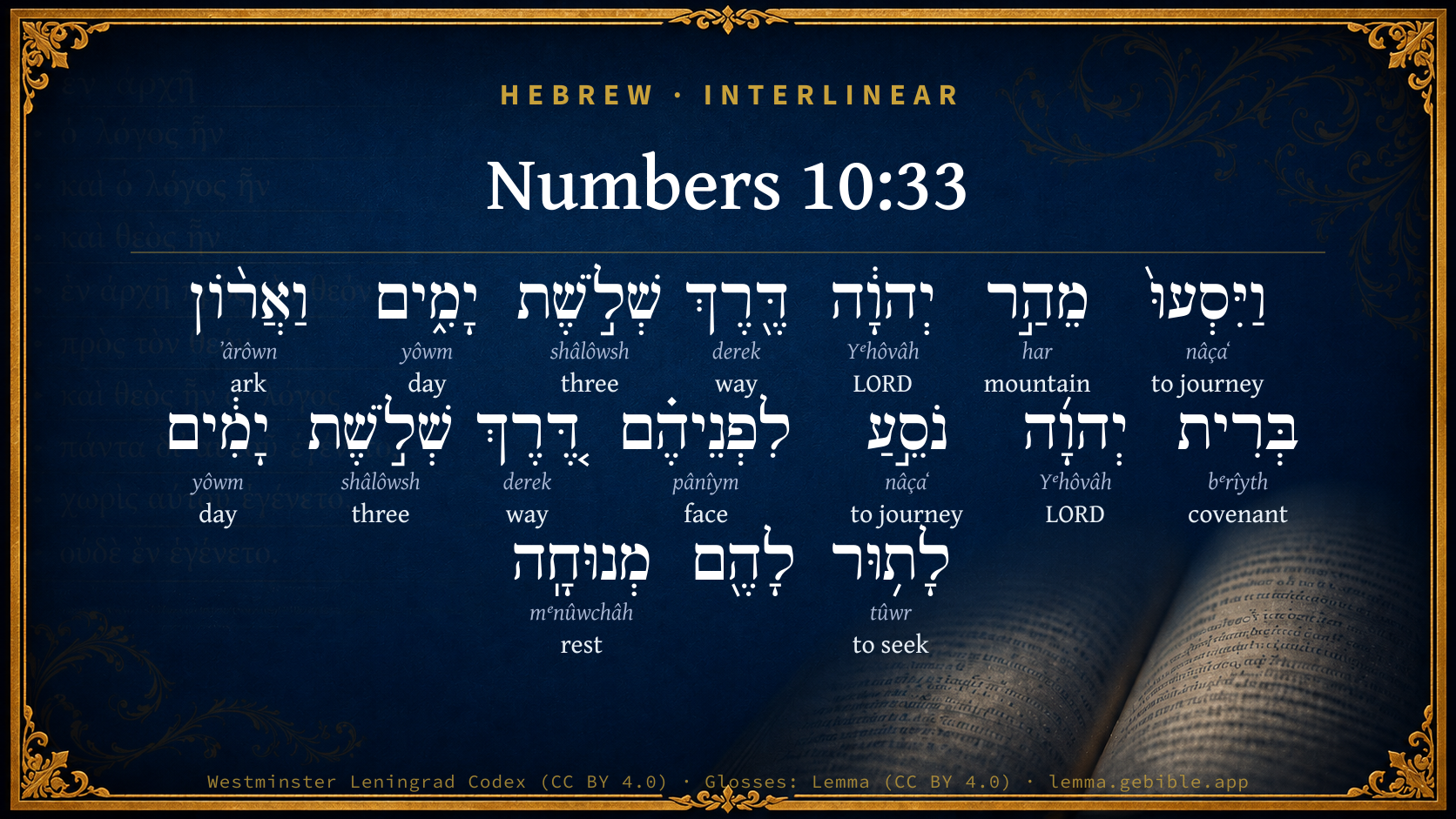
Hebrew (Westminster Leningrad Codex) Numbers 10:33 appears in the Hebrew Old Testament. The text above is from the Westminster Leningrad Codex. Each word links to its Strong’s number, a concise gloss, and parsing drawn from the Open Scriptures Hebrew Bible morphology. Click any word for its full Brown-Driver-Briggs (BDB) entry.
Download image
Cite this verse

Numbers 10:33 (World English Bible). Public Domain. Lemma interlinear Bible study tool, https://lemma.gebible.app/v/numbers/10/33.

Show BibTeX & RIS
BibTeX
RIS
English Translation
They set forward from the Mount of Yahweh three days' journey; and the ark of the covenant of Yahweh went before them three days' journey, to seek out a resting-place for them.
World English Bible · Public Domain
Highlights
  • 1 first appearance in the Hebrew Bible
Full analysis ↓
Download a study sheet

One document with this verse’s original text, its word-by-word gloss line, the meaning frame, cross-references with their text, attributed commentary, and full source and license credits — printable, and it pastes into notes with its structure intact.

This verse Autodidact and up

Study sheet (.html) Plain text (.txt)

A passage Seminary Student

Up to 50 verses in one chapter. A passage sheet keeps up to 6 commentary sources and 12 cross-references per verse, in the order this page ranks them, and says so on the sheet whenever that leaves anything out. Ask for a single verse and you get the Autodidact verse sheet above.

Everything on this page stays free to read, with no account — the sheet is a download of what is already on screen, not access to it.

Want to remove ads? Support Godless Engineer
Compare translations 3

The same verse in 3 English versions, stacked beneath the original-language interlinear above. Click any original word for its lexicon entry.

Each is an independent rendering of the whole verse — the interlinear is not word-aligned to these translations.

Highlighted words mark where these versions differ — a whole-verse word diff, not a word-by-word alignment.

  • World English Bible Public Domain
    They set forward from the Mount of Yahweh three days' journey; and the ark of the covenant of Yahweh went before them three days' journey, to seek out a resting-place for them.
  • King James Version Public Domain
    And they departed from the mount of the LORD three days' journey: and the ark of the covenant of the LORD went before them in the three days' journey, to search out a resting place for them.
  • unfoldingWord Literal Text CC BY-SA 4.0
    And they set out from the mountain of Yahweh a way of three days, and the box of the covenant of Yahweh was setting out to their face a way of three days, to seek out for them rest,

unfoldingWord Literal Text — © unfoldingWord, licensed CC BY-SA 4.0. Word-aligned USFM3 via Door43 (git.door43.org/unfoldingWord/en_ult).

Versions to compare (up to 4)

3 of 4 selected

Show all 18 translations

Every available English version of this verse, each an independent rendering of the whole verse.

  • World English Bible Public Domain
    They set forward from the Mount of Yahweh three days' journey; and the ark of the covenant of Yahweh went before them three days' journey, to seek out a resting-place for them.
  • Berean Standard Bible Public Domain
    So they set out on a three-day journey from the mountain of the LORD, with the ark of the covenant of the LORD traveling ahead of them for those three days to seek a resting place for them.
  • Majority Standard Bible Public Domain
    So they set out on a three-day journey from the mountain of the LORD, with the ark of the covenant of the LORD traveling ahead of them for those three days to seek a resting place for them.
  • King James Version Public Domain
    And they departed from the mount of the LORD three days' journey: and the ark of the covenant of the LORD went before them in the three days' journey, to search out a resting place for them.
  • American Standard Version (1901) Public Domain
    And they set forward from the mount of Jehovah three days' journey; and the ark of the covenant of Jehovah went before them three days' journey, to seek out a resting-place for them.
  • Revised Version (1885) Public Domain
    And they set forward from the mount of the LORD three days’ journey; and the ark of the covenant of the LORD went before them three days’ journey, to seek out a resting place for them.
  • Geneva Bible (1599) Public Domain
    So they departed from the mount of the Lord, three dayes iourney: and the Arke of the couenant of the Lord went before them in the three dayes iourney, to searche out a resting place for them.
  • Douay-Rheims (1899) Public Domain
    So they marched from the mount of the Lord three days' journey, and the ark of the covenant of the Lord went before them, for three days providing a place for the camp.
  • Young's Literal Translation Public Domain
    And they journey from the mount of Jehovah a journey of three days; and the ark of the covenant of Jehovah is journeying before them the journey of three days, to spy out for them a resting-place;
  • Literal Standard Version CC BY-SA 4.0
    And they journey from the mountain of YHWH a journey of three days; and the Ark of the Covenant of YHWH is journeying before them [for] the journey of three days, to spy out a resting place for them;
  • Unlocked Literal Bible CC BY-SA 4.0
    They journeyed from the mountain of Yahweh for three days. The ark of the covenant of Yahweh went before them for three days to find a place for them to rest.
  • unfoldingWord Literal Text CC BY-SA 4.0
    And they set out from the mountain of Yahweh a way of three days, and the box of the covenant of Yahweh was setting out to their face a way of three days, to seek out for them rest,
  • Darby Bible Public Domain
    And they set forward from the mountain of Jehovah [and went] three days' journey; and the ark of the covenant of Jehovah went before them in the three days' journey, to search out a resting-place for them.
  • World Messianic Bible Public Domain
    They set forward from the Mount of the LORD three days’ journey. The ark of the LORD’s covenant went before them three days’ journey, to seek out a resting place for them.
  • Webster's Bible Public Domain
    And they departed from the mount of the LORD three days' journey: and the ark of the covenant of the LORD went before them in the three days' journey, to seek a resting-place for them.
  • Free Bible Version CC BY-SA 4.0
    They left the mountain of the Lord to go on a three-day journey. The Ark of the Lord's Agreement led the way for them during these three days to find a place for them to camp.
  • Bible in Basic English Public Domain
    So they went forward three days' journey from the mountain of the Lord; and the ark of the Lord's agreement went three days' journey before them, looking for a resting-place for them;
  • JPS Tanakh (1917) Public Domain
    And they set forward from the mount of the LORD three days' journey; and the ark of the covenant of the LORD went before them three days' journey, to seek out a resting-place for them.

Literal Standard Version (2020), Covenant Press — licensed CC BY-SA 4.0. Text via the HelloAO Bible API (eBible.org). Unlocked Literal Bible (unfoldingWord) — licensed CC BY-SA 4.0. Text via the HelloAO Bible API (eBible.org). unfoldingWord Literal Text — © unfoldingWord, licensed CC BY-SA 4.0. Word-aligned USFM3 via Door43 (git.door43.org/unfoldingWord/en_ult). Free Bible Version, Dr. Jonathan Gallagher — licensed CC BY-SA 4.0. Text via the HelloAO Bible API (eBible.org).

Word by word

More ways to search: Search by grammar → Find every occurrence → Compare this word →

Practice this passage: Drill this verse → Learn its vocabulary →

מְנוּחָֽה
mᵉnûwchâh
H4496
“rest”
Noun, Common, Both, Singular, Absolute
Part of Speech
Noun
Type
Common
Gender
Both
Number
Singular
State
Absolute
Full BDB Definition

Origin: from H4495

TWOT: 1323f

resting place, rest - resting place - rest, quietness
  1. וַיִּסְעוּ֙ nâçaʻ H5265 “and · to journey” Conjunction + Verb, Qal, Sequential Imperfect, 3rd Person, Masculine, Plural
  2. מֵהַ֣ר har H2022 “from · mountain of” Preposition + Noun, Common, Masculine, Singular, Construct
  3. יְהוָ֔ה Yᵉhôvâh H3068 “LORD” Noun, Proper
  4. דֶּ֖רֶךְ derek H1870 “way of” Noun, Common, Both, Singular, Construct
  5. שְׁלֹ֣שֶׁת shâlôwsh H7969 “three” Adjective, Cardinal number, Masculine, Singular, Construct
  6. יָמִ֑ים yôwm H3117 “days” Noun, Common, Masculine, Plural, Absolute
  7. וַאֲר֨וֹן ʼârôwn H727 “and · ark of” Conjunction + Noun, Common, Both, Singular, Construct
  8. בְּרִית bᵉrîyth H1285 “covenant of” Noun, Common, Feminine, Singular, Construct
  9. יְהוָ֜ה Yᵉhôvâh H3068 “LORD” Noun, Proper
  10. נֹסֵ֣עַ nâçaʻ H5265 “journeying” Verb, Qal, Participle Active, Masculine, Singular, Absolute
  11. לִפְנֵיהֶ֗ם pânîym H6440 “to/for · face(s) · their” Preposition + Noun, Common, Both, Plural, Construct + Suffix, Personal, 3rd Person, Masculine, Plural
  12. דֶּ֚רֶךְ derek H1870 “way of” Noun, Common, Both, Singular, Construct
  13. שְׁלֹ֣שֶׁת shâlôwsh H7969 “three” Adjective, Cardinal number, Masculine, Singular, Construct
  14. יָמִ֔ים yôwm H3117 “days” Noun, Common, Masculine, Plural, Absolute
  15. לָת֥וּר tûwr H8446 “to seek” Preposition + Verb, Qal, Infinitive Construct

About this verse

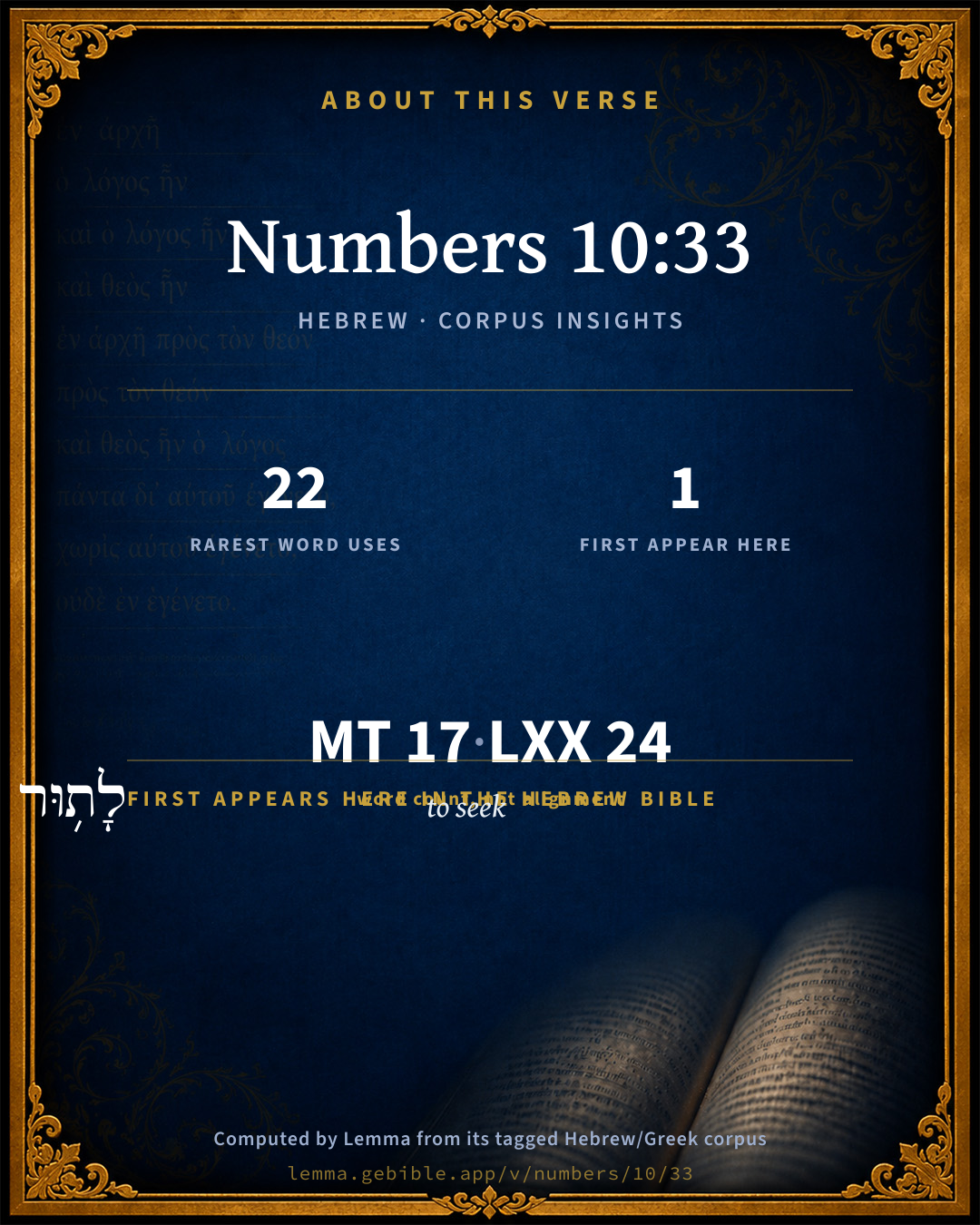
These counts appear in no published source. They are computed here, from the morphology-tagged text and Lemma’s own curated glosses. What Lemma adds →

17
words
11
distinct lemmas
Pentateuch
section

Notable vocabulary

The rarest word here is מְנוּחָֽה rest H4496 — appearing just 22 times in the whole Hebrew Bible.

First appearance in Scripture

This word makes its first canonical appearance in the Hebrew Bible here:

  • לָת֥וּר to seek H8446

Shared distinctive vocabulary

מְנוּחָֽה rest H4496 occurs in 22 verses of the Hebrew Bible. Also found in:

Grammatical profile

  • 3 verbs
  • 11 nouns
  • 2 adjectives
  • 1 preposition

Verb forms

  • וַיִּסְעוּ֙ Qal · Sequential Imperfect
  • נֹסֵ֣עַ Qal · Participle Active
  • לָת֥וּר Qal · Infinitive Construct

Repetition

Words recur within this verse — often emphatic in Hebrew:

  • וַיִּסְעוּ֙ to journey H5265 ×2
  • יְהוָ֔ה LORD H3068 ×2
  • דֶּ֖רֶךְ way H1870 ×2
  • שְׁלֹ֣שֶׁת three H7969 ×2
  • יָמִ֑ים day H3117 ×2

Hebrew & Septuagint length

In English translation the verse runs 32 words from the Hebrew and 34 from the Septuagint (LXX English) — closely comparable.

A rough comparison of the two English renderings, which tokenize alike — not a word-level alignment.

Word counts can differ between the Hebrew and the Greek without any difference in meaning — e.g. the Hebrew direct-object marker אֵת has no separate Greek word, and Greek often adds the article ὁ.

In the original languages it is 17 Hebrew tokens and 24 Greek tokens — but the two are counted differently (Hebrew bundles its prefixes and suffixes into one token; the Greek is in lemma form), so that isn’t a like-for-like length.

Cross-references

23

Topical passages linked to Numbers 10:33 in the Treasury of Scripture Knowledge — connected by theme and wording, ordered by reader-vote popularity; previews shown in the World English Bible.

  • Deuteronomy 1:33 who went before you in the way, to seek you out a place to pitch your tents in, in fire by night, to show you by what way you should go, and in the cloud by day.
  • Exodus 3:1 Now Moses was keeping the flock of Jethro, his father-in-law, the priest of Midian, and he led the flock to the back of the wilderness, and came to God's mountain, to Horeb.
  • Exodus 19:3 Moses went up to God, and Yahweh called to him out of the mountain, saying, "This is what you shall tell the house of Jacob, and tell the children of Israel:
  • Exodus 24:17–18 The appearance of the glory of Yahweh was like devouring fire on the top of the mountain in the eyes of the children of Israel.
  • Exodus 33:14–15 He said, "My presence will go with you, and I will give you rest."
  • Numbers 10:12 The children of Israel set forward according to their journeys out of the wilderness of Sinai; and the cloud abode in the wilderness of Paran.
  • Deuteronomy 9:9 When I was gone up onto the mountain to receive the tables of stone, even the tables of the covenant which Yahweh made with you, then I stayed on the mountain forty days and forty nights; I did neither eat bread nor drink water.
  • Deuteronomy 31:26 Take this book of the law, and put it by the side of the ark of the covenant of Yahweh your God, that it may be there for a witness against you.
  • Joshua 3:2–6 It happened after three days, that the officers went through the midst of the camp;
  • Joshua 3:11–17 Behold, the ark of the covenant of the Lord of all the earth passes over before you into the Jordan.
  • Joshua 4:7 then you shall tell them, Because the waters of the Jordan were cut off before the ark of the covenant of Yahweh; when it passed over the Jordan, the waters of the Jordan were cut off: and these stones shall be for a memorial to the children of Israel forever.
  • Judges 20:27 The children of Israel asked of Yahweh (for the ark of the covenant of God was there in those days,
  • 1 Samuel 4:3 When the people were come into the camp, the elders of Israel said, Why has Yahweh struck us today before the Philistines? Let us get the ark of the covenant of Yahweh out of Shiloh to us, that it may come among us, and save us out of the hand of our enemies.
  • Psalms 95:11 Therefore I swore in my wrath, "They won't enter into my rest."
  • Isaiah 28:12 to whom he said, This is the rest, give you rest to him who is weary; and this is the refreshing: yet they would not hear.
  • Isaiah 66:1 Thus says Yahweh, heaven is my throne, and the earth is my footstool: what manner of house will you build to me? and what place shall be my rest?
  • Jeremiah 3:16 It shall come to pass, when you are multiplied and increased in the land, in those days, says Yahweh, they shall say no more, The ark of the covenant of Yahweh; neither shall it come to mind; neither shall they remember it; neither shall they miss it; neither shall it be made any more.
  • Jeremiah 6:16 Thus says Yahweh, Stand you in the ways and see, and ask for the old paths, where is the good way; and walk therein, and you shall find rest for your souls: but they said, We will not walk [therein].
  • Ezekiel 20:6 in that day I swore to them, to bring them forth out of the land of Egypt into a land that I had searched out for them, flowing with milk and honey, which is the glory of all lands.
  • Matthew 11:28–30 "Come to me, all you who labor and are heavily burdened, and I will give you rest.
  • Hebrews 4:3–11 For we who have believed do enter into that rest, even as he has said, "As I swore in my wrath, they will not enter into my rest;" although the works were finished from the foundation of the world.
  • Hebrews 13:20 Now may the God of peace, who brought again from the dead the great shepherd of the sheep with the blood of an eternal covenant, our Lord Jesus,
  • Jeremiah 31:8–9 Behold, I will bring them from the north country, and gather them from the uttermost parts of the earth, [and] with them the blind and the lame, the woman with child and her who travails with child together: a great company shall they return here.

Cross-references courtesy of OpenBible.info (CC BY 4.0).

Hebrew and Greek witnesses Masoretic Hebrew ↔ Greek Septuagint

The same verse in the two great witnesses to the Old Testament, shown verse-for-verse.

These are two independent witnesses, not word-aligned to each other, and the Septuagint is shown in lemma (dictionary) form.

Hebrew Numbers 10:33 Masoretic · Westminster Leningrad Codex

וַיִּסְעוּ֙ מֵהַ֣ר יְהוָ֔ה דֶּ֖רֶךְ שְׁלֹ֣שֶׁת יָמִ֑ים וַאֲר֨וֹן בְּרִית יְהוָ֜ה נֹסֵ֣עַ לִפְנֵיהֶ֗ם דֶּ֚רֶךְ שְׁלֹ֣שֶׁת יָמִ֔ים לָת֥וּר לָהֶ֖ם מְנוּחָֽה

They set forward from the Mount of Yahweh three days' journey; and the ark of the covenant of Yahweh went before them three days' journey, to seek out a resting-place for them.

World English Bible · Public Domain

Greek LXX Numbers 10:33 Septuagint · lemma form

καί ἐκαἴρω ἐκ ὁ ὄρος κύριος ὁδός τρεῖς ἡμέρα καί ὁ κιβωτός ὁ διαθήκη κύριος προπορεύομαι πρότερος αὐτός ὁδός τρεῖς ἡμέρα κατασκέπτομαι αὐτός ἀνάπαυσις

And they departed from the mount of the Lord a three days' journey; and the ark of the covenant of the Lord went before them a three days' journey to provide rest for them.

LXX2012 (modern English Septuagint) · Public Domain

On this verse, The Pulpit Commentary discusses the Septuagint’s reading. Read the note in Commentary ↓

Hebrew: Westminster Leningrad Codex (CC BY 4.0). Greek: Septuagint (public domain); English from LXX2012 (modern English Septuagint) (Public Domain). How the Septuagint differs from the Hebrew →

Targum (Aramaic paraphrase)

2

The Targum is the ancient Jewish Aramaic paraphrase of the Hebrew Scriptures — an interpretive translation, not the Hebrew text itself. Onkelos (literal) and Pseudo-Jonathan (expansive) render the Torah, and Jonathan the Prophets. Coverage is partial: where no permissively-licensed English translation exists for a verse, only the Aramaic is shown. This is verse-level text, not a word-by-word alignment to the Hebrew.

  1. Targum Onkelos Torah (Genesis–Deuteronomy)
    וּנְטָּלוּ מִטוּרָא דְאִתְגְלֵי עֲלוֹהִי יְקָרָא דַיְיָ מַהֲלַךְ תְּלָתָא יוֹמִין וַאֲרוֹן קְיָמָא דַיְיָ נְטַּל קֳדָמֵיהוֹן מַהֲלַךְ תְּלָתָא יוֹמִין לְאַתְקְנָאָה לְהוֹן אֲתַר בֵּית מֵישְׁרֵי

    (no public-domain English translation for this verse)

    Targum Onkelos — Aramaic: “Onkelos Genesis” (public domain); “Onkelos Exodus” (public domain); “Onkelos Leviticus” (public domain); “Onkelos Numbers” (public domain); “Onkelos Deuteronomy” (public domain). English: “Sefaria Community Translation” (CC0 1.0 (public-domain dedication)); “J.W. Etheridge. The Targums of Onkelos and Jonathan Ben Uzziel on the Pentateuch. London: Longmans, Green, 1862” (public domain). Text via Sefaria.

  2. Targum Pseudo-Jonathan Torah (Genesis–Deuteronomy)
    וּנְטָלוּ מִטוּרָא דְאִתְגְלֵי עֲלוֹי אִיקַר שְׁכִינְתָּא דַיְיָ מַהֲלַךְ תְּלָתָא יוֹמִין וַאֲרוֹן קְיָימָא דַיְיָ מְטַיֵיל קֳדָמֵיהוֹן תְּלָתִין וְשִׁית מִלִין הֲלִיךְ בְּיוֹמָא הַהוּא וְהוּא הֲוָה מִידַבֵּר קֳדָם מַשִׁרְיָיתָא דְיִשְרָאֵל מַהֲלַךְ תְּלָתָא יוֹמִין לְאַתְקָנָא לְהוֹן אֲתַר בֵּית מֵשְׁרוֹי

    And they went forward from the mountain where the glory of the Shekinah of the Lord had been revealed, going three days; and the Ark of the Lord's covenant went before them. Thirty and six miles it went that day; it preceded the camp of Israel, going three days, to provide for them a place to encamp in.

    Targum Pseudo-Jonathan — Aramaic: “Targum Jonathan on Genesis” (public domain); “Targum Jonathan on Exodus” (public domain); “Targum Jonathan on Leviticus” (public domain); “Targum Jonathan on Numbers” (public domain); “Targum Jonathan on Deuteronomy” (public domain). English: “The Targum of Jonathan ben Uzziel, trans. J. W. Etheridge, London, 1862” (public domain). Text via Sefaria.

Commentary

Notes on Numbers 10:33 from classic Christian and Jewish commentators (each source and its license shown beneath its notes). The classic Christian expositions comment on the surrounding passage and are grouped to its opening verse, so a note may address several verses; the Jewish commentaries on the Tanakh (Rashi and others) are per-verse, so they appear only where the commentator wrote on this verse.

Lemma curates 59 commentaries, every one of them public domain or Creative Commons licensed, each selected and text-cleaned for this edition rather than reprinted as found. About our sources →

Trapp's Complete Commentary

John Trapp

Num 10:33 And they departed from the mount of the LORD three days’ journey: and the ark of the covenant of the LORD went before them in the three days’ journey, to search out a resting place for them.

Ver. 33. Three days’ journey.] Three days together without resting: this made them murmur. {Num 11:1}

Went before them.] And, as the Jews conceive, for the facilitating of their march the cloud levelled mountains, raised valleys, and laid all of a flat; that is, burnt up bushes, smoothed rocks, and made all plain, &c. {a}

{a} Non quia dura sed quia molles patimur. - Sen.

John Trapp, A Commentary or Exposition upon All the Books of the Old and New Testament (1647–1656) — public domain. Text from a community e-Sword module.

Joseph Benson's Commentary

Num 10:33. Three days — With continued journeys; only it seems probable that the cloud made little pauses, that they might have time for sleep and necessary refreshments. The ark went before them — Although in their stations it was in the middle, yet in their marches it went before them; and the cloud was constantly over the ark, whether it stood or went; therefore the ark is said to go before and direct them, not as if the ark could be seen of all the camps, which, as it was carried only upon men’s shoulders, was impossible, but because the cloud, which always attended upon the ark, and did, together with the ark, constitute, in a manner, one sign of God’s presence, did lead and direct them. To search out — A metaphorical expression, for discovering to them; for the ark could not search; and God, who knew all places and things, needed not to search.

Joseph Benson's Commentary on the Old and New Testaments (1811–1818) — public domain. Text from a community e-Sword module.

Whedon's Commentary on the Bible

Daniel D. Whedon

THE THREE DAYS’ MARCH, Num_10:33-34.

By this we are not to understand an unbroken march of the entire people during seventy-two hours with no halt, but that the ark was borne steadily onward during this period before it came to a permanent stopping-place. The people must have paused to eat and sleep while the pillar of cloud or of fire moved ever slowly onward.

33. Ark of the covenant — It is so called according to its design and signification for Israel. The covenant is thus associated with the most sacred thing on the earth, on whose golden lid was the Shekinah, the visible Presence, and over which sublimely towered the cloudy, fiery pillar. This cannot be quoted to prove, as Prof. W. Robertson Smith attempts to do, that the sanctuary was then outside of the camp, for no mention is made of that sacred structure. The record simply says that the ark went before them as their guide.

Went before them — The ark was carried separately from the rest of the sacred furniture, in advance of the column, wrapped in its peculiar purple blue covering, (Num_4:6, note,) at once an object of veneration and a symbol of Jehovah’s presence and of his separateness from sinners. “It is true, that in the order observed in the camp and on the march no mention is made of the ark going in front of the whole army; but this omission is no more proof of any discrepancy between this verse and Num_2:17, or of a different authorship, than the separation of the different divisions of the Levites upon the march, which is not mentioned in Num_2:17.” — Keil.

A resting place — This was not Taberah, the first place mentioned, (Num_11:3,) but Kibroth-hattaavah. Comp. Num_11:34-35; Num_33:16. Although the pillar of cloud was the real guide of Israel in all their journeying, yet the local knowledge of Hobab would manifestly prove of the greatest use in indicating springs and places of pasturage, since divine guidance, in any age, is never a substitute for the best means which human skill or knowledge can suggest.

Daniel D. Whedon (gen. ed.), Commentary on the Old and New Testaments (1874–1909) — public domain. Text from a community e-Sword module.

Keil & Delitzsch

C. F. Keil & F. Delitzsch

"And they (the Israelites) departed from the mount of Jehovah (Exo 3:1) three days' journey; the ark of the covenant of Jehovah going before them, to search out a resting-place for them. And the cloud of Jehovah was over them by day, when they broke up from the camp." Jehovah still did as He had already done on the way to Sinai (Exo 13:21-22): He went before them in the pillar of cloud, according to His promise (Exo 33:13), on their journey from Sinai to Canaan; with this simple difference, however, that henceforth the cloud that embodied the presence of Jehovah was connected with the ark of the covenant, as the visible throne of His gracious presence which had been appointed by Jehovah Himself. To this end the ark of the covenant was carried separately from the rest of the sacred things, in front of the whole army; so that the cloud which went before them floated above the ark, leading the procession, and regulating its movements in the direction it took in such a manner that the permanent connection between the cloud and the sanctuary might be visibly manifested even during their march. It is true that, in the order observed in the camp and on the march, no mention is made of the ark of the covenant going in front of the whole army; but this omission is no more a proof of any discrepancy between this verse and Num 2:17, or of a difference of authorship, than the separation of the different divisions of the Levites upon the march, which is also not mentioned in Num 2:17, although the Gershonites and Merarites actually marched between the banners of Judah and Reuben, and the Kohathites with the holy things between the banners of Reuben and Ephraim (Num 10:17 and Num 10:21).

(Note: As the critics do not deny that vv. 11-28 are written by the "Elohist" notwithstanding this difference, they have no right to bring forward the account of the ark going first as a contradiction to ch. 2, and therefore a proof that Num 10:33. are not of Elohistic origin.)

The words, "the cloud was above them" (the Israelites), and so forth, can be reconciled with this supposition without any difficulty, whether we understand them as signifying that the cloud, which appeared as a guiding column floating above the ark and moved forward along with it, also extended itself along the whole procession, and spread out as a protecting shade over the whole army (as O. v. Gerlach and Baumgarten suppose), or that "above them" (upon them) is to be regarded as expressive of the fact that it accompanied them as a protection and shade. Nor is Psa 105:39, which seems, so far as the words are concerned, rather to favour the first explanation, really at variance with this view; for the Psalmist's intention is not so much to give a physical description of the phenomenon, as to describe the sheltering protection of God in poetical words as a spreading out of the cloud above the wandering people of God, in the form of a protection against both heat and rain (cf. Isa 4:5-6). Moreover, Num 10:33 and Num 10:34 have a poetical character, answering to the elevated nature of their subject, and are to be interpreted as follows according to the laws of a poetical parallelism: The one thought that the ark of the covenant, with the cloud soaring above it, led the way and sheltered those who were marching, is divided into two clauses; in Num 10:33 only the ark of the covenant is mentioned as going in front of the Israelites, and in Num 10:34 only the cloud as a shelter over them: whereas the carrying of the ark in front of the army could only accomplish the end proposed, viz., to search out a resting-place for them, by Jehovah going above them in the cloud, and showing the bearers of the ark both the way they were to take, and the place where they were to rest. The ark with the tables of the law is not called "the ark of testimony" here, according to its contents, as in Exo 25:22; Exo 26:33-34; Exo 30:6, etc., but the ark of the covenant of Jehovah, according to its design and signification for Israel, which was the only point, or at any rate the principal point, in consideration here. The resting-place which the ark of the covenant found at the end of three days, is not mentioned in Num 10:34; it was not Tabeerah, however (Num 11:3), but Kibroth-hattaavah (Num 11:34-35; cf. Num 33:16).

Keil & Delitzsch — Biblical Commentary on the Old Testament (1861–1891) — public domain (CC PDM 1.0). Text via the HelloAO Bible API. (Old Testament only.)

Tyndale Open Study Notes

Tyndale Open Resources

10:33 The mountain of the Lord refers here to Mount Sinai; elsewhere the expression refers to Mount Moriah or Zion in Jerusalem (Gen 22:14; Ps 24:3; Isa 2:3; Zech 8:3).

Tyndale Open Study Notes — © Tyndale Open Resources, licensed CC BY-SA 4.0. Text via the HelloAO Bible API.

Geneva Bible (1599)

Geneva Bible translators

Mount Sinai, or Horeb.

Geneva Bible (1599) marginal notes — public domain. Text via Bolls.life.

Jamieson, Fausset & Brown

Robert Jamieson, A. R. Fausset & David Brown

they departed . . . three days' journey--the first day's progress being very small, about eighteen or twenty miles.

ark of the covenant of the Lord went before them--It was carried in the center, and hence some eminent commentators think the passage should be rendered, "the ark went in their presence," the cloud above upon it being conspicuous in their eyes. But it is probable that the cloudy pillar, which, while stationary, rested upon the ark, preceded them in the march--as, when in motion at one time (Exo 14:19) it is expressly said to have shifted its place.

Jamieson, Fausset & Brown — Commentary Critical and Explanatory on the Whole Bible (1871) — public domain (CC PDM 1.0). Text via the HelloAO Bible API.

Adam Clarke's Commentary

Verse 33. The ark - went before them] We find from Nu 10:21 that the ark was carried by the Kohathites in the center of the army; but as the army never moved till the cloud was taken up, it is said to go before them, i. e., to be the first to move, as without this motion the Israelites continued in their encampments.

Adam Clarke's Commentary on the Bible (1810–1826) — public domain. Text from a community e-Sword/MySword module.

Ellicott's Commentary for English Readers

(33) Three days’ journey.—The place at which the first protracted halt was made appears to have been either at Taberah, which means burning, or at Kibroth-hattaavah, the graves of lust. (Comp. Num_11:3; Num_33:16; see also Note on Num_11:34.)

And the ark of the covenant of the Lord went before them.—It has been inferred from the fact that the Kohathites had the charge of the ark (Num_3:31), and that they were to set forward, “bearing the sanctuary,” after the second or southern camp, i.e., in the midst of the host, that the position of the ark during the journeys was in that place, and not in front. The obvious objection to this supposition arising out of the fact that the cloud which directed the march rested upon, or over, the ark may be overcome by the consideration that the cloud appears to have extended over the whole of the host during the journeys, and to have served as a protection from the scorching heat (see Num_10:34; also Exo_13:21; Neh_9:12; Psa_105:39). On the other hand, the natural interpretation of this verse is that the ark was borne in front of the host, and did not merely serve to direct its line of march as a general, whose station might be in any part of an army. This interpretation is confirmed by Exo_13:21, Deu_1:33, and also by the position which the ark occupied at the passage of the Jordan. In the latter case the people were expressly directed to go after the ark (Jos_3:3); and in Num_10:11 the same word is used which occurs in this verse, “the ark of the covenant of the Lord of all the earth passeth over before you into Jordan.” It will not follow, however, as a necessary inference, that the ark uniformly occupied the same position in all the journeys, and it cannot be denied that Num_10:21 presents a difficulty, partly arising from the ambiguity of meaning which is to be attached to the word mikdash, sanctuary, and partly from the omission of any word in the Hebrew corresponding to the words in italics, the other. Ibn Ezra thinks that this three days’ journey was different from all the other journeys in respect of the position of the ark.

A Bible Commentary for English Readers, edited by Charles John Ellicott (1878–1897) — public domain. Text from a community e-Sword module.

The Cambridge Bible for Schools and Colleges

gen. ed. J. J. S. Perowne

33. three days’ journey] A characteristic expression of J ; cf. Gen_30:36, Exo_3:18; Exo_5:3; Exo_8:27.

33b. the ark of the covenant of Jehovah] This description of the ark, as containing the tablets of the covenant (i.e. the decalogue), is Deuteronomic; cf. Num_14:44, Deu_10:8; Deu_31:9; Deu_31:25, Jos_4:7; Jos_4:18; Jos_6:8 &c.

went before them three days’ journey] It is very doubtful if the text can be right. The ark would be useless as a guide if it were three days’ journey in advance. In Jos_3:4 (P ) it went 2000 cubits (c. 1000 yards) in front. The words ‘three days’ journey’ may have been accidentally repeated from the former half of the verse, and should perhaps be omitted.

The Cambridge Bible for Schools and Colleges (gen. ed. J. J. S. Perowne; Cambridge University Press, 1878–1918) — public domain. Text from a community e-Sword module.

Albert Barnes' Notes on the Bible

Three days’ journey - Probably a technical expression for such a distance as could not be traversed in a single day, and therefore not without intervals of encampment and due provision: compare Gen 30:36; Exo 3:18; Exo 5:3; Exo 8:27; Exo 15:22. The technical use of the phrase “Sabbath-day’s journey” for another average distance, Act 1:12, is similar.

The ark of the covenant of the Lord went before them - From Num 10:21; Num 2:17 it would appear that the usual place of the ark during the march was in the midst of the host. It was evidently an exceptional case when, in Jos 3:3, Jos 3:6, the ark preceded the people into the bed of the Jordan. Hence, the words “went before them” do not here imply local precedence. The phrase, or its equivalent, is used of a leader going out in command of his troops, Num 27:17; Deu 31:3; 1Sa 18:16; 2Ch 1:10; and similarly the ark may well be said to have gone at the head of the Israelites, when it was borne solemnly in the midst of them as the outward embodiment of the presence whose sovereign word was their law.

A resting place - literally, “rest.” It is commonly understood of each successive encampment; or, in particular, of the first encampment. Yet the term would hardly be here employed, did it not carry with it a higher meaning, pointing to the promised rest of Canaan, for which the Israelites were now in full march, and from the speedy enjoyment of which no sentence of exclusion as yet debarred them. Compare the marginal references.

Albert Barnes' Notes on the Bible (1834–1885) — public domain. Text from a community e-Sword/MySword module.

Haydock's Catholic Bible Commentary

Journey. During this time, we know not where they encamped. The first place that is specified is Tabera, or "the burning," (chap. xi. 3.; Calmet) which St. Jerome believes is the same place which was also called the sepulchres of concupiscence, (ver. 34,) the 13th station, (Haydock) which is described above as the desert of Pharan. (Menochius) --- Before them. See ver. 17. (Haydock) --- The Rabbins assert that there were two arks; one containing the writings of Moses going before, with the lawgiver, at the head of the army; and the other, carried by the Levites, in the centre. (Drusius) --- Calmet would rather translate "went in their presence;" that is, in the midst. The kings of Persia always marched in the centre, for greater safety, and that they might communicate their orders with more expedition, as well as to keep all in order, and observe what was doing. (Xenophon.; Cyrop. iv. and viii.; Arian ii. and iii.) (Calmet) --- But the ark of God would probably go before the people, with the cloud, which hung over it.

George Leo Haydock (1774–1849), Haydock's Catholic Family Bible and Commentary, 1859 edition — public domain. Excludes Psalms (Douay-Rheims chapter numbering differs from Protestant) and Deuterocanonical books (Catholic canon only).

Matthew Poole's English Annotations

Three days’ journey, with continued journeys, only it seems most probable that the cloud made little pauses, that they might have time for sleep and necessary refreshments, which their natures required. And thus all writers, when they relate the continued journeys of persons for many days together, are to be understood with this exception.

Before them; not so much in place, say some, for so it went in the midst, or at least after the first camp, as may seem from Num 10:21, as in office and authority, as a general who is said to go before or lead his army, though he do not go in the very first place. But others more probably think that the ark, which indeed is not mentioned Num 10:21, albeit in their stations it was in the middle, where also the cloud was, yet in their marches it went before them, as also the cloud did, and so the cloud was constantly over the ark, whether it stood or went; and therefore the ark is said to go before and direct them, not as if the ark could be seen of all the camps, which being carried only upon men’s shoulders was impossible, but because the cloud, which always attended upon the ark, and did together with the ark constitute in a manner one sign of God’s presence, did lead and direct them.

To search out a resting-place, where they might safely and commodiously rest. But this is a metaphorical expression for discovering to them; for otherwise the ark could not. search, and God, who knew all places and things, heeded not to search.

Matthew Poole's English Annotations on the Holy Bible (1683–1685) — public domain. Text from a community e-Sword/MySword module.

The Pulpit Commentary

THE ACTUAL DEPARTURE FROM SINAI (verses 12. It was one of the supreme moments in the life of Israel one of those beginnings or "departures" which lead to untold gain or loss; it was, in fact, although they knew it not, the commencement of a march which for almost all of them should know no end except within a hasty grave. No doubt, during the months spent at Sinai, every preparation had been made for the onward journey; but none the less it was a stupendous enterprise to march that vast host, so largely composed of women and children, so little inured to such fatigue, and so impatient of such discipline, for three consecutive days into a wilderness. Three days" journey. This expression is apparently a general one, and not to be strictly pressed. (cf. Gen_30:36 Exo_3:18 Exo_15:22) At the same time it implies

(1) that the host twice halted for the night during the journey, and

(2) that the whole journey was regarded as one and in some sense as complete in itself.

The terminus ad quem of this three days" journey is given us in verse 12; it was to take them across the intervening belt of sand, and to land them fairly within the "wilderness of Paran." During this journey no doubt the march would be pushed on as steadily as possible, but it is not likely that it would cover so much as thirty miles. A modern army, unencumbered with non-combatants, does not make more than ten miles a day over difficult country, nor can cattle be driven faster than that. Even to accomplish that rate, and to keep the whole multitude together, as the narrative implies, required supernatural aid and strength. For the direction of the march see notes on chapter 13. The ark of the covenant of the Lord went before them. It is obvious that what is apparently affirmed here is apparently at variance with Num_2:17 and verse 21 of this chapter, which speak of the holy things of which the ark was the most holy as carried by the Kohathites in the very midst of the long line of march. Three opinions have been held on the subject.

1. That the ark was really carried with the other "holy things," and only "went before" metaphorically, as a general may be said to lead his troops, although he may not be actually in front of them; to which it is obvious to reply that if the ark did not actually precede the host, there was no possible way in which it could direct their movements; the cloud alone would be the visible expression of the Divine guidance.

2. That the "holy things" generally were ordered to be carried in the midst of the host by the Kohathites, but that God reserved the place of the ark itself to his own immediate disposition. A general does not include himself in his own marching orders, however minute; and the ark was the outward symbol of God"s own personal presence and guidance. It is, therefore, not at all surprising that the first intimation of the position of the ark on the march should be given at the moment when the march actually commenced.

3. That the usual place for the ark was no doubt with the sanctuary, as implied in the orders, but that o a this special occasion the ark went to the front in consequence of some Divine intimation, just as it did at the crossing of Jordan and at the taking of Jericho. Certainly there is much reason in this view, considering how momentous and formidable was their first assay at marching from their temporary home towards that unknown land beyond the northern horizon. If the deep waters of Jordan might fright them, or the walls of Jericho defy them, well might they shrink from plunging into the broken, stony, and intractable country into which the ark and the cloud now led them. We shall probably think that either habitually or at least occasionally the ark did go before, and that the feet of them that bare it were supernaturally directed, either by the movements of the cloud, or by some more secret intimation, towards the destined place of rest. It is allowed by all that the cloud preceded and directed the march, and it would be strange indeed if these twin symbols of the Divine presence had been so far separated from one another; for the accustomed place of the cloud was above the tabernacle, i.e., above the ark, yet outside of the tabernacle, so as to be visible to all.

Vers. 33-36. The heavenward march.

Spiritually, we have here the journey of the Church of God, or of the faithful soul, towards heaven under the guidance of the Saviour. For the ark, whereon rested the Shechinah, and in which was carried the law, is the type of Jesus, in whom dwelt the whole fullness of the Godhead bodily, (cf. 2Co_3:18 2Co_4:6 Col_2:9) and in whom as manifested to us is found the new law of love and liberty. (Psa_40:8 Mar_12:30, 31 Rom_7:6 Jam_1:25 1Pe_2:21) Therefore we have here Jesus going before his own,

(1) to guide them in the daily path,

(2) to lead them to their rest when the journey is over. (cf. Joh_10:4 Joh_14:2)

In the cloud, again, we have (it may be) the refreshment of the Holy Spirit ("another Comforter"), when we face the burden and heat of life. Lastly, we have the devout prayers of the faithful for the help of God in their spiritual warfare, for the presence of God with their souls. Consider, therefore, on verses 33, 34

I THAT THE HOUR OF DEPARTURE FROM HOREB, SO LONG DELAYED, AND THE PLUNGE INTO THE STONY DESERT, SO OFTEN ANTICIPATED, CAME AT LAST. Many may have thought it would never really arrive, but it did; and in a few hours the mount, which had been the scene of such wondrous events, was hidden for ever from their eyes. Even so we cannot abide on the heights of contemplation (with Moses), or in the plains of instruction (with the people). There is a time to receive marching orders; there is a much longer and more trying time to march accordingly amidst hard trials and difficult undertakings and this time will surely come to each and all. (Mat_10:38 Act_14:22 2Ti_2:12 2Ti_3:12)

II THAT THE ISRAELITES WERE NOT REQUIRED TO FIND THEIR OWN WAY, OR TRUST TO HUMAN GUIDANCE: THE ARK WENT BEFORE THEM. They only had to follow as best they might. Even so Jesus goes before his own; once for all, by his death, resurrection, and ascension; daily, by his example and encouragement. As he has gone before us all into heaven to prepare a "rest" for the people of God, so he goes before each weary soul in life and death to find out resting-places and places of refreshment for it. (Psa_23:4 Joh_8:12 Joh 12:26 Joh_14:2, Joh_14:6)

III THAT THE ISRAELITES WERE IN PART SHIELDED FROM THE FIERCE AND FATAL HEATS OF THE DESERT MARCH BY THE CLOUD WHICH OVERSHADOWED THEM FROM ABOVE THE ARK. For that luminous cloud which rested permanently over the ark was spread over the following host when on the march. St. Paul says that the Jews were "baptized unto Moses in the cloud and in the sea", (1Co_10:2) whence it appears that as the passage of the sea represented in a figure the baptism of water which separates outwardly unto Christ (the Moses of the better covenant), so did the overhanging cloud with its moist coolness represent the baptism of the Spirit, which is all abiding refreshment to tire faithful while (but only while) they follow Christ. And thus the old hymn, Veni Sanctus Spiritus Thou of Comforters the best; Thou the soul"s most welcome guest; Sweet refreshment here below; In our labour rest most sweet; Grateful coolness in the heat, Solace in the midst of woe.

Even so, therefore, the overshadowing presence (cf. Luk_1:35) of the Holy Ghost is the blessed solace, comfort, and refreshment of the faithful in fiery trials, fierce temptations, and weary disappointments; and this overshadowing Presence reaches us only from and through the glorified humanity of Jesus (our Ark), and only while we walk in faith and patience. (cf. Joh_7:39 Joh_16:7 Rom_8:14 1Jn_2:20 1Pe_4:14) Note, that the unrecorded sufferings and vexations of such a host on such a march must have been beyond description; but this much appears, that the nearer they kept to the ark the more they were sheltered by the cloud: if any staid in camp, he had no shade. The more closely we follow Jesus, the more comfort of the Spirit shall we have amidst the unavoidable sorrows and sufferings of life. And note, that there are in the Old Testament very few symbols of the Holy Spirit, whereas there are an endless number of types of Christ and this, no doubt, in accordance with the deep saying of Joh_7:39. (oupw ga ). When therefore, we find one which is recognized in the New Testament, It is the more precious. Consider, again, on verses 35, 36

I THAT EVERY DAY OF THE MARCH HAD FOR MOSES ITS TWO SUPREME MOMENTS, OF SETTING OUT AND OF SETTLING DOWN, AND EACH HAD ITS OWN DANGERS AND ANXIETIES. Even so every day in a Christian"s life has its morning and evening, its opening and closing; its going forth to work, to business, to converse with the outer world, to manifold encounter with the strange, the unexpected, the difficult, perhaps the terrible; its coming in to rest, to ease, to unguarded relaxation, to the little circle where self is paramount, where the individual is all important. These two points are the critical points in the Christian"s daily life.

II THAT MOSES MADE HIS MORNING PRAYER FOR DIVINE DEFENCE AND AID AGAINST THE FOE. He knew that many enemies were hovering round (like the Amalekites) who might attack them at any time, even when least expected, and might find them, humanly speaking, an easy prey. He prayed that God would undertake their cause, and put to flight their foes. Even so the faithful soul, looking forward to the active hours of the day, knows from sad experience that spiritual foes will dog its path to assail it by temptation and overthrow it by sin when least prepared. Therefore, before it ventures forth, it beseeches God to be its succour and defense against all the craft and subtlety of its foes.

III THAT MOSES MADE HIS EVENING PRAYER FOR THE CONTINUANCE OF THE DIVINE PRESENCE IN THEIR MIDST. He knew that the people were helpless, and moreover stiff-necked and hardhearted, and that mischief would breed in the camp as readily as it might meet them on the march, and that they must perish miserably if left to themselves. He prayed that God would stay with them, and be their worship, and remain the center of their life ab intra, as well as their defense ab extra. Even so the Christian"s evening prayer is, "Abide with us." The faithful soul, when it ceases from outward cares and is most thrown upon itself, feels most how lost would be its state without the abiding Presence and grace of God; and then it beseeches him whom it has more or less offended to return to it, because without him it were empty, desolate, and destroyed. Note, that if we read with some, "Restore the many thousands of Israel," i.e., to their promised land, then it is the voice of the faithful, recognizing at each pause in life that we are still strangers and wanderers here, and beseeching God to bring us to our true and only rest. (cf. 2Co_5:4 Php_3:11 Rev_6:10, Rev_6:11) And cf. the ancient prayer, "Beseeching thee shortly to accomplish the number of thine elect, and to hasten thy kingdom, that we with all those that are departed in the true faith of thy holy name, may have our perfect consummation and joy in thy eternal and everlasting glory." Or, if we read with the Septuagint, "convert the many thousands of Israel," then it is the voice of the faithful in the intervals of labour supplicating God for all who in any wise belong to the Israel of God, that the grace of a true and entire conversion which is the one thing needful may be granted unto them. (cf. Luk_22:32 2Co_13:9 1Th_3:10)

The Pulpit Commentary (1880–1919), ed. H.D.M. Spence-Jones & Joseph S. Exell — public domain. Text from a community e-Sword module.

John Wesley's Explanatory Notes

Three days - With continued journeys; only it seems probable, that the cloud made little pauses that they might have time for sleep and necessary refreshments. The ark went before them - Altho' in their stations it was in the middle, yet in their marches it went before them; and the cloud was constantly over the ark whether it stood or went; therefore the ark is said to go before and direct them, not as if the ark could be seen of all the camps, which being carried only upon mens shoulders was impossible; but because the cloud, which always attended upon the ark, and did, together with the ark, constitute, in a manner, one sign of God's presence, did lead and direct them. To search out - A metaphorical expression, for discovering to them; for the ark could not search, and God, who knew all places and things, needed not to search.

John Wesley, Explanatory Notes Upon the Whole Bible (1754–1765) — public domain. Text via the GEBible commentary corpus.

unfoldingWord translationNotes

Door43 World Missions Community

They journeyed

"They" refers to the people of Israel.

the mountain of Yahweh

This refers to Mount Sinai. The full meaning of this statement can be made explicit. AT: "Mount Sinai, the mountain of Yahweh" (See: Assumed Knowledge and Implicit Information)

The ark of the covenant of Yahweh went before them

The group of Levites carrying the ark of the covenant went before the people of Israel as the traveled. AT: "Men carried the ark of the covenant of Yahweh before them as they traveled" (See: Personification)

by daylight

"every day" or "during the day"

translationWords

ark of the covenant

rest

unfoldingWord translationNotes — © Distant Shores Media and the Door43 World Missions Community, licensed CC BY-SA 4.0. Source: git.door43.org/Door43/en_tn.

Rashi

Rabbi Shlomo Yitzchaki (Rashi)

דרך שלשת ימים [AND THEY DEPARTED FROM THE MOUNT OF THE LORD] THREE DAYS’ JOURNEY — A distance of three days’ journey they miraculously travelled in one day, because the Holy One, blessed be He, desired to bring them straight away into the Land (cf. Sifrei Bamidbar 82).

וארון ברית ה' נסע לפניהם דרך שלשת ימים AND THE ARK OF THE COVENANT OF THE LORD WENT BEFORE THEM IN THE THREE DAYS' JOURNEY — This was the Ark that went with them whenever they waged war and in which the broken Tablets were placed. It traveled in front of them a distance of three days’ journey to prepare for them a proper place for encampment (Sifrei Bamidbar 82; Talmud Yerushalmi Shekalim 6:1).

Rashi on the Tanakh — English translations: “The Judaica Press complete Tanach with Rashi, translated by A. J. Rosenberg” (CC BY 4.0); “Pentateuch with Rashi's commentary by M. Rosenbaum and A.M. Silbermann, 1929-1934” (public domain); “The Metsudah Tanach series, Lakewood, N.J” (CC BY 4.0); and “The Book of Joshua, Metsudah Publications, 1997” (CC BY 4.0). Text via Sefaria.

Ramban (Nachmanides)

Rabbi Moshe ben Nachman (Ramban / Nachmanides)

AND THEY SET FORWARD FROM THE MOUNT OF THE ETERNAL THREE DAYS’ JOURNEY. According to the plain meaning of Scripture, the cloud [of the Eternal] journeyed and went before them for three days and the ark followed the cloud in front of the people, and it did not come to rest in that place until the night of the third day, when the cloud rested in the wilderness of Paran, which was a good place for them to camp in. This is the sense of [the expression] to seek out a resting-place for them. And when the cloud rested they erected the Tabernacle and brought the ark into it. Scripture, however, did not explain whether they also journeyed at night.

Ramban (Nachmanides) on the Tanakh — English translation: “Commentary on the Torah by Ramban (Nachmanides). Translated and annotated by Charles B. Chavel. New York, Shilo Pub. House, 1971-1976” (CC BY 4.0). Text via Sefaria.

Lesson kit

Teaching starters — assembled from the data on this page, not authored interpretation. Every prompt links to the verse data it draws on. Edit before teaching.

Numbers, in the Pentateuch, opens this verse with 17 words (11 distinct Hebrew lemmas). Its most distinctive word is mᵉnûwchâh (“rest”). A historical commentator’s framing appears above. Read the whole chapter for the surrounding context.

Discussion questions

  1. How does “rest” (mᵉnûwchâh) shape what this verse is saying?
  2. This is the first place “to seek” appears in Scripture (first appears here). What does its debut here establish?
  3. How does Genesis 49:15, which shares the word «rest», read alongside this verse?
  4. What does the repetition of “to journey” (2× in this one verse) do in this verse?
  5. These translations render this verse differently; the difference is in the English rendering, not the original. What questions does that raise?
  6. «וַיִּסְעוּ֙» is a Qal Sequential Imperfect verb. How does that grammatical form shape the action described?
  7. Compare how Trapp's Complete Commentary and Joseph Benson's Commentary read this verse. Where do they agree or differ?

Things to notice

Reading settings

Reading text

Shown beneath each verse's original-language words.

Old Testament
Old Testament edition

Read the OT as the Masoretic Hebrew (MT) or the Greek Septuagint (LXX).

English shown for the Greek Septuagint (in the Hebrew ↔ Greek comparison).

Comparing translations? Open the Compare panel on any verse page to stack up to four side by side.