1 Samuel 6:13

Hebrew (Westminster Leningrad Codex) 1 Samuel 6:13 appears in the Hebrew Old Testament. The text above is from the Westminster Leningrad Codex. Each word links to its Strong’s number, a concise gloss, and parsing drawn from the Open Scriptures Hebrew Bible morphology. Click any word for its full Brown-Driver-Briggs (BDB) entry.
Download image
Cite this verse

1 Samuel 6:13 (World English Bible). Public Domain. Lemma interlinear Bible study tool, https://lemma.gebible.app/v/1-samuel/6/13.

Show BibTeX & RIS
BibTeX
RIS
English Translation
They of Beth-shemesh were reaping their wheat harvest in the valley; and they lifted up their eyes, and saw the ark, and rejoiced to see it.
World English Bible · Public Domain
Download a study sheet

One document with this verse’s original text, its word-by-word gloss line, the meaning frame, cross-references with their text, attributed commentary, and full source and license credits — printable, and it pastes into notes with its structure intact.

This verse Autodidact and up

Study sheet (.html) Plain text (.txt)

A passage Seminary Student

Up to 50 verses in one chapter. A passage sheet keeps up to 6 commentary sources and 12 cross-references per verse, in the order this page ranks them, and says so on the sheet whenever that leaves anything out. Ask for a single verse and you get the Autodidact verse sheet above.

Everything on this page stays free to read, with no account — the sheet is a download of what is already on screen, not access to it.

Want to remove ads? Support Godless Engineer
Compare translations 3

The same verse in 3 English versions, stacked beneath the original-language interlinear above. Click any original word for its lexicon entry.

Each is an independent rendering of the whole verse — the interlinear is not word-aligned to these translations.

Highlighted words mark where these versions differ — a whole-verse word diff, not a word-by-word alignment.

  • World English Bible Public Domain
    They of Beth-shemesh were reaping their wheat harvest in the valley; and they lifted up their eyes, and saw the ark, and rejoiced to see it.
  • King James Version Public Domain
    And they of Bethshemesh were reaping their wheat harvest in the valley: and they lifted up their eyes, and saw the ark, and rejoiced to see it.
  • unfoldingWord Literal Text CC BY-SA 4.0
    Now Beth Shemesh was harvesting the harvest of wheat in the valley. And they lifted up their eyes, and they saw the Box, and they rejoiced to see.

unfoldingWord Literal Text — © unfoldingWord, licensed CC BY-SA 4.0. Word-aligned USFM3 via Door43 (git.door43.org/unfoldingWord/en_ult).

Versions to compare (up to 4)

3 of 4 selected

Show all 18 translations

Every available English version of this verse, each an independent rendering of the whole verse.

  • World English Bible Public Domain
    They of Beth-shemesh were reaping their wheat harvest in the valley; and they lifted up their eyes, and saw the ark, and rejoiced to see it.
  • Berean Standard Bible Public Domain
    Now the people of Beth-shemesh were harvesting wheat in the valley, and when they looked up and saw the ark, they were overjoyed at the sight.
  • Majority Standard Bible Public Domain
    Now the people of Beth-shemesh were harvesting wheat in the valley, and when they looked up and saw the ark, they were overjoyed at the sight.
  • King James Version Public Domain
    And they of Bethshemesh were reaping their wheat harvest in the valley: and they lifted up their eyes, and saw the ark, and rejoiced to see it.
  • American Standard Version (1901) Public Domain
    And they of Beth-shemesh were reaping their wheat harvest in the valley; and they lifted up their eyes, and saw the ark, and rejoiced to see it.
  • Revised Version (1885) Public Domain
    And they of Beth-shemesh were reaping their wheat harvest in the valley: and they lifted up their eyes, and saw the ark, and rejoiced to see it.
  • Geneva Bible (1599) Public Domain
    Nowe they of Beth-shemesh were reaping their wheate haruest in the valley, and they lift vp their eyes, and spied the Arke, and reioyced when they sawe it.
  • Douay-Rheims (1899) Public Domain
    Now the Bethsamites were reaping wheat in the valley: and lifting up their eyes they saw the ark, and rejoiced to see it.
  • Young's Literal Translation Public Domain
    And the Beth-Shemeshites are reaping their wheat-harvest in the valley, and they lift up their eyes, and see the ark, and rejoice to see `it'.
  • Literal Standard Version CC BY-SA 4.0
    And the Beth-Shemeshites are reaping their wheat-harvest in the valley, and they lift up their eyes, and see the Ark, and rejoice to see [it].
  • Unlocked Literal Bible CC BY-SA 4.0
    Now the people of Beth Shemesh were harvesting their wheat in the valley. When they lifted up their eyes and saw the ark, they rejoiced.
  • unfoldingWord Literal Text CC BY-SA 4.0
    Now Beth Shemesh was harvesting the harvest of wheat in the valley. And they lifted up their eyes, and they saw the Box, and they rejoiced to see.
  • Darby Bible Public Domain
    And [they of] Beth-shemesh were reaping the wheat-harvest in the valley; and they lifted up their eyes and saw the ark, and rejoiced to see it.
  • World Messianic Bible Public Domain
    The people of Beth Shemesh were reaping their wheat harvest in the valley; and they lifted up their eyes and saw the ark, and rejoiced to see it.
  • Webster's Bible Public Domain
    And they of Beth-shemesh were reaping their wheat harvest in the valley: and they lifted up their eyes, and saw the ark, and rejoiced to see it.
  • Free Bible Version CC BY-SA 4.0
    The people of Beth-shemesh were reaping wheat in the valley. When they looked up and saw the Ark, they were so happy to see it.
  • Bible in Basic English Public Domain
    And the people of Beth-shemesh were cutting their grain in the valley, and lifting up their eyes they saw the ark and were full of joy when they saw it.
  • JPS Tanakh (1917) Public Domain
    And they of Beth-shemesh were reaping their wheat harvest in the valley; and they lifted up their eyes, and saw the ark, and rejoiced to see it.

Literal Standard Version (2020), Covenant Press — licensed CC BY-SA 4.0. Text via the HelloAO Bible API (eBible.org). Unlocked Literal Bible (unfoldingWord) — licensed CC BY-SA 4.0. Text via the HelloAO Bible API (eBible.org). unfoldingWord Literal Text — © unfoldingWord, licensed CC BY-SA 4.0. Word-aligned USFM3 via Door43 (git.door43.org/unfoldingWord/en_ult). Free Bible Version, Dr. Jonathan Gallagher — licensed CC BY-SA 4.0. Text via the HelloAO Bible API (eBible.org).

Word by word

More ways to search: Search by grammar → Find every occurrence → Compare this word →

Practice this passage: Drill this verse → Learn its vocabulary →

חִטִּ֖ים
chiṭṭâh
H2406
“wheat”
Noun, Common, Feminine, Plural, Absolute
Part of Speech
Noun
Type
Common
Gender
Feminine
Number
Plural
State
Absolute
Full BDB Definition

Origin: of uncertain derivation

TWOT: 691b

wheat - wheat (plant) - wheat flour
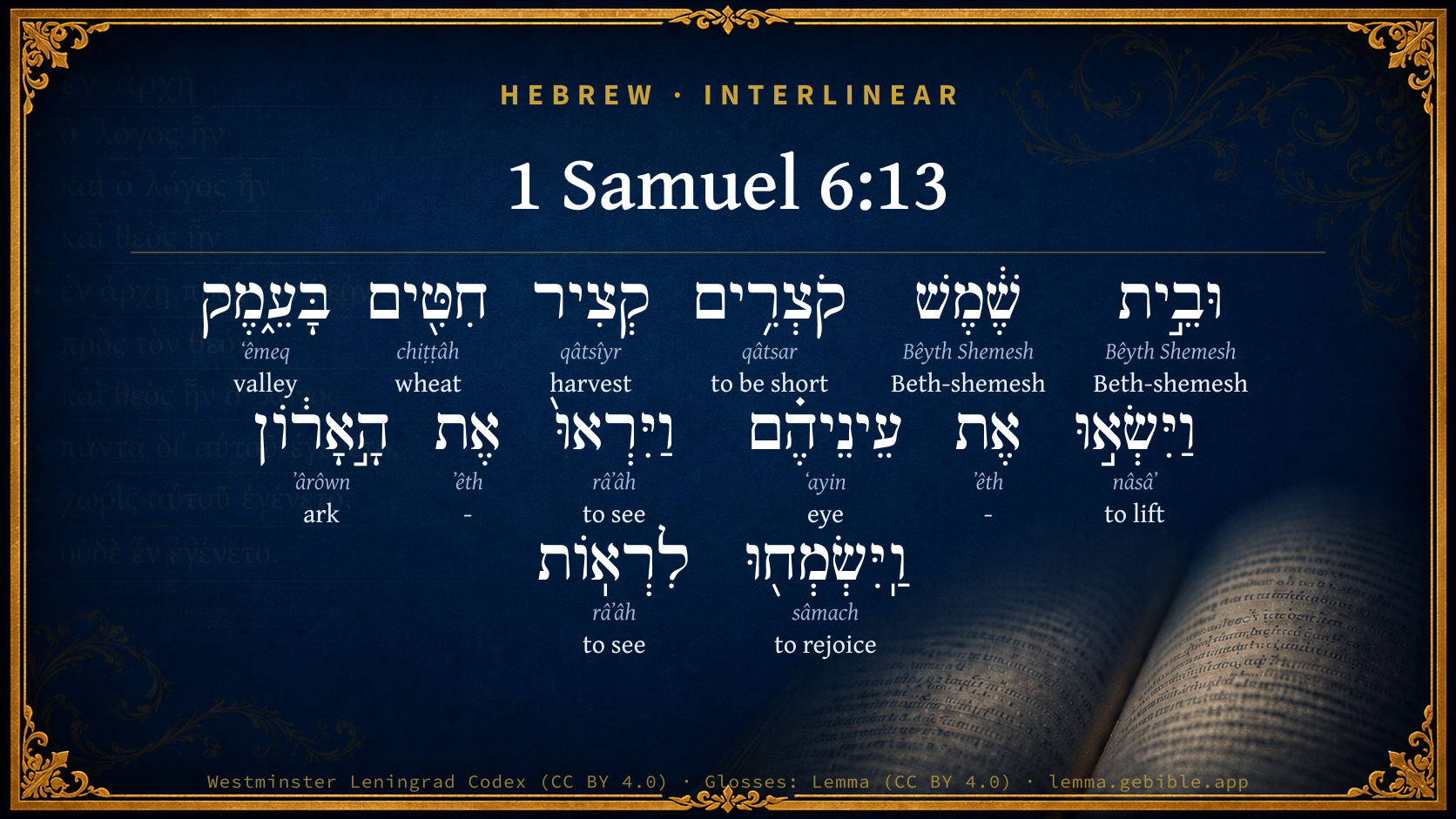
  1. וּבֵ֣ית Bêyth Shemesh H1053 “and · Beth-shemesh” Conjunction + Noun, Proper
  2. שֶׁ֔מֶשׁ Bêyth Shemesh H1053 “Beth-shemesh” Noun, Proper
  3. קֹצְרִ֥ים qâtsar H7114 “being short” Verb, Qal, Participle Active, Masculine, Plural, Absolute
  4. קְצִיר qâtsîyr H7105 “harvest of” Noun, Common, Masculine, Singular, Construct
  5. בָּעֵ֑מֶק ʻêmeq H6010 “in/at the · valley” Preposition, Determined + Noun, Common, Masculine, Singular, Absolute
  6. וַיִּשְׂא֣וּ nâsâʼ H5375 “and · to lift” Conjunction + Verb, Qal, Sequential Imperfect, 3rd Person, Masculine, Plural
  7. אֶת ʼêth H853 “-” Particle, Direct Object
  8. עֵינֵיהֶ֗ם ʻayin H5869 “eyes · their” Noun, Common, Both, Dual, Construct + Suffix, Personal, 3rd Person, Masculine, Plural
  9. וַיִּרְאוּ֙ râʼâh H7200 “and · to see” Conjunction + Verb, Qal, Sequential Imperfect, 3rd Person, Masculine, Plural
  10. אֶת ʼêth H853 “-” Particle, Direct Object
  11. הָ֣אָר֔וֹן ʼârôwn H727 “the · ark” Particle, Definite Article + Noun, Common, Both, Singular, Absolute
  12. וַֽיִּשְׂמְח֖וּ sâmach H8055 “and · to rejoice” Conjunction + Verb, Qal, Sequential Imperfect, 3rd Person, Masculine, Plural
  13. לִרְאֽוֹת râʼâh H7200 “to see” Preposition + Verb, Qal, Infinitive Construct

About this verse

These counts appear in no published source. They are computed here, from the morphology-tagged text and Lemma’s own curated glosses. What Lemma adds →

14
words
11
distinct lemmas
Historical
section

Shared distinctive vocabulary

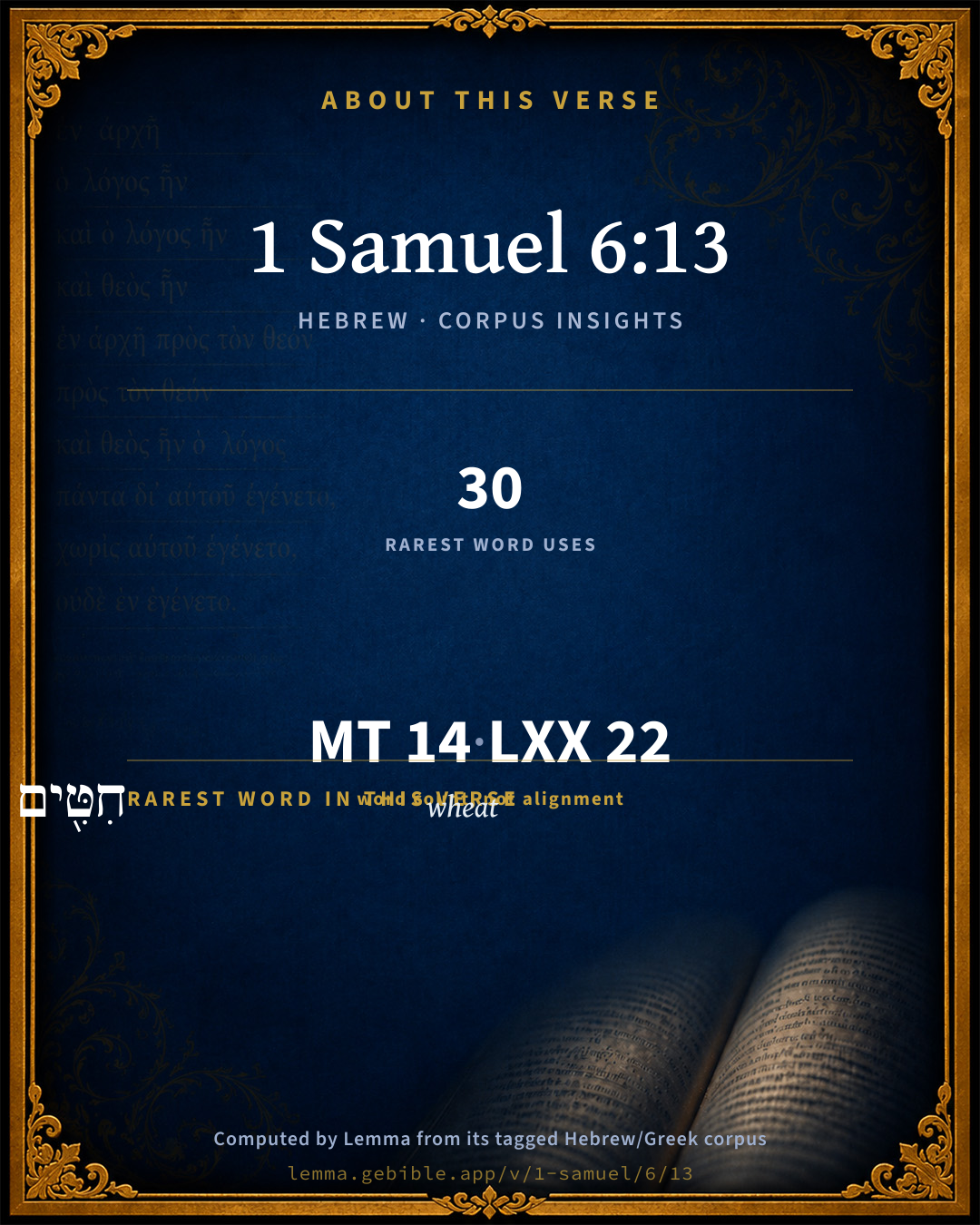
חִטִּ֖ים wheat H2406 occurs in 30 verses of the Hebrew Bible. Also found in:

Grammatical profile

  • 5 verbs
  • 7 nouns
  • 2 particles

Verb forms

  • קֹצְרִ֥ים Qal · Participle Active
  • וַיִּשְׂא֣וּ Qal · Sequential Imperfect
  • וַיִּרְאוּ֙ Qal · Sequential Imperfect
  • וַֽיִּשְׂמְח֖וּ Qal · Sequential Imperfect
  • לִרְאֽוֹת Qal · Infinitive Construct

Repetition

Words recur within this verse — often emphatic in Hebrew:

  • וּבֵ֣ית Beth-shemesh H1053 ×2
  • וַיִּרְאוּ֙ to see H7200 ×2

Hebrew & Septuagint length

In English translation the verse runs 26 words from the Hebrew and 31 from the Septuagint (LXX English) — closely comparable.

A rough comparison of the two English renderings, which tokenize alike — not a word-level alignment.

Word counts can differ between the Hebrew and the Greek without any difference in meaning — e.g. the Hebrew direct-object marker אֵת has no separate Greek word, and Greek often adds the article ὁ.

In the original languages it is 14 Hebrew tokens and 22 Greek tokens — but the two are counted differently (Hebrew bundles its prefixes and suffixes into one token; the Greek is in lemma form), so that isn’t a like-for-like length.

Hebrew and Greek witnesses Masoretic Hebrew ↔ Greek Septuagint

The same verse in the two great witnesses to the Old Testament, shown verse-for-verse.

These are two independent witnesses, not word-aligned to each other, and the Septuagint is shown in lemma (dictionary) form.

Hebrew 1 Samuel 6:13 Masoretic · Westminster Leningrad Codex

וּבֵ֣ית שֶׁ֔מֶשׁ קֹצְרִ֥ים קְצִיר חִטִּ֖ים בָּעֵ֑מֶק וַיִּשְׂא֣וּ אֶת עֵינֵיהֶ֗ם וַיִּרְאוּ֙ אֶת הָ֣אָר֔וֹן וַֽיִּשְׂמְח֖וּ לִרְאֽוֹת

They of Beth-shemesh were reaping their wheat harvest in the valley; and they lifted up their eyes, and saw the ark, and rejoiced to see it.

World English Bible · Public Domain

Greek LXX 1 Samuel 6:13 Septuagint · lemma form

καί ὁ ἐν βαιθσαμυς θερίζω θερισμός πῦρ ἐν κοιλάς καί αἴρω ὀφθαλμός αὐτός καί ὁράω κιβωτός κύριος καί εὐφραίνω εἰς ἀπάντησις αὐτός

And the men of Baethsamys were reaping the wheat harvest in the valley; and they lifted up their eyes, and saw the ark of the Lord, and rejoiced to meet it.

LXX2012 (modern English Septuagint) · Public Domain

Hebrew: Westminster Leningrad Codex (CC BY 4.0). Greek: Septuagint (public domain); English from LXX2012 (modern English Septuagint) (Public Domain). How the Septuagint differs from the Hebrew →

Targum (Aramaic paraphrase)

1

The Targum is the ancient Jewish Aramaic paraphrase of the Hebrew Scriptures — an interpretive translation, not the Hebrew text itself. Onkelos (literal) and Pseudo-Jonathan (expansive) render the Torah, and Jonathan the Prophets. Coverage is partial: where no permissively-licensed English translation exists for a verse, only the Aramaic is shown. This is verse-level text, not a word-by-word alignment to the Hebrew.

  1. Targum Jonathan Prophets (Joshua–Malachi)
    וּבֵית שֶׁמֶשׁ חַצְדִין חֲצַד חִטִין בְּמֵישְׁרָא וּזְקָפוּ יַת עֵינֵיהוֹן וַחֲזוֹ יַת אֲרוֹנָא וַחֲדִיאוּ לְמֶחְזֵי:

    (no public-domain English translation for this verse)

    Targum Jonathan — Aramaic: “Mikraot Gedolot” (public domain). English: “Sefaria Community Translation” (CC0 1.0 (public-domain dedication)); “London "Chaldee Paraphrase," 1871” (public domain). Text via Sefaria.

Commentary

Notes on 1 Samuel 6:13 from classic Christian and Jewish commentators (each source and its license shown beneath its notes). The classic Christian expositions comment on the surrounding passage and are grouped to its opening verse, so a note may address several verses; the Jewish commentaries on the Tanakh (Rashi and others) are per-verse, so they appear only where the commentator wrote on this verse.

Lemma curates 59 commentaries, every one of them public domain or Creative Commons licensed, each selected and text-cleaned for this edition rather than reprinted as found. About our sources →

Trapp's Complete Commentary

John Trapp

1Sa 6:13 And [they of] Bethshemesh [were] reaping their wheat harvest in the valley: and they lifted up their eyes, and saw the ark, and rejoiced to see [it].

Ver. 13. And they of Bethshemesh were reaping, &c.] And so it was in April or May that the ark was brought back, after seven months’ abode among the Philistines. So that it was taken in October, or, as some will have it, in September, which was a solemn month amongst the Hebrews, and, for most part, sacred. For then, besides the new moon feast, were kept the feast of trumpets, of tabernacles, of atonement, &c., {Lev 23:24-32} so that all was full of oblations and sacrifices: which because both priests and people polluted and profaned, therefore was the ark taken, and all lost that month.

Lifted up their eyes … and rejoiced to see it.] This was well done, and had they not fallen under that heavy hand of God for their later sin, they would have found in their hearts to show their joy by dedicating unto God, as those Milesians once did to Apollo, χρυσουν θερος, a harvest of gold, as the Philistines had done mice of gold.

John Trapp, A Commentary or Exposition upon All the Books of the Old and New Testament (1647–1656) — public domain. Text from a community e-Sword module.

The Biblical Illustrator

Joseph S. Exell

1Sa_6:13

And they of Beth-shemesh were reaping their wheat harvest in the valley.

The harvest field

The words of the text give a harvest scene.

I. Signs from God. Every harvest scene is a new Divine revelation. Thousands of years have rolled away since He promised that while the earth remaineth, seed time and harvest shall not fail. In the fulfilment of that promise, how much of God is seen!

1. There is His goodness. Provision is made for man and beast.

2. There is His power.

3. There is His faithfulness.

4. There is His eternity.

He who fulfils today in fields of ripened corn a promise made thousands of years ago, must be independent of the revolutions of times and circumstances. It is said that Dr. Johnson took off his hat whenever he passed a steeple. But he must have a dull soul who feels no reverence when walking through ripened cornfields. In the harvest fields we see--

II. Life from death. The grain which the sower dropped into the soil in spring underwent the process of dissolution and death. For weeks it lay buried in the dust. All this exuberance of the harvest field has come out of apparent death.

1. It symbolises spiritual labour. The true Christian teacher, philanthropist, reformer, minister, like the husbandman, has his seed buried for a time. However, though he dies, the seed lives, and will rise, grow, and ripen to perfection.

2. This exuberance in the harvest field illustrates human life on earth. The harvest field reminds us of the true education of man. Like the seed sown, it is the bringing out of what is in the soul--the moral ego. Some teachers speak of the mind as a vessel, some as a stone. And the idea is to fill up the vessel, to polish the stone. But it is neither stone nor vessel; it is a seed. You cannot fill it, you cannot polish it. You must bring it out. Man at birth is sown into the earth, like seed, in two respects. The seed existed before it was sown. Man existed before he was born into this world. The seed required sowing in order for its development. Man required birth into this world in order for the development of his powers. As a seed, man differs from other germinant existences in two respects:--

(1) He has a self-formative power.

(2) He has boundless possibilities. In the harvest field we see--

III. Like from like. Each seed has come forth in its own kind. Man reaps like what he sows.

1. It is thus in spiritual things.

2. It is thus in bodily development. In the harvest field we see--

IV. Much from little. Each seed is multiplied, some thirty, some sixty, some a hundred fold. So wondrously prolific is the seed that one single grain in the course of time will cover continents. One thought has formed a character and one character has changed the destiny of a nation. Much from little characterises all Gods operations. In the harvest field we see--

V. Blessings from labour. The crops would never have appeared had man not cultivated the soil and sowed the precious grain. Every harvest field is a testimony to the importance of human agency. In the harvest field we see--

VI. Maturity from progress. From the commencement of germination, the seed went on until it appeared in the multiplied grains of harvest. All things tend to ripeness:--

1. All things in nature.

2. All things in society.

3. All classes of character. (D. Thomas, D. D.)

The Biblical Illustrator, edited by Joseph S. Exell (c. 1880s–1900s) — public domain. Text from a community e-Sword module.

Tyndale Open Study Notes

Tyndale Open Resources

6:13 Harvesting wheat was usually done in May or June.

Tyndale Open Study Notes — © Tyndale Open Resources, licensed CC BY-SA 4.0. Text via the HelloAO Bible API.

Ellicott's Commentary for English Readers

(13) And they of Beth-shemesh.—Beth-shemesh, or “House of the Sun,” nearly equivalent to Heliopolis, “City of the Sun,” was a priestly city. It would thus have seemed that this was a fitting home for the Ark of the Covenant to rest in for a time. Shiloh, the old sanctuary, was, we know, now desolate and ruined; but the priests and Levites, from what follows, evidently had forfeited their old position as guides and teachers of the people. Beth-shemesh was no fit permanent dwelling for the Ark of God. The story of the priestly life in the once famous Shiloh during the latter years of Eli indicated how utterly incapable the Levitical families were to influence and guide the people. The subsequent conduct of priestly Beth-shemesh on this memorable occasion, therefore, is not to be wondered at; at first they seem to have rejoiced at the sight of their lost sacred treasure, but an act of careless irreverence called down a swift and unexpected punishment.

A Bible Commentary for English Readers, edited by Charles John Ellicott (1878–1897) — public domain. Text from a community e-Sword module.

The Cambridge Bible for Schools and Colleges

gen. ed. J. J. S. Perowne

13. they of Beth-shemesh were reaping their wheat harvest] A description of harvest in Philistia by a modem traveller helps us to realise the scene in the valley of Beth-shemesh, which was suddenly suspended by the appearance of the Ark. “When the fog dispersed the whole plain appeared to be dotted over with harvesting parties, men reaping, women and children gleaning and gathering the grain into bundles, or taking care of the flocks which followed closely upon the footsteps of the gleaners. All seemed to be in good humour, enjoying the cool air of the morning. There was singing alone and in chorus, incessant talking, home-made jokes, and laughter long and loud.” Thomson’s The Land and the Book, p. 543.

This notice fixes the time of year as the end of May or beginning of June. Robinson saw wheat harvest in progress at Gaza on the 19th of May, and just commencing at Hebron on the 4th of June. Bibl. Res. I. 431.

in the valley] Heb. “êmek,” denoting “the long broad sweeps sometimes found between parallel ranges of hills.” Sin. and Pal. p. 481.

The Cambridge Bible for Schools and Colleges (gen. ed. J. J. S. Perowne; Cambridge University Press, 1878–1918) — public domain. Text from a community e-Sword module.

John Gill's Exposition

And they of Bethshemesh were reaping their wheat harvest in the valley,.... Which began at Pentecost, in the month Sivan, about our May; so that there were many people in the fields, who were eyewitnesses of this wonderful event:

and they lifted up their eyes, and saw the ark, and rejoiced to see it; for though the ark while in the tabernacle was only seen by the high priest, when he went into the holy of holies; yet this having been brought out from thence, and exposed in the camp of Israel, some of this place very probably were there at that time, and had seen it, and knew it again by its form and splendour; and which gave them great pleasure to behold, which had been taken, and had been so long in the hand of the enemy, and the people of Israel deprived of it; which was the symbol of the divine Presence among them, and now restored to them again; and in this wonderful way, without seeking for it, without going to war on account of it, without paying a ransom for it; and was brought to them in a cart drawn by cattle without a driver, the lords of the Philistines with a large retinue following it. This is to be understood not of their looking "into" it, as they afterwards did, and were punished, as Kimchi; but of their looking "on" it.

John Gill's Exposition of the Whole Bible (1746–1763) — public domain (CC PDM 1.0). Text via the HelloAO Bible API.

Albert Barnes' Notes on the Bible

The whole population was in the field. The harvest work was suspended in an instant, and all the workmen ran to where the ark was.

Albert Barnes' Notes on the Bible (1834–1885) — public domain. Text from a community e-Sword/MySword module.

Haydock's Catholic Bible Commentary

Wheat, about Pentecost, in May; so that the ark must have been taken in November. (Menochius)

George Leo Haydock (1774–1849), Haydock's Catholic Family Bible and Commentary, 1859 edition — public domain. Excludes Psalms (Douay-Rheims chapter numbering differs from Protestant) and Deuterocanonical books (Catholic canon only).

The Pulpit Commentary

THE ARK AT BETH-SHEMESH (vers. 13-20).

And they of Beth-shemesh. More exactly, "And Beth-shemesh was reaping its wheat harvest," the whole population being in the fields. Though a priestly city, we find in ver. 15 the Levites distinguished from the ordinary inhabitants, as though they and the priests formed only the ruling class. In the valley. Now called the Wady Surar, branching off into another valley on the south. Robinson ("Later Bibl. Res.," 153) speaks of the site of Beth-shemesh as a very noble one, being "a low plateau at the junction of two fine plains." The wheat harvest takes place in Palestine in May, and consequently the disastrous battle of Eben-ezer must have been fought in the previous October.

Ver. 13. (BETH-SHEMESH.)

The ark in harvest.

It was in the time of harvest that the ark was restored to Israel. Whilst the cornfields of the Philistines were wasted by an extraordinary plague, the valley of Beth-shemesh was covered with golden grain, and the men of that city were busily occupied in gathering it in. (Rth_1:6) But at the sight of the sacred symbol they left their secular occupation, gathered around it with great joy, and spent the day in "offering burnt offerings and sacrificing sacrifices to the Lord" (ver. 15). We may regard the harvest as representing material blessings, which are more richly bestowed at this season of the year than any other; the ark as representing spiritual blessings: "the law which came by Moses," and "the grace and truth which came by Jesus Christ;" the throne of grace, and the mercy and grace which are there obtained. And the fact just mentioned suggests a comparison between the former and the latter. Both come from the.same hand; but spiritual are superior to material blessings, inasmuch as they

I REVEAL MORE OF THE DIVINE GOODNESS. Consider them

1. In the principle from which they proceed. The one class of benefits from benevolence in general; the other from benevolence in the form of mercy. "According to his mercy he saved us". (Tit_3:5)

2. In the mode by which they are communicated. The operation of the laws of nature (Gen_8:22; Jer_5:21) the gift and sacrifice of his only begotten Son. "Through Jesus Christ.

3. In the nearness with which the great Benefactor comes to us. "Thou visitest the earth"; (Psa_65:9) but "blessed is the man whom thou choosest and causest to approach unto thee", (Psa_65:4) in that closer fellowship which those who are reconciled in Christ enjoy, and whose hearts are the temple of thine abode, the habitation of thy Spirit. "Revelation is the voluntary approximation of the infinite Being to the ways and thoughts of finite humanity; and until this step has been taken by Almighty grace, how should man have a warrant for loving him with all his mind, and heart, and strength?" (A.H. Hallam).

II INVOLVE MORE VALUABLE GOOD.

1. The one pertains to the body, the other to the soul.

2. The one to man considered simply as a creature, needing support; the other as a sinner, needing forgiveness, renewal, salvation.

3. The one pertains to time, the other to eternity; "bread that perisheth," "bread that endureth to everlasting life"; (Joh_6:27, Joh_6:51) "that good part which cannot be taken away". (Luk_10:42)

III PRODUCE MORE EXALTED JOY. "Rejoiced." "The joy in harvest". (Isa_9:3)

1. In its relation to God. The one is felt less and the other more directly in him. The difference is very much the same as that which exists between the joy felt at receiving a present from a friend at a distance, and that of seeing his face and holding personal intercourse with him. And what are all the harvests which the earth ever produced compared with one smile of the Father"s countenance, one whisper of Divine love?. (Psa_4:6, Psa_4:7)

2. In its influence on the heart; elevating, purifying, enlarging, strengthening, satisfying it.

3. In its power over circumstances. The joy of our harvest may be speedily turned into sorrow by bereavement (ver. 19) and other afflictions; but the joy which is felt in God is independent of outward circumstances, lifts the soul above them, (Hab_3:17, Hab_3:18) lives in death, and is perfected in heavenly bliss.

IV INCITE TO MORE COMPLETE CONSECRATION.

1. With respect to the Giver. His bestowment of "fruitful seasons, filling our heart with food and gladness," incites to some return to him; (Exo_23:14-17) but his bestowment of mercy and grace, to the "whole burnt offering" of the man himself. (Rom_12:1)

1. With respect to our fellow men. The one incites to the giving of "those things which are necessary for the body"; (Exo_23:11) the other incites (and effectually constrains) to the giving of what is good for the whole man, body and soul; to self-sacrifice, and the "peace offerings" of brotherly kindness, and of charity toward all men.

2. The whole course of life; not in one or two acts merely, but in a continued service of love to be completed in eternity.

Conclusion.

1. If God has bestowed upon you temporal good, rejoice not in it so much as in spiritual.

2. If he has withheld it, rejoice in the higher good which is yours.

3. "Seek first the kingdom of God," etc.. D. (Mat_6:33)

The Pulpit Commentary (1880–1919), ed. H.D.M. Spence-Jones & Joseph S. Exell — public domain. Text from a community e-Sword module.

Keil & Delitzsch

C. F. Keil & F. Delitzsch

The inhabitants of Bethshemesh were busy with the wheat-harvest in the valley (in front of the town), when they unexpectedly saw the ark of the covenant coming, and rejoiced to see it. The cart had arrived at the field of Joshua, a Bethshemeshite, and there it stood still before a large stone. And they (the inhabitants of Bethshemesh) chopped up the wood of the cart, and offered the cows to the Lord as a burnt-offering. In the meantime the Levites had taken off the ark, with the chest of golden presents, and placed it upon the large stone; and the people of Bethshemesh offered burnt-offerings and slain-offerings that day to the Lord. The princes of the Philistines stood looking at this, and then returned the same day to Ekron. That the Bethshemeshites, and not the Philistines, are the subject to ויבקּעוּ, is evident from the correct interpretation of the clauses; viz., from the fact that in Sa1 6:14 the words from והעגלה to גּדולה אבן are circumstantial clauses introduced into the main clause, and that ויבקּעוּ is attached to לראות ויּשׂמחוּ, and carries on the principal clause.

Keil & Delitzsch — Biblical Commentary on the Old Testament (1861–1891) — public domain (CC PDM 1.0). Text via the HelloAO Bible API. (Old Testament only.)

Kretzmann's Popular Commentary

Paul E. Kretzmann

The Ark Accepted, but the People Slain

v. 13. And they of Beth-shemesh, which was a city set aside for priests on the boundary between Judah and Dan, Jos 15:10; Jos 21:16, were reaping their wheat-harvest in the valley, about the beginning of June; and they lifted up their eyes, and saw the ark, and rejoiced to see it, very much pleased to know that it had been returned to Israel.

v. 14. And the cart came into the field of Joshua, a Beth-shemite, and stood there, where there was a great stone, the cows came to a halt there of their own free will; and they, the inhabitants of the city, clave the wood of the cart and offered the kine a burnt offering unto the Lord.

v. 15. And the Levites, who also were living in the city, took down the ark of the Lord, had taken it down as soon as they received news of the joyful happening, and the coffer that was with it, wherein the jewels of gold were, and put them on the great stone; and the men of Beth-shemesh, in a second sacrificial act, offered burnt offerings, thus consecrating themselves anew to the service of the Lord, and sacrificed sacrifices the same day unto the Lord, the sacrificial meals being intended to renew their fellowship with Jehovah, who had proved Himself such a mighty God, the only true Lord.

v. 16. And when the five lords of the Philistines had seen it, being witnesses of this Revelation of the God of Israel, they returned to Ekron the same day, having followed the instructions of their priests.

v. 17. And these are the golden emerods which the Philistines returned for a trespass-offering unto the Lord, as expiatory gifts: for Ashdod one, for Gaza one, for Askelon one, for Gath one, for Ekron one, these being the five city-states of the Philistines;

v. 18. and the golden mice, according to the number of all the cities of the Philistines belonging to the five lords, both of fenced cities and of country villages, every city and town in the five states thus being represented by a figure, evidently because the plague of the mice had extended over the entire country, even unto the great stone of Abel, that mighty attar like ledge in the field of Joshua, whereon they set the ark of the Lord; which stone remaineth unto this day in the field of Joshua, the Beth-shemite, a mute witness and monument of the event as here recorded.

v. 19. And he, God, smote the men of Beth-shemesh, because they, overcome by a blasphemous curiosity, had looked into the ark of the Lord, in a manner which did not agree with the holiness of Jehovah, to whom the ark was dedicated, even He smote of the people fifty thousand and threescore and ten men. And the people lamented because the Lord had smitten many of the people with a great slaughter Apparently the presence of the ark attracted a great many sightseers from the entire surrounding country, who came with anything but a reverent mind and were therefore punished by Jehovah.

v. 20. And the men of Beth-shemesh said, Who is able to stand before this holy Lord God? And to whom shall He go up from us? They were afraid to keep the ark in their own midst after the great tragedy had occurred.

v. 21. And they sent messengers to the inhabitants of Kirjath-jearim, a city of Judah somewhat farther to the east, saying, The Philistines have brought again the ark of the Lord; come ye down and fetch it up to you. The Beth-shemites felt that they were no better than the men who had been killed, and they dreaded a recurrence of the tragedy. All those who dare to draw near to the means of grace, the Word and the Sacrament, with fleshly minds, with sacrilegious hearts, will receive no blessing, but only God’s judgment and condemnation.

Paul E. Kretzmann, Popular Commentary of the Bible (1921–1924) — public domain. Text from a community e-Sword module.

unfoldingWord translationNotes

Door43 World Missions Community

Now

The writer is introducing a new part of the story. If your language has a way of marking the beginning of a new part of the story, you could use it here.

people of Beth Shemesh

These were Israelites.

lifted up their eyes

This is an idiom. AT: "looked up" (See: Idiom)

translationWords

harvest

wheat

joy

unfoldingWord translationNotes — © Distant Shores Media and the Door43 World Missions Community, licensed CC BY-SA 4.0. Source: git.door43.org/Door43/en_tn.

Rashi

Rabbi Shlomo Yitzchaki (Rashi)

And they rejoiced to see. They were going to see how it came alone, and out of their joy, they behaved with levity, for they did not gaze at it with awe and respect.

Rashi on the Tanakh — English translations: “The Judaica Press complete Tanach with Rashi, translated by A. J. Rosenberg” (CC BY 4.0); “Pentateuch with Rashi's commentary by M. Rosenbaum and A.M. Silbermann, 1929-1934” (public domain); “The Metsudah Tanach series, Lakewood, N.J” (CC BY 4.0); and “The Book of Joshua, Metsudah Publications, 1997” (CC BY 4.0). Text via Sefaria.

Lesson kit

Teaching starters — assembled from the data on this page, not authored interpretation. Every prompt links to the verse data it draws on. Edit before teaching.

1 Samuel, in the Historical, opens this verse with 14 words (11 distinct Hebrew lemmas). Its most distinctive word is chiṭṭâh (“wheat”). A historical commentator’s framing appears above. Read the whole chapter for the surrounding context.

Discussion questions

  1. What does “wheat” (chiṭṭâh) contribute to the verse as a whole?
  2. Genesis 30:14 shares the word «wheat» with this verse. How do the two illuminate each other?
  3. “Beth-shemesh” occurs 2× in this one verse. What is the effect of the repetition?
  4. These translations render this verse differently. What is at stake in choosing one wording over another?
  5. The verb «קֹצְרִ֥ים» is Qal Participle Active. How does its form color the action?
  6. Reading how Trapp's Complete Commentary and The Biblical Illustrator read this verse, where do the two commentators agree and where do they part?

Things to notice

Reading settings

Reading text

Shown beneath each verse's original-language words.

Old Testament
Old Testament edition

Read the OT as the Masoretic Hebrew (MT) or the Greek Septuagint (LXX).

English shown for the Greek Septuagint (in the Hebrew ↔ Greek comparison).

Comparing translations? Open the Compare panel on any verse page to stack up to four side by side.