
2 Chronicles 6:41

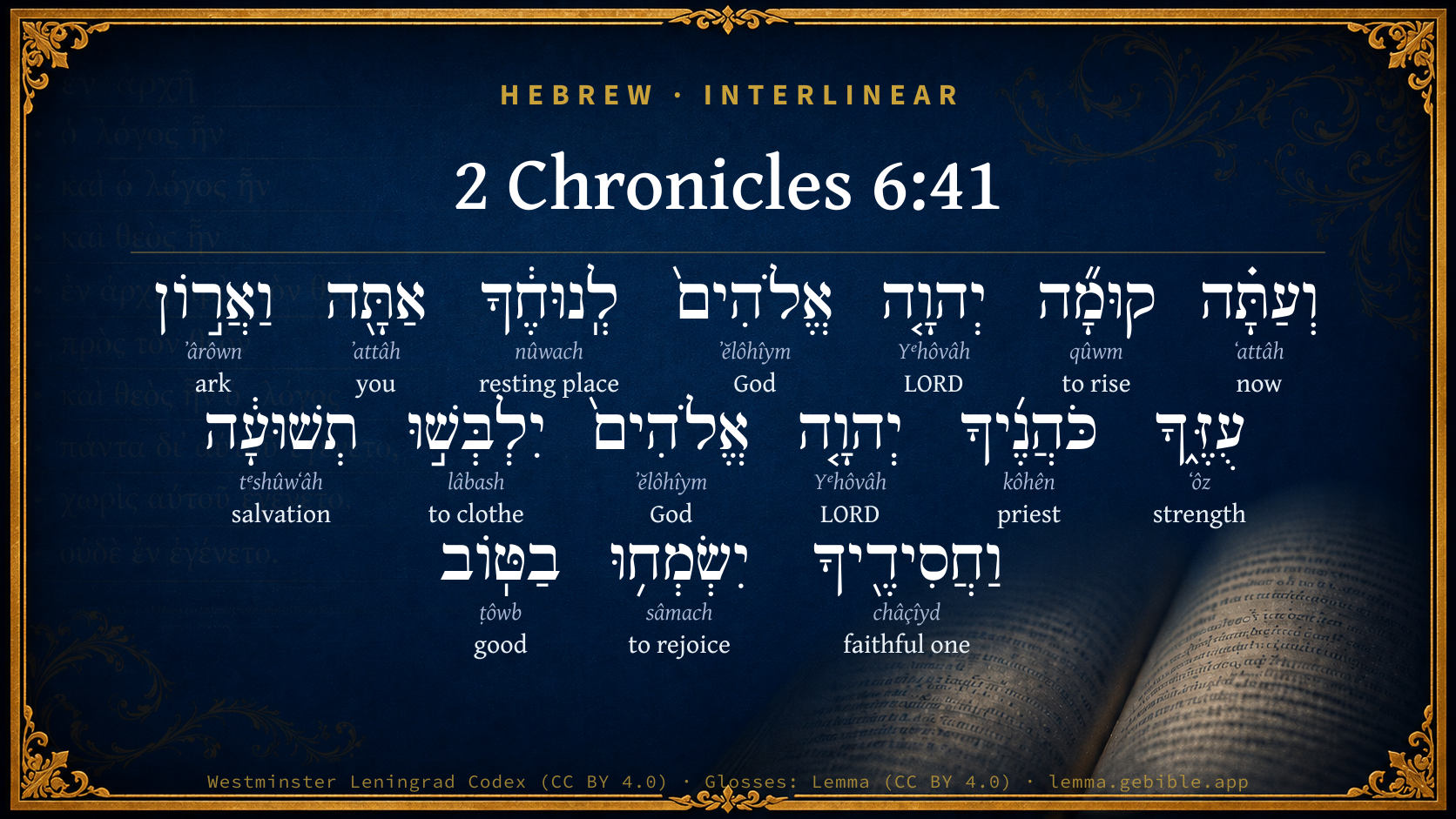
Hebrew (Westminster Leningrad Codex) 2 Chronicles 6:41 appears in the Hebrew Old Testament. The text above is from the Westminster Leningrad Codex. Each word links to its Strong’s number, a concise gloss, and parsing drawn from the Open Scriptures Hebrew Bible morphology. Click any word for its full Brown-Driver-Briggs (BDB) entry.
Download image
Cite this verse

2 Chronicles 6:41 (World English Bible). Public Domain. Lemma interlinear Bible study tool, https://lemma.gebible.app/v/2-chronicles/6/41.

Show BibTeX & RIS
BibTeX
RIS
English Translation
Now therefore arise, Yahweh God, into your resting-place, you, and the ark of your strength: let your priests, Yahweh God, be clothed with salvation, and let your saints rejoice in goodness.
World English Bible · Public Domain
Highlights
  • 1 first appearance in the Hebrew Bible
Full analysis ↓
Download a study sheet

One document with this verse’s original text, its word-by-word gloss line, the meaning frame, cross-references with their text, attributed commentary, and full source and license credits — printable, and it pastes into notes with its structure intact.

This verse Autodidact and up

Study sheet (.html) Plain text (.txt)

A passage Seminary Student

Up to 50 verses in one chapter. A passage sheet keeps up to 6 commentary sources and 12 cross-references per verse, in the order this page ranks them, and says so on the sheet whenever that leaves anything out. Ask for a single verse and you get the Autodidact verse sheet above.

Everything on this page stays free to read, with no account — the sheet is a download of what is already on screen, not access to it.

Want to remove ads? Support Godless Engineer
Compare translations 3

The same verse in 3 English versions, stacked beneath the original-language interlinear above. Click any original word for its lexicon entry.

Each is an independent rendering of the whole verse — the interlinear is not word-aligned to these translations.

Highlighted words mark where these versions differ — a whole-verse word diff, not a word-by-word alignment.

  • World English Bible Public Domain
    Now therefore arise, Yahweh God, into your resting-place, you, and the ark of your strength: let your priests, Yahweh God, be clothed with salvation, and let your saints rejoice in goodness.
  • King James Version Public Domain
    Now therefore arise, O LORD God, into thy resting place, thou, and the ark of thy strength: let thy priests, O LORD God, be clothed with salvation, and let thy saints rejoice in goodness.
  • unfoldingWord Literal Text CC BY-SA 4.0
    And now arise, Yahweh God, to your resting place, you and the Box of your strength. Your priests, Yahweh God, may they be clothed in salvation, and your faithful ones rejoice in goodness.

unfoldingWord Literal Text — © unfoldingWord, licensed CC BY-SA 4.0. Word-aligned USFM3 via Door43 (git.door43.org/unfoldingWord/en_ult).

Versions to compare (up to 4)

3 of 4 selected

Show all 18 translations

Every available English version of this verse, each an independent rendering of the whole verse.

  • World English Bible Public Domain
    Now therefore arise, Yahweh God, into your resting-place, you, and the ark of your strength: let your priests, Yahweh God, be clothed with salvation, and let your saints rejoice in goodness.
  • Berean Standard Bible Public Domain
    Now therefore, arise, O LORD God, and enter Your resting place, You and the ark of Your might. May Your priests, O LORD God, be clothed with salvation, and may Your godly ones rejoice in goodness.
  • Majority Standard Bible Public Domain
    Now therefore, arise, O LORD God, and enter Your resting place, You and the ark of Your might. May Your priests, O LORD God, be clothed with salvation, and may Your godly ones rejoice in goodness.
  • King James Version Public Domain
    Now therefore arise, O LORD God, into thy resting place, thou, and the ark of thy strength: let thy priests, O LORD God, be clothed with salvation, and let thy saints rejoice in goodness.
  • American Standard Version (1901) Public Domain
    Now therefore arise, O Jehovah God, into thy resting-place, thou, and the ark of thy strength: let thy priests, O Jehovah God, be clothed with salvation, and let thy saints rejoice in goodness.
  • Revised Version (1885) Public Domain
    Now therefore arise, O LORD God, into thy resting place, thou, and the ark of thy strength: let thy priests, O LORD God, be clothed with salvation, and let thy saints rejoice in goodness.
  • Geneva Bible (1599) Public Domain
    Nowe therefore arise, O Lord God, to come into thy rest, thou, and the Arke of thy strength: O Lord God, let thy Priestes be clothed with saluation, and let thy Saints reioyce in goodnesse.
  • Douay-Rheims (1899) Public Domain
    Now therefore arise, O Lord God, into thy resting place, thou and the ark of thy strength: let thy priests, O Lord God, put on salvation, and thy saints rejoice in good things.
  • Young's Literal Translation Public Domain
    and now, rise, O Jehovah God, to Thy rest, Thou, and the ark of Thy strength; Thy priests, O Jehovah God, are clothed with salvation, and Thy saints rejoice in the goodness,
  • Literal Standard Version CC BY-SA 4.0
    And now, rise, O YHWH God, to Your rest, You and the Ark of Your strength; Your priests, O YHWH God, are clothed with salvation, and Your saints rejoice in the goodness.
  • Unlocked Literal Bible CC BY-SA 4.0
    Now then arise, Yahweh God, to your resting place, you and the ark of your strength. Let your priests, Yahweh God, be clothed with salvation, and let your saints rejoice in your goodness.
  • unfoldingWord Literal Text CC BY-SA 4.0
    And now arise, Yahweh God, to your resting place, you and the Box of your strength. Your priests, Yahweh God, may they be clothed in salvation, and your faithful ones rejoice in goodness.
  • Darby Bible Public Domain
    And now, arise, Jehovah Elohim, into thy resting-place, thou and the ark of thy strength: let thy priests, Jehovah Elohim, be clothed with salvation, and let thy saints rejoice in [thy] goodness.
  • World Messianic Bible Public Domain
    “Now therefore arise, LORD God, into your resting place, you, and the ark of your strength. Let your priests, LORD God, be clothed with salvation [yeshu`ah], and let your holy ones rejoice in goodness.
  • Webster's Bible Public Domain
    Now therefore arise, O LORD God, into thy resting-place, thou, and the ark of thy strength: let thy priests, O LORD God, be clothed with salvation, and let thy saints rejoice in goodness.
  • Free Bible Version CC BY-SA 4.0
    ‘Come, Lord, and enter your home, together with your Ark of power. May your priests wear salvation like clothing; may your faithful people shout for joy in your goodness.
  • Bible in Basic English Public Domain
    Up! now, O Lord God, come back to your resting-place, you and the ark of your strength: let your priests, O Lord God, be clothed with salvation, and let your saints be glad in what is good.
  • JPS Tanakh (1917) Public Domain
    Now therefore arise, O LORD God, into Thy resting-place, Thou, and the ark of Thy strength; let Thy priests, O LORD God, be clothed with salvation, and let Thy saints rejoice in good.

Literal Standard Version (2020), Covenant Press — licensed CC BY-SA 4.0. Text via the HelloAO Bible API (eBible.org). Unlocked Literal Bible (unfoldingWord) — licensed CC BY-SA 4.0. Text via the HelloAO Bible API (eBible.org). unfoldingWord Literal Text — © unfoldingWord, licensed CC BY-SA 4.0. Word-aligned USFM3 via Door43 (git.door43.org/unfoldingWord/en_ult). Free Bible Version, Dr. Jonathan Gallagher — licensed CC BY-SA 4.0. Text via the HelloAO Bible API (eBible.org).

Word by word

More ways to search: Search by grammar → Find every occurrence → Compare this word →

Practice this passage: Drill this verse → Learn its vocabulary →

לְֽנוּחֶ֔ךָ
nûwach
H5118
“to/for · resting place · your”
Preposition + Noun, Common, Masculine, Singular, Construct + Suffix, Personal, 2nd Person, Masculine, Singular
Part of Speech
Preposition + Noun
Type
Common
Gender
Masculine
Number
Singular
State
Construct
Full BDB Definition

Origin: from H5117

TWOT: 1323 ?

resting place
  1. וְעַתָּ֗ה ʻattâh H6258 “and · now” Conjunction + Adverb
  2. קוּמָ֞ה qûwm H6965 “rise” Verb, Qal, Imperative, 2nd Person, Masculine, Singular + Suffix, h
  3. יְהוָ֤ה Yᵉhôvâh H3068 “LORD” Noun, Proper
  4. אֱלֹהִים֙ ʼĕlôhîym H430 “God(s)” Noun, Common, Masculine, Plural, Absolute
  5. אַתָּ֖ה ʼattâh H859 “you” Pronoun, Personal, 2nd Person, Masculine, Singular
  6. וַאֲר֣וֹן ʼârôwn H727 “and · ark of” Conjunction + Noun, Common, Both, Singular, Construct
  7. עֻזֶּ֑ךָ ʻôz H5797 “strength · your” Noun, Common, Masculine, Singular, Construct + Suffix, Personal, 2nd Person, Masculine, Singular
  8. כֹּהֲנֶ֜יךָ kôhên H3548 “priests · your” Noun, Common, Masculine, Plural, Construct + Suffix, Personal, 2nd Person, Masculine, Singular
  9. יְהוָ֤ה Yᵉhôvâh H3068 “LORD” Noun, Proper
  10. אֱלֹהִים֙ ʼĕlôhîym H430 “God(s)” Noun, Common, Masculine, Plural, Absolute
  11. יִלְבְּשׁ֣וּ lâbash H3847 “to clothe” Verb, Qal, Imperfect, 3rd Person, Masculine, Plural
  12. תְשׁוּעָ֔ה tᵉshûwʻâh H8668 “salvation” Noun, Common, Feminine, Singular, Absolute
  13. וַחֲסִידֶ֖יךָ châçîyd H2623 “and · faithful one · your” Conjunction + Adjective, Adjective, Masculine, Plural, Construct + Suffix, Personal, 2nd Person, Masculine, Singular
  14. יִשְׂמְח֥וּ sâmach H8055 “to rejoice” Verb, Qal, Imperfect, 3rd Person, Masculine, Plural
  15. בַטּֽוֹב ṭôwb H2896 “in/at the · good” Preposition, Determined + Adjective, Adjective, Masculine, Singular, Absolute

About this verse

These counts appear in no published source. They are computed here, from the morphology-tagged text and Lemma’s own curated glosses. What Lemma adds →

16
words
14
distinct lemmas
Historical
section

Notable vocabulary

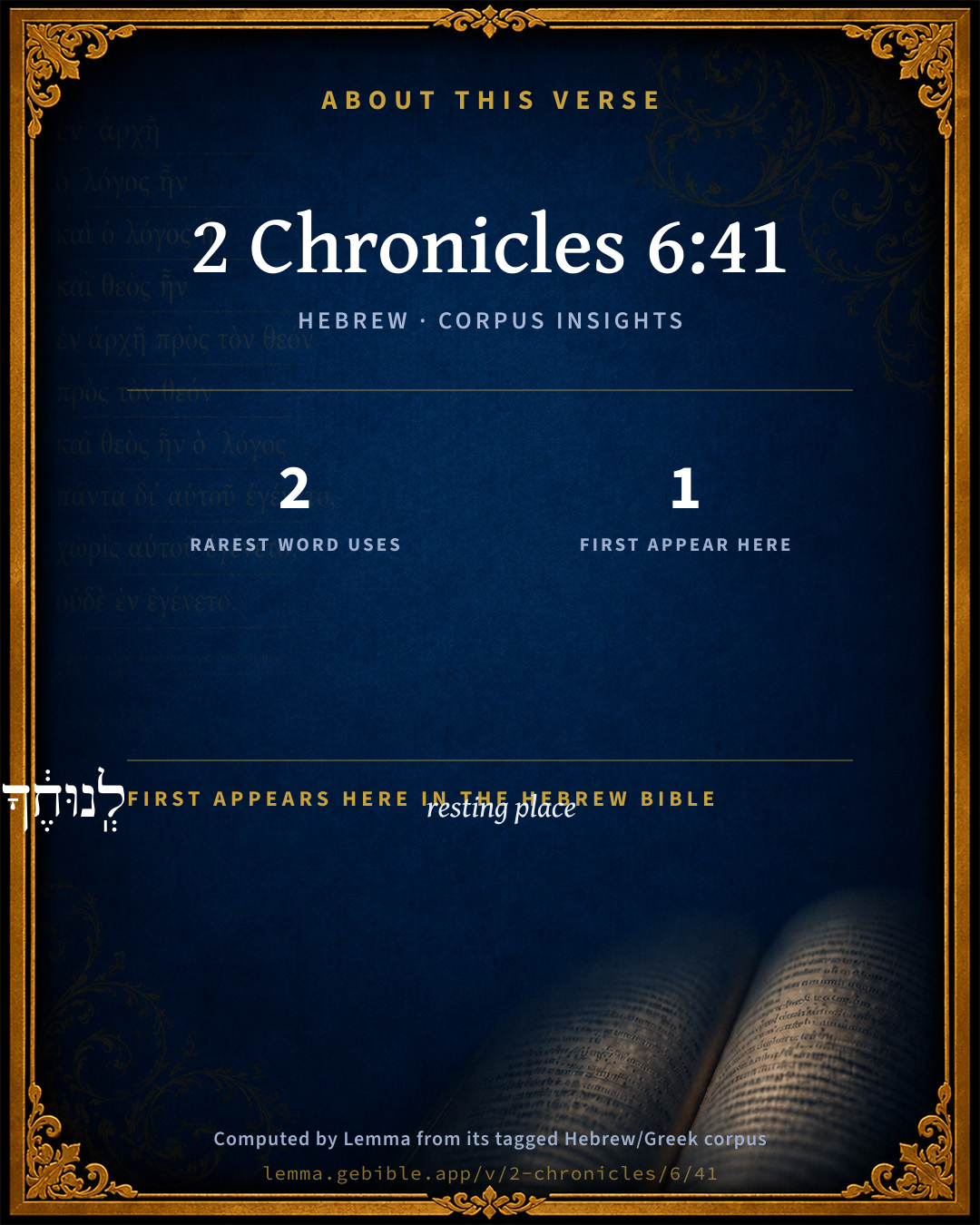
The rarest word here is לְֽנוּחֶ֔ךָ resting place H5118 — appearing just 2 times in the whole Hebrew Bible.

First appearance in Scripture

This word makes its first canonical appearance in the Hebrew Bible here:

  • לְֽנוּחֶ֔ךָ resting place H5118

Shared distinctive vocabulary

לְֽנוּחֶ֔ךָ resting place H5118 occurs in 2 verses of the Hebrew Bible. Also found in:

Grammatical profile

  • 3 verbs
  • 9 nouns
  • 2 adjectives
  • 1 pronoun
  • 1 adverb

Verb forms

  • קוּמָ֞ה Qal · Imperative
  • יִלְבְּשׁ֣וּ Qal · Imperfect
  • יִשְׂמְח֥וּ Qal · Imperfect

Repetition

Words recur within this verse — often emphatic in Hebrew:

  • יְהוָ֤ה LORD H3068 ×2
  • אֱלֹהִים֙ God H430 ×2

Hebrew & Septuagint length

In English translation the verse runs 31 words from the Hebrew and 32 from the Septuagint (LXX English) — closely comparable.

A rough comparison of the two English renderings, which tokenize alike — not a word-level alignment.

Word counts can differ between the Hebrew and the Greek without any difference in meaning — e.g. the Hebrew direct-object marker אֵת has no separate Greek word, and Greek often adds the article ὁ.

Cross-references

24

Topical passages linked to 2 Chronicles 6:41 in the Treasury of Scripture Knowledge — connected by theme and wording, ordered by reader-vote popularity; previews shown in the World English Bible.

  • 1 Chronicles 28:2 Then David the king stood up on his feet, and said, Hear me, my brothers, and my people: as for me, it was in my heart to build a house of rest for the ark of the covenant of Yahweh, and for the footstool of our God; and I had made ready for the building.
  • Isaiah 61:10 I will greatly rejoice in Yahweh, my soul shall be joyful in my God; for he has clothed me with the garments of salvation, he has covered me with the robe of righteousness, as a bridegroom decks himself with a garland, and as a bride adorns herself with her jewels.
  • Nehemiah 9:25 They took fortified cities, and a fat land, and possessed houses full of all good things, cisterns hewn out, vineyards, and olive groves, and fruit trees in abundance: so they ate, and were filled, and became fat, and delighted themselves in your great goodness.
  • Psalms 110:2 Yahweh will send forth the rod of your strength out of Zion. Rule in the midst of your enemies.
  • Psalms 132:8–10 Arise, Yahweh, into your resting place; You, and the ark of your strength.
  • Psalms 132:16 Her priests I will also clothe with salvation. Her saints will shout aloud for joy.
  • Isaiah 61:3 to appoint to those who mourn in Zion, to give to them a garland for ashes, the oil of joy for mourning, the garment of praise for the spirit of heaviness; that they may be called trees of righteousness, the planting of Yahweh, that he may be glorified.
  • Isaiah 61:6 But you shall be named the priests of Yahweh; men shall call you the ministers of our God: you shall eat the wealth of the nations, and in their glory shall you boast yourselves.
  • Isaiah 66:1 Thus says Yahweh, heaven is my throne, and the earth is my footstool: what manner of house will you build to me? and what place shall be my rest?
  • Zechariah 9:17 For how great is his goodness, And how great is his beauty! Grain will make the young men flourish, And new wine the virgins.
  • Romans 1:16 For I am not ashamed of the Gospel of Christ, for it is the power of God for salvation for everyone who believes; for the Jew first, and also for the Greek.
  • Romans 13:14 But put on the Lord Jesus Christ, and make no provision for the flesh, for its lusts.
  • Galatians 3:27 For as many of you as were baptized into Christ have put on Christ.
  • Ephesians 4:22–24 that you put away, as concerning your former way of life, the old man, that grows corrupt after the lusts of deceit;
  • Philippians 3:3 For we are the circumcision, who worship God in the Spirit, and rejoice in Christ Jesus, and have no confidence in the flesh;
  • Philippians 4:4 Rejoice in the Lord always! Again I will say, Rejoice!
  • Revelation 19:8 It was given to her that she would array herself in bright, pure, fine linen: for the fine linen is the righteous acts of the saints.
  • Joshua 3:13 It shall come to pass, when the soles of the feet of the priests who bear the ark of Yahweh, the Lord of all the earth, shall rest in the waters of the Jordan, that the waters of the Jordan shall be cut off, even the waters that come down from above; and they shall stand in one heap.
  • Joshua 6:4–5 Seven priests shall bear seven trumpets of rams' horns before the ark: and the seventh day you shall compass the city seven times, and the priests shall blow the trumpets.
  • Psalms 65:4 Blessed is one whom you choose, and cause to come near, That he may live in your courts. We will be filled with the goodness of your house, Your holy temple.
  • Psalms 65:11 You crown the year with your bounty. Your carts overflow with abundance.
  • Isaiah 59:16–18 He saw that there was no man, and wondered that there was no intercessor: therefore his own arm brought salvation to him; and his righteousness, it upheld him.
  • Revelation 19:14 The armies which are in heaven followed him on white horses, clothed in white, pure, fine linen.
  • Isaiah 65:18–19 But be you glad and rejoice forever in that which I create; for, behold, I create Jerusalem a rejoicing, and her people a joy.

Cross-references courtesy of OpenBible.info (CC BY 4.0).

Hebrew and Greek witnesses Masoretic Hebrew ↔ Greek Septuagint

The same verse in the two great witnesses to the Old Testament, shown verse-for-verse.

These are two independent witnesses, not word-aligned to each other, and the Septuagint is shown in lemma (dictionary) form.

Hebrew 2 Chronicles 6:41 Masoretic · Westminster Leningrad Codex

וְעַתָּ֗ה קוּמָ֞ה יְהוָ֤ה אֱלֹהִים֙ לְֽנוּחֶ֔ךָ אַתָּ֖ה וַאֲר֣וֹן עֻזֶּ֑ךָ כֹּהֲנֶ֜יךָ יְהוָ֤ה אֱלֹהִים֙ יִלְבְּשׁ֣וּ תְשׁוּעָ֔ה וַחֲסִידֶ֖יךָ יִשְׂמְח֥וּ בַטּֽוֹב

Now therefore arise, Yahweh God, into your resting-place, you, and the ark of your strength: let your priests, Yahweh God, be clothed with salvation, and let your saints rejoice in goodness.

World English Bible · Public Domain

Greek LXX 2 Chronicles 6:41 Septuagint · lemma form

καί νῦν ἀναἵστημι κύριος ὁ θεός εἰς ὁ κατάπαυσις σύ σύ καί ὁ κιβωτός ὁ ἰσχύς σύ ὁ ἱερεύς σύ κύριος ὁ θεός ἐνδύω σωτηρία καί ὁ υἱός σύ εὐφραίνω ἐν ἀγαθός

And now, O Lord God, arise into your resting-place, you, and the ark of your strength: let your priests, O Lord God, clothe themselves with salvation, and your sons rejoice in prosperity.

LXX2012 (modern English Septuagint) · Public Domain

Hebrew: Westminster Leningrad Codex (CC BY 4.0). Greek: Septuagint (public domain); English from LXX2012 (modern English Septuagint) (Public Domain). How the Septuagint differs from the Hebrew →

Commentary

Notes on 2 Chronicles 6:41 from classic Christian and Jewish commentators (each source and its license shown beneath its notes). The classic Christian expositions comment on the surrounding passage and are grouped to its opening verse, so a note may address several verses; the Jewish commentaries on the Tanakh (Rashi and others) are per-verse, so they appear only where the commentator wrote on this verse.

Lemma curates 59 commentaries, every one of them public domain or Creative Commons licensed, each selected and text-cleaned for this edition rather than reprinted as found. About our sources →

Ellicott's Commentary for English Readers

(41) Now therefore arise, O Lord God, into thy resting place.—The two verses (2Ch_6:41-42) are slightly altered from Psa_132:8-10. It would seem that the chronicler selected them as forming a more natural and appropriate conclusion to the Prayer of Dedication than that which he found in the older account. The aptness of the quotation may be admitted, without assuming that “for want of this summons to take possession of the sanctuary, the point of the whole prayer is wanting in Kings” (Zöckler). The peroration of 1Ki_8:50-53 is quite natural, though different; the closing thoughts being a return to those with which the prayer began, so that the prayer forms a well-rounded whole, and the suggestion of a lacuna is out of place. There is no difficulty in this view; the difficulty lies rather in maintaining the originality of these verses here. (Comp. the free adaptation of several late Psalms in the Hymn of Praise in 1Ch_16:8, sqq.) The versification of the original psalm is neglected here, as there.

(41) Now therefore.—And now added by chronicler.

O Lord God.—Iahweh ’ĕlôhîm. This rare divine title occurs thrice in these two verses, but nowhere else in the prayer. The chronicler uses it as least eight times, but it does not appear at all in the books of Kings. In the Psalm we read simply Iahweh.

Into thy resting place.—Nûah. A late word, found besides only in Est_9:16-18 (nôah). In the Psalm it is mĕnûhâh, a common word.

The idea that the sanctuary is God’s resting-place is not in keeping with the spirit of the prayer. (Comp. 2Ch_6:18; and the frequent expression, “Hear Thou from heaven thy dwelling place.”)

Let thy priests, O Lord God.—Psa_132:9. The Divine name is added here.

Salvation.—Or, prosperity. The psalm has, “with righteousness;” but the other idea occurs a little after in 2Ch_6:16.

Rejoice in goodness.—Be glad at the good. A paraphrase of “shout for joy” in the psalm.

A Bible Commentary for English Readers, edited by Charles John Ellicott (1878–1897) — public domain. Text from a community e-Sword module.

Trapp's Complete Commentary

John Trapp

2Ch 6:41 Now therefore arise, O LORD God, into thy resting place, thou, and the ark of thy strength: let thy priests, O LORD God, be clothed with salvation, and let thy saints rejoice in goodness.

Ver. 41. Now therefore arise, O Lord God.] Surge, age, Summe Pater: thus he inviteth the Lord to take possession of the temple, his resting place, where his ark should be no more transported, but settled for a long season.

Let thy priests, O Lord God, be clothed with salvation.] Ut plane pleneque sint sani et salvi, that they may save themselves, and those that hear them. The psalmist hath it, "Let thy priests, O Lord, be clothed with righteousness," both imputed and imparted: these are called "the righteousnesses of the saints." {Rev 19:8} Let them be both justified and sanctified, adorned with holiness as with a garment. {Isa 61:10} The priests, who were daily conversant in the temple, had their peculiar vestments, which foreshadowed different virtues. Solomon therefore prayeth that they may be eminent in the gifts and graces of the Spirit: immo ut circumvallentur et cireummuniantur salutaribus Dei beneficiis, ut vestimento corpus; { a} yea, that God would "compass them about with his favour," not only "as with a shield," {Psa 5:12} but as with a garment, which sitteth close to the body, and is to it both integumentum, ornamentum et munimentum; whence also it is called garment, q., gardment, as some hold. See more, Psa 132:8-10, which is the same almost with this, and is therefore thought to have been made by Solomon.

{a} Jun.

John Trapp, A Commentary or Exposition upon All the Books of the Old and New Testament (1647–1656) — public domain. Text from a community e-Sword module.

Joseph Benson's Commentary

2Ch 6:41. Arise, O Lord, into thy resting-place, &c. — Thus he concludes his prayer with some expressions borrowed from one of his father’s Psalms, namely, Psalms 132. The whole word of God in general, and the Psalms in particular, are of use to direct us in prayer: and how can we express ourselves in better language to God, than in that of his own Spirit? But these words were peculiarly proper and suitable to be expressed now, because they had a reference to this very occasion on which Solomon used them. And, in quoting them, he prays that God would take and keep possession of the temple for himself, and make it, as it were, his resting- place, where he would continue to dwell. Thou, and the ark of thy strength — Thou, in and by the ark, which is the sign and instrument of thy great power, put forth from time to time in behalf of thy people. Let thy priests be clothed with salvation — Let them be saved from their sins, restored to thy favour and image, and be encompassed on every side with thy protection and benediction. And let thy saints rejoice in goodness — Let them have cause of rejoicing and thanksgiving for the effects of thy goodness imparted to them.

Joseph Benson's Commentary on the Old and New Testaments (1811–1818) — public domain. Text from a community e-Sword module.

Tyndale Open Study Notes

Tyndale Open Resources

6:41-42 Solomon’s prayer concludes with the quotation of a psalm (Ps 132:8-10). This prayer was the final part of transferring the Ark to its place in the Temple. Prayers with psalms had also accompanied David’s transfer of the Ark to Jerusalem (1 Chr 16:7-36); Solomon’s use of a psalm recalls the time when the Ark was first brought to its proper place. • God is called to arise, not to war (cp. Num 10:35) but to his resting place in the Temple.

Tyndale Open Study Notes — © Tyndale Open Resources, licensed CC BY-SA 4.0. Text via the HelloAO Bible API.

Geneva Bible (1599)

Geneva Bible translators

That is, into thy Temple.

Let them be preserved by thy power, and made virtuous and holy.

Geneva Bible (1599) marginal notes — public domain. Text via Bolls.life.

Jamieson, Fausset & Brown

Robert Jamieson, A. R. Fausset & David Brown

arise, O Lord God into thy resting-place--These words are not found in the record of this prayer in the First Book of Kings; but they occur in Psa 132:8, which is generally believed to have been composed by David, or rather by Solomon, in reference to this occasion. "Arise" is a very suitable expression to be used when the ark was to be removed from the tabernacle in Zion to the temple on Mount Moriah.

into thy resting-place--the temple so called (Isa 66:1), because it was a fixed and permanent mansion (Psa 132:14).

the ark of thy strength--the abode by which Thy glorious presence is symbolized, and whence Thou dost issue Thine authoritative oracles, and manifest Thy power on behalf of Thy people when they desire and need it. It might well be designated the ark of God's strength, because it was through means of it the mighty miracles were wrought and the brilliant victories were won, that distinguish the early annals of the Hebrew nation. The sight of it inspired the greatest animation in the breasts of His people, while it diffused terror and dismay through the ranks of their enemies (compare Psa 78:61).

let thy priests . . . be clothed with salvation--or with righteousness (Psa 132:9), that is, be equipped not only with the pure white linen garments Thou hast appointed for their robe of office, but also adorned with the moral beauties of true holiness, that their person and services may be accepted, both for themselves and all the people. Thus they would be "clothed with salvation," for that is the effect and consequence of a sanctified character.

Jamieson, Fausset & Brown — Commentary Critical and Explanatory on the Whole Bible (1871) — public domain (CC PDM 1.0). Text via the HelloAO Bible API.

Adam Clarke's Commentary

Verse 41. Let thy saints rejoice in goodness] "In the abundance of the tithes and other goods which shall be given to the Levites, as their reward for keeping the ark, and singing before it." - Jarchi.

Adam Clarke's Commentary on the Bible (1810–1826) — public domain. Text from a community e-Sword/MySword module.

The Cambridge Bible for Schools and Colleges

gen. ed. J. J. S. Perowne

41. Now therefore arise] This whole ver. corresponds (with some variation of reading) with 2Ch_6:8-9 of Psalms 132.

the ark of thy strength] This appellation of the ark perhaps refers to its use in war; cp. 1Sa_4:3; 1Sa_4:6-7.

with salvation] i.e. with victory. In Psa_132:9, with righteousness. The thought in Chron. and in Psalms 132. is the same, for through victory the human victor receives salvation (i.e. deliverance from the enemy), and the Divine Giver of victory asserts His righteousness (i.e. by giving victory to the right).

thy saints] i.e. thy people Israel; cp. Psa_79:2; Psa_149:5. So in the N.T. the Christians as a body are spoken of as “saints” and “sanctified.”

rejoice in goodness] Render (with R.V. mg.) rejoice in good, i.e. in prosperity. In Psalms 132. shout for joy.

The Cambridge Bible for Schools and Colleges (gen. ed. J. J. S. Perowne; Cambridge University Press, 1878–1918) — public domain. Text from a community e-Sword module.

Haydock's Catholic Bible Commentary

Now, therefore. This is taken from Psalm cxxxi. 8, 9, 10., (Menochius) almost word for word. We do not find that Solomon spoke this, 3 Kings. (Calmet) --- Place: literally, "rest." (Haydock) --- Come, O Lord, and dwell here. --- Strength, by which thy wonders shine forth, and thy enemies are dismayed. The ark is styled the strength of Israel, Psalm lxxvii. 61., and lxii. 3.; and in the parallel passage we read, Thou and the ark of they sanctification, or sanctuary, which is its highest ornament, and which thou hast sanctified, or required to be treated with respect. --- Salvation, or justice, (Psalm cxxxi.) which is the surest method of obtaining happiness.

George Leo Haydock (1774–1849), Haydock's Catholic Family Bible and Commentary, 1859 edition — public domain. Excludes Psalms (Douay-Rheims chapter numbering differs from Protestant) and Deuterocanonical books (Catholic canon only).

Matthew Poole's English Annotations

O thou that sittest in the heavens. arise from the throne of thy glory, and come down into this place, which thou hast appointed for thy constant and fixed habitation, from which thou wilt not remove, as formerly thou hast done, from place to place.

Thou and the ark, i.e. thou in the ark.

Of thy strength; which is the sign and instrument of thy great power put forth from time to time on the behalf of thy people.

Let thy priests, O Lord God, be clothed with salvation, i.e. let them be adorned and encompassed on every side with thy protection and benediction. For he seems rather to speak of the salvation afforded to the priests, than of that which by God’s blessing on the priests’ labours is conferred upon the people; this being a prayer for God’s blessing upon the whole community, consisting of priests and people.

Let thy saints rejoice in goodness, i.e. let them have cause of rejoicing and thanksgiving for the effects of thy goodness imparted unto them.

Matthew Poole's English Annotations on the Holy Bible (1683–1685) — public domain. Text from a community e-Sword/MySword module.

John Wesley's Explanatory Notes

Arise - O thou that sittest in the heavens, arise from the throne of thy glory, and come down into this place, which thou hast appointed for thy constant habitation, from which thou wilt not remove, as formerly thou hast done, from place to place. And the ark - Thou in the ark. Thy strength - Which is the sign and instrument of thy great power put forth from time to time on the behalf of thy people. Salvation - Let them be encompassed on every side with thy protection and benediction.

John Wesley, Explanatory Notes Upon the Whole Bible (1754–1765) — public domain. Text via the GEBible commentary corpus.

Rashi

Rabbi Shlomo Yitzchaki (Rashi)

And now, arise, O Lord so as not to have to move as until now, from Shiloh to Nob and from Nob to Gibeon.

You and the Ark of Your might that it will no longer move from now on.

Your might Because of the following it is called “Your might”: because it performed wonders and mighty deeds among the Philistines. And so it is written above (I Chron 16:8-36): “Give thanks to the Lord,” “Search for the Lord and His might.” Our Sages stated further in Tractate Abodah Zarah 24b (I Sam. 6:12): “And the cows sang.” What song did they recite? They said, (Ps. 98:1) “His right hand and His holy arm have gained Him the victory.”

shall be attired with salvation because they will not wander from place to place, like (Isa. 11:5): “And righteousness shall be the girdle of his loins.”

and Your pious ones shall rejoice with the goodness with the abundance of goodness and tithes that will be given to the Levites as reward for guarding the Ark and singing before it.

Rashi on the Tanakh — English translations: “The Judaica Press complete Tanach with Rashi, translated by A. J. Rosenberg” (CC BY 4.0); “Pentateuch with Rashi's commentary by M. Rosenbaum and A.M. Silbermann, 1929-1934” (public domain); “The Metsudah Tanach series, Lakewood, N.J” (CC BY 4.0); and “The Book of Joshua, Metsudah Publications, 1997” (CC BY 4.0). Text via Sefaria.

Lesson kit

Teaching starters — assembled from the data on this page, not authored interpretation. Every prompt links to the verse data it draws on. Edit before teaching.

2 Chronicles, in the Historical, opens this verse with 16 words (14 distinct Hebrew lemmas). Its most distinctive word is nûwach (“resting place”). A historical commentator’s framing appears above. Read the whole chapter for the surrounding context.

Discussion questions

  1. How does “resting place” (nûwach) shape what this verse is saying?
  2. This is the first place “resting place” appears in Scripture (first appears here). What does its debut here establish?
  3. How does Esther 9:16, which shares the word «resting place», read alongside this verse?
  4. What does the repetition of “LORD” (2× in this one verse) do in this verse?
  5. These translations render this verse differently; the difference is in the English rendering, not the original. What questions does that raise?
  6. «קוּמָ֞ה» is a Qal Imperative verb. How does that grammatical form shape the action described?
  7. Compare how Ellicott's Commentary for English Readers and Trapp's Complete Commentary read this verse. Where do they agree or differ?

Things to notice

  • 1 word makes its first canonical appearance in Scripture here.
  • These translations choose different wording for 16 words in this verse.
  • “LORD” occurs 2× in this single verse.
  • 14 distinct Hebrew lemmas span 16 words in this verse.

Reading settings

Reading text

Shown beneath each verse's original-language words.

Old Testament
Old Testament edition

Read the OT as the Masoretic Hebrew (MT) or the Greek Septuagint (LXX).

English shown for the Greek Septuagint (in the Hebrew ↔ Greek comparison).

Comparing translations? Open the Compare panel on any verse page to stack up to four side by side.