
Joshua 3:6

Hebrew (Westminster Leningrad Codex) Joshua 3:6 appears in the Hebrew Old Testament. The text above is from the Westminster Leningrad Codex. Each word links to its Strong’s number, a concise gloss, and parsing drawn from the Open Scriptures Hebrew Bible morphology. Click any word for its full Brown-Driver-Briggs (BDB) entry.
Download image
Cite this verse

Joshua 3:6 (World English Bible). Public Domain. Lemma interlinear Bible study tool, https://lemma.gebible.app/v/joshua/3/6.

Show BibTeX & RIS
BibTeX
RIS
English Translation
Joshua spoke to the priests, saying, Take up the ark of the covenant, and pass over before the people. They took up the ark of the covenant, and went before the people.
World English Bible · Public Domain
Download a study sheet

One document with this verse’s original text, its word-by-word gloss line, the meaning frame, cross-references with their text, attributed commentary, and full source and license credits — printable, and it pastes into notes with its structure intact.

This verse Autodidact and up

Study sheet (.html) Plain text (.txt)

A passage Seminary Student

Up to 50 verses in one chapter. A passage sheet keeps up to 6 commentary sources and 12 cross-references per verse, in the order this page ranks them, and says so on the sheet whenever that leaves anything out. Ask for a single verse and you get the Autodidact verse sheet above.

Everything on this page stays free to read, with no account — the sheet is a download of what is already on screen, not access to it.

Want to remove ads? Support Godless Engineer
Compare translations 3

The same verse in 3 English versions, stacked beneath the original-language interlinear above. Click any original word for its lexicon entry.

Each is an independent rendering of the whole verse — the interlinear is not word-aligned to these translations.

Highlighted words mark where these versions differ — a whole-verse word diff, not a word-by-word alignment.

  • World English Bible Public Domain
    Joshua spoke to the priests, saying, Take up the ark of the covenant, and pass over before the people. They took up the ark of the covenant, and went before the people.
  • King James Version Public Domain
    And Joshua spake unto the priests, saying, Take up the ark of the covenant, and pass over before the people. And they took up the ark of the covenant, and went before the people.
  • unfoldingWord Literal Text CC BY-SA 4.0
    And Joshua spoke to the priests, saying, “Lift up the Box of the Covenant and cross over to the face of the people.” And they lifted up the Box of the Covenant and went to the face of the people.

unfoldingWord Literal Text — © unfoldingWord, licensed CC BY-SA 4.0. Word-aligned USFM3 via Door43 (git.door43.org/unfoldingWord/en_ult).

Versions to compare (up to 4)

3 of 4 selected

Show all 18 translations

Every available English version of this verse, each an independent rendering of the whole verse.

  • World English Bible Public Domain
    Joshua spoke to the priests, saying, Take up the ark of the covenant, and pass over before the people. They took up the ark of the covenant, and went before the people.
  • Berean Standard Bible Public Domain
    And he said to the priests, “Take the ark of the covenant and go on ahead of the people.” So they carried the ark of the covenant and went ahead of them.
  • Majority Standard Bible Public Domain
    And he said to the priests, “Take the ark of the covenant and go on ahead of the people.” So they carried the ark of the covenant and went ahead of them.
  • King James Version Public Domain
    And Joshua spake unto the priests, saying, Take up the ark of the covenant, and pass over before the people. And they took up the ark of the covenant, and went before the people.
  • American Standard Version (1901) Public Domain
    And Joshua spake unto the priests, saying, Take up the ark of the covenant, and pass over before the people. And they took up the ark of the covenant, and went before the people.
  • Revised Version (1885) Public Domain
    And Joshua spake unto the priests, saying, Take up the ark of the covenant, and pass over before the people. And they took up the ark of the covenant, and went before the people.
  • Geneva Bible (1599) Public Domain
    Also Ioshua spake vnto the Priestes, saying, Take vp the Arke of the couenant, and goe ouer before the people: so they tooke vp the Arke of the couenant, and went before the people.
  • Douay-Rheims (1899) Public Domain
    And he said to the priests: Take up the ark of the covenant, and go before the people. And they obeyed his commands, and took it up and walked before them.
  • Young's Literal Translation Public Domain
    And Joshua speaketh unto the priests, saying, `Take up the ark of the covenant, and pass over before the people;' and they take up the ark of the covenant, and go before the people.
  • Literal Standard Version CC BY-SA 4.0
    And Joshua speaks to the priests, saying, “Take up the Ark of the Covenant, and pass over before the people”; and they take up the Ark of the Covenant, and go before the people.
  • Unlocked Literal Bible CC BY-SA 4.0
    Then Joshua said to the priests, “Take up the ark of the covenant, and pass in front of the people.” So they picked up the ark of the covenant and went in front of people.
  • unfoldingWord Literal Text CC BY-SA 4.0
    And Joshua spoke to the priests, saying, “Lift up the Box of the Covenant and cross over to the face of the people.” And they lifted up the Box of the Covenant and went to the face of the people.
  • Darby Bible Public Domain
    And Joshua spoke to the priests, saying, Take up the ark of the covenant, and go over before the people. And they took up the ark of the covenant, and went before the people.
  • World Messianic Bible Public Domain
    Joshua spoke to the priests, saying, “Take up the ark of the covenant, and cross over before the people.” They took up the ark of the covenant, and went before the people.
  • Webster's Bible Public Domain
    And Joshua spoke to the priests, saying, Take up the ark of the covenant, and pass over before the people. And they took up the ark of the covenant, and went before the people.
  • Free Bible Version CC BY-SA 4.0
    Joshua spoke to the priests, “Pick up the Ark of the Agreement and go before the people.” So they picked up the Ark of the Agreement and went ahead of the people.
  • Bible in Basic English Public Domain
    Then Joshua said to the priests, Take up the ark of the agreement and go over in front of the people. So they took up the ark of the agreement and went in front of the people.
  • JPS Tanakh (1917) Public Domain
    And Joshua spoke unto the priests, saying: 'Take up the ark of the covenant, and pass on before the people.' And they took up the ark of the covenant, and went before the people.

Literal Standard Version (2020), Covenant Press — licensed CC BY-SA 4.0. Text via the HelloAO Bible API (eBible.org). Unlocked Literal Bible (unfoldingWord) — licensed CC BY-SA 4.0. Text via the HelloAO Bible API (eBible.org). unfoldingWord Literal Text — © unfoldingWord, licensed CC BY-SA 4.0. Word-aligned USFM3 via Door43 (git.door43.org/unfoldingWord/en_ult). Free Bible Version, Dr. Jonathan Gallagher — licensed CC BY-SA 4.0. Text via the HelloAO Bible API (eBible.org).

Word by word

More ways to search: Search by grammar → Find every occurrence → Compare this word →

Practice this passage: Drill this verse → Learn its vocabulary →

אֲר֣וֹן
ʼârôwn
H727
“ark of”
Noun, Common, Both, Singular, Construct
Part of Speech
Noun
Type
Common
Gender
Both
Number
Singular
State
Construct
Full BDB Definition

Origin: from H717 (in the sense of gathering)

TWOT: 166a

chest, ark - money chest - Ark of the Covenant - (TWOT)coffin
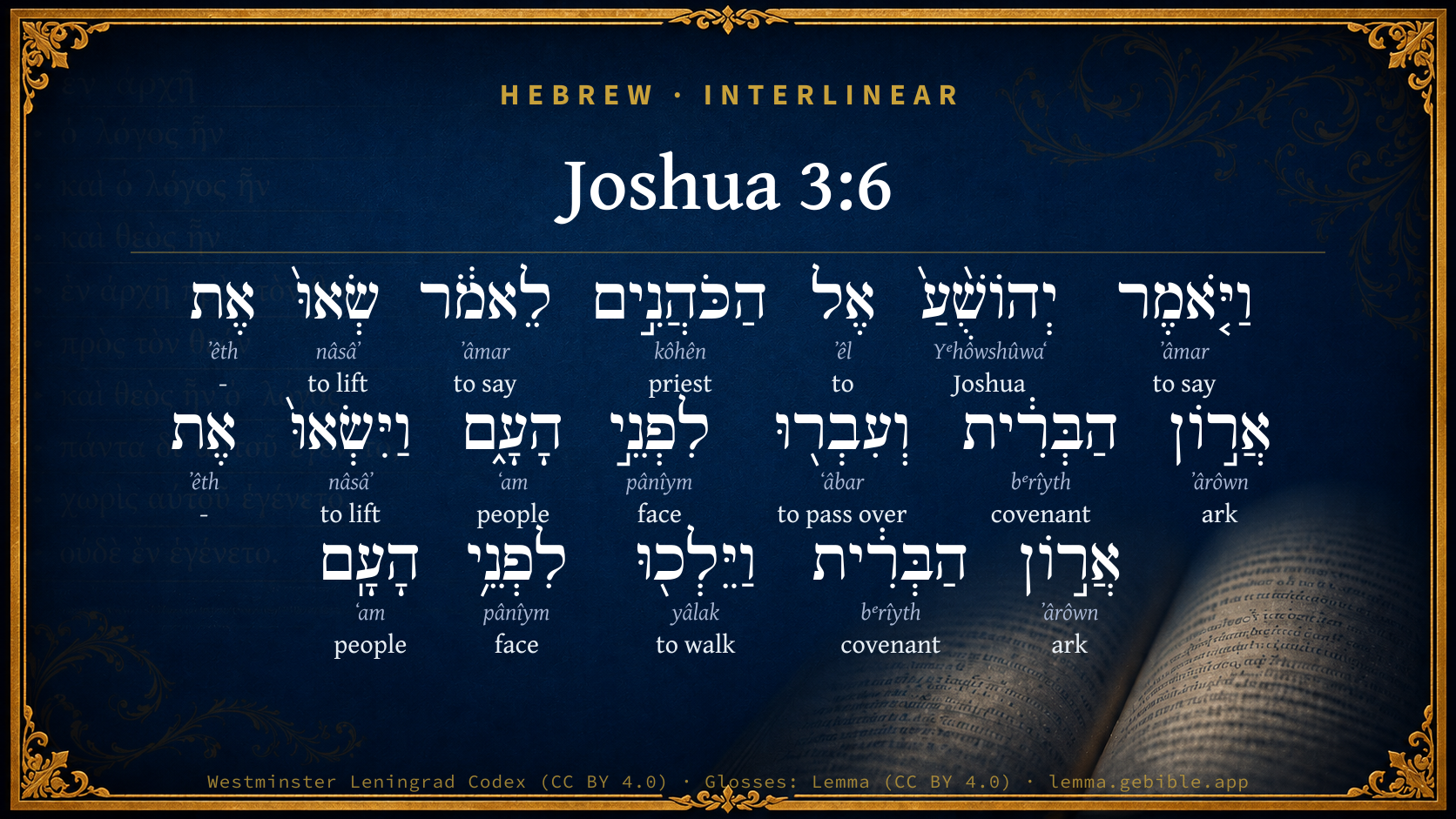
  1. וַיֹּ֤אמֶר ʼâmar H559 “and · to say” Conjunction + Verb, Qal, Sequential Imperfect, 3rd Person, Masculine, Singular
  2. יְהוֹשֻׁ֨עַ֙ Yᵉhôwshûwaʻ H3091 “Joshua” Noun, Proper
  3. אֶל ʼêl H413 “to” Preposition
  4. הַכֹּהֲנִ֣ים kôhên H3548 “the · priests” Particle, Definite Article + Noun, Common, Masculine, Plural, Absolute
  5. לֵאמֹ֔ר ʼâmar H559 “to say” Preposition + Verb, Qal, Infinitive Construct
  6. שְׂאוּ֙ nâsâʼ H5375 “lift” Verb, Qal, Imperative, 2nd Person, Masculine, Plural
  7. אֶת ʼêth H853 “-” Particle, Direct Object
  8. הַבְּרִ֔ית bᵉrîyth H1285 “the · covenant” Particle, Definite Article + Noun, Common, Feminine, Singular, Absolute
  9. וְעִבְר֖וּ ʻâbar H5674 “and · pass over” Conjunction + Verb, Qal, Imperative, 2nd Person, Masculine, Plural
  10. לִפְנֵ֣י pânîym H6440 “to/for · face(s) of” Preposition + Noun, Common, Both, Plural, Construct
  11. הָעָ֑ם ʻam H5971 “the · people” Particle, Definite Article + Noun, Common, Masculine, Singular, Absolute
  12. וַיִּשְׂאוּ֙ nâsâʼ H5375 “and · to lift” Conjunction + Verb, Qal, Sequential Imperfect, 3rd Person, Masculine, Plural
  13. אֶת ʼêth H853 “-” Particle, Direct Object
  14. אֲר֣וֹן ʼârôwn H727 “ark of” Noun, Common, Both, Singular, Construct
  15. הַבְּרִ֔ית bᵉrîyth H1285 “the · covenant” Particle, Definite Article + Noun, Common, Feminine, Singular, Absolute
  16. וַיֵּלְכ֖וּ yâlak H3212 “and · to walk” Conjunction + Verb, Qal, Sequential Imperfect, 3rd Person, Masculine, Plural
  17. לִפְנֵ֥י pânîym H6440 “to/for · face(s) of” Preposition + Noun, Common, Both, Plural, Construct
  18. הָעָֽם ʻam H5971 “the · people” Particle, Definite Article + Noun, Common, Masculine, Singular, Absolute

About this verse

These counts appear in no published source. They are computed here, from the morphology-tagged text and Lemma’s own curated glosses. What Lemma adds →

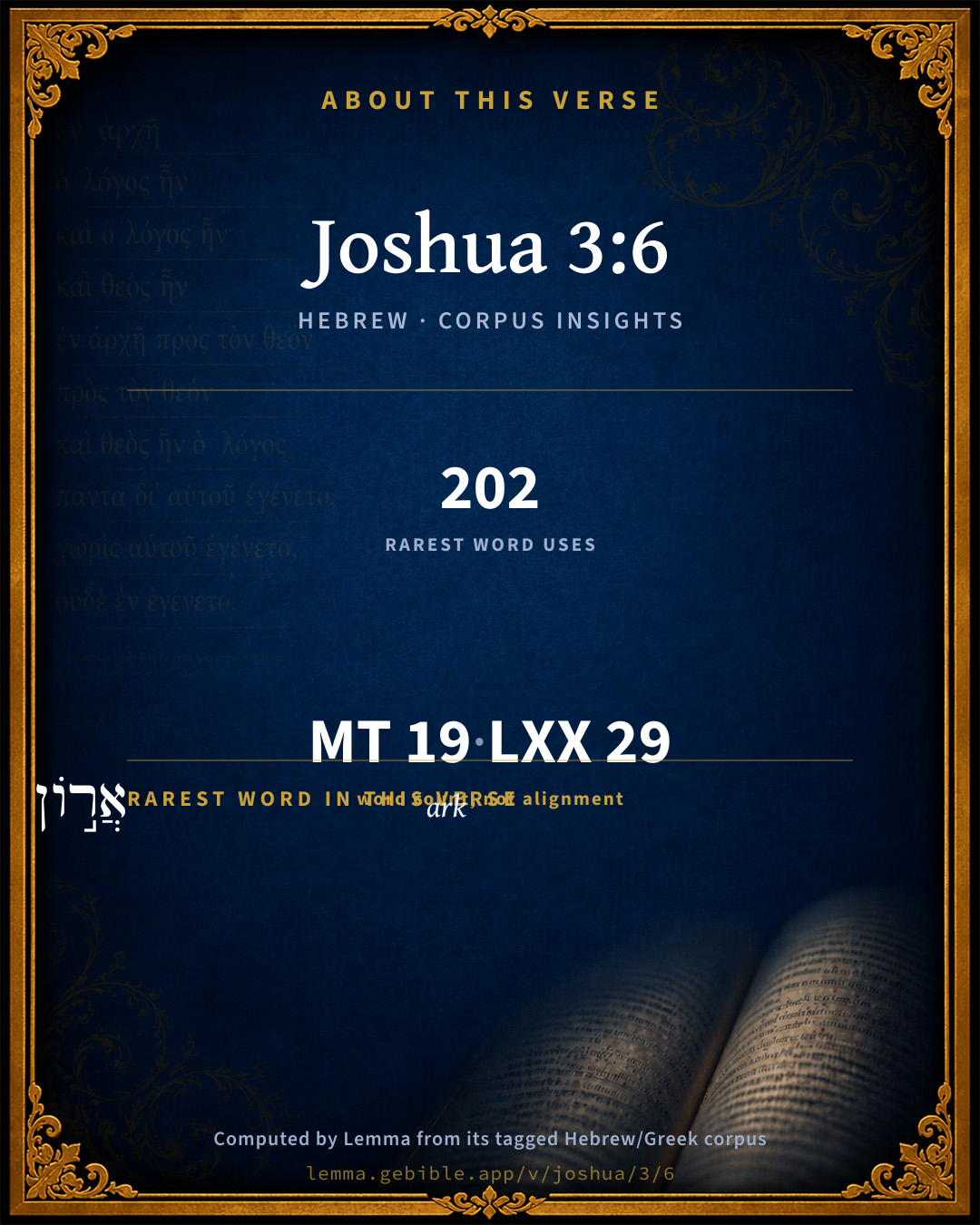
19
words
12
distinct lemmas
Historical
section

Grammatical profile

  • 6 verbs
  • 10 nouns
  • 1 preposition
  • 2 particles

Verb forms

  • וַיֹּ֤אמֶר Qal · Sequential Imperfect
  • לֵאמֹ֔ר Qal · Infinitive Construct
  • שְׂאוּ֙ Qal · Imperative
  • וְעִבְר֖וּ Qal · Imperative
  • וַיִּשְׂאוּ֙ Qal · Sequential Imperfect
  • וַיֵּלְכ֖וּ Qal · Sequential Imperfect

Repetition

Words recur within this verse — often emphatic in Hebrew:

  • וַיֹּ֤אמֶר to say H559 ×2
  • שְׂאוּ֙ to lift H5375 ×2
  • אֲר֣וֹן ark H727 ×2
  • הַבְּרִ֔ית covenant H1285 ×2
  • לִפְנֵ֣י face H6440 ×2
  • הָעָ֑ם people H5971 ×2

Hebrew & Septuagint length

In English translation the verse runs 32 words from the Hebrew and 39 from the Septuagint (LXX English) — closely comparable.

A rough comparison of the two English renderings, which tokenize alike — not a word-level alignment.

Word counts can differ between the Hebrew and the Greek without any difference in meaning — e.g. the Hebrew direct-object marker אֵת has no separate Greek word, and Greek often adds the article ὁ.

In the original languages it is 19 Hebrew tokens and 29 Greek tokens — but the two are counted differently (Hebrew bundles its prefixes and suffixes into one token; the Greek is in lemma form), so that isn’t a like-for-like length.

Cross-references

6

Topical passages linked to Joshua 3:6 in the Treasury of Scripture Knowledge — connected by theme and wording, ordered by reader-vote popularity; previews shown in the World English Bible.

  • Numbers 10:33 They set forward from the Mount of Yahweh three days' journey; and the ark of the covenant of Yahweh went before them three days' journey, to seek out a resting-place for them.
  • Numbers 14:15 Now if you shall kill this people as one man, then the nations which have heard the fame of you will speak, saying,
  • Joshua 3:3 and they commanded the people, saying, When you see the ark of the covenant of Yahweh your God, and the priests the Levites bearing it, then you shall remove from your place, and go after it.
  • Micah 2:13 He who breaks open the way goes up before them. They break through the gate, and go out. And their king passes on before them, With Yahweh at their head."
  • John 14:2–3 In my Father's house are many mansions. If it weren't so, I would have told you. I am going to prepare a place for you.
  • Hebrews 6:20 where as a forerunner Jesus entered for us, having become a high priest forever after the order of Melchizedek.

Cross-references courtesy of OpenBible.info (CC BY 4.0).

Hebrew and Greek witnesses Masoretic Hebrew ↔ Greek Septuagint

The same verse in the two great witnesses to the Old Testament, shown verse-for-verse.

These are two independent witnesses, not word-aligned to each other, and the Septuagint is shown in lemma (dictionary) form.

Hebrew Joshua 3:6 Masoretic · Westminster Leningrad Codex

וַיֹּ֤אמֶר יְהוֹשֻׁ֨עַ֙ אֶל הַכֹּהֲנִ֣ים לֵאמֹ֔ר שְׂאוּ֙ אֶת אֲר֣וֹן הַבְּרִ֔ית וְעִבְר֖וּ לִפְנֵ֣י הָעָ֑ם וַיִּשְׂאוּ֙ אֶת אֲר֣וֹן הַבְּרִ֔ית וַיֵּלְכ֖וּ לִפְנֵ֥י הָעָֽם

Joshua spoke to the priests, saying, Take up the ark of the covenant, and pass over before the people. They took up the ark of the covenant, and went before the people.

World English Bible · Public Domain

Greek LXX Joshua 3:6 Septuagint · lemma form

καί εἶπον ἰησοῦς ὁ ἱερεύς αἴρω ὁ κιβωτός ὁ διαθήκη κύριος καί προπορεύομαι ὁ λαός καί αἴρω ὁ ἱερεύς ὁ κιβωτός ὁ διαθήκη κύριος καί πορεύομαι ἔμπροσθεν ὁ λαός

And Joshua said to the priests, Take up the ark of the covenant of the Lord, and go before the people: and the priests took up the ark of the covenant of the Lord, and went before the people.

LXX2012 (modern English Septuagint) · Public Domain

Hebrew: Westminster Leningrad Codex (CC BY 4.0). Greek: Septuagint (public domain); English from LXX2012 (modern English Septuagint) (Public Domain). How the Septuagint differs from the Hebrew →

Targum (Aramaic paraphrase)

1

The Targum is the ancient Jewish Aramaic paraphrase of the Hebrew Scriptures — an interpretive translation, not the Hebrew text itself. Onkelos (literal) and Pseudo-Jonathan (expansive) render the Torah, and Jonathan the Prophets. Coverage is partial: where no permissively-licensed English translation exists for a verse, only the Aramaic is shown. This is verse-level text, not a word-by-word alignment to the Hebrew.

  1. Targum Jonathan Prophets (Joshua–Malachi)
    וַאֲמַר יְהוֹשֻׁעַ לְכַהֲנַיָא לְמֵימָר טוּלוּ יַת אֲרוֹן קְיָמָא וַעֲבַרוּ קֳדָם עַמָא וּנְטָלוּ יַת אֲרוֹנָא דִקְיָמָא וַאֲזַלוּ קֳדָם עַמָא:

    (no public-domain English translation for this verse)

    Targum Jonathan — Aramaic: “Mikraot Gedolot” (public domain). English: “Sefaria Community Translation” (CC0 1.0 (public-domain dedication)); “London "Chaldee Paraphrase," 1871” (public domain). Text via Sefaria.

Commentary

Notes on Joshua 3:6 from classic Christian and Jewish commentators (each source and its license shown beneath its notes). The classic Christian expositions comment on the surrounding passage and are grouped to its opening verse, so a note may address several verses; the Jewish commentaries on the Tanakh (Rashi and others) are per-verse, so they appear only where the commentator wrote on this verse.

Lemma curates 59 commentaries, every one of them public domain or Creative Commons licensed, each selected and text-cleaned for this edition rather than reprinted as found. About our sources →

Trapp's Complete Commentary

John Trapp

Jos 3:6 And Joshua spake unto the priests, saying, Take up the ark of the covenant, and pass over before the people. And they took up the ark of the covenant, and went before the people.

Ver. 6. And went before the people.] To the further side of the river, say some; to the middle only, say others, {as Jos 3:17} the pillar of cloud still going before them for a guide, as some conceive, but others doubt.

John Trapp, A Commentary or Exposition upon All the Books of the Old and New Testament (1647–1656) — public domain. Text from a community e-Sword module.

Joseph Benson's Commentary

Jos 3:6. Take up the ark — Namely, upon your shoulders; for so they were to carry it, Num 7:9. Before the people — Not in the middle of them, as you used to do. And they took up the ark — They did as they were commanded. And now we may suppose that prayer of Moses to be used, which he addressed to God when the ark set forward, Num 10:3. Rise up, Lord, and let thine enemies be scattered.

Joseph Benson's Commentary on the Old and New Testaments (1811–1818) — public domain. Text from a community e-Sword module.

Jamieson, Fausset & Brown

Robert Jamieson, A. R. Fausset & David Brown

Joshua spake unto the priests--This order to the priests would be given privately, and involving as it did an important change in the established order of march, it must be considered as announced in the name and by the authority of God. Moreover, as soon as the priests stepped into the waters of Jordan, they were to stand still. The ark was to accomplish what had been done by the rod of Moses.

Jamieson, Fausset & Brown — Commentary Critical and Explanatory on the Whole Bible (1871) — public domain (CC PDM 1.0). Text via the HelloAO Bible API.

Adam Clarke's Commentary

Verse 6. Spake unto the priests, saying, Take up the ark] It is remarkable that the priests, not the Levites, whose ordinary business it was were employed to carry the ark on this occasion. Calmet conjectures that this was because it was probably carried without being wrapped up in its curtains, as it always was when the Levites carried it. Though it was the business of the Levites, the sons of Kohath, to carry the ark; yet on certain occasions the priests alone performed this office.

1. In the present case.

2. When they encompassed Jericho, Jos 6:6.

3. When it was carried to the war against the Philistines by the priests, the sons of Eli, 2Sa 15:25.

4. When David sent it back to Jerusalem, at the time he was obliged to fly from it, through the rebellion of his son Absalom, 2Sa 15:25; and,

5. At the time that it was taken out of the tabernacle, to be deposited in the temple; see 1Kg 8:6-11. These were the most solemn occasions, and on such alone, we may presume, the priests performed this office instead of the Levites.

In all their former marches the ark was carried in the centre of this immense camp; (see the scheme at the end of Nu 2:2 of the book of Numbers;) but now it was to proceed at the head of the army, and to go before them, and at such a distance, about three quarters of a mile, that the whole camp might see it as their guide.

Adam Clarke's Commentary on the Bible (1810–1826) — public domain. Text from a community e-Sword/MySword module.

John Calvin's Commentaries

6. And Joshua spoke unto the priests, etc It is probable that the priests were informed why God wished the ark to precede, that they might be more ready to execute the command, for the whole people are immediately after made acquainted with the intended division of the waters. As the prefects had formerly published in the camp, that the people were to follow the ark of the covenant, the priests could not possibly be ignorant as to the office which they were to perform. For it had been distinctly declared that they were to be leaders or standard-bearers. But when all were in readiness, Joshua publicly unfolded the divine message which he had received. For it would have been incongruous to make the divine favor more clearly manifest to the common people than to them. It is added, however, immediately after, that the people were made acquainted with the miracle.

I conclude, therefore, that after the priests had for some time been kept in suspense, along with the multitude, the Lord, on ascertaining the obedience of all, publicly declared what he was to do. First, then, it is related that the priests were enjoined by Joshua to bear the ark before the people; and secondly, lest any one might think that he was making the attempt at random, or at his own hand, mention is at the same time made of the promise with which he had been furnished as a means of ensuring his command. But although it is not then distinctly said that the course of the Jordan would be interrupted, yet, from the language which Joshua used to the people, we may infer that the Lord spoke more in detail, and explained more distinctly what he had determined to do. For Joshua did not mention anything which he had not previously learned from the mouth of God himself. Nay, before he makes any mention of the matter at all, he tells them to hear the words of the Lord, and thus premises that he has the authority of God for what he is about to say.

John Calvin's Commentaries (1540-1563) — public domain. Text from the Calvin Translation Society English edition (1840s-50s) via the Christian Classics Ethereal Library (ccel.org). Calvin's coverage is partial (roughly two-thirds of the Bible); uncommented books and verses are honest gaps, never fabricated. The 19th-century editor's footnotes and remarks are omitted so the notes are faithfully Calvin's own voice.

The Cambridge Bible for Schools and Colleges

gen. ed. J. J. S. Perowne

6. And they took up] i.e. on the day following.

The Cambridge Bible for Schools and Colleges (gen. ed. J. J. S. Perowne; Cambridge University Press, 1878–1918) — public domain. Text from a community e-Sword module.

John Gill's Exposition

And Joshua spoke unto the priests,.... On the morrow, that is, on the tenth day of the month, the day on which they went over Jordan:

saying, take up the ark of the covenant; in which the law was put, which was the covenant between God and the people, from whence the ark had this name; and in which it was typical of Christ, in whom both the law, the covenant of works, was fulfilled, and with whom the covenant of grace was made; who is the Mediator; surety, and messenger of it, and in whom all the blessings and promises of it are, and with whom it is, and will be kept for evermore: the ark, the priests were ordered to take up and bear on their shoulders; for no other way might they carry it; these typified the ministers of Christ who bear his name, his Gospel in the world, see Act 9:15,

and pass over before the people; over the river Jordan, to direct them in the way through it, and encourage them to follow them:

and they took up the ark of the covenant, and went before the people; from the place where they had lodged the night before to the brink of the river.

John Gill's Exposition of the Whole Bible (1746–1763) — public domain (CC PDM 1.0). Text via the HelloAO Bible API.

Albert Barnes' Notes on the Bible

They took up - i. e. on the day following. The course of events is anticipated.

Albert Barnes' Notes on the Bible (1834–1885) — public domain. Text from a community e-Sword/MySword module.

Haydock's Catholic Bible Commentary

Commands. Josue was only the organ of God, (Calmet) whose orders he announces to the sacred ministers; (ver. 8.; Menochius) though as a civil magistrate, he was bound to hear and to obey them in matters of religion. (Calmet) --- When he ordered circumcision to be administered, when he blessed the multitude, and ratified the covenant between God and the people, (Chap. v., and xxiv., &c.) he did nothing but what a virtuous governor ought to do; yet he did not these things by virtue of his civil jurisdiction, or in opposition to the spiritual authority of Eleazar. Moses had been the supreme head, being both priest and king. But only part of his glory was communicated to Josue, while Eleazar was directed to consult the Lord for him, (Numbers xxvii. 21.; Theodoret, q. 48. in Numbers) Josue was to govern at his word, so that he was bound to consider the high priest as his superior. What he therefore did, was in subordination and conformity to the will of Eleazar and of God, and not designed to shew that the priestly authority belonged to himself, as English Protestants would hence infer. The best of princes, both in the Old and New Testament, have always looked upon it as a part of their duty to promote the true religion. (Worthington) --- Isaias (xlix) foretold that kings and queens would esteem it their glory to guard and to advance the prosperity of the Church. (Haydock) --- Hence they may enact laws for this purpose. (St. Augustine, contra Crescon. iii. 51.) Constantine ratified the judgment passed already by the bishops in the cause of Cecilian, though he confessed at the same time that the determination did not belong to his tribunal; (Worthington) and he greatly disapproved of the conduct of the Donatists, who appealed to him, as the heathens might have done to an emperor, who was at the same time one of their high priests. (Haydock) --- O rabida furoris audacia, said he, sicut in causis gentilium fieri solet, appellationem interposuerunt. (1 Optat. c. Parm. i.; St. Augustine, ep. 166.) Other emperors and kings have acquired great fame, on account of their labours and zeal in defence of the Church. Thus the kings of Spain and of France have obtained the titles of Catholic and Most Christian, and our Henry VIII was honoured by Pope Leo X with the title of Defender of the Faith, in 1521, (Worthington) on account of the book which he presented to that pontiff, while he was yet an obedient son of the Catholic Church, and undertook to defend her faith on the sacraments, against the objections of Luther. In this the faith which the kings of England defend at present? Whatever the princes might do in the old law in spiritual matters, no inference can be drawn for the same right being now exercised by civil magistrates, how supreme soever in their own sphere. Those princes, Josue, &c. might be considered not only in the light of civil governors, but also in that of prophets, who had a great share in the administration of affairs under the Jewish theocracy. If God chose to make known his will by the mouth of a king, or by that of a shepherd, his mandates were to be put in execution with equal exactitude. But now the distinctive limits of the ecclesiastical and of the civil power are more clearly ascertained. Render therefore to Cæsar the things that are Cæsar’s and to God the things that are God’s. (Matthew xxii. 21.) The kingdom of Christ is not of this world; neither did he appoint kings to be the pastors of his Church. (Haydock)

George Leo Haydock (1774–1849), Haydock's Catholic Family Bible and Commentary, 1859 edition — public domain. Excludes Psalms (Douay-Rheims chapter numbering differs from Protestant) and Deuterocanonical books (Catholic canon only).

Matthew Poole's English Annotations

Take up the ark, to wit, upon your shoulders; for so they were to carry it, Num 7:9.

Before the people; not in the middle of them, as you used to do.

Matthew Poole's English Annotations on the Holy Bible (1683–1685) — public domain. Text from a community e-Sword/MySword module.

Whedon's Commentary on the Bible

Daniel D. Whedon

6. Take up the ark — This command was among the announcements relating to the order of crossing, and not to the crossing itself, which took place on the next day.

And they took up the ark — A statement which is, according to the rules of modern composition, brought in before its proper place, which would naturally be between Jos_3:13-14. For the message from God to Joshua, and the address of the latter, must have been given before the priests moved. But this is the manner of the Hebrew historians, who often thus mention the fulfilment of a prophecy or the execution of a command in the immediate connection.

Daniel D. Whedon (gen. ed.), Commentary on the Old and New Testaments (1874–1909) — public domain. Text from a community e-Sword module.

The Pulpit Commentary

And Joshua spake. We return now to the ordinary course of the narrative. To the priests. This was because the occasion was an extraordinary one. On ordinary occasions this was the duty of the Kohathites. (Num_4:15) And went before the people. The people were to "follow the priests as far as they carried the ark, but no further; so we must follow our ministers only as they follow Christ" (Matthew Henry).

The Pulpit Commentary (1880–1919), ed. H.D.M. Spence-Jones & Joseph S. Exell — public domain. Text from a community e-Sword module.

John Wesley's Explanatory Notes

Take up - Namely, upon your shoulders; for so they were to carry it, Num. vii, 9. Before the people - Not in the middle of them, as you used to do.

John Wesley, Explanatory Notes Upon the Whole Bible (1754–1765) — public domain. Text via the GEBible commentary corpus.

Rashi

Rabbi Shlomo Yitzchaki (Rashi)

And Yehoshua said to the Kohanim. He said this on the next day.

Carry the Ark of the Covenant. Until now it was carried by the Levites, but today it was to be carried by the Kohanim.

Rashi on the Tanakh — English translations: “The Judaica Press complete Tanach with Rashi, translated by A. J. Rosenberg” (CC BY 4.0); “Pentateuch with Rashi's commentary by M. Rosenbaum and A.M. Silbermann, 1929-1934” (public domain); “The Metsudah Tanach series, Lakewood, N.J” (CC BY 4.0); and “The Book of Joshua, Metsudah Publications, 1997” (CC BY 4.0). Text via Sefaria.

Lesson kit

Teaching starters — assembled from the data on this page, not authored interpretation. Every prompt links to the verse data it draws on. Edit before teaching.

Joshua, in the Historical, opens this verse with 19 words (12 distinct Hebrew lemmas). Its most distinctive word is ʼârôwn (“ark”). A historical commentator’s framing appears above. Read the whole chapter for the surrounding context.

Discussion questions

  1. The word ʼârôwn carries the sense “ark.” How does it shape the verse?
  2. How does Numbers 10:33, which shares this passage’s theme, read alongside this verse?
  3. What does the repetition of “to say” (2× in this one verse) do in this verse?
  4. These translations render this verse differently. What is at stake in choosing one wording over another?
  5. «וַיֹּ֤אמֶר» is a Qal Sequential Imperfect verb. How does that grammatical form shape the action described?
  6. Compare how Trapp's Complete Commentary and Joseph Benson's Commentary read this verse. Where do they agree or differ?

Things to notice

Reading settings

Reading text

Shown beneath each verse's original-language words.

Old Testament
Old Testament edition

Read the OT as the Masoretic Hebrew (MT) or the Greek Septuagint (LXX).

English shown for the Greek Septuagint (in the Hebrew ↔ Greek comparison).

Comparing translations? Open the Compare panel on any verse page to stack up to four side by side.