1 Samuel 5:2

Hebrew (Westminster Leningrad Codex) 1 Samuel 5:2 appears in the Hebrew Old Testament. The text above is from the Westminster Leningrad Codex. Each word links to its Strong’s number, a concise gloss, and parsing drawn from the Open Scriptures Hebrew Bible morphology. Click any word for its full Brown-Driver-Briggs (BDB) entry.
Download image
Cite this verse

1 Samuel 5:2 (World English Bible). Public Domain. Lemma interlinear Bible study tool, https://lemma.gebible.app/v/1-samuel/5/2.

Show BibTeX & RIS
BibTeX
RIS
English Translation
The Philistines took the ark of God, and brought it into the house of Dagon, and set it by Dagon.
World English Bible · Public Domain
Download a study sheet

One document with this verse’s original text, its word-by-word gloss line, the meaning frame, cross-references with their text, attributed commentary, and full source and license credits — printable, and it pastes into notes with its structure intact.

This verse Autodidact and up

Study sheet (.html) Plain text (.txt)

A passage Seminary Student

Up to 50 verses in one chapter. A passage sheet keeps up to 6 commentary sources and 12 cross-references per verse, in the order this page ranks them, and says so on the sheet whenever that leaves anything out. Ask for a single verse and you get the Autodidact verse sheet above.

Everything on this page stays free to read, with no account — the sheet is a download of what is already on screen, not access to it.

Want to remove ads? Support Godless Engineer
Compare translations 3

The same verse in 3 English versions, stacked beneath the original-language interlinear above. Click any original word for its lexicon entry.

Each is an independent rendering of the whole verse — the interlinear is not word-aligned to these translations.

Highlighted words mark where these versions differ — a whole-verse word diff, not a word-by-word alignment.

  • World English Bible Public Domain
    The Philistines took the ark of God, and brought it into the house of Dagon, and set it by Dagon.
  • King James Version Public Domain
    When the Philistines took the ark of God, they brought it into the house of Dagon, and set it by Dagon.
  • unfoldingWord Literal Text CC BY-SA 4.0
    And the Philistines took the Box of God and caused it to enter the house of Dagon. And they placed it beside Dagon.

unfoldingWord Literal Text — © unfoldingWord, licensed CC BY-SA 4.0. Word-aligned USFM3 via Door43 (git.door43.org/unfoldingWord/en_ult).

Versions to compare (up to 4)

3 of 4 selected

Show all 18 translations

Every available English version of this verse, each an independent rendering of the whole verse.

  • World English Bible Public Domain
    The Philistines took the ark of God, and brought it into the house of Dagon, and set it by Dagon.
  • Berean Standard Bible Public Domain
    carried it into the temple of Dagon, and set it beside his statue.
  • Majority Standard Bible Public Domain
    carried it into the temple of Dagon, and set it beside his statue.
  • King James Version Public Domain
    When the Philistines took the ark of God, they brought it into the house of Dagon, and set it by Dagon.
  • American Standard Version (1901) Public Domain
    And the Philistines took the ark of God, and brought it into the house of Dagon, and set it by Dagon.
  • Revised Version (1885) Public Domain
    And the Philistines took the ark of God, and brought it into the house of Dagon, and set it by Dagon.
  • Geneva Bible (1599) Public Domain
    Euen the Philistims tooke ye Arke of God, and brought it into the house of Dagon, and set it by Dagon.
  • Douay-Rheims (1899) Public Domain
    And the Philistines took the ark of God, and brought it into the temple of Dagon, and set it by Dagon.
  • Young's Literal Translation Public Domain
    and the Philistines take the ark of God and bring it into the house of Dagon, and set it near Dagon.
  • Literal Standard Version CC BY-SA 4.0
    and the Philistines take the Ark of God and bring it into the house of Dagon, and set it near Dagon.
  • Unlocked Literal Bible CC BY-SA 4.0
    The Philistines took the ark of God, brought it into the house of Dagon, and set it up beside Dagon.
  • unfoldingWord Literal Text CC BY-SA 4.0
    And the Philistines took the Box of God and caused it to enter the house of Dagon. And they placed it beside Dagon.
  • Darby Bible Public Domain
    And the Philistines took the ark of God and brought it into the house of Dagon, and set it by Dagon.
  • World Messianic Bible Public Domain
    The Philistines took God’s ark, and brought it into the house of Dagon and set it by Dagon.
  • Webster's Bible Public Domain
    When the Philistines took the ark of God, they brought it into the house of Dagon, and set it by Dagon.
  • Free Bible Version CC BY-SA 4.0
    They brought the Ark of God into the Temple of Dagon and placed it next to Dagon.
  • Bible in Basic English Public Domain
    They took the ark of God into the house of Dagon and put it by the side of Dagon.
  • JPS Tanakh (1917) Public Domain
    And the Philistines took the ark of God, and brought it into the house of Dagon, and set it by Dagon.

Literal Standard Version (2020), Covenant Press — licensed CC BY-SA 4.0. Text via the HelloAO Bible API (eBible.org). Unlocked Literal Bible (unfoldingWord) — licensed CC BY-SA 4.0. Text via the HelloAO Bible API (eBible.org). unfoldingWord Literal Text — © unfoldingWord, licensed CC BY-SA 4.0. Word-aligned USFM3 via Door43 (git.door43.org/unfoldingWord/en_ult). Free Bible Version, Dr. Jonathan Gallagher — licensed CC BY-SA 4.0. Text via the HelloAO Bible API (eBible.org).

Word by word

More ways to search: Search by grammar → Find every occurrence → Compare this word →

Practice this passage: Drill this verse → Learn its vocabulary →

דָּג֑וֹן
Dâgôwn
H1712
“Dagon”
Noun, Proper
Part of Speech
Noun
Type
Proper
Full BDB Definition

Origin: from H1709

TWOT: None

Dagon = "a fish" - a Philistine deity of fertility; represented with the face and hands of a man and the tail of a fish
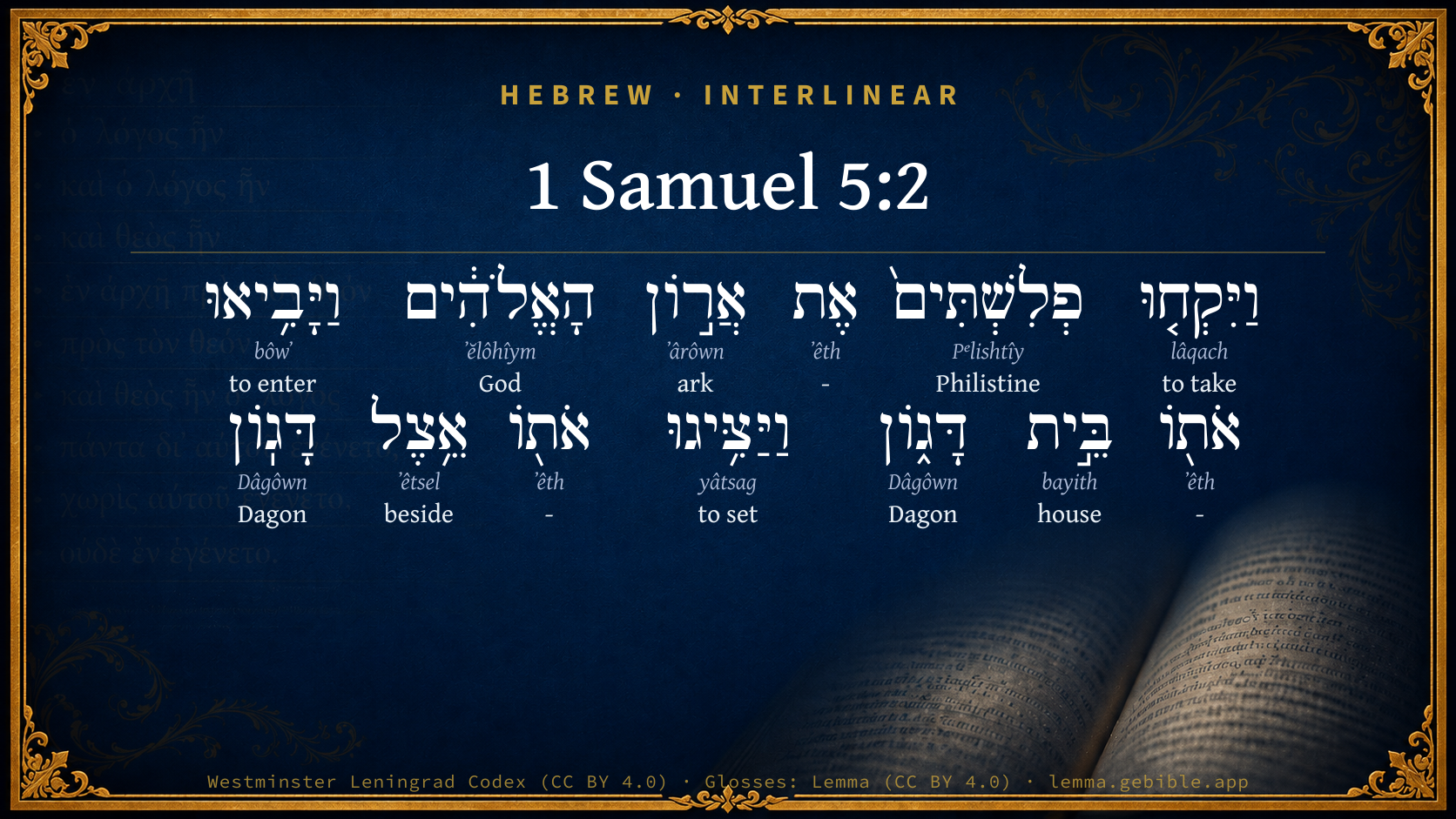
  1. וַיִּקְח֤וּ lâqach H3947 “and · to take” Conjunction + Verb, Qal, Sequential Imperfect, 3rd Person, Masculine, Plural
  2. פְלִשְׁתִּים֙ Pᵉlishtîy H6430 “Philistines” Noun, Gentilic, Masculine, Plural, Absolute
  3. אֶת ʼêth H853 “-” Particle, Direct Object
  4. אֲר֣וֹן ʼârôwn H727 “ark of” Noun, Common, Both, Singular, Construct
  5. הָאֱלֹהִ֔ים ʼĕlôhîym H430 “the · God(s)” Particle, Definite Article + Noun, Common, Masculine, Plural, Absolute
  6. וַיָּבִ֥יאוּ bôwʼ H935 “and · to enter” Conjunction + Verb, Hiphil, Sequential Imperfect, 3rd Person, Masculine, Plural
  7. אֹת֖וֹ ʼêth H853 “- · him” Particle, Direct Object + Suffix, Personal, 3rd Person, Masculine, Singular
  8. בֵּ֣ית bayith H1004 “house of” Noun, Common, Masculine, Singular, Construct
  9. וַיַּצִּ֥יגוּ yâtsag H3322 “and · to set” Conjunction + Verb, Hiphil, Sequential Imperfect, 3rd Person, Masculine, Plural
  10. אֹת֖וֹ ʼêth H853 “- · him” Particle, Direct Object + Suffix, Personal, 3rd Person, Masculine, Singular
  11. אֵ֥צֶל ʼêtsel H681 “beside” Preposition
  12. דָּגֽוֹן Dâgôwn H1712 “Dagon” Noun, Proper

About this verse

These counts appear in no published source. They are computed here, from the morphology-tagged text and Lemma’s own curated glosses. What Lemma adds →

13
words
10
distinct lemmas
Historical
section

Notable vocabulary

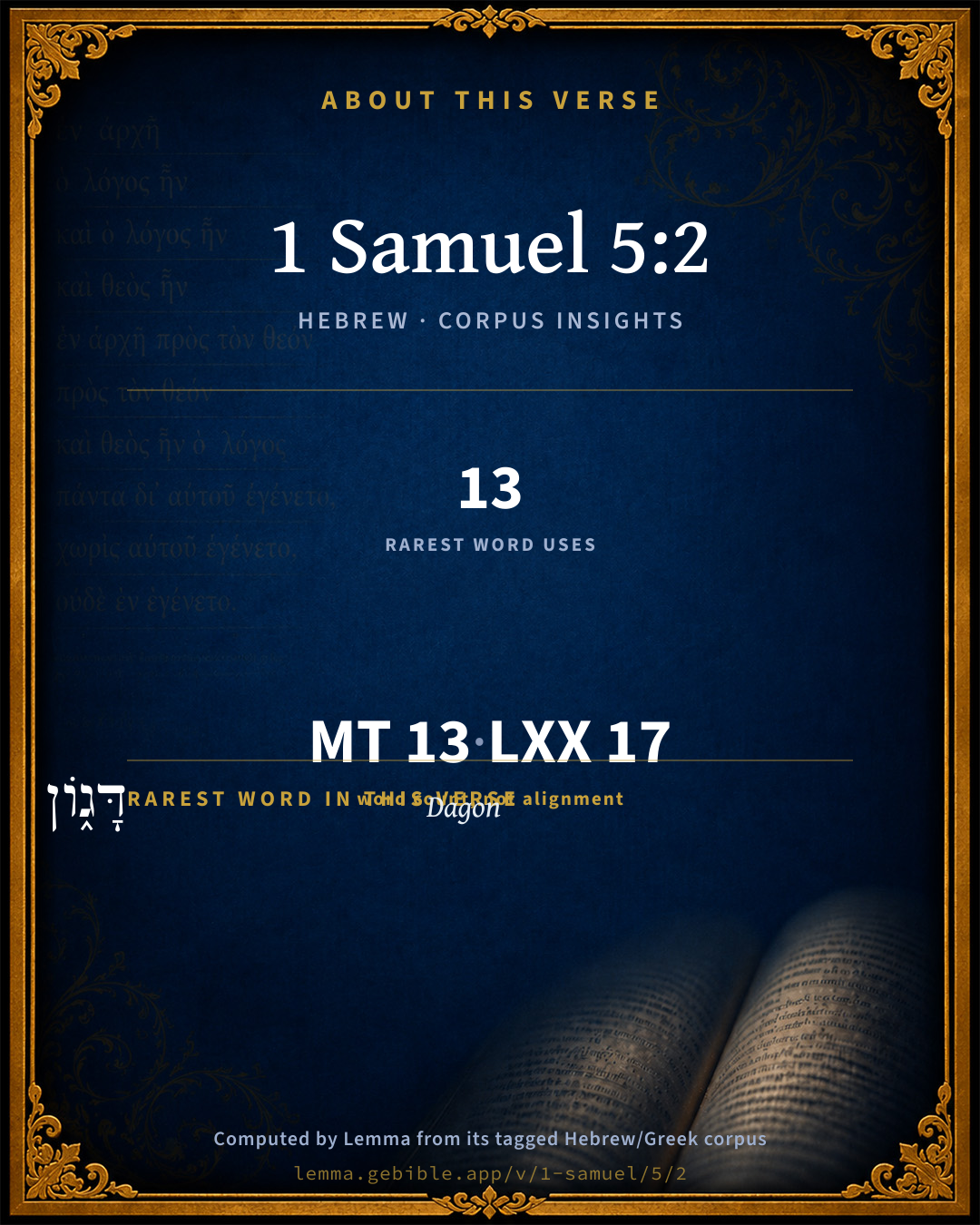
The rarest word here is דָּג֑וֹן Dagon H1712 — appearing just 13 times in the whole Hebrew Bible.

Shared distinctive vocabulary

דָּג֑וֹן Dagon H1712 occurs in 7 verses of the Hebrew Bible. Also found in:

Grammatical profile

  • 3 verbs
  • 6 nouns
  • 1 preposition
  • 3 particles

Verb forms

  • וַיִּקְח֤וּ Qal · Sequential Imperfect
  • וַיָּבִ֥יאוּ Hiphil · Sequential Imperfect
  • וַיַּצִּ֥יגוּ Hiphil · Sequential Imperfect

Repetition

A word recurs within this verse — often emphatic in Hebrew:

  • דָּג֑וֹן Dagon H1712 ×2

Hebrew & Septuagint length

In English translation the verse runs 20 words from the Hebrew and 22 from the Septuagint (LXX English) — closely comparable.

A rough comparison of the two English renderings, which tokenize alike — not a word-level alignment.

Word counts can differ between the Hebrew and the Greek without any difference in meaning — e.g. the Hebrew direct-object marker אֵת has no separate Greek word, and Greek often adds the article ὁ.

In the original languages it is 13 Hebrew tokens and 17 Greek tokens — but the two are counted differently (Hebrew bundles its prefixes and suffixes into one token; the Greek is in lemma form), so that isn’t a like-for-like length.

Cross-references

6

Topical passages linked to 1 Samuel 5:2 in the Treasury of Scripture Knowledge — connected by theme and wording, ordered by reader-vote popularity; previews shown in the World English Bible.

  • Judges 16:23 The lords of the Philistines gathered them together to offer a great sacrifice to Dagon their god, and to rejoice; for they said, Our god has delivered Samson our enemy into our hand.
  • 1 Chronicles 10:10 They put his armor in the house of their gods, and fastened his head in the house of Dagon.
  • Daniel 5:2 Belshazzar, while he tasted the wine, commanded to bring the golden and silver vessels which Nebuchadnezzar his father had taken out of the temple which was in Jerusalem; that the king and his lords, his wives and his concubines, might drink from it.
  • Daniel 5:23 but have lifted up yourself against the Lord of heaven; and they have brought the vessels of his house before you, and you and your lords, your wives and your concubines, have drunk wine from them; and you have praised the gods of silver and gold, of brass, iron, wood, and stone, which don't see, nor hear, nor know; and the God in whose hand your breath is, and whose are all your ways, you have not glorified.
  • Habakkuk 1:11 Then he sweeps by like the wind, and goes on. He is indeed guilty, whose strength is his god."
  • Habakkuk 1:16 Therefore he sacrifices to his net, and burns incense to his dragnet, because by them his life is luxurious, and his food is good.

Cross-references courtesy of OpenBible.info (CC BY 4.0).

Hebrew and Greek witnesses Masoretic Hebrew ↔ Greek Septuagint

The same verse in the two great witnesses to the Old Testament, shown verse-for-verse.

These are two independent witnesses, not word-aligned to each other, and the Septuagint is shown in lemma (dictionary) form.

Hebrew 1 Samuel 5:2 Masoretic · Westminster Leningrad Codex

וַיִּקְח֤וּ פְלִשְׁתִּים֙ אֶת אֲר֣וֹן הָאֱלֹהִ֔ים וַיָּבִ֥יאוּ אֹת֖וֹ בֵּ֣ית דָּג֑וֹן וַיַּצִּ֥יגוּ אֹת֖וֹ אֵ֥צֶל דָּגֽוֹן

The Philistines took the ark of God, and brought it into the house of Dagon, and set it by Dagon.

World English Bible · Public Domain

Greek LXX 1 Samuel 5:2 Septuagint · lemma form

καί λαμβάνω ἀλλόφυλος ὁ κιβωτός κύριος καί εἰςφέρω αὐτός εἰς οἶκος δαγων καί παραἵστημι αὐτός παρά δαγων

And the Philistines took the ark of the Lord, and brought it into the house of Dagon, and set it by Dagon.

LXX2012 (modern English Septuagint) · Public Domain

Hebrew: Westminster Leningrad Codex (CC BY 4.0). Greek: Septuagint (public domain); English from LXX2012 (modern English Septuagint) (Public Domain). How the Septuagint differs from the Hebrew →

Targum (Aramaic paraphrase)

1

The Targum is the ancient Jewish Aramaic paraphrase of the Hebrew Scriptures — an interpretive translation, not the Hebrew text itself. Onkelos (literal) and Pseudo-Jonathan (expansive) render the Torah, and Jonathan the Prophets. Coverage is partial: where no permissively-licensed English translation exists for a verse, only the Aramaic is shown. This is verse-level text, not a word-by-word alignment to the Hebrew.

  1. Targum Jonathan Prophets (Joshua–Malachi)
    וּנְסִיבוּ פְלִשְׁתָּאֵי יַת אֲרוֹנָא דַייָ וְאָעִילוּ יָתֵיהּ לְבֵית דָגוֹן וַאֲקִימוּ יָתֵיהּ בִּסְטַר דָגוֹן:

    (no public-domain English translation for this verse)

    Targum Jonathan — Aramaic: “Mikraot Gedolot” (public domain). English: “Sefaria Community Translation” (CC0 1.0 (public-domain dedication)); “London "Chaldee Paraphrase," 1871” (public domain). Text via Sefaria.

Commentary

Notes on 1 Samuel 5:2 from classic Christian and Jewish commentators (each source and its license shown beneath its notes). The classic Christian expositions comment on the surrounding passage and are grouped to its opening verse, so a note may address several verses; the Jewish commentaries on the Tanakh (Rashi and others) are per-verse, so they appear only where the commentator wrote on this verse.

Lemma curates 59 commentaries, every one of them public domain or Creative Commons licensed, each selected and text-cleaned for this edition rather than reprinted as found. About our sources →

Trapp's Complete Commentary

John Trapp

1Sa 5:2 When the Philistines took the ark of God, they brought it into the house of Dagon, and set it by Dagon.

Ver. 2. They brought it into the house of Dagon.] Which some {a} will have to be Iupiter Aratrius sive Frumentarius, - called Dagon of Dagan, which signifieth grain, - because he taught them the use of the plough, and of tillage, Others, {b} to be Triton, a sea god, - the Philistines or Phenicians were situate by the sea side, and worshipped fishes, as Xenophon, Siculus, and Cicero testify, - called Dagon of Dagah, a fish, because they made him like a man upward, and downward like a fish, whence that of Virgil,

“ Frons hominem praefert, in pristin desinit alvus. ”

And set it by Dagon.] Tanquam Iovi Feretrio spolia opima, as consecrating it unto their idol for a chief spoil.

{a} Euseb., Lel., Gyral., Arias, Pagnin., Jerome, Abulens, Adrichom.

{b} Ibid.

John Trapp, A Commentary or Exposition upon All the Books of the Old and New Testament (1647–1656) — public domain. Text from a community e-Sword module.

Joseph Benson's Commentary

1Sa 5:2-3. They set it by Dagon — By way of reproach, as a spoil and trophy set there to the honour of Dagon, to whom, doubtless, they ascribed this victory. Behold Dagon was fallen upon his face — In a posture of the most humble adoration, which was prostration; as acknowledging the God of Israel to be above all gods. They (the priests of Dagon) took Dagon and set him in his place — Supposing his fall to be casual.

Joseph Benson's Commentary on the Old and New Testaments (1811–1818) — public domain. Text from a community e-Sword module.

Tyndale Open Study Notes

Tyndale Open Resources

5:2 Dagon was one of the Philistines’ gods (see Judg 16:23-24). The name could be related to the Hebrew dag (“fish”), an appropriate name for a god of seafaring people. More likely, it reflects the Hebrew dagan (“grain”), suggesting a fertility or agriculture god.

Tyndale Open Study Notes — © Tyndale Open Resources, licensed CC BY-SA 4.0. Text via the HelloAO Bible API.

Geneva Bible (1599)

Geneva Bible translators

Which was their chief idol, and as some write, from the navel downward was like a fish, and upward like a man.

Geneva Bible (1599) marginal notes — public domain. Text via Bolls.life.

Jamieson, Fausset & Brown

Robert Jamieson, A. R. Fausset & David Brown

the house of Dagon--Stately temples were erected in honor of this idol, which was the principal deity of the Philistines, but whose worship extended over all Syria, as well as Mesopotamia and Chaldea; its name being found among the Assyrian gods on the cuneiform inscriptions [RAWLINSON]. It was represented under a monstrous combination of a human head, breast, and arms, joined to the belly and tail of a fish. The captured ark was placed in the temple of Dagon, right before this image of the idol.

Jamieson, Fausset & Brown — Commentary Critical and Explanatory on the Whole Bible (1871) — public domain (CC PDM 1.0). Text via the HelloAO Bible API.

Adam Clarke's Commentary

Verse 2. The house of Dagon] On this idol, which was supposed to be partly in a human form, and partly in that of a fish, see the note on Jdg 16:23. Some think that this idol was the same with Dirceto, Attergatis, the Venus of Askelon, and the Moon. - See Calmet's Dissertation on the gods of the Philistines.

The motive which induced the Philistines to set up the ark in the temple of Dagon, may be easily ascertained. It was customary, in all nations, to dedicate the spoils taken from an enemy to their gods:

1. As a gratitude-offering for the help which they supposed them to have furnished; and,

2. As a proof that their gods, i.e., the gods of the conquerors, were more powerful than those of the conquered.

It was, no doubt, to insult the God of Israel, and to insult and terrify his people, that they placed his ark in the temple of Dagon. When the Philistines had conquered Saul, they hung up his armour in the temple of Ashtaroth, 1Sa 31:10. And when David slew Goliath, he laid up his sword in the tabernacle of the Lord, 1Sa 21:8-9. We have the remains of this custom in the depositing of colours, standards, c., taken from an enemy, in our churches but whether this may be called superstition or a religious act, is hard to say. If the battle were the Lord's, which few battles are, the dedication might be right.

Adam Clarke's Commentary on the Bible (1810–1826) — public domain. Text from a community e-Sword/MySword module.

Ellicott's Commentary for English Readers

(2) They brought it into the house of Dagon.—The conquerors, we are told, in the meantime, with triumph, carried the captured Ark from the battle-field to Ashdod. This was one of the capital cities of the five Philistine princes. It is built on a hill close to the Mediterranean Sea, and was in after days known as Azotus (Act_8:40).

In Ashdod they placed it in the temple of the popular Philistine god, Dagon. This was their vengeance for the slaughter of the 3,000 Philistine worshippers in the temple of the same deity at Gaza, not many years before, by the blind Hebrew champion Samson.

The princes and Philistine people well remembered how the blind hero on that awful day, when 3,000 perished in the house of Dagon when he with his superhuman strength forced the great temple pillars down, called on the name of the God of Israel, whom they in their idol-trained hearts associated with the golden Ark.

“This only hope relieves me, that the strife

With me hath end, all the contest now

‘Twixt God and Dagon; Dagon hath presumed,

Me overthrown, to enter lists with God,

His deity comparing and preferring

Before the God of Abraham. He, be sure,

Will not connive or linger thus provoked,

But will arise, and His great name assert.”—MILTON.

The insulted Dagon and all their murdered countrymen should be avenged by the perpetual humiliation of the “God of Abraham.”

The sacred Ark should henceforth be placed at the feet of their god Dagon.

A Bible Commentary for English Readers, edited by Charles John Ellicott (1878–1897) — public domain. Text from a community e-Sword module.

The Cambridge Bible for Schools and Colleges

gen. ed. J. J. S. Perowne

2. When the Philistines, &c.] Better, And the Philistines took the ark of God and brought it. The repetition is characteristic of the Hebrew historical style.

Dagon] Dagon (a diminutive of endearment from dâg = fish) was the national god of the Philistines, worshipped also at Gaza (Jdg_16:21-30), and elsewhere, as the name Beth-dagon (Jos_15:41; Jos_19:27) indicates. The statue of Dagon had the head and hands of a man, and the body of a fish. The fish was an emblem of fruitfulness. See Smith’s Dict. of the Bible, I. 381, or Layard’s Nineveh, II. p. 466, for a representation of a fish-god, which is probably the Philistine Dagon, as the bas-reliefs at Khorsabad from which it is taken record the wars of Sargon with Syria. A corresponding goddess Dercìto or Atargatis was worshipped at Askelon.

The ark was placed in Dagon’s temple as a votive-offering (cp. 1Ch_10:10), and to mark the supposed victory of Dagon over Jehovah.

The Cambridge Bible for Schools and Colleges (gen. ed. J. J. S. Perowne; Cambridge University Press, 1878–1918) — public domain. Text from a community e-Sword module.

John Gill's Exposition

When the Philistines took the ark of God,.... And had brought it to Ashdod:

they brought it into the house of Dagon; a temple dedicated to that idol, and in which his image stood; of which See Gill on Jdg 16:23,

and set it by Dagon; by the side of him, either in honour to the ark, as Abarbinel, designing to give it homage and adoration, as to their own deity; for though the Gentiles did not choose to change their gods, yet they would add the gods of other nations to them; and such the Philistines might take the ark to be: or else, as Procopius Gazaeus, they brought it into their idol's temple, as a trophy of victory, and as a spoil taken from their enemies, and which they dedicated to their idol. Laniado (r) observes, that the word here used signifies servitude, as in Gen 33:15 and that the ark was set here to minister to, or serve their god Dagon. The temple of Dagon at Ashdod or Azotus was in being in the times of the Maccabees, and was burnt by Jonathan,"83 The horsemen also, being scattered in the field, fled to Azotus, and went into Bethdagon, their idol's temple, for safety. 84 But Jonathan set fire on Azotus, and the cities round about it, and took their spoils; and the temple of Dagon, with them that were fled into it, he burned with fire.'' (1 Maccabees 10)

(r) Cli Yaker, fol. 162. 4.

John Gill's Exposition of the Whole Bible (1746–1763) — public domain (CC PDM 1.0). Text via the HelloAO Bible API.

Albert Barnes' Notes on the Bible

They brought it into the house of Dagon (see the marginal reference) in order to enhance the triumph of the gods of the Philistines over the God of Israel. (Compare 1Sa 31:9; Jdg 16:23; Isa 37:12.)

Albert Barnes' Notes on the Bible (1834–1885) — public domain. Text from a community e-Sword/MySword module.

Haydock's Catholic Bible Commentary

Dagon is the same as Derceto, Atergatis, Venus, and the moon, (Calmet) and was represented like a woman, (Tirinus) as far as the waist, and a fish below. (Haydock) (Judges xvi. 23.) --- The ark was placed near the idol, out of respect; (Calmet) or as a trophy of the victory, which they attributed to Dagon. (Menochius) --- Thus they hung up the arms of Saul in the temple of Asteroth; (chap. xxxi. 10,) and David placed the sword of Goliah[Goliath] in the tabernacle.

George Leo Haydock (1774–1849), Haydock's Catholic Family Bible and Commentary, 1859 edition — public domain. Excludes Psalms (Douay-Rheims chapter numbering differs from Protestant) and Deuterocanonical books (Catholic canon only).

Matthew Poole's English Annotations

Either, first, Out of respect to it, that it might be worshipped together with Dagon. Or rather, secondly, By way of reproach and contempt of it, as a spoil and trophy set there to the honour of Dagon, to whom doubtless they ascribed this victory, as they did a former, Jdg 16:23. And though they had some reverence for the ark before, 1Sa 4:7, &c.; yet that was certainly much diminished by their success against Israel, notwithstanding the presence and help of the ark.

Matthew Poole's English Annotations on the Holy Bible (1683–1685) — public domain. Text from a community e-Sword/MySword module.

Whedon's Commentary on the Bible

Daniel D. Whedon

2. House of Dagon — Hebrew, Beth-Dagon; not here the name of a city, as at Jos_15:41; Jos_19:27, but the house or temple (1Ch_10:10) in which Dagon was worshipped. The Philistines placed the ark in Dagon’s temple as a dedicatory offering to their god, who had gotten them their victory. Dagon was the great national god of the Philistines. His image bore the body of a fish, and the face and hands of a man. Various representations of this idol have been found on the Assyrian monuments, and in them all the characteristic feature is the figure of a fish. See note and cut at Jdg_16:23.

Daniel D. Whedon (gen. ed.), Commentary on the Old and New Testaments (1874–1909) — public domain. Text from a community e-Sword module.

The Pulpit Commentary

When the Philistines, etc. The words are exactly the same as those in ver. 1, viz. "And the Philistines took the ark of God, and brought it," marking the simplicity of ancient narrative. Dagon is derived by Philo from dagan, "corn," and is explained by him as an emblem of the earth"s fertility; but as the shape of this national deity of the Philistines was certainly that of a man to the waist, ending in the body and tail of a fish, the true derivation is doubtless that from dag, "a fish." It represented, however, not so much the sea, on which the Philistines trafficked, as the fruitfulness of water, which in the East is looked upon as the active principle of life (comp. Gen_1:20) In one of the sculptures brought from Khorsabad there is a representation of a battle between the Assyrians and the inhabitants of the Syrian sea coast, and in it there is a figure, the upper part of which is a bearded man with a crown, while from the waist downwards it has the shape of a fish (Layard"s "Nineveh," 2:466). Moreover, it is swimming in the sea, and is surrounded by a multitude of marine creatures. Doubtless this figure represents Dagon, who, nevertheless, is not to be regarded as a sea god, like Neptune; but as the fish is the product of water, he is the symbol of nature"s reproductive energy. Together with Dagon a female deity was commonly worshipped, called Atergatis, half woman and half fish, whose temple is mentioned in RAPC 2Ma 12:26. In the margin there she is explained as being Venus; but the ideas have only this in common that Venus also, as rising out of the sea, symbolises life as springing out of water. As Dagon had a temple also at, (Jud_1:16:23) and at the other cities of Philistia, (Jerome on Isa_46:1) he was evidently the chief deity of the nation, and thesolemn depositing of the ark in his temple, and by Dagon, literally, "at his side, was intended as a public demonstration that the God of the Israelites was inferior to, and had been vanquished by, the national deity of the Philistines.

The Pulpit Commentary (1880–1919), ed. H.D.M. Spence-Jones & Joseph S. Exell — public domain. Text from a community e-Sword module.

John Wesley's Explanatory Notes

By Dagon - By way of reproach, as a spoil and trophy set there to the honour of Dagon, to whom doubtless they ascribed this victory.

John Wesley, Explanatory Notes Upon the Whole Bible (1754–1765) — public domain. Text via the GEBible commentary corpus.

Rashi

Rabbi Shlomo Yitzchaki (Rashi)

Beside Dagon. The idol was made in the form of a fish.

Rashi on the Tanakh — English translations: “The Judaica Press complete Tanach with Rashi, translated by A. J. Rosenberg” (CC BY 4.0); “Pentateuch with Rashi's commentary by M. Rosenbaum and A.M. Silbermann, 1929-1934” (public domain); “The Metsudah Tanach series, Lakewood, N.J” (CC BY 4.0); and “The Book of Joshua, Metsudah Publications, 1997” (CC BY 4.0). Text via Sefaria.

Lesson kit

Teaching starters — assembled from the data on this page, not authored interpretation. Every prompt links to the verse data it draws on. Edit before teaching.

1 Samuel, in the Historical, opens this verse with 13 words (10 distinct Hebrew lemmas). Its most distinctive word is Dâgôwn (“Dagon”). A historical commentator’s framing appears above. Read the whole chapter for the surrounding context.

Discussion questions

  1. The word Dâgôwn carries the sense “Dagon.” How does it shape the verse?
  2. How does Judges 16:23, which shares the word «Dagon», read alongside this verse?
  3. What does the repetition of “Dagon” (2× in this one verse) do in this verse?
  4. These translations render this verse differently; the difference is in the English rendering, not the original. What questions does that raise?
  5. «וַיִּקְח֤וּ» is a Qal Sequential Imperfect verb. How does that grammatical form shape the action described?
  6. Compare how Trapp's Complete Commentary and Joseph Benson's Commentary read this verse. Where do they agree or differ?

Things to notice

Reading settings

Reading text

Shown beneath each verse's original-language words.

Old Testament
Old Testament edition

Read the OT as the Masoretic Hebrew (MT) or the Greek Septuagint (LXX).

English shown for the Greek Septuagint (in the Hebrew ↔ Greek comparison).

Comparing translations? Open the Compare panel on any verse page to stack up to four side by side.