
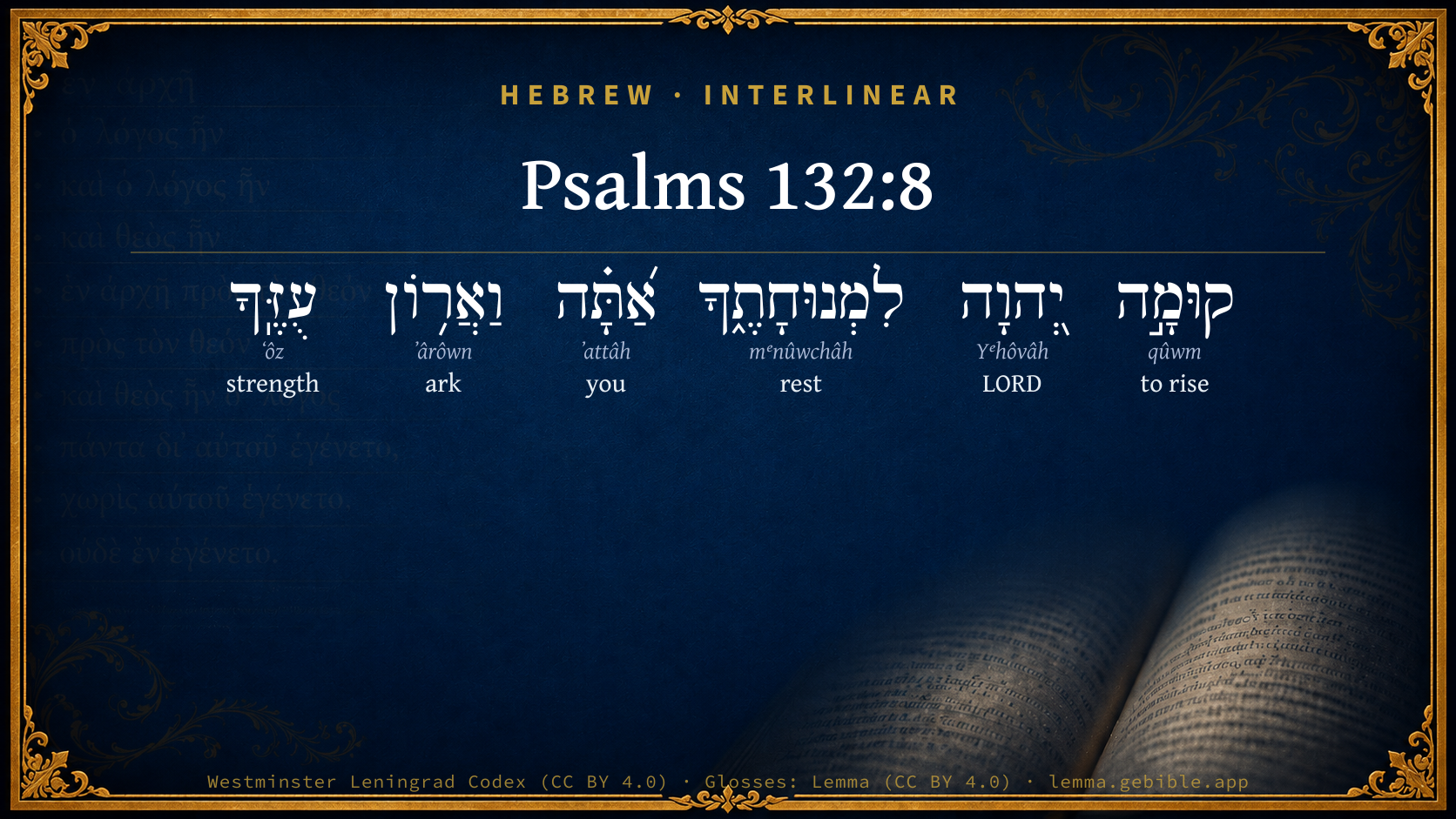
Psalms 132:8

Hebrew (Westminster Leningrad Codex) Psalms 132:8 appears in the Hebrew Old Testament. The text above is from the Westminster Leningrad Codex. Each word links to its Strong’s number, a concise gloss, and parsing drawn from the Open Scriptures Hebrew Bible morphology. Click any word for its full Brown-Driver-Briggs (BDB) entry.
Download image
Cite this verse

Psalms 132:8 (World English Bible). Public Domain. Lemma interlinear Bible study tool, https://lemma.gebible.app/v/psalms/132/8.

Show BibTeX & RIS
BibTeX
RIS
English Translation
Arise, Yahweh, into your resting place; You, and the ark of your strength.
World English Bible · Public Domain
Download a study sheet

One document with this verse’s original text, its word-by-word gloss line, the meaning frame, cross-references with their text, attributed commentary, and full source and license credits — printable, and it pastes into notes with its structure intact.

This verse Autodidact and up

Study sheet (.html) Plain text (.txt)

A passage Seminary Student

Up to 50 verses in one chapter. A passage sheet keeps up to 6 commentary sources and 12 cross-references per verse, in the order this page ranks them, and says so on the sheet whenever that leaves anything out. Ask for a single verse and you get the Autodidact verse sheet above.

Everything on this page stays free to read, with no account — the sheet is a download of what is already on screen, not access to it.

Want to remove ads? Support Godless Engineer
Compare translations 3

The same verse in 3 English versions, stacked beneath the original-language interlinear above. Click any original word for its lexicon entry.

Each is an independent rendering of the whole verse — the interlinear is not word-aligned to these translations.

Highlighted words mark where these versions differ — a whole-verse word diff, not a word-by-word alignment.

  • World English Bible Public Domain
    Arise, Yahweh, into your resting place; You, and the ark of your strength.
  • King James Version Public Domain
    Arise, O LORD, into thy rest; thou, and the ark of thy strength.
  • unfoldingWord Literal Text CC BY-SA 4.0
    Arise, Yahweh, to your resting place, you and the box of your strength.

unfoldingWord Literal Text — © unfoldingWord, licensed CC BY-SA 4.0. Word-aligned USFM3 via Door43 (git.door43.org/unfoldingWord/en_ult).

Versions to compare (up to 4)

3 of 4 selected

Show all 17 translations

Every available English version of this verse, each an independent rendering of the whole verse.

  • World English Bible Public Domain
    Arise, Yahweh, into your resting place; You, and the ark of your strength.
  • Berean Standard Bible Public Domain
    Arise, O LORD, to Your resting place, You and the ark of Your strength.
  • Majority Standard Bible Public Domain
    Arise, O LORD, to Your resting place, You and the ark of Your strength.
  • King James Version Public Domain
    Arise, O LORD, into thy rest; thou, and the ark of thy strength.
  • American Standard Version (1901) Public Domain
    Arise, O Jehovah, into thy resting-place; Thou, and the ark of thy strength.
  • Revised Version (1885) Public Domain
    Arise, O LORD, into thy resting place; thou, and the ark of thy strength.
  • Geneva Bible (1599) Public Domain
    Arise, O Lord, to come into thy rest, thou, and the Arke of thy strength.
  • Young's Literal Translation Public Domain
    Arise, O Jehovah, to Thy rest, Thou, and the ark of Thy strength,
  • Literal Standard Version CC BY-SA 4.0
    Arise, O YHWH, to Your rest, || You, and the Ark of Your strength,
  • Unlocked Literal Bible CC BY-SA 4.0
    Arise, Yahweh, to your resting place, you and the ark of your strength!
  • unfoldingWord Literal Text CC BY-SA 4.0
    Arise, Yahweh, to your resting place, you and the box of your strength.
  • Darby Bible Public Domain
    Arise, Jehovah, into thy rest, thou and the ark of thy strength.
  • World Messianic Bible Public Domain
    Arise, LORD, into your resting place, you, and the ark of your strength.
  • Webster's Bible Public Domain
    Arise, O LORD, into thy rest; thou, and the ark of thy strength.
  • Free Bible Version CC BY-SA 4.0
    Come, Lord, and enter your home, together with your Ark of your power.
  • Bible in Basic English Public Domain
    Come back, O Lord, to your resting-place; you and the ark of your strength.
  • JPS Tanakh (1917) Public Domain
    Arise, O LORD, unto Thy resting-place; Thou, and the ark of Thy strength.

Literal Standard Version (2020), Covenant Press — licensed CC BY-SA 4.0. Text via the HelloAO Bible API (eBible.org). Unlocked Literal Bible (unfoldingWord) — licensed CC BY-SA 4.0. Text via the HelloAO Bible API (eBible.org). unfoldingWord Literal Text — © unfoldingWord, licensed CC BY-SA 4.0. Word-aligned USFM3 via Door43 (git.door43.org/unfoldingWord/en_ult). Free Bible Version, Dr. Jonathan Gallagher — licensed CC BY-SA 4.0. Text via the HelloAO Bible API (eBible.org).

Word by word

More ways to search: Search by grammar → Find every occurrence → Compare this word →

Practice this passage: Drill this verse → Learn its vocabulary →

About this verse

These counts appear in no published source. They are computed here, from the morphology-tagged text and Lemma’s own curated glosses. What Lemma adds →

6
words
6
distinct lemmas
Wisdom
section

Notable vocabulary

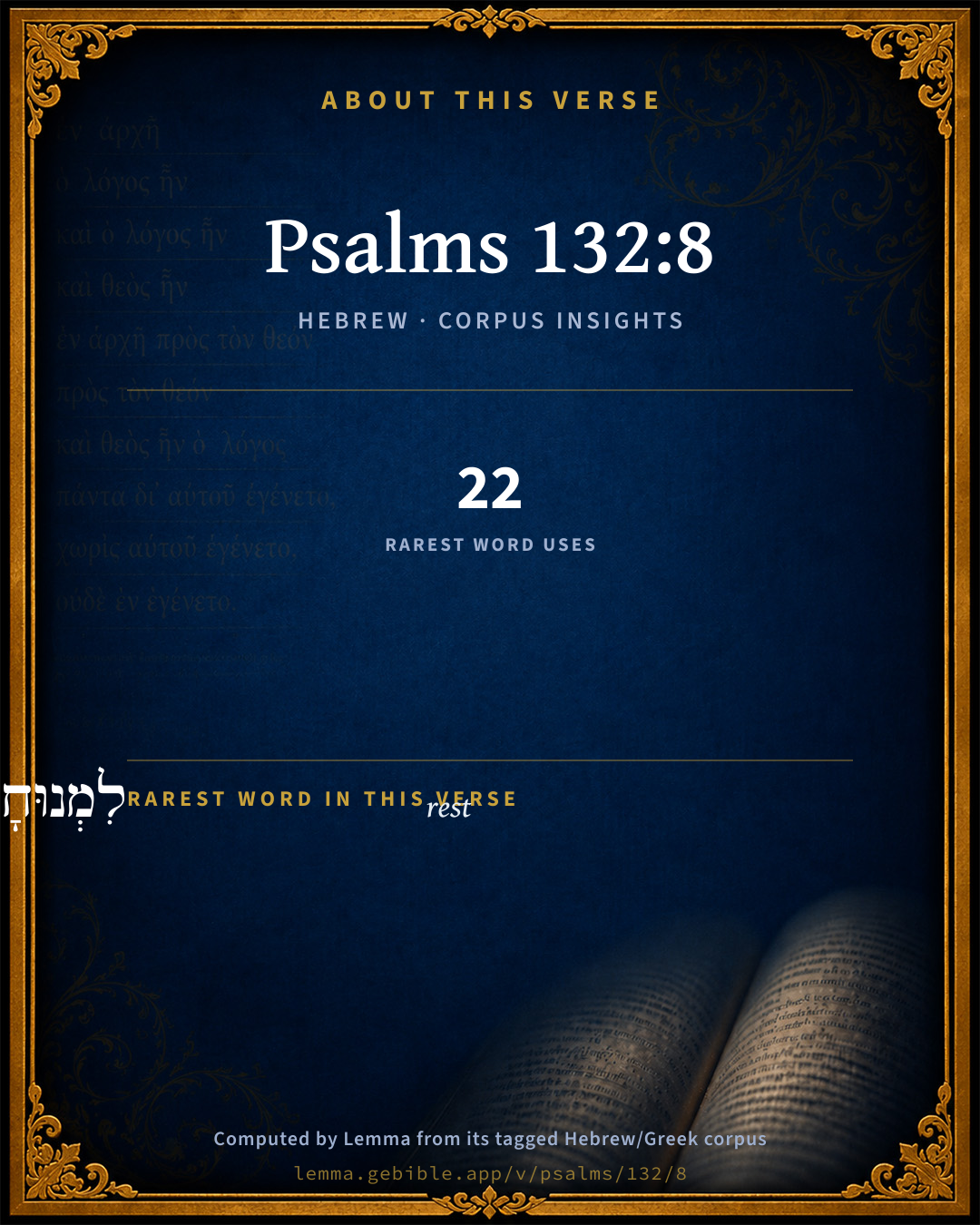
The rarest word here is לִמְנוּחָתֶ֑ךָ rest H4496 — appearing just 22 times in the whole Hebrew Bible.

Shared distinctive vocabulary

לִמְנוּחָתֶ֑ךָ rest H4496 occurs in 22 verses of the Hebrew Bible. Also found in:

Grammatical profile

  • 1 verb
  • 4 nouns
  • 1 pronoun

Verb forms

  • קוּמָ֣ה Qal · Imperative

Hebrew & Septuagint length

In English translation the verse runs 13 words from the Hebrew and 13 from the Septuagint (LXX English) — the same length.

A rough comparison of the two English renderings, which tokenize alike — not a word-level alignment.

Word counts can differ between the Hebrew and the Greek without any difference in meaning — e.g. the Hebrew direct-object marker אֵת has no separate Greek word, and Greek often adds the article ὁ.

Cross-references

4

Topical passages linked to Psalms 132:8 in the Treasury of Scripture Knowledge — connected by theme and wording, ordered by reader-vote popularity; previews shown in the World English Bible.

  • 2 Chronicles 6:41–42 Now therefore arise, Yahweh God, into your resting-place, you, and the ark of your strength: let your priests, Yahweh God, be clothed with salvation, and let your saints rejoice in goodness.
  • Numbers 10:35–36 It happened, when the ark set forward, that Moses said, Rise up, Yahweh, and let your enemies be scattered; and let those who hate you flee before you.
  • Psalms 68:1 Let God arise! Let his enemies be scattered! Let them who hate him also flee before him.
  • Psalms 78:61 And delivered his strength into captivity, His glory into the adversary's hand.

Cross-references courtesy of OpenBible.info (CC BY 4.0).

Hebrew and Greek witnesses Masoretic Hebrew ↔ Greek Septuagint

The same verse in the two great witnesses to the Old Testament, shown verse-for-verse.

You’re reading Greek Psalm 131 (Hebrew Psalm 132). The Septuagint counts the superscription, so verse numbers can differ from the Hebrew — chapter-level alignment, not verse-by-verse. Numbering follows Rahlfs.

These are two independent witnesses, not word-aligned to each other, and the Septuagint is shown in lemma (dictionary) form.

Hebrew Psalms 132:8 Masoretic · Westminster Leningrad Codex

קוּמָ֣ה יְ֭הוָה לִמְנוּחָתֶ֑ךָ אַ֝תָּ֗ה וַאֲר֥וֹן עֻזֶּֽךָ

Arise, Yahweh, into your resting place; You, and the ark of your strength.

World English Bible · Public Domain

Greek LXX Greek Psalm 131:8 Septuagint · lemma form

ἀναἵστημι κύριος εἰς ὁ ἀνάπαυσις σύ σύ καί ὁ κιβωτός ὁ ἁγίασμα σύ

Arise, O Lord, into your rest; you, and the ark of your holiness.

LXX2012 (modern English Septuagint) · Public Domain

On this verse, Ellicott's Commentary for English Readers discusses the Septuagint’s reading. Read the note in Commentary ↓

Hebrew: Westminster Leningrad Codex (CC BY 4.0). Greek: Septuagint (public domain); English from LXX2012 (modern English Septuagint) (Public Domain). How the Septuagint differs from the Hebrew →

Commentary

Notes on Psalms 132:8 from classic Christian and Jewish commentators (each source and its license shown beneath its notes). The classic Christian expositions comment on the surrounding passage and are grouped to its opening verse, so a note may address several verses; the Jewish commentaries on the Tanakh (Rashi and others) are per-verse, so they appear only where the commentator wrote on this verse.

Lemma curates 59 commentaries, every one of them public domain or Creative Commons licensed, each selected and text-cleaned for this edition rather than reprinted as found. About our sources →

The Cambridge Bible for Schools and Colleges

gen. ed. J. J. S. Perowne

8. The people’s prayer that Jehovah will occupy the resting-place (1Ch_28:2) prepared for Him; that His Presence may accompany the symbol of it. The first line is an adaptation of the watchword used when the Ark started to find a resting-place for the Israelites in their wanderings. See Num_10:33; Num_10:35. In 2Ch_6:41-42 the words of the Psalm are quoted at the close of Solomon’s prayer at the Dedication of the Temple, and some commentators suppose that in Psa_132:8 ff. the Psalmist carries us on into the Solomonic period; but it is simpler and more natural to suppose that he is still describing David’s translation of the Ark to Zion.

the ark of thy strength] See 1Sa_5:7; 1Sa_6:19 ff.; Psa_78:61.

The Cambridge Bible for Schools and Colleges (gen. ed. J. J. S. Perowne; Cambridge University Press, 1878–1918) — public domain. Text from a community e-Sword module.

Trapp's Complete Commentary

John Trapp

Psa 132:8 Arise, O LORD, into thy rest; thou, and the ark of thy strength.

Ver. 8. Arise, O Lord, into thy rest] The place of thy rest; for the ark was transportative till settled in Solomon’s temple; so, till we come to heaven, we are in continual motion.

Thou, and the ark of thy strength] The ark in the temple was the chiefest evidence of God’s presence, and the most principal type of Christ, in whom the fulness of the Godhead dwelleth bodily. The word is aron, which is put for a coffin, coffer, or chest, Gen 50:26 2Ki 12:9. This showeth, that all the counsels of God, all the love and favour of God, all that God accounteth precious, are treasured up in Christ, Col 2:3; Col 1:13 Isa 42:1 Heb 10:12.

John Trapp, A Commentary or Exposition upon All the Books of the Old and New Testament (1647–1656) — public domain. Text from a community e-Sword module.

The Biblical Illustrator

Joseph S. Exell

Psa_132:8-9

Arise, O Lord, into Thy rest, Thou and the ark of Thy strength.

Blessings on the sanctuary

I. The temple is here called the place of rest, or the abiding place of God.

II. The temple, gorgeous as it was, was incomplete and valueless without the ark. In all ages the ark in the Temple is its life. Still the quick heart within the man, and you will have the stately skeleton soon. Withdraw the magic vapour, and the wheels whirr no longer, and the most exquisite contrivances are mute and motionless machinery. Take the breath from the great organs heart, and in vain you bid it discourse its harmonies.

III. Look at the other blessings which are asked for, either obviously or by direct implication in the psalm.

1. The ark of Gods strength in the Temple implies that Gods power is in the Temple, and He waits to exert it in the Word, in the ministers appeals, in the peoples prayers.

2. The prayer proceeds to ask that the priests may be clothed with righteousness, which is, in fact, a petition for universal purity. It is a prayer not only for us who minister, but for you who hearken, that we may, all of us, be robed always, robed already, in the new linen, clean and white, in which the saints were seen in heaven.

3. The third blessing that is asked for is holy joy in God, which has its foundation in oneness with God, both in favour and feeling, and which has its outlet in the appropriate expressions of praise. (W. M. Punshon, LL. D.)

The gracious presence of God in His own ordinances, an object of earnest desire to every acceptable worshipper

I. The glorious Object to whom the people of God present their supplication, in the view of a solemn appearance before God in the ordinances of His worship--Jehovah Himself.

1. He, to whom this great name belongs, is the independent, self-existent God, whose being is in and of Himself; and who gives being to all His words and works.

2. He is the eternal, and, consequently, the unchangeable God.

3. He is the fountain of all blessedness, as well as of all being. Indeed, if He is the one, he must needs be the other. If He is independent, He cannot but be all-sufficient.

4. He is Israels own God. In our applications to Him, therefore, on this and on every other occasion, we ought still to view Him as Jehovah, our God: our God by His own gracious grant and promise; our God by virtue of that everlasting covenant, which is sealed to every worthy communicant at the sacramental table. This will encourage us both to be fervent in our supplications for His presence, and confident in our expectations of it.

II. The place into which God is here invited, or where His presence is desired; called, in the text, His rest. The Church of Christ may be called Gods rest on a twofold account.

1. On account of His Divine pleasure and satisfaction in her, much beyond the pleasure that a weary or burdened person has in a place or state of rest.

2. On account of His constant and perpetual residence in her.

III. The invitation which they humbly, yet confidently, address to Him. Arise. The manner of expression here used, especially when applied to the Church, intimates the following things.

1. That, in taking possession of His rest, it is necessary that God should make signal displays of His power.

2. That there may be times when God seems, in human reckoning, inactive and negligent about the affairs of His Church.

3. That though Zion is Gods rest, there is, and always will be, much work for Him to accomplish in her.

IV. The manner in which He was desired and expected to accept the invitation. They did not ask Him to be present, unless in a manner adapted to the dispensation under which they lived, and under those symbols by which His presence among them was always exhibited and secured. They only wished Him to be present, along with the ark of His strength. This imports--

1. That the people of God had an earnest desire after the symbol itself, and expected not to enjoy the presence of God, in the same comfortable manner, without it.

2. That they could not be satisfied with the symbol, without the thing signified and represented by it.

3. But the principal thing to be attended to about this ark of Gods strength was its being the most lively type of Christ. This intimates--

(1) That they desired the presence of Christ as Mediator, and the benefit of His mediation, as well as the presence of God Himself. Indeed, these two can never be separated.

(2) That they neither expected the presence of God, nor desired it, otherwise than through Christ. Out of Christ God is a consuming fire.

V. Improvement of the subject. It affords us--

1. Matter of wonder, gratitude, and praise; in that we enjoy the symbols of Gods presence, and have access to worship Him according to His own appointment.

2. Matter of reproof to all who satisfy themselves with outward privileges, and matter of warning to all who enjoy them, against such a fatal mistake.

3. Matter of encouragement to all in this company who have business with God to-day.

4. Matter of consolation to all those who mourn for the low state of the Church in our day, and for the very low state of the work of God in her.

5. Matter of trial to all present; particularly to those who intend to eat the sacramental bread and drink the sacramental cup. (John Young, D. D.)

The Biblical Illustrator, edited by Joseph S. Exell (c. 1880s–1900s) — public domain. Text from a community e-Sword module.

Joseph Benson's Commentary

Psa 132:8-10. Arise, O Lord, to thy rest, &c. — See notes on Num 10:35; 2Ch 6:41-42. Let thy priests be clothed with righteousness — Not only with those outward sacerdotal garments of glory and beauty, which thou hast appointed for them, but, especially, with the inward ornaments of righteousness and true holiness, that so their persons and services may be accepted by thee, both for themselves and for all thy people; and they may be clothed with salvation, (Psa 132:16,) which is the effect, or consequent, of the former clothing. And let thy saints shout for joy — Let all thy people have cause of rejoicing in the tokens of thy goodness; which they eminently had at the dedication of the temple, as is signified 1Ki 8:66. For thy servant David’s sake — In regard of thy singular kindness and promises vouchsafed to David, as this is explained in the following verses. This verse makes it more than probable that David was not the penman of this Psalm, for he never used to beg mercies from God for his own sake, but constantly for God’s name’s sake, and for the sake of his truth, mercy, goodness, or righteousness. Turn not away the face of thine anointed — Of me, whom thou hast anointed to be king over thy people. Cast me not out of thy presence: do not reject or deny my request.

Joseph Benson's Commentary on the Old and New Testaments (1811–1818) — public domain. Text from a community e-Sword module.

J. A. Alexander on Psalms

Joseph Addison Alexander

8. (Psa 132:8) Arise, Jehovah, to thy resting-place, thou and the ark, of thy strength. Here again the form of expression is borrowed from the words of Solomon at the dedication of the temple, as recorded in 2Ch 6:41. This shews that the Psalmist regarded Solomon as merely carrying out his father's plan, or acting as the executor of his will, which is in fact the mutual relation of these personages as they appear in sacred history. A more remote allusion may be traced to Num 10:35. See above, on Psa 68:1. The word translated resting-place, has here its proper meaning as a local noun. The last clause shews the true import of the ark in the Mosaic system, as a pledge and token of Jehovah's presence, so that its solemn entrance into Zion was the entrance of the Lord himself, and to bow down to it was to worship him. The ark of thy strength is by some, in accordance with a common Hebrew idiom, resolved into thy ark of strength, end that into thy strong (or mighty) ark. It is simpler, however, and in this case yields a better meaning, to retain the original expression in its obvious sense, the ark which assures us of the presence and exertion of thy power for our protection.

Joseph Addison Alexander, The Psalms Translated and Explained (1850) — public domain. Text from a community e-Sword module.

Tyndale Open Study Notes

Tyndale Open Resources

132:8-10 These verses are a quotation from Solomon’s prayer at the dedication of the Temple (2 Chr 6:41-42).

Tyndale Open Study Notes — © Tyndale Open Resources, licensed CC BY-SA 4.0. Text via the HelloAO Bible API.

Geneva Bible (1599)

Geneva Bible translators

That is, Jerusalem, because that afterward his Ark should remove to none other place.

Geneva Bible (1599) marginal notes — public domain. Text via Bolls.life.

Adam Clarke's Commentary

Verse 8. Arise, O Lord, into thy rest; thou and the ark of thy strength.] Using the same expressions which Solomon used when he dedicated the temple, 2Ch 6:41-42. There are several difficulties in these passages. Ephratah may mean the tribe of Ephraim; and then we may understand the place thus: "I have learned that the ark had been in the tribe of Ephraim, and I have seen it at Kirjath-jearim, or Field of the woods; but this is not a proper place for it, for the Lord hath chosen Jerusalem." It is true that the ark did remain in that tribe from the days of Joshua to Samuel, during three hundred and twenty-eight years; and thence it was brought to Kirjath-jearim, where it continued seventy years, till the commencement of the reign of David over all Israel.

But if we take Ps 132:6-8, not as the continuation of David's vow, but as the words of the captives in Babylon, the explanation will be more plain and easy: "We have heard, O Lord, from our fathers, that thy tabernacle was formerly a long time at Shiloh, in the tribe of Ephraim. And our history informs us that it has been also at Kirjath-jearim, the fields of the wood; and afterwards it was brought to Jerusalem, and there established: but Jerusalem is now ruined, the temple destroyed, and thy people in captivity. Arise, O Lord, and re-establish thy dwelling-place in thy holy city!" See Calmet and others on this place.

Adam Clarke's Commentary on the Bible (1810–1826) — public domain. Text from a community e-Sword/MySword module.

John Calvin's Commentaries

8. Arise, O Jehovah? Arise, O Jehovah! were the words which Moses used (Numbers 10:35) whenever in the journey through the wilderness the Ark moved forward; and this and the two following verses form a part of the prayer which Solomon offered at the dedication of the Temple, (2 Chronicles 6:41, 42,) which might be considered as the resting-place of God and of the Ark. The Ark is here called “the Ark of thy strength” — that is, the symbol of thy power and majesty. This phrase is found only in this place and in the passage above cited.

John Calvin's Commentaries (1540-1563) — public domain. Text from the Calvin Translation Society English edition (1840s-50s) via the Christian Classics Ethereal Library (ccel.org). Calvin's coverage is partial (roughly two-thirds of the Bible); uncommented books and verses are honest gaps, never fabricated. The 19th-century editor's footnotes and remarks are omitted so the notes are faithfully Calvin's own voice.

Ellicott's Commentary for English Readers

(8) Ark of thy strength.—See the reference in Chronicles. The expression occurs nowhere else but in Psa_78:61, where the word strength by itself denotes the ark. The technical word ark nowhere else occurs in the psalms. For strength the LXX. and Vulg. have “sanctification.”

(8-10) These are the words which the chronicler (2Ch_6:41-42) puts into Solomon’s mouth at the dedication of the Temple. Some think that they are there only as a quotation from this psalm, but the mode in which the words are here introduced points the other way. The psalmist does not at his distance from the events distinguish between David and Solomon. He merges the executor of the work in the projector; and in honour of the second Temple it is as natural for him to take up words used at the actual dedication of the first as it was to refer to the original purpose in David’s mind. All is blended together in the long perspective of poetry. As to the form of the words, they are of course themselves a reminiscence of the ancient battle-cry of the nation when the Ark set forward on the march. (See Psa_68:1, Note.) The mention of the Ark does not definitely dispose of the Maccabæan theory of this psalm, though it doubtless must weigh against it. The quotation may have been adopted generally without meaning literal correspondence between all the circumstances—just as the battle-cry had become merely a religious formula—or, as Lightfoot and Prideaux suggest (see Prideaux, Connection, i. 141), there may have been an ark made for the second Temple in imitation of the original.

A Bible Commentary for English Readers, edited by Charles John Ellicott (1878–1897) — public domain. Text from a community e-Sword module.

John Gill's Exposition

For thy servant David's sake,.... Not for any virtues, or excellencies or merits, of David, literally understood; rather for the sake of the covenant and promises made with him: but for the sake of the antitypical David, the Messiah, the son of David according to the flesh, and the servant of the Lord as Mediator; for whose sake, and in whose name, prayers and supplications are made and presented;

turn not away the face of thine anointed; not David; rather Solomon, as the Targum expresses it; so Jarchi: but any of the Lord's anointed, every Christian, or believer in Christ, is an anointed one; and has received the unction from the Holy One, the oil of true grace. And the request is, that God would not turn such away from him, and cause them to depart from his throne of grace, ashamed and disappointed; but hear and answer their petitions, for his Son's sake. In Ch2 6:42; it is added, "remember the mercies of David thy servant"; the kind and good things promised to him, and perform them.

John Gill's Exposition of the Whole Bible (1746–1763) — public domain (CC PDM 1.0). Text via the HelloAO Bible API.

Albert Barnes' Notes on the Bible

Arise, O Lord, into thy rest - Into that which is appointed for its permanent place of repose, that it may no longer be removed from spot to spot. This is spoken of the ark, considered as the place where God, by an appropriate symbol, abode. That symbol - the Shechinah - rested on the cover of the ark. The same language was used by Solomon at the dedication of the temple: “Now, therefore, arise, O Lord God, into thy resting place, thou and the ark of thy strength,” 2Ch 6:41.

Thou, and the ark of thy strength - The ark, the symbol of the divine power, as if the power of God resided there, or as if the Almighty had his abode there. Perhaps the language was derived from the fact that the ark, in the wars of the Hebrews against their foes, was a symbol of the divine presence and protection - that by which the divine power was put forth.

Albert Barnes' Notes on the Bible (1834–1885) — public domain. Text from a community e-Sword/MySword module.

Matthew Poole's English Annotations

Arise, i.e. arise and come. One word put for two, as Gen 43:33, marvelled (i.e. marvelled looking) one at another; and Gen 43:34, he took messes, i.e. he took and sent messes, as our translation renders it. And this word is very proper in this place, because it was to be used by God’s appointment when the ark was to be removed from one place to another, Num 10:35, as now it was from the tabernacle in Zion to the temple in Moriah, upon which occasion this and the two following verses were used by Solomon, 2Ch 6:41,42.

Into thy rest; into thy resting-place, the temple, so called Isa 66:1, where thou hast now a fixed habitation.

The ark of thy strength; the seat of thy powerful and glorious presence, from whence thou dost put forth and manifest thy strength on the behalf of thy people when they desire and need it.

Matthew Poole's English Annotations on the Holy Bible (1683–1685) — public domain. Text from a community e-Sword/MySword module.

The Treasury of David

Charles H. Spurgeon

Ver. 8. In these three verses we see the finders of the ark removing it to its appointed place, using a formula somewhat like to that used by Moses when he said, "Rise up, Lord", and again, "Return, O Lord, unto the many thousands of Israel." The ark had been long upon the move, and no fit place had been found for it in Canaan, but now devout men have prepared a temple, and they sing, Arise, O Lord, into thy rest; thou, and the ark of thy strength. They hoped that now the covenant symbol had found a permanent abodea rest, and they trusted that Jehovah would now abide with it for ever. Vain would it be for the ark to be settled if the Lord did not continue with it, and perpetually shine forth from between the cherubim. Unless the Lord shall rest with us there is no rest for us; unless the ark of his strength abide with us we are ourselves without strength. The ark of the covenant is here mentioned by a name which it well deserved; for in its captivity it smote its captors, and broke their gods, and when it was brought back it guarded its own honour by the death of those who dared to treat it with disrespect. The power of God was thus connected with the sacred chest. Reverently, therefore, did Solomon pray concerning it as he besought the living God to consecrate the temple by his presence. It is the Lord and the covenant, or rather say the covenant Jehovah whose presence we desire in our assemblies, and this presence is the strength of his people. Oh that the Lord would indeed abide in all the churches, and cause his power to be revealed in Zion.

Ver. 8. Arise, O LORD, into thy rest; thou, and the ark of thy strength. Whenever the camp was about to move, Moses used the language found in the first part of this verse. "Arise (or rise up), O Jehovah." William Swan Plumer.

Ver. 8. Thou, and the ark of thy strength. "Both he that sanctifieth and they who are sanctified are all of one" Heb 2:11. Now Christ, our Great High Priest, is gone up into the holy resting place. Of him it is said, "Arise": for he arose from the dead, and ascended into heaven. And to his "ark", the church, it is said, "Arise": because he lives, all in him shall live also. Edward Simms, in "A Spiritual Commentary on the Book of Psalms", 1882.

Ver. 8. The ark of thy strength. The historical records of the ark are numerous, and deeply interesting. Miracles were often wrought at its presence. At the passage of the Jordan, no sooner were the feet of the priests which bare this holy vessel dipped in the brim of the river, than the waters rose up upon an heap, and the people of God passed over on dry ground"clean over Jordan": Jos 3:14-17. At the siege of Jericho, the ark occupied a most prominent position in the daily procession of the tribes around the doomed city...It was, however, captured by the Philistines, and Hophni and Phineas, Eli's wicked sons, in whose care it was placed, slain. Thus the Lord "delivered his strength into captivity and his glory into the enemy's hand": Ps 78:61. Frank H. White, in "Christ in the Tabernacle", 1877.

Ver. 8-9.

1. The Presence of God desired

a) That it may be signally manifested: "Arise" and enter.

b) That it may be gracious: "Thou and the ark" that he may be present on the mercyseat.

c) That it may be felt: accompanied with power: "The ark of thy strength."

d) That it may be abiding: "Arise into thy rest."

2. The reasons for this desire.

a) With respect to the priests or ministers: "Let thy priests", etc.: not their own righteousness, but as a clothing: let them speak of "garments of salvation" and "robes of righteousness."

b) With respect to the worshippers: "And let thy saints", etc. Let ministers preach the gift of righteousness; not that which grows out of man's nature, but that which is "unto all and upon all them that believe", and saints will shout for joy. G. R.

Psalms 132:9*

Charles H. Spurgeon's The Treasury of David (1869–1885) — public domain. Psalms only. Text from a community e-Sword/MySword module.

Whedon's Commentary on the Bible

Daniel D. Whedon

8. Arise, O Lord, into thy rest—Let Jehovah take possession of the ark on Zion, and make it his dwelling place, as in the tabernacle in the wilderness. Exo_40:34-35; Lev_9:23-24. The formula was quoted by Solomon. 2Ch_6:41.

Ark of thy strength—The “ark” was the standing symbol of the power and protection of God. It is simply called “strength,” Psa_78:61, which see. The word “ark” occurs nowhere else in the Psalms.

Daniel D. Whedon (gen. ed.), Commentary on the Old and New Testaments (1874–1909) — public domain. Text from a community e-Sword module.

The Pulpit Commentary

Arise, O Lord, into thy rest. Another transfer, but into the place of final "rest." The words are a quotation from 2Ch_8:4, and were uttered originally by Solomon at the close of his long dedication prayer. Thou, and the ark of thy strength. The quotation continues. God is regarded as entering the temple, and taking possession of it, in and with the ark.

Vers. 8, 9. The Church the rest of the Lord.

This is the only place in the Psalms where the ark is mentioned. And it is only described as here in 2Ch_6:41.

I THE CHURCH THE LORD"S RESTING-PLACE. (See Num_10:33-36) When the ark set forward, it was "to search out a resting-place for them." And where they were, God would be (ver. 13). It is not the magnificence of the shrine, the numbers or the rank or wealth of the attendants, but it is the spiritual character of the people, that God looks at. His Church consists of those who believe, love, and obey him. They are the objects of his love and care and choice. They shall have his presence, and his delight shall be with them.

II THE CHURCH CANNOT PROSPER WITHOUT THE PRESENCE OF GOD IN CHRIST. This is the meaning of the words, "Thou and the ark of thy strength." For though we had the presence of God, we could not know it apart from Christ. "No man cometh unto the Father but by me;" "This is life eternal, to know thee, and Jesus Christ whom thou hast sent." Our knowledge of God is dependent on our knowledge of Christ. The ark was the ark of God"s strength. Before it the waters of Jordan parted asunder; the walls of Jericho fell down; the idol-god of the Philistines, Dagon, was shattered. It was the symbol and pledge of strength from God for all Israel"s need. Hence the consternation of Eli when he heard that the ark of God was taken. But so is our Lord Jesus Christ the strength of God. For through him God wins us, keeps us, inspires us, strengthens us. God can do anything with us and through us when Christ is our Life. Revealed to our hearts in Christ, we are utterly his.

III THE CHURCH IS BLESSED INDEED WHEN THIS PRAYER IS ANSWERED.

1. Her priests are clothed with righteousness endued with the spirit of holiness. The being clothed tells of manifested character, the habit and garment of the soul. And what a joy and a power to the Church is a holy ministry! Nothing can compare with it, nothing can compensate for its absence.

2. Her saints are filled with joy. Gladness and sanctity go together, as they ever should. Let us ever pray, "Endue thy ministers with righteousness, and make thy chosen people joyful.

IV THE CHURCH, WOULD SHE BE THUS BLESSED, MUST SEEK FOR THE BLESSING IN PRAYER. "Arise, O Lord," etc. Then the Lord will dwell in her; she will be his rest (vers. 14-18). S.C.

The Pulpit Commentary (1880–1919), ed. H.D.M. Spence-Jones & Joseph S. Exell — public domain. Text from a community e-Sword module.

John Wesley's Explanatory Notes

Rest - Into thy resting place, the temple so called, Isaiah lxvi, 1, where thou hast now a fixed habitation. The ark - The seat of thy powerful and glorious presence.

John Wesley, Explanatory Notes Upon the Whole Bible (1754–1765) — public domain. Text via the GEBible commentary corpus.

Lesson kit

Teaching starters — assembled from the data on this page, not authored interpretation. Every prompt links to the verse data it draws on. Edit before teaching.

Psalms, in the Wisdom, opens this verse with 6 words (6 distinct Hebrew lemmas). Its most distinctive word is mᵉnûwchâh (“rest”). A historical commentator’s framing appears above. Read the whole chapter for the surrounding context.

Discussion questions

  1. What does “rest” (mᵉnûwchâh) contribute to the verse as a whole?
  2. Genesis 49:15 shares the word «rest» with this verse. How do the two illuminate each other?
  3. The translations on this page render this verse differently — a whole-verse word diff, not a word-by-word alignment. What might account for the different wordings?
  4. The verb «קוּמָ֣ה» is Qal Imperative. How does its form color the action?
  5. Reading how The Cambridge Bible for Schools and Colleges and Trapp's Complete Commentary read this verse, where do the two commentators agree and where do they part?

Things to notice

Reading settings

Reading text

Shown beneath each verse's original-language words.

Old Testament
Old Testament edition

Read the OT as the Masoretic Hebrew (MT) or the Greek Septuagint (LXX).

English shown for the Greek Septuagint (in the Hebrew ↔ Greek comparison).

Comparing translations? Open the Compare panel on any verse page to stack up to four side by side.