
1 Chronicles 15:24

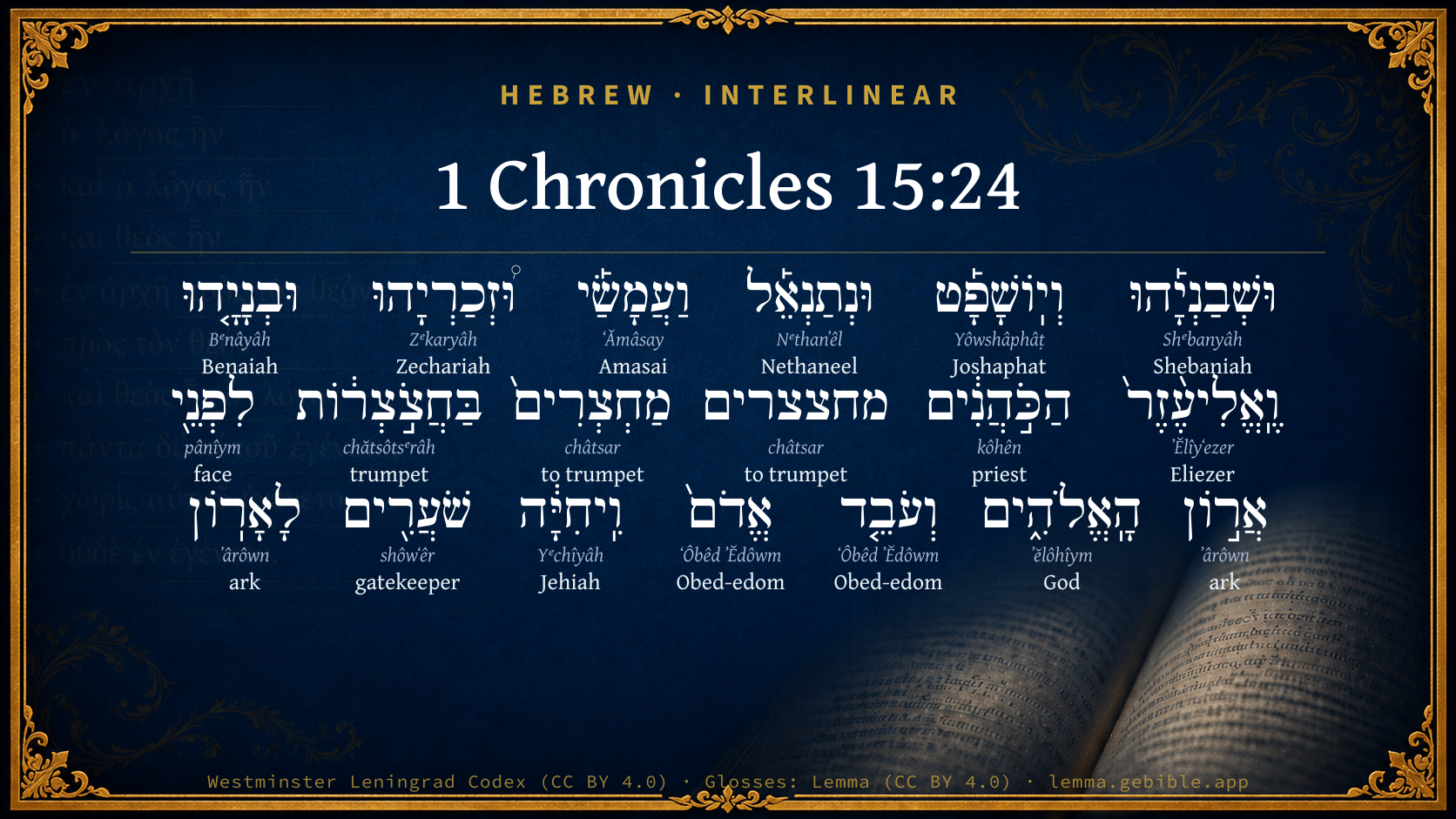
Hebrew (Westminster Leningrad Codex) 1 Chronicles 15:24 appears in the Hebrew Old Testament. The text above is from the Westminster Leningrad Codex. Each word links to its Strong’s number, a concise gloss, and parsing drawn from the Open Scriptures Hebrew Bible morphology. Click any word for its full Brown-Driver-Briggs (BDB) entry.
Download image
Cite this verse

1 Chronicles 15:24 (World English Bible). Public Domain. Lemma interlinear Bible study tool, https://lemma.gebible.app/v/1-chronicles/15/24.

Show BibTeX & RIS
BibTeX
RIS
English Translation
Shebaniah, and Joshaphat, and Nethanel, and Amasai, and Zechariah, and Benaiah, and Eliezer, the priests, did blow the trumpets before the ark of God: and Obed-edom and Jehiah were doorkeepers for the ark.
World English Bible · Public Domain
Highlights
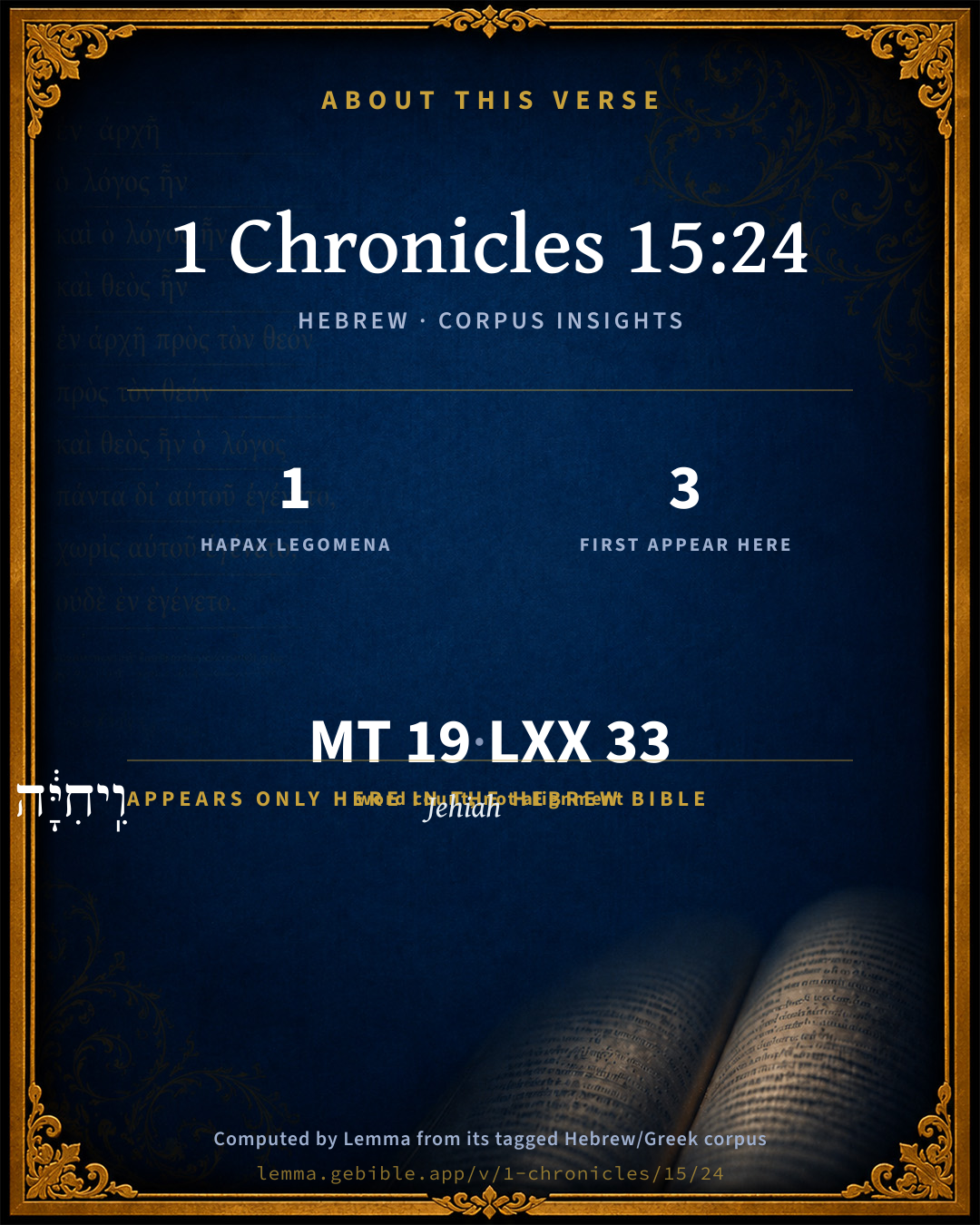
  • 1 hapax legomenon — only here in the Hebrew Bible
  • 3 first appearances in the Hebrew Bible
Full analysis ↓
Download a study sheet

One document with this verse’s original text, its word-by-word gloss line, the meaning frame, cross-references with their text, attributed commentary, and full source and license credits — printable, and it pastes into notes with its structure intact.

This verse Autodidact and up

Study sheet (.html) Plain text (.txt)

A passage Seminary Student

Up to 50 verses in one chapter. A passage sheet keeps up to 6 commentary sources and 12 cross-references per verse, in the order this page ranks them, and says so on the sheet whenever that leaves anything out. Ask for a single verse and you get the Autodidact verse sheet above.

Everything on this page stays free to read, with no account — the sheet is a download of what is already on screen, not access to it.

Want to remove ads? Support Godless Engineer
Compare translations 3

The same verse in 3 English versions, stacked beneath the original-language interlinear above. Click any original word for its lexicon entry.

Each is an independent rendering of the whole verse — the interlinear is not word-aligned to these translations.

Highlighted words mark where these versions differ — a whole-verse word diff, not a word-by-word alignment.

  • World English Bible Public Domain
    Shebaniah, and Joshaphat, and Nethanel, and Amasai, and Zechariah, and Benaiah, and Eliezer, the priests, did blow the trumpets before the ark of God: and Obed-edom and Jehiah were doorkeepers for the ark.
  • King James Version Public Domain
    And Shebaniah, and Jehoshaphat, and Nethaneel, and Amasai, and Zechariah, and Benaiah, and Eliezer, the priests, did blow with the trumpets before the ark of God: and Obededom and Jehiah were doorkeepers for the ark.
  • unfoldingWord Literal Text CC BY-SA 4.0
    And Shebaniah, and Joshaphat, and Nethanel, and Amasai, and Zechariah, and Benaiah, and Eliezer, the priests, were blowing trumpets to the face of the Box of God. And Obed Edom and Jehiah keepers for the Box.

unfoldingWord Literal Text — © unfoldingWord, licensed CC BY-SA 4.0. Word-aligned USFM3 via Door43 (git.door43.org/unfoldingWord/en_ult).

Versions to compare (up to 4)

3 of 4 selected

Show all 18 translations

Every available English version of this verse, each an independent rendering of the whole verse.

  • World English Bible Public Domain
    Shebaniah, and Joshaphat, and Nethanel, and Amasai, and Zechariah, and Benaiah, and Eliezer, the priests, did blow the trumpets before the ark of God: and Obed-edom and Jehiah were doorkeepers for the ark.
  • Berean Standard Bible Public Domain
    Shebaniah, Joshaphat, Nethanel, Amasai, Zechariah, Benaiah, and Eliezer—the priests—were to blow the trumpets before the ark of God. Obed-edom and Jehiah were also to be guardians of the ark.
  • Majority Standard Bible Public Domain
    Shebaniah, Joshaphat, Nethanel, Amasai, Zechariah, Benaiah, and Eliezer—the priests—were to blow the trumpets before the ark of God. Obed-edom and Jehiah were also to be guardians of the ark.
  • King James Version Public Domain
    And Shebaniah, and Jehoshaphat, and Nethaneel, and Amasai, and Zechariah, and Benaiah, and Eliezer, the priests, did blow with the trumpets before the ark of God: and Obededom and Jehiah were doorkeepers for the ark.
  • American Standard Version (1901) Public Domain
    And Shebaniah, and Joshaphat, and Nethanel, and Amasai, and Zechariah, and Benaiah, and Eliezer, the priests, did blow the trumpets before the ark of God: and Obed-edom and Jehiah were doorkeepers for the ark.
  • Revised Version (1885) Public Domain
    And Shebaniah, and Joshaphat, and Nethanel, and Amasai, and Zechariah, and Benaiah, and Eliezer, the priests, did blow with the trumpets before the ark of God: and Obed-edom and Jehiah were doorkeepers for the ark.
  • Geneva Bible (1599) Public Domain
    And Shecaniah and Iehoshaphat and Nethaneel and Amasai, and Zechariah, and Benaiah, and Eliezer the Priestes did blowe with trumpets before the Arke of God, and Obed Edom and Ieiiah were porters for the Arke.
  • Douay-Rheims (1899) Public Domain
    And Sebenias, and Josaphat, and Nathanael, and Amasai, and Zacharias, and Banaias, and Eliezer the priests, sounded with trumpets, before the ark of God: and Obededom and Jehias were porters of the ark.
  • Young's Literal Translation Public Domain
    And Shebaniah, and Joshaphat, and Nethaneel, and Amasai, and Zechariah, and Benaiah, and Eliezer the priests, are blowing with trumpets before the ark of God; and Obed-Edom and Jehiah `are' gatekeepers for the ark.
  • Literal Standard Version CC BY-SA 4.0
    And Shebaniah, and Joshaphat, and Nethaneel, and Amasai, and Zechariah, and Benaiah, and Eliezer the priests, are blowing with trumpets before the Ark of God; and Obed-Edom and Jehiah [are] gatekeepers for the Ark.
  • Unlocked Literal Bible CC BY-SA 4.0
    Shebaniah, Joshaphat, Nethanel, Amasai, Zechariah, Benaiah, and Eliezer, the priests, were to blow the trumpets before the ark of God. Obed Edom and Jehiah were guards for the ark.
  • unfoldingWord Literal Text CC BY-SA 4.0
    And Shebaniah, and Joshaphat, and Nethanel, and Amasai, and Zechariah, and Benaiah, and Eliezer, the priests, were blowing trumpets to the face of the Box of God. And Obed Edom and Jehiah keepers for the Box.
  • Darby Bible Public Domain
    And Shebaniah, and Jehoshaphat, and Nethaneel, and Amasai, and Zechariah, and Benaiah, and Eliezer, the priests, blew with the trumpets before the ark of God; and Obed-Edom and Jehijah were doorkeepers for the ark.
  • World Messianic Bible Public Domain
    Shebaniah, Joshaphat, Nethanel, Amasai, Zechariah, Benaiah, and Eliezer, the priests, blew the shofars before God’s ark; and Obed-Edom and Jehiah were doorkeepers for the ark.
  • Webster's Bible Public Domain
    And Shebaniah, and Jehoshaphat, and Nethaneel, and Amasai, and Zechariah, and Benaiah, and Eliezer the priests, did blow with the trumpets before the ark of God: and Obed-edom and Jehiah were door-keepers for the ark.
  • Free Bible Version CC BY-SA 4.0
    Shebaniah, Joshaphat, Nethanel, Amasai, Zechariah, Benaiah, and Eliezer the priests were to blow the trumpets in front of the Ark of God. Obed-edom and Jehiah were also appointed to guard the Ark.
  • Bible in Basic English Public Domain
    And Shebaniah and Joshaphat and Nethanel and Amasai and Zechariah and Benaiah and Eliezer, the priests, made music on the horns before the ark of God; and Obed-edom and Jehiah were door-keepers for the ark.
  • JPS Tanakh (1917) Public Domain
    And Shebaniah, and Joshaphat, and Nethanel, and Amasai, and Zechariah, and Benaiah, and Eliezer, the priests, did blow with the trumpets before the ark of God; and Obed-edom and Jehiah were doorkeepers for the ark.

Literal Standard Version (2020), Covenant Press — licensed CC BY-SA 4.0. Text via the HelloAO Bible API (eBible.org). Unlocked Literal Bible (unfoldingWord) — licensed CC BY-SA 4.0. Text via the HelloAO Bible API (eBible.org). unfoldingWord Literal Text — © unfoldingWord, licensed CC BY-SA 4.0. Word-aligned USFM3 via Door43 (git.door43.org/unfoldingWord/en_ult). Free Bible Version, Dr. Jonathan Gallagher — licensed CC BY-SA 4.0. Text via the HelloAO Bible API (eBible.org).

Word by word

More ways to search: Search by grammar → Find every occurrence → Compare this word →

Practice this passage: Drill this verse → Learn its vocabulary →

וִֽיחִיָּ֔ה
Yᵉchîyâh
H3174
“and · Jehiah”
Conjunction + Noun, Proper
Part of Speech
Conjunction + Noun
Type
Proper
Full BDB Definition

Origin: from H2421 and H3050

TWOT: None

Jehiah = "Jehovah lives" - doorkeeper of the ark at the time of its establishment in Jerusalem
  1. וּשְׁבַנְיָ֡הוּ Shᵉbanyâh H7645 “and · Shebaniah” Conjunction + Noun, Proper
  2. וְיֽוֹשָׁפָ֡ט Yôwshâphâṭ H3146 “and · Joshaphat” Conjunction + Noun, Proper
  3. וּנְתַנְאֵ֡ל Nᵉthanʼêl H5417 “and · Nethaneel” Conjunction + Noun, Proper
  4. וַעֲמָשַׂ֡י ʻĂmâsay H6022 “and · Amasai” Conjunction + Noun, Proper
  5. וּ֠זְכַרְיָהוּ Zᵉkaryâh H2148 “and · Zechariah” Conjunction + Noun, Proper
  6. וּבְנָיָ֤הוּ Bᵉnâyâh H1141 “and · Benaiah” Conjunction + Noun, Proper
  7. וֶֽאֱלִיעֶ֨זֶר֙ ʼĔlîyʻezer H461 “and · Eliezer” Conjunction + Noun, Proper
  8. הַכֹּ֣הֲנִ֔ים kôhên H3548 “the · priests” Particle, Definite Article + Noun, Common, Masculine, Plural, Absolute
  9. מחצצרים châtsar H2690 “trumpeting” Verb, Hiphil, Participle Active, Masculine, Plural, Absolute
  10. מַחְצְרִים֙ châtsar H2690 “trumpeting” Verb, Hiphil, Participle Active, Masculine, Plural, Absolute
  11. בַּחֲצֹ֣צְר֔וֹת chătsôtsᵉrâh H2689 “in/at · trumpets” Preposition + Noun, Common, Feminine, Plural, Absolute
  12. לִפְנֵ֖י pânîym H6440 “to/for · face(s) of” Preposition + Noun, Common, Both, Plural, Construct
  13. אֲר֣וֹן ʼârôwn H727 “ark of” Noun, Common, Both, Singular, Construct
  14. הָֽאֱלֹהִ֑ים ʼĕlôhîym H430 “the · God(s)” Particle, Definite Article + Noun, Common, Masculine, Plural, Absolute
  15. וְעֹבֵ֤ד ʻÔbêd ʼĔdôwm H5654 “and · Obed-edom” Conjunction + Noun, Proper
  16. אֱדֹם֙ ʻÔbêd ʼĔdôwm H5654 “Obed-edom” Noun, Proper
  17. שֹׁעֲרִ֖ים shôwʻêr H7778 “gatekeepers” Noun, Common, Masculine, Plural, Absolute
  18. לָאָרֽוֹן ʼârôwn H727 “to/for the · ark” Preposition, Determined + Noun, Common, Both, Singular, Absolute

About this verse

These counts appear in no published source. They are computed here, from the morphology-tagged text and Lemma’s own curated glosses. What Lemma adds →

19
words
16
distinct lemmas
Historical
section

Notable vocabulary

1 hapax legomenon — a word that appears only here in the entire Hebrew Bible:

  • וִֽיחִיָּ֔ה Jehiah H3174

First appearance in Scripture

These words make their first canonical appearance in the Hebrew Bible here:

  • וּשְׁבַנְיָ֡הוּ Shebaniah H7645
  • מחצצרים to trumpet H2690
  • וִֽיחִיָּ֔ה Jehiah H3174

Shared distinctive vocabulary

וְיֽוֹשָׁפָ֡ט Joshaphat H3146 occurs in 2 verses of the Hebrew Bible. Also found in:

Grammatical profile

  • 2 verbs
  • 17 nouns

Verb forms

  • מחצצרים Hiphil · Participle Active
  • מַחְצְרִים֙ Hiphil · Participle Active

Repetition

Words recur within this verse — often emphatic in Hebrew:

  • מחצצרים to trumpet H2690 ×2
  • אֲר֣וֹן ark H727 ×2
  • וְעֹבֵ֤ד Obed-edom H5654 ×2

Hebrew & Septuagint length

In English translation the verse runs 33 words from the Hebrew and 36 from the Septuagint (LXX English) — closely comparable.

A rough comparison of the two English renderings, which tokenize alike — not a word-level alignment.

Word counts can differ between the Hebrew and the Greek without any difference in meaning — e.g. the Hebrew direct-object marker אֵת has no separate Greek word, and Greek often adds the article ὁ.

In the original languages it is 19 Hebrew tokens and 33 Greek tokens — but the two are counted differently (Hebrew bundles its prefixes and suffixes into one token; the Greek is in lemma form), so that isn’t a like-for-like length.

Cross-references

9

Topical passages linked to 1 Chronicles 15:24 in the Treasury of Scripture Knowledge — connected by theme and wording, ordered by reader-vote popularity; previews shown in the World English Bible.

  • 1 Chronicles 16:6 and Benaiah and Jahaziel the priests with trumpets continually, before the ark of the covenant of God.
  • Numbers 10:8 The sons of Aaron, the priests, shall blow the trumpets; and they shall be to you for a statute forever throughout your generations.
  • 1 Chronicles 15:28 Thus all Israel brought up the ark of the covenant of Yahweh with shouting, and with sound of the cornet, and with trumpets, and with cymbals, sounding aloud with psalteries and harps.
  • 1 Chronicles 15:18 and with them their brothers of the second degree, Zechariah, Ben, and Jaaziel, and Shemiramoth, and Jehiel, and Unni, Eliab, and Benaiah, and Maaseiah, and Mattithiah, and Eliphelehu, and Mikneiah, and Obed-edom, and Jeiel, the doorkeepers.
  • 1 Chronicles 15:23 Berechiah and Elkanah were doorkeepers for the ark.
  • 2 Chronicles 5:12–13 also the Levites who were the singers, all of them, even Asaph, Heman, Jeduthun, and their sons and their brothers, arrayed in fine linen, with cymbals and psalteries and harps, stood at the east end of the altar, and with them one hundred twenty priests sounding with trumpets;)
  • Psalms 81:13 Oh that my people would listen to me, That Israel would walk in my ways!
  • Joel 2:1 Blow you the trumpet in Zion, And sound an alarm in my holy mountain! Let all the inhabitants of the land tremble, For the day of Yahweh comes, For it is close at hand:
  • Joel 2:15 Blow the trumpet in Zion! Sanctify a fast. Call a solemn assembly.

Cross-references courtesy of OpenBible.info (CC BY 4.0).

Hebrew and Greek witnesses Masoretic Hebrew ↔ Greek Septuagint

The same verse in the two great witnesses to the Old Testament, shown verse-for-verse.

These are two independent witnesses, not word-aligned to each other, and the Septuagint is shown in lemma (dictionary) form.

Hebrew 1 Chronicles 15:24 Masoretic · Westminster Leningrad Codex

וּשְׁבַנְיָ֡הוּ וְיֽוֹשָׁפָ֡ט וּנְתַנְאֵ֡ל וַעֲמָשַׂ֡י וּ֠זְכַרְיָהוּ וּבְנָיָ֤הוּ וֶֽאֱלִיעֶ֨זֶר֙ הַכֹּ֣הֲנִ֔ים מחצצרים מַחְצְרִים֙ בַּחֲצֹ֣צְר֔וֹת לִפְנֵ֖י אֲר֣וֹן הָֽאֱלֹהִ֑ים וְעֹבֵ֤ד אֱדֹם֙ וִֽיחִיָּ֔ה שֹׁעֲרִ֖ים לָאָרֽוֹן

Shebaniah, and Joshaphat, and Nethanel, and Amasai, and Zechariah, and Benaiah, and Eliezer, the priests, did blow the trumpets before the ark of God: and Obed-edom and Jehiah were doorkeepers for the ark.

World English Bible · Public Domain

Greek LXX 1 Chronicles 15:24 Septuagint · lemma form

καί σοβνια καί ιωσαφατ καί ναθαναηλ καί αμασαι καί ζαχαρια καί βαναι καί ελιεζερ ὁ ἱερεύς σαλπίζω ὁ σάλπιγξ ἔμπροσθεν ὁ κιβωτός ὁ θεός καί αβδεδομ καί ιια πυλωρός ὁ κιβωτός ὁ θεός

And Somnia, and Josaphat, and Nathanael, and Amasai, and Zacharia, and Banaea, and Eliezer, the priests, were sounding with trumpets before the ark of God: and Abdedom and Jeia were doorkeepers of the ark of God.

LXX2012 (modern English Septuagint) · Public Domain

Hebrew: Westminster Leningrad Codex (CC BY 4.0). Greek: Septuagint (public domain); English from LXX2012 (modern English Septuagint) (Public Domain). How the Septuagint differs from the Hebrew →

Commentary

Notes on 1 Chronicles 15:24 from classic Christian and Jewish commentators (each source and its license shown beneath its notes). The classic Christian expositions comment on the surrounding passage and are grouped to its opening verse, so a note may address several verses; the Jewish commentaries on the Tanakh (Rashi and others) are per-verse, so they appear only where the commentator wrote on this verse.

Lemma curates 59 commentaries, every one of them public domain or Creative Commons licensed, each selected and text-cleaned for this edition rather than reprinted as found. About our sources →

The Biblical Illustrator

Joseph S. Exell

1Ch_15:1; 1Ch_15:24

And David made him houses in the city Of David, and prepared a place for the ark of God.

Removal of the ark, or carrying on the work of God

I. Preparation for Gods work.

1. By personal sanctification.

2. By implicit obedience to Gods command.

II. Hearty co-operation in gods work.

1. Gained by consultation. Teachers Meetings, Ministers Conferences, National Councils of great help in effective work.

2. Displayed in united ranks.

3. Expressed by individual effort.

III. Success achieved in Gods work. (J. Wolfendale.)

The call to service

I. The call.

1. Personal.

2. Pressing.

3. Worthy.

II. The response.

1. Ready.

2. Universal.

3. Immediate.

III. The directions to carry it out.

1. Clear.

2. Right.

3. Safe. (J. Wolfendale.)

The Biblical Illustrator, edited by Joseph S. Exell (c. 1880s–1900s) — public domain. Text from a community e-Sword module.

Geneva Bible (1599)

Geneva Bible translators

With Berechiah and Elkanah, verse 23.

Geneva Bible (1599) marginal notes — public domain. Text via Bolls.life.

Ellicott's Commentary for English Readers

(24) Seven priestly trumpeters.

The priests, did blow with the trumpets.—Were blowing. (Comp. Num_10:2.) A pair of silver clarions were blown by the priests “for the calling of the assembly, and the journeying of the camps.” (See also 1Ch_16:6.) The seven priests perhaps walked immediately before the Ark, as in Jos_6:4.

of the Ark,

And Obed-edom and Jehiah were door-keepers for the ark.—Comp. 1Ch_15:23. It is hardly likely that these persons were identical with the minstrels Obed-edom and Jeiel of 1Ch_15:18; 1Ch_15:21, for (1) 1Ch_15:19-24 appear to describe the order of the procession, according to which two “doorkeepers” walked before and two behind the ark (1Ch_15:23-24), whereas Obed-edom and Jeiel the minstrels walked, playing their lutes, two places before even the first pair of doorkeepers (1Ch_15:21); (2) the name “Jeiel” is different in form and meaning from “Jehiah,” Jah liveth; (3) the recurrence of names has been too frequent to allow us to be much surprised at a second Obed-edom. (Comp. 1Ch_16:38.)

A Bible Commentary for English Readers, edited by Charles John Ellicott (1878–1897) — public domain. Text from a community e-Sword module.

The Cambridge Bible for Schools and Colleges

gen. ed. J. J. S. Perowne

24. the priests] In Num_10:1-10 it is enjoined to make two silver trumpets to be blown by the priests on days of joy and on feast-days. This festal trumpet was different from the “cornet” (1Ch_15:28), properly a ram’s horn, which was freely used for secular purposes. See Driver, Amos, p. 144 ff. (with illustrations).

The Cambridge Bible for Schools and Colleges (gen. ed. J. J. S. Perowne; Cambridge University Press, 1878–1918) — public domain. Text from a community e-Sword module.

John Gill's Exposition

So David and the elders of Israel, and the captains over thousands,.... He and the principal men of the nation, and the officers of the army or militia:

went to bring up the ark of the covenant of the Lord out of the house of Obededom with joy; with all demonstrations of it; for which purpose such a band of music was prepared, as before described.

John Gill's Exposition of the Whole Bible (1746–1763) — public domain (CC PDM 1.0). Text via the HelloAO Bible API.

Haydock's Catholic Bible Commentary

Jehias is called Jehiel, ver. 18., and 21. He, Obededom, Barachias, and Elcana, (ver. 23.) were probably the four chief porters who attended the ark in arms; and others were, afterwards, stationed at the temple, chap. ix. 17. The two former took part also in the music, ver. 21. (Calmet) --- Perhaps two preceded and two went behind the ark, to keep off the crowd. (Menochius)

George Leo Haydock (1774–1849), Haydock's Catholic Family Bible and Commentary, 1859 edition — public domain. Excludes Psalms (Douay-Rheims chapter numbering differs from Protestant) and Deuterocanonical books (Catholic canon only).

The Pulpit Commentary

Between these couples probably went the seven priests blowing the trumpets. (Num_10:1-9) These trumpets were of solid silver, of one piece, were straight and narrow, and had an expanded mouth. They are found on the arch of Titus, and are described by Josephus. On the other hand, the trumpet, more correctly rendered "cornet" (rpwOv, as distinguished from our hrwOxj), which was used for proclaiming the jubilee, for announcing the new year for sentinel and other special signals, and for war, was shaped like a ram"s horn, and probably made of the same. The particular appropriateness of the use of the former on this occasion is manifest, in addition to the fact that they were the appointed trumpets for the journeying of the camp and a fortiori of the ark itself at a time so essentially religious as the present. Yet, as we learn from ver. 28, the latter were used as well, and cymbals, psalteries, and harps. The original number of the silver trumpets was two only, and they were to be sounded strictly by the anointed priests, sons of Aaron, at all events when their employment was within the sanctuary. Their employment, however, grew far more general, and we find (2Ch_5:12) that their number had risen to a hundred and twenty (so too 2Ch_13:12; Neh_12:35) For Obed-edom, the doorkeeper, see 1Ch_16:38; and therewith note on 1Ch_13:14.

The Pulpit Commentary (1880–1919), ed. H.D.M. Spence-Jones & Joseph S. Exell — public domain. Text from a community e-Sword module.

Keil & Delitzsch

C. F. Keil & F. Delitzsch

So David and the elders of Israel, and the captains over thousands,.... He and the principal men of the nation, and the officers of the army or militia:

went to bring up the ark of the covenant of the Lord out of the house of Obededom with joy; with all demonstrations of it; for which purpose such a band of music was prepared, as before described.

Keil & Delitzsch — Biblical Commentary on the Old Testament (1861–1891) — public domain (CC PDM 1.0). Text via the HelloAO Bible API. (Old Testament only.)

Lesson kit

Teaching starters — assembled from the data on this page, not authored interpretation. Every prompt links to the verse data it draws on. Edit before teaching.

1 Chronicles, in the Historical, opens this verse with 19 words (16 distinct Hebrew lemmas). Its most distinctive word is Yᵉchîyâh (“Jehiah”). A historical commentator’s framing appears above. Read the whole chapter for the surrounding context.

Discussion questions

  1. The word Yᵉchîyâh carries the sense “Jehiah.” How does it shape the verse?
  2. 1 word here appears nowhere else in the Hebrew Bible. Why might the author reach for such rare wording?
  3. 3 words make their first appearance in Scripture here. What does this debut establish?
  4. How does 1 Chronicles 11:43, which shares the word «Joshaphat», read alongside this verse?
  5. What does the repetition of “to trumpet” (2× in this one verse) do in this verse?
  6. The translations on this page render this verse differently — a whole-verse word diff, not a word-by-word alignment. What might account for the different wordings?
  7. «מחצצרים» is a Hiphil Participle Active verb. How does that grammatical form shape the action described?
  8. Compare how The Biblical Illustrator and Geneva Bible (1599) read this verse. Where do they agree or differ?

Things to notice

  • 1 word in this verse appears nowhere else in the Hebrew Bible.
  • 3 words make their first canonical appearance in Scripture here.
  • This verse counts 19 Hebrew ↔ 33 Greek words.
  • These translations choose different wording for 17 words in this verse.
  • “to trumpet” occurs 2× in this single verse.

Reading settings

Reading text

Shown beneath each verse's original-language words.

Old Testament
Old Testament edition

Read the OT as the Masoretic Hebrew (MT) or the Greek Septuagint (LXX).

English shown for the Greek Septuagint (in the Hebrew ↔ Greek comparison).

Comparing translations? Open the Compare panel on any verse page to stack up to four side by side.