Joshua 4:11

Hebrew (Westminster Leningrad Codex) Joshua 4:11 appears in the Hebrew Old Testament. The text above is from the Westminster Leningrad Codex. Each word links to its Strong’s number, a concise gloss, and parsing drawn from the Open Scriptures Hebrew Bible morphology. Click any word for its full Brown-Driver-Briggs (BDB) entry.
Download image
Cite this verse

Joshua 4:11 (World English Bible). Public Domain. Lemma interlinear Bible study tool, https://lemma.gebible.app/v/joshua/4/11.

Show BibTeX & RIS
BibTeX
RIS
English Translation
It happened, when all the people had completely passed over, that the ark of Yahweh passed over, with the priests, in the presence of the people.
World English Bible · Public Domain
Download a study sheet

One document with this verse’s original text, its word-by-word gloss line, the meaning frame, cross-references with their text, attributed commentary, and full source and license credits — printable, and it pastes into notes with its structure intact.

This verse Autodidact and up

Study sheet (.html) Plain text (.txt)

A passage Seminary Student

Up to 50 verses in one chapter. A passage sheet keeps up to 6 commentary sources and 12 cross-references per verse, in the order this page ranks them, and says so on the sheet whenever that leaves anything out. Ask for a single verse and you get the Autodidact verse sheet above.

Everything on this page stays free to read, with no account — the sheet is a download of what is already on screen, not access to it.

Want to remove ads? Support Godless Engineer
Compare translations 3

The same verse in 3 English versions, stacked beneath the original-language interlinear above. Click any original word for its lexicon entry.

Each is an independent rendering of the whole verse — the interlinear is not word-aligned to these translations.

Highlighted words mark where these versions differ — a whole-verse word diff, not a word-by-word alignment.

  • World English Bible Public Domain
    It happened, when all the people had completely passed over, that the ark of Yahweh passed over, with the priests, in the presence of the people.
  • King James Version Public Domain
    And it came to pass, when all the people were clean passed over, that the ark of the LORD passed over, and the priests, in the presence of the people.
  • unfoldingWord Literal Text CC BY-SA 4.0
    And it happened, when all of the people had finished crossing over, that the Box of Yahweh and the priests crossed over to the face of the people.

unfoldingWord Literal Text — © unfoldingWord, licensed CC BY-SA 4.0. Word-aligned USFM3 via Door43 (git.door43.org/unfoldingWord/en_ult).

Versions to compare (up to 4)

3 of 4 selected

Show all 18 translations

Every available English version of this verse, each an independent rendering of the whole verse.

  • World English Bible Public Domain
    It happened, when all the people had completely passed over, that the ark of Yahweh passed over, with the priests, in the presence of the people.
  • Berean Standard Bible Public Domain
    and after everyone had finished crossing, the priests with the ark of the LORD crossed in the sight of the people.
  • Majority Standard Bible Public Domain
    and after everyone had finished crossing, the priests with the ark of the LORD crossed in the sight of the people.
  • King James Version Public Domain
    And it came to pass, when all the people were clean passed over, that the ark of the LORD passed over, and the priests, in the presence of the people.
  • American Standard Version (1901) Public Domain
    And it came to pass, when all the people were clean passed over, that the ark of Jehovah passed over, and the priests, in the presence of the people.
  • Revised Version (1885) Public Domain
    And it came to pass, when all the people were clean passed over, that the ark of the LORD passed over, and the priests, in the presence of the people.
  • Geneva Bible (1599) Public Domain
    When all the people were cleane passed ouer, the Arke of the Lord went ouer also, and the Priests before the people.
  • Douay-Rheims (1899) Public Domain
    And when they had all passed over, the ark also of the Lord passed over, and the priests went before the people.
  • Young's Literal Translation Public Domain
    And it cometh to pass when all the people have completed to pass over, that the ark of Jehovah passeth over, and the priests, in the presence of the people;
  • Literal Standard Version CC BY-SA 4.0
    And it comes to pass, when all the people have completed to pass over, that the Ark of YHWH passes over, and the priests, in the presence of the people;
  • Unlocked Literal Bible CC BY-SA 4.0
    When all the people had finished crossing over, the ark of Yahweh and the priests crossed over before the people.
  • unfoldingWord Literal Text CC BY-SA 4.0
    And it happened, when all of the people had finished crossing over, that the Box of Yahweh and the priests crossed over to the face of the people.
  • Darby Bible Public Domain
    And it came to pass, when all the people had completely gone over, that the ark of Jehovah went over, and the priests, in the presence of the people.
  • World Messianic Bible Public Domain
    When all the people had completely crossed over, the LORD’s ark crossed over with the priests in the presence of the people.
  • Webster's Bible Public Domain
    And it came to pass, when all the people had quite passed over, that the ark of the LORD passed over, and the priests in the presence of the people.
  • Free Bible Version CC BY-SA 4.0
    Once all the people had crossed over, they watched as the Ark of the Lord was carried across by the priests.
  • Bible in Basic English Public Domain
    And when all the people had come to the other side, the ark of the Lord went over, and the priests, before the eyes of the people.
  • JPS Tanakh (1917) Public Domain
    And it came to pass, when all the people were clean passed over, that the ark of the LORD passed on, and the priests, before the people.

Literal Standard Version (2020), Covenant Press — licensed CC BY-SA 4.0. Text via the HelloAO Bible API (eBible.org). Unlocked Literal Bible (unfoldingWord) — licensed CC BY-SA 4.0. Text via the HelloAO Bible API (eBible.org). unfoldingWord Literal Text — © unfoldingWord, licensed CC BY-SA 4.0. Word-aligned USFM3 via Door43 (git.door43.org/unfoldingWord/en_ult). Free Bible Version, Dr. Jonathan Gallagher — licensed CC BY-SA 4.0. Text via the HelloAO Bible API (eBible.org).

Word by word

More ways to search: Search by grammar → Find every occurrence → Compare this word →

Practice this passage: Drill this verse → Learn its vocabulary →

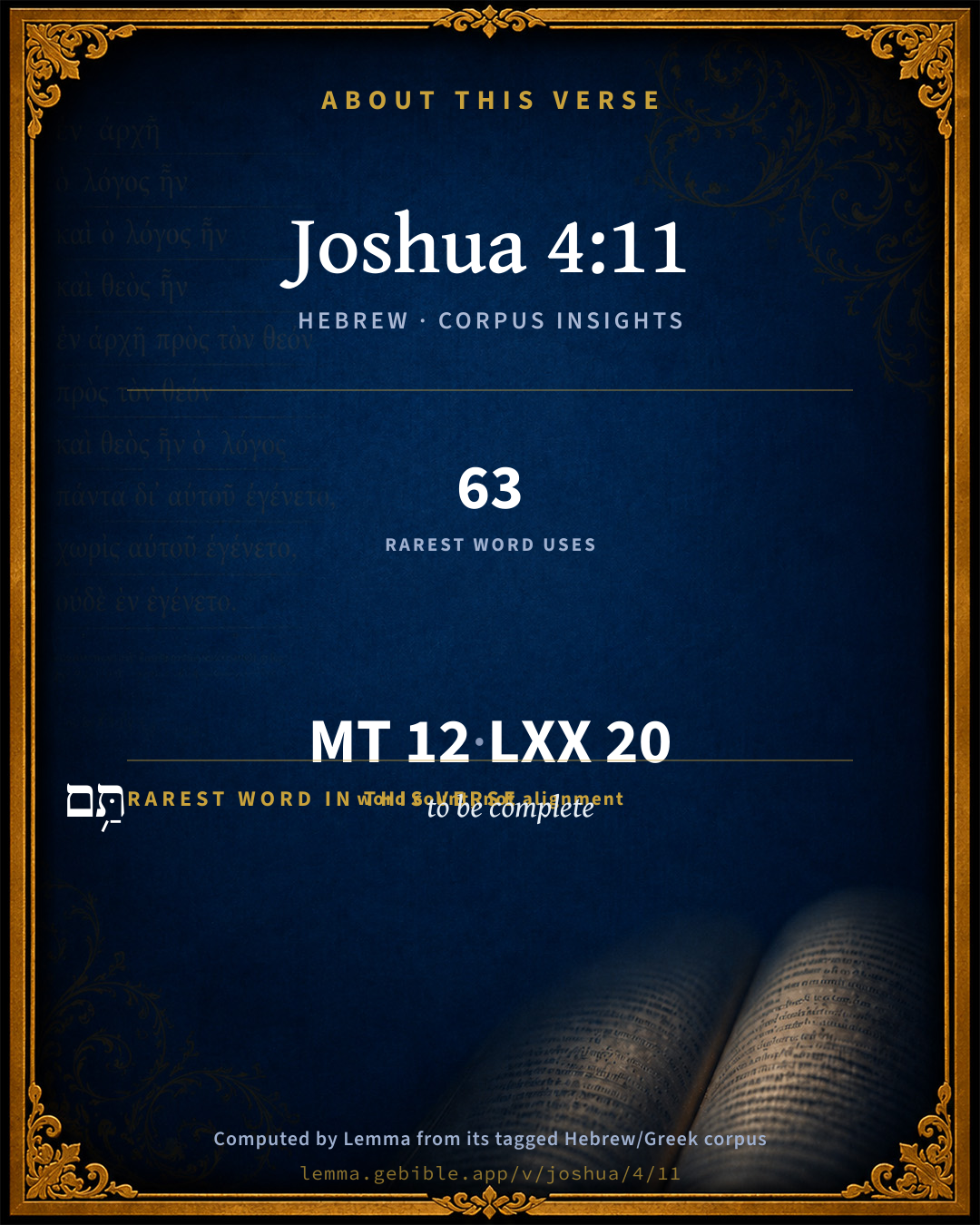
תַּ֥ם
tâmam
H8552
“to be complete”
Verb, Qal, Perfect, 3rd Person, Masculine, Singular
Part of Speech
Verb
Stem
Qal
Form
Perfect
Person
3rd Person
Gender
Masculine
Number
Singular
Full BDB Definition

Origin: a primitive root

TWOT: 2522

to be complete, be finished, be at an end - (Qal) - to be finished, be completed - completely, wholly, entirely (as auxiliary with verb) - to be finished, come to an end, cease - to be complete (of number) - to be consumed, be exhausted, be spent - to be finished, be consumed, be destroyed - to be complete, be sound, be unimpaired, be upright - to complete, finish - to be completely crossed over - (Niphal) to be consumed - (Hiphil) - to finish, complete, perfect - to finish, cease doing, leave off doing - to complete, sum up, make whole - to destroy (uncleanness) - to make sound - (Hithpael) to deal in integrity, act uprightly

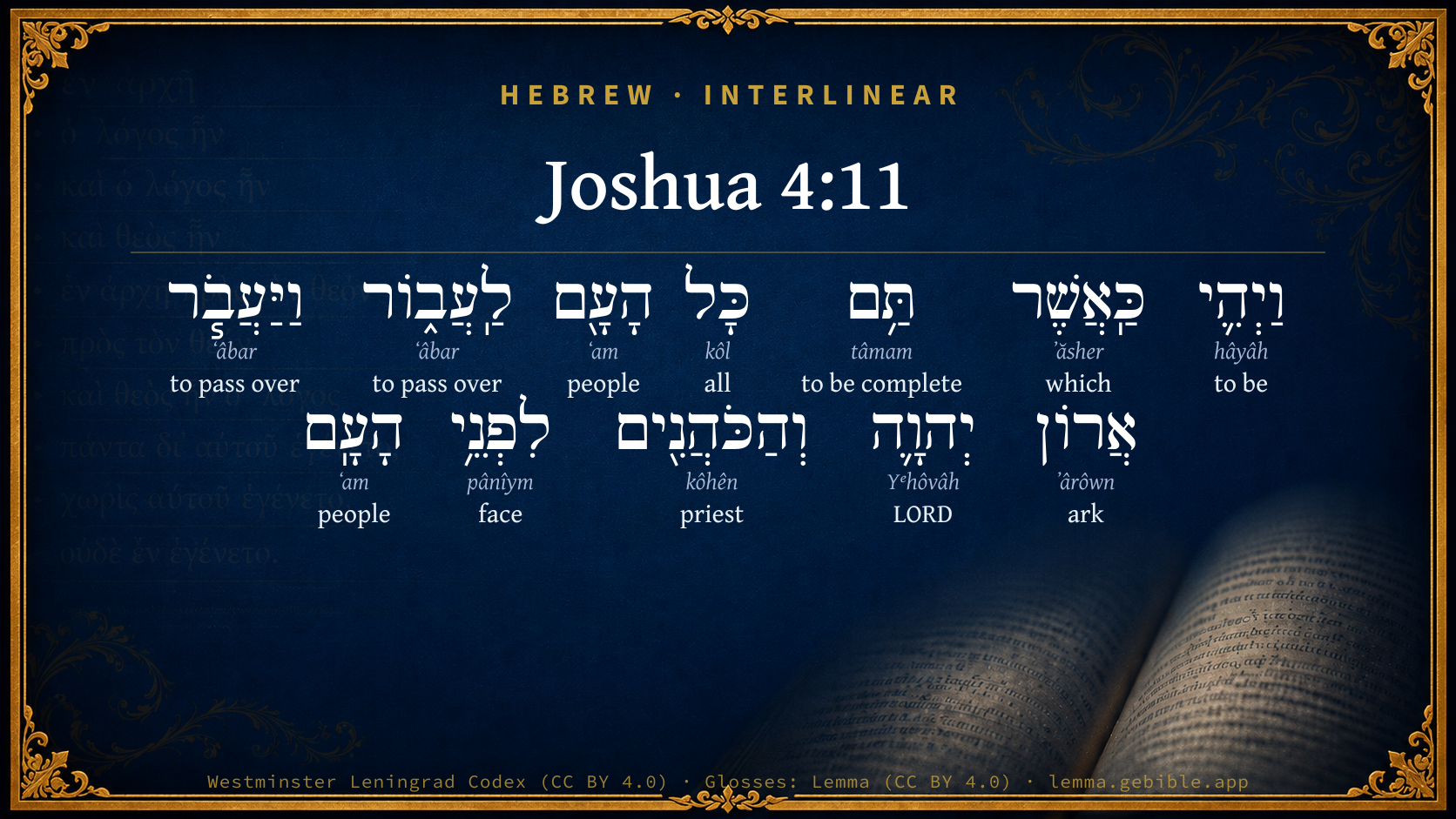
  1. וַיְהִ֛י hâyâh H1961 “and · to be” Conjunction + Verb, Qal, Sequential Imperfect, 3rd Person, Masculine, Singular
  2. כַּֽאֲשֶׁר ʼăsher H834 “like/as · which” Preposition + Particle, Relative
  3. כָּל kôl H3605 “all of” Noun, Common, Masculine, Singular, Construct
  4. הָעָ֖ם ʻam H5971 “the · people” Particle, Definite Article + Noun, Common, Masculine, Singular, Absolute
  5. לַֽעֲב֑וֹר ʻâbar H5674 “to pass over” Preposition + Verb, Qal, Infinitive Construct
  6. וַיַּעֲבֹ֧ר ʻâbar H5674 “and · to pass over” Conjunction + Verb, Qal, Sequential Imperfect, 3rd Person, Masculine, Singular
  7. אֲרוֹן ʼârôwn H727 “ark of” Noun, Common, Both, Singular, Construct
  8. יְהוָ֛ה Yᵉhôvâh H3068 “LORD” Noun, Proper
  9. וְהַכֹּהֲנִ֖ים kôhên H3548 “and · the · priests” Conjunction + Particle, Definite Article + Noun, Common, Masculine, Plural, Absolute
  10. לִפְנֵ֥י pânîym H6440 “to/for · face(s) of” Preposition + Noun, Common, Both, Plural, Construct
  11. הָעָֽם ʻam H5971 “the · people” Particle, Definite Article + Noun, Common, Masculine, Singular, Absolute

About this verse

These counts appear in no published source. They are computed here, from the morphology-tagged text and Lemma’s own curated glosses. What Lemma adds →

12
words
10
distinct lemmas
Historical
section

Grammatical profile

  • 4 verbs
  • 7 nouns
  • 1 particle

Verb forms

  • וַיְהִ֛י Qal · Sequential Imperfect
  • תַּ֥ם Qal · Perfect
  • לַֽעֲב֑וֹר Qal · Infinitive Construct
  • וַיַּעֲבֹ֧ר Qal · Sequential Imperfect

Repetition

Words recur within this verse — often emphatic in Hebrew:

  • הָעָ֖ם people H5971 ×2
  • לַֽעֲב֑וֹר to pass over H5674 ×2

Hebrew & Septuagint length

In English translation the verse runs 26 words from the Hebrew and 28 from the Septuagint (LXX English) — closely comparable.

A rough comparison of the two English renderings, which tokenize alike — not a word-level alignment.

Word counts can differ between the Hebrew and the Greek without any difference in meaning — e.g. the Hebrew direct-object marker אֵת has no separate Greek word, and Greek often adds the article ὁ.

In the original languages it is 12 Hebrew tokens and 20 Greek tokens — but the two are counted differently (Hebrew bundles its prefixes and suffixes into one token; the Greek is in lemma form), so that isn’t a like-for-like length.

Cross-references

3

Topical passages linked to Joshua 4:11 in the Treasury of Scripture Knowledge — connected by theme and wording, ordered by reader-vote popularity; previews shown in the World English Bible.

  • Joshua 3:8 You shall command the priests who bear the ark of the covenant, saying, When you are come to the brink of the waters of the Jordan, you shall stand still in the Jordan.
  • Joshua 3:17 The priests who bore the ark of the covenant of Yahweh stood firm on dry ground in the midst of the Jordan; and all Israel passed over on dry ground, until all the nation were passed clean over the Jordan.
  • Joshua 4:18 It happened, when the priests who bore the ark of the covenant of Yahweh were come up out of the midst of the Jordan, and the soles of the priests' feet were lifted up to the dry ground, that the waters of the Jordan returned to their place, and went over all its banks, as before.

Cross-references courtesy of OpenBible.info (CC BY 4.0).

Hebrew and Greek witnesses Masoretic Hebrew ↔ Greek Septuagint

The same verse in the two great witnesses to the Old Testament, shown verse-for-verse.

These are two independent witnesses, not word-aligned to each other, and the Septuagint is shown in lemma (dictionary) form.

Hebrew Joshua 4:11 Masoretic · Westminster Leningrad Codex

וַיְהִ֛י כַּֽאֲשֶׁר תַּ֥ם כָּל הָעָ֖ם לַֽעֲב֑וֹר וַיַּעֲבֹ֧ר אֲרוֹן יְהוָ֛ה וְהַכֹּהֲנִ֖ים לִפְנֵ֥י הָעָֽם

It happened, when all the people had completely passed over, that the ark of Yahweh passed over, with the priests, in the presence of the people.

World English Bible · Public Domain

Greek LXX Joshua 4:11 Septuagint · lemma form

καί γίγνομαι ὡς συντελέω πᾶς ὁ λαός διαβαίνω καί διαβαίνω ὁ κιβωτός ὁ διαθήκη κύριος καί ὁ λίθος ἔμπροσθεν αὐτός

And it came to pass when all the people had passed over, that the ark of the covenant of the Lord passed over, and the stones before them.

LXX2012 (modern English Septuagint) · Public Domain

On this verse, John Gill's Exposition discusses the Septuagint’s reading. Read the note in Commentary ↓

Hebrew: Westminster Leningrad Codex (CC BY 4.0). Greek: Septuagint (public domain); English from LXX2012 (modern English Septuagint) (Public Domain). How the Septuagint differs from the Hebrew →

Targum (Aramaic paraphrase)

1

The Targum is the ancient Jewish Aramaic paraphrase of the Hebrew Scriptures — an interpretive translation, not the Hebrew text itself. Onkelos (literal) and Pseudo-Jonathan (expansive) render the Torah, and Jonathan the Prophets. Coverage is partial: where no permissively-licensed English translation exists for a verse, only the Aramaic is shown. This is verse-level text, not a word-by-word alignment to the Hebrew.

  1. Targum Jonathan Prophets (Joshua–Malachi)
    וַהֲוָה כַּד שְׁלִים כָּל עַמָא לְמֶעְבַּר וַעֲבַר אֲרוֹנָא דַייָ וְכַהֲנַיָא קֳדָם עַמָא:

    (no public-domain English translation for this verse)

    Targum Jonathan — Aramaic: “Mikraot Gedolot” (public domain). English: “Sefaria Community Translation” (CC0 1.0 (public-domain dedication)); “London "Chaldee Paraphrase," 1871” (public domain). Text via Sefaria.

Commentary

Notes on Joshua 4:11 from classic Christian and Jewish commentators (each source and its license shown beneath its notes). The classic Christian expositions comment on the surrounding passage and are grouped to its opening verse, so a note may address several verses; the Jewish commentaries on the Tanakh (Rashi and others) are per-verse, so they appear only where the commentator wrote on this verse.

Lemma curates 59 commentaries, every one of them public domain or Creative Commons licensed, each selected and text-cleaned for this edition rather than reprinted as found. About our sources →

Trapp's Complete Commentary

John Trapp

Jos 4:11 And it came to pass, when all the people were clean passed over, that the ark of the LORD passed over, and the priests, in the presence of the people.

Ver. 11. That the ark of the Lord passed over.] That it might be both van and rear. "For ye shall not go out with haste" (it was weakness of faith that made this people to do so), "nor go by flight: for the Lord will go before you; and the God of Israel will be your rereward." {Isa 52:12}

John Trapp, A Commentary or Exposition upon All the Books of the Old and New Testament (1647–1656) — public domain. Text from a community e-Sword module.

Geneva Bible (1599)

Geneva Bible translators

Meaning, in the presence or sight of the people.

Geneva Bible (1599) marginal notes — public domain. Text via Bolls.life.

Jamieson, Fausset & Brown

Robert Jamieson, A. R. Fausset & David Brown

the ark of the Lord passed over, and the priests, in the presence of the people--The ark is mentioned as the efficient cause; it had been the first to move--it was the last to leave--and its movements arrested the deep attention of the people, who probably stood on the opposite bank, wrapt in admiration and awe of this closing scene. It was a great miracle, greater even than the passage of the Red Sea in this respect: that, admitting the fact, there is no possibility of rationalistic insinuations as to the influence of natural causes in producing it, as have been made in the former case.

Jamieson, Fausset & Brown — Commentary Critical and Explanatory on the Whole Bible (1871) — public domain (CC PDM 1.0). Text via the HelloAO Bible API.

John Gill's Exposition

And it came to pass, when the people were clean passed over,.... Every one of them, as in Jos 3:17,

that the ark of the Lord passed over, and the priests, in the presence of the people; that is, the priests bearing the ark came out of the midst of Jordan in the sight of all the people, who were on the banks of it, on the other side, where they had been stationed during the passage of the people; though this motion of them was not until they received an order for it, of which there is an after mention. The Septuagint version reads, "and the stones before them"; see Jos 4:8.

John Gill's Exposition of the Whole Bible (1746–1763) — public domain (CC PDM 1.0). Text via the HelloAO Bible API.

Haydock's Catholic Bible Commentary

People, who passed over 2000 cubits lower down, and always kept the same distance, till they arrived at Galgal. (Calmet)

George Leo Haydock (1774–1849), Haydock's Catholic Family Bible and Commentary, 1859 edition — public domain. Excludes Psalms (Douay-Rheims chapter numbering differs from Protestant) and Deuterocanonical books (Catholic canon only).

Matthew Poole's English Annotations

The people looking on, and beholding this wonderful work of God with attention and admiration.

Matthew Poole's English Annotations on the Holy Bible (1683–1685) — public domain. Text from a community e-Sword/MySword module.

Whedon's Commentary on the Bible

Daniel D. Whedon

11. The ark of the Lord passed over — Great prominence is given to the ark as the visible instrument of the miracle, the first to enter and the last to leave the bed of the Jordan.

In the presence of the people — Who, after their own hasty passage, were now standing on the western bank, contemplating the wonderful spectacle. This greatest miracle of the Old Testament had at least a million eye-witnesses.

Daniel D. Whedon (gen. ed.), Commentary on the Old and New Testaments (1874–1909) — public domain. Text from a community e-Sword module.

Rashi

Rabbi Shlomo Yitzchaki (Rashi)

And it was when all the people had finished crossing and the Ark crossed. The Ark did not cross as the others did, but in the manner explained below: ‘The soles of the feet of the Kohanim were lifted and they were moved back to the dry land, on the bank from which they initially entered. They were standing next to it and the waters were returned to their course to flow as they did before. The result of all this was that the Ark and its bearers were on this side and all the Bnei Yisroel were on the other (lit. this) side. The Ark then lifted its bearers and crossed over.’

In the people’s presence. Before the eyes of the people.

Rashi on the Tanakh — English translations: “The Judaica Press complete Tanach with Rashi, translated by A. J. Rosenberg” (CC BY 4.0); “Pentateuch with Rashi's commentary by M. Rosenbaum and A.M. Silbermann, 1929-1934” (public domain); “The Metsudah Tanach series, Lakewood, N.J” (CC BY 4.0); and “The Book of Joshua, Metsudah Publications, 1997” (CC BY 4.0). Text via Sefaria.

Lesson kit

Teaching starters — assembled from the data on this page, not authored interpretation. Every prompt links to the verse data it draws on. Edit before teaching.

Joshua, in the Historical, opens this verse with 12 words (10 distinct Hebrew lemmas). Its most distinctive word is tâmam (“to be complete”). A historical commentator’s framing appears above. Read the whole chapter for the surrounding context.

Discussion questions

  1. How does “to be complete” (tâmam) shape what this verse is saying?
  2. Joshua 3:8 shares this passage’s theme. How do the two illuminate each other?
  3. “people” occurs 2× in this one verse. What is the effect of the repetition?
  4. These translations render this verse differently; the difference is in the English rendering, not the original. What questions does that raise?
  5. The verb «וַיְהִ֛י» is Qal Sequential Imperfect. How does its form color the action?
  6. Reading how Trapp's Complete Commentary and Geneva Bible (1599) read this verse, where do the two commentators agree and where do they part?

Things to notice

Reading settings

Reading text

Shown beneath each verse's original-language words.

Old Testament
Old Testament edition

Read the OT as the Masoretic Hebrew (MT) or the Greek Septuagint (LXX).

English shown for the Greek Septuagint (in the Hebrew ↔ Greek comparison).

Comparing translations? Open the Compare panel on any verse page to stack up to four side by side.