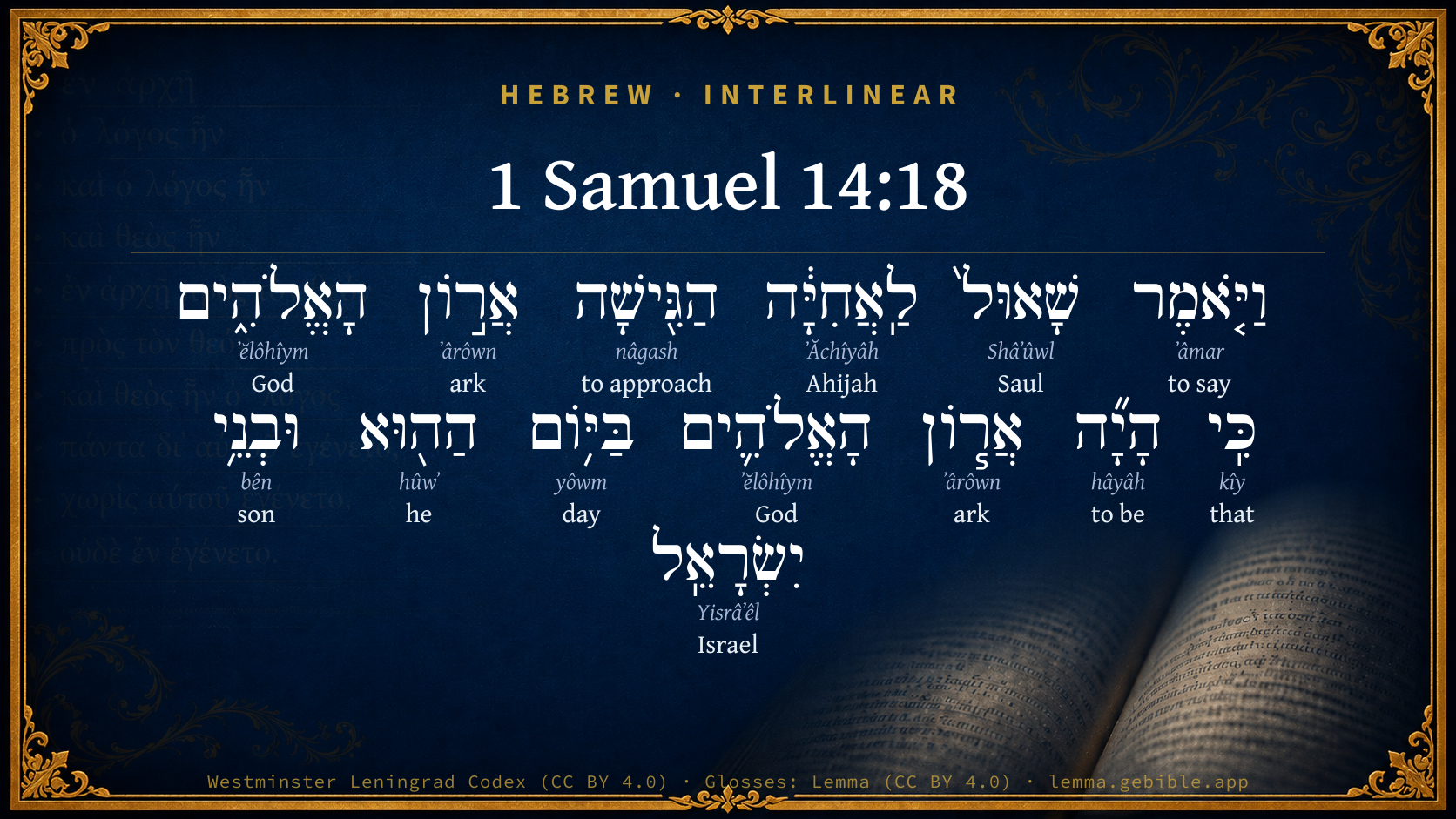
1 Samuel 14:18

Hebrew (Westminster Leningrad Codex) 1 Samuel 14:18 appears in the Hebrew Old Testament. The text above is from the Westminster Leningrad Codex. Each word links to its Strong’s number, a concise gloss, and parsing drawn from the Open Scriptures Hebrew Bible morphology. Click any word for its full Brown-Driver-Briggs (BDB) entry.
Download image
Cite this verse

1 Samuel 14:18 (World English Bible). Public Domain. Lemma interlinear Bible study tool, https://lemma.gebible.app/v/1-samuel/14/18.

Show BibTeX & RIS
BibTeX
RIS
English Translation
Saul said to Ahijah, Bring here the ark of God. For the ark of God was [there] at that time with the children of Israel.
World English Bible · Public Domain
Download a study sheet

One document with this verse’s original text, its word-by-word gloss line, the meaning frame, cross-references with their text, attributed commentary, and full source and license credits — printable, and it pastes into notes with its structure intact.

This verse Autodidact and up

Study sheet (.html) Plain text (.txt)

A passage Seminary Student

Up to 50 verses in one chapter. A passage sheet keeps up to 6 commentary sources and 12 cross-references per verse, in the order this page ranks them, and says so on the sheet whenever that leaves anything out. Ask for a single verse and you get the Autodidact verse sheet above.

Everything on this page stays free to read, with no account — the sheet is a download of what is already on screen, not access to it.

Want to remove ads? Support Godless Engineer
Compare translations 3

The same verse in 3 English versions, stacked beneath the original-language interlinear above. Click any original word for its lexicon entry.

Each is an independent rendering of the whole verse — the interlinear is not word-aligned to these translations.

Highlighted words mark where these versions differ — a whole-verse word diff, not a word-by-word alignment.

  • World English Bible Public Domain
    Saul said to Ahijah, Bring here the ark of God. For the ark of God was [there] at that time with the children of Israel.
  • King James Version Public Domain
    And Saul said unto Ahiah, Bring hither the ark of God. For the ark of God was at that time with the children of Israel.
  • unfoldingWord Literal Text CC BY-SA 4.0
    And Saul said to Ahijah, “Bring near the Box of God.” For the Box of God was with the sons of Israel on that day.

unfoldingWord Literal Text — © unfoldingWord, licensed CC BY-SA 4.0. Word-aligned USFM3 via Door43 (git.door43.org/unfoldingWord/en_ult).

Versions to compare (up to 4)

3 of 4 selected

Show all 18 translations

Every available English version of this verse, each an independent rendering of the whole verse.

  • World English Bible Public Domain
    Saul said to Ahijah, Bring here the ark of God. For the ark of God was [there] at that time with the children of Israel.
  • Berean Standard Bible Public Domain
    Then Saul said to Ahijah, “Bring the ark of God.” (For at that time it was with the Israelites.)
  • Majority Standard Bible Public Domain
    Then Saul said to Ahijah, “Bring the ark of God.” (For at that time it was with the Israelites.)
  • King James Version Public Domain
    And Saul said unto Ahiah, Bring hither the ark of God. For the ark of God was at that time with the children of Israel.
  • American Standard Version (1901) Public Domain
    And Saul said unto Ahijah, Bring hither the ark of God. For the ark of God was `there' at that time with the children of Israel.
  • Revised Version (1885) Public Domain
    And Saul said unto Ahijah, Bring hither the ark of God. For the ark of God was there at that time with the children of Israel.
  • Geneva Bible (1599) Public Domain
    And Saul said vnto Ahiah, Bring hither the Arke of God (for the Arke of God was at that time with the children of Israel)
  • Douay-Rheims (1899) Public Domain
    And Saul said to Achias: Bring the ark of the Lord. (For the ark of God was there that day with the children of Israel.)
  • Young's Literal Translation Public Domain
    And Saul saith to Ahiah, `Bring nigh the ark of God;' for the ark of God hath been on that day with the sons of Israel.
  • Literal Standard Version CC BY-SA 4.0
    And Saul says to Ahiah, “Bring the Ark of God near”; for the Ark of God has been with the sons of Israel on that day.
  • Unlocked Literal Bible CC BY-SA 4.0
    Saul said to Ahijah, “Bring the ark of God here,” for at that time it was with the people of Israel.
  • unfoldingWord Literal Text CC BY-SA 4.0
    And Saul said to Ahijah, “Bring near the Box of God.” For the Box of God was with the sons of Israel on that day.
  • Darby Bible Public Domain
    And Saul said to Ahijah, Bring hither the ark of God. For the ark of God was at that time with the children of Israel.
  • World Messianic Bible Public Domain
    Saul said to Ahijah, “Bring God’s ark here.” For God’s ark was with the children of Israel at that time.
  • Webster's Bible Public Domain
    And Saul said to Ahiah, Bring hither the ark of God. For the ark of God was at that time with the children of Israel.
  • Free Bible Version CC BY-SA 4.0
    Saul said to Ahijah, “Bring the Ark of God here.” (At the time the Ark of God traveled with the Israelites.)
  • Bible in Basic English Public Domain
    And Saul said to Ahijah, Let the ephod come here. For he went before Israel with the ephod at that time.
  • JPS Tanakh (1917) Public Domain
    And Saul said unto Ahijah: 'Bring hither the ark of God.' For the ark of God was there at that time with the children of Israel.

Literal Standard Version (2020), Covenant Press — licensed CC BY-SA 4.0. Text via the HelloAO Bible API (eBible.org). Unlocked Literal Bible (unfoldingWord) — licensed CC BY-SA 4.0. Text via the HelloAO Bible API (eBible.org). unfoldingWord Literal Text — © unfoldingWord, licensed CC BY-SA 4.0. Word-aligned USFM3 via Door43 (git.door43.org/unfoldingWord/en_ult). Free Bible Version, Dr. Jonathan Gallagher — licensed CC BY-SA 4.0. Text via the HelloAO Bible API (eBible.org).

Word by word

More ways to search: Search by grammar → Find every occurrence → Compare this word →

Practice this passage: Drill this verse → Learn its vocabulary →

לַֽאֲחִיָּ֔ה
ʼĂchîyâh
H281
“to/for · Ahijah”
Preposition + Noun, Proper
Part of Speech
Preposition + Noun
Type
Proper
Full BDB Definition

Origin: from H251 and H3050

TWOT: None

Ahiah or Ahijah = "brother of Jehovah (Yahu)" - grandson of Phinehas - scribe of Solomon - a prophet who predicted the revolt of the Northern tribes - father of Baasha, who usurped the Northern throne - grandson of Hezron (or mother of 1-4 above) - a Benjamite, son of Ehud - one of David's heroes - a Levite during David's time - a chief man under Nehemiah
  1. וַיֹּ֤אמֶר ʼâmar H559 “and · to say” Conjunction + Verb, Qal, Sequential Imperfect, 3rd Person, Masculine, Singular
  2. שָׁאוּל֙ Shâʼûwl H7586 “Saul” Noun, Proper
  3. הַגִּ֖ישָׁה nâgash H5066 “approach” Verb, Hiphil, Imperative, 2nd Person, Masculine, Singular + Suffix, h
  4. אֲר֣וֹן ʼârôwn H727 “ark of” Noun, Common, Both, Singular, Construct
  5. הָאֱלֹהִ֑ים ʼĕlôhîym H430 “the · God(s)” Particle, Definite Article + Noun, Common, Masculine, Plural, Absolute
  6. כִּֽי kîy H3588 “that” Conjunction
  7. הָיָ֞ה hâyâh H1961 “to be” Verb, Qal, Perfect, 3rd Person, Masculine, Singular
  8. אֲר֧וֹן ʼârôwn H727 “ark of” Noun, Common, Both, Singular, Construct
  9. הָאֱלֹהִ֛ים ʼĕlôhîym H430 “the · God(s)” Particle, Definite Article + Noun, Common, Masculine, Plural, Absolute
  10. בַּיּ֥וֹם yôwm H3117 “in/at the · day” Preposition, Determined + Noun, Common, Masculine, Singular, Absolute
  11. הַה֖וּא hûwʼ H1931 “the · he” Particle, Definite Article + Pronoun, Personal, 3rd Person, Masculine, Singular
  12. וּבְנֵ֥י bên H1121 “and · sons of” Conjunction + Noun, Common, Masculine, Plural, Construct
  13. יִשְׂרָאֵֽל Yisrâʼêl H3478 “Israel” Noun, Proper

About this verse

These counts appear in no published source. They are computed here, from the morphology-tagged text and Lemma’s own curated glosses. What Lemma adds →

14
words
12
distinct lemmas
Historical
section

Notable vocabulary

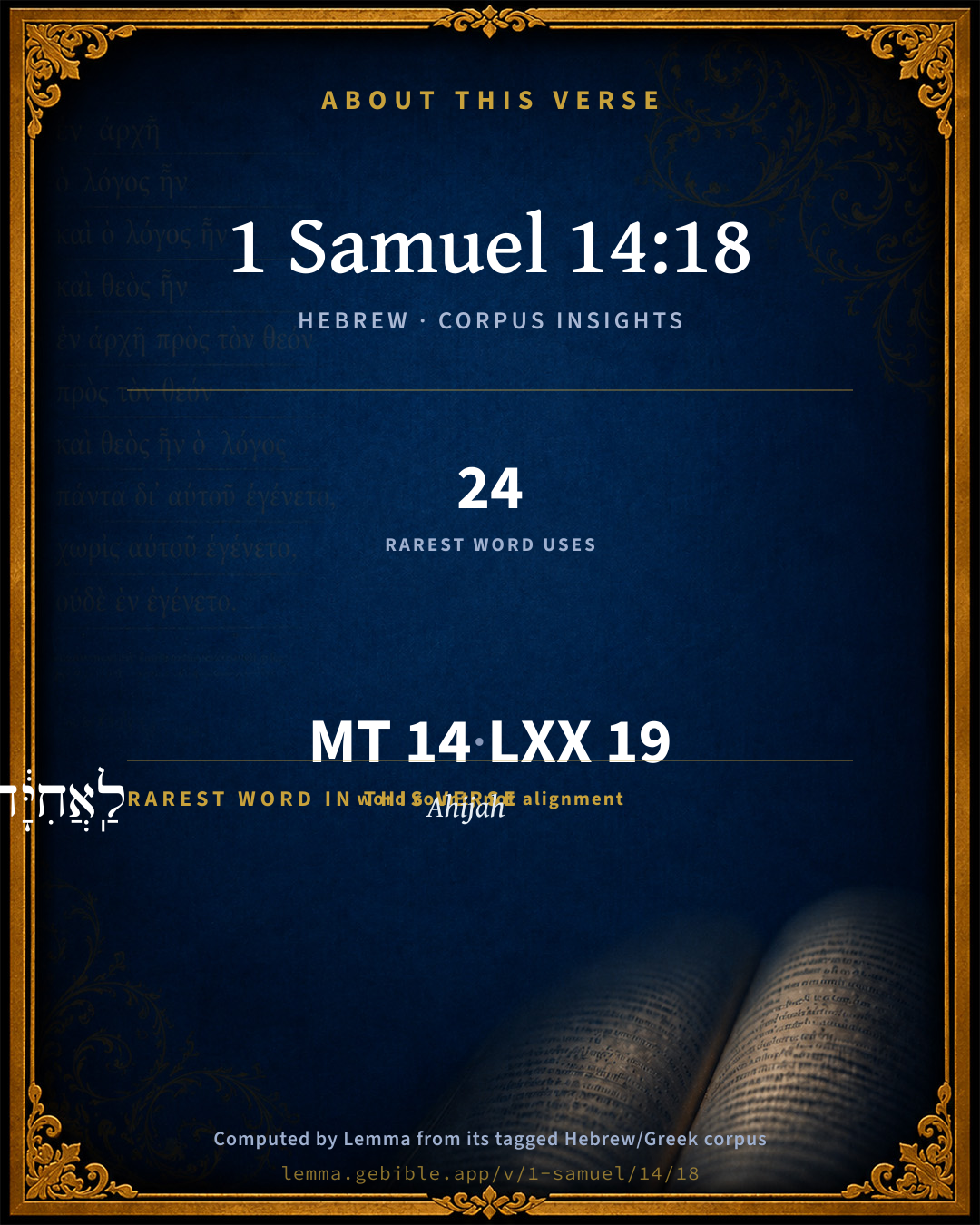
The rarest word here is לַֽאֲחִיָּ֔ה Ahijah H281 — appearing just 24 times in the whole Hebrew Bible.

Shared distinctive vocabulary

לַֽאֲחִיָּ֔ה Ahijah H281 occurs in 23 verses of the Hebrew Bible. Also found in:

Grammatical profile

  • 3 verbs
  • 9 nouns
  • 1 pronoun
  • 1 conjunction

Verb forms

  • וַיֹּ֤אמֶר Qal · Sequential Imperfect
  • הַגִּ֖ישָׁה Hiphil · Imperative
  • הָיָ֞ה Qal · Perfect

Repetition

Words recur within this verse — often emphatic in Hebrew:

  • אֲר֣וֹן ark H727 ×2
  • הָאֱלֹהִ֑ים God H430 ×2

Hebrew & Septuagint length

In English translation the verse runs 25 words from the Hebrew and 18 from the Septuagint (LXX English) — closely comparable.

A rough comparison of the two English renderings, which tokenize alike — not a word-level alignment.

Word counts can differ between the Hebrew and the Greek without any difference in meaning — e.g. the Hebrew direct-object marker אֵת has no separate Greek word, and Greek often adds the article ὁ.

In the original languages it is 14 Hebrew tokens and 19 Greek tokens — but the two are counted differently (Hebrew bundles its prefixes and suffixes into one token; the Greek is in lemma form), so that isn’t a like-for-like length.

Cross-references

10

Topical passages linked to 1 Samuel 14:18 in the Treasury of Scripture Knowledge — connected by theme and wording, ordered by reader-vote popularity; previews shown in the World English Bible.

  • Numbers 27:21 He shall stand before Eleazar the priest, who shall inquire for him by the judgment of the Urim before Yahweh: at his word shall they go out, and at his word they shall come in, both he, and all the children of Israel with him, even all the congregation.
  • Judges 20:18 The children of Israel arose, and went up to Bethel, and asked counsel of God; and they said, Who shall go up for us first to battle against the children of Benjamin? Yahweh said, Judah [shall go up] first.
  • Judges 20:23 The children of Israel went up and wept before Yahweh until even; and they asked of Yahweh, saying, Shall I again draw near to battle against the children of Benjamin my brother? Yahweh said, Go up against him.
  • Judges 20:27–28 The children of Israel asked of Yahweh (for the ark of the covenant of God was there in those days,
  • 1 Samuel 4:3–5 When the people were come into the camp, the elders of Israel said, Why has Yahweh struck us today before the Philistines? Let us get the ark of the covenant of Yahweh out of Shiloh to us, that it may come among us, and save us out of the hand of our enemies.
  • 1 Samuel 5:2 The Philistines took the ark of God, and brought it into the house of Dagon, and set it by Dagon.
  • 1 Samuel 7:1 The men of Kiriath Jearim came, and fetched up the ark of Yahweh, and brought it into the house of Abinadab in the hill, and sanctified Eleazar his son to keep the ark of Yahweh.
  • 1 Samuel 30:7–8 David said to Abiathar the priest, the son of Ahimelech, Please bring me here the ephod. Abiathar brought there the ephod to David.
  • 2 Samuel 11:11 Uriah said to David, The ark, and Israel, and Judah, abide in booths; and my lord Joab, and the servants of my lord, are encamped in the open field; shall I then go into my house, to eat and to drink, and to lie with my wife? as you live, and as your soul lives, I will not do this thing.
  • 2 Samuel 15:24–26 Behold, Zadok also [came], and all the Levites with him, bearing the ark of the covenant of God; and they set down the ark of God; and Abiathar went up, until all the people had done passing out of the city.

Cross-references courtesy of OpenBible.info (CC BY 4.0).

Hebrew and Greek witnesses Masoretic Hebrew ↔ Greek Septuagint

The same verse in the two great witnesses to the Old Testament, shown verse-for-verse.

These are two independent witnesses, not word-aligned to each other, and the Septuagint is shown in lemma (dictionary) form.

Hebrew 1 Samuel 14:18 Masoretic · Westminster Leningrad Codex

וַיֹּ֤אמֶר שָׁאוּל֙ לַֽאֲחִיָּ֔ה הַגִּ֖ישָׁה אֲר֣וֹן הָאֱלֹהִ֑ים כִּֽי הָיָ֞ה אֲר֧וֹן הָאֱלֹהִ֛ים בַּיּ֥וֹם הַה֖וּא וּבְנֵ֥י יִשְׂרָאֵֽל

Saul said to Ahijah, Bring here the ark of God. For the ark of God was [there] at that time with the children of Israel.

World English Bible · Public Domain

Greek LXX 1 Samuel 14:18 Septuagint · lemma form

καί εἶπον σαούλ ὁ αχια προςἄγω ὁ εφουδ ὅτι αὐτός αἴρω ὁ εφουδ ἐν ὁ ἡμέρα ἐκεῖνος ἐνώπιον ἰσραήλ

And Saul said to Achia, Bring the ephod; for he wore the ephod in that day before Israel.

LXX2012 (modern English Septuagint) · Public Domain

On this verse, Jamieson, Fausset & Brown discusses the Septuagint’s reading. Read the note in Commentary ↓

Hebrew: Westminster Leningrad Codex (CC BY 4.0). Greek: Septuagint (public domain); English from LXX2012 (modern English Septuagint) (Public Domain). How the Septuagint differs from the Hebrew →

Targum (Aramaic paraphrase)

1

The Targum is the ancient Jewish Aramaic paraphrase of the Hebrew Scriptures — an interpretive translation, not the Hebrew text itself. Onkelos (literal) and Pseudo-Jonathan (expansive) render the Torah, and Jonathan the Prophets. Coverage is partial: where no permissively-licensed English translation exists for a verse, only the Aramaic is shown. This is verse-level text, not a word-by-word alignment to the Hebrew.

  1. Targum Jonathan Prophets (Joshua–Malachi)
    וַאֲמַר שָׁאוּל לַאֲחִיָהּ קָרֵיב אֲרוֹנָא דַייָ אֲרֵי הֲוָה אֲרוֹנָא דַייָ בְּיוֹמָא הַהוּא עִם בְּנֵי יִשְׂרָאֵל:

    (no public-domain English translation for this verse)

    Targum Jonathan — Aramaic: “Mikraot Gedolot” (public domain). English: “Sefaria Community Translation” (CC0 1.0 (public-domain dedication)); “London "Chaldee Paraphrase," 1871” (public domain). Text via Sefaria.

Commentary

Notes on 1 Samuel 14:18 from classic Christian and Jewish commentators (each source and its license shown beneath its notes). The classic Christian expositions comment on the surrounding passage and are grouped to its opening verse, so a note may address several verses; the Jewish commentaries on the Tanakh (Rashi and others) are per-verse, so they appear only where the commentator wrote on this verse.

Lemma curates 59 commentaries, every one of them public domain or Creative Commons licensed, each selected and text-cleaned for this edition rather than reprinted as found. About our sources →

Trapp's Complete Commentary

John Trapp

1Sa 14:18 And Saul said unto Ahiah, Bring hither the ark of God. For the ark of God was at that time with the children of Israel.

Ver. 18. And Saul said unto Ahiah.] See 1Sa 14:3. Hypocrites in a strait repair to God, not so much to serve him, as to serve themselves upon him: for at another time they think themselves men good enough; and act as if they were petty gods within themselves.

John Trapp, A Commentary or Exposition upon All the Books of the Old and New Testament (1647–1656) — public domain. Text from a community e-Sword module.

Joseph Benson's Commentary

1Sa 14:18-19. Saul said, Bring hither the ark of God — Finding only Jonathan and his armour-bearer missing, Saul did not know what to conclude, and therefore called in all haste for Ahiah the priest, to inquire of the Lord concerning it, and in what manner he and the people with him were to act. But before the priest had performed his office, the rout and flight of the Philistines were perceived so plainly that Saul called to the priest to desist, or, as it is expressed, to withdraw his hand, as there was no occasion for further inquiry, it being plain what the matter was, and what they had to do.

Joseph Benson's Commentary on the Old and New Testaments (1811–1818) — public domain. Text from a community e-Sword module.

Tyndale Open Study Notes

Tyndale Open Resources

14:18 Bring . . . Israelites: See NLT textual note; the Greek text is likely original. The Ark remained at Kiriath-jearim for twenty years (7:2), and it was never used for getting information about the future, as the ephod was (see study note on 2:18).

Tyndale Open Study Notes — © Tyndale Open Resources, licensed CC BY-SA 4.0. Text via the HelloAO Bible API.

Jamieson, Fausset & Brown

Robert Jamieson, A. R. Fausset & David Brown

Saul said unto Ahiah, Bring hither the ark of God--There is no evidence that the ark had been brought from Kirjath-jearim. The Septuagint version is preferable; which, by a slight variation of the text, reads, "the ephod"; that is, the priestly cape, which the high priest put on when consulting the oracle. That this should be at hand is natural, from the presence of Ahiah himself, as well as the nearness of Nob, where the tabernacle was then situated.

Jamieson, Fausset & Brown — Commentary Critical and Explanatory on the Whole Bible (1871) — public domain (CC PDM 1.0). Text via the HelloAO Bible API.

Adam Clarke's Commentary

Verse 18. Bring hither the ark of God] He wished to inquire what use he should make of the present favourable circumstances, and to proceed in the business as God should direct.

Adam Clarke's Commentary on the Bible (1810–1826) — public domain. Text from a community e-Sword/MySword module.

Ellicott's Commentary for English Readers

(18) And Saul said unto Ahiah . . .—The LXX. renders here, “And Saul said to Ahijah, Bring hither the ephod; for he bore the ephod in those days before the children of Israel.” This is a statement easily to be understood. Saul was in doubt what to do under the present emergency. Should he—seeing the panic that was evidently increasing in the Philistine camp, and knowing nothing of the cause, only that his son and the armour-bearer were missing—should he risk his little force, and, leaving his strong position, attack that great host of apparently panic-stricken enemies? So he sent for the high priest Ahijah, and bade him consult the Urim and Thummim in his ephod.

But the Hebrew and all the versions read as in our English Version, “Bring hither the Ark of God” What does this mean? Was the Ark, then, with that little band of Saul? We never before, or after, find the slightest hint that the sacred coffer ever left the “city of woods” (Kiriath-yearim) until David bore it to Zion. Then, again, the word preceding “Bring hither” is never used in connection with the Ark. No question or oracle could be asked of the Ark or by the Ark. The Urim and Thummim, whatever these mysterious objects were alone were used to give answers to questions solemnly asked by king and people, and this Urim and Thummim were connected, not with the Ark, but with the high-priestly ephod. On the whole, the reading of the LXX. probably represents the original Hebrew. The present Hebrew text, with the word “Ark,” is, however, clearly of extreme antiquity; the second part of the verse is most likely an explanatory gloss of some ancient scribe. Josephus’ account of this transaction shows us that he had before him a text corresponding to the LXX. His words are, “He bid the priest take the garment of his high priesthood and prophesy” (Antiq., 6 § 3). Maurer prefers the present Hebrew text, for he says, At that supreme moment of danger Saul wanted not the advice of an oracle, but rather the help and encouragement which the presence of the sacred Ark would give to his handful of soldiers. But this would rather degrade Saul to the level of the superstitious Hophni and Phinehas, the wicked sons of Eli. who, it will be remembered, exposed and lost the sacred Ark in the fatal battle in which they perished. Saul, with all his faults, was a far nobler type of man than those profligate, though brave, priests.

A Bible Commentary for English Readers, edited by Charles John Ellicott (1878–1897) — public domain. Text from a community e-Sword module.

The Cambridge Bible for Schools and Colleges

gen. ed. J. J. S. Perowne

18. Bring hither the ark of God] Saul wished to “inquire of God” before going to battle. See Num_27:21. But apart from the fact that we have no mention of the transportation of the Ark from Kirjath-jearim, it was not the Ark, but the Ephod with Urim and Thummim which was the proper instrument for ascertaining the will of God. Moreover “bring hither” is a term applied to the Ephod (1Sa_23:9, 1Sa_30:7) but not to the Ark. It seems best therefore to follow the reading of the Sept.; “And Saul said to Ahia, bring hither the Ephod: for he wore the Ephod at that time before the children of Israel.”

The Cambridge Bible for Schools and Colleges (gen. ed. J. J. S. Perowne; Cambridge University Press, 1878–1918) — public domain. Text from a community e-Sword module.

John Gill's Exposition

And Saul said unto Ahiah, bring hither the ark of the Lord,.... That he, the high priest, might put on the ephod, with the Urim and Thummim, and inquire by them of the Lord before it, concerning the affair of Jonathan, what he had done, and the agitation that was in the host of the Philistines; so the Septuagint version, "bring the ephod", of which, with the Urim and Thummim, Kimchi interprets it; and ask, whether it was right for him to go out unto them, or continue where he was:

for the ark of God was at that time with the children of Israel; and so it always was, except a few months it was in the hands of the Philistines; so it was at Kirjathjearim, where it was last. Jarchi thinks a word is wanting, and to be supplied thus,"the ark of God was there at that time with the children of Israel,''at Gibeah; perhaps it might be removed first to Gilgal, when Saul and Samuel were there, and when they came to Gibeah it was brought along with them; but the last words may be considered as a distinct clause, and, literally tendered, are, "and the children of Israel": which Abarbinel accounts for thus, and Saul said this:

bring hither the ark of the Lord; and the children of Israel said so likewise, joined with him in it: though the ark had been with Saul, and the people, some time, and also the high priest, yet we do not find that Saul in all his straits and difficulties consulted the Lord before; but perceiving something extraordinary was doing, and might turn to his advantage, he begins to inquire.

John Gill's Exposition of the Whole Bible (1746–1763) — public domain (CC PDM 1.0). Text via the HelloAO Bible API.

Albert Barnes' Notes on the Bible

For “the ark,” some read “the ephod,” owing to the improbability of the ark being with Saul at this time, and from the verb “Bring hither” being never applied to the ark, but regularly to the ephod 1Sa 23:9; 1Sa 30:7. Moreover, not the ark, but the ephod with Urim and Thummim, was the proper instrument for inquiring of the Lord. If, however, the Hebrew text is correct, they must have brought the ark into Saul’s camp from Kirjath-jearim 1 Sam. 7, possibly to be safe from the Philistines.

Albert Barnes' Notes on the Bible (1834–1885) — public domain. Text from a community e-Sword/MySword module.

Haydock's Catholic Bible Commentary

Ark. Septuagint, "the ephod." (Kimchi, &c.) --- Spencer follows the sentiment of the Rabbins, and explains it of a little box, in which the ephod and pectoral were placed, when they were brought to the army. But what need of this explication? (Calmet) --- How the oracle was given is uncertain. (Menochius)

George Leo Haydock (1774–1849), Haydock's Catholic Family Bible and Commentary, 1859 edition — public domain. Excludes Psalms (Douay-Rheims chapter numbering differs from Protestant) and Deuterocanonical books (Catholic canon only).

Matthew Poole's English Annotations

That the priest may put on the ephod, and may inquire of the Lord before the ark what the occasion of this tumult among our enemies is, and what we shall do.

With the children of Israel, to wit, in the camp, whither sometimes it was brought; as 1Sa 4:5; and now the rather, partly because it was now in an unsettled condition, and without the tabernacle, and therefore easily removed from place to place; and partly because Saul thought to compensate Samuel’s absence with the presence of the ark.

Matthew Poole's English Annotations on the Holy Bible (1683–1685) — public domain. Text from a community e-Sword/MySword module.

Whedon's Commentary on the Bible

Daniel D. Whedon

18. Bring hither the ark of God — In his excitement and alarm on finding Jonathan and his armourbearer gone, Saul is about to commit as grievous a blunder as did the elders of Israel in a former war with the Philistines. 1Sa_4:3.

For the ark of God was at that time with the children of Israel — That is, it was at Kirjath-jearim, (1Sa_7:1,) and in the possession of the Israelites, from whom it had not been taken since its return from the land of the Philistines. The Hebrew text ובני ישׂראל, and the children of Israel, gives no sense, and must be an error of the copyist for לבני or בבני, to or among the children of Israel. This need not be understood as meaning that the ark was with Saul’s six hundred at Gibeah, but, as explained above, in the possession of the Israelites. This seems to us the most satisfactory way of explaining this verse as it stands in the present Hebrew text. But there are grave reasons for doubting the integrity of this text, and for adopting the reading of the Septuagint, which has ephod instead of ark. The ephod, not the ark, was used for inquiring of God, and the expression, bring hither the ark, is strange in this connexion, but bring hither the ephod is common. See 1Sa_23:9; 1Sa_30:7. The Septuagint reads: Bring hither the ephod, for he (Ahiah) bore the ephod in that day before Israel.

Daniel D. Whedon (gen. ed.), Commentary on the Old and New Testaments (1874–1909) — public domain. Text from a community e-Sword module.

unfoldingWord translationNotes

Door43 World Missions Community

Bring the ark of God here

A few versions have "ephod" here instead of "ark of God." (See: Textual Variants)

commotion

great noise and confusion

Withdraw your hand

This seems to be an idiom the means "Stop what you are doing." Saul did not want Ahijah to continue to use the ark to ask God for direction. AT: "Do not bring the sacred chest at this time" (See: Idiom)

translationWords

Ahijah

ark of the covenant

God

Israel

priest

Philistines

unfoldingWord translationNotes — © Distant Shores Media and the Door43 World Missions Community, licensed CC BY-SA 4.0. Source: git.door43.org/Door43/en_tn.

Rashi

Rabbi Shlomo Yitzchaki (Rashi)

Bring near the Ark of God. I.e., the Urim and Tumim.

For the Ark of God was there on that day. This verse is missing one word; [what it means is,] "because the Ark of God was there [שָׁם] on that day."

Rashi on the Tanakh — English translations: “The Judaica Press complete Tanach with Rashi, translated by A. J. Rosenberg” (CC BY 4.0); “Pentateuch with Rashi's commentary by M. Rosenbaum and A.M. Silbermann, 1929-1934” (public domain); “The Metsudah Tanach series, Lakewood, N.J” (CC BY 4.0); and “The Book of Joshua, Metsudah Publications, 1997” (CC BY 4.0). Text via Sefaria.

Lesson kit

Teaching starters — assembled from the data on this page, not authored interpretation. Every prompt links to the verse data it draws on. Edit before teaching.

1 Samuel, in the Historical, opens this verse with 14 words (12 distinct Hebrew lemmas). Its most distinctive word is ʼĂchîyâh (“Ahijah”). A historical commentator’s framing appears above. Read the whole chapter for the surrounding context.

Discussion questions

  1. The word ʼĂchîyâh carries the sense “Ahijah.” How does it shape the verse?
  2. 1 Samuel 14:3 shares the word «Ahijah» with this verse. How do the two illuminate each other?
  3. “ark” occurs 2× in this one verse. What is the effect of the repetition?
  4. These translations render this verse differently; the difference is in the English rendering, not the original. What questions does that raise?
  5. The verb «וַיֹּ֤אמֶר» is Qal Sequential Imperfect. How does its form color the action?
  6. Reading how Trapp's Complete Commentary and Joseph Benson's Commentary read this verse, where do the two commentators agree and where do they part?

Things to notice

Reading settings

Reading text

Shown beneath each verse's original-language words.

Old Testament
Old Testament edition

Read the OT as the Masoretic Hebrew (MT) or the Greek Septuagint (LXX).

English shown for the Greek Septuagint (in the Hebrew ↔ Greek comparison).

Comparing translations? Open the Compare panel on any verse page to stack up to four side by side.