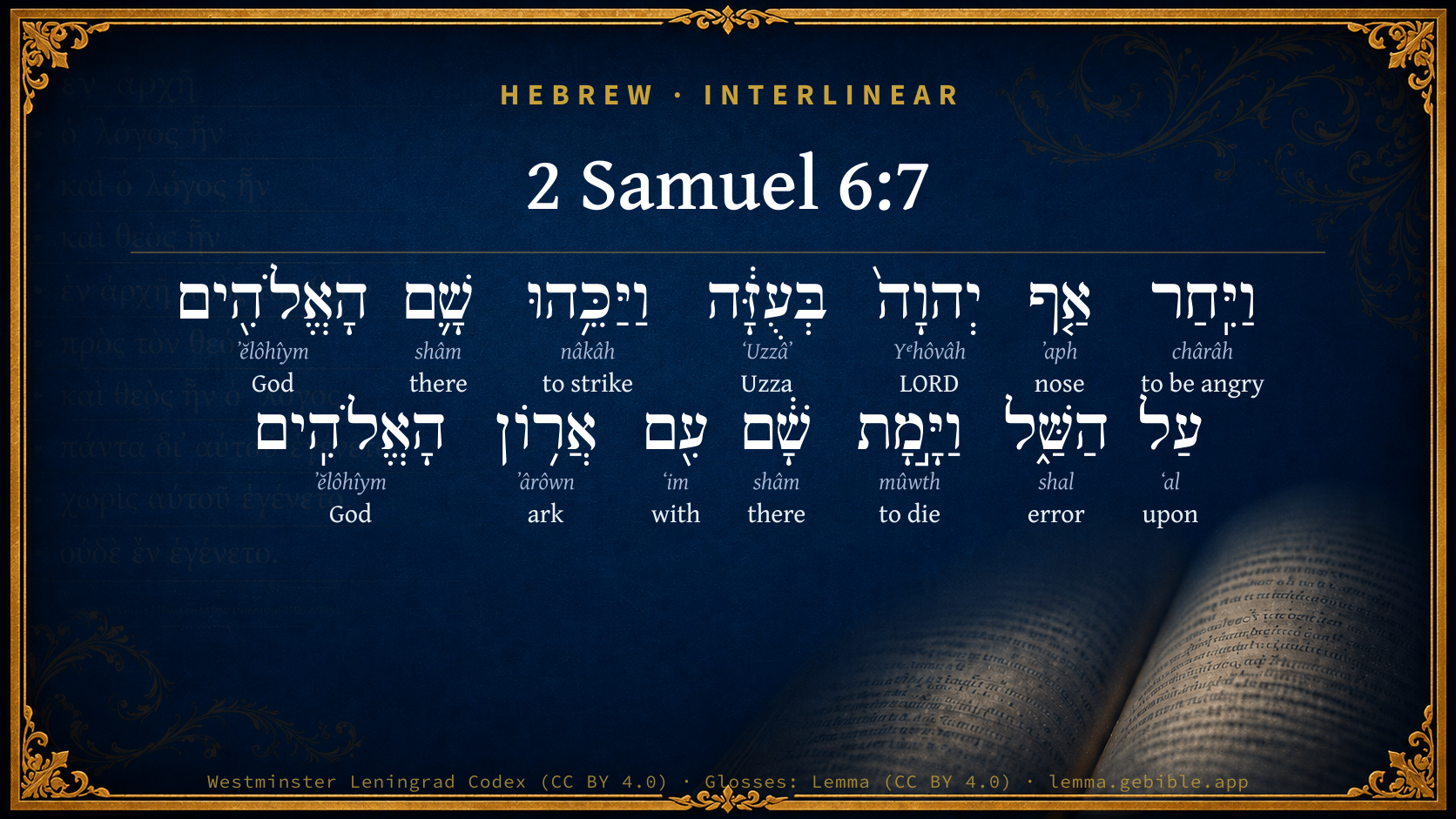
2 Samuel 6:7

Hebrew (Westminster Leningrad Codex) 2 Samuel 6:7 appears in the Hebrew Old Testament. The text above is from the Westminster Leningrad Codex. Each word links to its Strong’s number, a concise gloss, and parsing drawn from the Open Scriptures Hebrew Bible morphology. Click any word for its full Brown-Driver-Briggs (BDB) entry.
Download image
Cite this verse

2 Samuel 6:7 (World English Bible). Public Domain. Lemma interlinear Bible study tool, https://lemma.gebible.app/v/2-samuel/6/7.

Show BibTeX & RIS
BibTeX
RIS
English Translation
The anger of Yahweh was kindled against Uzzah; and God struck him there for his error; and there he died by the ark of God.
World English Bible · Public Domain
Highlights
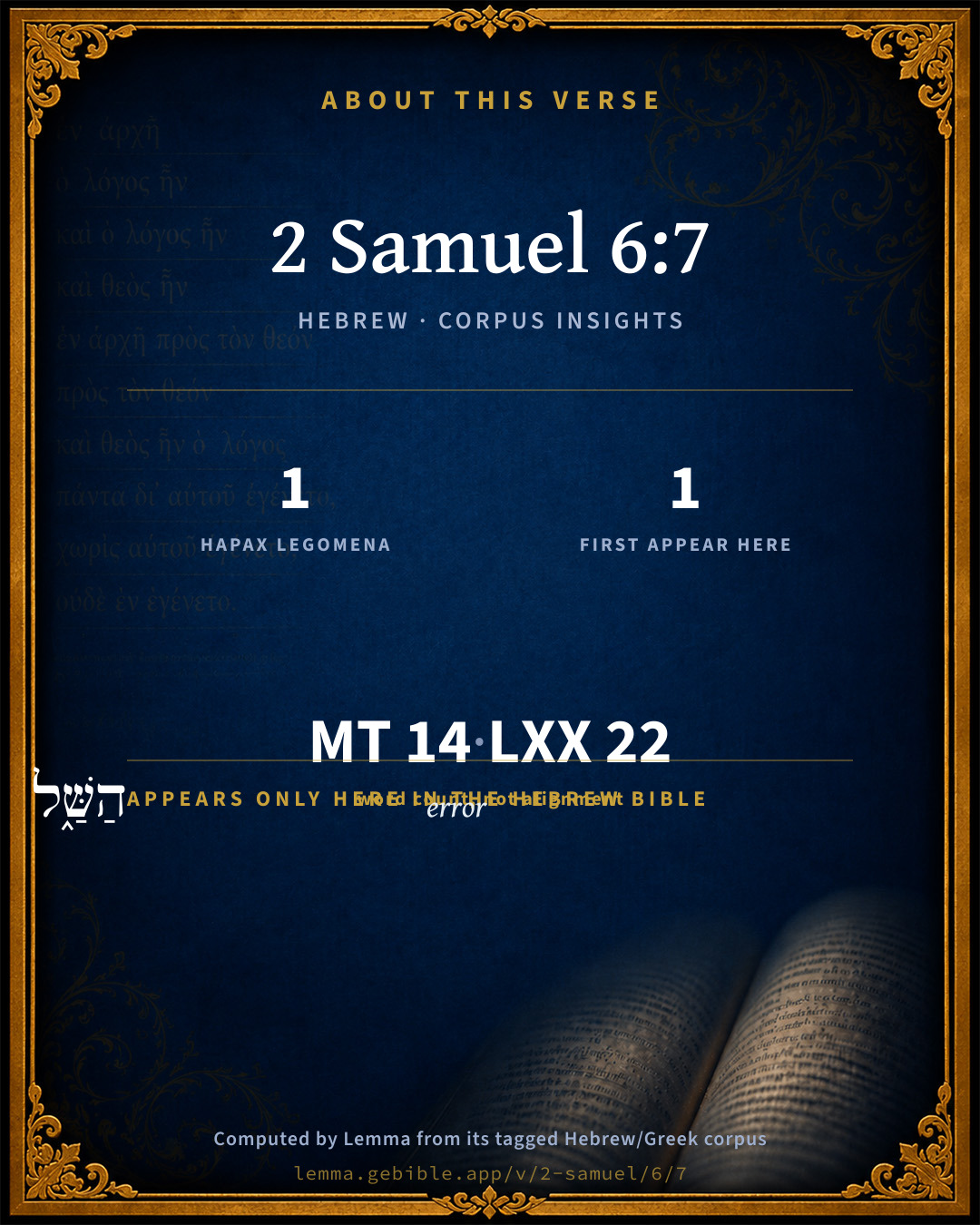
  • 1 hapax legomenon — only here in the Hebrew Bible
  • 1 first appearance in the Hebrew Bible
Full analysis ↓
Download a study sheet

One document with this verse’s original text, its word-by-word gloss line, the meaning frame, cross-references with their text, attributed commentary, and full source and license credits — printable, and it pastes into notes with its structure intact.

This verse Autodidact and up

Study sheet (.html) Plain text (.txt)

A passage Seminary Student

Up to 50 verses in one chapter. A passage sheet keeps up to 6 commentary sources and 12 cross-references per verse, in the order this page ranks them, and says so on the sheet whenever that leaves anything out. Ask for a single verse and you get the Autodidact verse sheet above.

Everything on this page stays free to read, with no account — the sheet is a download of what is already on screen, not access to it.

Want to remove ads? Support Godless Engineer
Compare translations 3

The same verse in 3 English versions, stacked beneath the original-language interlinear above. Click any original word for its lexicon entry.

Each is an independent rendering of the whole verse — the interlinear is not word-aligned to these translations.

Highlighted words mark where these versions differ — a whole-verse word diff, not a word-by-word alignment.

  • World English Bible Public Domain
    The anger of Yahweh was kindled against Uzzah; and God struck him there for his error; and there he died by the ark of God.
  • King James Version Public Domain
    And the anger of the LORD was kindled against Uzzah; and God smote him there for his error; and there he died by the ark of God.
  • unfoldingWord Literal Text CC BY-SA 4.0
    And the nose of Yahweh burned against Uzzah, and God struck him there for the fault. And he died there by the Box of God.

unfoldingWord Literal Text — © unfoldingWord, licensed CC BY-SA 4.0. Word-aligned USFM3 via Door43 (git.door43.org/unfoldingWord/en_ult).

Versions to compare (up to 4)

3 of 4 selected

Show all 18 translations

Every available English version of this verse, each an independent rendering of the whole verse.

  • World English Bible Public Domain
    The anger of Yahweh was kindled against Uzzah; and God struck him there for his error; and there he died by the ark of God.
  • Berean Standard Bible Public Domain
    And the anger of the LORD burned against Uzzah, and God struck him down on the spot for his irreverence, and he died there beside the ark of God.
  • Majority Standard Bible Public Domain
    And the anger of the LORD burned against Uzzah, and God struck him down on the spot for his irreverence, and he died there beside the ark of God.
  • King James Version Public Domain
    And the anger of the LORD was kindled against Uzzah; and God smote him there for his error; and there he died by the ark of God.
  • American Standard Version (1901) Public Domain
    And the anger of Jehovah was kindled against Uzzah; and God smote him there for his error; and there he died by the ark of God.
  • Revised Version (1885) Public Domain
    And the anger of the LORD was kindled against Uzzah; and God smote him there for his error; and there he died by the ark of God.
  • Geneva Bible (1599) Public Domain
    And the Lord was verie wroth with Vzzah, and God smote him in the same place for his fault, and there he dyed by the Arke of God.
  • Douay-Rheims (1899) Public Domain
    And the indignation of the Lord was enkindled against Oza, and he struck him for his rashness: and he died there before the ark of God.
  • Young's Literal Translation Public Domain
    and the anger of Jehovah burneth against Uzzah, and God smiteth him there for the error, and he dieth there by the ark of God.
  • Literal Standard Version CC BY-SA 4.0
    and the anger of YHWH burns against Uzzah, and God strikes him there for the error, and he dies there by the Ark of God.
  • Unlocked Literal Bible CC BY-SA 4.0
    Then the anger of Yahweh burned against Uzzah. God attacked him there for his sin. Uzzah died there by the ark of God.
  • unfoldingWord Literal Text CC BY-SA 4.0
    And the nose of Yahweh burned against Uzzah, and God struck him there for the fault. And he died there by the Box of God.
  • Darby Bible Public Domain
    And the anger of Jehovah was kindled against Uzzah; and God smote him there for his error; and there he died by the ark of God.
  • World Messianic Bible Public Domain
    The LORD’s anger burned against Uzzah, and God struck him there for his error; and he died there by God’s ark.
  • Webster's Bible Public Domain
    And the anger of the LORD was kindled against Uzzah, and God smote him there for his error; and there he died by the ark of God.
  • Free Bible Version CC BY-SA 4.0
    The Lord was angry with Uzzah, and God struck him down right there for his disobedience, and he died beside the Ark of God.
  • Bible in Basic English Public Domain
    And the wrath of the Lord, burning against Uzzah, sent destruction on him because he had put his hand on the ark, and death came to him there by the ark of God.
  • JPS Tanakh (1917) Public Domain
    And the anger of the LORD was kindled against Uzzah; and God smote him there for his error; and there he died by the ark of God.

Literal Standard Version (2020), Covenant Press — licensed CC BY-SA 4.0. Text via the HelloAO Bible API (eBible.org). Unlocked Literal Bible (unfoldingWord) — licensed CC BY-SA 4.0. Text via the HelloAO Bible API (eBible.org). unfoldingWord Literal Text — © unfoldingWord, licensed CC BY-SA 4.0. Word-aligned USFM3 via Door43 (git.door43.org/unfoldingWord/en_ult). Free Bible Version, Dr. Jonathan Gallagher — licensed CC BY-SA 4.0. Text via the HelloAO Bible API (eBible.org).

Word by word

More ways to search: Search by grammar → Find every occurrence → Compare this word →

Practice this passage: Drill this verse → Learn its vocabulary →

הַשַּׁ֑ל
shal
H7944
“the · error”
Particle, Definite Article + Noun, Common, Masculine, Singular, Absolute
Part of Speech
Particle + Noun
Type
Common
Gender
Masculine
Number
Singular
State
Absolute
Full BDB Definition

Origin: from H7952 abbrev

TWOT: 2389 . 1

error, fault - meaning uncertain
  1. וַיִּֽחַר chârâh H2734 “and · to be angry” Conjunction + Verb, Qal, Sequential Imperfect, 3rd Person, Masculine, Singular
  2. אַ֤ף ʼaph H639 “nose” Particle, Accusative
  3. יְהוָה֙ Yᵉhôvâh H3068 “LORD” Noun, Proper
  4. בְּעֻזָּ֔ה ʻUzzâʼ H5798 “in/at · Uzza” Preposition + Noun, Proper
  5. וַיַּכֵּ֥הוּ nâkâh H5221 “and · to strike · him” Conjunction + Verb, Hiphil, Sequential Imperfect, 3rd Person, Masculine, Singular + Suffix, Personal, 3rd Person, Masculine, Singular
  6. שָׁ֛ם shâm H8033 “there” Adverb
  7. הָאֱלֹהִ֖ים ʼĕlôhîym H430 “the · God(s)” Particle, Definite Article + Noun, Common, Masculine, Plural, Absolute
  8. עַל ʻal H5921 “upon” Preposition
  9. וַיָּ֣מָת mûwth H4191 “and · to die” Conjunction + Verb, Qal, Sequential Imperfect, 3rd Person, Masculine, Singular
  10. שָׁ֔ם shâm H8033 “there” Adverb
  11. עִ֖ם ʻim H5973 “with” Preposition
  12. אֲר֥וֹן ʼârôwn H727 “ark of” Noun, Common, Both, Singular, Construct
  13. הָאֱלֹהִֽים ʼĕlôhîym H430 “the · God(s)” Particle, Definite Article + Noun, Common, Masculine, Plural, Absolute

About this verse

These counts appear in no published source. They are computed here, from the morphology-tagged text and Lemma’s own curated glosses. What Lemma adds →

14
words
12
distinct lemmas
Historical
section

Notable vocabulary

1 hapax legomenon — a word that appears only here in the entire Hebrew Bible:

  • הַשַּׁ֑ל error H7944

First appearance in Scripture

This word makes its first canonical appearance in the Hebrew Bible here:

  • הַשַּׁ֑ל error H7944

Shared distinctive vocabulary

בְּעֻזָּ֔ה Uzza H5798 occurs in 14 verses of the Hebrew Bible. Also found in:

Grammatical profile

  • 3 verbs
  • 6 nouns
  • 2 prepositions
  • 2 adverbs
  • 1 particle

Verb forms

  • וַיִּֽחַר Qal · Sequential Imperfect
  • וַיַּכֵּ֥הוּ Hiphil · Sequential Imperfect
  • וַיָּ֣מָת Qal · Sequential Imperfect

Repetition

Words recur within this verse — often emphatic in Hebrew:

  • שָׁ֛ם there H8033 ×2
  • הָאֱלֹהִ֖ים God H430 ×2

Hebrew & Septuagint length

In English translation the verse runs 25 words from the Hebrew and 25 from the Septuagint (LXX English) — the same length.

A rough comparison of the two English renderings, which tokenize alike — not a word-level alignment.

Word counts can differ between the Hebrew and the Greek without any difference in meaning — e.g. the Hebrew direct-object marker אֵת has no separate Greek word, and Greek often adds the article ὁ.

In the original languages it is 14 Hebrew tokens and 22 Greek tokens — but the two are counted differently (Hebrew bundles its prefixes and suffixes into one token; the Greek is in lemma form), so that isn’t a like-for-like length.

Cross-references

6

Topical passages linked to 2 Samuel 6:7 in the Treasury of Scripture Knowledge — connected by theme and wording, ordered by reader-vote popularity; previews shown in the World English Bible.

  • 1 Samuel 6:19 He struck of the men of Beth-shemesh, because they had looked into the ark of Yahweh, he struck of the people fifty thousand seventy men; and the people mourned, because Yahweh had struck the people with a great slaughter.
  • 1 Chronicles 15:13 For because you didn't carry it at the first, Yahweh our God made a breach on us, because we didn't seek him according to the ordinance.
  • 1 Chronicles 13:10 The anger of Yahweh was kindled against Uzza, and he struck him, because he put forth his hand to the ark; and there he died before God.
  • 1 Chronicles 15:2 Then David said, None ought to carry the ark of God but the Levites: for them has Yahweh chosen to carry the ark of God, and to minister to him forever.
  • Leviticus 10:1–3 Nadab and Abihu, the sons of Aaron, each took his censer, and put fire in it, and laid incense on it, and offered strange fire before Yahweh, which he had not commanded them.
  • 1 Corinthians 11:30–32 For this cause many among you are weak and sickly, and not a few sleep.

Cross-references courtesy of OpenBible.info (CC BY 4.0).

Hebrew and Greek witnesses Masoretic Hebrew ↔ Greek Septuagint

The same verse in the two great witnesses to the Old Testament, shown verse-for-verse.

These are two independent witnesses, not word-aligned to each other, and the Septuagint is shown in lemma (dictionary) form.

Hebrew 2 Samuel 6:7 Masoretic · Westminster Leningrad Codex

וַיִּֽחַר אַ֤ף יְהוָה֙ בְּעֻזָּ֔ה וַיַּכֵּ֥הוּ שָׁ֛ם הָאֱלֹהִ֖ים עַל הַשַּׁ֑ל וַיָּ֣מָת שָׁ֔ם עִ֖ם אֲר֥וֹן הָאֱלֹהִֽים

The anger of Yahweh was kindled against Uzzah; and God struck him there for his error; and there he died by the ark of God.

World English Bible · Public Domain

Greek LXX 2 Samuel 6:7 Septuagint · lemma form

καί θυμόω κύριος ὁ οζα καί παίζω αὐτός ἐκεῖ ὁ θεός καί ἀποθνήσκω ἐκεῖ παρά ὁ κιβωτός ὁ κύριος ἐνώπιον ὁ θεός

And the Lord was very angry with Oza; and God struck him there: and he died there by the ark of the Lord before God.

LXX2012 (modern English Septuagint) · Public Domain

Hebrew: Westminster Leningrad Codex (CC BY 4.0). Greek: Septuagint (public domain); English from LXX2012 (modern English Septuagint) (Public Domain). How the Septuagint differs from the Hebrew →

Targum (Aramaic paraphrase)

1

The Targum is the ancient Jewish Aramaic paraphrase of the Hebrew Scriptures — an interpretive translation, not the Hebrew text itself. Onkelos (literal) and Pseudo-Jonathan (expansive) render the Torah, and Jonathan the Prophets. Coverage is partial: where no permissively-licensed English translation exists for a verse, only the Aramaic is shown. This is verse-level text, not a word-by-word alignment to the Hebrew.

  1. Targum Jonathan Prophets (Joshua–Malachi)
    וּתְקֵיף רוּגְזָא דַייָ בְּעֻזָה וּמְחָהִי תַמָן מֵימְרָא דַייָ עַל דְאִישְׁתְּלֵי וּמִית תַּמָן עִם אֲרוֹנָא דַיָי:

    (no public-domain English translation for this verse)

    Targum Jonathan — Aramaic: “Mikraot Gedolot” (public domain). English: “Sefaria Community Translation” (CC0 1.0 (public-domain dedication)); “London "Chaldee Paraphrase," 1871” (public domain). Text via Sefaria.

Commentary

Notes on 2 Samuel 6:7 from classic Christian and Jewish commentators (each source and its license shown beneath its notes). The classic Christian expositions comment on the surrounding passage and are grouped to its opening verse, so a note may address several verses; the Jewish commentaries on the Tanakh (Rashi and others) are per-verse, so they appear only where the commentator wrote on this verse.

Lemma curates 59 commentaries, every one of them public domain or Creative Commons licensed, each selected and text-cleaned for this edition rather than reprinted as found. About our sources →

Trapp's Complete Commentary

John Trapp

2Sa 6:7 And the anger of the LORD was kindled against Uzzah; and God smote him there for [his] error; and there he died by the ark of God.

Ver. 7. And the anger of the Lord was kindled.] For he will not take up with a careless and slubbered service: he "will be sanctified in all those that draw near unto him." {Lev 10:3}

And God smote him there for his error.] Smote the breath out of his body: the Rabbis say it was done by rending his arm from his shoulder: that it was by a rent or rupture, may be gathered from the name given thereupon to the place Perez Uzza, or the Breach of Uzza. Ipso in officio inofficiosus fuit qui iniussa praesumpsit, saith Salvian. {a} He was too officious, and therein inofficious; this was his error, his factum imprudens, as Tremellius rendereth it. See Num 4:15. Satan, who loveth to be God’s ape, told the heathens that Ilus Palladium ex incendio eripiens, dum arderet Templum Minervae, luminibus privatus est. {b} Ilus, whilst he snatched the image of their goddess Minerva out of her burning temple, lost his eyes.

{a} Lib. vi., De Provid.

{b} Plutarch. Parallel.

John Trapp, A Commentary or Exposition upon All the Books of the Old and New Testament (1647–1656) — public domain. Text from a community e-Sword module.

Joseph Benson's Commentary

2Sa 6:7. The anger of the Lord was kindled against Uzzah — For his rashness in touching the ark. Some have thought it was because he was not a Levite, and therefore should not have touched it. But it is pretty plain he was, being the brother of Eleazar, who, as a Levite, was consecrated to take care of the ark, 1Sa 7:1. But, although a Levite, he was guilty of a double error; first, in not carrying the ark upon his shoulders, together with his brethren; which their neglecting to do, on this solemn occasion, and consulting their ease more than their duty, was an offence of no small aggravation. Secondly, in touching it, which even the Levites were prohibited from doing, under the express penalty of death, Num 4:15-20. And this penalty, being incurred by a violation of that prohibition, was justly inflicted by him that threatened it, as an example to others, and to preserve a due reverence to the institution; especially as this, it appears, was the first instance of such violation. Add to this, the infliction of the penalty in this extraordinary way, manifested the prohibition to be divine; and as David himself, and the whole house of Israel, by their heads and representatives, were present at this solemnity, the nature of the punishment, and the reason why it was executed, would be made very public. Some have observed, thirdly, that Uzzah discovered by this action his want of faith, in the presence of God with the ark, and in his power, as if he were not able to preserve that sacred symbol of his presence from falling without Uzzah’s helping hand. Uzzah, therefore, they say, was thus punished to teach and impress on the minds of the people, that God was peculiarly present with the ark, in order that they might be deterred from breaking any of his laws, or profaning sacred things. It may not be improper to add to the above the following observations from Poole. “God’s smiting Uzzah, so that he instantly died by the ark, may seem very severe, considering his intention was pious, and his transgression not great. But, besides that men are improper judges of the actions of God; and that God’s judgments are always just, though sometimes obscure; it is reasonable God should make some present examples of his high displeasure against sins seemingly small; partly for the demonstration of his own exact and impartial holiness; and partly for the establishment of discipline, and for the greater terror and caution of mankind, who are very prone to have slight thoughts of sin, and to give way to small sins, and thereby to be led on to greater; all which is, or may be, prevented by such instances of severity; and consequently there is more of God’s mercy than of his justice in such actions, because the justice is confined to one particular person, but the benefit of it is common to mankind in that and all future ages.”

Joseph Benson's Commentary on the Old and New Testaments (1811–1818) — public domain. Text from a community e-Sword module.

Geneva Bible (1599)

Geneva Bible translators

Here we see what danger it is to follow good intentions, or to do anything in God’s service without his express word.

Geneva Bible (1599) marginal notes — public domain. Text via Bolls.life.

Adam Clarke's Commentary

Verse 7. Smote him there for his error] Uzzah sinned through ignorance and precipitancy; he had not time to reflect, the oxen suddenly stumbled; and, fearing lest the ark should fall, he suddenly stretched out his hand to prevent it. Had he touched the ark with impunity, the populace might have lost their respect for it and its sacred service, the example of Uzzah must have filled them with fear and sacred reverence; and, as to Uzzah, no man can doubt of his eternal safety. He committed a sin unto death, but doubtless the mercy of God was extended to his soul.

Adam Clarke's Commentary on the Bible (1810–1826) — public domain. Text from a community e-Sword/MySword module.

Ellicott's Commentary for English Readers

(7) For his error.—The original is hero very obscure: 1Ch_13:10 has “because he put his hand to the ark.” (Comp. 1Sa_6:19.) Especial sacredness was by the law attached to the ark, and it was strictly commanded, that when it was to be moved it should be first covered by the priests, and then borne by the Levites by means of its staves; but until it was covered, the Levites might not look upon it, and might not touch it, upon pain of death (Num_4:5; Num_4:15; Num_4:19-20). Uzzah was probably a Levite, or, at any rate, had been so long in the house with the ark that he ought to have made himself familiar with the law in regard to it. What may seem, at first thought, an exceeding severe penalty for a well-meaning, though unlawful act, is seen on reflection to have been a very necessary manifestation of the Divine displeasure; for this act involved not only a violation of the letter of the law (of which David also was guilty), but a want of reverence for the majesty of God as symbolised by the ark, and showed a disposition to profane familiarity with sacred things. “Uzzah was a type of all who, with good intentions, humanly speaking, yet with unsanctified minds, interfere in the affairs of the kingdom of God, from the notion that they are in danger, and with the hope of saving them” (O. von Gerlach). Judgments of this kind were, however, temporal, and give in themselves no indication of the treatment of the offender beyond the grave.

A Bible Commentary for English Readers, edited by Charles John Ellicott (1878–1897) — public domain. Text from a community e-Sword module.

The Cambridge Bible for Schools and Colleges

gen. ed. J. J. S. Perowne

7. for his error] The Hebrew word occurs nowhere else, but if genuine, may best be rendered thus, or as in the margin, for his rashness. The reading of Chronicles, “because he put his hand to the ark,” sounds like a substitution for an expression which had already become obscure.

God smote him there for his error] As before at Beth-shemesh (1Sa_6:19), an act of irreverence towards the Ark was punished with death. Such a penalty for a well-meant and natural action seems to us at first sight strangely severe. But it must be remembered that one of the great lessons which the nation of Israel had to learn was the unapproachable Majesty of the holy God. The Ark was the symbol of His presence, and the Levitical ordinances were designed to secure the strictest reverence for it. It was to be carried by the Levites, but they might not come near until it had been covered by the priests, nor touch it except by the staves provided for the purpose, upon pain of death (Num_4:5; Num_4:15; Num_4:19-20). It is probable that Uzzah was a Levite, and if so, he ought to have known these injunctions: but in any case, as the Ark had been under his charge, he ought to have made himself acquainted with them. Perhaps he had come to regard the sacred symbol which had been in his house so long with undue familiarity. Nor was David free from blame in allowing such a neglect of the Law. The occasion was an important one. It was the first step in the inauguration of a new era of worship, in the newly established capital of the kingdom; and if these breaches of the divine ordinances had been left unpunished, the lessons they were intended to teach might have been neglected. Uzzah’s death was necessary for a solemn warning to David and the people. “By this severe stroke upon the first violation of the law, God impressed a dread upon the hearts of men, and gave a sanction to His commands that no man should attempt upon any pretence whatever, to act in defiance of his Law, or boldly to dispense with what God has established.” (Bp. Sanderson, quoted by Bp. Wordsworth.)

If such reverence was due to the symbol, with how much greater reverence should the realities of the Christian Covenant be regarded? See Heb_10:28-29.

The Cambridge Bible for Schools and Colleges (gen. ed. J. J. S. Perowne; Cambridge University Press, 1878–1918) — public domain. Text from a community e-Sword module.

John Gill's Exposition

And David was displeased, because the Lord had made a breach upon Uzzah,.... He could not easily submit, and be reconciled to the providence; his heart was ready to rise up against God, and murmur at him for striking him dead in such an awful manner, for so small a matter as this might seem to be; and the rather, as this put a stop to the procession, and cast a damp upon their joy and mirth on this occasion, and might seem to be an ill omen to David, and be improved by his enemies against him:

and he called the name of the place Perezuzzah unto this day; the name he gave the place, which signifies "the breach of Uzzah", continued to the time of writing this book.

John Gill's Exposition of the Whole Bible (1746–1763) — public domain (CC PDM 1.0). Text via the HelloAO Bible API.

Albert Barnes' Notes on the Bible

For his error - The Hebrew is difficult, and some prefer the reading of the parallel passage, “because ... ask” 1Ch 13:10.

Albert Barnes' Notes on the Bible (1834–1885) — public domain. Text from a community e-Sword/MySword module.

Haydock's Catholic Bible Commentary

Rashness. Hebrew shal, means also "error, ignorance," &c. Syriac and Arabic better, "because he put forth his hand." (Kennicott) --- Oza had touched the ark uncovered, (Serarius) shewing too little confidence in God, as if he could not have hindered it from falling; (Rabbins) or perhaps he was the advisor of the ark’s being placed upon a cart, instead of the Levites’ shoulders. (Tirinus) --- It is not certain that he was a Levite; and the privilege belonged to the sons of Caath, who could claim this honour only after the ark had bee folded up with three covers. Moreover, the priests seem to have been always selected to carry the ark, after they came into the promised land, ver. 3., and 1 Kings iv. 4., &c. It is hoped that the fault of Oza would be expiated by his sudden death, (Calmet) as his intention was laudable. (Tirinus) --- But God would teach his ministers with what caution they were to treat sacred things, (Calmet) and how exactly all his injunctions were to be observed. (Haydock)

George Leo Haydock (1774–1849), Haydock's Catholic Family Bible and Commentary, 1859 edition — public domain. Excludes Psalms (Douay-Rheims chapter numbering differs from Protestant) and Deuterocanonical books (Catholic canon only).

Matthew Poole's English Annotations

God smote him with some deadly disease or stroke, as it follows.

For his error; either,

1. For his touching the ark, when he was no Levite, as Josephus reports; nor indeed was Kirjath-jearim a Levitical city; or, that being but a Levite, he touched the bare ark, which only the priests might do, Num 4:15; 18:3. And though the ark was ordinarily covered, yet it is not impossible but the covering might be either loose, and so blown aside by the wind; or worn out, and so he might touch the ark itself. Or,

2. Because he put the ark into a cart, and thereby exposed it to the danger of falling, which would have been a great disencouragement to the Israelites, and a reproach to, the ark. And though Ahio also might have a hand in putting it into the cart, yet Uzzah only is smitten; either because he was the elder brother, and the person to whose care the ark was more especially committed; or because he was the chief author of this counsel of putting it into a cart; or because he added a new fault of touching the ark, and that out of distrust of God’s care over it.

There he died: this may seem very severe, considering that his intention was pious, and his transgression not great. But, besides that men are very improper judges of the actions of God, and that God’s judgments are always just, though sometimes obscure, there are many things to be said of this and suchlike cases.

1. That it is fit and reasonable that God should make some persons examples of his just and high displeasure against sins seemingly small; partly for the demonstration of his own exact and impartial holiness; partly for the establishment of discipline, (for which very reason even earthly princes have ofttimes inflicted great punishments for small offences,) and for the greater terror and caution of mankind, who are very prone to have slight thoughts of sin, and to give way to small sins, and thereby to be led on to greater; all which is or may be prevented by such instances of severity; and consequently, there is more of God’s mercy than of his justice in such actions, because the justice is confined to one particular person, but the mercy and benefit of it public and common to mankind of that and all future ages.

2. That God is justly most severe in those things which immediately concern his worship and service; and against those persons who have the nearest relation to him, and the greatest opportunities of knowing, and the highest obligation of careful practicing, those duties which they neglect: see Lev 10:3.

3. That this punishment possibly was not so great as it may seem to be; for as for his body, the disease, though dangerous, might not be exceedingly painful; and for his soul, the stroke probably was not so sudden as not to give him space of repentance.

Matthew Poole's English Annotations on the Holy Bible (1683–1685) — public domain. Text from a community e-Sword/MySword module.

Whedon's Commentary on the Bible

Daniel D. Whedon

7. For his error — More literally, On account of the error. There were two errors of which he was guilty, attempting to transport the ark with cart and oxen, and presuming to touch the ark itself. “When we reflect what an encouragement the impunity of this offence might have been for the introduction of other innovations, it is not to be wondered at that the Lord should manifest his displeasure at this offence by inflicting the punishment he had denounced against it, thus discouraging any future attempts to make alterations in the theocratical institutions which he had established.” — Kitto.

Daniel D. Whedon (gen. ed.), Commentary on the Old and New Testaments (1874–1909) — public domain. Text from a community e-Sword module.

The Pulpit Commentary

Error. The word so translated is one quite unknown, and Ewald renders it "unexpectedly." The Revised Version puts "rashness" in the margin. But all three alike are mere guesses, of which "error" is that approved by Keil and others. The Syriac has the same reading here as that found in 1Ch_13:10, namely, "because he put his hand to the ark." This would require the insertion of four or five letters in the Hebrew. By the ark. The word translated "accompanying the ark" in ver. 4.

The Pulpit Commentary (1880–1919), ed. H.D.M. Spence-Jones & Joseph S. Exell — public domain. Text from a community e-Sword module.

John Wesley's Explanatory Notes

He died - This may seem very severe, considering his intention was pious, and his transgression not great. But, besides that, men are improper Judges of the actions of God; and that God's judgments are always just, though sometimes obscure: it is reasonable, God should make some present examples of his high displeasure against sins, seemingly small; partly, for the demonstration of his own exact and impartial holiness; partly, for the establishment of discipline, and for the greater terror and caution of mankind, who are very prone to have slight thoughts of sin, and to give way to small sins, and thereby to be led on to greater; all which is, or may be prevented by such instances of severity: and consequently there is more of God's mercy, than of his justice, in such actions, because the justice is confined to one particular person, but the benefit of it common to mankind in that, and all future ages.

John Wesley, Explanatory Notes Upon the Whole Bible (1754–1765) — public domain. Text via the GEBible commentary corpus.

Rashi

Rabbi Shlomo Yitzchaki (Rashi)

Because of his mistake. Because of his mistake, he should have expounded a fortiori [as follows:] the Ark carried its own porters in the Yardein, isn't it all the more so [that it is able to carry] itself.

Rashi on the Tanakh — English translations: “The Judaica Press complete Tanach with Rashi, translated by A. J. Rosenberg” (CC BY 4.0); “Pentateuch with Rashi's commentary by M. Rosenbaum and A.M. Silbermann, 1929-1934” (public domain); “The Metsudah Tanach series, Lakewood, N.J” (CC BY 4.0); and “The Book of Joshua, Metsudah Publications, 1997” (CC BY 4.0). Text via Sefaria.

Lesson kit

Teaching starters — assembled from the data on this page, not authored interpretation. Every prompt links to the verse data it draws on. Edit before teaching.

2 Samuel, in the Historical, opens this verse with 14 words (12 distinct Hebrew lemmas). Its most distinctive word is shal (“error”). A historical commentator’s framing appears above. Read the whole chapter for the surrounding context.

Discussion questions

  1. What does “error” (shal) contribute to the verse as a whole?
  2. This verse holds 1 word here found nowhere else in the Hebrew Bible. What might the rare word draw attention to?
  3. The word “error” first appears here in Scripture. What is being introduced at this debut?
  4. 2 Samuel 6:3 shares the word «Uzza» with this verse. How do the two illuminate each other?
  5. “there” occurs 2× in this one verse. What is the effect of the repetition?
  6. The translations on this page render this verse differently — a whole-verse word diff, not a word-by-word alignment. What might account for the different wordings?
  7. The verb «וַיִּֽחַר» is Qal Sequential Imperfect. How does its form color the action?
  8. Reading how Trapp's Complete Commentary and Joseph Benson's Commentary read this verse, where do the two commentators agree and where do they part?

Things to notice

  • 1 word in this verse appears nowhere else in the Hebrew Bible.
  • 1 word makes its first canonical appearance in Scripture here.
  • This verse counts 14 Hebrew ↔ 22 Greek words.
  • These translations choose different wording for 12 words in this verse.
  • “there” occurs 2× in this single verse.

Reading settings

Reading text

Shown beneath each verse's original-language words.

Old Testament
Old Testament edition

Read the OT as the Masoretic Hebrew (MT) or the Greek Septuagint (LXX).

English shown for the Greek Septuagint (in the Hebrew ↔ Greek comparison).

Comparing translations? Open the Compare panel on any verse page to stack up to four side by side.