
1 Chronicles 28:18

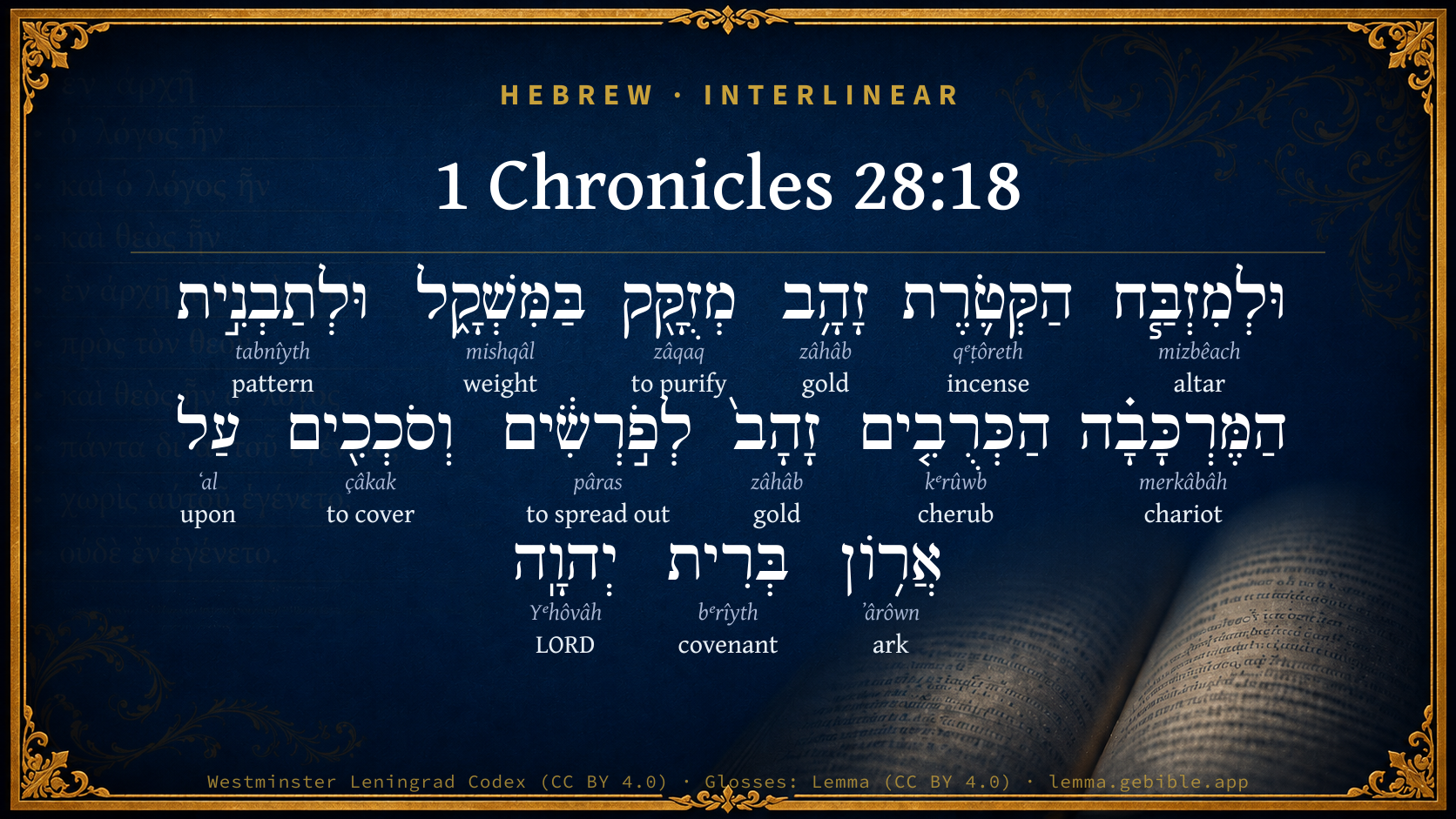
Hebrew (Westminster Leningrad Codex) 1 Chronicles 28:18 appears in the Hebrew Old Testament. The text above is from the Westminster Leningrad Codex. Each word links to its Strong’s number, a concise gloss, and parsing drawn from the Open Scriptures Hebrew Bible morphology. Click any word for its full Brown-Driver-Briggs (BDB) entry.
Download image
Cite this verse

1 Chronicles 28:18 (World English Bible). Public Domain. Lemma interlinear Bible study tool, https://lemma.gebible.app/v/1-chronicles/28/18.

Show BibTeX & RIS
BibTeX
RIS
English Translation
and for the altar of incense refined gold by weight; and gold for the pattern of the chariot, [even] the cherubim, that spread out [their wings], and covered the ark of the covenant of Yahweh.
World English Bible · Public Domain
Highlights
  • 1 first appearance in the Hebrew Bible
Full analysis ↓
Download a study sheet

One document with this verse’s original text, its word-by-word gloss line, the meaning frame, cross-references with their text, attributed commentary, and full source and license credits — printable, and it pastes into notes with its structure intact.

This verse Autodidact and up

Study sheet (.html) Plain text (.txt)

A passage Seminary Student

Up to 50 verses in one chapter. A passage sheet keeps up to 6 commentary sources and 12 cross-references per verse, in the order this page ranks them, and says so on the sheet whenever that leaves anything out. Ask for a single verse and you get the Autodidact verse sheet above.

Everything on this page stays free to read, with no account — the sheet is a download of what is already on screen, not access to it.

Want to remove ads? Support Godless Engineer
Compare translations 3

The same verse in 3 English versions, stacked beneath the original-language interlinear above. Click any original word for its lexicon entry.

Each is an independent rendering of the whole verse — the interlinear is not word-aligned to these translations.

Highlighted words mark where these versions differ — a whole-verse word diff, not a word-by-word alignment.

  • World English Bible Public Domain
    and for the altar of incense refined gold by weight; and gold for the pattern of the chariot, [even] the cherubim, that spread out [their wings], and covered the ark of the covenant of Yahweh.
  • King James Version Public Domain
    And for the altar of incense refined gold by weight; and gold for the pattern of the chariot of the cherubim, that spread out their wings, and covered the ark of the covenant of the LORD.
  • unfoldingWord Literal Text CC BY-SA 4.0
    and for the altar of incense, refined gold by weight, and for the plan of the chariot of the gold cherubs for spreading out and covering over the Box of the Covenant of Yahweh.

unfoldingWord Literal Text — © unfoldingWord, licensed CC BY-SA 4.0. Word-aligned USFM3 via Door43 (git.door43.org/unfoldingWord/en_ult).

Versions to compare (up to 4)

3 of 4 selected

Show all 18 translations

Every available English version of this verse, each an independent rendering of the whole verse.

  • World English Bible Public Domain
    and for the altar of incense refined gold by weight; and gold for the pattern of the chariot, [even] the cherubim, that spread out [their wings], and covered the ark of the covenant of Yahweh.
  • Berean Standard Bible Public Domain
    the weight of the refined gold for the altar of incense; and the plans for the chariot of the gold cherubim that spread their wings and overshadowed the ark of the covenant of the LORD.
  • Majority Standard Bible Public Domain
    the weight of the refined gold for the altar of incense; and the plans for the chariot of the gold cherubim that spread their wings and overshadowed the ark of the covenant of the LORD.
  • King James Version Public Domain
    And for the altar of incense refined gold by weight; and gold for the pattern of the chariot of the cherubim, that spread out their wings, and covered the ark of the covenant of the LORD.
  • American Standard Version (1901) Public Domain
    and for the altar of incense refined gold by weight; and gold for the pattern of the chariot, `even' the cherubim, that spread out `their wings', and covered the ark of the covenant of Jehovah.
  • Revised Version (1885) Public Domain
    and for the altar of incense refined gold by weight: and gold for the pattern of the chariot, even the cherubim, that spread out their wings, and covered the ark of the covenant of the LORD.
  • Geneva Bible (1599) Public Domain
    And for the altar of incense, pure golde by weight, and golde for the paterne of the charet of the Cherubs that spread themselues, and couered the Arke of the couenant of the Lord:
  • Douay-Rheims (1899) Public Domain
    And for the altar of incense, he gave the purest gold: and to make the likeness of the chariot of the cherubims spreading their wings, and covering the ark of the covenant of the Lord.
  • Young's Literal Translation Public Domain
    and for the altar of perfume refined gold by weight, and for the pattern of the chariot of the cherubs of gold -- spreading and covering over the ark of the covenant of Jehovah.
  • Literal Standard Version CC BY-SA 4.0
    and for the altar of incense, refined gold by weight, and for the pattern of the chariot of the cherubim of gold, spreading and covering over the Ark of the Covenant of YHWH.
  • Unlocked Literal Bible CC BY-SA 4.0
    He gave the weight of refined gold for the incense altar, and of the gold for the design of the cherubim that spread out their wings and covered the ark of the covenant of Yahweh.
  • unfoldingWord Literal Text CC BY-SA 4.0
    and for the altar of incense, refined gold by weight, and for the plan of the chariot of the gold cherubs for spreading out and covering over the Box of the Covenant of Yahweh.
  • Darby Bible Public Domain
    and for the altar of incense, refined gold by weight; and the pattern of the chariot of the cherubim of gold, which spread out [their wings] and cover the ark of the covenant of Jehovah.
  • World Messianic Bible Public Domain
    and for the altar of incense, refined gold by weight; and gold for the plans for the chariot, and the cherubim that spread out and cover the ark of the LORD’s covenant.
  • Webster's Bible Public Domain
    And for the altar of incense refined gold by weight; and gold for the pattern of the chariot of the cherubim, that spread out their wings, and covered the ark of the covenant of the LORD.
  • Free Bible Version CC BY-SA 4.0
    the weight of the refined gold for the altar of incense; and lastly plans for a golden chariot of cherubim that spread their wings, covering the Ark of the Lord's Agreement.
  • Bible in Basic English Public Domain
    And the best gold for the altar of perfumes; and gold for the design of the carriage, for the winged ones whose wings were outstretched covering the ark of the Lord's agreement.
  • JPS Tanakh (1917) Public Domain
    and for the altar of incense refined gold by weight; and gold for the pattern of the chariot, even the cherubim, that spread out their wings, and covered the ark of the covenant of the LORD.

Literal Standard Version (2020), Covenant Press — licensed CC BY-SA 4.0. Text via the HelloAO Bible API (eBible.org). Unlocked Literal Bible (unfoldingWord) — licensed CC BY-SA 4.0. Text via the HelloAO Bible API (eBible.org). unfoldingWord Literal Text — © unfoldingWord, licensed CC BY-SA 4.0. Word-aligned USFM3 via Door43 (git.door43.org/unfoldingWord/en_ult). Free Bible Version, Dr. Jonathan Gallagher — licensed CC BY-SA 4.0. Text via the HelloAO Bible API (eBible.org).

Word by word

More ways to search: Search by grammar → Find every occurrence → Compare this word →

Practice this passage: Drill this verse → Learn its vocabulary →

מְזֻקָּ֖ק
zâqaq
H2212
“purified”
Verb, Pual, Participle Passive, Masculine, Singular, Absolute
Part of Speech
Verb
Stem
Pual
Form
Participle Passive
Gender
Masculine
Number
Singular
State
Absolute
Full BDB Definition

Origin: a primitive root

TWOT: 576

to purify, distil, strain, refine - (Qal) - to purify, distil, strain - to refine - (Piel) to purge, refine - (Pual) to refine, purify
  1. וּלְמִזְבַּ֧ח mizbêach H4196 “and · to/for · altar of” Conjunction + Preposition + Noun, Common, Masculine, Singular, Construct
  2. הַקְּטֹ֛רֶת qᵉṭôreth H7004 “the · incense” Particle, Definite Article + Noun, Common, Feminine, Singular, Absolute
  3. זָהָ֥ב zâhâb H2091 “gold” Noun, Common, Masculine, Singular, Absolute
  4. בַּמִּשְׁקָ֑ל mishqâl H4948 “in/at the · weight” Preposition, Determined + Noun, Common, Masculine, Singular, Absolute
  5. וּלְתַבְנִ֣ית tabnîyth H8403 “and · to/for · pattern of” Conjunction + Preposition + Noun, Common, Feminine, Singular, Construct
  6. הַמֶּרְכָּבָ֗ה merkâbâh H4818 “the · chariot” Particle, Definite Article + Noun, Common, Feminine, Singular, Absolute
  7. הַכְּרֻבִ֤ים kᵉrûwb H3742 “the · cherubim” Particle, Definite Article + Noun, Common, Masculine, Plural, Absolute
  8. זָהָב֙ zâhâb H2091 “gold” Noun, Common, Masculine, Singular, Absolute
  9. לְפֹ֣רְשִׂ֔ים pâras H6566 “to/for · spreading out” Preposition + Verb, Qal, Participle Active, Masculine, Plural, Absolute
  10. וְסֹכְכִ֖ים çâkak H5526 “and · covering” Conjunction + Verb, Qal, Participle Active, Masculine, Plural, Absolute
  11. עַל ʻal H5921 “upon” Preposition
  12. אֲר֥וֹן ʼârôwn H727 “ark of” Noun, Common, Both, Singular, Construct
  13. בְּרִית bᵉrîyth H1285 “covenant of” Noun, Common, Feminine, Singular, Construct
  14. יְהוָֽה Yᵉhôvâh H3068 “LORD” Noun, Proper

About this verse

These counts appear in no published source. They are computed here, from the morphology-tagged text and Lemma’s own curated glosses. What Lemma adds →

15
words
14
distinct lemmas
Historical
section

Notable vocabulary

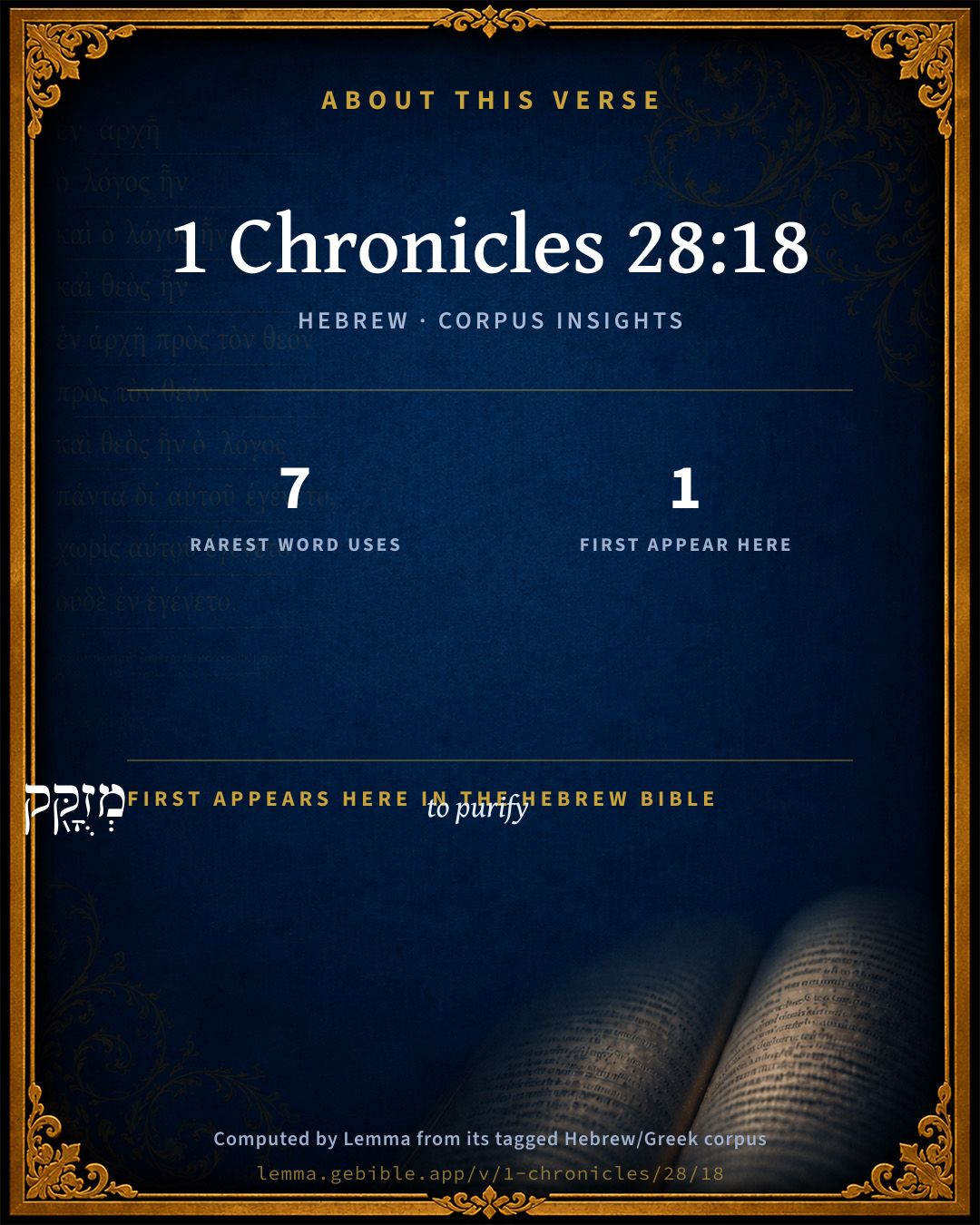
The rarest word here is מְזֻקָּ֖ק to purify H2212 — appearing just 7 times in the whole Hebrew Bible.

First appearance in Scripture

This word makes its first canonical appearance in the Hebrew Bible here:

  • מְזֻקָּ֖ק to purify H2212

Shared distinctive vocabulary

מְזֻקָּ֖ק to purify H2212 occurs in 7 verses of the Hebrew Bible. Also found in:

Grammatical profile

  • 3 verbs
  • 11 nouns
  • 1 preposition

Verb forms

  • מְזֻקָּ֖ק Pual · Participle Passive
  • לְפֹ֣רְשִׂ֔ים Qal · Participle Active
  • וְסֹכְכִ֖ים Qal · Participle Active

Repetition

A word recurs within this verse — often emphatic in Hebrew:

  • זָהָ֥ב gold H2091 ×2

Hebrew & Septuagint length

In English translation the verse runs 35 words from the Hebrew and 43 from the Septuagint (LXX English) — closely comparable.

A rough comparison of the two English renderings, which tokenize alike — not a word-level alignment.

Word counts can differ between the Hebrew and the Greek without any difference in meaning — e.g. the Hebrew direct-object marker אֵת has no separate Greek word, and Greek often adds the article ὁ.

Cross-references

12

Topical passages linked to 1 Chronicles 28:18 in the Treasury of Scripture Knowledge — connected by theme and wording, ordered by reader-vote popularity; previews shown in the World English Bible.

  • Exodus 25:18–22 You shall make two cherubim of hammered gold. You shall make them at the two ends of the mercy seat.
  • Exodus 30:1–10 "You shall make an altar to burn incense on. You shall make it of acacia wood.
  • 1 Samuel 4:4 So the people sent to Shiloh; and they brought from there the ark of the covenant of Yahweh of Hosts, who sits [above] the cherubim: and the two sons of Eli, Hophni and Phinehas, were there with the ark of the covenant of God.
  • 1 Kings 6:23–30 In the oracle he made two cherubim of olive-wood, each ten cubits high.
  • 1 Kings 7:48 Solomon made all the vessels that were in the house of Yahweh: the golden altar, and the table whereupon the show bread was, of gold;
  • Psalms 18:10 He rode on a cherub, and flew. Yes, he soared on the wings of the wind.
  • Psalms 68:17 The chariots of God are tens of thousands and thousands of thousands. The Lord is among them, from Sinai, into the sanctuary.
  • Psalms 80:1 Hear us, Shepherd of Israel, You who lead Joseph like a flock, You who sit above the cherubim, shine forth.
  • Psalms 99:1 Yahweh reigns! Let the peoples tremble. He sits enthroned among the cherubim. Let the earth be moved.
  • Ezekiel 1:15–24 Now as I saw the living creatures, behold, one wheel on the earth beside the living creatures, for each of the four faces of it.
  • Ezekiel 10:2–22 He spoke to the man clothed in linen, and said, Go in between the whirling [wheels], even under the cherub, and fill both your hands with coals of fire from between the cherubim, and scatter them over the city. He went in as I watched.
  • Hebrews 9:5 and above it cherubim of glory overshadowing the mercy seat, of which things we can't now speak in detail.

Cross-references courtesy of OpenBible.info (CC BY 4.0).

Hebrew and Greek witnesses Masoretic Hebrew ↔ Greek Septuagint

The same verse in the two great witnesses to the Old Testament, shown verse-for-verse.

These are two independent witnesses, not word-aligned to each other, and the Septuagint is shown in lemma (dictionary) form.

Hebrew 1 Chronicles 28:18 Masoretic · Westminster Leningrad Codex

וּלְמִזְבַּ֧ח הַקְּטֹ֛רֶת זָהָ֥ב מְזֻקָּ֖ק בַּמִּשְׁקָ֑ל וּלְתַבְנִ֣ית הַמֶּרְכָּבָ֗ה הַכְּרֻבִ֤ים זָהָב֙ לְפֹ֣רְשִׂ֔ים וְסֹכְכִ֖ים עַל אֲר֥וֹן בְּרִית יְהוָֽה

and for the altar of incense refined gold by weight; and gold for the pattern of the chariot, [even] the cherubim, that spread out [their wings], and covered the ark of the covenant of Yahweh.

World English Bible · Public Domain

Greek LXX 1 Chronicles 28:18 Septuagint · lemma form

καί ὁ ὁ θυσιαστήριον ὁ θυμίαμα ἐκ χρυσίον δόκιμος σταθμός ὑποδεικνύω αὐτός καί ὁ παράδειγμα ὁ ἅρμα ὁ χερουβιν ὁ διαπετάζω ὁ πτέρυξ καί σκιάζω ἐπί ὁ κιβωτός διαθήκη κύριος

And he showed him the weight of the utensils of the altar of incense, which was of pure gold, and the plan of the chariot of the cherubs that spread out their wings, and overshadowed the ark of the covenant of the Lord.

LXX2012 (modern English Septuagint) · Public Domain

Hebrew: Westminster Leningrad Codex (CC BY 4.0). Greek: Septuagint (public domain); English from LXX2012 (modern English Septuagint) (Public Domain). How the Septuagint differs from the Hebrew →

Commentary

Notes on 1 Chronicles 28:18 from classic Christian and Jewish commentators (each source and its license shown beneath its notes). The classic Christian expositions comment on the surrounding passage and are grouped to its opening verse, so a note may address several verses; the Jewish commentaries on the Tanakh (Rashi and others) are per-verse, so they appear only where the commentator wrote on this verse.

Lemma curates 59 commentaries, every one of them public domain or Creative Commons licensed, each selected and text-cleaned for this edition rather than reprinted as found. About our sources →

Trapp's Complete Commentary

John Trapp

1Ch 28:18 And for the altar of incense refined gold by weight; and gold for the pattern of the chariot of the cherubims, that spread out [their wings], and covered the ark of the covenant of the LORD.

Ver. 18. The chariot of the cherubims.] So called, because God sat between them, {Psa 99:1} rode upon them; {Psa 18:10} the angels - represented by those cherubims - are called the chariots of God; {Psa 68:17} and the Hebrews have a saying, that such as saw God of old saw only Merehavah velo harocheb, the chariot in which God rode, but not the rider in it; some created image and glory testifying his presence they saw, but himself they saw not. It is a good note also that is given here by some expositors - viz., that by this chariot of the cherubims God gave his people to understand that his presence in the ark was not so fixed among them, but that he would leave them, and ride clean away from them, if they should thereunto provoke him by their sins. In the 9th, 10th, and llth chapters of Ezekiel, God maketh various moves: as first, From the cherubims in the oracle to the threshold; {Eze 9:3} secondly, To the cherubims on the right side of the house; {Eze 10:1} thirdly, To the east gate of the house and the first entrance into the temple; {Eze 10:19} fourthly, To Mount Olivet, quite out of the city; - and {Eze 11:23} then followed the fatal calamity of that state.

John Trapp, A Commentary or Exposition upon All the Books of the Old and New Testament (1647–1656) — public domain. Text from a community e-Sword module.

Joseph Benson's Commentary

1Ch 28:18. For the altar of incense reigned gold — Purer than any of the rest. For that was typical of the intercession of Christ, than which nothing can be more pure and perfect. The chariot of the cherubim — Which Solomon was to make, (for those which were fastened to the mercy-seat were made by Moses long before,) which he fitly compares to a chariot, because within them God is said to sit and to dwell. And because a chariot is made to carry a person from place to place, this expression may be used to intimate, that God was not so fixed to them by the building of this temple, but that he would remove from them if they forsook him. Covered the ark — Not above it, for that was done by Moses’s cherubim, but before it, to keep it from the eyes of the high-priest, when he entered into the most holy place.

Joseph Benson's Commentary on the Old and New Testaments (1811–1818) — public domain. Text from a community e-Sword module.

Tyndale Open Study Notes

Tyndale Open Resources

28:18 for the Lord’s “chariot”—the gold cherubim: The cherubim were various images of composite creatures found in connection with thrones and palaces. Ancient kings sat on cherub thrones. In God’s throne room (the Most Holy Place of Israel’s sanctuary), cherubim atop the Ark of the Covenant served a similar function (see Exod 25:18-22; 2 Sam 6:2; Ps 99:1; cp. Ezek 10).

Tyndale Open Study Notes — © Tyndale Open Resources, licensed CC BY-SA 4.0. Text via the HelloAO Bible API.

Geneva Bible (1599)

Geneva Bible translators

Meaning, of the mercy seat which covered the Ark, which was called the chariot, because the Lord declared himself there.

Geneva Bible (1599) marginal notes — public domain. Text via Bolls.life.

Jamieson, Fausset & Brown

Robert Jamieson, A. R. Fausset & David Brown

the chariot of the cherubim--The expanded wings of the cherubim formed what was figuratively styled the throne of God, and as they were emblematical of rapid motion, the throne or seat was spoken of as a chariot (Psa 18:10; Psa 99:1). It is quite clear that in all these directions David was not guided by his own taste, or by a desire for taking any existing model of architecture, but solely by a regard to the express revelation of the divine will. In a vision, or trance, the whole edifice, with its appurtenances, had been placed before his eyes so vividly and permanently, that he had been able to take a sketch of them in the models delivered to Solomon.

Jamieson, Fausset & Brown — Commentary Critical and Explanatory on the Whole Bible (1871) — public domain (CC PDM 1.0). Text via the HelloAO Bible API.

Adam Clarke's Commentary

Verse 18. The chariot of the cherubims] "And the figure of the chariot, like to the figure of the propitiatory, where are the figures of the golden cherubim, extending their wings and covering the ark of the covenant of the Lord." - T.

Adam Clarke's Commentary on the Bible (1810–1826) — public domain. Text from a community e-Sword/MySword module.

The Cambridge Bible for Schools and Colleges

gen. ed. J. J. S. Perowne

18. the altar of incense] 2Ch_26:16; Exo_30:1-10.

the chariot of the cherubims] R.V. the chariot, even the cherubim. Cp. Eze_1:5-10; Eze_1:15-17.

The Cambridge Bible for Schools and Colleges (gen. ed. J. J. S. Perowne; Cambridge University Press, 1878–1918) — public domain. Text from a community e-Sword module.

John Gill's Exposition

And for the altar of incense refined gold by weight,.... This was also one hundred pounds weight in gold, with which it was to be overlaid (w):

and gold for the pattern of the chariot of the cherubim; which were two large ones, besides those which Moses made; and these were not made of gold, as they were, but overlaid with it, see Kg1 6:23 which with them made four; and to which the four living creatures in Ezekiel's vision allude, and make the "mercavah", or chariot, the Jews so much speak of, perhaps from this and other like phrases; and the Lord sitting here as in a chariot, not only denotes the glory and splendour of the Shechinah, or divine Majesty; but, as some observe, his readiness to ride off and depart, when displeased and provoked, see Eze 10:18,

that spread out their wings, and covered the ark of the covenant of the Lord; not that spread their wings over the ark, and covered it, that the Mosaic cherubim did; but these spread their wings before it from wall to wall, so that it could not be seen by any that turned aside the vail, and even by the high priest when he entered into the holy of holies: the ark, with the cherubim, which were on that, weighed two hundred pounds of pure gold, according to the Jacob Leon (x).

(w) Ibid. (Relation of Memorable Things in the Tabernacle and Temple, ch. 4. p. 20.) (x) Ibid.

John Gill's Exposition of the Whole Bible (1746–1763) — public domain (CC PDM 1.0). Text via the HelloAO Bible API.

Albert Barnes' Notes on the Bible

The chariot of the cherubims - The cherubim are themselves the chariot upon which Yahweh rides Psa 18:10; Psa 99:1.

Albert Barnes' Notes on the Bible (1834–1885) — public domain. Text from a community e-Sword/MySword module.

Haydock's Catholic Bible Commentary

Purest. Hebrew, "refined." --- Lord. He was represented as riding in a chariot, drawn by Cherubim, (Calmet) or sitting on their wings. (Haydock) --- Two, particularly, filled up the space between the walls in the most holy place, and covered the ark, and also the Cherubim made by Moses, 3 Kings vii. 23.

George Leo Haydock (1774–1849), Haydock's Catholic Family Bible and Commentary, 1859 edition — public domain. Excludes Psalms (Douay-Rheims chapter numbering differs from Protestant) and Deuterocanonical books (Catholic canon only).

Matthew Poole's English Annotations

Of the chariot of the cherubims, i.e. of the cherubims, which Solomon was to make, of which see 1Ki 6:23, (for those which were fastened to the mercy-seat were made by Moses long before,) which he fitly compares to a chariot, because within them God is oft said to sit and to dwell, as 2Ki 19:5; Psa 80:1; 99:1; and sometimes he is said to ride upon a cherub, Psa 18:10. And because a chariot is made to carry a person from place to place, this expression may be used to intimate that God was not so fixed to them by the building of his temple, but that he both could and would remove from them if they forsook him. And when they did so, God did make use of the chariot of his cherubims to convey himself away from them, as is noted, Eze 10:15, &c.

Covered the ark; not above it, for that was done by Moses’s cherubims, but before it, to keep it from the eyes of the high priest when he entered into the most holy place, 1Ki 6:23.

Matthew Poole's English Annotations on the Holy Bible (1683–1685) — public domain. Text from a community e-Sword/MySword module.

Whedon's Commentary on the Bible

Daniel D. Whedon

18. The chariot of the cherubim — The words chariot and cherubim are grammatically in apposition — the chariot, namely, the cherubim. The cherubim were themselves regarded as the chariot on which Jehovah rode. Psa_18:10.

Daniel D. Whedon (gen. ed.), Commentary on the Old and New Testaments (1874–1909) — public domain. Text from a community e-Sword module.

The Pulpit Commentary

By the chariot of the cherubims, is of course not meant that the cherubim had a chariot, but that they constituted the chariot of Jehovah. (Psa_18:11)

The Pulpit Commentary (1880–1919), ed. H.D.M. Spence-Jones & Joseph S. Exell — public domain. Text from a community e-Sword module.

John Wesley's Explanatory Notes

Refined gold - Purer than any of the rest. For that was typical of the intercession of Christ, than which nothing can be more pure and perfect. The cherubim - Which Solomon was to make, (for those which were fastened to the mercy-seat were made by Moses long before) which he fitly compares to a chariot, because within them God is said to sit and to dwell. And because a chariot is made to carry a person from place to place, this expression may be used to intimate that God was not so fixed to them by the building of this temple, but that he would remove from them if they forsook him. Covered - Not above it, for that was done by Moses's cherubim, but before it, to keep it from the eyes of the high-priest, when he entered into the most holy place.

John Wesley, Explanatory Notes Upon the Whole Bible (1754–1765) — public domain. Text via the GEBible commentary corpus.

Keil & Delitzsch

C. F. Keil & F. Delitzsch

And for the altar of incense refined gold by weight,.... This was also one hundred pounds weight in gold, with which it was to be overlaid (w):

and gold for the pattern of the chariot of the cherubim; which were two large ones, besides those which Moses made; and these were not made of gold, as they were, but overlaid with it, see Kg1 6:23 which with them made four; and to which the four living creatures in Ezekiel's vision allude, and make the "mercavah", or chariot, the Jews so much speak of, perhaps from this and other like phrases; and the Lord sitting here as in a chariot, not only denotes the glory and splendour of the Shechinah, or divine Majesty; but, as some observe, his readiness to ride off and depart, when displeased and provoked, see Eze 10:18,

that spread out their wings, and covered the ark of the covenant of the Lord; not that spread their wings over the ark, and covered it, that the Mosaic cherubim did; but these spread their wings before it from wall to wall, so that it could not be seen by any that turned aside the vail, and even by the high priest when he entered into the holy of holies: the ark, with the cherubim, which were on that, weighed two hundred pounds of pure gold, according to the Jacob Leon (x).

(w) Ibid. (Relation of Memorable Things in the Tabernacle and Temple, ch. 4. p. 20.) (x) Ibid.

Keil & Delitzsch — Biblical Commentary on the Old Testament (1861–1891) — public domain (CC PDM 1.0). Text via the HelloAO Bible API. (Old Testament only.)

unfoldingWord translationNotes

Door43 World Missions Community

refined gold

"purified gold" or "extra valuable gold"

of the gold for the design

The refers to the weight of the gold. AT: "the weight of the gold for the design" (See: Ellipsis)

I have put all this in writing

This is an idiom. AT: "I wrote all of this down" (See: Idiom)

gave me to understand regarding the design

This refers to the detail for the design of the temple. AT: "helped me to understand the details for his temple" (See: Assumed Knowledge and Implicit Information)

translationWords

incense

altar

cherub

ark of the covenant

David

understand

unfoldingWord translationNotes — © Distant Shores Media and the Door43 World Missions Community, licensed CC BY-SA 4.0. Source: git.door43.org/Door43/en_tn.

Rashi

Rabbi Shlomo Yitzchaki (Rashi)

refined gold - Heb. זָהָב מְזֻקָּק, like refined silver (כֶּסֶף מְזֻקָּק).

and for the pattern of the chariot They are the cherubim upon which the Shechinah “rides.”

which spread out [their wings] and covered Heb. לְפרְשִׂים. i.e., which were spreading and covering over the Ark, as is stated (Ex. 25: 20): “The cherubim shall spread their wings, etc.”

Rashi on the Tanakh — English translations: “The Judaica Press complete Tanach with Rashi, translated by A. J. Rosenberg” (CC BY 4.0); “Pentateuch with Rashi's commentary by M. Rosenbaum and A.M. Silbermann, 1929-1934” (public domain); “The Metsudah Tanach series, Lakewood, N.J” (CC BY 4.0); and “The Book of Joshua, Metsudah Publications, 1997” (CC BY 4.0). Text via Sefaria.

Lesson kit

Teaching starters — assembled from the data on this page, not authored interpretation. Every prompt links to the verse data it draws on. Edit before teaching.

1 Chronicles, in the Historical, opens this verse with 15 words (14 distinct Hebrew lemmas). Its most distinctive word is zâqaq (“to purify”). A historical commentator’s framing appears above. Read the whole chapter for the surrounding context.

Discussion questions

  1. The word zâqaq carries the sense “to purify.” How does it shape the verse?
  2. The word “to purify” first appears here in Scripture. What is being introduced at this debut?
  3. 1 Chronicles 29:4 shares the word «to purify» with this verse. How do the two illuminate each other?
  4. “gold” occurs 2× in this one verse. What is the effect of the repetition?
  5. The translations on this page render this verse differently — a whole-verse word diff, not a word-by-word alignment. What might account for the different wordings?
  6. The verb «מְזֻקָּ֖ק» is Pual Participle Passive. How does its form color the action?
  7. Reading how Trapp's Complete Commentary and Joseph Benson's Commentary read this verse, where do the two commentators agree and where do they part?

Things to notice

  • 1 word makes its first canonical appearance in Scripture here.
  • These translations choose different wording for 15 words in this verse.
  • “gold” occurs 2× in this single verse.
  • 14 distinct Hebrew lemmas span 15 words in this verse.

Reading settings

Reading text

Shown beneath each verse's original-language words.

Old Testament
Old Testament edition

Read the OT as the Masoretic Hebrew (MT) or the Greek Septuagint (LXX).

English shown for the Greek Septuagint (in the Hebrew ↔ Greek comparison).

Comparing translations? Open the Compare panel on any verse page to stack up to four side by side.