סֵ֫פֶר
book
‘book’ is one of 2 main senses fuller range ↓
Full lexicon entry — Brown-Driver-Briggs (BDB)
From Brown-Driver-Briggs (BDB)
Where this word appears
See every Construct-state word in the Hebrew Bible →
Grammar key — what these labels mean
Part of speech
- Noun
- A naming word — a person, place, thing, or idea.
Noun type
- Common
- A common noun — a general class of person, place, or thing (“king,” “city,” “water”), not a specific name.
State
- Construct
- A noun bound to a following noun in a possessive / “of” relationship (the construct chain).
- Absolute
- The independent form of a noun, not bound to a following word.
Gender
- Masculine
- Grammatically masculine.
- Feminine
- Grammatically feminine.
Number
- Singular
- One.
- Plural
- More than one (in Hebrew, generally three or more).
Grammatical forms
- Noun, Common, Masculine, Singular, Construct 95 times (51%)
- Noun, Common, Masculine, Singular, Absolute 71 times (38%)
- Noun, Common, Masculine, Plural, Absolute 21 times (11%)
- Noun, Common, Feminine, Singular, Construct 1 time (1%)
Parsed forms decoded from the imported morphology (morphhb / Westminster Leningrad Codex — WLC text public domain, morphhb tagging CC BY 4.0), counted across 188 parsed occurrences — not distinct verses.
Every verse where H5612 appears — 174 distinct verses across 22 books. Click any verse to open its interlinear word-by-word view. Verse text shown in the World English Bible for context — . Each verse’s Hebrew form is shown with its reference; the English is not keyword-highlighted, since the data carries no word-level English alignment. Use “Compare translations” on any verse to read it across multiple English versions. This concordance covers the Hebrew Bible; Septuagint (Greek Old Testament) occurrences are not indexed here.
Genesis 1 verse
Exodus 4 verses
- Exodus 17:14 בַּ/סֵּ֔פֶר prep det + n c ms Yahweh said to Moses, "Write this for a memorial in a book, and rehearse it in the ears of Joshua: that I will utterly blot out the memory of Amalek from under the sky."
- Exodus 24:7 סֵ֣פֶר n c ms cs He took the book of the covenant and read it in the hearing of the people, and they said, "All that Yahweh has spoken will we do, and be obedient."
- Exodus 32:32 מִֽ/סִּפְרְ/ךָ֖ prep + n c ms cs + sfx pers 2ms Yet now, if you will, forgive their sin-- and if not, please blot me out of your book which you have written."
- Exodus 32:33 מִ/סִּפְרִֽ/י prep + n c ms cs + sfx pers 1cs Yahweh said to Moses, "Whoever has sinned against me, him will I blot out of my book.
Numbers 2 verses
Deuteronomy 11 verses
- Deuteronomy 17:18 סֵ֔פֶר n c ms It shall be, when he sits on the throne of his kingdom, that he shall write him a copy of this law in a book, out of [that which is] before the priests the Levites:
- Deuteronomy 24:1 סֵ֤פֶר n c ms cs When a man takes a wife, and marries her, then it shall be, if she find no favor in his eyes, because he has found some unseemly thing in her, that he shall write her a bill of divorce, and give it in her hand, and send her out of his house.
- Deuteronomy 24:3 סֵ֤פֶר n c ms cs If the latter husband hate her, and write her a bill of divorce, and give it in her hand, and send her out of his house; or if the latter husband die, who took her to be his wife;
- Deuteronomy 28:58 בַּ/סֵּ֣פֶר prep det + n c ms If you will not observe to do all the words of this law that are written in this book, that you may fear this glorious and fearful name, YAHWEH YOUR GOD;
- Deuteronomy 28:61 בְּ/סֵ֖פֶר prep + n c ms cs Also every sickness, and every plague, which is not written in the book of this law, them will Yahweh bring on you, until you are destroyed.
- Deuteronomy 29:20 בַּ/סֵּ֣פֶר prep det + n c ms Yahweh will not pardon him, but then the anger of Yahweh and his jealousy will smoke against that man, and all the curse that is written in this book shall lie on him, and Yahweh will blot out his name from under the sky.
- Deuteronomy 29:21 בְּ/סֵ֥פֶר prep + n c ms cs Yahweh will set him apart to evil out of all the tribes of Israel, according to all the curses of the covenant that is written in this book of the law.
- Deuteronomy 29:27 בַּ/סֵּ֥פֶר prep det + n c ms therefore the anger of Yahweh was kindled against this land, to bring on it all the curse that is written in this book;
- Deuteronomy 30:10 בְּ/סֵ֥פֶר prep + n c ms cs if you shall obey the voice of Yahweh your God, to keep his commandments and his statutes which are written in this book of the law; if you turn to Yahweh your God with all your heart, and with all your soul.
- Deuteronomy 31:24 סֵ֑פֶר n c ms It happened, when Moses had made an end of writing the words of this law in a book, until they were finished,
- Deuteronomy 31:26 סֵ֤פֶר n c ms cs Take this book of the law, and put it by the side of the ark of the covenant of Yahweh your God, that it may be there for a witness against you.
Joshua 7 verses
- Joshua 1:8 סֵפֶר֩ n c ms cs This book of the law shall not depart out of your mouth, but you shall meditate thereon day and night, that you may observe to do according to all that is written therein: for then you shall make your way prosperous, and then you shall have good success.
- Joshua 8:31 בְּ/סֵ֨פֶר֙ prep + n c ms cs as Moses the servant of Yahweh commanded the children of Israel, as it is written in the book of the law of Moses, an altar of uncut stones, on which no man had lifted up any iron: and they offered thereon burnt offerings to Yahweh, and sacrificed peace-offerings.
- Joshua 8:34 בְּ/סֵ֥פֶר prep + n c ms cs Afterward he read all the words of the law, the blessing and the curse, according to all that is written in the book of the law.
- Joshua 10:13 סֵ֣פֶר n c ms cs The sun stood still, and the moon stayed, Until the nation had avenged themselves of their enemies. Isn't this written in the book of Jashar? The sun stayed in the midst of the sky, and didn't hurry to go down about a whole day.
- Joshua 18:9 סֵ֑פֶר n c ms The men went and passed through the land, and described it by cities into seven portions in a book; and they came to Joshua to the camp at Shiloh.
- Joshua 23:6 בְּ/סֵ֖פֶר prep + n c ms cs Therefore be you very courageous to keep and to do all that is written in the book of the law of Moses, that you not turn aside from it to the right hand or to the left;
- Joshua 24:26 בְּ/סֵ֖פֶר prep + n c ms cs Joshua wrote these words in the book of the law of God; and he took a great stone, and set it up there under the oak that was by the sanctuary of Yahweh.
1 Samuel 1 verse
2 Samuel 3 verses
- 2 Samuel 1:18 סֵ֥פֶר n c ms cs (and he bade them teach the children of Judah [the song of] the bow: behold, it is written in the book of Jashar):
- 2 Samuel 11:14 סֵ֖פֶר n c ms It happened in the morning, that David wrote a letter to Joab, and sent it by the hand of Uriah.
- 2 Samuel 11:15 בַּ/סֵּ֖פֶר prep det + n c ms He wrote in the letter, saying, Set Uriah in the forefront of the hottest battle, and retire you from him, that he may be struck, and die.
1 Kings 15 verses
- 1 Kings 11:41 סֵ֖פֶר n c ms cs Now the rest of the acts of Solomon, and all that he did, and his wisdom, aren't they written in the book of the acts of Solomon?
- 1 Kings 14:19 סֵ֛פֶר n c ms cs The rest of the acts of Jeroboam, how he warred, and how he reigned, behold, they are written in the book of the chronicles of the kings of Israel.
- 1 Kings 14:29 סֵ֛פֶר n c ms cs Now the rest of the acts of Rehoboam, and all that he did, aren't they written in the book of the chronicles of the kings of Judah?
- 1 Kings 15:7 סֵ֛פֶר n c ms cs The rest of the acts of Abijam, and all that he did, aren't they written in the book of the chronicles of the kings of Judah? There was war between Abijam and Jeroboam.
- 1 Kings 15:23 סֵ֛פֶר n c ms cs Now the rest of all the acts of Asa, and all his might, and all that he did, and the cities which he built, aren't they written in the book of the chronicles of the kings of Judah? But in the time of his old age he was diseased in his feet.
- 1 Kings 15:31 סֵ֛פֶר n c ms cs Now the rest of the acts of Nadab, and all that he did, aren't they written in the book of the chronicles of the kings of Israel?
- 1 Kings 16:5 סֵ֛פֶר n c ms cs Now the rest of the acts of Baasha, and what he did, and his might, aren't they written in the book of the chronicles of the kings of Israel?
- 1 Kings 16:14 סֵ֛פֶר n c ms cs Now the rest of the acts of Elah, and all that he did, aren't they written in the book of the chronicles of the kings of Israel?
- 1 Kings 16:20 סֵ֛פֶר n c ms cs Now the rest of the acts of Zimri, and his treason that he did, aren't they written in the book of the chronicles of the kings of Israel?
- 1 Kings 16:27 סֵ֛פֶר n c ms cs Now the rest of the acts of Omri which he did, and his might that he shown, aren't they written in the book of the chronicles of the kings of Israel?
- 1 Kings 21:8 סְפָרִים֙ ה/ספרים סְפָרִ֗ים n c mp ptcl def.art + n c mp n c mp So she wrote letters in Ahab's name, and sealed them with his seal, and sent the letters to the elders and to the nobles who were in his city, [and] who lived with Naboth.
- 1 Kings 21:9 בַּ/סְּפָרִ֖ים prep det + n c mp She wrote in the letters, saying, Proclaim a fast, and set Naboth on high among the people:
- 1 Kings 21:11 בַּ/סְּפָרִ֔ים prep det + n c mp The men of his city, even the elders and the nobles who lived in his city, did as Jezebel had sent to them, according as it was written in the letters which she had sent to them.
- 1 Kings 22:39 סֵ֛פֶר n c ms cs Now the rest of the acts of Ahab, and all that he did, and the ivory house which he built, and all the cities that he built, aren't they written in the book of the chronicles of the kings of Israel?
- 1 Kings 22:45 סֵ֛פֶר n c ms cs Now the rest of the acts of Jehoshaphat, and his might that he shown, and how he warred, aren't they written in the book of the chronicles of the kings of Judah?
2 Kings 41 verses
- 2 Kings 1:18 סֵ֛פֶר n c ms cs Now the rest of the acts of Ahaziah which he did, aren't they written in the book of the chronicles of the kings of Israel?
- 2 Kings 5:5 סֵ֖פֶר n c ms The king of Syria said, Go now, and I will send a letter to the king of Israel. He departed, and took with him ten talents of silver, and six thousand [pieces] of gold, and ten changes of clothing.
- 2 Kings 5:6 הַ/סֵּ֔פֶר הַ/סֵּ֤פֶר ptcl def.art + n c ms ptcl def.art + n c ms He brought the letter to the king of Israel, saying, Now when this letter is come to you, behold, I have sent Naaman my servant to you, that you may recover him of his leprosy.
- 2 Kings 5:7 הַ/סֵּ֜פֶר ptcl def.art + n c ms It happened, when the king of Israel had read the letter, that he tore his clothes, and said, Am I God, to kill and to make alive, that this man does send to me to recover a man of his leprosy? but consider, I pray you, and see how he seeks a quarrel against me.
- 2 Kings 8:23 סֵ֛פֶר n c ms cs The rest of the acts of Joram, and all that he did, aren't they written in the book of the chronicles of the kings of Judah?
- 2 Kings 10:1 סְפָרִ֜ים n c mp Now Ahab had seventy sons in Samaria. Jehu wrote letters, and sent to Samaria, to the rulers of Jezreel, even the elders, and to those who brought up [the sons of] Ahab, saying,
- 2 Kings 10:2 הַ/סֵּ֤פֶר ptcl def.art + n c ms Now as soon as this letter comes to you, seeing your master's sons are with you, and there are with you chariots and horses, a fortified city also, and armor;
- 2 Kings 10:6 סֵ֨פֶר n c ms Then he wrote a letter the second time to them, saying, If you be on my side, and if you will listen to my voice, take the heads of the men your master's sons, and come to me to Jezreel by tomorrow this time. Now the king's sons, being seventy persons, were with the great men of the city, who brought them up.
- 2 Kings 10:7 הַ/סֵּ֨פֶר֙ ptcl def.art + n c ms It happened, when the letter came to them, that they took the king's sons, and killed them, even seventy persons, and put their heads in baskets, and sent them to him to Jezreel.
- 2 Kings 10:34 סֵ֛פֶר n c ms cs Now the rest of the acts of Jehu, and all that he did, and all his might, aren't they written in the book of the chronicles of the kings of Israel?
- 2 Kings 12:19 סֵ֛פֶר n c ms cs Now the rest of the acts of Joash, and all that he did, aren't they written in the book of the chronicles of the kings of Judah?
- 2 Kings 13:8 סֵ֛פֶר n c ms cs Now the rest of the acts of Jehoahaz, and all that he did, and his might, aren't they written in the book of the chronicles of the kings of Israel?
- 2 Kings 13:12 סֵ֛פֶר n c ms cs Now the rest of the acts of Joash, and all that he did, and his might with which he fought against Amaziah king of Judah, aren't they written in the book of the chronicles of the kings of Israel?
- 2 Kings 14:6 בְּ/סֵ֣פֶר prep + n c ms cs but the children of the murderers he didn't put to death; according to that which is written in the book of the law of Moses, as Yahweh commanded, saying, The fathers shall not be put to death for the children, nor the children be put to death for the fathers; but every man shall die for his own sin.
- 2 Kings 14:15 סֵ֛פֶר n c ms cs Now the rest of the acts of Jehoash which he did, and his might, and how he fought with Amaziah king of Judah, aren't they written in the book of the chronicles of the kings of Israel?
- 2 Kings 14:18 סֵ֛פֶר n c ms cs Now the rest of the acts of Amaziah, aren't they written in the book of the chronicles of the kings of Judah?
- 2 Kings 14:28 סֵ֛פֶר n c ms cs Now the rest of the acts of Jeroboam, and all that he did, and his might, how he warred, and how he recovered Damascus, and Hamath, [which had belonged] to Judah, for Israel, aren't they written in the book of the chronicles of the kings of Israel?
- 2 Kings 15:6 סֵ֛פֶר n c ms cs Now the rest of the acts of Azariah, and all that he did, aren't they written in the book of the chronicles of the kings of Judah?
- 2 Kings 15:11 סֵ֛פֶר n c ms cs Now the rest of the acts of Zechariah, behold, they are written in the book of the chronicles of the kings of Israel.
- 2 Kings 15:15 סֵ֛פֶר n c ms cs Now the rest of the acts of Shallum, and his conspiracy which he made, behold, they are written in the book of the chronicles of the kings of Israel.
- 2 Kings 15:21 סֵ֛פֶר n c ms cs Now the rest of the acts of Menahem, and all that he did, aren't they written in the book of the chronicles of the kings of Israel?
- 2 Kings 15:26 סֵ֛פֶר n c ms cs Now the rest of the acts of Pekahiah, and all that he did, behold, they are written in the book of the chronicles of the kings of Israel.
- 2 Kings 15:31 סֵ֛פֶר n c ms cs Now the rest of the acts of Pekah, and all that he did, behold, they are written in the book of the chronicles of the kings of Israel.
- 2 Kings 15:36 סֵ֛פֶר n c ms cs Now the rest of the acts of Jotham, and all that he did, aren't they written in the book of the chronicles of the kings of Judah?
- 2 Kings 16:19 סֵ֛פֶר n c ms cs Now the rest of the acts of Ahaz which he did, aren't they written in the book of the chronicles of the kings of Judah?
- 2 Kings 19:14 הַ/סְּפָרִ֛ים ptcl def.art + n c mp Hezekiah received the letter from the hand of the messengers, and read it; and Hezekiah went up to the house of Yahweh, and spread it before Yahweh.
- 2 Kings 20:12 סְפָרִ֥ים n c mp At that time Berodach-baladan the son of Baladan, king of Babylon, sent letters and a present to Hezekiah; for he had heard that Hezekiah had been sick.
- 2 Kings 20:20 סֵ֛פֶר n c ms cs Now the rest of the acts of Hezekiah, and all his might, and how he made the pool, and the conduit, and brought water into the city, aren't they written in the book of the chronicles of the kings of Judah?
- 2 Kings 21:17 סֵ֛פֶר n c ms cs Now the rest of the acts of Manasseh, and all that he did, and his sin that he sinned, aren't they written in the book of the chronicles of the kings of Judah?
- 2 Kings 21:25 סֵ֛פֶר n c ms cs Now the rest of the acts of Amon which he did, aren't they written in the book of the chronicles of the kings of Judah?
- 2 Kings 22:8 סֵ֧פֶר הַ/סֵּ֛פֶר n c ms cs ptcl def.art + n c ms Hilkiah the high priest said to Shaphan the scribe, I have found the book of the law in the house of Yahweh. Hilkiah delivered the book to Shaphan, and he read it.
- 2 Kings 22:10 סֵ֚פֶר n c ms Shaphan the scribe told the king, saying, Hilkiah the priest has delivered me a book. Shaphan read it before the king.
- 2 Kings 22:11 סֵ֣פֶר n c ms cs It happened, when the king had heard the words of the book of the law, that he tore his clothes.
- 2 Kings 22:13 הַ/סֵּ֥פֶר הַ/סֵּ֣פֶר ptcl def.art + n c ms ptcl def.art + n c ms Go you, inquire of Yahweh for me, and for the people, and for all Judah, concerning the words of this book that is found; for great is the wrath of Yahweh that is kindled against us, because our fathers have not listened to the words of this book, to do according to all that which is written concerning us.
- 2 Kings 22:16 הַ/סֵּ֔פֶר ptcl def.art + n c ms Thus says Yahweh, Behold, I will bring evil on this place, and on the inhabitants of it, even all the words of the book which the king of Judah has read.
- 2 Kings 23:2 סֵ֣פֶר n c ms cs The king went up to the house of Yahweh, and all the men of Judah and all the inhabitants of Jerusalem with him, and the priests, and the prophets, and all the people, both small and great: and he read in their ears all the words of the book of the covenant which was found in the house of Yahweh.
- 2 Kings 23:3 הַ/סֵּ֣פֶר ptcl def.art + n c ms The king stood by the pillar, and made a covenant before Yahweh, to walk after Yahweh, and to keep his commandments, and his testimonies, and his statutes, with all [his] heart, and all [his] soul, to confirm the words of this covenant that were written in this book: and all the people stood to the covenant.
- 2 Kings 23:21 סֵ֥פֶר n c ms cs The king commanded all the people, saying, Keep the Passover to Yahweh your God, as it is written in this book of the covenant.
- 2 Kings 23:24 הַ/סֵּ֔פֶר ptcl def.art + n c ms Moreover those who had familiar spirits, and the wizards, and the teraphim, and the idols, and all the abominations that were seen in the land of Judah and in Jerusalem, did Josiah put away, that he might confirm the words of the law which were written in the book that Hilkiah the priest found in the house of Yahweh.
- 2 Kings 23:28 סֵ֛פֶר n c ms cs Now the rest of the acts of Josiah, and all that he did, aren't they written in the book of the chronicles of the kings of Judah?
- 2 Kings 24:5 סֵ֛פֶר n c ms cs Now the rest of the acts of Jehoiakim, and all that he did, aren't they written in the book of the chronicles of the kings of Judah?
1 Chronicles 1 verse
2 Chronicles 21 verses
- 2 Chronicles 16:11 סֵ֣פֶר n c ms cs Behold, the acts of Asa, first and last, behold, they are written in the book of the kings of Judah and Israel.
- 2 Chronicles 17:9 סֵ֖פֶר n c ms cs They taught in Judah, having the book of the law of Yahweh with them; and they went about throughout all the cities of Judah, and taught among the people.
- 2 Chronicles 20:34 סֵ֖פֶר n c ms cs Now the rest of the acts of Jehoshaphat, first and last, behold, they are written in the history of Jehu the son of Hanani, which is inserted in the book of the kings of Israel.
- 2 Chronicles 24:27 סֵ֣פֶר n c ms cs Now concerning his sons, and the greatness of the burdens [laid] on him, and the rebuilding of the house of God, behold, they are written in the commentary of the book of the kings. Amaziah his son reigned in his place.
- 2 Chronicles 25:4 בְּ/סֵ֣פֶר prep + n c ms cs But he didn't put their children to death, but did according to that which is written in the law in the book of Moses, as Yahweh commanded, saying, The fathers shall not die for the children, neither shall the children die for the fathers; but every man shall die for his own sin.
- 2 Chronicles 25:26 סֵ֥פֶר n c ms cs Now the rest of the acts of Amaziah, first and last, behold, aren't they written in the book of the kings of Judah and Israel?
- 2 Chronicles 27:7 סֵ֥פֶר n c ms cs Now the rest of the acts of Jotham, and all his wars, and his ways, behold, they are written in the book of the kings of Israel and Judah.
- 2 Chronicles 28:26 סֵ֥פֶר n c ms cs Now the rest of his acts, and all his ways, first and last, behold, they are written in the book of the kings of Judah and Israel.
- 2 Chronicles 32:17 וּ/סְפָרִ֣ים conj + n c mp He wrote also letters, to rail on Yahweh, the God of Israel, and to speak against him, saying, As the gods of the nations of the lands, which have not delivered their people out of my hand, so shall the God of Hezekiah not deliver his people out of my hand.
- 2 Chronicles 32:32 סֵ֥פֶר n c ms cs Now the rest of the acts of Hezekiah, and his good deeds, behold, they are written in the vision of Isaiah the prophet the son of Amoz, in the book of the kings of Judah and Israel.
- 2 Chronicles 34:14 סֵ֥פֶר n c ms cs When they brought out the money that was brought into the house of Yahweh, Hilkiah the priest found the book of the law of Yahweh [given] by Moses.
- 2 Chronicles 34:15 סֵ֧פֶר הַ/סֵּ֖פֶר n c ms cs ptcl def.art + n c ms Hilkiah answered Shaphan the scribe, I have found the book of the law in the house of Yahweh. Hilkiah delivered the book to Shaphan.
- 2 Chronicles 34:16 הַ/סֵּ֨פֶר֙ ptcl def.art + n c ms Shaphan carried the book to the king, and moreover brought back word to the king, saying, All that was committed to your servants, they are doing.
- 2 Chronicles 34:18 סֵ֚פֶר n c ms Shaphan the scribe told the king, saying, Hilkiah the priest has delivered me a book. Shaphan read therein before the king.
- 2 Chronicles 34:21 הַ/סֵּ֖פֶר הַ/סֵּ֥פֶר ptcl def.art + n c ms ptcl def.art + n c ms Go you, inquire of Yahweh for me, and for those who are left in Israel and in Judah, concerning the words of the book that is found; for great is the wrath of Yahweh that is poured out on us, because our fathers have not kept the word of Yahweh, to do according to all that is written in this book.
- 2 Chronicles 34:24 הַ/סֵּ֔פֶר ptcl def.art + n c ms Thus says Yahweh, Behold, I will bring evil on this place, and on the inhabitants of it, even all the curses that are written in the book which they have read before the king of Judah.
- 2 Chronicles 34:30 סֵ֣פֶר n c ms cs The king went up to the house of Yahweh, and all the men of Judah and the inhabitants of Jerusalem, and the priests, and the Levites, and all the people, both great and small: and he read in their ears all the words of the book of the covenant that was found in the house of Yahweh.
- 2 Chronicles 34:31 הַ/סֵּ֥פֶר ptcl def.art + n c ms The king stood in his place, and made a covenant before Yahweh, to walk after Yahweh, and to keep his commandments, and his testimonies, and his statutes, with all his heart, and with all his soul, to perform the words of the covenant that were written in this book.
- 2 Chronicles 35:12 בְּ/סֵ֣פֶר prep + n c ms cs They removed the burnt offerings, that they might give them according to the divisions of the fathers' houses of the children of the people, to offer to Yahweh, as it is written in the book of Moses. So did they with the oxen.
- 2 Chronicles 35:27 סֵ֥פֶר n c ms cs and his acts, first and last, behold, they are written in the book of the kings of Israel and Judah.
- 2 Chronicles 36:8 סֵ֛פֶר n c ms cs Now the rest of the acts of Jehoiakim, and his abominations which he did, and that which was found in him, behold, they are written in the book of the kings of Israel and Judah: and Jehoiachin his son reigned in his place.
Nehemiah 9 verses
- Nehemiah 7:5 סֵ֤פֶר n c ms cs My God put into my heart to gather together the nobles, and the rulers, and the people, that they might be reckoned by genealogy. I found the book of the genealogy of those who came up at the first, and I found written therein:
- Nehemiah 8:1 סֵ֨פֶר֙ n c ms cs All the people gathered themselves together as one man into the broad place that was before the water gate; and they spoke to Ezra the scribe to bring the book of the law of Moses, which Yahweh had commanded to Israel.
- Nehemiah 8:3 סֵ֥פֶר n c ms cs He read therein before the broad place that was before the water gate from early morning until midday, in the presence of the men and the women, and of those who could understand; and the ears of all the people were [attentive] to the book of the law.
- Nehemiah 8:5 הַ/סֵּ֨פֶר֙ ptcl def.art + n c ms Ezra opened the book in the sight of all the people; (for he was above all the people;) and when he opened it, all the people stood up:
- Nehemiah 8:8 בַ/סֵּ֛פֶר prep det + n c ms They read in the book, in the law of God, distinctly; and they gave the sense, so that they understood the reading.
- Nehemiah 8:18 בְּ/סֵ֨פֶר prep + n c ms cs Also day by day, from the first day to the last day, he read in the book of the law of God. They kept the feast seven days; and on the eighth day was a solemn assembly, according to the ordinance.
- Nehemiah 9:3 בְּ/סֵ֨פֶר prep + n c ms cs They stood up in their place, and read in the book of the law of Yahweh their God a fourth part of the day; and [another] fourth part they confessed, and worshiped Yahweh their God.
- Nehemiah 12:23 סֵ֖פֶר n c ms cs The sons of Levi, heads of fathers' [houses], were written in the book of the chronicles, even until the days of Johanan the son of Eliashib.
- Nehemiah 13:1 בְּ/סֵ֥פֶר prep + n c ms cs On that day they read in the book of Moses in the audience of the people; and therein was found written, that an Ammonite and a Moabite should not enter into the assembly of God forever,
Esther 11 verses
- Esther 1:22 סְפָרִים֙ n c mp for he sent letters into all the king's provinces, into every province according to the writing of it, and to every people after their language, that every man should bear rule in his own house, and should speak according to the language of his people.
- Esther 2:23 בְּ/סֵ֛פֶר prep + n c ms cs When inquisition was made of the matter, and it was found to be so, they were both hanged on a tree: and it was written in the book of the chronicles before the king.
- Esther 3:13 סְפָרִ֜ים n c mp Letters were sent by posts into all the king's provinces, to destroy, to kill, and to cause to perish, all Jews, both young and old, little children and women, in one day, even on the thirteenth [day] of the twelfth month, which is the month Adar, and to take the spoil of them for a prey.
- Esther 6:1 סֵ֤פֶר n c ms cs On that night the king couldn't sleep; and he commanded to bring the book of records of the chronicles, and they were read before the king.
- Esther 8:5 הַ/סְּפָרִ֗ים ptcl def.art + n c mp She said, If it please the king, and if I have found favor in his sight, and the thing seem right before the king, and I be pleasing in his eyes, let it be written to reverse the letters devised by Haman, the son of Hammedatha the Agagite, which he wrote to destroy the Jews who are in all the king's provinces:
- Esther 8:10 סְפָרִ֡ים n c mp He wrote the name of king Ahasuerus, and sealed it with the king's ring, and sent letters by post on horseback, riding on swift steeds that were used in the king's service, bred of the stud:
- Esther 9:20 סְפָרִ֜ים n c mp Mordecai wrote these things, and sent letters to all the Jews who were in all the provinces of the king Ahasuerus, both near and far,
- Esther 9:25 הַ/סֵּ֔פֶר ptcl def.art + n c ms but when [the matter] came before the king, he commanded by letters that his wicked device, which he had devised against the Jews, should return on his own head, and that he and his sons should be hanged on the gallows.
- Esther 9:30 סְפָרִ֜ים n c mp He sent letters to all the Jews, to the hundred twenty-seven provinces of the kingdom of Ahasuerus, [with] words of peace and truth,
- Esther 9:32 בַּ/סֵּֽפֶר prep det + n c ms The commandment of Esther confirmed these matters of Purim; and it was written in the book.
- Esther 10:2 סֵ֨פֶר֙ n c ms cs All the acts of his power and of his might, and the full account of the greatness of Mordecai, whereunto the king advanced him, aren't they written in the book of the chronicles of the kings of Media and Persia?
Job 2 verses
Psalms 4 verses
- Psalms 40:7 סֵ֝֗פֶר n c ms Then I said, "Behold, I have come. It is written about me in the book in the scroll.
- Psalms 56:8 בְּ/סִפְרָתֶֽ/ךָ prep + n c fs cs + sfx pers 2ms You number my wanderings. You put my tears into your bottle. Aren't they in your book?
- Psalms 69:28 מִ/סֵּ֣פֶר prep + n c ms cs Let them be blotted out of the book of life, And not be written with the righteous.
- Psalms 139:16 סִפְרְ/ךָ֮ n c ms cs + sfx pers 2ms Your eyes saw my body. In your book they were all written, The days that were ordained for me, When as yet there were none of them.
Ecclesiastes 1 verse
Isaiah 9 verses
- Isaiah 29:11 הַ/סֵּ֣פֶר ה/ספר סֵ֛פֶר ptcl def.art + n c ms ptcl def.art + n c ms n c ms All vision is become to you as the words of a book that is sealed, which men deliver to one who is learned, saying, Read this, I pray you; and he says, I can't, for it is sealed:
- Isaiah 29:12 הַ/סֵּ֗פֶר סֵ֛פֶר סֵֽפֶר ptcl def.art + n c ms n c ms n c ms and the book is delivered to him who is not learned, saying, Read this, I pray you; and he says, I am not learned.
- Isaiah 29:18 סֵ֑פֶר n c ms In that day shall the deaf hear the words of the book, and the eyes of the blind shall see out of obscurity and out of darkness.
- Isaiah 30:8 סֵ֣פֶר n c ms Now go, write it before them on a tablet, and inscribe it in a book, that it may be for the time to come forever and ever.
- Isaiah 34:4 כַ/סֵּ֖פֶר prep det + n c ms All the host of the sky shall be dissolved, and the heavens shall be rolled together as a scroll; and all their host shall fade away, as the leaf fades from off the vine, and as a fading [leaf] from the fig tree.
- Isaiah 34:16 סֵ֤פֶר n c ms cs Seek you out of the book of Yahweh, and read: no one of these shall be missing, none shall want her mate; for my mouth, it has commanded, and his Spirit, it has gathered them.
- Isaiah 37:14 הַ/סְּפָרִ֛ים ptcl def.art + n c mp Hezekiah received the letter from the hand of the messengers, and read it; and Hezekiah went up to the house of Yahweh, and spread it before Yahweh.
- Isaiah 39:1 סְפָרִ֥ים n c mp At that time Merodach Baladan the son of Baladan, king of Babylon, sent letters and a present to Hezekiah; for he heard that he had been sick, and was recovered.
- Isaiah 50:1 סֵ֣פֶר n c ms cs Thus says Yahweh, Where is the bill of your mother's divorce, with which I have put her away? or which of my creditors is it to whom I have sold you? Behold, for your iniquities were you sold, and for your transgressions was your mother put away.
Jeremiah 23 verses
- Jeremiah 3:8 סֵ֥פֶר n c ms cs I saw, when, for this very cause that backsliding Israel had committed adultery, I had put her away and given her a bill of divorce, yet treacherous Judah, her sister, didn't fear; but she also went and played the prostitute.
- Jeremiah 25:13 בַּ/סֵּ֣פֶר prep det + n c ms I will bring on that land all my words which I have pronounced against it, even all that is written in this book, which Jeremiah has prophesied against all the nations.
- Jeremiah 29:1 הַ/סֵּ֔פֶר ptcl def.art + n c ms Now these are the words of the letter that Jeremiah the prophet sent from Jerusalem to the residue of the elders of the captivity, and to the priests, and to the prophets, and to all the people, whom Nebuchadnezzar had carried away captive from Jerusalem to Babylon,
- Jeremiah 29:25 סְפָרִ֗ים n c mp Thus speaks Yahweh of Hosts, the God of Israel, saying, Because you have sent letters in your own name to all the people who are at Jerusalem, and to Zephaniah the son of Maaseiah, the priest, and to all the priests, saying,
- Jeremiah 29:29 הַ/סֵּ֣פֶר ptcl def.art + n c ms Zephaniah the priest read this letter in the ears of Jeremiah the prophet.
- Jeremiah 30:2 סֵֽפֶר n c ms Thus speaks Yahweh, the God of Israel, saying, Write you all the words that I have spoken to you in a book.
- Jeremiah 32:10 בַּ/סֵּ֨פֶר֙ prep det + n c ms I subscribed the deed, and sealed it, and called witnesses, and weighed him the money in the balances.
- Jeremiah 32:11 סֵ֣פֶר n c ms cs So I took the deed of the purchase, both that which was sealed, containing the terms and conditions, and that which was open;
- Jeremiah 32:12 הַ/סֵּ֣פֶר בְּ/סֵ֣פֶר ptcl def.art + n c ms prep + n c ms cs and I delivered the deed of the purchase to Baruch the son of Neriah, the son of Mahseiah, in the presence of Hanamel my uncle's son, and in the presence of the witnesses who subscribed the deed of the purchase, before all the Jews who sat in the court of the guard.
- Jeremiah 32:14 הַ/סְּפָרִ֣ים סֵפֶר֩ סֵ֤פֶר ptcl def.art + n c mp n c ms cs n c ms cs Thus says Yahweh of Hosts, the God of Israel: Take these deeds, this deed of the purchase which is sealed, and this deed which is open, and put them in an earthen vessel; that they may continue many days.
- Jeremiah 32:16 סֵ֣פֶר n c ms cs Now after I had delivered the deed of the purchase to Baruch the son of Neriah, I prayed to Yahweh, saying,
- Jeremiah 32:44 בַּ/סֵּ֥פֶר prep det + n c ms Men shall buy fields for money, and subscribe the deeds, and seal them, and call witnesses, in the land of Benjamin, and in the places about Jerusalem, and in the cities of Judah, and in the cities of the hill-country, and in the cities of the lowland, and in the cities of the South: for I will cause their captivity to return, says Yahweh.
- Jeremiah 36:2 סֵפֶר֒ n c ms Take a scroll of a book, and write therein all the words that I have spoken to you against Israel, and against Judah, and against all the nations, from the day I spoke to you, from the days of Josiah, even to this day.
- Jeremiah 36:4 סֵֽפֶר n c ms Then Jeremiah called Baruch the son of Neriah; and Baruch wrote from the mouth of Jeremiah all the words of Yahweh, which he had spoken to him, on a scroll of a book.
- Jeremiah 36:8 בַ/סֵּ֛פֶר prep det + n c ms Baruch the son of Neriah did according to all that Jeremiah the prophet commanded him, reading in the book the words of Yahweh in Yahweh's house.
- Jeremiah 36:10 בַּ/סֵּ֛פֶר prep det + n c ms Then read Baruch in the book the words of Jeremiah in the house of Yahweh, in the chamber of Gemariah the son of Shaphan, the scribe, in the upper court, at the entry of the new gate of Yahweh's house, in the ears of all the people.
- Jeremiah 36:11 הַ/סֵּֽפֶר ptcl def.art + n c ms When Micaiah the son of Gemariah, the son of Shaphan, had heard out of the book all the words of Yahweh,
- Jeremiah 36:13 בַּ/סֵּ֖פֶר prep det + n c ms Then Micaiah declared to them all the words that he had heard, when Baruch read the book in the ears of the people.
- Jeremiah 36:18 הַ/סֵּ֖פֶר ptcl def.art + n c ms Then Baruch answered them, He pronounced all these words to me with his mouth, and I wrote them with ink in the book.
- Jeremiah 36:32 הַ/סֵּ֔פֶר ptcl def.art + n c ms Then took Jeremiah another scroll, and gave it to Baruch the scribe, the son of Neriah, who wrote therein from the mouth of Jeremiah all the words of the book which Jehoiakim king of Judah had burned in the fire; and there were added besides to them many like words.
- Jeremiah 45:1 סֵ֨פֶר֙ n c ms The word that Jeremiah the prophet spoke to Baruch the son of Neriah, when he wrote these word in a book at the mouth of Jeremiah, in the fourth year of Jehoiakim the son of Josiah, king of Judah, saying,
- Jeremiah 51:60 סֵ֣פֶר n c ms Jeremiah wrote in a book all the evil that should come on Babylon, even all these words that are written concerning Babylon.
- Jeremiah 51:63 הַ/סֵּ֣פֶר ptcl def.art + n c ms It shall be, when you have made an end of reading this book, that you shall bind a stone to it, and cast it into the midst of the Euphrates:
Ezekiel 1 verse
Daniel 5 verses
- Daniel 1:4 סֵ֖פֶר n c ms youths in whom was no blemish, but well-favored, and skillful in all wisdom, and endowed with knowledge, and understanding science, and such as had ability to stand in the king's palace; and that he should teach them the learning and the language of the Chaldeans.
- Daniel 1:17 סֵ֣פֶר n c ms Now as for these four youths, God gave them knowledge and skill in all learning and wisdom: and Daniel had understanding in all visions and dreams.
- Daniel 9:2 בַּ/סְּפָרִ֑ים prep det + n c mp in the first year of his reign I, Daniel, understood by the books the number of the years about which the word of Yahweh came to Jeremiah the prophet, for the accomplishing of the desolations of Jerusalem, even seventy years.
- Daniel 12:1 בַּ/סֵּֽפֶר prep det + n c ms "At that time shall Michael stand up, the great prince who stands for the children of your people; and there shall be a time of trouble, such as never was since there was a nation even to that same time: and at that time your people shall be delivered, everyone who shall be found written in the book.
- Daniel 12:4 הַ/סֵּ֖פֶר ptcl def.art + n c ms But you, Daniel, shut up the words, and seal the book, even to the time of the end: many shall run back and forth, and knowledge shall be increased."
Nahum 1 verse
Malachi 1 verse
About this entry
At a glance — auto-summarized from this page’s data, not written by a person. Every figure links to its source below. This summary describes the numbers; it doesn’t interpret them.
The Hebrew word ספר centers on the idea of “book.” Its English rendering has broadened — “book” classically, “book of” (unfoldingWord Literal Text) in modern versions; see the renderings breakdown. The Hebrew Bible uses it across 174 verses — common. Its earliest occurrence is Genesis 5:1. The lexicon spreads it across several senses; see its full sense range. Dig into 174-verse concordance and the renderings breakdown below.
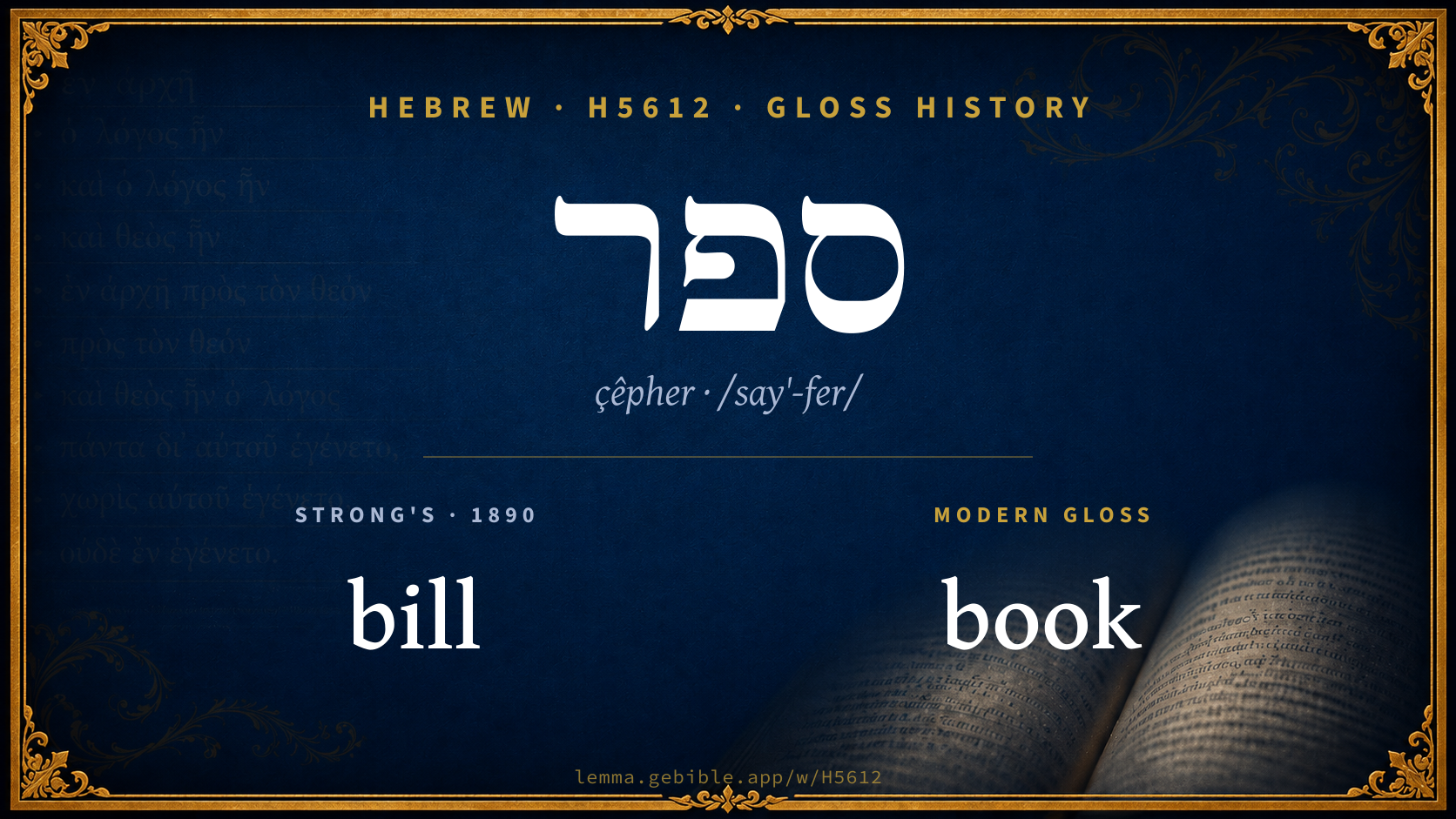
Gloss history
Strong's 1890 vs modern scholarship
About this word
Strong's H5612 catalogs a Hebrew word from the Hebrew Old Testament.
These counts are not copied from any lexicon or concordance. They are computed here, from the morphology-tagged Hebrew Old Testament. What Lemma adds →
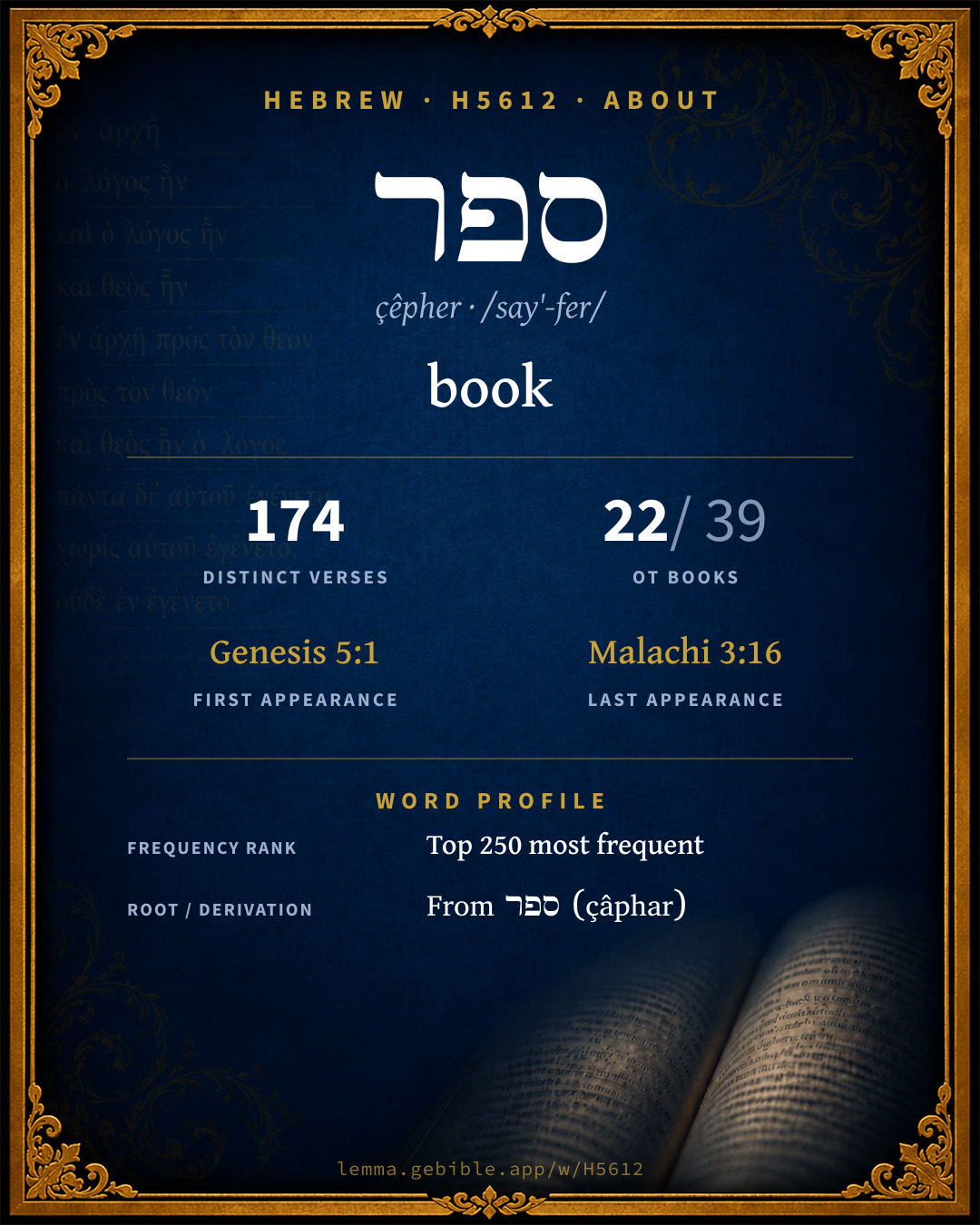
- 174
- distinct verses
- The word appears in 174 distinct verses.
- 22 / 39
- OT books
- The word appears in 22 of 39 Old Testament books.
- #249
- by frequency
- Top 250 most frequent Hebrew words (rank 249 of 8,640 Hebrew words by occurrence).
View all 174 occurrences in the concordance →
Most concentrated in
- 2 Kings 41 verses 24%
- Jeremiah 23 verses 13%
- 2 Chronicles 21 verses 12%
By section of the Old Testament
By traditional corpus
Conventional, traditional groupings — biblical authorship is debated, so this is a traditional corpus grouping, not an authorship claim. Each share is this word’s portion of its verses in that division of the Hebrew canon. Each figure is a share of the word’s 174 distinct verses.
- Prophets (Nevi'im) 102 verses · 59%
- Writings (Ketuvim) 54 verses · 31%
- Torah (Pentateuch) 18 verses · 10%
How translations render this word
Counts come from each version’s own published word-to-Strong’s tagging or interlinear alignment — an approximate guide to how each version renders this word, not a word-level alignment the data otherwise carries. Because each total is that version’s own tagged count, the per-version totals vary from one another and need not match the appearance or distinct-verse counts above. These counts may also differ from a printed concordance because Lemma counts each distinctly tagged rendering and does not collapse phrase taggings into a single head-word total. This is a fixed set of word-tagged versions (KJV, ASV, BSB, ULT) and does not change with the reading translation you choose elsewhere. Each version’s license is shown beside its name below (and on Sources).
BDB lists this Strong’s number as 2 distinct words (homographs). Each count above pools all of them and is not split by sense — see the Senses section below. A low-frequency rendering may belong to a different one of those words, not the primary meaning.
- King James Version†: Book 130×, Letters 16×, Letter 10×
- American Standard Version†: Book 107×, Letters 15×, Letter 10×
- Berean Standard Bible†: Book 107×, Scroll 18×, Letter 14×
- unfoldingWord Literal Text†: Book of 58×, Scroll 24×, Scroll of 23×
King James Version Public Domain
Renders H5612 across 183† tagged occurrences — most commonly:
Plus 14 renderings that appear only once — usually multi-word phrases or single function words the recovered tagging swept in, not distinct renderings. Not rendered by a distinct English word in 1 further occurrence.
American Standard Version Public Domain
Renders H5612 across 183† tagged occurrences — most commonly:
Plus 27 renderings that appear only once — usually multi-word phrases or single function words the recovered tagging swept in, not distinct renderings.
Berean Standard Bible Public Domain
Renders H5612 across 176† tagged occurrences — most commonly:
Plus 11 renderings that appear only once — usually multi-word phrases or single function words the recovered tagging swept in, not distinct renderings. Not rendered by a distinct English word in 10 further occurrences.
unfoldingWord Literal Text CC BY-SA 4.0
Renders H5612 across 170† tagged occurrences — most commonly:
Plus 7 renderings that appear only once — usually multi-word phrases or single function words the recovered tagging swept in, not distinct renderings.
13 senses and sub-senses in the full BDB
What do BDB’s symbols mean?
BDB uses these scholarly abbreviations:
| Symbol | Meaning |
|---|---|
| 𝔊 | the Septuagint (the ancient Greek translation, LXX) |
| 𝔙 | the Vulgate (the Latin translation) |
| 𝔖 | the Syriac version (the Peshitta) |
| 𝔗 | the Targum (the Aramaic translation) |
| ψ | the Psalms |
| √ | root (the underlying root or stem) |
| ‖ | parallel passage (a synonymous or contrasted parallel) |
| † | the dagger: every passage where the word occurs is cited |
The 13 senses and sub-senses the full Brown-Driver-Briggs lexicon distinguishes for this word, in lexicon order (not ranked by frequency), with BDB’s own verbatim wording and sub-sense lettering. Shown in Hebrew script with BDB’s own scholarly abbreviations. The condensed entry is in the Lexicon Entry tab. See also the Forms in the corpus table below.
ספר I
- 1. missive:
- a. letter of instruction, written order, commission, or request, usually from king, 2 S 11:14, 15; 1 K 21:8(×2), 9, 11; 2 K 5:5, 6(×2), 7; 10:1, 2, 6, 7; 19:14 = Is 37:14 cf. 2 Ch 32:17; 2 K 20:12 = Is 39:1; = written decree for publication Est 1:22; 3:13; 8:5; 9:20, 25, 30 (= אִגֶּרֶת v 26, 29, vid. p. 8 b supra), cf. וַיִּשְׁלַּח סְפָרִים בְּיַד הָרָצִים בַּסּוסִים רֹכְבֵי הָרֶכֶשׁ 8:10.—[כָּתַב ס׳ 2 S 11:15; 1 K 21:8; 2 K 10:1, 6; 2 Ch 32:17; כָּתַב בַּסּ׳ (of specif. contents) 2 S 11:15; 1 K 21:9, 11; קָרָא אֶת־הַסּ׳ 2 K 5:7 read the letter].— e.g. 2 Samuel 11:14
- b. from prophet Je 29:1, other influential persons v 25, 29†. e.g. Jeremiah 29:1
- 2. legal document, ס׳ כְּרִיתֻת certificate of divorce Dt 24:1, 3 and (fig.) Je 3:8; Is 50:1; ס׳ הַסִּקְנָה deed of purchase Je 32:11, 12 (del. art.), v 12, 14, 16, cf. בַּסּ׳ v 10, הַסִּפָרִים v 14 (si vera l.; del. 𝔊 Gie cf. Gf), סֵפֶר v 14 b, 44; ס׳ = indictment Jb 31:35 (obj. of כָּתַב; כָּתַב בְּ׳ = sign Je 32:10, 12, 44). e.g. Deuteronomy 24:1
- 3. book, or scroll, in which something is written to preserve it for future use Ex 17:14 (E), Jos 18:9 (JE), 1 S 10:25; Is 30:8 Jb 19:23 +; in form of roll, cf. וְנָגֹ֫לּוּ כַּסֵּפֶר הַשָּׁמַיִם Is 34:4, הַסּ׳ הֶחָתוּם 29:11, 12 (v. Je 36 etc., infr.); partic.: e.g. Exodus 17:14
- a. book of prophecies Je 25:13; 30:2 + 6 times Je 3:6; Dn 12:4; ס׳ חֲזוֹן נַחוּם Na 1:1; סֵפֶר י׳ Is 34:4; so מְגִלַּת סֵפֶר Je 36:2, 4 (= מְגִלָּה v 6 + 6 times; with many columns, דְּלָתוֹת v 23), Ez 2:9, cf. ψ 40:8. e.g. Jeremiah 25:13
- b. geneal. register, ס׳ תּוֹלְדוֹת Gn 5:1 (P), ס׳ הַיַּ֫חַשׂ Ne 7:5. e.g. Genesis 5:1
- c. law-book, †ס׳ הַבְּרִית Ex 24:7 (E), 2 K 23:2 = 2 Ch 34:30; 2 K 23:21; †ס׳ הַתּוֹרָה Dt 28:61; 29:20; 30:10; 31:26; Jos 1:8; 8:34 (all D), 2 K 22:8 = 2 Ch 34:15, 2 K 22:11; Ne 8:3; †ס׳ תּוֹרַת אֱלֹהִים Jos 24:26 (E), Ne 8:8 (reading ס׳ תּוֹרַת, so 𝔊, cf. Talm. Nedarim 37 b), v 18; 9:3; †ס׳ תּוֹרַת י׳ 2 Ch 17:9; 34:14; †ס׳ תִוֹרַת מֹשֶׁה Jos 8:31; 23:6 (both D), 2 K 14:6; Ne 8:1; †ס׳ מֹשֶׁה 2 Ch 25:4; 35:12; Ne 13:1. e.g. Exodus 24:7
- d. book of poems, ס׳ מִלְחֲמֹת י׳ Nu 21:14 (JE), ס׳ הַיָּשָׁר Jos 10:13 (JE), 2 S 1:18. e.g. Numbers 21:14
- e. book concerned with kings, ס׳ דִּבְרֵי שְׁלֹמֹה 1 K 11:41, and especially ס׳ דִּבְרֵי הַיָּמִים לְמַלְכֵי וגו׳ 1 K 14:19, 29 + 31 times K (18 times of Isr., 15 times of Judah), cf. Est 10:2 (of Media and Pers.); also ס׳ דִּבְרֵי הַיָמִים לַמֶּלֶךְ דָּוִיד 1 Ch 27:24 (reading ס׳ for מִסְפָּר, 𝔊 Kit Hpt); ס׳ הַמְּלָכִים לִיהוּדָה וְיִשְׂרָאֵל 2 Ch 16:11; ס׳ מַלְכֵי יְהוּדָה וְיִשׂ׳ 25:26; 28:26; 32:32; ס׳ מ׳ יִשׂ׳ וִיהוּדָה 27:7 35:27; 36:8; ס׳ מ׳ יִשׂ׳ 1 Ch 9:1; 2 Ch 20:34; מִדְרַשׁ ס׳ הַמְּלָבִים 24:27; also ס׳ דִּבְרֵי הַיָּמִים Ne 12:23; Est 2:23; ס׳ הַזִּכְרֹנוֹת דִּבְרֵי הַיָּמִים Est 6:1. e.g. 1 Kings 11:41
- f. once בַּסְּפָרִים Dn 9:2 by means of the Scriptures (canonical books) cf. Ew Meinh Bev MartiKau. e.g. Daniel 9:2
- g. God’s record-book, ψ 139:16, ס׳ זִכָּרוֹן Mal 3:16; God’s register of living, Ex 32:32, 33 (E), ס׳ חַיִּים ψ 69:29; הַסּ׳ Dn 12:1 (citizens of Mess. kingdom). e.g. Psalms 139:16
- 4. ס׳ =book-learning, especially writing: יָדַע (הַ)סֵּפֶר Is 29:11, 12(×2) (of ability to read); so לְלַמְּדָם סֵפֶר וּלְשׁוֹן כַּשְׂדִּים Dn 1:4 to teach them the writing and speech of the Chaldeans (on constr. v. Ges§ 128 a); more gen. הַשְׂכִּיל בְּכָל־ס׳ וְחָכְמָה v 17.—[סֵפֶר book is joined with vbs. thus: it is written (יִכָּתֵב) Mal 3:16; a thing is written בַּסּ׳ Ex 17:14 + 20 times, עַל־ס׳ 2 S 1:18 + 50 times (+ Je 36:32; בַּדְּיוֹ with ink v 18), אֶל־ס׳ †Je 30:2; 51:60; conversely דָּרַשׁ מֵעַל ס׳ Is 34:16; שָׁמַע מֵעַל ס׳ Je 36:11; v. also †בַּסּ׳ וְיֻחָ֑קוּ Jb 19:23 inscribe in a book, †עַל־ס׳ חֻקָּהּ Is 30:8 (‖ כָּתְבָהּ עַל־לוּחַ); †מָחָה מִסּ׳ blot out of a book Ex 32:32, 33 ψ 69:29; †קָרָא אֶת־הַסּ׳ Je 51:63 read the book, scroll, but usually †קָרָא בְס׳ 36:8, 10, 13 Ne 8:8, 18; 9:3; 13:1].—ס׳ in קִרְיַת ס׳, v. ק׳. e.g. Isaiah 29:11
ספר II book
Senses from the full Brown-Driver-Briggs lexicon (Brown, Driver, Briggs; Oxford 1906 — public domain), digitized via Sefaria, supplemented by the OpenScriptures HebrewLexicon (CC BY 4.0). Full attribution on Sources.
Word origin
I. n.m. Is 29:11 missive, document, writing, book (prob. ancient loan-word from Assyrian šipru, missive, message DlHWB 683, TelAm. šipru, šipirtu, id. WklTA Gloss.; √ šâpâru, send, send message or letter DlHWB 683, Wkll.c., whence also šâpiru, writer, and (perhaps ruler, šapirûtu, rule; v. HomAufsätze (1892), 34 BuhlLex 13; perhaps cf. Arabic سَفَرَ go forth to journey, ii. send on a journey Lane1370; NH סֵפֶר = BH; so Aramaic סִיפְרָא, ܣܶܦܪܳܐ; ChrPal. Aramaic ܣܝܦܪܐ SchwallyIdiot. 64; Arabic سِفْرٌ );—ס׳ abs. 2 S 11:14 +; cstr. Ex 24:7 +; sf. סִפְרִי Ex 32:33, סִפְרְךָ v 33 ψ 139:16; pl. סְפָרִים 1 K 21:8 +;—
I. n.f. book;—sf. הֲלֹא בְּסִפְרָתֶ֑ךָ ψ 56:9 (cf. סֵפֶר 3 g); del. as gloss Bi Che Hup-Now Du.—Cf. also [סְפֹרָה] infr.
— Brown-Driver-Briggs (Oxford 1906, public domain), digitized via Sefaria, supplemented by the OpenScriptures HebrewLexicon (CC BY 4.0). See Sources.
Derived from ספר (çâphar) (H5608) — to count.
Jastrow Dictionary
A second Hebrew/Aramaic lexicon for comparison, covering Aramaic and post-biblical (Talmudic, Targumic, Midrashic) usage that the biblical-Hebrew BDB does not. Matched by lemma rather than by Strong’s number, so a lemma may carry more than one Jastrow headword (shown separately below), and the entries cover usage well beyond the Bible.
סָפַר
- (b. h.) [to cut; to mark,]
- 1. to write; to count. Y. Kil. VII, end, 31ᵃ יִסְפּוֹר he (who is in possession of property bought from an oppressor, v. אַנָּס) must count (settle with the original owner according to rules, v. גוֹרְדְּיָינִי), opp. יחזיר he must return the property; ib. יִסְפֹּר (or יְסַפֵּר Pi.). Kidd. 30ᵃ שהיו סוֹפְרִים, v. סוֹפֵר. Nidd. 69ᵃ סוֹפַרְתָּן למנין וכ׳ she counts them in with the requisite number of seven days. Ib. 31ᵃ יושב וסוֹפֵר וכ׳ sits and records the copulations &c. Men. 65ᵇ, v. סְפִירָה; a. v. fr.—[Sifré Deut. 33 סופרה; read: סופנה, v. סָפַן.]—Part. pass. סָפוּר, q. v.
- 2. to cut, shear, v. infra.
- to be counted. Bekh. 45ᵃ שנִסְפֶּרֶת ע"ג היד when the additional finger is counted (is in a line) with the others; Yalk. Sam. 156.
- 1. to cut, shear. Sot. 49ᵇ, a. fr. מְסַפֵּר קומי, v. קוֹמִי I. Ib. התירו (לו)לסַפֵּר וכ׳ they allowed him to cut his hair in gentile fashion, because of his connections with royalty. Sifra Aḥăré, Par. 9, ch. XIII תִּסְפּוֹר, v. קוֹמִי I. Tosef. Bets. III, 19 אין מְסַפְּרִין הירק וכ׳ you must not no trim vegetables with the clipper (on the Holy Day) &c.; a. fr.
- 2. to tell, speak, count. Y. Kil. l. c., v. supra. Gen. R. s. 78 (ref. to אברם in place of אברהם, Neh. IX, 7) סיפור הוא מְסַפֵּר וכ׳ he states a historical fact, saying &c. Y. Ber. IX, beg. 12ᵈ אם בא אדם לסַפֵּר וכ׳ if one were to undertake to count the mighty deeds of the Lord, he would be ruined (ref. to Job XXXVII, 20); המספר בשבחו וכ׳ he who tells the praise of the Lord more than is becoming. Ib. מכאן … אסור לסַפֵּר וכ׳ beyond that (which has been adopted in ritual prayers) one must not tell &c. Arakh. 16ᵃ לעולם אל יְסַפֵּר אדם בטובתו וכ׳ man should not count up his neighbor’s good qualities, for he may be induced to speak of his shortcomings; B. Bath. 164ᵇ. Sot. 42ᵃ מְספְּרֵי לשון הרע gossipers. Snh. 38ᵇ בלשון ארמי סי׳ spoke Aramæan; a. v. fr.—Ib. 52ᵇ סי׳ הימנו if he (the scholar) holds conversation with him. e.g. Nehemiah 9:7
- to have one’s hair cut. Ab. Zar. II, 2 אין מִסְתַּפְּרִין מהן וכ׳ you must not have your hair cut by them in any place (on account of danger to life). Tosef. ib. III, 5 ישראל המִסְתַּפֵּר וכ׳ if an Israelite has his hair cut by a gentile, he must look into the mirror; Ab. Zar. 29ᵃ; a. fr.
סְפַר
- 1. to count, mark, write, v. סַפְרָא I. I.
- 2. to shear, v. infra.
- to cut, shear, shave. Targ. Job I, 20 (Ms. סְפַר Pe.). Targ. Y. Lev. XIII, 33 (not יַסְפֵּר); ib. XIV, 8, sq. (h. text גלח); a. fr.—Lev. R. s. 28, end יתיב ומְסַפֵּר ליה (Haman) sat down and cut his (Mordecai’s) hair; ib. מן דחסל (מן) מְסַפְּרָא ליה when he had done cutting his hair; a. fr.—Part. pass. מְסַפֵּר. Ib. אית בר נש … ולא מ׳ is there a man who putts the royal crown on his head without having his hair cut?; Esth. R. to VI, 10.
סַפָּר
- (preced. wds.)
- 1. (v. סֵפֶר) Bible teacher. Y. Maasr. III, 50ᵈ בית … טובלין לס׳ ולמַשְׁנֶה (not ולא למש׳) school houses for Bible and Talmud make fruits ṭebel for the Bible teacher and for the Talmud teacher. [Perh. to be read: סָפַר Chald. form.]
- 2. hair-cutter, barber. Sabb. I, 2 לא ישב אדם לפני הס׳ וכ׳ one must not sit down for the hair-cutter near Minḥah time beforesaying the prayer. Shebi. VIII, 5; a. e.—Pl. סַפָּרִים, סַפָּרִין. Kel. XIII, 1 זוג של ס׳ the barbers’ scissors. Sabb. 9ᵇ. v. מַעֲפוֹרֶת; a. e.
סַפָּר ²
- , hair-cutter. Targ. II Esth. VI, 12.—Lev. R. s. 28, end; Esth. R. to VI, 10. Lev. R. s. 14, end לית ס׳ דמספר לגרמיה no hair-cutter can cut his own hair (i.e. the female sperm begets the male embryo and vice versa); a. e.
סְפָר
- (סָפַר) [mark, march,] boundary, border district. Yeb. 48ᵇ עיר הסמוכה לס׳ a town near the boundary. Sot. 42ᵃ פעמים מדבר עמו אחת בס׳ וכ׳ the priest addressed the people twice, once on the border line (before entering the enemy’s land) and once before the battle. Tosef. Erub. IV (III), 5 באו … הסמוכות לס׳ if the enemy invades towns near the boundary (of Palestine); Y. ib. IV, 21ᵈ bot.; Bab. ib. 45ᵃ. Ib. ובבל כעיר הסמוכה לס׳ וכ׳ and Babylonia is (as regards the duty of defence) like a town near the boundary, which was interpreted to mean Neharde‘a. Num. R. s. 16 מה ראה לישב לו על הס׳ וכ׳ what reason had he (Amalek) to settle on the border, on the way of the entrance of the Israelites into the land?; a. e.—Pi. סְפָרִים, constr. סִפְרֵי. Y. Ḥall. II, 58ᵇ bot. ס׳ א"י Palestinian districts, ס׳ חוצה לארץ foreign districts (conquered by Israelites).
סְפַר ²
- constr. סְפַר, same; ס׳ יַמָּא sea-district. Targ. O. Gen. XLIX, 13 (h. text חֹף); a. fr.—Pl. סַפְרַיָּא, constr. סַפְרֵי. Targ. Y. ib.—[Targ. Y. Lev. XIII, 45 ספריא, some ed., v. סָפְדָּא.]
סָפֵר
- (preced. wds.) = סְפִירָה, counting. Naz. VII, 3 (54ᵃ) ימי סְפֵרוֹ (comment. סְפֵירוֹ; Y. ed. ספורו) the days which the cured leper has to count (Lev. XIV, 8); Y. ib. 56ᶜ bot. ספירו. e.g. Leviticus 14:8
סֵפֶר
- preced. wds.) letter, document, book. Erub. 15ᵇ; Gitt. 21ᵇ; Succ. 24ᵇ, v. סְפִירָה. Eduy. I, 12, a. fr. ס׳ כתובה the formula of a Kethubah. Y. Sot. IX, end, 24ᶜ משמת ר"א נגנז ס׳ החכמה with the death of R. El. a book of wisdom disappeared; Bab. Sot. 49ᵇ נגנז ס׳ תורה; Tosef. ib. XV, 3 בטל ס׳ תורה. Gen. R. s. 24 סִפְרוֹ של אה"ר the book of Adam (the destinies of humanity); Ex. R. s. 40; Lev. R. s. 15 beg.; a. fr.—Esp. a Biblical book. B. Bath. 15ᵃ ירמיה כתב ספרו וס׳ מלכים וכ׳ Jeremiah wrote his book (the prophecies of Jerem.) and the Book of Kings and the Lamentations. Ib. 14ᵇ משה כתב ספרו וכ׳ Moses wrote his own book, and the Section of Balaam (the chapters on B., Num. XXII, 2—XXIV, 25) and Job; Y. Sot. V, end, 20ᵈ; a. v. fr.—ס׳ תורה (abbrev. ס"ת) (or ס׳ only) the Pentateuch in a scroll. Ab. Zar. 18ᵃ כרכוהו בס"ת וכ׳ they wrapped him up in the scroll &c. Sabb. 116ᵃ ס"ת שנמחק a scroll of the Pentateuch the writing of which is effaced; Yad. III, 5 ס׳ שנמחק; a. v. fr.—Kel. XV, 6, a. e. ס׳ העזרה the Pentateuch kept in the Temple court, v. עֲזָרָה.—ס׳ הוא, ס׳ זעטוטים &c., v. respective determinants.—בֵּית סֵ׳, בֵּית הַסֵּ׳ the school in which the Bible is taught, secondary school, contrad. to בית תלמוד Talmud school. Y. Maasr. III, 50ᵈ, v. סַפָּר 1. Midr. Till. to XCII, 16 שתולים … אלו התינוקות שבבית הס׳ ‘planted in the house of the Lord’ (ib. 14), that means the children at school; a. fr.—Pl. סְפָרִים, constr. סִפְרֵי, סִיפְ׳. Ex. R. s. 41 זריז בכ"ד ס׳ well-versed in the twenty-four books of the Scripture. Sabb. 116ᵃ (ס׳ צדוקים) ס׳ מינים heretical books, v. מִין III. Snh. 68ᵃ שתי … כשני ס׳ תורה וכ׳ my two arms which are like two rolled up scrolls of the Torah, a. v. fr.—Ch. סִפְרָא, constr. סֵפֶר. e.g. Numbers 22:2
סָפַר ²
- = h. סוֹפֵר,
- 1. scribe, writer of documents; copyist. Targ. Jer. XXXVI, 20, sq.; a. fr.—Ab. Zar. 9ᵃ, v. בַּצִּירָא, Ib. 10ᵃ, v. דַּוְקָנָא. Ḥull. 64ᵇ, sq. פסיק להו ס׳ וכ׳ the copyist (of the Scriptures) divides them into two words. Y. Succ. II, 53ᵃ top סַפְרָה דגופתא the scribe of Gufta; a. fr.
- 2. scholar, teacher. Targ. Is. III, 2 (h. text נביא); ib. IX, 14. Targ. O. Gen. XLIX, 10 (h. text מחקק); a. fr.—Gen. R. s. 70, end אית ס׳ דלית וכ׳ is there a teacher that has no pupils?, i.e. I (Laban) learned trickery from you (Jacob).—Esp. Bible teacher. Y. Ḥag. I, 76ᶜ, a. e., v. מַתְנְיָין; a. fr.—ס׳ מתא, v. סוֹפֵר.—Pl. סַפְרַיָּא, סַפְרַיָּיא, סַפְרִין, סַפְרֵי. Targ. Y. I Gen. XLIX, 10. Targ. I Sam. X, 15 (h. text נביאים); a. fr.—Sot. IX, 5 (49ᵃ), v. חַכִּימָא. Midr. Till. to Ps. XCI, 6 מפקיד לס׳ וכ׳ ordered the school teachers to let the children go free (during the summer) from the fourth to the ninth hour of the day; Lam. R. to I, 3; Num. R. s. 12 לסַפְרַיָּה; a. fr.
A Dictionary of the Targumim, the Talmud Babli and Yerushalmi, and the Midrashic Literature (Marcus Jastrow; London, Luzac, 1903) — Public Domain. Digitized via Sefaria. Digitized via Sefaria. Full attribution on Sources.
Forms in the corpus
The 62 distinct written forms H5612 takes in the Hebrew Bible, most frequent first — each parse links to that state’s occurrences in the concordance. Hebrew forms include their vowel points and cantillation, so a single lemma takes many written forms.
The 60 most common forms are shown; 2 rarer forms follow in the full concordance.
Same root — word family
Other BDB entries built from the same root as H5612, grouped by Strong’s listed origin. These share a root / origin per the lexicon — not necessarily a shared meaning. Each links to that word’s own entry.
Derives from
Shares the same root
- מספר miçpâr H4557 number
- ספיר çappîyr H5601 sapphire
- ספר çᵉphar H5609 book
- ספר çᵉphâr H5610 census
- ספרה çᵉphôrâh H5615 number
Proper names from this root
People and places named from this root — a name, not an additional meaning of the word.
Compare all same-root words → Showing 4 of 8 — not the complete family. 1 of the same-root words is a proper name (a person or place). They share a root, not necessarily a meaning.
Septuagint verse parallels
This word appears in 152 verses that also exist in the Greek Old Testament (Septuagint), out of the 174 Hebrew verses it occurs in. You can read those verses in Greek by switching the Old Testament edition to the Septuagint.
Read these verses in the Septuagint
- Genesis 5:1
- Exodus 17:14
- Numbers 5:23
- Deuteronomy 17:18
- Joshua 1:8
- 1 Samuel 10:25
- 2 Samuel 1:18
- 1 Kings 11:41
- 2 Kings 1:18
- 1 Chronicles 9:1
- 2 Chronicles 16:11
- Esther 1:22
This is a verse-level parallel only — the same verses exist in both the Hebrew and Greek Old Testaments. No word-level Hebrew↔Greek correspondence is claimed: the data carries no such alignment, so no Greek word is shown as this Hebrew word’s translation. Coverage is not total — the Septuagint omits the deuterocanon and renumbers the Psalms, so some Hebrew verses have no direct Greek parallel.