Isaiah 29:12

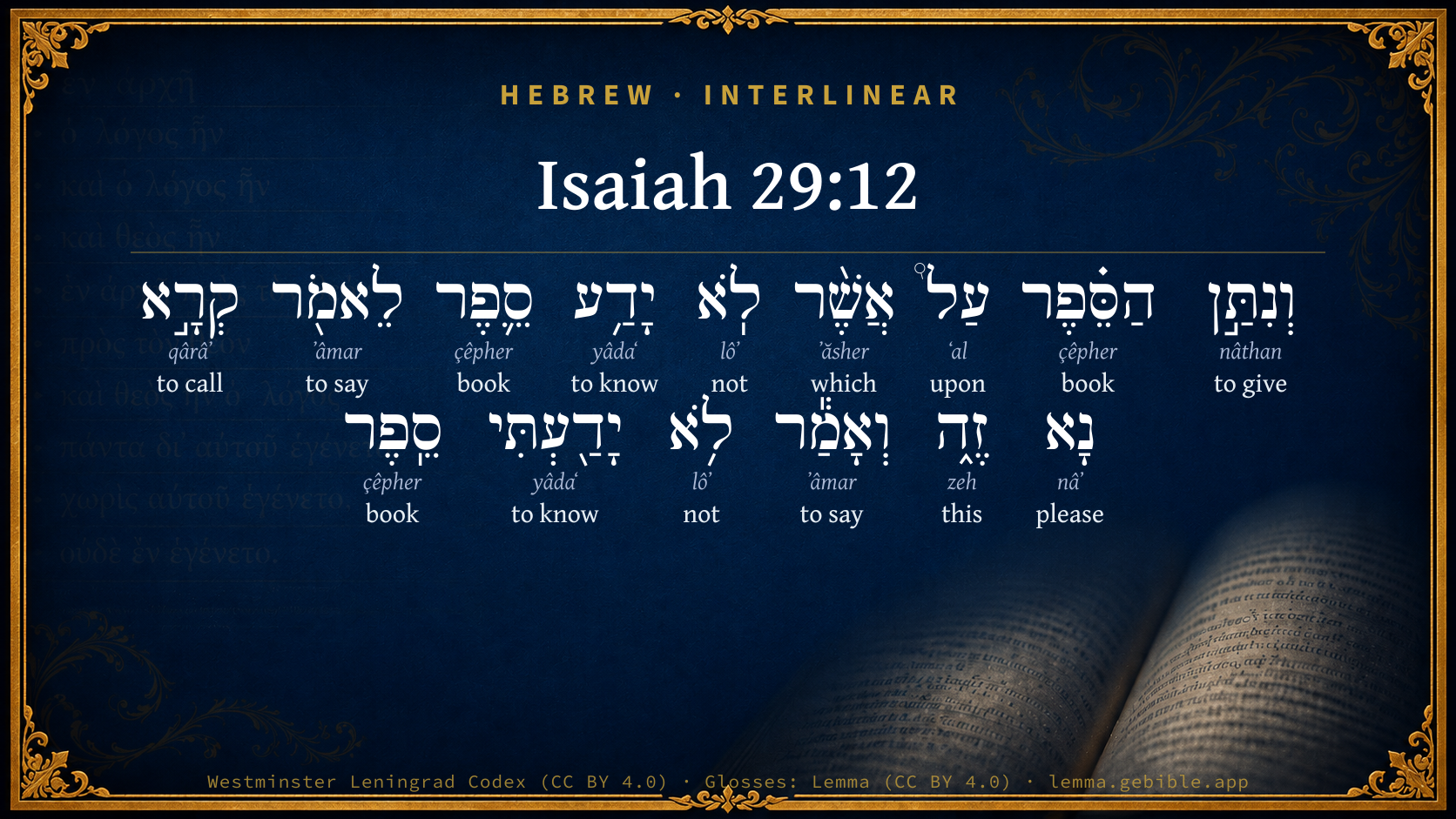
Hebrew (Westminster Leningrad Codex) Isaiah 29:12 appears in the Hebrew Old Testament. The text above is from the Westminster Leningrad Codex. Each word links to its Strong’s number, a concise gloss, and parsing drawn from the Open Scriptures Hebrew Bible morphology. Click any word for its full Brown-Driver-Briggs (BDB) entry.
Download image
Cite this verse

Isaiah 29:12 (World English Bible). Public Domain. Lemma interlinear Bible study tool, https://lemma.gebible.app/v/isaiah/29/12.

Show BibTeX & RIS
BibTeX
RIS
English Translation
and the book is delivered to him who is not learned, saying, Read this, I pray you; and he says, I am not learned.
World English Bible · Public Domain
Download a study sheet

One document with this verse’s original text, its word-by-word gloss line, the meaning frame, cross-references with their text, attributed commentary, and full source and license credits — printable, and it pastes into notes with its structure intact.

This verse Autodidact and up

Study sheet (.html) Plain text (.txt)

A passage Seminary Student

Up to 50 verses in one chapter. A passage sheet keeps up to 6 commentary sources and 12 cross-references per verse, in the order this page ranks them, and says so on the sheet whenever that leaves anything out. Ask for a single verse and you get the Autodidact verse sheet above.

Everything on this page stays free to read, with no account — the sheet is a download of what is already on screen, not access to it.

Want to remove ads? Support Godless Engineer
Compare translations 3

The same verse in 3 English versions, stacked beneath the original-language interlinear above. Click any original word for its lexicon entry.

Each is an independent rendering of the whole verse — the interlinear is not word-aligned to these translations.

Highlighted words mark where these versions differ — a whole-verse word diff, not a word-by-word alignment.

  • World English Bible Public Domain
    and the book is delivered to him who is not learned, saying, Read this, I pray you; and he says, I am not learned.
  • King James Version Public Domain
    And the book is delivered to him that is not learned, saying, Read this, I pray thee: and he saith, I am not learned.
  • unfoldingWord Literal Text CC BY-SA 4.0
    Or the scroll is given to who does not know writing, saying, “Read this, please,” and he says, “I do not know writing.”

unfoldingWord Literal Text — © unfoldingWord, licensed CC BY-SA 4.0. Word-aligned USFM3 via Door43 (git.door43.org/unfoldingWord/en_ult).

Versions to compare (up to 4)

3 of 4 selected

Show all 18 translations

Every available English version of this verse, each an independent rendering of the whole verse.

  • World English Bible Public Domain
    and the book is delivered to him who is not learned, saying, Read this, I pray you; and he says, I am not learned.
  • Berean Standard Bible Public Domain
    Or if the scroll is handed to one unable to read, he will say, “I cannot read.”
  • Majority Standard Bible Public Domain
    Or if the scroll is handed to one unable to read, he will say, “I cannot read.”
  • King James Version Public Domain
    And the book is delivered to him that is not learned, saying, Read this, I pray thee: and he saith, I am not learned.
  • American Standard Version (1901) Public Domain
    and the book is delivered to him that is not learned, saying, Read this, I pray thee; and he saith, I am not learned.
  • Revised Version (1885) Public Domain
    and the book is delivered to him that is not learned, saying, Read this, I pray thee: and he saith, I am not learned.
  • Geneva Bible (1599) Public Domain
    And the booke is giuen vnto him that can not reade, saying, Reade this, I pray thee. And he shall say, I can not reade.
  • Douay-Rheims (1899) Public Domain
    And the book shall be given to one that knoweth no letters, and it shall be said to him: Read: and he shall answer: I know no letters.
  • Young's Literal Translation Public Domain
    And the book is given to him who hath not known books, Saying, `Read this, we pray thee,' And he hath said, `I have not known books.'
  • Literal Standard Version CC BY-SA 4.0
    And the scroll is given to him who has not known scrolls, || Saying, “Please read this,” || And he has said, “I have not known scrolls.”
  • Unlocked Literal Bible CC BY-SA 4.0
    If the book is given to one who cannot read, saying, “Read this,” he says, “I cannot read.”
  • unfoldingWord Literal Text CC BY-SA 4.0
    Or the scroll is given to who does not know writing, saying, “Read this, please,” and he says, “I do not know writing.”
  • Darby Bible Public Domain
    And they give the book to him that cannot read, saying, Read this, I pray thee; and he saith, I cannot read.
  • World Messianic Bible Public Domain
    and the book is delivered to one who is not educated, saying, “Read this, please;” and he says, “I can’t read.”
  • Webster's Bible Public Domain
    And the book is delivered to him that is not learned, saying, Read this, I pray thee: and he saith, I am not learned.
  • Free Bible Version CC BY-SA 4.0
    If you give it to someone who doesn't know how to read and say, “Please read it,” they'll say, “I don't know how to read.”
  • Bible in Basic English Public Domain
    And they give it to one without learning, saying, Make clear to us what is in the book: and he says, I have no knowledge of writing.
  • JPS Tanakh (1917) Public Domain
    and the writing is delivered to him that is not learned, saying: 'Read this, I pray thee'; and he saith: 'I am not learned.'

Literal Standard Version (2020), Covenant Press — licensed CC BY-SA 4.0. Text via the HelloAO Bible API (eBible.org). Unlocked Literal Bible (unfoldingWord) — licensed CC BY-SA 4.0. Text via the HelloAO Bible API (eBible.org). unfoldingWord Literal Text — © unfoldingWord, licensed CC BY-SA 4.0. Word-aligned USFM3 via Door43 (git.door43.org/unfoldingWord/en_ult). Free Bible Version, Dr. Jonathan Gallagher — licensed CC BY-SA 4.0. Text via the HelloAO Bible API (eBible.org).

Word by word

More ways to search: Search by grammar → Find every occurrence → Compare this word →

Practice this passage: Drill this verse → Learn its vocabulary →

הַסֵּ֗פֶר
çêpher
H5612
“the · book”
Particle, Definite Article + Noun, Common, Masculine, Singular, Absolute
Part of Speech
Particle + Noun
Type
Common
Gender
Masculine
Number
Singular
State
Absolute
Full BDB Definition

Origin: from H5608

TWOT: 1540a , 1540b

book (noun feminine) - missive, document, writing, book (noun masculine) - missive - letter (of instruction), written order, commission, request, written decree - legal document, certificate of divorce, deed of purchase, indictment, sign - book, scroll - book of prophecies - genealogical register - law-book - book (of poems) - book (of kings) - books of the canon, scripture - record book (of God) - book-learning, writing - be able to read (after verb 'to know')
  1. וְנִתַּ֣ן nâthan H5414 “and · to give” Conjunction + Verb, Niphal, Sequential Perfect, 3rd Person, Masculine, Singular
  2. עַל֩ ʻal H5921 “upon” Preposition
  3. אֲשֶׁ֨ר ʼăsher H834 “which” Particle, Relative
  4. לֹֽא lôʼ H3808 “not” Particle, Negative
  5. יָדַ֥ע yâdaʻ H3045 “to know” Verb, Qal, Perfect, 3rd Person, Masculine, Singular
  6. סֵ֛פֶר çêpher H5612 “book” Noun, Common, Masculine, Singular, Absolute
  7. לֵאמֹ֖ר ʼâmar H559 “to say” Preposition + Verb, Qal, Infinitive Construct
  8. קְרָ֣א qârâʼ H7121 “call” Verb, Qal, Imperative, 2nd Person, Masculine, Singular
  9. נָא nâʼ H4994 “please” Particle, Exhortation
  10. זֶ֑ה zeh H2088 “this” Pronoun, Demonstrative, Masculine, Singular
  11. וְאָמַ֕ר ʼâmar H559 “and · to say” Conjunction + Verb, Qal, Sequential Perfect, 3rd Person, Masculine, Singular
  12. לֹ֥א lôʼ H3808 “not” Particle, Negative
  13. יָדַ֖עְתִּי yâdaʻ H3045 “to know” Verb, Qal, Perfect, 1st Person, Common, Singular
  14. סֵֽפֶר çêpher H5612 “book” Noun, Common, Masculine, Singular, Absolute

About this verse

These counts appear in no published source. They are computed here, from the morphology-tagged text and Lemma’s own curated glosses. What Lemma adds →

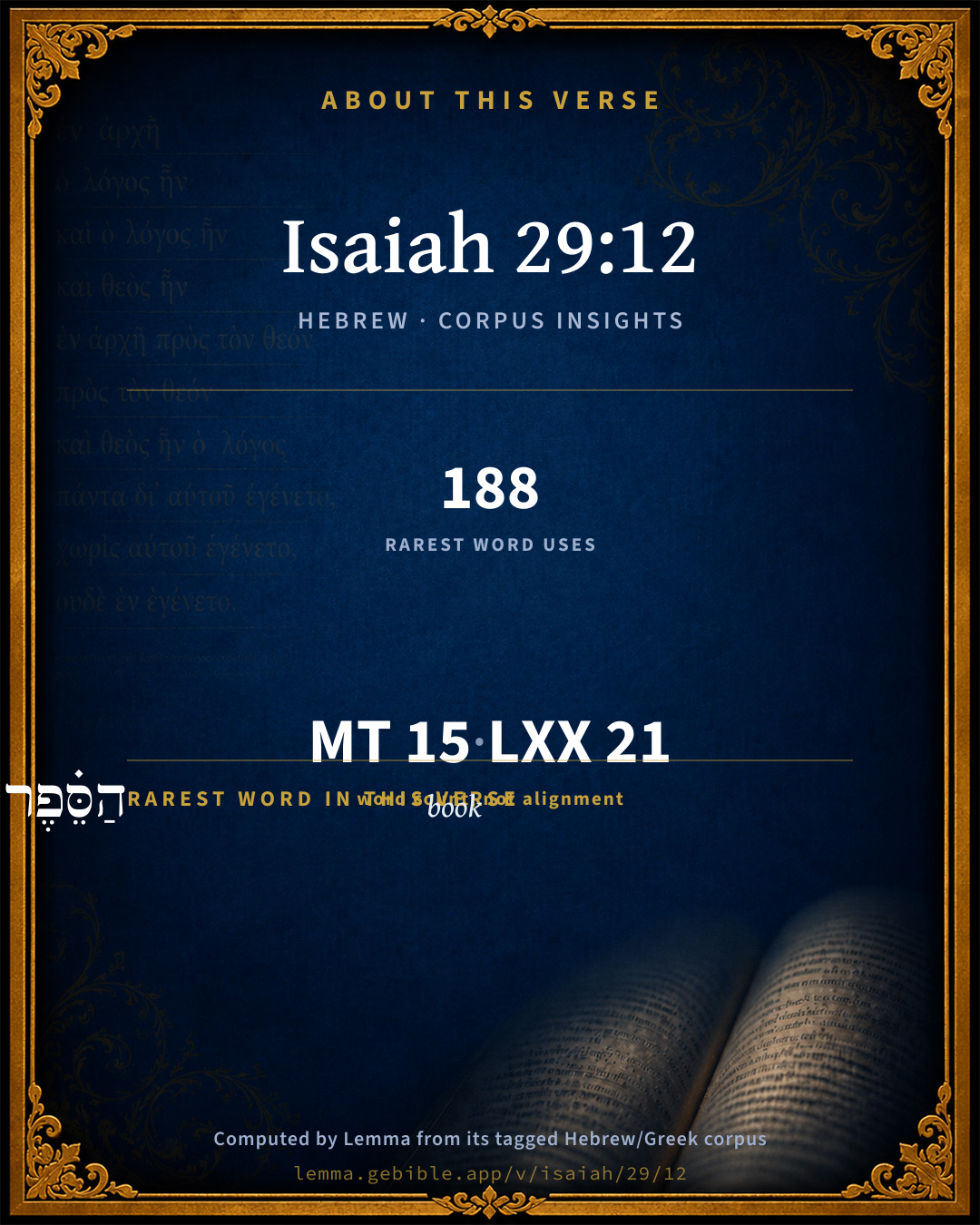
15
words
10
distinct lemmas
Prophets
section

Grammatical profile

  • 6 verbs
  • 3 nouns
  • 1 pronoun
  • 1 preposition
  • 4 particles

Verb forms

  • וְנִתַּ֣ן Niphal · Sequential Perfect
  • יָדַ֥ע Qal · Perfect
  • לֵאמֹ֖ר Qal · Infinitive Construct
  • קְרָ֣א Qal · Imperative
  • וְאָמַ֕ר Qal · Sequential Perfect
  • יָדַ֖עְתִּי Qal · Perfect

Repetition

Words recur within this verse — often emphatic in Hebrew:

  • הַסֵּ֗פֶר book H5612 ×3
  • יָדַ֥ע to know H3045 ×2
  • לֵאמֹ֖ר to say H559 ×2
  • לֹֽא not H3808 ×2

Hebrew & Septuagint length

In English translation the verse runs 24 words from the Hebrew and 31 from the Septuagint (LXX English) — closely comparable.

A rough comparison of the two English renderings, which tokenize alike — not a word-level alignment.

Word counts can differ between the Hebrew and the Greek without any difference in meaning — e.g. the Hebrew direct-object marker אֵת has no separate Greek word, and Greek often adds the article ὁ.

In the original languages it is 15 Hebrew tokens and 21 Greek tokens — but the two are counted differently (Hebrew bundles its prefixes and suffixes into one token; the Greek is in lemma form), so that isn’t a like-for-like length.

Cross-references

5

Topical passages linked to Isaiah 29:12 in the Treasury of Scripture Knowledge — connected by theme and wording, ordered by reader-vote popularity; previews shown in the World English Bible.

  • John 7:15–16 The Jews therefore marveled, saying, "How does this man know letters, having never been educated?"
  • Isaiah 29:18 In that day shall the deaf hear the words of the book, and the eyes of the blind shall see out of obscurity and out of darkness.
  • Isaiah 28:12–13 to whom he said, This is the rest, give you rest to him who is weary; and this is the refreshing: yet they would not hear.
  • Jeremiah 5:4 Then I said, Surely these are poor; they are foolish; for they don't know the way of Yahweh, nor the law of their God:
  • Hosea 4:6 My people are destroyed for lack of knowledge. Because you have rejected knowledge, I will also reject you, That you may be no priest to me. Because you have your God's law, I will also forget your children.

Cross-references courtesy of OpenBible.info (CC BY 4.0).

Hebrew and Greek witnesses Masoretic Hebrew ↔ Greek Septuagint

The same verse in the two great witnesses to the Old Testament, shown verse-for-verse.

These are two independent witnesses, not word-aligned to each other, and the Septuagint is shown in lemma (dictionary) form.

Hebrew Isaiah 29:12 Masoretic · Westminster Leningrad Codex

וְנִתַּ֣ן הַסֵּ֗פֶר עַל֩ אֲשֶׁ֨ר לֹֽא יָדַ֥ע סֵ֛פֶר לֵאמֹ֖ר קְרָ֣א נָא זֶ֑ה וְאָמַ֕ר לֹ֥א יָדַ֖עְתִּי סֵֽפֶר

and the book is delivered to him who is not learned, saying, Read this, I pray you; and he says, I am not learned.

World English Bible · Public Domain

Greek LXX Isaiah 29:12 Septuagint · lemma form

καί δίδωμι ὁ βιβλίον οὗτος εἰς χείρ ἄνθρωπος μή ἐπίσταμαι γράμμα καί εἶπον αὐτός ἀναγιγνώσκω οὗτος καί εἶπον οὐ ἐπίσταμαι γράμμα

And this book shall be given into the hands of a man that is unlearned, and one shall say to him, Read this; and he shall say, I am not learned.

LXX2012 (modern English Septuagint) · Public Domain

Hebrew: Westminster Leningrad Codex (CC BY 4.0). Greek: Septuagint (public domain); English from LXX2012 (modern English Septuagint) (Public Domain). How the Septuagint differs from the Hebrew →

Targum (Aramaic paraphrase)

1

The Targum is the ancient Jewish Aramaic paraphrase of the Hebrew Scriptures — an interpretive translation, not the Hebrew text itself. Onkelos (literal) and Pseudo-Jonathan (expansive) render the Torah, and Jonathan the Prophets. Coverage is partial: where no permissively-licensed English translation exists for a verse, only the Aramaic is shown. This is verse-level text, not a word-by-word alignment to the Hebrew.

  1. Targum Jonathan Prophets (Joshua–Malachi)
    וְיִתְיְהַב סַפְרָא לִדְלָא יָדַע סִפְרָא לְמֵימַר קְרֵי כְעַן דֵין וְיֵימַר לֵית אֲנָא יָדַע סִפְרָא:

    Or should the book be given to one that is not learned, saying, “Read this now,” then he, shall answer, “I am not learned.”

    Targum Jonathan — Aramaic: “Mikraot Gedolot” (public domain). English: “Sefaria Community Translation” (CC0 1.0 (public-domain dedication)); “London "Chaldee Paraphrase," 1871” (public domain). Text via Sefaria.

Commentary

Notes on Isaiah 29:12 from classic Christian and Jewish commentators (each source and its license shown beneath its notes). The classic Christian expositions comment on the surrounding passage and are grouped to its opening verse, so a note may address several verses; the Jewish commentaries on the Tanakh (Rashi and others) are per-verse, so they appear only where the commentator wrote on this verse.

Lemma curates 59 commentaries, every one of them public domain or Creative Commons licensed, each selected and text-cleaned for this edition rather than reprinted as found. About our sources →

Trapp's Complete Commentary

John Trapp

Isa 29:12 And the book is delivered to him that is not learned, saying, Read this, I pray thee: and he saith, I am not learned.

Ver. 12. And the book is delivered to one that is not learned.] Heb., Knoweth not to read. By the learned is meant, say some, the rulers in Church and State; by the unlearned, the common people: all were in a pickle. Nicodemus had oft read in this our prophet, in Ezekiel and elsewhere, of regeneration, though not under that term; but how little he understood it, see Joh 3:4; Joh 3:9 And what a buzzard is Bellarmine himself in some such fundamentals as whereof it is a shame for a very child to be ignorant! I must needs confess, said a learned Papist to the Bishop of Cavaillon, that I have often been at the schools of Sorbonne in Paris, where I have heard the disputations of the divines, but yet I never learned so much as I have done by hearing these young children at Merindol posing one another before the bishop about points of religion. The poor men of Lyons in France were enlightened when the great doctors were blinded and besotted in their superstitious tenets and practices. {a}

{a} Acts and Mon, 865.

John Trapp, A Commentary or Exposition upon All the Books of the Old and New Testament (1647–1656) — public domain. Text from a community e-Sword module.

Jamieson, Fausset & Brown

Robert Jamieson, A. R. Fausset & David Brown

The unlearned succeed no better than the learned, not from want of human learning, as they fancy, but from not having the teaching of God (Isa 54:13; Jer 31:34; Joh 6:45; Co1 2:7-10; Jo1 2:20).

Jamieson, Fausset & Brown — Commentary Critical and Explanatory on the Whole Bible (1871) — public domain (CC PDM 1.0). Text via the HelloAO Bible API.

John Gill's Exposition

And the book is delivered to him that is not learned,.... Or that knows not a book or letters, as before, and so consequently cannot read, having never been put to school, or learned to read:

saying, Read this, I pray thee; or "now" (w), at once, immediately:

and he saith, I am not learned; he does not excuse himself on account of its being sealed, but on account of his want of learning; which shows the former was but an excuse. In short, the sum of it is this, that neither the learned nor unlearned, among the Jews, cared to read their Bibles, or to search the Scriptures, and the prophecies in them, concerning the Messiah, and that neither of them understood them; these things were hid from the wise and prudent, as well as from the ignorant and unlearned of the people, in common, and were only made known to a few babes and sucklings. There was great ignorance of the Scriptures in the times of Christ, to which these passages truly belong, Mat 11:25.

(w) "nunc", Pagninus, Montanus.

John Gill's Exposition of the Whole Bible (1746–1763) — public domain (CC PDM 1.0). Text via the HelloAO Bible API.

Albert Barnes' Notes on the Bible

And the book is delivered ... - That is, they are just as ignorant of the true nature and meaning of the revelations of God as a man is of the contents of a book who is utterly unable to read.

Albert Barnes' Notes on the Bible (1834–1885) — public domain. Text from a community e-Sword/MySword module.

Matthew Poole's English Annotations

The vision of all; of all your prophets, whether the true or false ones. As the words of a book that is sealed; in which no man can read whilst it is scaled up, as books then sometimes were, 1Ki 21:8; Est 3:12,13, being made in the form of rolls, which was convenient for that purpose.

The book is delivered to him that is not learned; unsealed and opened, as the following clause implies. God so orders the manner of delivering this book, that neither the learned nor unlearned could read and understand it.

Matthew Poole's English Annotations on the Holy Bible (1683–1685) — public domain. Text from a community e-Sword/MySword module.

The Pulpit Commentary

Him that is not learned; i.e. "that cannot read writing." Even in our Lord"s day the ordinary Jew was not taught to read and write. Hence the surprise of the rulers at his teaching the people out of the Law. (Joh_7:15, "How knoweth this man letters, having never learned?

The Pulpit Commentary (1880–1919), ed. H.D.M. Spence-Jones & Joseph S. Exell — public domain. Text from a community e-Sword module.

John Wesley's Explanatory Notes

Of all - Of all, your prophets. As a book - In which no man can read, while it is sealed up, as books then sometimes were, being made in the form of rolls. Delivered - Unsealed and opened.

John Wesley, Explanatory Notes Upon the Whole Bible (1754–1765) — public domain. Text via the GEBible commentary corpus.

J. A. Alexander on Isaiah

Joseph Addison Alexander

“And the writing is given to one who knows not writing, saying, Pray read this, and he says, I know not writing.” The common version, ‘I am not learned’, is too comprehensive and indefinite. A man might read a letter without being learned, at least in the modern sense, although the word was once the opposite of illiterate or wholly ignorant. In this case it is necessary to the full effect of the comparison, that the phrase should be distinctly understood to mean, ‘I cannot read’. The comparison itself represents the people as alike incapable of understanding the divine communications, or rather as professing incapacity to understand them, some upon the general ground of ignorance, and others on the ground of their obscurity.

Joseph Addison Alexander, The Prophecies of Isaiah (1846–1847; New York: Scribner, 1870–1878) — public domain. Text from a community e-Sword module.

Rashi

Rabbi Shlomo Yitzchaki (Rashi)

And if the book is given And when they take it from him and open its seal and give it to one who does not understand the language of the letter, and they say to him, “now read this,” he will say, “I cannot read.” Similarly, when you adjure the prince of fire, he will say, “I cannot, for the matter is sealed from me,” and when you adjure his colleague, he will say, “I do not recognize this name, by which you adjure me, for this is not my name.” This is what Jeremiah said (Jer. 21:4): “Behold I will turn around my implements of war that are in your hands.” This refers to the Explicit Name. In Midrash Tehillim (36:5).

Rashi on the Tanakh — English translations: “The Judaica Press complete Tanach with Rashi, translated by A. J. Rosenberg” (CC BY 4.0); “Pentateuch with Rashi's commentary by M. Rosenbaum and A.M. Silbermann, 1929-1934” (public domain); “The Metsudah Tanach series, Lakewood, N.J” (CC BY 4.0); and “The Book of Joshua, Metsudah Publications, 1997” (CC BY 4.0). Text via Sefaria.

Ibn Ezra

Rabbi Abraham ibn Ezra

And the book is delivered, etc. Neither the wise men nor those that have no intellect will understand this prophecy.

Ibn Ezra on the Tanakh — English translations: “Sefaria Community Translation” (CC0 1.0 (public-domain dedication)); “Yalkut, Sifsei Chachomim Chumash, Metsudah Publications, 2009” (CC BY 4.0); and “Commentary of Ibn Ezra on Isaiah - trans. by M. Friedlander, 1873” (public domain). Text via Sefaria.

Lesson kit

Teaching starters — assembled from the data on this page, not authored interpretation. Every prompt links to the verse data it draws on. Edit before teaching.

Isaiah, in the Prophets, opens this verse with 15 words (10 distinct Hebrew lemmas). Its most distinctive word is çêpher (“book”). A historical commentator’s framing appears above. Read the whole chapter for the surrounding context.

Discussion questions

  1. What does “book” (çêpher) contribute to the verse as a whole?
  2. How does John 7:15–16, which shares this passage’s theme, read alongside this verse?
  3. What does the repetition of “book” (3× in this one verse) do in this verse?
  4. The translations on this page render this verse differently — a whole-verse word diff, not a word-by-word alignment. What might account for the different wordings?
  5. «וְנִתַּ֣ן» is a Niphal Sequential Perfect verb. How does that grammatical form shape the action described?
  6. Compare how Trapp's Complete Commentary and Jamieson, Fausset & Brown read this verse. Where do they agree or differ?

Things to notice

Reading settings

Reading text

Shown beneath each verse's original-language words.

Old Testament
Old Testament edition

Read the OT as the Masoretic Hebrew (MT) or the Greek Septuagint (LXX).

English shown for the Greek Septuagint (in the Hebrew ↔ Greek comparison).

Comparing translations? Open the Compare panel on any verse page to stack up to four side by side.