
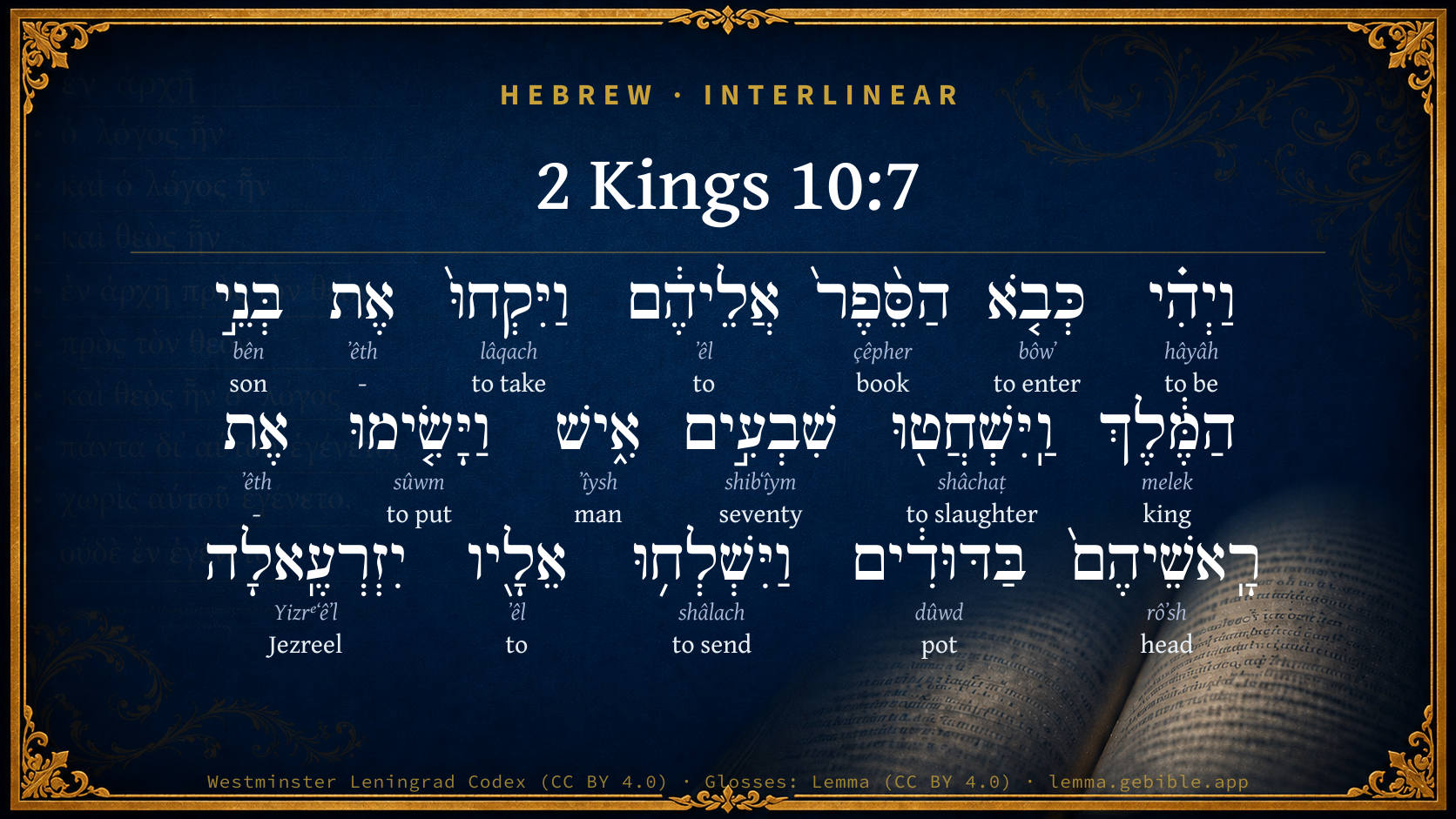
2 Kings 10:7

Hebrew (Westminster Leningrad Codex) 2 Kings 10:7 appears in the Hebrew Old Testament. The text above is from the Westminster Leningrad Codex. Each word links to its Strong’s number, a concise gloss, and parsing drawn from the Open Scriptures Hebrew Bible morphology. Click any word for its full Brown-Driver-Briggs (BDB) entry.
Download image
Cite this verse

2 Kings 10:7 (World English Bible). Public Domain. Lemma interlinear Bible study tool, https://lemma.gebible.app/v/2-kings/10/7.

Show BibTeX & RIS
BibTeX
RIS
English Translation
It happened, when the letter came to them, that they took the king's sons, and killed them, even seventy persons, and put their heads in baskets, and sent them to him to Jezreel.
World English Bible · Public Domain
Download a study sheet

One document with this verse’s original text, its word-by-word gloss line, the meaning frame, cross-references with their text, attributed commentary, and full source and license credits — printable, and it pastes into notes with its structure intact.

This verse Autodidact and up

Study sheet (.html) Plain text (.txt)

A passage Seminary Student

Up to 50 verses in one chapter. A passage sheet keeps up to 6 commentary sources and 12 cross-references per verse, in the order this page ranks them, and says so on the sheet whenever that leaves anything out. Ask for a single verse and you get the Autodidact verse sheet above.

Everything on this page stays free to read, with no account — the sheet is a download of what is already on screen, not access to it.

Want to remove ads? Support Godless Engineer
Compare translations 3

The same verse in 3 English versions, stacked beneath the original-language interlinear above. Click any original word for its lexicon entry.

Each is an independent rendering of the whole verse — the interlinear is not word-aligned to these translations.

Highlighted words mark where these versions differ — a whole-verse word diff, not a word-by-word alignment.

  • World English Bible Public Domain
    It happened, when the letter came to them, that they took the king's sons, and killed them, even seventy persons, and put their heads in baskets, and sent them to him to Jezreel.
  • King James Version Public Domain
    And it came to pass, when the letter came to them, that they took the king's sons, and slew seventy persons, and put their heads in baskets, and sent him them to Jezreel.
  • unfoldingWord Literal Text CC BY-SA 4.0
    And it happened when the letter came to them that they took the sons of the king and slaughtered 70 men. And they put their heads in baskets and sent to him in Jezreel.

unfoldingWord Literal Text — © unfoldingWord, licensed CC BY-SA 4.0. Word-aligned USFM3 via Door43 (git.door43.org/unfoldingWord/en_ult).

Versions to compare (up to 4)

3 of 4 selected

Show all 18 translations

Every available English version of this verse, each an independent rendering of the whole verse.

  • World English Bible Public Domain
    It happened, when the letter came to them, that they took the king's sons, and killed them, even seventy persons, and put their heads in baskets, and sent them to him to Jezreel.
  • Berean Standard Bible Public Domain
    And when the letter arrived, they took the sons of the king and slaughtered all seventy of them. They put their heads in baskets and sent them to Jehu at Jezreel.
  • Majority Standard Bible Public Domain
    And when the letter arrived, they took the sons of the king and slaughtered all seventy of them. They put their heads in baskets and sent them to Jehu at Jezreel.
  • King James Version Public Domain
    And it came to pass, when the letter came to them, that they took the king's sons, and slew seventy persons, and put their heads in baskets, and sent him them to Jezreel.
  • American Standard Version (1901) Public Domain
    And it came to pass, when the letter came to them, that they took the king's sons, and slew them, even seventy persons, and put their heads in baskets, and sent them unto him to Jezreel.
  • Revised Version (1885) Public Domain
    And it came to pass, when the letter came to them, that they took the king’s sons, and slew them, even seventy persons, and put their heads in baskets, and sent them unto him to Jezreel.
  • Geneva Bible (1599) Public Domain
    And when the letter came to them, they tooke the Kings sonnes, and slewe the seuentie persons, and layde their heads in baskets, and sent them vnto him to Izreel.
  • Douay-Rheims (1899) Public Domain
    And when the letters came to them, they took the king's sons, and slew seventy persons, and put their heads in baskets, and sent them to him to Jezrahel.
  • Young's Literal Translation Public Domain
    And it cometh to pass, at the coming in of the letter unto them, that they take the sons of the king, and slaughter seventy men, and put their heads in baskets, and send unto him to Jezreel,
  • Literal Standard Version CC BY-SA 4.0
    And it comes to pass, at the coming in of the letter to them, that they take the sons of the king, and slaughter seventy men, and put their heads in baskets, and send [them] to him at Jezreel,
  • Unlocked Literal Bible CC BY-SA 4.0
    So when the letter came to them, they took the king's sons and killed them, seventy persons, put their heads in baskets, and sent them to Jehu in Jezreel.
  • unfoldingWord Literal Text CC BY-SA 4.0
    And it happened when the letter came to them that they took the sons of the king and slaughtered 70 men. And they put their heads in baskets and sent to him in Jezreel.
  • Darby Bible Public Domain
    And it came to pass when the letter came to them, that they took the king's sons, and slaughtered seventy persons, and put their heads in baskets, and sent them to him to Jizreel.
  • World Messianic Bible Public Domain
    When the letter came to them, they took the king’s sons and killed them, even seventy people, and put their heads in baskets, and sent them to him to Jezreel.
  • Webster's Bible Public Domain
    And it came to pass, when the letter came to them, that they took the king's sons, and slew seventy persons, and put their heads in baskets, and sent them to him to Jezreel.
  • Free Bible Version CC BY-SA 4.0
    When the letter arrived, they seized the king's sons and killed all seventy of them, placed their heads in baskets, and sent them to Jehu at Jezreel.
  • Bible in Basic English Public Domain
    And when the letter came to them, they took the king's sons and put them to death, all the seventy, and put their heads in baskets and sent them to him at Jezreel.
  • JPS Tanakh (1917) Public Domain
    And it came to pass, when the letter came to them, that they took the king's sons, and slew them, even seventy persons, and put their heads in baskets, and sent them unto him to Jezreel.

Literal Standard Version (2020), Covenant Press — licensed CC BY-SA 4.0. Text via the HelloAO Bible API (eBible.org). Unlocked Literal Bible (unfoldingWord) — licensed CC BY-SA 4.0. Text via the HelloAO Bible API (eBible.org). unfoldingWord Literal Text — © unfoldingWord, licensed CC BY-SA 4.0. Word-aligned USFM3 via Door43 (git.door43.org/unfoldingWord/en_ult). Free Bible Version, Dr. Jonathan Gallagher — licensed CC BY-SA 4.0. Text via the HelloAO Bible API (eBible.org).

Word by word

More ways to search: Search by grammar → Find every occurrence → Compare this word →

Practice this passage: Drill this verse → Learn its vocabulary →

בַּדּוּדִ֔ים
dûwd
H1731
“in/at the · pots”
Preposition, Determined + Noun, Common, Masculine, Plural, Absolute
Part of Speech
Preposition + Noun
Type
Common
Gender
Masculine
Number
Plural
State
Absolute
Full BDB Definition

Origin: from the same as H1730

TWOT: 410e

pot, jar, basket, kettle - pot, kettle - basket, jar
  1. וַיְהִ֗י hâyâh H1961 “and · to be” Conjunction + Verb, Qal, Sequential Imperfect, 3rd Person, Masculine, Singular
  2. כְּבֹ֤א bôwʼ H935 “like/as · to enter” Preposition + Verb, Qal, Infinitive Construct
  3. הַסֵּ֨פֶר֙ çêpher H5612 “the · book” Particle, Definite Article + Noun, Common, Masculine, Singular, Absolute
  4. אֲלֵיהֶ֔ם ʼêl H413 “to · them” Preposition + Suffix, Personal, 3rd Person, Masculine, Plural
  5. וַיִּקְחוּ֙ lâqach H3947 “and · to take” Conjunction + Verb, Qal, Sequential Imperfect, 3rd Person, Masculine, Plural
  6. אֶת ʼêth H853 “-” Particle, Direct Object
  7. בְּנֵ֣י bên H1121 “sons of” Noun, Common, Masculine, Plural, Construct
  8. הַמֶּ֔לֶךְ melek H4428 “the · king” Particle, Definite Article + Noun, Common, Masculine, Singular, Absolute
  9. וַֽיִּשְׁחֲט֖וּ shâchaṭ H7819 “and · to slaughter” Conjunction + Verb, Qal, Sequential Imperfect, 3rd Person, Masculine, Plural
  10. שִׁבְעִ֣ים shibʻîym H7657 “seventy” Adjective, Cardinal number, Both, Plural, Absolute
  11. אִ֑ישׁ ʼîysh H376 “man” Noun, Common, Masculine, Singular, Absolute
  12. וַיָּשִׂ֤ימוּ sûwm H7760 “and · to put” Conjunction + Verb, Qal, Sequential Imperfect, 3rd Person, Masculine, Plural
  13. אֶת ʼêth H853 “-” Particle, Direct Object
  14. רָֽאשֵׁיהֶם֙ rôʼsh H7218 “heads · their” Noun, Common, Masculine, Plural, Construct + Suffix, Personal, 3rd Person, Masculine, Plural
  15. וַיִּשְׁלְח֥וּ shâlach H7971 “and · to send” Conjunction + Verb, Qal, Sequential Imperfect, 3rd Person, Masculine, Plural
  16. אֵלָ֖יו ʼêl H413 “to · him” Preposition + Suffix, Personal, 3rd Person, Masculine, Singular
  17. יִזְרְעֶֽאלָה Yizrᵉʻêʼl H3157 “Jezreel · toward” Noun, Proper + Suffix, Demonstrative

About this verse

These counts appear in no published source. They are computed here, from the morphology-tagged text and Lemma’s own curated glosses. What Lemma adds →

18
words
16
distinct lemmas
Historical
section

Notable vocabulary

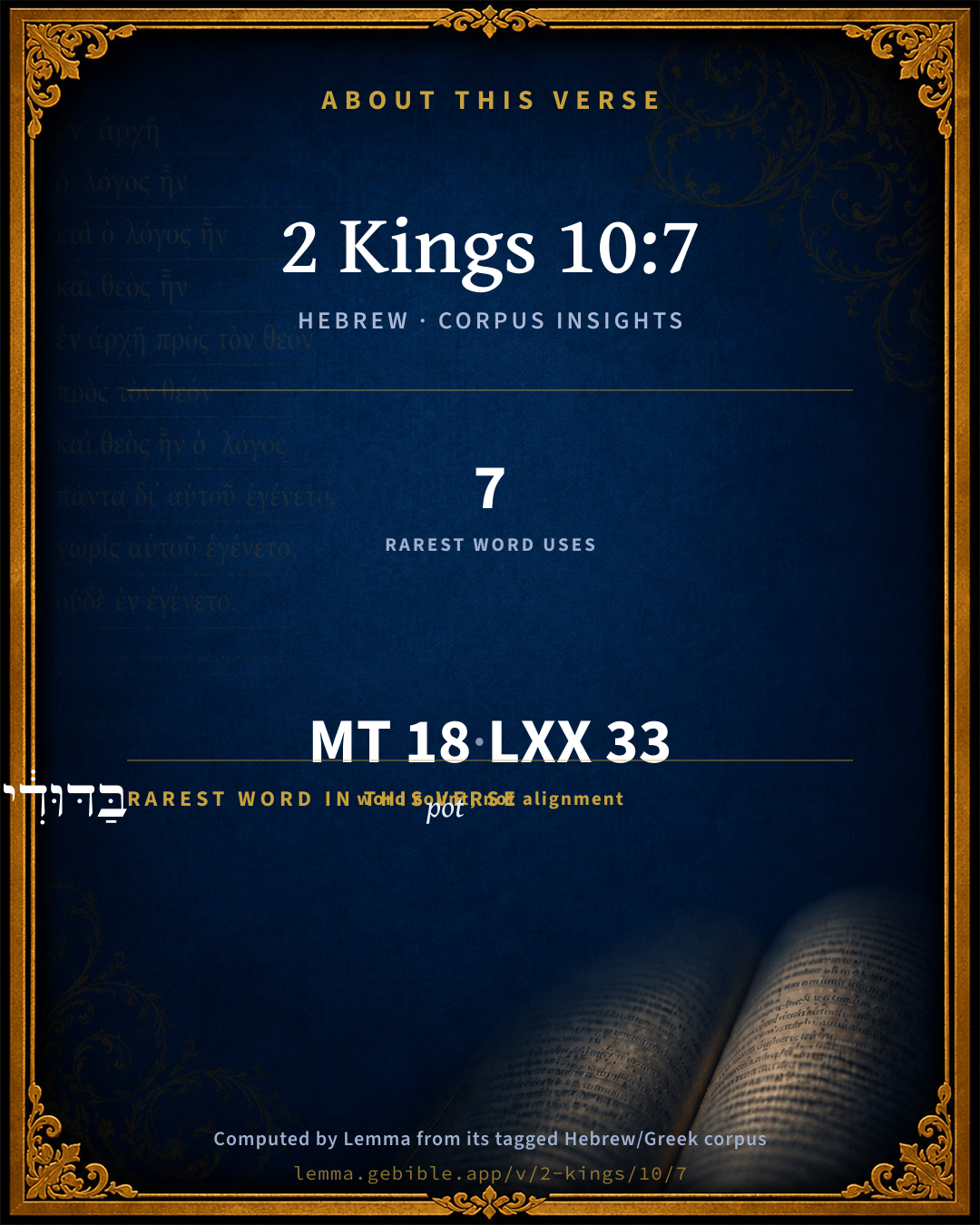
The rarest word here is בַּדּוּדִ֔ים pot H1731 — appearing just 7 times in the whole Hebrew Bible.

Shared distinctive vocabulary

בַּדּוּדִ֔ים pot H1731 occurs in 6 verses of the Hebrew Bible. Also found in:

Grammatical profile

  • 6 verbs
  • 7 nouns
  • 1 adjective
  • 2 prepositions
  • 2 particles

Verb forms

  • וַיְהִ֗י Qal · Sequential Imperfect
  • כְּבֹ֤א Qal · Infinitive Construct
  • וַיִּקְחוּ֙ Qal · Sequential Imperfect
  • וַֽיִּשְׁחֲט֖וּ Qal · Sequential Imperfect
  • וַיָּשִׂ֤ימוּ Qal · Sequential Imperfect
  • וַיִּשְׁלְח֥וּ Qal · Sequential Imperfect

Repetition

A word recurs within this verse — often emphatic in Hebrew:

  • אֲלֵיהֶ֔ם to H413 ×2

Hebrew & Septuagint length

In English translation the verse runs 33 words from the Hebrew and 36 from the Septuagint (LXX English) — closely comparable.

A rough comparison of the two English renderings, which tokenize alike — not a word-level alignment.

Word counts can differ between the Hebrew and the Greek without any difference in meaning — e.g. the Hebrew direct-object marker אֵת has no separate Greek word, and Greek often adds the article ὁ.

In the original languages it is 18 Hebrew tokens and 33 Greek tokens — but the two are counted differently (Hebrew bundles its prefixes and suffixes into one token; the Greek is in lemma form), so that isn’t a like-for-like length.

Cross-references

6

Topical passages linked to 2 Kings 10:7 in the Treasury of Scripture Knowledge — connected by theme and wording, ordered by reader-vote popularity; previews shown in the World English Bible.

  • 1 Kings 21:21 Behold, I will bring evil on you, and will utterly sweep you away and will cut off from Ahab every man-child, and him who is shut up and him who is left at large in Israel:
  • 2 Kings 11:1 Now when Athaliah the mother of Ahaziah saw that her son was dead, she arose and destroyed all the seed royal.
  • Judges 9:5–57 He went to his father's house at Ophrah, and killed his brothers the sons of Jerubbaal, being seventy persons, on one stone: but Jotham the youngest son of Jerubbaal was left; for he hid himself.
  • 2 Kings 10:9 It happened in the morning, that he went out, and stood, and said to all the people, You are righteous: behold, I conspired against my master, and killed him; but who struck all these?
  • 2 Chronicles 21:4 Now when Jehoram was risen up over the kingdom of his father, and had strengthened himself, he killed all his brothers with the sword, and various also of the princes of Israel.
  • Matthew 14:8–11 She, being prompted by her mother, said, "Give me here on a platter the head of John the Baptizer."

Cross-references courtesy of OpenBible.info (CC BY 4.0).

Hebrew and Greek witnesses Masoretic Hebrew ↔ Greek Septuagint

The same verse in the two great witnesses to the Old Testament, shown verse-for-verse.

These are two independent witnesses, not word-aligned to each other, and the Septuagint is shown in lemma (dictionary) form.

Hebrew 2 Kings 10:7 Masoretic · Westminster Leningrad Codex

וַיְהִ֗י כְּבֹ֤א הַסֵּ֨פֶר֙ אֲלֵיהֶ֔ם וַיִּקְחוּ֙ אֶת בְּנֵ֣י הַמֶּ֔לֶךְ וַֽיִּשְׁחֲט֖וּ שִׁבְעִ֣ים אִ֑ישׁ וַיָּשִׂ֤ימוּ אֶת רָֽאשֵׁיהֶם֙ בַּדּוּדִ֔ים וַיִּשְׁלְח֥וּ אֵלָ֖יו יִזְרְעֶֽאלָה

It happened, when the letter came to them, that they took the king's sons, and killed them, even seventy persons, and put their heads in baskets, and sent them to him to Jezreel.

World English Bible · Public Domain

Greek LXX 2 Kings 10:7 Septuagint · lemma form

καί γίγνομαι ὡς ἔρχομαι ὁ βιβλίον πρός αὐτός καί λαμβάνω ὁ υἱός ὁ βασιλεύς καί σφάζω αὐτός ἑβδομήκοντα ἀνήρ καί τίθημι ὁ κεφαλή αὐτός ἐν κάρταλλος καί ἀποστέλλω αὐτός πρός αὐτός εἰς ιεζραελ

And it came to pass, when the letter came to them, that they took the king's sons, and killed them, even seventy men, and put their heads in baskets, and sent them to him at Jezrael.

LXX2012 (modern English Septuagint) · Public Domain

On this verse, Ellicott's Commentary for English Readers discusses the Septuagint’s reading. Read the note in Commentary ↓

Hebrew: Westminster Leningrad Codex (CC BY 4.0). Greek: Septuagint (public domain); English from LXX2012 (modern English Septuagint) (Public Domain). How the Septuagint differs from the Hebrew →

Targum (Aramaic paraphrase)

1

The Targum is the ancient Jewish Aramaic paraphrase of the Hebrew Scriptures — an interpretive translation, not the Hebrew text itself. Onkelos (literal) and Pseudo-Jonathan (expansive) render the Torah, and Jonathan the Prophets. Coverage is partial: where no permissively-licensed English translation exists for a verse, only the Aramaic is shown. This is verse-level text, not a word-by-word alignment to the Hebrew.

  1. Targum Jonathan Prophets (Joshua–Malachi)
    וַהֲוָא כְּמֵיתֵי אִגַרְתָּא לְוַתְהוֹן וְדַבָּרוּ יַת בְּנֵי מַלְכָּא וּנְכִיסוּ שַׁבְעִין גַבְרָא וְשַׁוִיאוּ יַת רֵישֵׁהוֹן בְּסָלַיָא וְשַׁדְרִינוּן לְוָתֵיהּ לְיִזְרְעֶאל:

    (no public-domain English translation for this verse)

    Targum Jonathan — Aramaic: “Mikraot Gedolot” (public domain). English: “Sefaria Community Translation” (CC0 1.0 (public-domain dedication)); “London "Chaldee Paraphrase," 1871” (public domain). Text via Sefaria.

Commentary

Notes on 2 Kings 10:7 from classic Christian and Jewish commentators (each source and its license shown beneath its notes). The classic Christian expositions comment on the surrounding passage and are grouped to its opening verse, so a note may address several verses; the Jewish commentaries on the Tanakh (Rashi and others) are per-verse, so they appear only where the commentator wrote on this verse.

Lemma curates 59 commentaries, every one of them public domain or Creative Commons licensed, each selected and text-cleaned for this edition rather than reprinted as found. About our sources →

Trapp's Complete Commentary

John Trapp

2Ki 10:7 And it came to pass, when the letter came to them, that they took the king’s sons, and slew seventy persons, and put their heads in baskets, and sent him [them] to Jezreel.

Ver. 7. And put their heads in baskets.] Apposite ad culpam Achab, saith A Lapide: this was suitable to Ahab’s sin. He had sent for baskets of grapes out of Naboth’s vineyard at Jezreel; and now the heads of his sons are brought thither in baskets. Oh, doleful burden!

John Trapp, A Commentary or Exposition upon All the Books of the Old and New Testament (1647–1656) — public domain. Text from a community e-Sword module.

Joseph Benson's Commentary

2Ki 10:7. They took the king’s sons, and slew seventy persons — Having been wickedly obsequious to Jezebel’s order for the murder of Naboth, now, by the same base spirit, they are as pliable to Jehu, and as ready to obey his orders for the murder of Ahab’s sons. From this example, princes may learn two important lessons: 1st, Not to place any dependance on the attachment or fidelity of those who are not influenced by the fear of God, and the dictates of conscience: for who can reasonably expect him to be true to his prince who is false to his God? 2d, Not to aim at arbitrary power, lest they be found rolling a stone, which, some time or other, will return upon themselves. Princes that make their people slaves, take the readiest way to make them rebels; and by forcing men’s consciences, as Jezebel did, they lose their hold of them.

Joseph Benson's Commentary on the Old and New Testaments (1811–1818) — public domain. Text from a community e-Sword module.

Adam Clarke's Commentary

Verse 7. Put their heads in baskets] What cold-blooded wretches were the whole of these people!

Adam Clarke's Commentary on the Bible (1810–1826) — public domain. Text from a community e-Sword/MySword module.

Ellicott's Commentary for English Readers

(7) And slew.—Rather, butchered, or slaughtered. The way in which the writer speaks of this massacre—“they took the king’s sons, and butchered seventy persons”—shows that he did not sympathise with Jehu’s deeds of blood. His interest rather centres in the fact that the predictions of Elijah were fulfilled by the wickedness of Jehu. (See 2Ki_10:10.)

In baskets.—Rather, in the baskets. The word (dûd) means a “pot” elsewhere (1Sa_2:14). In Psa_81:6, the LXX. renders κόφινος; here it gives καρτάλλοις (“pointed baskets”).

A Bible Commentary for English Readers, edited by Charles John Ellicott (1878–1897) — public domain. Text from a community e-Sword module.

The Cambridge Bible for Schools and Colleges

gen. ed. J. J. S. Perowne

7. and slew seventy persons] R.V. and slew them, even seventy persons. Though the pronoun is not expressed in the original, it is needed for the sense. The A.V. might signify any seventy persons.

in baskets] The word is that which is used (Jer_24:2) for the baskets in which the figs were gathered.

sent him them to Jezreel] R.V. sent them unto him. Before they come themselves, they take care that the price, by which they expect to purchase Jehu’s favour, shall be paid down. The change in R.V. from the English idiom to a more close representation of the Hebrew seems altogether unnecessary.

The Cambridge Bible for Schools and Colleges (gen. ed. J. J. S. Perowne; Cambridge University Press, 1878–1918) — public domain. Text from a community e-Sword module.

John Gill's Exposition

And it came to pass, when the letter came to them,.... They did not in the least hesitate, but immediately complied with the contents of it:

that they took the king's sons, and slew seventy persons; which was the whole number of them:

and put their heads in baskets, and sent them to Jezreel; as a present to Jehu, just as they carried the firstfruits, as Abarbinel observes.

John Gill's Exposition of the Whole Bible (1746–1763) — public domain (CC PDM 1.0). Text via the HelloAO Bible API.

Matthew Poole's English Annotations

Slew seventy persons: Jehu justly required this, because the sovereign and most righteous Lord of all men’s lives commanded it; but the Samaritans wickedly obeyed it, because they destroyed persons in a great measure innocent, merely out of slavish fear, and without any knowledge of or regard to God’s command.

Matthew Poole's English Annotations on the Holy Bible (1683–1685) — public domain. Text from a community e-Sword/MySword module.

The Pulpit Commentary

And it came to pass, when the letter came to them, that they took the king"s sons, and slew seventy persons. Having committed themselves by their answer to Jehu"s first letter, the Samaritan great men seemed to themselves to have no choice, on receiving his second, but to allow themselves to become the tools and agents of his policy. They accordingly put the seventy princes to death without any hesitation, though they can scarcely have done so without reluctance. And put their heads in baskets. Thus concealing their bloody deed as long as they could. In the Assyrian sculptures, those who slay the king"s enemies carry the heads openly in their hands, as though glorying in what they have done. And sent him them to Jezreel. Jehu had bidden them to bring the heads to him; but this was a degradation to which they did not feel bound to submit. They therefore sent the heads by trusty messengers.

The Pulpit Commentary (1880–1919), ed. H.D.M. Spence-Jones & Joseph S. Exell — public domain. Text from a community e-Sword module.

John Wesley's Explanatory Notes

Sent them - Jehu justly required this, because the sovereign Lord of all mens lives commanded it, but the Samaritans wickedly obeyed it, without any knowledge of, or regard to God's command.

John Wesley, Explanatory Notes Upon the Whole Bible (1754–1765) — public domain. Text via the GEBible commentary corpus.

Rashi

Rabbi Shlomo Yitzchaki (Rashi)

In pots. [In] pots.

Rashi on the Tanakh — English translations: “The Judaica Press complete Tanach with Rashi, translated by A. J. Rosenberg” (CC BY 4.0); “Pentateuch with Rashi's commentary by M. Rosenbaum and A.M. Silbermann, 1929-1934” (public domain); “The Metsudah Tanach series, Lakewood, N.J” (CC BY 4.0); and “The Book of Joshua, Metsudah Publications, 1997” (CC BY 4.0). Text via Sefaria.

Lesson kit

Teaching starters — assembled from the data on this page, not authored interpretation. Every prompt links to the verse data it draws on. Edit before teaching.

2 Kings, in the Historical, opens this verse with 18 words (16 distinct Hebrew lemmas). Its most distinctive word is dûwd (“pot”). A historical commentator’s framing appears above. Read the whole chapter for the surrounding context.

Discussion questions

  1. What does “pot” (dûwd) contribute to the verse as a whole?
  2. 1 Samuel 2:14 shares the word «pot» with this verse. How do the two illuminate each other?
  3. “to” occurs 2× in this one verse. What is the effect of the repetition?
  4. The translations on this page render this verse differently — a whole-verse word diff, not a word-by-word alignment. What might account for the different wordings?
  5. The verb «וַיְהִ֗י» is Qal Sequential Imperfect. How does its form color the action?
  6. Reading how Trapp's Complete Commentary and Joseph Benson's Commentary read this verse, where do the two commentators agree and where do they part?

Things to notice

Reading settings

Reading text

Shown beneath each verse's original-language words.

Old Testament
Old Testament edition

Read the OT as the Masoretic Hebrew (MT) or the Greek Septuagint (LXX).

English shown for the Greek Septuagint (in the Hebrew ↔ Greek comparison).

Comparing translations? Open the Compare panel on any verse page to stack up to four side by side.