
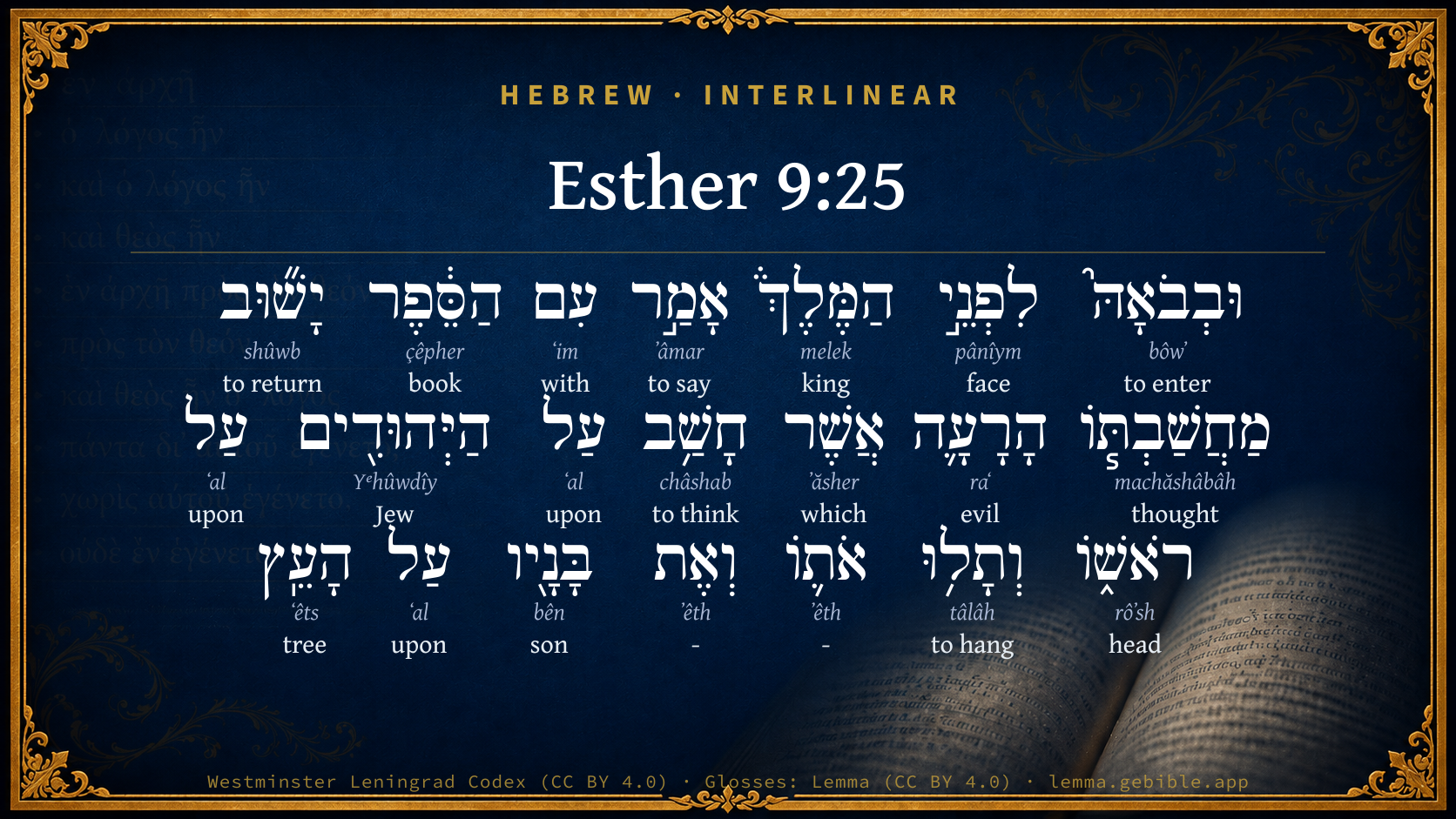
Esther 9:25

Hebrew (Westminster Leningrad Codex) Esther 9:25 appears in the Hebrew Old Testament. The text above is from the Westminster Leningrad Codex. Each word links to its Strong’s number, a concise gloss, and parsing drawn from the Open Scriptures Hebrew Bible morphology. Click any word for its full Brown-Driver-Briggs (BDB) entry.
Download image
Cite this verse

Esther 9:25 (World English Bible). Public Domain. Lemma interlinear Bible study tool, https://lemma.gebible.app/v/esther/9/25.

Show BibTeX & RIS
BibTeX
RIS
English Translation
but when [the matter] came before the king, he commanded by letters that his wicked device, which he had devised against the Jews, should return on his own head, and that he and his sons should be hanged on the gallows.
World English Bible · Public Domain
Download a study sheet

One document with this verse’s original text, its word-by-word gloss line, the meaning frame, cross-references with their text, attributed commentary, and full source and license credits — printable, and it pastes into notes with its structure intact.

This verse Autodidact and up

Study sheet (.html) Plain text (.txt)

A passage Seminary Student

Up to 50 verses in one chapter. A passage sheet keeps up to 6 commentary sources and 12 cross-references per verse, in the order this page ranks them, and says so on the sheet whenever that leaves anything out. Ask for a single verse and you get the Autodidact verse sheet above.

Everything on this page stays free to read, with no account — the sheet is a download of what is already on screen, not access to it.

Want to remove ads? Support Godless Engineer
Compare translations 3

The same verse in 3 English versions, stacked beneath the original-language interlinear above. Click any original word for its lexicon entry.

Each is an independent rendering of the whole verse — the interlinear is not word-aligned to these translations.

Highlighted words mark where these versions differ — a whole-verse word diff, not a word-by-word alignment.

  • World English Bible Public Domain
    but when [the matter] came before the king, he commanded by letters that his wicked device, which he had devised against the Jews, should return on his own head, and that he and his sons should be hanged on the gallows.
  • King James Version Public Domain
    But when Esther came before the king, he commanded by letters that his wicked device, which he devised against the Jews, should return upon his own head, and that he and his sons should be hanged on the gallows.
  • unfoldingWord Literal Text CC BY-SA 4.0
    But when she came to the face of the king, he said with the letter, “Let his evil plot that he plotted concerning the Jews return on his head, and let them hang him and his sons on the pole.”

unfoldingWord Literal Text — © unfoldingWord, licensed CC BY-SA 4.0. Word-aligned USFM3 via Door43 (git.door43.org/unfoldingWord/en_ult).

Versions to compare (up to 4)

3 of 4 selected

Show all 18 translations

Every available English version of this verse, each an independent rendering of the whole verse.

  • World English Bible Public Domain
    but when [the matter] came before the king, he commanded by letters that his wicked device, which he had devised against the Jews, should return on his own head, and that he and his sons should be hanged on the gallows.
  • Berean Standard Bible Public Domain
    But when it came before the king, he commanded by letter that the wicked scheme which Haman had devised against the Jews should come back upon his own head, and that he and his sons should be hanged on the gallows.
  • Majority Standard Bible Public Domain
    But when it came before the king, he commanded by letter that the wicked scheme which Haman had devised against the Jews should come back upon his own head, and that he and his sons should be hanged on the gallows.
  • King James Version Public Domain
    But when Esther came before the king, he commanded by letters that his wicked device, which he devised against the Jews, should return upon his own head, and that he and his sons should be hanged on the gallows.
  • American Standard Version (1901) Public Domain
    but when `the matter' came before the king, he commanded by letters that his wicked device, which he had devised against the Jews, should return upon his own head, and that he and his sons should be hanged on the gallows.
  • Revised Version (1885) Public Domain
    but when the matter came before the king, he commanded by letters that his wicked device, which he had devised against the Jews, should return upon his own head; and that he and his sons should he hanged on the gallows.
  • Geneva Bible (1599) Public Domain
    And when she came before the King, he commanded by letters, Let this wicked deuise (which he imagined against the Iewes) turne vpon his owne head, and let them hang him and his sonnes on the tree.
  • Douay-Rheims (1899) Public Domain
    And afterwards Esther went in to the king, beseeching him that his endeavours might be made void by the king's letters: and the evil that he had intended against the Jews, might return upon his own head. And so both he and his sons were hanged upon gibbets.
  • Young's Literal Translation Public Domain
    and in her coming in before the king, he said with the letter, `Let his evil device that he devised against the Jews turn back upon his own head,' and they have hanged him and his sons on the tree,
  • Literal Standard Version CC BY-SA 4.0
    and in her coming in before the king, he commanded with the letter, “Let his evil scheme that he devised against the Jews return on his own head,” and they have hanged him and his sons on the tree,
  • Unlocked Literal Bible CC BY-SA 4.0
    But when the matter came before the king, he gave orders by letters that the wicked plan Haman developed against the Jews should come back on his own head, and that he and his sons should be hanged on the gallows.
  • unfoldingWord Literal Text CC BY-SA 4.0
    But when she came to the face of the king, he said with the letter, “Let his evil plot that he plotted concerning the Jews return on his head, and let them hang him and his sons on the pole.”
  • Darby Bible Public Domain
    and when [Esther] came before the king, he commanded by letters that his wicked device, which he had devised against the Jews, should return upon his own head; and they hanged him and his sons on the gallows.
  • World Messianic Bible Public Domain
    but when this became known to the king, he commanded by letters that his wicked plan, which he had planned against the Jews, should return on his own head, and that he and his sons should be hanged on the gallows.
  • Webster's Bible Public Domain
    But when Esther came before the king, he commanded by letters that his wicked device, which he devised against the Jews, should return upon his own head, and that he and his sons should be hanged on the gallows.
  • Free Bible Version CC BY-SA 4.0
    But when it came to the king's attention, he sent out letters ordering that the evil scheme which Haman had planned against the Jews should rebound on him, and that he and his sons should be impaled on poles.
  • Bible in Basic English Public Domain
    But when the business was put before the king, he gave orders by letters that the evil design which he had made against the Jews was to be turned against himself; and that he and his sons were to be put to death by hanging.
  • JPS Tanakh (1917) Public Domain
    but when she came before the king, he commanded by letters that his wicked device, which he had devised against the Jews, should return upon his own head; and that he and his sons should be hanged on the gallows.

Literal Standard Version (2020), Covenant Press — licensed CC BY-SA 4.0. Text via the HelloAO Bible API (eBible.org). Unlocked Literal Bible (unfoldingWord) — licensed CC BY-SA 4.0. Text via the HelloAO Bible API (eBible.org). unfoldingWord Literal Text — © unfoldingWord, licensed CC BY-SA 4.0. Word-aligned USFM3 via Door43 (git.door43.org/unfoldingWord/en_ult). Free Bible Version, Dr. Jonathan Gallagher — licensed CC BY-SA 4.0. Text via the HelloAO Bible API (eBible.org).

Word by word

More ways to search: Search by grammar → Find every occurrence → Compare this word →

Practice this passage: Drill this verse → Learn its vocabulary →

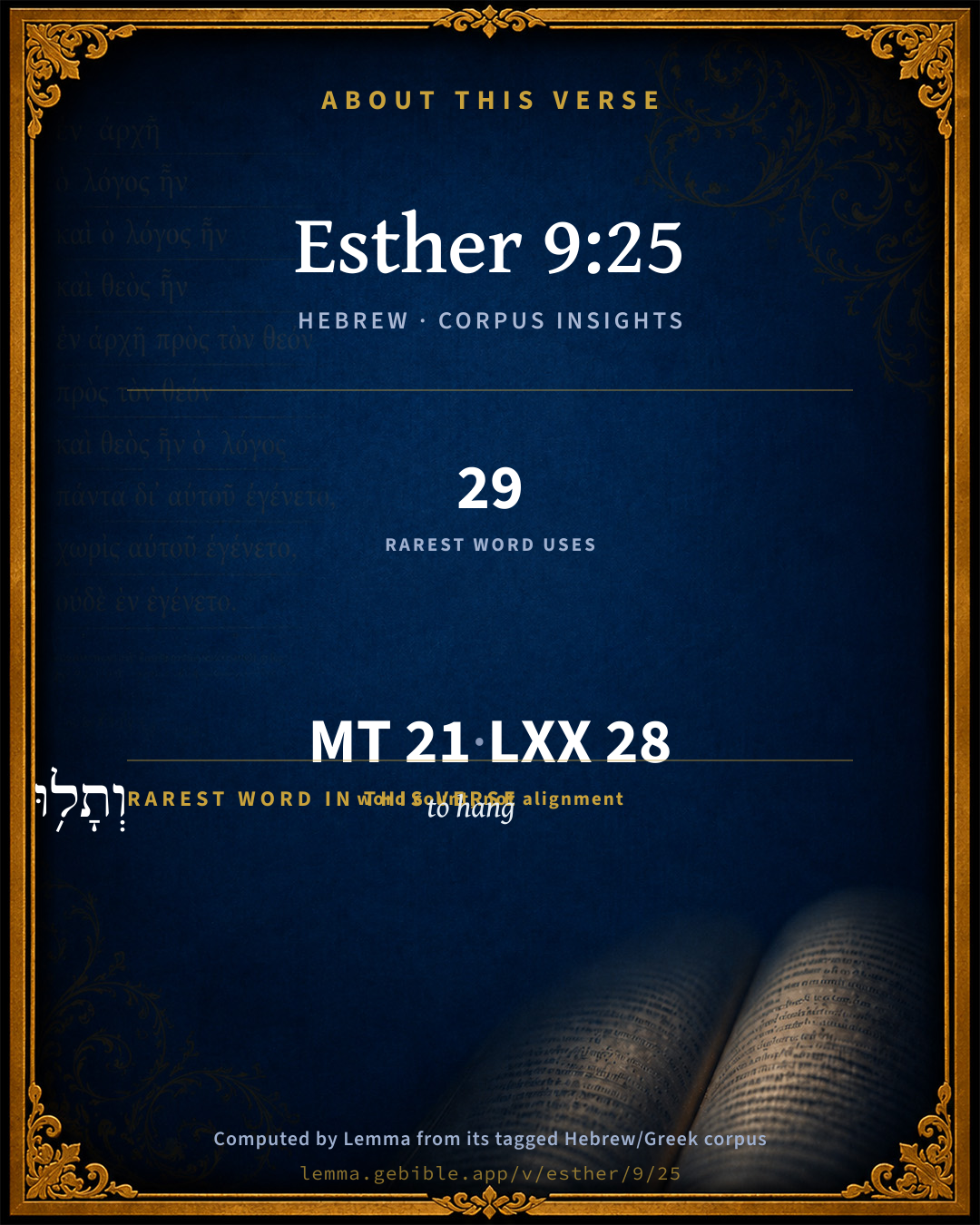
וְתָל֥וּ
tâlâh
H8518
“and · to hang”
Conjunction + Verb, Qal, Sequential Perfect, 3rd Person, Common, Plural
Part of Speech
Conjunction + Verb
Stem
Qal
Form
Sequential Perfect
Person
3rd Person
Gender
Common
Number
Plural
Full BDB Definition

Origin: a primitive root

TWOT: 2512

to hang - (Qal) - to hang - to hang up (any object) - to put to death by hanging - (Niphal) to be hanged - (Piel) to hang, hang up (for display)
  1. וּבְבֹאָהּ֮ bôwʼ H935 “and · in/at · to enter · her” Conjunction + Preposition + Verb, Qal, Infinitive Construct + Suffix, Personal, 3rd Person, Feminine, Singular
  2. לִפְנֵ֣י pânîym H6440 “to/for · face(s) of” Preposition + Noun, Common, Both, Plural, Construct
  3. הַמֶּלֶךְ֒ melek H4428 “the · king” Particle, Definite Article + Noun, Common, Masculine, Singular, Absolute
  4. אָמַ֣ר ʼâmar H559 “to say” Verb, Qal, Perfect, 3rd Person, Masculine, Singular
  5. עִם ʻim H5973 “with” Preposition
  6. הַסֵּ֔פֶר çêpher H5612 “the · book” Particle, Definite Article + Noun, Common, Masculine, Singular, Absolute
  7. יָשׁ֞וּב shûwb H7725 “to return” Verb, Qal, Imperfect, 3rd Person, Masculine, Singular
  8. מַחֲשַׁבְתּ֧וֹ machăshâbâh H4284 “thought · his” Noun, Common, Feminine, Singular, Construct + Suffix, Personal, 3rd Person, Masculine, Singular
  9. הָרָעָ֛ה raʻ H7451 “the · evil” Particle, Definite Article + Adjective, Adjective, Feminine, Singular, Absolute
  10. אֲשֶׁר ʼăsher H834 “which” Particle, Relative
  11. חָשַׁ֥ב châshab H2803 “to think” Verb, Qal, Perfect, 3rd Person, Masculine, Singular
  12. עַל ʻal H5921 “upon” Preposition
  13. הַיְּהוּדִ֖ים Yᵉhûwdîy H3064 “the · Jews” Particle, Definite Article + Noun, Gentilic, Masculine, Plural, Absolute
  14. עַל ʻal H5921 “upon” Preposition
  15. רֹאשׁ֑וֹ rôʼsh H7218 “head · his” Noun, Common, Masculine, Singular, Construct + Suffix, Personal, 3rd Person, Masculine, Singular
  16. אֹת֛וֹ ʼêth H853 “- · him” Particle, Direct Object + Suffix, Personal, 3rd Person, Masculine, Singular
  17. וְאֶת ʼêth H853 “and · -” Conjunction + Particle, Direct Object
  18. בָּנָ֖יו bên H1121 “sons · his” Noun, Common, Masculine, Plural, Construct + Suffix, Personal, 3rd Person, Masculine, Singular
  19. עַל ʻal H5921 “upon” Preposition
  20. הָעֵֽץ ʻêts H6086 “the · tree” Particle, Definite Article + Noun, Common, Masculine, Singular, Absolute

About this verse

These counts appear in no published source. They are computed here, from the morphology-tagged text and Lemma’s own curated glosses. What Lemma adds →

21
words
18
distinct lemmas
Historical
section

Shared distinctive vocabulary

וְתָל֥וּ to hang H8518 occurs in 27 verses of the Hebrew Bible. Also found in:

Grammatical profile

  • 5 verbs
  • 8 nouns
  • 1 adjective
  • 4 prepositions
  • 3 particles

Verb forms

  • וּבְבֹאָהּ֮ Qal · Infinitive Construct
  • אָמַ֣ר Qal · Perfect
  • יָשׁ֞וּב Qal · Imperfect
  • חָשַׁ֥ב Qal · Perfect
  • וְתָל֥וּ Qal · Sequential Perfect

Repetition

A word recurs within this verse — often emphatic in Hebrew:

Hebrew & Septuagint length

In English translation the verse runs 41 words from the Hebrew and 34 from the Septuagint (LXX English) — closely comparable.

A rough comparison of the two English renderings, which tokenize alike — not a word-level alignment.

Word counts can differ between the Hebrew and the Greek without any difference in meaning — e.g. the Hebrew direct-object marker אֵת has no separate Greek word, and Greek often adds the article ὁ.

In the original languages it is 21 Hebrew tokens and 28 Greek tokens — but the two are counted differently (Hebrew bundles its prefixes and suffixes into one token; the Greek is in lemma form), so that isn’t a like-for-like length.

Cross-references

7

Topical passages linked to Esther 9:25 in the Treasury of Scripture Knowledge — connected by theme and wording, ordered by reader-vote popularity; previews shown in the World English Bible.

  • Psalms 7:16 The trouble he causes shall return to his own head. His violence shall come down on the crown of his own head.
  • Esther 7:5–8:14 Then spoke the king Ahasuerus and said to Esther the queen, Who is he, and where is he, that dared presume in his heart to do so?
  • Esther 9:13–14 Then said Esther, If it please the king, let it be granted to the Jews who are in Shushan to do tomorrow also according to this day's decree, and let Haman's ten sons be hanged on the gallows.
  • Psalms 109:17–18 Yes, he loved cursing, and it came to him. He didn't delight in blessing, and it was far from him.
  • Psalms 140:9 As for the head of those who surround me, Let the mischief of their own lips cover them.
  • Psalms 141:10 Let the wicked fall together into their own nets, While I pass by.
  • Matthew 21:44 He who falls on this stone will be broken to pieces, but on whoever it will fall, it will scatter him as dust."

Cross-references courtesy of OpenBible.info (CC BY 4.0).

Hebrew and Greek witnesses Masoretic Hebrew ↔ Greek Septuagint

The same verse in the two great witnesses to the Old Testament, shown verse-for-verse.

These are two independent witnesses, not word-aligned to each other, and the Septuagint is shown in lemma (dictionary) form.

Hebrew Esther 9:25 Masoretic · Westminster Leningrad Codex

וּבְבֹאָהּ֮ לִפְנֵ֣י הַמֶּלֶךְ֒ אָמַ֣ר עִם הַסֵּ֔פֶר יָשׁ֞וּב מַחֲשַׁבְתּ֧וֹ הָרָעָ֛ה אֲשֶׁר חָשַׁ֥ב עַל הַיְּהוּדִ֖ים עַל רֹאשׁ֑וֹ וְתָל֥וּ אֹת֛וֹ וְאֶת בָּנָ֖יו עַל הָעֵֽץ

but when [the matter] came before the king, he commanded by letters that his wicked device, which he had devised against the Jews, should return on his own head, and that he and his sons should be hanged on the gallows.

World English Bible · Public Domain

Greek LXX Esther 9:25 Septuagint · lemma form

καί ὡς εἰςἔρχομαι πρός ὁ βασιλεύς λέγω κρεμάζω ὁ μαρδοχαῖος ὅσος δέ ἐπιχειρέω ἐπιἄγω ἐπί ὁ ἰουδαῖος κακός ἐπί αὐτός γίγνομαι καί κρεμάζω αὐτός καί ὁ τέκνον αὐτός

also how he went in to the king, telling him to hang Mardochaeus: but all the calamities he tried to bring upon the Jews came upon himself, and he was hanged, and his children.

LXX2012 (modern English Septuagint) · Public Domain

On this verse, Trapp's Complete Commentary discusses the Septuagint’s reading. Read the note in Commentary ↓

Hebrew: Westminster Leningrad Codex (CC BY 4.0). Greek: Septuagint (public domain); English from LXX2012 (modern English Septuagint) (Public Domain). How the Septuagint differs from the Hebrew →

Commentary

Notes on Esther 9:25 from classic Christian and Jewish commentators (each source and its license shown beneath its notes). The classic Christian expositions comment on the surrounding passage and are grouped to its opening verse, so a note may address several verses; the Jewish commentaries on the Tanakh (Rashi and others) are per-verse, so they appear only where the commentator wrote on this verse.

Lemma curates 59 commentaries, every one of them public domain or Creative Commons licensed, each selected and text-cleaned for this edition rather than reprinted as found. About our sources →

Trapp's Complete Commentary

John Trapp

Est 9:25 But when [Esther] came before the king, he commanded by letters that his wicked device, which he devised against the Jews, should return upon his own head, and that he and his sons should be hanged on the gallows.

Ver. 25. But when Esther came] Heb. when she came. This was the subject of the Jews’ discourse upon those days, which they spent, not in idle chat, but in telling one another what great things the Lord had done for them; relating all the particulars. All honourable mention was then made of Esther and Mordecai; neither was Haman’s malice instanced without utmost detestation. So true is that of Solomon, Pro 10:7, "The memory of the just is blessed (or, is with praises, μετ εγκωμιων, as the Septuagint there render it); but the name of the wicked shall rot," as now doth the name of the gunpowder plotters, of Bonner, Gardiner, and other Popish persecutors. Memoria eius sicut vinum Libani, The memory of him as is the wine of Lebanon, say the Jews of those they honour (Bud. Pand.).

Should return upon his own head] According to Psa 7:17, and haply not without allusion to those Piaculares et Abominales among the Grecians, which were certain condemned persons, on whose heads they put the public guilt, and then tumbled them into the sea, Herod. 1. 2, or else to those expiatory sacrifices amongst the Egyptians, which were first cursed by them, and then cast into the river, or sold to the Grecian merchants, in an apish imitation of the Hebrews’ scape-goat, and the day of atonement.

John Trapp, A Commentary or Exposition upon All the Books of the Old and New Testament (1647–1656) — public domain. Text from a community e-Sword module.

Geneva Bible (1599)

Geneva Bible translators

That is, Esther.

These are the words of the king’s commandment to disannul Haman’s wicked enterprise.

Geneva Bible (1599) marginal notes — public domain. Text via Bolls.life.

Ellicott's Commentary for English Readers

(25) Esther.—It will be seen that in the English Version this word is printed in italics. The Hebrew is literally, and on her (or its) coming. To make the pronoun refer to Esther seems harsh, seeing that she has not been mentioned for some time, and we therefore prefer to make it impersonal, “when it (i.e., the matter) came.”

A Bible Commentary for English Readers, edited by Charles John Ellicott (1878–1897) — public domain. Text from a community e-Sword module.

The Cambridge Bible for Schools and Colleges

gen. ed. J. J. S. Perowne

25. the matter] A.V. inserts Esther as the subject of the verb. In the original it is simply the feminine pronoun, which however in Heb. may also stand for the neuter.

The Cambridge Bible for Schools and Colleges (gen. ed. J. J. S. Perowne; Cambridge University Press, 1878–1918) — public domain. Text from a community e-Sword module.

John Gill's Exposition

The Jews ordained, and took upon them, and upon their seed, and upon all such that joined themselves unto them,.... Who became proselytes to their religion; that is, they appointed the above two days as festivals, and engaged for themselves, for their children, and all proselytes, to observe them as such; and one of their canons (s) runs thus,"all are obliged to read the Megillah (the book of Esther, which they always read on those days), priests, Levites, Nethinims, Israelites, men, women, and proselytes, and servants made free, and they train up little ones to read it:"

so as it should not fail; of being observed, so as no man should transgress it, or pass it over:

that they should keep these two days; the fourteenth and fifteenth of the month Adar or February:

according to their writing; in this book, the book of Esther, which was to be read, as Aben Ezra; written in the Hebrew character, as the Targum; that is, in the Assyrian character, as Jarchi; the square character, as they call it:

and according to their appointed time every year; whether simple or intercalated, as Aben Ezra observes: in an intercalary year the Jews have two Adars, and, though they keep the feast of Purim on the fourteenth of the first Adar, yet not with so much mirth, and call it the lesser Purim; but in the second Adar they observe it with all its ceremonies (t); so, in their canon, they do not keep Purim but in Adar that is next to Nisan or March, that redemption might be near redemption; the redemption of Mordecai near the redemption of Moses (u).

(s) Lebush & Schulchan, ib. (par. 1.) c. 689. sect. 1. (t) Vid. Buxtorf. Synagog. Jud. c. 29. p. 563. (u) Lebush, par. 1. c. 6, 7. sect. 1.

John Gill's Exposition of the Whole Bible (1746–1763) — public domain (CC PDM 1.0). Text via the HelloAO Bible API.

Haydock's Catholic Bible Commentary

And. Hebrew, "But when she came." Septuagint, "and how he came to the king, asking leave to hang Mardochai. But his machinations against the Jews, turned upon his own head; and so," &c. (Haydock)

George Leo Haydock (1774–1849), Haydock's Catholic Family Bible and Commentary, 1859 edition — public domain. Excludes Psalms (Douay-Rheims chapter numbering differs from Protestant) and Deuterocanonical books (Catholic canon only).

Whedon's Commentary on the Bible

Daniel D. Whedon

25. When Esther came before the king — As the word Esther is not in the Hebrew text, and is not mentioned in the context, it is better to translate, when it came before the king, that is, when Haman’s wicked device came before the king.

Daniel D. Whedon (gen. ed.), Commentary on the Old and New Testaments (1874–1909) — public domain. Text from a community e-Sword module.

The Pulpit Commentary

But when Esther came before the king. Rather, "when the matter came before the king." It is impossible to supply a proper name which has not occurred once in the last eleven verses. We must suppose the feminine suffix attached to the verb bo, "came," to be superfluous, as it Eze_33:33. His wicked device should return upon his own head. Compare Psa_7:16. The device of Haman to massacre all the Jews turned to the destruction of the Jews" chief enemies, and of Haman himself and his sons among them.

The Pulpit Commentary (1880–1919), ed. H.D.M. Spence-Jones & Joseph S. Exell — public domain. Text from a community e-Sword module.

Keil & Delitzsch

C. F. Keil & F. Delitzsch

וּבבאהּ, and when it (the matter), not when she, Esther, came before the king, - for Esther is not named in the context, - he commanded by letters (Est 8:8), i.e., he gave the written order: let the wicked device which he devised against the Jews return upon his own head; and they hanged him and his sons upon the tree.

Keil & Delitzsch — Biblical Commentary on the Old Testament (1861–1891) — public domain (CC PDM 1.0). Text via the HelloAO Bible API. (Old Testament only.)

Rashi

Rabbi Shlomo Yitzchaki (Rashi)

And when she came [when] Esther [came] to the king to beseech him.

he commanded through letters The king stated orally and commanded to write letters that his evil device return upon his own head.

Rashi on the Tanakh — English translations: “The Judaica Press complete Tanach with Rashi, translated by A. J. Rosenberg” (CC BY 4.0); “Pentateuch with Rashi's commentary by M. Rosenbaum and A.M. Silbermann, 1929-1934” (public domain); “The Metsudah Tanach series, Lakewood, N.J” (CC BY 4.0); and “The Book of Joshua, Metsudah Publications, 1997” (CC BY 4.0). Text via Sefaria.

Lesson kit

Teaching starters — assembled from the data on this page, not authored interpretation. Every prompt links to the verse data it draws on. Edit before teaching.

Esther, in the Historical, opens this verse with 21 words (18 distinct Hebrew lemmas). Its most distinctive word is tâlâh (“to hang”). A historical commentator’s framing appears above. Read the whole chapter for the surrounding context.

Discussion questions

  1. The word tâlâh carries the sense “to hang.” How does it shape the verse?
  2. How does Genesis 40:19, which shares the word «to hang», read alongside this verse?
  3. What does the repetition of “upon” (3× in this one verse) do in this verse?
  4. These translations render this verse differently. What is at stake in choosing one wording over another?
  5. «וּבְבֹאָהּ֮» is a Qal Infinitive Construct verb. How does that grammatical form shape the action described?
  6. Compare how Trapp's Complete Commentary and Geneva Bible (1599) read this verse. Where do they agree or differ?

Things to notice

Reading settings

Reading text

Shown beneath each verse's original-language words.

Old Testament
Old Testament edition

Read the OT as the Masoretic Hebrew (MT) or the Greek Septuagint (LXX).

English shown for the Greek Septuagint (in the Hebrew ↔ Greek comparison).

Comparing translations? Open the Compare panel on any verse page to stack up to four side by side.