Jeremiah 36:8

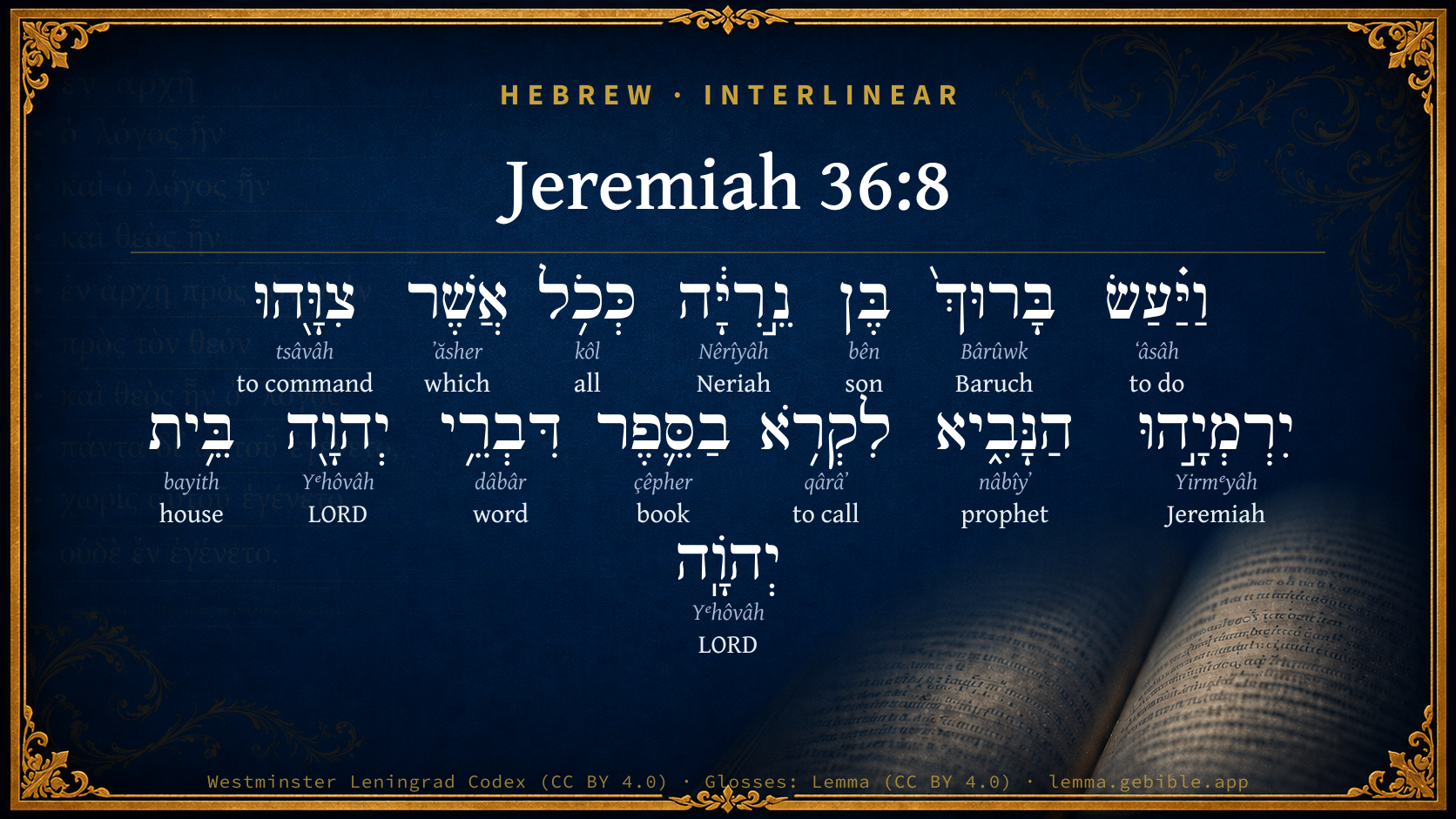
Hebrew (Westminster Leningrad Codex) Jeremiah 36:8 appears in the Hebrew Old Testament. The text above is from the Westminster Leningrad Codex. Each word links to its Strong’s number, a concise gloss, and parsing drawn from the Open Scriptures Hebrew Bible morphology. Click any word for its full Brown-Driver-Briggs (BDB) entry.
Download image
Cite this verse

Jeremiah 36:8 (World English Bible). Public Domain. Lemma interlinear Bible study tool, https://lemma.gebible.app/v/jeremiah/36/8.

Show BibTeX & RIS
BibTeX
RIS
English Translation
Baruch the son of Neriah did according to all that Jeremiah the prophet commanded him, reading in the book the words of Yahweh in Yahweh's house.
World English Bible · Public Domain
Download a study sheet

One document with this verse’s original text, its word-by-word gloss line, the meaning frame, cross-references with their text, attributed commentary, and full source and license credits — printable, and it pastes into notes with its structure intact.

This verse Autodidact and up

Study sheet (.html) Plain text (.txt)

A passage Seminary Student

Up to 50 verses in one chapter. A passage sheet keeps up to 6 commentary sources and 12 cross-references per verse, in the order this page ranks them, and says so on the sheet whenever that leaves anything out. Ask for a single verse and you get the Autodidact verse sheet above.

Everything on this page stays free to read, with no account — the sheet is a download of what is already on screen, not access to it.

Want to remove ads? Support Godless Engineer
Compare translations 3

The same verse in 3 English versions, stacked beneath the original-language interlinear above. Click any original word for its lexicon entry.

Each is an independent rendering of the whole verse — the interlinear is not word-aligned to these translations.

Highlighted words mark where these versions differ — a whole-verse word diff, not a word-by-word alignment.

  • World English Bible Public Domain
    Baruch the son of Neriah did according to all that Jeremiah the prophet commanded him, reading in the book the words of Yahweh in Yahweh's house.
  • King James Version Public Domain
    And Baruch the son of Neriah did according to all that Jeremiah the prophet commanded him, reading in the book the words of the LORD in the LORD's house.
  • unfoldingWord Literal Text CC BY-SA 4.0
    So Baruch son of Neriah did everything that Jeremiah the prophet had commanded him to do. He read aloud the words of Yahweh in the house of Yahweh.

unfoldingWord Literal Text — © unfoldingWord, licensed CC BY-SA 4.0. Word-aligned USFM3 via Door43 (git.door43.org/unfoldingWord/en_ult).

Versions to compare (up to 4)

3 of 4 selected

Show all 18 translations

Every available English version of this verse, each an independent rendering of the whole verse.

  • World English Bible Public Domain
    Baruch the son of Neriah did according to all that Jeremiah the prophet commanded him, reading in the book the words of Yahweh in Yahweh's house.
  • Berean Standard Bible Public Domain
    So Baruch son of Neriah did everything that Jeremiah the prophet had commanded him. In the house of the LORD he read the words of the LORD from the scroll.
  • Majority Standard Bible Public Domain
    So Baruch son of Neriah did everything that Jeremiah the prophet had commanded him. In the house of the LORD he read the words of the LORD from the scroll.
  • King James Version Public Domain
    And Baruch the son of Neriah did according to all that Jeremiah the prophet commanded him, reading in the book the words of the LORD in the LORD's house.
  • American Standard Version (1901) Public Domain
    And Baruch the son of Neriah did according to all that Jeremiah the prophet commanded him, reading in the book the words of Jehovah in Jehovah's house.
  • Revised Version (1885) Public Domain
    And Baruch the son of Neriah did according to all that Jeremiah the prophet commanded him, reading in the book the words of the LORD in the LORD’S house.
  • Geneva Bible (1599) Public Domain
    So Baruch the sonne of Neriah did according vnto all, that Ieremiah the Prophet commanded him, reading in the booke the wordes of the Lord in the Lords House.
  • Douay-Rheims (1899) Public Domain
    And Baruch the son of Nerias did according to all that Jeremias the prophet had commanded him, reading out of the volume the words of the Lord in the house of the Lord.
  • Young's Literal Translation Public Domain
    And Baruch son of Neriah doth according to all that Jeremiah the prophet commanded him, to read in the book the words of Jehovah in the house of Jehovah.
  • Literal Standard Version CC BY-SA 4.0
    And Baruch son of Neriah does according to all that Jeremiah the prophet commanded him, to read in the scroll the words of YHWH in the house of YHWH.
  • Unlocked Literal Bible CC BY-SA 4.0
    So Baruch son of Neriah did everything that Jeremiah the prophet had commanded him to do. He read aloud the words of Yahweh in the house of Yahweh.
  • unfoldingWord Literal Text CC BY-SA 4.0
    So Baruch son of Neriah did everything that Jeremiah the prophet had commanded him to do. He read aloud the words of Yahweh in the house of Yahweh.
  • Darby Bible Public Domain
    And Baruch the son of Nerijah did according to all that the prophet Jeremiah commanded him, reading in the book the words of Jehovah in Jehovah's house.
  • World Messianic Bible Public Domain
    Baruch the son of Neriah did according to all that Jeremiah the prophet commanded him, reading in the book the LORD’s words in the LORD’s house.
  • Webster's Bible Public Domain
    And Baruch the son of Neriah did according to all that Jeremiah the prophet commanded him, reading in the book the words of the LORD in the LORD'S house.
  • Free Bible Version CC BY-SA 4.0
    Baruch son of Neriah did exactly what Jeremiah the prophet had told him to do. He went and read the Lord's message from the scroll in the Temple.
  • Bible in Basic English Public Domain
    And Baruch, the son of Neriah, did as Jeremiah the prophet gave him orders to do, reading from the book the words of the Lord in the Lord's house.
  • JPS Tanakh (1917) Public Domain
    And Baruch the son of Neriah did according to all that Jeremiah the prophet commanded him, reading in the book the words of the LORD in the LORD'S house.

Literal Standard Version (2020), Covenant Press — licensed CC BY-SA 4.0. Text via the HelloAO Bible API (eBible.org). Unlocked Literal Bible (unfoldingWord) — licensed CC BY-SA 4.0. Text via the HelloAO Bible API (eBible.org). unfoldingWord Literal Text — © unfoldingWord, licensed CC BY-SA 4.0. Word-aligned USFM3 via Door43 (git.door43.org/unfoldingWord/en_ult). Free Bible Version, Dr. Jonathan Gallagher — licensed CC BY-SA 4.0. Text via the HelloAO Bible API (eBible.org).

Word by word

More ways to search: Search by grammar → Find every occurrence → Compare this word →

Practice this passage: Drill this verse → Learn its vocabulary →

נֵ֣רִיָּ֔ה
Nêrîyâh
H5374
“Neriah”
Noun, Proper
Part of Speech
Noun
Type
Proper
Full BDB Definition

Origin: from H5216 and H3050

TWOT: None

Neriah = "lamp of Jehovah" - son of Maaseiah and father of Baruch and Seraiah
  1. וַיַּ֗עַשׂ ʻâsâh H6213 “and · to do” Conjunction + Verb, Qal, Sequential Imperfect, 3rd Person, Masculine, Singular
  2. בָּרוּךְ֙ Bârûwk H1263 “Baruch” Noun, Proper
  3. בֶּן bên H1121 “son of” Noun, Common, Masculine, Singular, Construct
  4. כְּכֹ֥ל kôl H3605 “like/as · all” Preposition + Noun, Common, Masculine, Singular, Absolute
  5. אֲשֶׁר ʼăsher H834 “which” Particle, Relative
  6. צִוָּ֖הוּ tsâvâh H6680 “to command · him” Verb, Piel, Perfect, 3rd Person, Masculine, Singular + Suffix, Personal, 3rd Person, Masculine, Singular
  7. יִרְמְיָ֣הוּ Yirmᵉyâh H3414 “Jeremiah” Noun, Proper
  8. הַנָּבִ֑יא nâbîyʼ H5030 “the · prophet” Particle, Definite Article + Noun, Common, Masculine, Singular, Absolute
  9. לִקְרֹ֥א qârâʼ H7121 “to call” Preposition + Verb, Qal, Infinitive Construct
  10. בַסֵּ֛פֶר çêpher H5612 “in/at the · book” Preposition, Determined + Noun, Common, Masculine, Singular, Absolute
  11. דִּבְרֵ֥י dâbâr H1697 “words of” Noun, Common, Masculine, Plural, Construct
  12. יְהוָ֖ה Yᵉhôvâh H3068 “LORD” Noun, Proper
  13. בֵּ֥ית bayith H1004 “house of” Noun, Common, Masculine, Singular, Construct
  14. יְהֹוָֽה Yᵉhôvâh H3068 “LORD” Noun, Proper

About this verse

These counts appear in no published source. They are computed here, from the morphology-tagged text and Lemma’s own curated glosses. What Lemma adds →

15
words
14
distinct lemmas
Prophets
section

Notable vocabulary

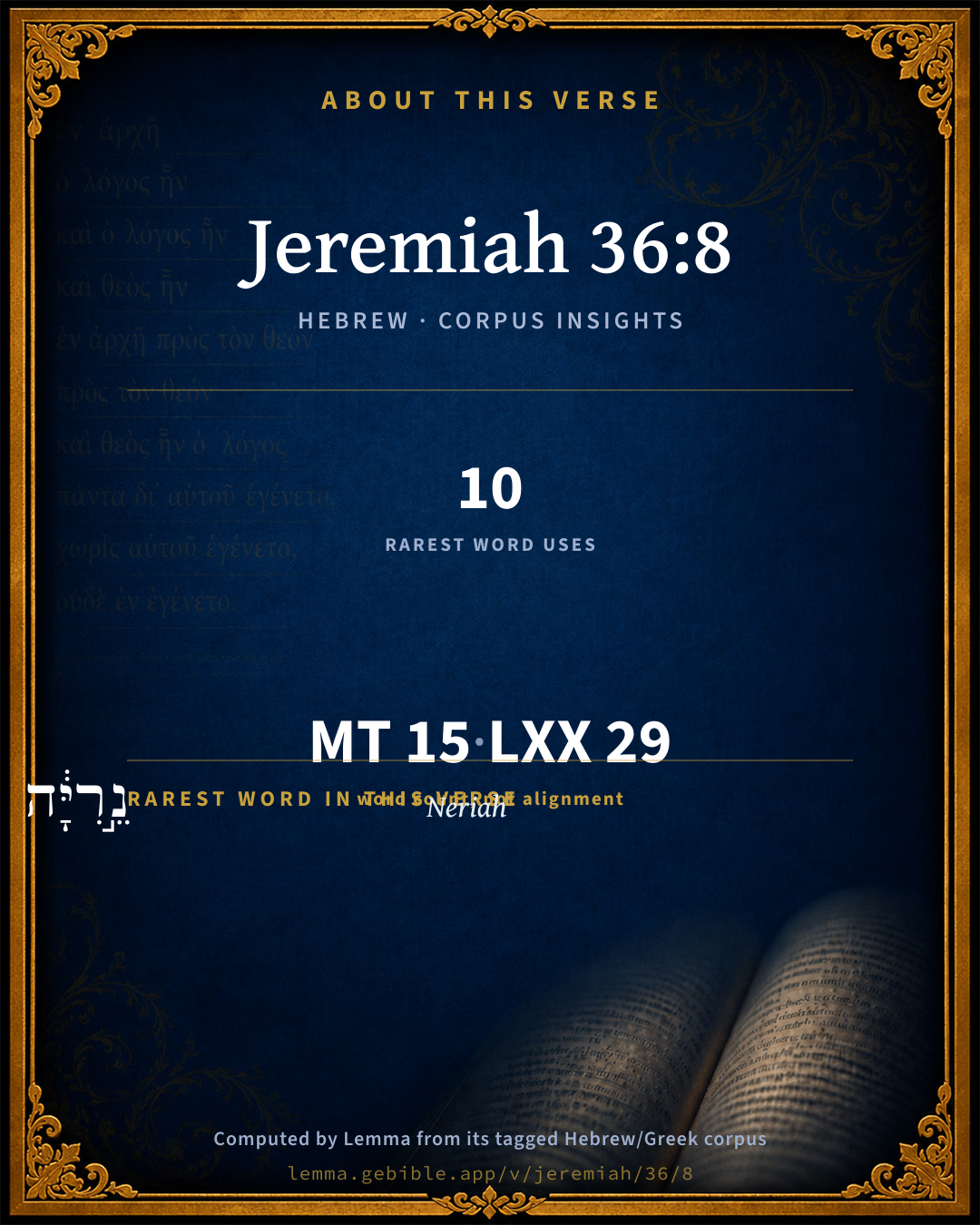
The rarest word here is נֵ֣רִיָּ֔ה Neriah H5374 — appearing just 10 times in the whole Hebrew Bible.

Shared distinctive vocabulary

נֵ֣רִיָּ֔ה Neriah H5374 occurs in 10 verses of the Hebrew Bible. Also found in:

Grammatical profile

  • 3 verbs
  • 11 nouns
  • 1 particle

Verb forms

  • וַיַּ֗עַשׂ Qal · Sequential Imperfect
  • צִוָּ֖הוּ Piel · Perfect
  • לִקְרֹ֥א Qal · Infinitive Construct

Repetition

A word recurs within this verse — often emphatic in Hebrew:

  • יְהוָ֖ה LORD H3068 ×2

Hebrew & Septuagint length

In the original languages it is 15 Hebrew tokens and 29 Greek tokens — but the two are counted differently (Hebrew bundles its prefixes and suffixes into one token; the Greek is in lemma form), so that isn’t a like-for-like length.

Cross-references

7

Topical passages linked to Jeremiah 36:8 in the Treasury of Scripture Knowledge — connected by theme and wording, ordered by reader-vote popularity; previews shown in the World English Bible.

  • Jeremiah 1:17 You therefore gird up your loins, and arise, and speak to them all that I command you: don't be dismayed at them, lest I dismay you before them.
  • Nehemiah 8:3 He read therein before the broad place that was before the water gate from early morning until midday, in the presence of the men and the women, and of those who could understand; and the ears of all the people were [attentive] to the book of the law.
  • Jeremiah 36:4 Then Jeremiah called Baruch the son of Neriah; and Baruch wrote from the mouth of Jeremiah all the words of Yahweh, which he had spoken to him, on a scroll of a book.
  • Matthew 16:24 Then Jesus said to his disciples, "If anyone desires to come after me, let him deny himself, and take up his cross, and follow me.
  • Luke 4:16–30 He came to Nazareth, where he had been brought up. He entered, as was his custom, into the synagogue on the Sabbath day, and stood up to read.
  • 1 Corinthians 16:10 Now if Timothy comes, see that he is with you without fear, for he does the work of the Lord, as I also do.
  • Philippians 2:19–22 But I hope in the Lord Jesus to send Timothy to you soon, that I also may be cheered up when I know how you are doing.

Cross-references courtesy of OpenBible.info (CC BY 4.0).

Hebrew and Greek witnesses Masoretic Hebrew ↔ Greek Septuagint

The same verse in the two great witnesses to the Old Testament, shown verse-for-verse.

These are two independent witnesses, not word-aligned to each other, and the Septuagint is shown in lemma (dictionary) form.

Hebrew Jeremiah 36:8 Masoretic · Westminster Leningrad Codex

וַיַּ֗עַשׂ בָּרוּךְ֙ בֶּן נֵ֣רִיָּ֔ה כְּכֹ֥ל אֲשֶׁר צִוָּ֖הוּ יִרְמְיָ֣הוּ הַנָּבִ֑יא לִקְרֹ֥א בַסֵּ֛פֶר דִּבְרֵ֥י יְהוָ֖ה בֵּ֥ית יְהֹוָֽה

Baruch the son of Neriah did according to all that Jeremiah the prophet commanded him, reading in the book the words of Yahweh in Yahweh's house.

World English Bible · Public Domain

Greek LXX Structure differs

In the Septuagint, Jeremiah is about an eighth shorter than the Hebrew and arranges its material differently — the Oracles Against the Nations (Hebrew chapters 46–51) appear in the middle of the Greek book, after 25:13. Because the chapter and verse boundaries do not line up, a verse-for-verse comparison with the Hebrew is not shown.

A verse-for-verse comparison isn’t shown here because the chapters and verses don’t line up. Switch to the LXX edition with the MT / LXX toggle above to read the Greek directly.

On this verse, Keil & Delitzsch discusses the Septuagint’s reading. Read the note in Commentary ↓

Hebrew: Westminster Leningrad Codex (CC BY 4.0). Greek: Septuagint (public domain); English from a public-domain English Septuagint. How the Septuagint differs from the Hebrew →

Targum (Aramaic paraphrase)

1

The Targum is the ancient Jewish Aramaic paraphrase of the Hebrew Scriptures — an interpretive translation, not the Hebrew text itself. Onkelos (literal) and Pseudo-Jonathan (expansive) render the Torah, and Jonathan the Prophets. Coverage is partial: where no permissively-licensed English translation exists for a verse, only the Aramaic is shown. This is verse-level text, not a word-by-word alignment to the Hebrew.

  1. Targum Jonathan Prophets (Joshua–Malachi)
    וַעֲבַד בָּרוּךְ בַּר נֵרִיָה כְּכֹל דִי פַקְדֵיהּ יִרְמְיָה נְבִיָא לְמִקְרֵי בְּסִפְרָא פִּתְגָמָא דַייָ בֵּית מַקְדְשָׁא דַיָי:

    (no public-domain English translation for this verse)

    Targum Jonathan — Aramaic: “Mikraot Gedolot” (public domain). English: “Sefaria Community Translation” (CC0 1.0 (public-domain dedication)); “London "Chaldee Paraphrase," 1871” (public domain). Text via Sefaria.

Commentary

Notes on Jeremiah 36:8 from classic Christian and Jewish commentators (each source and its license shown beneath its notes). The classic Christian expositions comment on the surrounding passage and are grouped to its opening verse, so a note may address several verses; the Jewish commentaries on the Tanakh (Rashi and others) are per-verse, so they appear only where the commentator wrote on this verse.

Lemma curates 59 commentaries, every one of them public domain or Creative Commons licensed, each selected and text-cleaned for this edition rather than reprinted as found. About our sources →

Trapp's Complete Commentary

John Trapp

Jer 36:8 And Baruch the son of Neriah did according to all that Jeremiah the prophet commanded him, reading in the book the words of the LORD in the LORD’S house.

Ver. 8. And Baruch the son of Neriah did according, &c.] Nihil de sua saliva admiscens. He faithfully performed the prophet Jeremiah’s commands, not standing to cast perils, being thereunto heartened and hardened by Jeremiah {Jer 45:5}

John Trapp, A Commentary or Exposition upon All the Books of the Old and New Testament (1647–1656) — public domain. Text from a community e-Sword module.

Tyndale Open Study Notes

Tyndale Open Resources

36:8-9 Baruch filled the columns of the scroll with Jeremiah’s messages from the Lord. Finally, a day of fasting was announced toward the end of 604 BC. Baruch faithfully obeyed Jeremiah’s order to read the scroll in the Temple, where many people crowded the courtyard.

Tyndale Open Study Notes — © Tyndale Open Resources, licensed CC BY-SA 4.0. Text via the HelloAO Bible API.

John Calvin's Commentaries

Here the promptitude of Baruch is commended, for he did not disobey God’s Prophet, but willingly undertook the office deputed to him. His office, as we have said, was not without danger. As then his message was by no means popular, but on the contrary very disagreeable, hence is seen the devotedness of Baruch. He made no refusal, for he knew that this burden was laid on him for some purpose. Jeremiah then says, that he did as he had been commanded, and read in the Temple the words of Jehovah He calls them a little farther on the words of Jeremiah, but the same thing is meant; for as God is, as it were, represented by his ministers, so he often transfers to them what belongs peculiarly to himself. (Romans 2:16; 16:25; 2 Timothy 2:8) That is called the doctrine of Jeremiah, which yet, properly speaking, has no other author but God. So Paul called that Gospel, of which he was the preacher and witness, his Gospel; and yet he himself had not devised the Gospel, but had received it from Christ, and faithfully delivered it as from his hand.

We ought, therefore, to notice this mode of speaking, which occurs everywhere in Scripture, — the same thing is ascribed to God and to his servants. Thus we find what may seem strange, — the Apostles are said to forgive sins, they are spoken of as bringing salvation; but the reason is, because they were ministers of God’s grace, and exhorted men in Christ’s name to be reconciled to God. They then absolved, because they were the testifiers of absolution. So also the words which God dictated to his servant were called the words of Jeremiah; yet, properly speaking, they were not the words of man, for they did not proceed from a mortal man, but from the only true God. It follows —

John Calvin's Commentaries (1540-1563) — public domain. Text from the Calvin Translation Society English edition (1840s-50s) via the Christian Classics Ethereal Library (ccel.org). Calvin's coverage is partial (roughly two-thirds of the Bible); uncommented books and verses are honest gaps, never fabricated. The 19th-century editor's footnotes and remarks are omitted so the notes are faithfully Calvin's own voice.

The Cambridge Bible for Schools and Colleges

gen. ed. J. J. S. Perowne

8. And Baruch … did according to all] This summary statement of the fact that Baruch carried out Jeremiah’s commands is followed by the detailed account in Jer_36:9 f.

The Cambridge Bible for Schools and Colleges (gen. ed. J. J. S. Perowne; Cambridge University Press, 1878–1918) — public domain. Text from a community e-Sword module.

John Gill's Exposition

And Baruch the son of Neriah did according to all that Jeremiah the prophet commanded him,.... Here follows Baruch's obedience to the prophet's commands; which he considered no doubt as the will of the Lord, who directed the prophet to give the orders he did; and which he punctually observed, in all respects, as to things, time, and place:

reading in the book the words of the Lord in the Lord's house; the prophecies of Jeremiah, which came from the Lord, and which he had transcribed into a book from the mouth of the prophet; these he read before the people in the temple, a first, if not a second time, before the reading of it recorded in the following verses.

John Gill's Exposition of the Whole Bible (1746–1763) — public domain (CC PDM 1.0). Text via the HelloAO Bible API.

Albert Barnes' Notes on the Bible

Reading - To read.

Albert Barnes' Notes on the Bible (1834–1885) — public domain. Text from a community e-Sword/MySword module.

Keil & Delitzsch

C. F. Keil & F. Delitzsch

Baruch executes his commission.

Jer 36:9-19

The reading of the book in the temple. - Jer 36:9. In the fifth year of Jehoiakim, in the ninth month, "they proclaimed a fast before the Lord - all the people in Jerusalem, and all the people who had come out of the cities of the Judah to Jerusalem." קתא צום, to call, declare, appoint a fast; cf. Kg1 21:9, Kg1 21:12; Ch2 20:3. From the tenor of the words, the people who lived in Jerusalem and those who had come thither out of the country might seem to have called the fast. But this is impossible; for the people from the cities of Judah evidently came to Jerusalem only in consequence of the fast being appointed. Hence Graf is of opinion that קתא צום seems here used in a general way of the keeping of such a fast. This view is not confirmed by any parallel instances. The expression is inexact, and the inexactness has arisen from the effort to attain greater conciseness of expression. The meaning is this: a fast was proclaimed, and all the people in Jerusalem and out of the cities of Judah came to worship the Lord in the temple. It remains doubtful with whom the appointment originated, - whether with the king, or with the high priest and the priesthood. The ninth month corresponds to our December, and consequently came round with the cold season; cf. Jer 36:22. The fast-day was a special one; for in the law only the day of atonement, in the seventh month, was prescribed as a fast-day. On the object of this measure, see supra, p. 316f.

Jer 36:10

On this day Baruch read the addresses of Jeremiah out of the book to the people who had come to the temple, in the "chamber of Gemariah, the son of Shaphan, the scribe, in the upper forecourt, at the entrance of the new gate of the house of the Lord." Gemariah the son of Shaphan was one of the king's private scribes, a secretary of state. For, according to Jer 36:12, he belonged to the princes, and was probably a brother of Ahikam the son of Shaphan, who had already shown himself, before this, a protector of the prophet (Jer 26:24). The chamber which he had in the temple was situated in the upper forecourt, at the entrance of the new gate, whose position we cannot exactly determine (see on Jer 26:10), but which led from the outer to the inner court of the priests, which rose higher than the others.

Jer 36:11-13

Micaiah, a son of Gemariah, was also listening to the reading; and he it was who brought the news into the palace. He made of the room, i.e., the office, of Elishama, the secretary of state, where the princes, viz., Elishama, Delaiah the son of Shemaiah, Elnathan the son of Achbor (cf. Jer 26:22), Gemariah the son of Shaphan, and Zedekiah the son of Hananiah, had just met for a consultation; and he mentioned to them what he had heard.

Jer 36:14

On this information the princes sent Jehudi (perhaps one of the under-officers of the secretary of state) to Baruch, to bring him, with the book from which he had read. From the designation, "Jehudi son of Nethaniah, son of Shelemiah, son of Cushi," Hitzig and Graf conclude that the first and last are not proper names, but appellatives, "the Jew" and "the Cushite," and account for the use of them on the ground that, through the application of the law given in Deu 23:7-8 to Cushites as well as Egyptians, the ancestor was a Cushite, and only his great-grandson became a Jew, or Jewish citizen, and was called "Jehudi." But this view is opposed (1) by the fact that the names of the father and the grandfather are true proper names, and these, moreover, contain the name Jah (Jahveh), - hence are genuine proper names of Israelites; moreover, (2) even in olden times Jehudith occurs as a woman's name, Gen 26:34. According to this, Jehudi is a true proper name, and at the most, Cushi is but a surname of the great-grandfather, given him because of his descent from the Cushites. Further, the law, Deu 23:7, applies only to the posterity of the Edomites and Egyptians, that these should not be received into the congregation of the Lord till the third generation; this ordinance was based on grounds which did not permit of its application to other nations. These might be naturalized even in the first generation on undergoing circumcision, with the exception of Canaanites, Ammonites, and Moabites, who were not to be admitted into the Israelitish community even in the tenth generation, Deu 23:3.

Jer 36:15-16

When Baruch came, the princes, in token of friendly and respectful treatment, bade him sit down and read to them out of the book he had brought with him. Jer 36:16. But when they heard all the words read, "they were afraid one at another;" i.e., by looks, gestures, and words, they gave mutual expression of their fear, partly because of the contents of what had been read. Although they were generally acquainted with the sense and the spirit of Jeremiah's addresses, yet what had now been read made a powerful impression on them; for Baruch plainly had read, both to the people in the temple and to the princes, not the whole book, but only the main portions, containing the sternest denunciations of sin and the strongest threats of punishment. The statement, "he read in (out of) the book the words of Jeremiah" (Jer 36:10), does not mean that he read the whole book; this would only have wearied the people and weakened the impression made. But they were partly also terrified, perhaps, by the boldness of a declaration which so decidedly opposed the desires and hopes of the king; for the thought of the event mentioned in Jer 26:20. would at once suggest to them the danger that might arise to the live of Jeremiah and Baruch from the despotic character of the king. They said therefore to Baruch, "We must tell the king all these things." For it was clear that the matter could not long remain concealed from the king, after the public reading in the temple. Hence they dared not, agreeably to their official relation to the king, hide from him what had taken place.

Jer 36:17-18

Meanwhile, in order to inform themselves more exactly regarding what had happened, they ask Baruch, "Tell us, how hast thou written all these words at his mouth?" Thereupon Baruch replied, "He used to call aloud these words to me," i.e., he used to dictate them to me by word of mouth, "and I wrote them in the book with ink." The imperfect expresses the repeated or continued doing of anything; hence יקרא here means to dictate, which requires considerable time. In the following circumstantial clause is found the participle ואני כתב, while I was writing; and so I myself was doing nothing else all the time than writing down what was dictated. Some commentators have found a stumbling-block in מפּיו in the question of the princes (Jer 36:17); the lxx and Ewald omit this word, inasmuch as Baruch does not explain till afterwards that he had written down the words from the mouth of Jeremiah. Others, like Venema, take מפּיו as a question = המפּיו. Both explanations are arbitrary and unnecessary. The princes knew quite well that the substance of the book was from the mouth of Jeremiah, i.e., contained his addresses; but Baruch, too, might have composed the book from the oral discourses of the prophet without being commissioned by him, without his knowledge also, and against his will. Accordingly, to attain certainty as to the share of the prophet in this matter, they ask him, and Baruch answers that Jeremiah had dictated it to him.

Jer 36:19

Thereupon the princes advised Baruch to hide himself and Jeremiah; for they know beforehand that Jehoiakim would put to death the witnesses of the truth.

Keil & Delitzsch — Biblical Commentary on the Old Testament (1861–1891) — public domain (CC PDM 1.0). Text via the HelloAO Bible API. (Old Testament only.)

Lesson kit

Teaching starters — assembled from the data on this page, not authored interpretation. Every prompt links to the verse data it draws on. Edit before teaching.

Jeremiah, in the Prophets, opens this verse with 15 words (14 distinct Hebrew lemmas). Its most distinctive word is Nêrîyâh (“Neriah”). A historical commentator’s framing appears above. Read the whole chapter for the surrounding context.

Discussion questions

  1. What does “Neriah” (Nêrîyâh) contribute to the verse as a whole?
  2. Jeremiah 32:12 shares the word «Neriah» with this verse. How do the two illuminate each other?
  3. “LORD” occurs 2× in this one verse. What is the effect of the repetition?
  4. The translations on this page render this verse differently — a whole-verse word diff, not a word-by-word alignment. What might account for the different wordings?
  5. The verb «וַיַּ֗עַשׂ» is Qal Sequential Imperfect. How does its form color the action?
  6. Reading how Trapp's Complete Commentary and Tyndale Open Study Notes read this verse, where do the two commentators agree and where do they part?

Things to notice

Reading settings

Reading text

Shown beneath each verse's original-language words.

Old Testament
Old Testament edition

Read the OT as the Masoretic Hebrew (MT) or the Greek Septuagint (LXX).

English shown for the Greek Septuagint (in the Hebrew ↔ Greek comparison).

Comparing translations? Open the Compare panel on any verse page to stack up to four side by side.