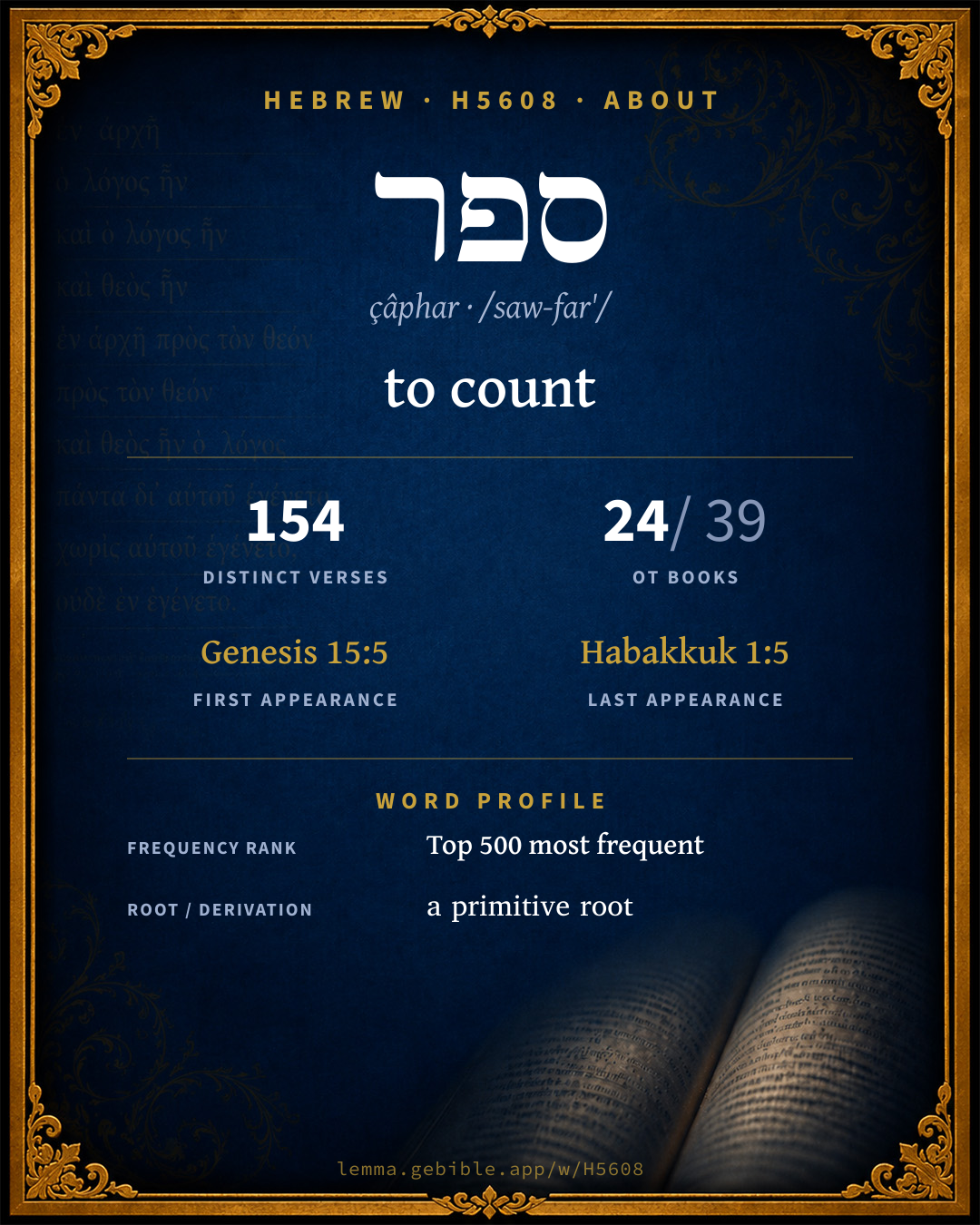
ספר
to count
also: recount, relate fuller range ↓
Full lexicon entry — Brown-Driver-Briggs (BDB)
From Brown-Driver-Briggs (BDB)
Where this word appears
See every Piel verb in the Hebrew Bible →
Grammar key — what these labels mean
Part of speech
- Noun
- A naming word — a person, place, thing, or idea.
- Verb
- An action or state-of-being word.
Noun type
- Common
- A common noun — a general class of person, place, or thing (“king,” “city,” “water”), not a specific name.
Stem
- Piel
- An intensive or resultative active stem. Here: ‘recount something’
- Niphal
- Usually the simple passive or reflexive of the Qal (“he was written”).
- Qal
- The basic, simple active stem — the plain form of the verb (“he wrote”). Here: ‘count things’
- Pual
- The passive counterpart of the Piel. Here: ‘be recounted’
Form
- Sequential Imperfect
- An imperfect with prefixed waw — the standard past-narrative form (waw-consecutive imperfect).
- Imperfect
- An incomplete, ongoing, or future action (“he will / would write”).
- Cohortative
- A first-person volitional form expressing wish or resolve (“let me / let us write”).
- Infinitive Construct
- A bound verbal noun, frequently with prepositions (“to write / in writing”).
- Perfect
- A completed action or state — Hebrew marks aspect (completeness) more than strict tense (“he wrote”).
- Imperative
- A direct command (“write!”).
- Participle Active
- A verbal adjective expressing ongoing or characteristic action (“writing / one who writes”).
- Sequential Perfect
- A perfect with prefixed waw continuing a preceding imperfect or command (waw-consecutive perfect).
- Jussive
- A third- or second-person volitional form expressing wish or command (“let him write”).
State
- Absolute
- The independent form of a noun, not bound to a following word.
- Construct
- A noun bound to a following noun in a possessive / “of” relationship (the construct chain).
Person
- 3rd Person
- The one spoken about (“he / she / it / they”).
- 1st Person
- The speaker (“I / we”).
- 2nd Person
- The one addressed (“you”).
Gender
- Masculine
- Grammatically masculine.
- Common
- Either gender — not distinguished for this form.
- Feminine
- Grammatically feminine.
Number
- Singular
- One.
- Plural
- More than one (in Hebrew, generally three or more).
Grammatical forms 46 distinct
- Noun, Common, Masculine, Singular, Absolute 44 times (27%)
- Verb, Piel, Sequential Imperfect, 3rd Person, Masculine, Singular 12 times (7%)
- Verb, Piel, Imperfect, 3rd Person, Masculine, Plural 9 times (6%)
- Verb, Piel, Cohortative, 1st Person, Common, Singular 7 times (4%)
- Verb, Piel, Infinitive Construct 6 times (4%)
- Verb, Niphal, Imperfect, 3rd Person, Masculine, Singular 5 times (3%)
- Verb, Piel, Sequential Imperfect, 3rd Person, Masculine, Plural 5 times (3%)
- Noun, Common, Masculine, Plural, Absolute 4 times (2%)
+38 more forms (69 occurrences)
Parsed forms decoded from the imported morphology (morphhb / Westminster Leningrad Codex — WLC text public domain, morphhb tagging CC BY 4.0), counted across 161 parsed occurrences — not distinct verses.
Every verse where H5608 appears — 154 distinct verses across 24 books. Click any verse to open its interlinear word-by-word view. Verse text shown in the World English Bible for context — . Each verse’s Hebrew form is shown with its reference; the English is not keyword-highlighted, since the data carries no word-level English alignment. Use “Compare translations” on any verse to read it across multiple English versions. This concordance covers the Hebrew Bible; Septuagint (Greek Old Testament) occurrences are not indexed here.
Genesis 12 verses
- Genesis 15:5 וּ/סְפֹר֙ לִ/סְפֹּ֣ר conj + Qal impv 2ms prep + Qal inf.cs Yahweh brought him outside, and said, "Look now toward the sky, and count the stars, if you are able to count them." He said to Abram, "So shall your seed be."
- Genesis 16:10 יִסָּפֵ֖ר Niphal impf 3ms The angel of Yahweh said to her, "I will greatly multiply your seed, that they will not be numbered for multitude."
- Genesis 24:66 וַ/יְסַפֵּ֥ר conj + Piel wimpf 3ms The servant told Isaac all the things that he had done.
- Genesis 29:13 וַ/יְסַפֵּ֣ר conj + Piel wimpf 3ms It happened, when Laban heard the news of Jacob, his sister's son, that he ran to meet Jacob, and embraced him, and kissed him, and brought him to his house. Jacob told Laban all these things.
- Genesis 32:12 יִסָּפֵ֖ר Niphal impf 3ms You said, 'I will surely do you good, and make your seed as the sand of the sea, which can't be numbered because there are so many.'"
- Genesis 37:9 וַ/יְסַפֵּ֥ר conj + Piel wimpf 3ms He dreamed yet another dream, and told it to his brothers, and said, "Behold, I have dreamed yet another dream: and behold, the sun and the moon and eleven stars bowed down to me."
- Genesis 37:10 וַ/יְסַפֵּ֣ר conj + Piel wimpf 3ms He told it to his father and to his brothers. His father rebuked him, and said to him, "What is this dream that you have dreamed? Will I and your mother and your brothers indeed come to bow ourselves down to you to the earth?"
- Genesis 40:8 סַפְּרוּ Piel impv 2mp They said to him, "We have dreamed a dream, and there is no one who can interpret it." Joseph said to them, "Don't interpretations belong to God? Please tell it to me."
- Genesis 40:9 וַ/יְסַפֵּ֧ר conj + Piel wimpf 3ms The chief cupbearer told his dream to Joseph, and said to him, "In my dream, behold, a vine was in front of me,
- Genesis 41:8 וַ/יְסַפֵּ֨ר conj + Piel wimpf 3ms It happened in the morning that his spirit was troubled, and he sent and called for all the magicians of Egypt, and all the wise men of it. Pharaoh told them his dream, but there was no one who could interpret them to Pharaoh.
- Genesis 41:12 וַ/נְּ֨סַפֶּר conj + Piel wimpf 1cp There was with us there a young man, a Hebrew, servant to the captain of the guard, and we told him, and he interpreted to us our dreams. To each man according to his dream he interpreted.
- Genesis 41:49 לִ/סְפֹּ֖ר prep + Qal inf.cs Joseph laid up grain as the sand of the sea, very much, until he stopped counting, for it was without number.
Exodus 4 verses
- Exodus 9:16 סַפֵּ֥ר Piel inf.cs but indeed for this cause I have made you stand: to show you my power, and that my name may be declared throughout all the earth;
- Exodus 10:2 תְּסַפֵּר֩ Piel impf 2ms and that you may tell in the hearing of your son, and of your son's son, what things I have done to Egypt, and my signs which I have done among them; that you may know that I am Yahweh."
- Exodus 18:8 וַ/יְסַפֵּ֤ר conj + Piel wimpf 3ms Moses told his father-in-law all that Yahweh had done to Pharaoh and to the Egyptians for Israel's sake, all the hardships that had come on them on the way, and how Yahweh delivered them.
- Exodus 24:3 וַ/יְסַפֵּ֤ר conj + Piel wimpf 3ms Moses came and told the people all the words of Yahweh, and all the ordinances; and all the people answered with one voice, and said, "All the words which Yahweh has spoken will we do."
Leviticus 5 verses
- Leviticus 15:13 וְ/סָ֨פַר conj + Qal wpf 3ms "'When he who has a discharge is cleansed of his discharge, then he shall count to himself seven days for his cleansing, and wash his clothes; and he shall bathe his flesh in running water, and shall be clean.
- Leviticus 15:28 וְ/סָ֥פְרָה conj + Qal wpf 3fs "'But if she is cleansed of her discharge, then she shall count to herself seven days, and after that she shall be clean.
- Leviticus 23:15 וּ/סְפַרְתֶּ֤ם conj + Qal wpf 2mp "'You shall count from the next day after the Sabbath, from the day that you brought the sheaf of the wave offering; seven Sabbaths shall be completed:
- Leviticus 23:16 תִּסְפְּר֖וּ Qal impf 2mp even to the next day after the seventh Sabbath you shall number fifty days; and you shall offer a new meal offering to Yahweh.
- Leviticus 25:8 וְ/סָפַרְתָּ֣ conj + Qal wpf 2ms "'You shall count off seven Sabbaths of years, seven times seven years; and there shall be to you the days of seven Sabbaths of years, even forty-nine years.
Numbers 1 verse
Deuteronomy 1 verse
Joshua 1 verse
Judges 3 verses
- Judges 5:14 סֹפֵֽר n c ms Out of Ephraim [came down] they whose root is in Amalek; After you, Benjamin, among your peoples; Out of Machir came down governors, Out of Zebulun those who handle the marshal's staff.
- Judges 6:13 סִפְּרוּ Piel pf 3cp Gideon said to him, Oh, my lord, if Yahweh is with us, why then has all this happened to us? and where are all his wondrous works which our fathers told us of, saying, Did not Yahweh bring us up from Egypt? but now Yahweh has cast us off, and delivered us into the hand of Midian.
- Judges 7:13 מְסַפֵּ֥ר Piel ptcp.act ms When Gideon had come, behold, there was a man telling a dream to his fellow; and he said, Behold, I dreamed a dream; and, behold, a cake of barley bread tumbled into the camp of Midian, and came to the tent, and struck it so that it fell, and turned it upside down, so that the tent lay flat.
1 Samuel 1 verse
2 Samuel 3 verses
- 2 Samuel 8:17 סוֹפֵֽר n c ms and Zadok the son of Ahitub, and Ahimelech the son of Abiathar, were priests; and Seraiah was scribe;
- 2 Samuel 20:25 סֹפֵ֑ר n c ms and Sheva was scribe; and Zadok and Abiathar were priests;
- 2 Samuel 24:10 סָפַ֣ר Qal pf 3ms David's heart struck him after that he had numbered the people. David said to Yahweh, I have sinned greatly in that which I have done: but now, Yahweh, put away, I beg you, the iniquity of your servant; for I have done very foolishly.
1 Kings 4 verses
- 1 Kings 3:8 יִסָּפֵ֖ר Niphal impf 3ms Your servant is in the midst of your people which you have chosen, a great people, that can't be numbered nor counted for multitude.
- 1 Kings 4:3 סֹפְרִ֑ים n c mp Elihoreph and Ahijah, the sons of Shisha, scribes; Jehoshaphat the son of Ahilud, the recorder;
- 1 Kings 8:5 יִסָּפְר֛וּ Niphal impf 3mp King Solomon and all the congregation of Israel, who were assembled to him, were with him before the ark, sacrificing sheep and oxen, that could not be counted nor numbered for multitude.
- 1 Kings 13:11 וַ/יְסַפֶּר וַֽ/יְסַפְּר֖וּ/ם conj + Piel wimpf 3ms conj + Piel wimpf 3mp + sfx pers 3mp Now there lived an old prophet in Bethel; and one of his sons came and told him all the works that the man of God had done that day in Bethel: the words which he had spoken to the king, them also they told to their father.
2 Kings 13 verses
- 2 Kings 8:4 סַפְּרָ/ה Piel impv 2ms + sfx h Now the king was talking with Gehazi the servant of the man of God, saying, Please tell me all the great things that Elisha has done.
- 2 Kings 8:5 מְסַפֵּ֣ר Piel ptcp.act ms It happened, as he was telling the king how he had restored to life him who was dead, that behold, the woman, whose son he had restored to life, cried to the king for her house and for her land. Gehazi said, My lord, O king, this is the woman, and this is her son, whom Elisha restored to life.
- 2 Kings 8:6 וַ/תְּסַפֶּר conj + Piel wimpf 3fs When the king asked the woman, she told him. So the king appointed to her a certain officer, saying, Restore all that was hers, and all the fruits of the field since the day that she left the land, even until now.
- 2 Kings 12:10 סֹפֵ֤ר n c ms cs It was so, when they saw that there was much money in the chest, that the king's scribe and the high priest came up, and they put up in bags and counted the money that was found in the house of Yahweh.
- 2 Kings 18:18 הַ/סֹּפֵ֔ר ptcl def.art + n c ms When they had called to the king, there came out to them Eliakim the son of Hilkiah, who was over the household, and Shebnah the scribe, and Joah the son of Asaph the recorder.
- 2 Kings 18:37 הַ/סֹּפֵ֜ר ptcl def.art + n c ms Then came Eliakim the son of Hilkiah, who was over the household, and Shebna the scribe, and Joah the son of Asaph the recorder, to Hezekiah with their clothes torn, and told him the words of Rabshakeh.
- 2 Kings 19:2 הַ/סֹּפֵ֗ר ptcl def.art + n c ms He sent Eliakim, who was over the household, and Shebna the scribe, and the elders of the priests, covered with sackcloth, to Isaiah the prophet the son of Amoz.
- 2 Kings 22:3 הַ/סֹּפֵ֔ר ptcl def.art + n c ms It happened in the eighteenth year of king Josiah, that the king sent Shaphan, the son of Azaliah the son of Meshullam, the scribe, to the house of Yahweh, saying,
- 2 Kings 22:8 הַ/סֹּפֵ֔ר ptcl def.art + n c ms Hilkiah the high priest said to Shaphan the scribe, I have found the book of the law in the house of Yahweh. Hilkiah delivered the book to Shaphan, and he read it.
- 2 Kings 22:9 הַ/סֹּפֵר֙ ptcl def.art + n c ms Shaphan the scribe came to the king, and brought the king word again, and said, Your servants have emptied out the money that was found in the house, and have delivered it into the hand of the workmen who have the oversight of the house of Yahweh.
- 2 Kings 22:10 הַ/סֹּפֵר֙ ptcl def.art + n c ms Shaphan the scribe told the king, saying, Hilkiah the priest has delivered me a book. Shaphan read it before the king.
- 2 Kings 22:12 הַ/סֹּפֵ֗ר ptcl def.art + n c ms The king commanded Hilkiah the priest, and Ahikam the son of Shaphan, and Achbor the son of Micaiah, and Shaphan the scribe, and Asaiah the king's servant, saying,
- 2 Kings 25:19 הַ/סֹּפֵר֙ ptcl def.art + n c ms and out of the city he took an officer who was set over the men of war; and five men of those who saw the king's face, who were found in the city; and the scribe, the captain of the host, who mustered the people of the land; and sixty men of the people of the land, who were found in the city.
1 Chronicles 7 verses
- 1 Chronicles 2:55 סֹפְרִים֙ n c mp The families of scribes who lived at Jabez: the Tirathites, the Shimeathites, the Sucathites. These are the Kenites who came of Hammath, the father of the house of Rechab.
- 1 Chronicles 16:24 סַפְּר֤וּ Piel impv 2mp Declare his glory among the nations, His marvelous works among all the peoples.
- 1 Chronicles 18:16 סוֹפֵֽר n c ms and Zadok the son of Ahitub, and Abimelech the son of Abiathar, were priests; and Shavsha was scribe;
- 1 Chronicles 21:2 סִפְרוּ֙ Qal impv 2mp David said to Joab and to the princes of the people, Go, number Israel from Beersheba even to Dan; and bring me word, that I may know the sum of them.
- 1 Chronicles 23:3 וַ/יִּסָּֽפְרוּ֙ conj + Niphal wimpf 3mp The Levites were numbered from thirty years old and upward: and their number by their polls, man by man, was thirty-eight thousand.
- 1 Chronicles 24:6 הַ/סּוֹפֵ֜ר ptcl def.art + n c ms Shemaiah the son of Nethanel the scribe, who was of the Levites, wrote them in the presence of the king, and the princes, and Zadok the priest, and Ahimelech the son of Abiathar, and the heads of the fathers' [houses] of the priests and of the Levites; one fathers' house being taken for Eleazar, and one taken for Ithamar.
- 1 Chronicles 27:32 וְ/סוֹפֵ֖ר conj + n c ms Also Jonathan, David's uncle, was a counselor, a man of understanding, and a scribe: and Jehiel the son of Hachmoni was with the king's sons:
2 Chronicles 9 verses
- 2 Chronicles 2:2 וַ/יִּסְפֹּ֨ר conj + Qal wimpf 3ms Solomon counted out seventy thousand men to bear burdens, and eighty thousand men who were stone cutters in the mountains, and three thousand and six hundred to oversee them.
- 2 Chronicles 2:17 וַ/יִּסְפֹּ֣ר סְפָרָ֖/ם conj + Qal wimpf 3ms Qal pf 3ms + sfx pers 3mp Solomon numbered all the foreigners who were in the land of Israel, after the numbering with which David his father had numbered them; and they were found one hundred fifty-three thousand six hundred.
- 2 Chronicles 5:6 יִסָּפְר֛וּ Niphal impf 3mp King Solomon and all the congregation of Israel, that were assembled to him, were before the ark, sacrificing sheep and oxen, that could not be counted nor numbered for multitude.
- 2 Chronicles 24:11 סוֹפֵ֤ר n c ms cs It was so, that whenever the chest was brought to the king's officers by the hand of the Levites, and when they saw that there was much money, the king's scribe and the chief priest's officer came and emptied the chest, and took it, and carried it to its place again. Thus they did day by day, and gathered money in abundance.
- 2 Chronicles 26:11 הַ/סּוֹפֵ֔ר ptcl def.art + n c ms Moreover Uzziah had an army of fighting men, who went out to war by bands, according to the number of their reckoning made by Jeiel the scribe and Maaseiah the officer, under the hand of Hananiah, one of the king's captains.
- 2 Chronicles 34:13 סוֹפְרִ֥ים n c mp Also they were over the bearers of burdens, and set forward all who did the work in every manner of service: and of the Levites there were scribes, and officers, and porters.
- 2 Chronicles 34:15 הַ/סּוֹפֵ֔ר ptcl def.art + n c ms Hilkiah answered Shaphan the scribe, I have found the book of the law in the house of Yahweh. Hilkiah delivered the book to Shaphan.
- 2 Chronicles 34:18 הַ/סּוֹפֵר֙ ptcl def.art + n c ms Shaphan the scribe told the king, saying, Hilkiah the priest has delivered me a book. Shaphan read therein before the king.
- 2 Chronicles 34:20 הַ/סּוֹפֵ֗ר ptcl def.art + n c ms The king commanded Hilkiah, and Ahikam the son of Shaphan, and Abdon the son of Micah, and Shaphan the scribe, and Asaiah the king's servant, saying,
Ezra 3 verses
- Ezra 1:8 וַֽ/יִּסְפְּרֵ/ם֙ conj + Qal wimpf 3ms + sfx pers 3mp even those did Cyrus king of Persia bring forth by the hand of Mithredath the treasurer, and numbered them to Sheshbazzar, the prince of Judah.
- Ezra 7:6 סֹפֵ֤ר n c ms this Ezra went up from Babylon: and he was a ready scribe in the law of Moses, which Yahweh, the God of Israel, had given; and the king granted him all his request, according to the hand of Yahweh his God on him.
- Ezra 7:11 הַ/סֹּפֵ֑ר סֹפֵ֞ר ptcl def.art + n c ms n c ms cs Now this is the copy of the letter that the king Artaxerxes gave to Ezra the priest, the scribe, even the scribe of the words of the commandments of Yahweh, and of his statutes to Israel:
Nehemiah 7 verses
- Nehemiah 8:1 הַ/סֹּפֵ֔ר ptcl def.art + n c ms All the people gathered themselves together as one man into the broad place that was before the water gate; and they spoke to Ezra the scribe to bring the book of the law of Moses, which Yahweh had commanded to Israel.
- Nehemiah 8:4 הַ/סֹּפֵ֗ר ptcl def.art + n c ms Ezra the scribe stood on a pulpit of wood, which they had made for the purpose; and beside him stood Mattithiah, and Shema, and Anaiah, and Uriah, and Hilkiah, and Maaseiah, on his right hand; and on his left hand, Pedaiah, and Mishael, and Malchijah, and Hashum, and Hashbaddanah, Zechariah, [and] Meshullam.
- Nehemiah 8:9 הַ/סֹּפֵ֡ר ptcl def.art + n c ms Nehemiah, who was the governor, and Ezra the priest the scribe, and the Levites who taught the people, said to all the people, This day is holy to Yahweh your God; don't mourn, nor weep. For all the people wept, when they heard the words of the law.
- Nehemiah 8:13 הַ/סֹּפֵ֑ר ptcl def.art + n c ms On the second day were gathered together the heads of fathers' [houses] of all the people, the priests, and the Levites, to Ezra the scribe, even to give attention to the words of the law.
- Nehemiah 12:26 הַ/סּוֹפֵֽר ptcl def.art + n c ms These were in the days of Joiakim the son of Jeshua, the son of Jozadak, and in the days of Nehemiah the governor, and of Ezra the priest the scribe.
- Nehemiah 12:36 הַ/סּוֹפֵ֖ר ptcl def.art + n c ms and his brothers, Shemaiah, and Azarel, Milalai, Gilalai, Maai, Nethanel, and Judah, Hanani, with the musical instruments of David the man of God; and Ezra the scribe was before them.
- Nehemiah 13:13 הַ/סּוֹפֵ֗ר ptcl def.art + n c ms I made treasurers over the treasuries, Shelemiah the priest, and Zadok the scribe, and of the Levites, Pedaiah: and next to them was Hanan the son of Zaccur, the son of Mattaniah; for they were counted faithful, and their business was to distribute to their brothers.
Esther 4 verses
- Esther 3:12 סֹפְרֵ֨י n c mp cs Then were the king's scribes called in the first month, on the thirteenth day of it; and there was written according to all that Haman commanded to the king's satraps, and to the governors who were over every province, and to the princes of every people, to every province according to the writing of it, and to every people after their language; in the name of king Ahasuerus was it written, and it was sealed with the king's ring.
- Esther 5:11 וַ/יְסַפֵּ֨ר conj + Piel wimpf 3ms Haman recounted to them the glory of his riches, and the multitude of his children, and all the things in which the king had promoted him, and how he had advanced him above the princes and servants of the king.
- Esther 6:13 וַ/יְסַפֵּ֨ר conj + Piel wimpf 3ms Haman recounted to Zeresh his wife and all his friends everything that had happened to him. Then his wise men and Zeresh his wife said to him, If Mordecai, before whom you have begun to fall, be of the seed of the Jews, you shall not prevail against him, but shall surely fall before him.
- Esther 8:9 סֹפְרֵֽי n c mp cs Then were the king's scribes called at that time, in the third month Sivan, on the three and twentieth [day] of it; and it was written according to all that Mordecai commanded to the Jews, and to the satraps, and the governors and princes of the provinces which are from India to Ethiopia, one hundred twenty-seven provinces, to every province according to the writing of it, and to every people after their language, and to the Jews according to their writing, and according to their language.
Job 8 verses
- Job 12:8 וִֽ/יסַפְּר֥וּ conj + Piel impf 3mp Or speak to the earth, and it shall teach you; The fish of the sea shall declare to you.
- Job 14:16 תִּסְפּ֑וֹר Qal impf 2ms But now you number my steps. Don't you watch over my sin?
- Job 15:17 וַ/אֲסַפֵּֽרָה conj + Piel coh 1cs "I will show you, listen to me; That which I have seen I will declare:
- Job 28:27 וַֽ/יְסַפְּרָ֑/הּ conj + Piel wimpf 3ms + sfx pers 3fs Then did he see it, and declare it. He established it, yes, and searched it out.
- Job 31:4 יִסְפּֽוֹר Qal impf 3ms Doesn't he see my ways, And number all my steps?
- Job 37:20 הַֽ/יְסֻפַּר ptcl inter + Pual impf 3ms Shall it be told him that I would speak? Or should a man wish that he were swallowed up?
- Job 38:37 יְסַפֵּ֣ר Piel impf 3ms Who can number the clouds by wisdom? Or who can pour out the bottles of the sky,
- Job 39:2 תִּסְפֹּ֣ר Qal impf 2ms Can you number the months that they fulfill? Or do you know the time when they give birth?
Psalms 37 verses
- Psalms 2:7 אֲסַפְּרָ֗ה Piel coh 1cs I will tell of the decree. Yahweh said to me, "You are my son. Today I have become your father.
- Psalms 9:1 אֲ֝סַפְּרָ֗ה Piel coh 1cs I will give thanks to Yahweh with my whole heart. I will tell of all your marvelous works.
- Psalms 9:14 אֲסַפְּרָ֗ה Piel coh 1cs That I may show forth all your praise. In the gates of the daughter of Zion, I will rejoice in your salvation.
- Psalms 19:1 מְֽסַפְּרִ֥ים Piel ptcp.act mp The heavens declare the glory of God. The expanse shows his handiwork.
- Psalms 22:17 אֲסַפֵּ֥ר Piel impf 1cs I can count all of my bones. They look and stare at me.
- Psalms 22:22 אֲסַפְּרָ֣ה Piel coh 1cs I will declare your name to my brothers. In the midst of the assembly, I will praise you.
- Psalms 22:30 יְסֻפַּ֖ר Pual impf 3ms Posterity shall serve him. Future generations shall be told about the Lord.
- Psalms 26:7 וּ֝/לְ/סַפֵּ֗ר conj + prep + Piel inf.cs That I may make the voice of thanksgiving to be heard, And tell of all your wondrous works.
- Psalms 40:5 מִ/סַּפֵּֽר prep + Piel inf.cs Many, Yahweh, my God, are the wonderful works which you have done, And your thoughts which are toward us. They can't be set in order to you; If I would declare and speak of them, they are more than can be numbered.
- Psalms 44:1 סִפְּרוּ Piel pf 3cp We have heard with our ears, God; Our fathers have told us, What work you did in their days, In the days of old.
- Psalms 45:1 סוֹפֵ֬ר n c ms My heart overflows with a noble theme. I recite my verses for the king. My tongue is like the pen of a skillful writer.
- Psalms 48:12 סִ֝פְר֗וּ Qal impv 2mp Walk about Zion, and go around her. Number its towers;
- Psalms 48:13 תְּ֝סַפְּר֗וּ Piel impf 2mp Mark well her bulwarks. Consider her palaces, That you may tell it to the next generation.
- Psalms 50:16 לְ/סַפֵּ֣ר prep + Piel inf.cs But to the wicked God says, "What right do you have to declare my statutes, That you have taken my covenant on your lips,
- Psalms 56:8 סָפַ֪רְתָּ֫ה Qal pf 2ms You number my wanderings. You put my tears into your bottle. Aren't they in your book?
- Psalms 59:12 יְסַפֵּֽרוּ Piel impf 3mp For the sin of their mouth, and the words of their lips, Let them be caught in their pride, For the curses and lies which they utter.
- Psalms 64:5 יְֽ֭סַפְּרוּ Piel impf 3mp They encourage themselves in evil plans. They talk about laying snares secretly. They say, "Who will see them?"
- Psalms 66:16 וַ֭/אֲסַפְּרָה conj + Piel coh 1cs Come, and hear, all you who fear God. I will declare what he has done for my soul.
- Psalms 69:26 יְסַפֵּֽרוּ Piel impf 3mp For they persecute him whom you have wounded. They tell of the sorrow of those whom you have hurt.
- Psalms 71:15 יְסַפֵּ֬ר Piel impf 3ms My mouth will tell about your righteousness, And of your salvation all day, Though I don't know its full measure.
- Psalms 73:15 אֲסַפְּרָ֥ה Piel coh 1cs If I had said, "I will speak thus;" Behold, I would have betrayed the generation of your children.
- Psalms 73:28 לְ֝/סַפֵּ֗ר prep + Piel inf.cs But it is good for me to come close to God. I have made the Lord Yahweh my refuge, That I may tell of all your works.
- Psalms 75:1 סִ֝פְּר֗וּ Piel pf 3cp We give thanks to you, God, We give thanks, for your Name is near. Men tell about your wondrous works.
- Psalms 78:3 סִפְּרוּ Piel pf 3cp Which we have heard and known, And our fathers have told us.
- Psalms 78:4 מְֽ֭סַפְּרִים Piel ptcp.act mp We will not hide them from their children, Telling to the generation to come the praises of Yahweh, His strength, and his wondrous works that he has done.
- Psalms 78:6 וִֽ/יסַפְּר֥וּ conj + Piel impf 3mp That the generation to come might know, even the children who should be born; Who should arise and tell their children,
- Psalms 79:13 נְ֝סַפֵּ֗ר Piel impf 1cp So we, your people and sheep of your pasture, Will give you thanks forever. We will praise you forever, to all generations.
- Psalms 87:6 יִ֭סְפֹּר Qal impf 3ms Yahweh will count, when he writes up the peoples, "This one was born there." Selah.
- Psalms 88:11 הַ/יְסֻפַּ֣ר ptcl inter + Pual impf 3ms Is your loving kindness declared in the grave? Or your faithfulness in Destruction?
- Psalms 96:3 סַפְּר֣וּ Piel impv 2mp Declare his glory among the nations, His marvelous works among all the peoples.
- Psalms 102:21 לְ/סַפֵּ֣ר prep + Piel inf.cs That men may declare the name of Yahweh in Zion, And his praise in Jerusalem;
- Psalms 107:22 וִֽ/יסַפְּר֖וּ conj + Piel impf 3mp Let them offer the sacrifices of thanksgiving, And declare his works with singing.
- Psalms 118:17 וַ֝/אֲסַפֵּ֗ר conj + Piel impf 1cs I will not die, but live, And declare Yah's works.
- Psalms 119:13 סִפַּ֑רְתִּי Piel pf 1cs With my lips, I have declared all the ordinances of your mouth.
- Psalms 119:26 סִ֭פַּרְתִּי Piel pf 1cs I declared my ways, and you answered me. Teach me your statutes.
- Psalms 139:18 אֶ֭סְפְּרֵ/ם Qal impf 1cs + sfx pers 3mp If I would count them, they are more in number than the sand. When I wake up, I am still with you.
- Psalms 145:6 אֲסַפְּרֶֽ/נָּה Piel impf 1cs + sfx pers 3fs Men will speak of the might of your awesome acts. I will declare your greatness.
Isaiah 8 verses
- Isaiah 22:10 סְפַרְתֶּ֑ם Qal pf 2mp and you numbered the houses of Jerusalem, and you broke down the houses to fortify the wall;
- Isaiah 33:18 סֹפֵר֙ סֹפֵ֥ר Qal ptcp.act ms Qal ptcp.act ms Your heart shall muse on the terror: Where is he who counted, where is he who weighed [the tribute]? where is he who counted the towers?
- Isaiah 36:3 הַ/סֹּפֵ֔ר ptcl def.art + n c ms Then came forth to him Eliakim the son of Hilkiah, who was over the household, and Shebna the scribe, and Joah, the son of Asaph, the recorder.
- Isaiah 36:22 הַ/סּוֹפֵ֜ר ptcl def.art + n c ms Then came Eliakim the son of Hilkiah, who was over the household, and Shebna the scribe, and Joah, the son of Asaph, the recorder, to Hezekiah with their clothes torn, and told him the words of Rabshakeh.
- Isaiah 37:2 הַ/סּוֹפֵ֗ר ptcl def.art + n c ms He sent Eliakim, who was over the household, and Shebna the scribe, and the elders of the priests, covered with sackcloth, to Isaiah the prophet the son of Amoz.
- Isaiah 43:21 יְסַפֵּֽרוּ Piel impf 3mp the people which I formed for myself, that they might set forth my praise.
- Isaiah 43:26 סַפֵּ֥ר Piel impv 2ms Put me in remembrance; let us plead together: set you forth [your cause], that you may be justified.
- Isaiah 52:15 סֻפַּ֤ר Pual pf 3ms so shall he sprinkle many nations; kings shall shut their mouths at him: for that which had not been told them shall they see; and that which they had not heard shall they understand.
Jeremiah 16 verses
- Jeremiah 8:8 סֹפְרִֽים n c mp How do you say, We are wise, and the law of Yahweh is with us? But, behold, the false pen of the scribes has worked falsely.
- Jeremiah 23:27 יְסַפְּר֖וּ Piel impf 3mp who think to cause my people to forget my name by their dreams which they tell every man to his neighbor, as their fathers forgot my name for Baal.
- Jeremiah 23:28 יְסַפֵּ֣ר Piel juss 3ms The prophet who has a dream, let him tell a dream; and he who has my word, let him speak my word faithfully. What is the straw to the wheat? says Yahweh.
- Jeremiah 23:32 וַֽ/יְסַפְּרוּ/ם֙ conj + Piel wimpf 3mp + sfx pers 3mp Behold, I am against those who prophesy lying dreams, says Yahweh, and do tell them, and cause my people to err by their lies, and by their vain boasting: yet I didn't send them, nor commanded them; neither do they profit this people at all, says Yahweh.
- Jeremiah 33:22 יִסָּפֵר֙ Niphal impf 3ms As the host of the sky can't be numbered, neither the sand of the sea measured; so will I multiply the seed of David my servant, and the Levites who minister to me.
- Jeremiah 36:10 הַ/סֹּפֵ֜ר ptcl def.art + n c ms Then read Baruch in the book the words of Jeremiah in the house of Yahweh, in the chamber of Gemariah the son of Shaphan, the scribe, in the upper court, at the entry of the new gate of Yahweh's house, in the ears of all the people.
- Jeremiah 36:12 הַ/סֹּפֵ֔ר הַ/סֹּפֵ֡ר ptcl def.art + n c ms ptcl def.art + n c ms he went down into the king's house, into the scribe's chamber: and, behold, all the princes were sitting there, [to wit], Elishama the scribe, and Delaiah the son of Shemaiah, and Elnathan the son of Achbor, and Gemariah the son of Shaphan, and Zedekiah the son of Hananiah, and all the princes.
- Jeremiah 36:20 הַ/סֹּפֵ֑ר ptcl def.art + n c ms They went in to the king into the court; but they had laid up the scroll in the chamber of Elishama the scribe; and they told all the words in the ears of the king.
- Jeremiah 36:21 הַ/סֹּפֵ֑ר ptcl def.art + n c ms So the king sent Jehudi to get the scroll; and he took it out of the chamber of Elishama the scribe. Jehudi read it in the ears of the king, and in the ears of all the princes who stood beside the king.
- Jeremiah 36:23 הַ/סֹּפֵ֔ר ptcl def.art + n c ms It happened, when Jehudi had read three or four leaves, that [the king] cut it with the penknife, and cast it into the fire that was in the brazier, until all the scroll was consumed in the fire that was in the brazier.
- Jeremiah 36:26 הַ/סֹּפֵ֔ר ptcl def.art + n c ms The king commanded Jerahmeel the king's son, and Seraiah the son of Azriel, and Shelemiah the son of Abdeel, to take Baruch the scribe and Jeremiah the prophet; but Yahweh hid them.
- Jeremiah 36:32 הַ/סֹּפֵר֒ ptcl def.art + n c ms Then took Jeremiah another scroll, and gave it to Baruch the scribe, the son of Neriah, who wrote therein from the mouth of Jeremiah all the words of the book which Jehoiakim king of Judah had burned in the fire; and there were added besides to them many like words.
- Jeremiah 37:15 הַ/סֹּפֵ֔ר ptcl def.art + n c ms The princes were angry with Jeremiah, and struck him, and put him in prison in the house of Jonathan the scribe; for they had made that the prison.
- Jeremiah 37:20 הַ/סֹּפֵ֔ר ptcl def.art + n c ms Now please hear, my lord the king: please let my supplication be presented before you, that you not cause me to return to the house of Jonathan the scribe, lest I die there.
- Jeremiah 51:10 וּ/נְסַפְּרָ֣ה conj + Piel coh 1cp Yahweh has brought forth our righteousness: come, and let us declare in Zion the work of Yahweh our God.
- Jeremiah 52:25 סֹפֵר֙ n c ms cs and out of the city he took an officer who was set over the men of war; and seven men of those who saw the king's face, who were found in the city; and the scribe of the captain of the host, who mustered the people of the land; and sixty men of the people of the land, who were found in the midst of the city.
Ezekiel 4 verses
- Ezekiel 9:2 הַ/סֹּפֵ֖ר ptcl def.art + n c ms Behold, six men came from the way of the upper gate, which lies toward the north, every man with his slaughter weapon in his hand; and one man in the midst of them clothed in linen, with a writer's inkhorn by his side. They went in, and stood beside the brazen altar.
- Ezekiel 9:3 הַ/סֹּפֵ֖ר ptcl def.art + n c ms The glory of the God of Israel was gone up from the cherub, whereupon it was, to the threshold of the house: and he called to the man clothed in linen, who had the writer's inkhorn by his side.
- Ezekiel 12:16 יְסַפְּר֜וּ Piel impf 3mp But I will leave a few men of them from the sword, from the famine, and from the pestilence; that they may declare all their abominations among the nations where they come; and they shall know that I am Yahweh.
- Ezekiel 44:26 יִסְפְּרוּ Qal impf 3mp After he is cleansed, they shall reckon to him seven days.
Hosea 1 verse
Joel 1 verse
Habakkuk 1 verse
About this entry
At a glance — auto-summarized from this page’s data, not written by a person. Every figure links to its source below. This summary describes the numbers; it doesn’t interpret them.
“to count” is the headline sense of the Hebrew word ספר (çâphar). First canonically at Genesis 15:5, it enters the text early. The Hebrew Bible uses it across 154 verses — common. Not a single-sense word: its full sense range also takes in “recount” and “relate”. It shares a root with מספר, ספיר and ספר. See the sense tree, 154-verse concordance, and the renderings breakdown below.
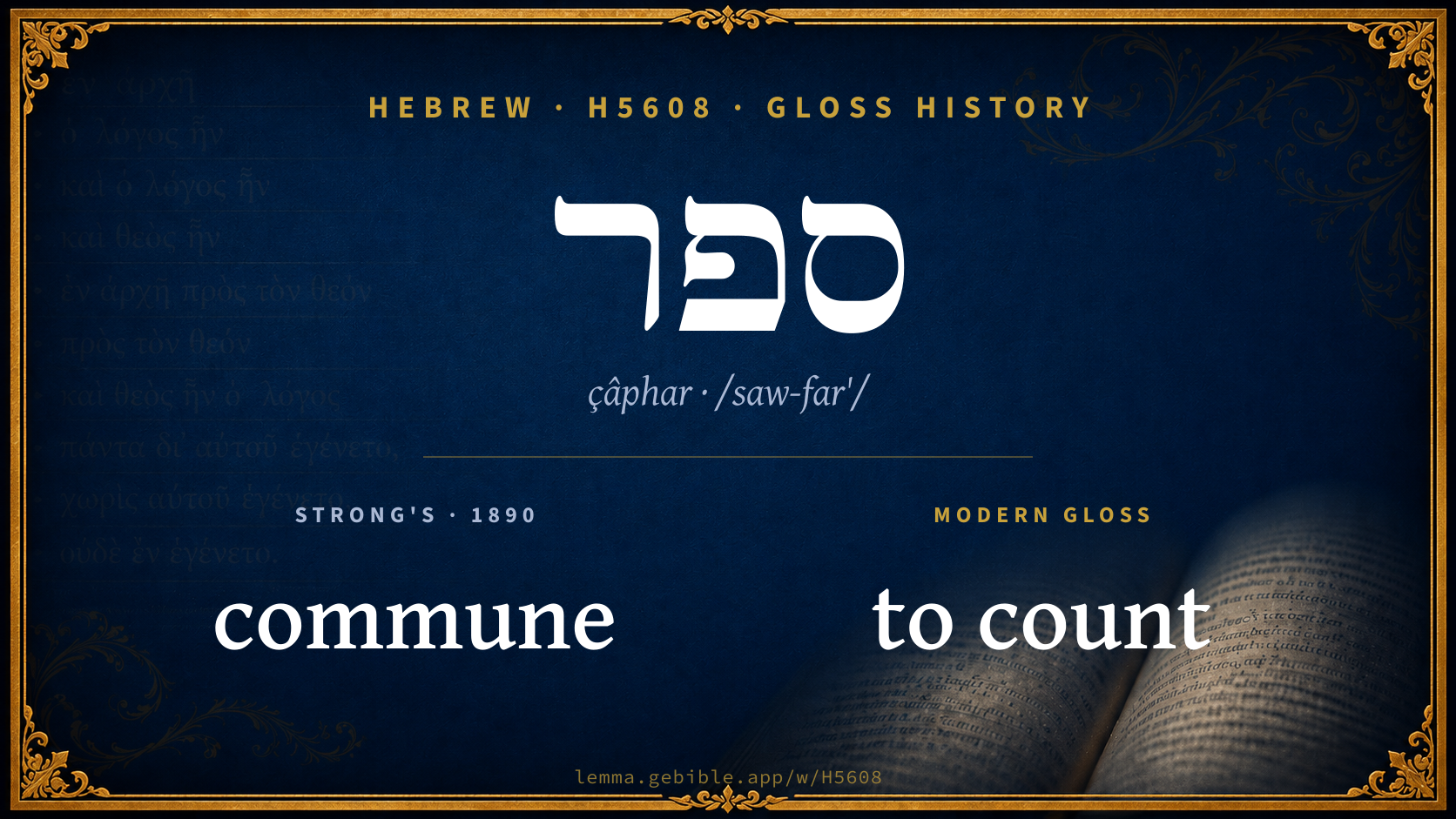
Gloss history
Strong's 1890 vs modern scholarship
About this word
Strong's H5608 catalogs a Hebrew word from the Hebrew Old Testament.
These counts are not copied from any lexicon or concordance. They are computed here, from the morphology-tagged Hebrew Old Testament. What Lemma adds →
- 154
- distinct verses
- The word appears in 154 distinct verses.
- 24 / 39
- OT books
- The word appears in 24 of 39 Old Testament books.
- #285
- by frequency
- Top 500 most frequent Hebrew words (rank 285 of 8,640 Hebrew words by occurrence).
View all 154 occurrences in the concordance →
By section of the Old Testament
By traditional corpus
Conventional, traditional groupings — biblical authorship is debated, so this is a traditional corpus grouping, not an authorship claim. Each share is this word’s portion of its verses in that division of the Hebrew canon. Each figure is a share of the word’s 154 distinct verses.
- Writings (Ketuvim) 75 verses · 49%
- Prophets (Nevi'im) 56 verses · 36%
- Torah (Pentateuch) 23 verses · 15%
How translations render this word
Counts come from each version’s own published word-to-Strong’s tagging or interlinear alignment — an approximate guide to how each version renders this word, not a word-level alignment the data otherwise carries. Because each total is that version’s own tagged count, the per-version totals vary from one another and need not match the appearance or distinct-verse counts above. These counts may also differ from a printed concordance because Lemma counts each distinctly tagged rendering and does not collapse phrase taggings into a single head-word total. This is a fixed set of word-tagged versions (KJV, ASV, BSB, ULT) and does not change with the reading translation you choose elsewhere. Each version’s license is shown beside its name below (and on Sources).
BDB lists this Strong’s number as 2 distinct words (homographs). Each count above pools all of them and is not split by sense — see the Senses section below. A low-frequency rendering may belong to a different one of those words, not the primary meaning.
- King James Version†: Scribe 38×, Told 12×, Declare 10×
- American Standard Version†: Scribe 37×, Told 7×, Declare 5×
- Berean Standard Bible†: Scribe 39×, Told 8×, Count 7×
- unfoldingWord Literal Text†: Scribe 29×, Recount 9×, And 7×
King James Version Public Domain
Renders H5608 across 160† tagged occurrences — most commonly:
Plus other, less common renderings. Plus 62 renderings that appear only once — usually multi-word phrases or single function words the recovered tagging swept in, not distinct renderings. Not rendered by a distinct English word in 1 further occurrence.
American Standard Version Public Domain
Renders H5608 across 158† tagged occurrences — most commonly:
Plus other, less common renderings. Plus 67 renderings that appear only once — usually multi-word phrases or single function words the recovered tagging swept in, not distinct renderings.
Berean Standard Bible Public Domain
Renders H5608 across 154† tagged occurrences — most commonly:
Plus other, less common renderings. Plus 69 renderings that appear only once — usually multi-word phrases or single function words the recovered tagging swept in, not distinct renderings. Not rendered by a distinct English word in 5 further occurrences.
unfoldingWord Literal Text CC BY-SA 4.0
Renders H5608 across 169† tagged occurrences — most commonly:
Plus other, less common renderings. Plus 66 renderings that appear only once — usually multi-word phrases or single function words the recovered tagging swept in, not distinct renderings.
15 senses and sub-senses in the full BDB
Hebrew verbs can shift meaning by stem (binyan): Qal is the basic action, Niphal is often passive or reflexive, Piel often intensifies or makes it factitive, and Hiphil is typically causative. The senses below are grouped under the stem BDB assigns to each. This entry also uses Pual (the passive of Piel).
What do BDB’s symbols mean?
BDB uses these scholarly abbreviations:
| Symbol | Meaning |
|---|---|
| 𝔊 | the Septuagint (the ancient Greek translation, LXX) |
| 𝔙 | the Vulgate (the Latin translation) |
| 𝔖 | the Syriac version (the Peshitta) |
| 𝔗 | the Targum (the Aramaic translation) |
| ψ | the Psalms |
| √ | root (the underlying root or stem) |
| ‖ | parallel passage (a synonymous or contrasted parallel) |
| † | the dagger: every passage where the word occurs is cited |
The 15 senses and sub-senses the full Brown-Driver-Briggs lexicon distinguishes for this word, in lexicon order (not ranked by frequency), with BDB’s own verbatim wording and sub-sense lettering. Shown in Hebrew script with BDB’s own scholarly abbreviations. The condensed entry is in the Lexicon Entry tab. See also the Forms in the corpus table below.
ספר I count, Pi. recount, relate (prob. ancient denom. from סֵפֶר
Qal
- Pf. 3 ms. ס׳ 2 S 24:10, 2 ms. סָפַרְתָּה ψ 56:9, וְסָפַרְתָּ֫ Lv 25:8, etc.; Impf. יִסְפֹּר ψ 87:6 + Jb 38:37 where read prob. יִסְפֹּר (Bu) for MT יְסַפֵּר, יְסְפּוֹר Jb 31:4, וַיִּסְפֹּר 2 Ch 2:1, 16, sf. וַיִּסְפְּרֵם Ezr 1:8; 2 ms. תִּסְפֹּר Jb 39:2, תִּסְפּוֹר 14:16, תִּסְפָּר־ Dt 16:9, etc.; Imv. ms. סְפֹר Gn 15:5; mpl. סִפְרוּ 1 Ch 21:2 ψ 48:13; Inf. cstr. לִסְפֹּר Gn 15:5 + 2 times; Pt. סֹפֵר Is 33:18(×2) (v. also סֹפֵר n. infr.);— e.g. 2 Samuel 24:10
- 1. count things, to learn their number, c. acc., Gn 15:5(×2) (J) 2 S 24:10 + 10 times (+ acc. cogn. 2 Ch 2:16); acc. om. Gn 41:49 (E); + ל (dat. comm. vel eth.), Lv 15:13, 28; 23:15; 25:8 (all PH), Dt 16:9; Ez 44:26; Ezr 1:8 ψ 87:6 Is 33:18 (abs.), v 18 (but text suspicious, conjj. in Du CheHpt). e.g. Genesis 15:5
- 2. number = take account of, carefully observe and consider, reckon: צְעָדַי תִּסְפּוֹר Jb 14:16 of my steps thou takest account, so 31:4; v. also 38:37 (cf. supr.); נֹדִי סָפַרְתָּה ψ 56:9 my wandering hast thou reckoned, taken into account (Che reads סִפַּרְתִּי after 𝔊). e.g. Job 14:16
Niphal
- Impf. 3 ms. יִסָּפֵר Ho 2:1 + 4 times; 3 mpl. יִסָּֽפְרוּ 1 K 8:5; 2 Ch 5:6, וַיִּסָּֽפְרוּ 1 Ch 23:3;— be counted, numbered, usually c. neg., to indicate multitude, לֹא יִסּ׳ מֵרֹב Gn 16:10 (J) it is not to be counted, for multitude, so 32:13 (J), 1 K 3:8 (‖ לֹא יִסָּנֶה), 8:5 (+ id.), 2 Ch 5:6 (+ id.); cf. Ho 2:1 (+ לֹא־יִמַּד), Je 33:22 (‖ לֹא יִמַּד); positively, only וַיִּסָּֽפְרוּ הַלְּוִיִּם 1 Ch 23:3. e.g. Hosea 2:1
Piel
- Pf. 1 s. סִפַּ֫רְתִּי ψ 119:26, סִפַּ֑רְתִּי v 13; 3 pl. סִפְּרוּ Ju 6:13 + 3 times; Impf. 3 ms. יְסַפֵּר Jb 38:37 +, 1 s. אֲסַפֵּר ψ 22:18 +; cohort. אֲסַפֵּ֑רָה Jb 15:17; 1 pl. וַנְּסַפֶּר־ Ex 10:2, etc.; Imv. סַפֵּר Is 43:26, etc.; Inf. cstr. (לְ)סַפֵּר ψ 50:16 + 5 times; Pt. מְסַפֵּר Ju 7:13; 2 K 8:5; pl. מְסַפְּרִים ψ 19:2; 78:4;—recount, rehearse, declare: e.g. Psalms 119:26
- 1. recount something (acc.), to (לְ pers.) Ju 6:13; 7:13; Gn 24:66 (J), 1 S 11:5 + 18 times (of rehearsing glorious deeds of י׳ ψ 44:2; 73:28; 78:3, 4; 79:13); c. acc. + בְּ loc. Ez 12:16, elsewhere of rehearsing name or praise of י׳ Ex 9:16 (J) ψ 9:15; 96:3 = 1 Ch 16:24, ψ 102:22 Je 51:10; c. acc. alone ψ 9:2; 19:2; 119:13 (+ בְּ instr.), 145:6 + 8 times ψψ + Is 43:21, all of rehearsing praise of י׳; cf. צְמוּ מִסַּפֵּר ψ 40:6 they are too great to rehearse, c. acc. also Je 23:28, 32; Jb 15:17; 28:27 ψ 119:26; acc. om. Is 43:26, c. לְ pers. Gn 40:8 (E) + 6 times, c. אֶל־ pers. Gn 37:10 (E), c. בְּאָזְנֵי Ex 10:2; c. בְּמוֹ (q.v.) ψ 73:15; c. אֶל־ concerning ψ 2:7, cf. 69:27 (𝔊 𝔖 Ew Ol Gr Bi Che Bae add; in that case read יֹסִ֑פּוּ); c. עַל־ concerning, + לְ pers. Jo 1:3. e.g. Judges 6:13
- 2. appar., in weakened sense, talk ψ 59:13, 64:6 (c. ל concerning), 73:15 (c. כְּמוֹ). e.g. Psalms 59:13
- 3. count exactly, accurately, אֲסַפֵּר כָּל־עַצְמוֹתָ֑י ψ 22:18 I can count exactly all my bones (in wasted body).—ψ 40:6 v. sub 1, Jb 38:37 read יִסְפִּר. e.g. Psalms 22:18
Pual
- be recounted, related, rehearsed: Pf. 3 ms. סֻפַּר לְ Is 52:15; Impf. 3 ms. יְסֻפַּר לְ Jb 37:20 (cl. as subj.), + לְ concerning ψ 22:31; c. בְּ loc. 88:12; abs. יְסֻפָּ֑ר Hb 1:5. e.g. Isaiah 52:15
ספר II
- 1.
- a. enumerator muster-cfier, in description of leaders of Isr. משְׁבִים בְּשֵׁבֶט ס׳ Ju 5:14. e.g. Judges 5:14
- b. king’s official = secretary 2 S 8:17 = 20:25 = 1 Ch 18:16; 2 K 18:18, 37 = Is 36:3, 22; Sol. has two 1 K 4:3 (in all these disting. from מַזְכִּיר); also 2 K 19:2 = Is 37:2; Je 36:10, 12, cf. לִשְׁכַּת הַסּ׳ v 12, 20, 21, בֵּית הַסּ׳ 37:15, 20; acting as treasurer and paymaster 2 K 12:11 = 2 Ch 24:11,—cf. Zadok Ne 13:13;—2 K 22:3, 8, 9, 10, 12 = 2 Ch 34:15, 18, 20; 1 Ch 24:6 (Levite); הַסּ׳ שַׂר הַצָּבָא 2 K 25:19 = Je 52:25 (si vera l. in K) implies military authority (but שַׂר הַצּ׳ perhaps gloss GFM Ju 5:14); Ew Sta al. read (as Je) scribe of general. e.g. 2 Samuel 8:17
- c. in Persia, secretaries who wrote out (king’s) decrees, according to Est 3:12; 8:9. e.g. Esther 3:12
- d. 2 Ch 26:11 uses ס׳ for muster-officer; 1 Ch 2:55 mentions families of סוֹפְרִים; 2 Ch 34:13 knows ס׳ as Levites; ס׳ 1 Ch 27:32 = man of learning. e.g. 2 Chronicles 26:11
- 2. professional class of learned men, ‘scribes,’ able to read and write Je 36:26, 32; with writing implements, עֵט ס׳ מָהִיר ψ 45:2, קֶסֶת הַסּ׳ Ez 9:2, 3, תַּעַר הַסּ׳ Je 36:23; especially learned in the law, and assuming to issue its precepts, עֵט שֶׁקֶר סֹפְרִים 8:8. e.g. Jeremiah 36:26
- 3. specif. of Ezra, at once priest (כֹּהֵן) and learned in the law (סֹפֵר), Ezr 7:11, ס׳ דִּבְרֵי מִצְוֹת י׳ v 11 [cf. Aramaic v 12, 21], ס׳ מָהִיר בְּתוֹרַת משֶׁה v 6; Ne 8:1, 4, 9, 13; 12:26, 36. e.g. Ezra 7:11
Senses from the full Brown-Driver-Briggs lexicon (Brown, Driver, Briggs; Oxford 1906 — public domain), digitized via Sefaria, supplemented by the OpenScriptures HebrewLexicon (CC BY 4.0). Full attribution on Sources.
Word origin
I. vb. count, Pi. recount, relate (prob. ancient denom. from סֵפֶר; NH = BH; Ethiopic ሰፈረ; measure Di404);—
I. n.m. ψ 45:2 enumerator, muster-officer, secretary, scribe (proposes pt. of סָפַר; Aramaic סַפְרָא, ܣܳܦܪܳܐ id., cf. ܣܦܺܝܪ doctus, literatus; Old Aramaic ספרא id., Lzb330 Cook85; Ph. ספר Lzb330);—abs. סֹפֵר Ju 5:14 +, סוֹפֵר 2 S 8:17 +; cstr. סֹפֵר 2 K 12:11 + 2 times, + Je 52:25 (Gie GFM read הַסּ׳ as ‖ 2 K 25:19); pl. סֹפְרִים 1 K 4:3; Je 8:8, סוֹ׳ 1 Ch 2:55; 2 Ch 34:13; cstr. סֹפְרֵי Est 3:12; 8:9;—
— Brown-Driver-Briggs (Oxford 1906, public domain), digitized via Sefaria, supplemented by the OpenScriptures HebrewLexicon (CC BY 4.0). See Sources.
Origin: a primitive root
Jastrow Dictionary
A second Hebrew/Aramaic lexicon for comparison, covering Aramaic and post-biblical (Talmudic, Targumic, Midrashic) usage that the biblical-Hebrew BDB does not. Matched by lemma rather than by Strong’s number, so a lemma may carry more than one Jastrow headword (shown separately below), and the entries cover usage well beyond the Bible.
סָפַר
- (b. h.) [to cut; to mark,]
- 1. to write; to count. Y. Kil. VII, end, 31ᵃ יִסְפּוֹר he (who is in possession of property bought from an oppressor, v. אַנָּס) must count (settle with the original owner according to rules, v. גוֹרְדְּיָינִי), opp. יחזיר he must return the property; ib. יִסְפֹּר (or יְסַפֵּר Pi.). Kidd. 30ᵃ שהיו סוֹפְרִים, v. סוֹפֵר. Nidd. 69ᵃ סוֹפַרְתָּן למנין וכ׳ she counts them in with the requisite number of seven days. Ib. 31ᵃ יושב וסוֹפֵר וכ׳ sits and records the copulations &c. Men. 65ᵇ, v. סְפִירָה; a. v. fr.—[Sifré Deut. 33 סופרה; read: סופנה, v. סָפַן.]—Part. pass. סָפוּר, q. v.
- 2. to cut, shear, v. infra.
- to be counted. Bekh. 45ᵃ שנִסְפֶּרֶת ע"ג היד when the additional finger is counted (is in a line) with the others; Yalk. Sam. 156.
- 1. to cut, shear. Sot. 49ᵇ, a. fr. מְסַפֵּר קומי, v. קוֹמִי I. Ib. התירו (לו)לסַפֵּר וכ׳ they allowed him to cut his hair in gentile fashion, because of his connections with royalty. Sifra Aḥăré, Par. 9, ch. XIII תִּסְפּוֹר, v. קוֹמִי I. Tosef. Bets. III, 19 אין מְסַפְּרִין הירק וכ׳ you must not no trim vegetables with the clipper (on the Holy Day) &c.; a. fr.
- 2. to tell, speak, count. Y. Kil. l. c., v. supra. Gen. R. s. 78 (ref. to אברם in place of אברהם, Neh. IX, 7) סיפור הוא מְסַפֵּר וכ׳ he states a historical fact, saying &c. Y. Ber. IX, beg. 12ᵈ אם בא אדם לסַפֵּר וכ׳ if one were to undertake to count the mighty deeds of the Lord, he would be ruined (ref. to Job XXXVII, 20); המספר בשבחו וכ׳ he who tells the praise of the Lord more than is becoming. Ib. מכאן … אסור לסַפֵּר וכ׳ beyond that (which has been adopted in ritual prayers) one must not tell &c. Arakh. 16ᵃ לעולם אל יְסַפֵּר אדם בטובתו וכ׳ man should not count up his neighbor’s good qualities, for he may be induced to speak of his shortcomings; B. Bath. 164ᵇ. Sot. 42ᵃ מְספְּרֵי לשון הרע gossipers. Snh. 38ᵇ בלשון ארמי סי׳ spoke Aramæan; a. v. fr.—Ib. 52ᵇ סי׳ הימנו if he (the scholar) holds conversation with him. e.g. Nehemiah 9:7
- to have one’s hair cut. Ab. Zar. II, 2 אין מִסְתַּפְּרִין מהן וכ׳ you must not have your hair cut by them in any place (on account of danger to life). Tosef. ib. III, 5 ישראל המִסְתַּפֵּר וכ׳ if an Israelite has his hair cut by a gentile, he must look into the mirror; Ab. Zar. 29ᵃ; a. fr.
סְפַר
- 1. to count, mark, write, v. סַפְרָא I. I.
- 2. to shear, v. infra.
- to cut, shear, shave. Targ. Job I, 20 (Ms. סְפַר Pe.). Targ. Y. Lev. XIII, 33 (not יַסְפֵּר); ib. XIV, 8, sq. (h. text גלח); a. fr.—Lev. R. s. 28, end יתיב ומְסַפֵּר ליה (Haman) sat down and cut his (Mordecai’s) hair; ib. מן דחסל (מן) מְסַפְּרָא ליה when he had done cutting his hair; a. fr.—Part. pass. מְסַפֵּר. Ib. אית בר נש … ולא מ׳ is there a man who putts the royal crown on his head without having his hair cut?; Esth. R. to VI, 10.
סַפָּר
- (preced. wds.)
- 1. (v. סֵפֶר) Bible teacher. Y. Maasr. III, 50ᵈ בית … טובלין לס׳ ולמַשְׁנֶה (not ולא למש׳) school houses for Bible and Talmud make fruits ṭebel for the Bible teacher and for the Talmud teacher. [Perh. to be read: סָפַר Chald. form.]
- 2. hair-cutter, barber. Sabb. I, 2 לא ישב אדם לפני הס׳ וכ׳ one must not sit down for the hair-cutter near Minḥah time beforesaying the prayer. Shebi. VIII, 5; a. e.—Pl. סַפָּרִים, סַפָּרִין. Kel. XIII, 1 זוג של ס׳ the barbers’ scissors. Sabb. 9ᵇ. v. מַעֲפוֹרֶת; a. e.
סַפָּר ²
- , hair-cutter. Targ. II Esth. VI, 12.—Lev. R. s. 28, end; Esth. R. to VI, 10. Lev. R. s. 14, end לית ס׳ דמספר לגרמיה no hair-cutter can cut his own hair (i.e. the female sperm begets the male embryo and vice versa); a. e.
סְפָר
- (סָפַר) [mark, march,] boundary, border district. Yeb. 48ᵇ עיר הסמוכה לס׳ a town near the boundary. Sot. 42ᵃ פעמים מדבר עמו אחת בס׳ וכ׳ the priest addressed the people twice, once on the border line (before entering the enemy’s land) and once before the battle. Tosef. Erub. IV (III), 5 באו … הסמוכות לס׳ if the enemy invades towns near the boundary (of Palestine); Y. ib. IV, 21ᵈ bot.; Bab. ib. 45ᵃ. Ib. ובבל כעיר הסמוכה לס׳ וכ׳ and Babylonia is (as regards the duty of defence) like a town near the boundary, which was interpreted to mean Neharde‘a. Num. R. s. 16 מה ראה לישב לו על הס׳ וכ׳ what reason had he (Amalek) to settle on the border, on the way of the entrance of the Israelites into the land?; a. e.—Pi. סְפָרִים, constr. סִפְרֵי. Y. Ḥall. II, 58ᵇ bot. ס׳ א"י Palestinian districts, ס׳ חוצה לארץ foreign districts (conquered by Israelites).
סְפַר ²
- constr. סְפַר, same; ס׳ יַמָּא sea-district. Targ. O. Gen. XLIX, 13 (h. text חֹף); a. fr.—Pl. סַפְרַיָּא, constr. סַפְרֵי. Targ. Y. ib.—[Targ. Y. Lev. XIII, 45 ספריא, some ed., v. סָפְדָּא.]
סָפֵר
- (preced. wds.) = סְפִירָה, counting. Naz. VII, 3 (54ᵃ) ימי סְפֵרוֹ (comment. סְפֵירוֹ; Y. ed. ספורו) the days which the cured leper has to count (Lev. XIV, 8); Y. ib. 56ᶜ bot. ספירו. e.g. Leviticus 14:8
סֵפֶר
- preced. wds.) letter, document, book. Erub. 15ᵇ; Gitt. 21ᵇ; Succ. 24ᵇ, v. סְפִירָה. Eduy. I, 12, a. fr. ס׳ כתובה the formula of a Kethubah. Y. Sot. IX, end, 24ᶜ משמת ר"א נגנז ס׳ החכמה with the death of R. El. a book of wisdom disappeared; Bab. Sot. 49ᵇ נגנז ס׳ תורה; Tosef. ib. XV, 3 בטל ס׳ תורה. Gen. R. s. 24 סִפְרוֹ של אה"ר the book of Adam (the destinies of humanity); Ex. R. s. 40; Lev. R. s. 15 beg.; a. fr.—Esp. a Biblical book. B. Bath. 15ᵃ ירמיה כתב ספרו וס׳ מלכים וכ׳ Jeremiah wrote his book (the prophecies of Jerem.) and the Book of Kings and the Lamentations. Ib. 14ᵇ משה כתב ספרו וכ׳ Moses wrote his own book, and the Section of Balaam (the chapters on B., Num. XXII, 2—XXIV, 25) and Job; Y. Sot. V, end, 20ᵈ; a. v. fr.—ס׳ תורה (abbrev. ס"ת) (or ס׳ only) the Pentateuch in a scroll. Ab. Zar. 18ᵃ כרכוהו בס"ת וכ׳ they wrapped him up in the scroll &c. Sabb. 116ᵃ ס"ת שנמחק a scroll of the Pentateuch the writing of which is effaced; Yad. III, 5 ס׳ שנמחק; a. v. fr.—Kel. XV, 6, a. e. ס׳ העזרה the Pentateuch kept in the Temple court, v. עֲזָרָה.—ס׳ הוא, ס׳ זעטוטים &c., v. respective determinants.—בֵּית סֵ׳, בֵּית הַסֵּ׳ the school in which the Bible is taught, secondary school, contrad. to בית תלמוד Talmud school. Y. Maasr. III, 50ᵈ, v. סַפָּר 1. Midr. Till. to XCII, 16 שתולים … אלו התינוקות שבבית הס׳ ‘planted in the house of the Lord’ (ib. 14), that means the children at school; a. fr.—Pl. סְפָרִים, constr. סִפְרֵי, סִיפְ׳. Ex. R. s. 41 זריז בכ"ד ס׳ well-versed in the twenty-four books of the Scripture. Sabb. 116ᵃ (ס׳ צדוקים) ס׳ מינים heretical books, v. מִין III. Snh. 68ᵃ שתי … כשני ס׳ תורה וכ׳ my two arms which are like two rolled up scrolls of the Torah, a. v. fr.—Ch. סִפְרָא, constr. סֵפֶר. e.g. Numbers 22:2
סָפַר ²
- = h. סוֹפֵר,
- 1. scribe, writer of documents; copyist. Targ. Jer. XXXVI, 20, sq.; a. fr.—Ab. Zar. 9ᵃ, v. בַּצִּירָא, Ib. 10ᵃ, v. דַּוְקָנָא. Ḥull. 64ᵇ, sq. פסיק להו ס׳ וכ׳ the copyist (of the Scriptures) divides them into two words. Y. Succ. II, 53ᵃ top סַפְרָה דגופתא the scribe of Gufta; a. fr.
- 2. scholar, teacher. Targ. Is. III, 2 (h. text נביא); ib. IX, 14. Targ. O. Gen. XLIX, 10 (h. text מחקק); a. fr.—Gen. R. s. 70, end אית ס׳ דלית וכ׳ is there a teacher that has no pupils?, i.e. I (Laban) learned trickery from you (Jacob).—Esp. Bible teacher. Y. Ḥag. I, 76ᶜ, a. e., v. מַתְנְיָין; a. fr.—ס׳ מתא, v. סוֹפֵר.—Pl. סַפְרַיָּא, סַפְרַיָּיא, סַפְרִין, סַפְרֵי. Targ. Y. I Gen. XLIX, 10. Targ. I Sam. X, 15 (h. text נביאים); a. fr.—Sot. IX, 5 (49ᵃ), v. חַכִּימָא. Midr. Till. to Ps. XCI, 6 מפקיד לס׳ וכ׳ ordered the school teachers to let the children go free (during the summer) from the fourth to the ninth hour of the day; Lam. R. to I, 3; Num. R. s. 12 לסַפְרַיָּה; a. fr.
A Dictionary of the Targumim, the Talmud Babli and Yerushalmi, and the Midrashic Literature (Marcus Jastrow; London, Luzac, 1903) — Public Domain. Digitized via Sefaria. Digitized via Sefaria. Full attribution on Sources.
Forms in the corpus
The 117 distinct written forms H5608 takes in the Hebrew Bible, most frequent first — each parse links to that stem’s occurrences in the concordance. Hebrew forms include their vowel points and cantillation, so a single lemma takes many written forms.
The 60 most common forms are shown; 57 rarer forms follow in the full concordance.
Same root — word family
Other BDB entries built from the same root as H5608, grouped by Strong’s listed origin. These share a root / origin per the lexicon — not necessarily a shared meaning. Each links to that word’s own entry.
Derived from this word
- מספר miçpâr H4557 number
- ספיר çappîyr H5601 sapphire
- ספר çᵉphar H5609 book
- ספר çᵉphâr H5610 census
- ספר çêpher H5612 book
- ספרה çᵉphôrâh H5615 number
Proper names from this root
People and places named from this root — a name, not an additional meaning of the word.
Compare all same-root words → Showing 4 of 8 — not the complete family. 1 of the same-root words is a proper name (a person or place). They share a root, not necessarily a meaning.
Septuagint verse parallels
This word appears in 133 verses that also exist in the Greek Old Testament (Septuagint), out of the 154 Hebrew verses it occurs in. You can read those verses in Greek by switching the Old Testament edition to the Septuagint.
Read these verses in the Septuagint
- Genesis 15:5
- Exodus 9:16
- Leviticus 15:13
- Numbers 13:27
- Deuteronomy 16:9
- Joshua 2:23
- Judges 5:14
- 1 Samuel 11:5
- 2 Samuel 8:17
- 1 Kings 3:8
- 2 Kings 8:4
- 1 Chronicles 2:55
This is a verse-level parallel only — the same verses exist in both the Hebrew and Greek Old Testaments. No word-level Hebrew↔Greek correspondence is claimed: the data carries no such alignment, so no Greek word is shown as this Hebrew word’s translation. Coverage is not total — the Septuagint omits the deuterocanon and renumbers the Psalms, so some Hebrew verses have no direct Greek parallel.