
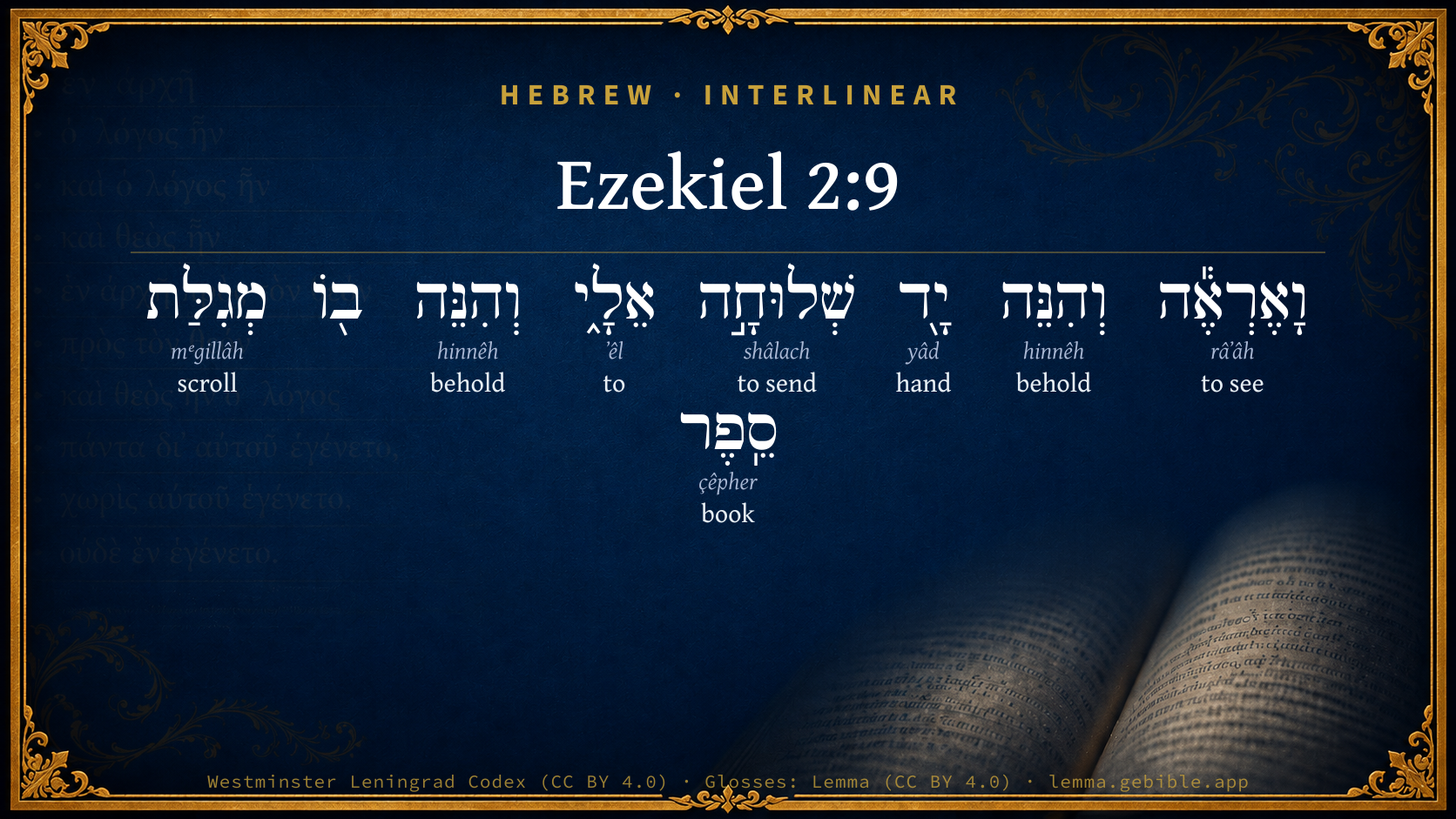
Ezekiel 2:9

Hebrew (Westminster Leningrad Codex) Ezekiel 2:9 appears in the Hebrew Old Testament. The text above is from the Westminster Leningrad Codex. Each word links to its Strong’s number, a concise gloss, and parsing drawn from the Open Scriptures Hebrew Bible morphology. Click any word for its full Brown-Driver-Briggs (BDB) entry.
Download image
Cite this verse

Ezekiel 2:9 (World English Bible). Public Domain. Lemma interlinear Bible study tool, https://lemma.gebible.app/v/ezekiel/2/9.

Show BibTeX & RIS
BibTeX
RIS
English Translation
When I looked, behold, a hand was put forth to me; and, behold, a scroll of a book was therein;
World English Bible · Public Domain
Download a study sheet

One document with this verse’s original text, its word-by-word gloss line, the meaning frame, cross-references with their text, attributed commentary, and full source and license credits — printable, and it pastes into notes with its structure intact.

This verse Autodidact and up

Study sheet (.html) Plain text (.txt)

A passage Seminary Student

Up to 50 verses in one chapter. A passage sheet keeps up to 6 commentary sources and 12 cross-references per verse, in the order this page ranks them, and says so on the sheet whenever that leaves anything out. Ask for a single verse and you get the Autodidact verse sheet above.

Everything on this page stays free to read, with no account — the sheet is a download of what is already on screen, not access to it.

Want to remove ads? Support Godless Engineer
Compare translations 3

The same verse in 3 English versions, stacked beneath the original-language interlinear above. Click any original word for its lexicon entry.

Each is an independent rendering of the whole verse — the interlinear is not word-aligned to these translations.

Highlighted words mark where these versions differ — a whole-verse word diff, not a word-by-word alignment.

  • World English Bible Public Domain
    When I looked, behold, a hand was put forth to me; and, behold, a scroll of a book was therein;
  • King James Version Public Domain
    And when I looked, behold, an hand was sent unto me; and, lo, a roll of a book was therein;
  • unfoldingWord Literal Text CC BY-SA 4.0
    Then I looked, and a hand was extended out to me; in it was a written scroll.

unfoldingWord Literal Text — © unfoldingWord, licensed CC BY-SA 4.0. Word-aligned USFM3 via Door43 (git.door43.org/unfoldingWord/en_ult).

Versions to compare (up to 4)

3 of 4 selected

Show all 18 translations

Every available English version of this verse, each an independent rendering of the whole verse.

  • World English Bible Public Domain
    When I looked, behold, a hand was put forth to me; and, behold, a scroll of a book was therein;
  • Berean Standard Bible Public Domain
    Then I looked and saw a hand reaching out to me, and in it was a scroll,
  • Majority Standard Bible Public Domain
    Then I looked and saw a hand reaching out to me, and in it was a scroll,
  • King James Version Public Domain
    And when I looked, behold, an hand was sent unto me; and, lo, a roll of a book was therein;
  • American Standard Version (1901) Public Domain
    And when I looked, behold, a hand was put forth unto me; and, lo, a roll of a book was therein;
  • Revised Version (1885) Public Domain
    And when I looked, behold, an hand was put forth unto me; and, lo, a roll of a book was therein;
  • Geneva Bible (1599) Public Domain
    And when I looked vp, beholde, an hande was sent vnto me, and loe, a roule of a booke was therein.
  • Douay-Rheims (1899) Public Domain
    And I looked, and behold, a hand was sent to me, wherein was a book rolled up: and he spread it before me, and it was written within and without: and there were written in it lamentations, and canticles, and woe.
  • Young's Literal Translation Public Domain
    And I look, and lo, a hand `is' sent forth unto me, and lo, in it a roll of a book,
  • Literal Standard Version CC BY-SA 4.0
    And I look, and behold, a hand [is] sent forth to me, and behold, a roll of a scroll [is] in it,
  • Unlocked Literal Bible CC BY-SA 4.0
    Then I looked, and a hand was extended out to me; in it was a written scroll.
  • unfoldingWord Literal Text CC BY-SA 4.0
    Then I looked, and a hand was extended out to me; in it was a written scroll.
  • Darby Bible Public Domain
    And I looked, and behold, a hand was put forth toward me; and behold, a roll of a book therein.
  • World Messianic Bible Public Domain
    When I looked, behold, a hand was stretched out to me; and behold, a scroll of a book was in it.
  • Webster's Bible Public Domain
    And when I looked, behold, a hand was sent to me; and lo, a roll of a book was in it;
  • Free Bible Version CC BY-SA 4.0
    I looked up and saw a hand stretched out to me holding a scroll.
  • Bible in Basic English Public Domain
    And looking, I saw a hand stretched out to me, and I saw the roll of a book in it;
  • JPS Tanakh (1917) Public Domain
    And when I looked, behold, a hand was put forth unto me; and, lo, a roll of a book was therein;

Literal Standard Version (2020), Covenant Press — licensed CC BY-SA 4.0. Text via the HelloAO Bible API (eBible.org). Unlocked Literal Bible (unfoldingWord) — licensed CC BY-SA 4.0. Text via the HelloAO Bible API (eBible.org). unfoldingWord Literal Text — © unfoldingWord, licensed CC BY-SA 4.0. Word-aligned USFM3 via Door43 (git.door43.org/unfoldingWord/en_ult). Free Bible Version, Dr. Jonathan Gallagher — licensed CC BY-SA 4.0. Text via the HelloAO Bible API (eBible.org).

Word by word

More ways to search: Search by grammar → Find every occurrence → Compare this word →

Practice this passage: Drill this verse → Learn its vocabulary →

About this verse

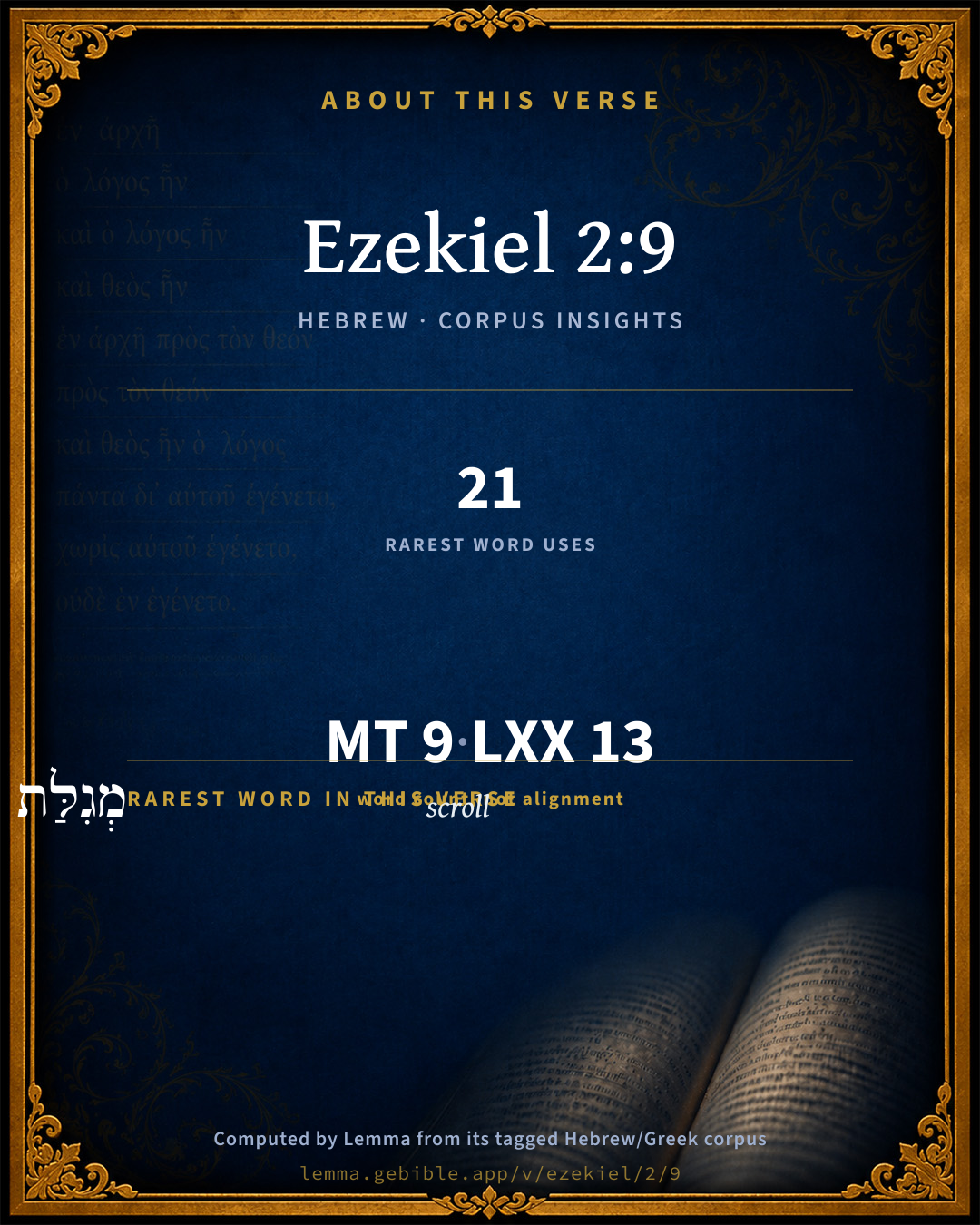
These counts appear in no published source. They are computed here, from the morphology-tagged text and Lemma’s own curated glosses. What Lemma adds →

9
words
7
distinct lemmas
Prophets
section

Notable vocabulary

The rarest word here is מְגִלַּת scroll H4039 — appearing just 21 times in the whole Hebrew Bible.

Shared distinctive vocabulary

מְגִלַּת scroll H4039 occurs in 19 verses of the Hebrew Bible. Also found in:

Grammatical profile

  • 2 verbs
  • 3 nouns
  • 2 prepositions
  • 2 particles

Verb forms

  • וָאֶרְאֶ֕ה Qal · Sequential Imperfect
  • שְׁלוּחָ֣ה Qal · Participle Passive

Repetition

A word recurs within this verse — often emphatic in Hebrew:

  • וְהִנֵּה behold H2009 ×2

Hebrew & Septuagint length

In English translation the verse runs 20 words from the Hebrew and 19 from the Septuagint (LXX English) — closely comparable.

A rough comparison of the two English renderings, which tokenize alike — not a word-level alignment.

Word counts can differ between the Hebrew and the Greek without any difference in meaning — e.g. the Hebrew direct-object marker אֵת has no separate Greek word, and Greek often adds the article ὁ.

In the original languages it is 9 Hebrew tokens and 13 Greek tokens — but the two are counted differently (Hebrew bundles its prefixes and suffixes into one token; the Greek is in lemma form), so that isn’t a like-for-like length.

Cross-references

10

Topical passages linked to Ezekiel 2:9 in the Treasury of Scripture Knowledge — connected by theme and wording, ordered by reader-vote popularity; previews shown in the World English Bible.

  • Ezekiel 8:3 He put forth the form of a hand, and took me by a lock of my head; and the Spirit lifted me up between earth and the sky, and brought me in the visions of God to Jerusalem, to the door of the gate of the inner [court] that looks toward the north; where was the seat of the image of jealousy, which provokes to jealousy.
  • Ezekiel 3:1 He said to me, Son of man, eat that which you find; eat this scroll, and go, speak to the house of Israel.
  • Daniel 10:10 Behold, a hand touched me, which set me on my knees and on the palms of my hands.
  • Revelation 5:1–5 I saw, in the right hand of him who sat on the throne, a book written inside and outside, sealed shut with seven seals.
  • Revelation 10:8–11 The voice which I heard from heaven, again speaking with me, said, "Go, take the book which is open in the hand of the angel who stands on the sea and on the land."
  • Jeremiah 1:9 Then Yahweh put forth his hand, and touched my mouth; and Yahweh said to me, Behold, I have put my words in your mouth:
  • Jeremiah 36:2 Take a scroll of a book, and write therein all the words that I have spoken to you against Israel, and against Judah, and against all the nations, from the day I spoke to you, from the days of Josiah, even to this day.
  • Daniel 5:5 In the same hour came forth the fingers of a man's hand, and wrote over against the lampstand on the plaster of the wall of the king's palace: and the king saw the part of the hand that wrote.
  • Daniel 10:16–18 Behold, one in the likeness of the sons of men touched my lips: then I opened my mouth, and spoke and said to him who stood before me, my lord, by reason of the vision my sorrows are turned on me, and I retain no strength.
  • Hebrews 10:7 Then I said, 'Behold, I have come (In the scroll of the book it is written of me) To do your will, God.'"

Cross-references courtesy of OpenBible.info (CC BY 4.0).

Hebrew and Greek witnesses Masoretic Hebrew ↔ Greek Septuagint

The same verse in the two great witnesses to the Old Testament, shown verse-for-verse.

These are two independent witnesses, not word-aligned to each other, and the Septuagint is shown in lemma (dictionary) form.

Hebrew Ezekiel 2:9 Masoretic · Westminster Leningrad Codex

וָאֶרְאֶ֕ה וְהִנֵּה יָ֖ד שְׁלוּחָ֣ה אֵלָ֑י וְהִנֵּה ב֖וֹ מְגִלַּת סֵֽפֶר

When I looked, behold, a hand was put forth to me; and, behold, a scroll of a book was therein;

World English Bible · Public Domain

Greek LXX Ezekiel 2:9 Septuagint · lemma form

καί ὁράω καί ἰδού χείρ ἐκτείνω πρός ἐγώ καί ἐν αὐτός κεφαλίς βιβλίον

And I looked, and behold, a hand stretched out to me, and in it a volume of a book.

LXX2012 (modern English Septuagint) · Public Domain

On this verse, Haydock's Catholic Bible Commentary discusses the Septuagint’s reading. Read the note in Commentary ↓

Hebrew: Westminster Leningrad Codex (CC BY 4.0). Greek: Septuagint (public domain); English from LXX2012 (modern English Septuagint) (Public Domain). How the Septuagint differs from the Hebrew →

Targum (Aramaic paraphrase)

1

The Targum is the ancient Jewish Aramaic paraphrase of the Hebrew Scriptures — an interpretive translation, not the Hebrew text itself. Onkelos (literal) and Pseudo-Jonathan (expansive) render the Torah, and Jonathan the Prophets. Coverage is partial: where no permissively-licensed English translation exists for a verse, only the Aramaic is shown. This is verse-level text, not a word-by-word alignment to the Hebrew.

  1. Targum Jonathan Prophets (Joshua–Malachi)
    וַחֲזֵית וְהָא דְמוּת יַד מִתּוֹשְׁטָא לְצַד לְוָתִי וְהָא בֵּיהּ מְגִלַת סַפְרָא:

    (no public-domain English translation for this verse)

    Targum Jonathan — Aramaic: “Mikraot Gedolot” (public domain). English: “Sefaria Community Translation” (CC0 1.0 (public-domain dedication)); “London "Chaldee Paraphrase," 1871” (public domain). Text via Sefaria.

Commentary

Notes on Ezekiel 2:9 from classic Christian and Jewish commentators (each source and its license shown beneath its notes). The classic Christian expositions comment on the surrounding passage and are grouped to its opening verse, so a note may address several verses; the Jewish commentaries on the Tanakh (Rashi and others) are per-verse, so they appear only where the commentator wrote on this verse.

Lemma curates 59 commentaries, every one of them public domain or Creative Commons licensed, each selected and text-cleaned for this edition rather than reprinted as found. About our sources →

Trapp's Complete Commentary

John Trapp

Eze 2:9 And when I looked, behold, an hand [was] sent unto me; and, lo, a roll of a book [was] therein;

Ver. 9. Behold, a hand was sent.] A hand from heaven. A hand is index rei et instrumentum operationis sign to the matter and the tool of working.

And, lo, a roll of a book.] {a} The Jews folded or rolled up their books upon a cedar stick, to preserve them from dust and other dangers. See on Isa 8:1.

{a} Palmoni bammidabber {Dan 10:1-21}

John Trapp, A Commentary or Exposition upon All the Books of the Old and New Testament (1647–1656) — public domain. Text from a community e-Sword module.

Joseph Benson's Commentary

Eze 2:9-10. Behold a hand was sent unto me — I saw a hand stretched out toward me, as from that divine person who appeared to me in the shape of a man. And lo, a roll of a book was therein — Wherein were contained the contents of the following prophecy. And he spread it before me — That I might understand the contents of it. And it was written within and without — The ancient books were rolled on cylinders of wood or ivory, and usually the writing was only on the inside; but this was written on both sides, both that which was innermost when it was rolled up, and on the outside also, which signified that the prophecy contained a long series of events. And there was written therein lamentations, and mourning, and wo — It contained predictions and revelations of impending calamities, and divers terrible judgments coming on the Jewish nation, and giving great cause for bitter sorrow and lamentation.

Joseph Benson's Commentary on the Old and New Testaments (1811–1818) — public domain. Text from a community e-Sword module.

Whedon's Commentary on the Bible

Daniel D. Whedon

IN SYMBOL AND BY DIRECT INSTRUCTION THE PREACHER IS TAUGHT THAT HE MUST NOT SPEAK HIS OWN WORDS, BUT JEHOVAH’S, Eze_2:9 to Eze_3:11.

9, 10. The roll which represented the prophecy Jehovah expected him to deliver was full and running over with lamentations, and mourning, and woe, written on both sides — a thing unusual in ancient papyri — and Ezekiel knew its contents, for it was spread out before him. God never deceives his messengers. He never coaxes them into his service by promises of an easy task. (Compare Mat_10:34-38.)

Daniel D. Whedon (gen. ed.), Commentary on the Old and New Testaments (1874–1909) — public domain. Text from a community e-Sword module.

Tyndale Open Study Notes

Tyndale Open Resources

2:9–3:1 There was so much judgment on the scroll that both sides were covered with writing. Ezekiel had to declare the curses for covenant breaking (Deut 28:15-68) to a rebellious people (cp. Zech 5:2-4). The scroll covered with messages of judgment is an apt image of the content of Ezek 1–24.

Tyndale Open Study Notes — © Tyndale Open Resources, licensed CC BY-SA 4.0. Text via the HelloAO Bible API.

Jamieson, Fausset & Brown

Robert Jamieson, A. R. Fausset & David Brown

roll--the form in which ancient books were made.

Jamieson, Fausset & Brown — Commentary Critical and Explanatory on the Whole Bible (1871) — public domain (CC PDM 1.0). Text via the HelloAO Bible API.

Adam Clarke's Commentary

Verse 9. A hand was sent] Here the hand signifies not only the instrument of conveyance, but an emblem of the Divine power, which the hand of God always signifies.

A roll of a book] מגלת שפר megillath sepher. All ancient books were written so as to be rolled up; hence volumen, a volume, from volvo, I roll.

Adam Clarke's Commentary on the Bible (1810–1826) — public domain. Text from a community e-Sword/MySword module.

John Calvin's Commentaries

Now the Prophet more fully explains what we have just dwelt upon. He narrates how a volume of a book was offered to him: that is, a book in the form of a roll was offered to him. For the noun which he uses, מגלת, megleth, comes from גלל, gelel, to roll, as the word volume among the Latins. For they were formerly accustomed to write on rolls, that is, they had not the form of books so compact and well arranged as we now use, but they had volumes, which barbarians call rolls. Ancient documents were written in this way, for there is nothing ancient in the archives of princes which is not written on rolls. Hence the phrase, “In the volume of the book it is written of me,” etc. (Psalm 40:8; Hebrews 10:7.) Now the Prophet says, such a volume was offered to me that I might eat it; and he adds, it was offered to me by a hand sent forth, But by this symbol God more clearly shows that the volume was not merely formed in the air, nor was produced anywhere but in heaven. For if the Prophet had only seen a volume presented to him, he might doubt whether it was sent by God or not. But when the hand which offers the volume appears, and is truly sent forth from God, nothing is wanting for full and complete certainty.

John Calvin's Commentaries (1540-1563) — public domain. Text from the Calvin Translation Society English edition (1840s-50s) via the Christian Classics Ethereal Library (ccel.org). Calvin's coverage is partial (roughly two-thirds of the Bible); uncommented books and verses are honest gaps, never fabricated. The 19th-century editor's footnotes and remarks are omitted so the notes are faithfully Calvin's own voice.

Ellicott's Commentary for English Readers

(9) Was sent unto me.—Better, was put forth, as the same word is translated in Gen_3:22; Gen_19:10; Eze_8:3. In Eze_10:7 it is rendered stretched forth, with the marginal sent forth, and the corresponding Chaldee word in Dan_5:24 is translated “sent.” It is not that a hand by itself containing the roll was sent to the prophet, but a hand, either of one of the cherubim,. or from the throne above, was stretched forth to him. In the corresponding vision in Rev_10:8-9, it is handed to the seer by the angel.

A roll of a book.—Books were anciently written upon skins sewed together, or upon papyrus in long strips, which were rolled up, one hand unrolling and the other rolling up from the other end as the contents were read. These were ordinarily written on one side only, as it would have been inconvenient to read the other; but in this case it was written on both sides,” within and without,” to denote the fullness of the message.

A Bible Commentary for English Readers, edited by Charles John Ellicott (1878–1897) — public domain. Text from a community e-Sword module.

John Gill's Exposition

And when I looked, behold, an hand was sent unto me,.... Not of an angel, but of Christ himself, in a visionary way; for this was not a real hand, but the likeness of one, as in Eze 8:3; and so the Targum here,

"and I saw, and behold, the likeness of a hand stretched out on the side to me.''

This symbol was to show that his prophecy, that he was sent to deliver, was from heaven and came from Christ; and that hand that delivered it to him would protect and defend him:

and, lo a roll of a book was therein; held in it, and held forth by it, to the prophet. Books were frequently written on parchment or vellum, and rolled about a stick, in form of a cylinder; and hence they were called volumes or rolls, Psa 40:7. This roll was a symbol of the prophecy of this book.

John Gill's Exposition of the Whole Bible (1746–1763) — public domain (CC PDM 1.0). Text via the HelloAO Bible API.

Albert Barnes' Notes on the Bible

Was sent - Rather, was put forth.

A roll of a book - The book was one of the ancient kind written on skins rolled up together. Hence, our English volume Psa 40:7. The writing was usually on one side, but in this case it was written within and without, on both sides, the writing as it were running over, to express the abundance of the calamities in store for the devoted people. To eat the book signifies to be thoroughly possessed with its contents (compare Eze 3:10; Jer 15:16). There should be no break between Eze 2:10 and Ezek. 3.

Albert Barnes' Notes on the Bible (1834–1885) — public domain. Text from a community e-Sword/MySword module.

Haydock's Catholic Bible Commentary

Without. This was only done when the work was long. (Calmet) --- Scriptus et in tergo, necdum finitus Orestes. (Juvenal 1.)

--- Septuagint, "past and present things were written in it." (Haydock) --- Woe, or the words of the penitent, of the blessed, and of the damned. (Worthington) --- The canticles were of a mournful nature, and the prophet had sorrows to announce. (Calmet)

George Leo Haydock (1774–1849), Haydock's Catholic Family Bible and Commentary, 1859 edition — public domain. Excludes Psalms (Douay-Rheims chapter numbering differs from Protestant) and Deuterocanonical books (Catholic canon only).

Matthew Poole's English Annotations

The prophet, newly come out of that astonishing trance wherein he lay, and gotten upon his feet, hearing what was spoken, and possibly looking if he might see who spake, he discovers a hand; either of one of those angels which ministered before the Lord, or the hand of God, or of Christ. This might fortify the prophet; when he saw a hand so soon with him as he was ready to hear and obey, power and skill to defend and guide him will ever be as ready.

Behold, an hand was sent unto me; an Eastern idiom of speech.

A roll of a book; their books were not of that fashion and make as ours now are, but written in parchment, and in the length of it, and so one piece fastened to other, till the whole would contain what was to be written, and then was it wrapped or rolled about a round piece of wood, fashioned for that purpose: hence books are called volumes.

Matthew Poole's English Annotations on the Holy Bible (1683–1685) — public domain. Text from a community e-Sword/MySword module.

The Pulpit Commentary

A hand was sent (put forth, Revised Version) unto me, etc. Apparently the hand was not that of the human form seated on the throne, (Eze_1:26) nor of one of the four living creatures, (Eze_1:8) but one appearing mysteriously by itself, as in the history of Belshazzar"s. (Dan_5:5) The words connect themselves with the use of the hand stretched out of a cloud as the symbols of the Divine energy both in Jewish and Christian art. The writer has in his possession a Jewish brass tablet, probably of the sixteenth century, commemorating the legend of the miraculous supply of oil at the Feast of the Dedication, in which such a hand appears as pouring oil into the seven-branched candlestick, or lamp, of the temple. Lo, a roll of a book, etc. The words remind us of the volume, or roll, in Psa_40:7; Jer_36:2; Zec_5:1; like those which are still used in Jewish synagogues.

The scroll.

It is certainly remarkable that, whilst the ministry of Ezekiel was to be fulfilled by word of mouth, the communication of its substance should be figuratively represented by the scroll roll of a book, written within and without." What the scroll was to the prophet, it may fairly be said, the volume of Holy Scripture is to us. Holy Writ is the record of successive revelations, and its form, as literature, answers very important purposes. Scripture is the standard of faith and doctrine and practice, to which the ministers of the gospel are bound to refer, according to the well known saying, "The Church to witness, the Scripture to prove." This strikingly symbolical passage suggests valuable truth regarding both the form and the substance of the inspired volume.

I THE FORM OF THE WRITTEN REVELATION. The fact is that we have the scroll, the volume, i.e. the mind of the holy and inspired men of old perpetuated in the written form. Certain advantages are by this means secured, which more than compensate for any disadvantages which may possibly be connected with the literary form which revelation assumes.

1. A written revelation, as compared with one merely oral, is deliberate. What men say in conversation, or under the stress of popular oratory, is not to be compared in this respect with what is carefully committed to a literary form. Speech is often intended merely to produce an immediate impression; what is written is probably intended to bear examination, to stand the test of reflection and of time.

2. Continuous. Fragmentary and disjointed utterances are all that can be expected from an ordinary speaker; and even a thoughtful and powerful speaker must usually, by the very conditions of his work, come short in the point of orderliness and continuity. The preparation of a book, and especially of a volume containing in many books the revelation of the Divine mind, involves a design, a plan, a connection and correspondence among the several parts which go to make up the whole.

3. Incorruptible. The untrustworthiness of tradition is proverbial. Wisdom is apparent in the arrangement by which the communication of God"s will to man has been placed beyond the corrupting influences to which every oral tradition is liable.

II THE SUBSTANCE OF THE WRITTEN REVELATION. The "roll of a book" delivered to Ezekiel may be presumed to have been the emblem of the communications which were to form the matter of his prophetic ministry. And although the writing is described as consisting of mourning and woe, this is probably only because such was the prevailing tenor of the earlier portions of his prophecies. We may say generally that the written revelation through Ezekiel is a summary of that which occupies the entire Bible. The scroll, accordingly, may be considered as:

1. Displaying the Divine interest in mankind.

2. Revealing Divine acquaintance with men"s sinful character theirwanderings from God, and the various errors and follies into which sin has ever led its victims.

3. Declaring God"s foresight of the miserable condition into which idolatry,apostasy, and every kind of moral evil and error must certainly plunge the rebellious. Nowhere is this more vividly displayed than in this book of prophecies.

4. Expressing the Divine solicitude for man"s welfare, and the Divineprovision for man"s recovery and salvation. In all these several particulars the Book of Ezekiel is a miniature of the Bible. The theme of the prophet, and the theme of Holy Writ as a whole, is surely nothing else than this the exhibition of man"s heinous sin, and the offer of God"s merciful salvation. T.

Ver. 9-ch. Mar_16:15) to "preach the Word", (2Ti_4:2) after the example of the apostles who, "when they had preached the Word of the Lord, returned to Jerusalem, and preached the gospel," etc.. (Act_8:25) "They ceased not to teach and preach Jesus Christ". (Act_5:42; and cf. 1Co_1:23; Eph_3:8; Col_1:27, Col_1:28)

II THE PROPHETIC MESSAGE IS BOTH LONG AND MOURNFUL. The roll was "written within and without: and there was written therein lamentations, and mourning, and woe." This roll is intended to represent the book of the prophet.

1. It was long. "Written within and without." Such was the extent and fulness of the revelation that the one side, which generally was alone used for writing on, was insufficient to contain it; both sides were required.

2. It was mournful. "There was written therein lamentations, and mourning, and woe." A correct description of many of the prophecies of this book. How mournful was the moral condition of the people as set forth by the prophet! How woeful the judgments which he proclaimed unto them! Very often the Word of the Lord by the prophets was in fact a heavy "burden". (cf. Isa_13:1 Isa_15:1 Isa_17:1 Isa_19:1; Nah_1:1; Hab_1:1; Zec_9:1 Zec_12:1; Mal_1:1) And the Word of the Lord to the rebellious and the hardened (such as the Israelites were) is still a stern word a word of condemnation and woe. The true prophet cannot prophesy smooth things to stiff-necked sinners. To such characters he must proclaim "the severity of God.

III THE PROPHETIC MESSAGE MUST BE WELL DIGESTED BY THE PROPHET. "Moreover he said unto me, Son of man, eat that thou fin, test; eat this roll," etc.. (Eze_3:1-3) The meaning of this is given in ch. 3:10, "Son of man, all my words that I shall speak unto thee receive in thine heart, and hear with thine ears." He must receive it, meditate upon it, appropriate it, make it a part of his being. "Here we have the right expression," says Umbreit on eating the roll, "to enable us to form a judgment and estimate of true inspiration. The Divine does not remain as a strange element in the man; it becomes his own feeling thoroughly, penetrates him entirely, just as food becomes a part of his bodily frame." There is need of a similar appropriation of the Word of God by Christian preachers today. That Word should be in them not only by intellectual apprehension, but by spiritual assimilation also. It should be not merely on their lips, but in their hearts. This will give the accent and power of conviction to their words when they publish it.

IV THE PROPHETIC MESSAGE WAS DELIGHTFUL UNTO THE PROPHET. "Then did I eat it; and it was in my mouth as honey for sweetness." "Thy words were found, and I did eat them," etc. (Jer_15:16) It seems strange that this roll of "lamentations, and mourning, and woe" should be sweet to Ezekiel. It was so probably:

1. Because it was the Word of the Lord. (cf. Psa_19:10 Psa_119:103)

2. Because of the honour conferred upon him in making him the agent of the Lord in hearing and speaking that Word. "It is infinitely sweet and lovely to be the organ and the spokesman of the Most High" (Hengstenberg).

3. Because even its severest portions were righteous. There was nothing that would clash with his sense of justice and truth. Says Calvin, "The sweet taste means Ezekiel"s approbation of God"s judgment and commands.

4. Because behind the severest judgments there was the grace of the Lord God. In the roll there were promises of mercy and restoration to the penitent. "Athwart the cloud," says Hengstenberg, "the rainbow gleams. Better to be condemned by God than comforted by the world. For he who smites can also heal, and will heal, if his proclamation of judgment, and the judgment itself, be met by penitence; while, on the other hand, the comfort of the world is vain." So the roll was in the prophet"s "mouth as honey for sweetness." Yet there were times when his stern message and his arduous mission were not sweet to him, and he "went in bitterness, in the heat of his spirit". (Eze_3:14; and cf. Rev_10:9, Rev_10:10) The work of the Christian preacher has its sweetness and bitterness; its high and holy joys, and its deep and heart-rending sorrows.

V THE PROPHETIC MESSAGE MUST BE FAITHFULLY DELIVERED. "Son of man, eat this roll, and go speak unto the house of Israel." Even despite the determined opposition of those to whom he is sent, he must discharge his mission with fidelity cf. Eze_3:4-11, the meaning of which is very similar to that of the paragraph, Eze_2:3-8, which has already engaged our attention. And it is required of the ministers of the gospel of Jesus Christ that they be faithful to the great trust which is committed to them. (1Co_4:1, 1Co_4:2; Eph_6:21; Col_1:7 Col_4:7; 2Ti_2:2) Blessed are they who in the review of their life can humbly declare, with St. Paul, that they have kept the glorious deposit which was entrusted to them. W.J. (cf. 1Ti_1:11; 2Ti_4:7)

The Pulpit Commentary (1880–1919), ed. H.D.M. Spence-Jones & Joseph S. Exell — public domain. Text from a community e-Sword module.

John Wesley's Explanatory Notes

Roll - Their books were not like ours, but written in parchment and in the length of it, and so one piece fastened to another, 'till the whole would contain what was to be written, and then it was wrapped or rolled about a round piece of wood, fashioned for that purpose.

John Wesley, Explanatory Notes Upon the Whole Bible (1754–1765) — public domain. Text via the GEBible commentary corpus.

unfoldingWord translationNotes

Door43 World Missions Community

a hand was extended out to me

It was as if 1) a person in the heavens had extended his hand out toward Ezekiel and all Ezekiel could see was from the hand to the elbow or shoulder or 2) the "one who looked like a man" (Ezekiel 1:26) extended his hand.

a written scroll

"a scroll that had writing on it"

He spread it out

The word "He" refers to the "one who looked like a man" (Ezekiel 1:26).

it had been written on both its front and back

This can be translated in active form. AT: "someone had written on both its front and its back" (See: Active or Passive)

written on it were lamentations, mourning, and woe

This can be restated to remove the abstract nouns "lamentations," "mourning," and "woe." AT: "someone had written on it that these people would lament, be sad the way they would be if someone they loved had died, and have bad things happen to them" (See: Abstract Nouns)

translationWords

scroll

lament

woe

unfoldingWord translationNotes — © Distant Shores Media and the Door43 World Missions Community, licensed CC BY-SA 4.0. Source: git.door43.org/Door43/en_tn.

Rashi

Rabbi Shlomo Yitzchaki (Rashi)

and behold, etc. Some things adopt both masculine and feminine gender, such as (Gen. 19:23): “The sun had risen (יָצָא) [msc.] over the earth, etc.”; (Mal. 3:20), “And for you who fear My name, shall the sun of mercy rise (וְזָרְחָה) [fem.]), etc.” [Likewise] (Gen. 32:9), “If Esau comes to the one camp (הָאַחַת) [fem.] and strikes it (וְהִכָּהוּ) [msc.].

Rashi on the Tanakh — English translations: “The Judaica Press complete Tanach with Rashi, translated by A. J. Rosenberg” (CC BY 4.0); “Pentateuch with Rashi's commentary by M. Rosenbaum and A.M. Silbermann, 1929-1934” (public domain); “The Metsudah Tanach series, Lakewood, N.J” (CC BY 4.0); and “The Book of Joshua, Metsudah Publications, 1997” (CC BY 4.0). Text via Sefaria.

Lesson kit

Teaching starters — assembled from the data on this page, not authored interpretation. Every prompt links to the verse data it draws on. Edit before teaching.

Ezekiel, in the Prophets, opens this verse with 9 words (7 distinct Hebrew lemmas). Its most distinctive word is mᵉgillâh (“scroll”). A historical commentator’s framing appears above. Read the whole chapter for the surrounding context.

Discussion questions

  1. The word mᵉgillâh carries the sense “scroll.” How does it shape the verse?
  2. Psalms 40:7 shares the word «scroll» with this verse. How do the two illuminate each other?
  3. “behold” occurs 2× in this one verse. What is the effect of the repetition?
  4. The translations on this page render this verse differently — a whole-verse word diff, not a word-by-word alignment. What might account for the different wordings?
  5. The verb «וָאֶרְאֶ֕ה» is Qal Sequential Imperfect. How does its form color the action?
  6. Reading how Trapp's Complete Commentary and Joseph Benson's Commentary read this verse, where do the two commentators agree and where do they part?

Things to notice

Reading settings

Reading text

Shown beneath each verse's original-language words.

Old Testament
Old Testament edition

Read the OT as the Masoretic Hebrew (MT) or the Greek Septuagint (LXX).

English shown for the Greek Septuagint (in the Hebrew ↔ Greek comparison).

Comparing translations? Open the Compare panel on any verse page to stack up to four side by side.