Jeremiah 36:11

Hebrew (Westminster Leningrad Codex) Jeremiah 36:11 appears in the Hebrew Old Testament. The text above is from the Westminster Leningrad Codex. Each word links to its Strong’s number, a concise gloss, and parsing drawn from the Open Scriptures Hebrew Bible morphology. Click any word for its full Brown-Driver-Briggs (BDB) entry.
Download image
Cite this verse

Jeremiah 36:11 (World English Bible). Public Domain. Lemma interlinear Bible study tool, https://lemma.gebible.app/v/jeremiah/36/11.

Show BibTeX & RIS
BibTeX
RIS
English Translation
When Micaiah the son of Gemariah, the son of Shaphan, had heard out of the book all the words of Yahweh,
World English Bible · Public Domain
Download a study sheet

One document with this verse’s original text, its word-by-word gloss line, the meaning frame, cross-references with their text, attributed commentary, and full source and license credits — printable, and it pastes into notes with its structure intact.

This verse Autodidact and up

Study sheet (.html) Plain text (.txt)

A passage Seminary Student

Up to 50 verses in one chapter. A passage sheet keeps up to 6 commentary sources and 12 cross-references per verse, in the order this page ranks them, and says so on the sheet whenever that leaves anything out. Ask for a single verse and you get the Autodidact verse sheet above.

Everything on this page stays free to read, with no account — the sheet is a download of what is already on screen, not access to it.

Want to remove ads? Support Godless Engineer
Compare translations 3

The same verse in 3 English versions, stacked beneath the original-language interlinear above. Click any original word for its lexicon entry.

Each is an independent rendering of the whole verse — the interlinear is not word-aligned to these translations.

Highlighted words mark where these versions differ — a whole-verse word diff, not a word-by-word alignment.

  • World English Bible Public Domain
    When Micaiah the son of Gemariah, the son of Shaphan, had heard out of the book all the words of Yahweh,
  • King James Version Public Domain
    When Michaiah the son of Gemariah, the son of Shaphan, had heard out of the book all the words of the LORD,
  • unfoldingWord Literal Text CC BY-SA 4.0
    Now Micaiah son of Gemariah son of Shaphan heard all of Yahweh’s words in the scroll.

unfoldingWord Literal Text — © unfoldingWord, licensed CC BY-SA 4.0. Word-aligned USFM3 via Door43 (git.door43.org/unfoldingWord/en_ult).

Versions to compare (up to 4)

3 of 4 selected

Show all 18 translations

Every available English version of this verse, each an independent rendering of the whole verse.

  • World English Bible Public Domain
    When Micaiah the son of Gemariah, the son of Shaphan, had heard out of the book all the words of Yahweh,
  • Berean Standard Bible Public Domain
    When Micaiah son of Gemariah, the son of Shaphan, heard all the words of the LORD from the scroll,
  • Majority Standard Bible Public Domain
    When Micaiah son of Gemariah, the son of Shaphan, heard all the words of the LORD from the scroll,
  • King James Version Public Domain
    When Michaiah the son of Gemariah, the son of Shaphan, had heard out of the book all the words of the LORD,
  • American Standard Version (1901) Public Domain
    And when Micaiah the son of Gemariah, the son of Shaphan, had heard out of the book all the words of Jehovah,
  • Revised Version (1885) Public Domain
    And when Micaiah the son of Gemariah, the son of Shaphan, had heard out of the book all the words of the LORD,
  • Geneva Bible (1599) Public Domain
    When Michaiah the sonne of Gemariah, the sonne of Shaphan had heard out of the booke all the wordes of the Lord,
  • Douay-Rheims (1899) Public Domain
    And when Micheas the son of Gamarias the son of Saphan had heard out of the book all the words of the Lord,
  • Young's Literal Translation Public Domain
    And Michaiah son of Gemariah, son of Shaphan, heareth all the words of Jehovah from off the book,
  • Literal Standard Version CC BY-SA 4.0
    And Michaiah son of Gemariah, son of Shaphan, hears all the words of YHWH from off the scroll,
  • Unlocked Literal Bible CC BY-SA 4.0
    Now Micaiah son of Gemariah son of Shaphan heard all of Yahweh's words in the scroll.
  • unfoldingWord Literal Text CC BY-SA 4.0
    Now Micaiah son of Gemariah son of Shaphan heard all of Yahweh’s words in the scroll.
  • Darby Bible Public Domain
    And Micah the son of Gemariah the son of Shaphan heard out of the book all the words of Jehovah;
  • World Messianic Bible Public Domain
    When Micaiah the son of Gemariah, the son of Shaphan, had heard out of the book all the LORD’s words,
  • Webster's Bible Public Domain
    When Michaiah the son of Gemariah, the son of Shaphan, had heard out of the book all the words of the LORD,
  • Free Bible Version CC BY-SA 4.0
    When Micaiah son of Gemariah, son of Shaphan, heard all the Lord's messages read from the scroll,
  • Bible in Basic English Public Domain
    And Micaiah, the son of Gemariah, the son of Shaphan, after hearing all the words of the Lord from the book,
  • JPS Tanakh (1917) Public Domain
    And when Micaiah the son of Gemariah, the son of Shaphan, had heard out of the book all the words of the LORD,

Literal Standard Version (2020), Covenant Press — licensed CC BY-SA 4.0. Text via the HelloAO Bible API (eBible.org). Unlocked Literal Bible (unfoldingWord) — licensed CC BY-SA 4.0. Text via the HelloAO Bible API (eBible.org). unfoldingWord Literal Text — © unfoldingWord, licensed CC BY-SA 4.0. Word-aligned USFM3 via Door43 (git.door43.org/unfoldingWord/en_ult). Free Bible Version, Dr. Jonathan Gallagher — licensed CC BY-SA 4.0. Text via the HelloAO Bible API (eBible.org).

Word by word

More ways to search: Search by grammar → Find every occurrence → Compare this word →

Practice this passage: Drill this verse → Learn its vocabulary →

גְּמַרְיָ֧הוּ
Gᵉmaryâh
H1587
“Gemariah”
Noun, Proper
Part of Speech
Noun
Type
Proper
Full BDB Definition

Origin: from H1584 and H3050

TWOT: None

Gemariah = "Jehovah has accomplished" - the son of Shaphan the scribe and father of Michaiah; one of the nobles of Judah who had a chamber in the temple from which Baruch read Jeremiah's alarming prophecy to all the people - the son of Hilkiah who bore Jeremiah's letter to the captive Jews
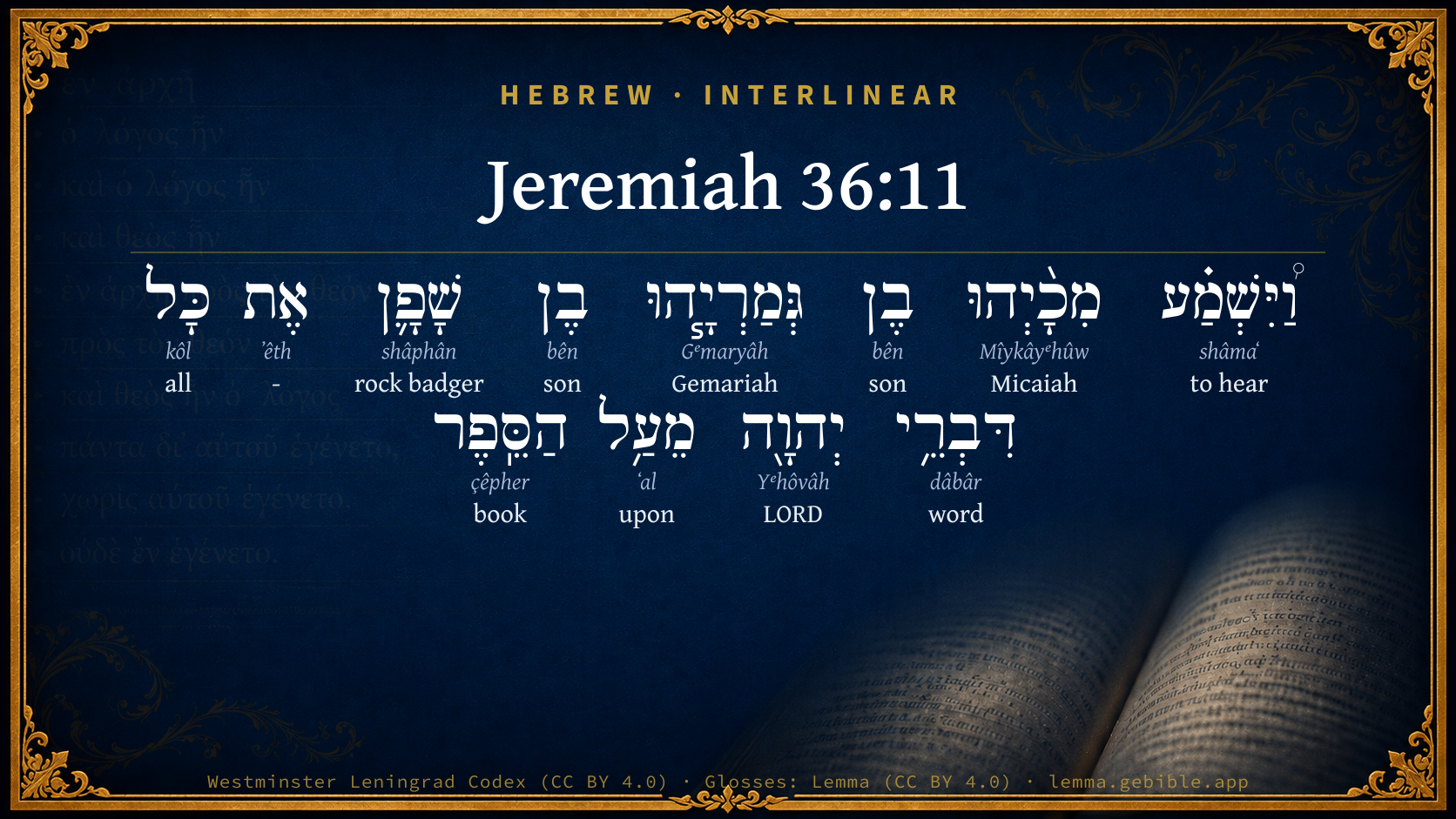
  1. וַ֠יִּשְׁמַ֗ע shâmaʻ H8085 “and · to hear” Conjunction + Verb, Qal, Sequential Imperfect, 3rd Person, Masculine, Singular
  2. מִכָ֨יְהוּ Mîykâyᵉhûw H4321 “Micaiah” Noun, Proper
  3. בֶן bên H1121 “son of” Noun, Common, Masculine, Singular, Construct
  4. בֶן bên H1121 “son of” Noun, Common, Masculine, Singular, Construct
  5. שָׁפָ֛ן shâphân H8227 “rock badger” Noun, Proper
  6. אֶת ʼêth H853 “-” Particle, Direct Object
  7. כָּל kôl H3605 “all of” Noun, Common, Masculine, Singular, Construct
  8. דִּבְרֵ֥י dâbâr H1697 “words of” Noun, Common, Masculine, Plural, Construct
  9. יְהוָ֖ה Yᵉhôvâh H3068 “LORD” Noun, Proper
  10. מֵעַ֥ל ʻal H5921 “from · upon” Preposition + Preposition
  11. הַסֵּֽפֶר çêpher H5612 “the · book” Particle, Definite Article + Noun, Common, Masculine, Singular, Absolute

About this verse

These counts appear in no published source. They are computed here, from the morphology-tagged text and Lemma’s own curated glosses. What Lemma adds →

12
words
11
distinct lemmas
Prophets
section

Notable vocabulary

The rarest word here is גְּמַרְיָ֧הוּ Gemariah H1587 — appearing just 5 times in the whole Hebrew Bible.

Shared distinctive vocabulary

גְּמַרְיָ֧הוּ Gemariah H1587 occurs in 5 verses of the Hebrew Bible. Also found in:

Grammatical profile

  • 1 verb
  • 9 nouns
  • 1 preposition
  • 1 particle

Verb forms

  • וַ֠יִּשְׁמַ֗ע Qal · Sequential Imperfect

Repetition

A word recurs within this verse — often emphatic in Hebrew:

Hebrew & Septuagint length

In the original languages it is 12 Hebrew tokens and 13 Greek tokens — but the two are counted differently (Hebrew bundles its prefixes and suffixes into one token; the Greek is in lemma form), so that isn’t a like-for-like length.

Cross-references

4

Topical passages linked to Jeremiah 36:11 in the Treasury of Scripture Knowledge — connected by theme and wording, ordered by reader-vote popularity; previews shown in the World English Bible.

  • 2 Kings 22:12–14 The king commanded Hilkiah the priest, and Ahikam the son of Shaphan, and Achbor the son of Micaiah, and Shaphan the scribe, and Asaiah the king's servant, saying,
  • 2 Kings 25:22 As for the people who were left in the land of Judah, whom Nebuchadnezzar king of Babylon had left, even over them he made Gedaliah the son of Ahikam, the son of Shaphan, governor.
  • 2 Chronicles 34:20 The king commanded Hilkiah, and Ahikam the son of Shaphan, and Abdon the son of Micah, and Shaphan the scribe, and Asaiah the king's servant, saying,
  • Jeremiah 36:10 Then read Baruch in the book the words of Jeremiah in the house of Yahweh, in the chamber of Gemariah the son of Shaphan, the scribe, in the upper court, at the entry of the new gate of Yahweh's house, in the ears of all the people.

Cross-references courtesy of OpenBible.info (CC BY 4.0).

Hebrew and Greek witnesses Masoretic Hebrew ↔ Greek Septuagint

The same verse in the two great witnesses to the Old Testament, shown verse-for-verse.

These are two independent witnesses, not word-aligned to each other, and the Septuagint is shown in lemma (dictionary) form.

Hebrew Jeremiah 36:11 Masoretic · Westminster Leningrad Codex

וַ֠יִּשְׁמַ֗ע מִכָ֨יְהוּ בֶן גְּמַרְיָ֧הוּ בֶן שָׁפָ֛ן אֶת כָּל דִּבְרֵ֥י יְהוָ֖ה מֵעַ֥ל הַסֵּֽפֶר

When Micaiah the son of Gemariah, the son of Shaphan, had heard out of the book all the words of Yahweh,

World English Bible · Public Domain

Greek LXX Structure differs

In the Septuagint, Jeremiah is about an eighth shorter than the Hebrew and arranges its material differently — the Oracles Against the Nations (Hebrew chapters 46–51) appear in the middle of the Greek book, after 25:13. Because the chapter and verse boundaries do not line up, a verse-for-verse comparison with the Hebrew is not shown.

A verse-for-verse comparison isn’t shown here because the chapters and verses don’t line up. Switch to the LXX edition with the MT / LXX toggle above to read the Greek directly.

Hebrew: Westminster Leningrad Codex (CC BY 4.0). Greek: Septuagint (public domain); English from a public-domain English Septuagint. How the Septuagint differs from the Hebrew →

Targum (Aramaic paraphrase)

1

The Targum is the ancient Jewish Aramaic paraphrase of the Hebrew Scriptures — an interpretive translation, not the Hebrew text itself. Onkelos (literal) and Pseudo-Jonathan (expansive) render the Torah, and Jonathan the Prophets. Coverage is partial: where no permissively-licensed English translation exists for a verse, only the Aramaic is shown. This is verse-level text, not a word-by-word alignment to the Hebrew.

  1. Targum Jonathan Prophets (Joshua–Malachi)
    וּשְׁמַע מִיכָיְהוּ בַּר גְמַרְיָה בַּר שָׁפָן יַת כָּל פִּתְגָמָא דַייָ מֵעַל סִפְרָא:

    (no public-domain English translation for this verse)

    Targum Jonathan — Aramaic: “Mikraot Gedolot” (public domain). English: “Sefaria Community Translation” (CC0 1.0 (public-domain dedication)); “London "Chaldee Paraphrase," 1871” (public domain). Text via Sefaria.

Commentary

Notes on Jeremiah 36:11 from classic Christian and Jewish commentators (each source and its license shown beneath its notes). The classic Christian expositions comment on the surrounding passage and are grouped to its opening verse, so a note may address several verses; the Jewish commentaries on the Tanakh (Rashi and others) are per-verse, so they appear only where the commentator wrote on this verse.

Lemma curates 59 commentaries, every one of them public domain or Creative Commons licensed, each selected and text-cleaned for this edition rather than reprinted as found. About our sources →

Trapp's Complete Commentary

John Trapp

Jer 36:11 When Michaiah the son of Gemariah, the son of Shaphan, had heard out of the book all the words of the LORD,

Ver. 11. When Micaiah the son of Gemariah had heard.] With what affection he heard the book read by Baruch is uncertain. We have many Herodian hearers before us a second time - such, I mean, as have a Herod’s heart toward the preacher, and little do we know who they are that sit before us; those precious balms we bring break their heads with a witness, and make the blood run about their ears.

John Trapp, A Commentary or Exposition upon All the Books of the Old and New Testament (1647–1656) — public domain. Text from a community e-Sword module.

Joseph Benson's Commentary

Jer 36:11-15. When Michaiah, the son of Shaphan, had heard, &c. — Shaphan’s family were all great men at court: see note on Jer 26:24; he went down into the king’s house, &c. — It is uncertain whether this Michaiah went to make this relation to the princes, who sat in the secretary’s chamber, as a piece of news only, or out of a malicious design to accuse the prophet and Baruch, as persons guilty of a seditious practice, in what they had done. Then Michaiah declared unto them all the words that he had heard — That is, the substance of all the words, &c.; for none can imagine that a hearer could remember every word. Therefore all the princes sent Jehudi, &c. — That is, all the princes who at that time sat there in council sent a messenger with a command to Baruch to appear before them, and to bring the roll which he had read in the ears of the people. And they said, Sit down now and read it. So Baruch read it — The courage of Baruch is admirable; he was now before the council, in the king’s house; the substance of the prophecies was, to threaten heavy judgments to the king, and court, and all the people; and the king, as appears by all history, was of a vindictive spirit, and a persecutor of God’s prophets; and yet Baruch is not afraid, but reads the prophecy in their ears.

Joseph Benson's Commentary on the Old and New Testaments (1811–1818) — public domain. Text from a community e-Sword module.

Tyndale Open Study Notes

Tyndale Open Resources

36:11-13 Micaiah realized the importance of the messages from the Lord that Baruch was reading, so he made sure that the administrative officials of the palace knew what was being said.

Tyndale Open Study Notes — © Tyndale Open Resources, licensed CC BY-SA 4.0. Text via the HelloAO Bible API.

Ellicott's Commentary for English Readers

(11) When Michaiah the son of Gemariah . . .—Gemariah himself was, as we find in the next verse, not one of the listeners, but took his place with the other princes, in the “scribe’s chamber,” probably used as a council-room, in the king’s palace. It seems obvious from Michaiah’s relation to him that his purpose in reporting Baruch’s discourse was not unfriendly. Probably it was part of a preconcerted plan, arranged between the prophet and his friends, that he should report it, and so give an opening for bringing Baruch into the presence of the king and his counsellors, as they sat in what we may call their council-chamber.

A Bible Commentary for English Readers, edited by Charles John Ellicott (1878–1897) — public domain. Text from a community e-Sword module.

The Cambridge Bible for Schools and Colleges

gen. ed. J. J. S. Perowne

11. when Micaiah … had heard] As it was in the chamber of Micaiah’s father that Baruch had been allowed to read the roll, Gemariah, engaged at the moment at a council of the princes in another room, would naturally be desirous of learning as soon as might be the particulars of what had occurred.

The Cambridge Bible for Schools and Colleges (gen. ed. J. J. S. Perowne; Cambridge University Press, 1878–1918) — public domain. Text from a community e-Sword module.

John Gill's Exposition

When Micaiah the son of Gemariah, the son of Shaphan,.... Who was present when Baruch read in the roll to the people in his father's chamber; but his father was absent, and was with the princes in the secretary's office at the same time, as Jer 36:12 shows: the son seems to be a more religious man than the father, unless he was placed as a spy, to hear and see what he could: however, when he

had heard out of the book all the words of the Lord: which were spoken by the Lord to Jeremiah, and which Baruch read out of the book he had written in his hearing; for it is a vain conceit of Abarbinel, that Micaiah did not hear these words from the mouth of Baruch reading, but out of the book which he looked into; for then it would have been said, which he had "seen" or "read" out of the book, and not "heard".

John Gill's Exposition of the Whole Bible (1746–1763) — public domain (CC PDM 1.0). Text via the HelloAO Bible API.

Albert Barnes' Notes on the Bible

Probably as his father had lent Jeremiah the hall, Michaiah had been commanded to bring Gemariah Jer 36:12 tidings, as soon as the reading was over, of the nature of the prophet’s words, and the effect produced by them upon the people.

Albert Barnes' Notes on the Bible (1834–1885) — public domain. Text from a community e-Sword/MySword module.

unfoldingWord translationNotes

Door43 World Missions Community

Now

Here the word "now" is used to draw attention to the important point that follows.

Micaiah son of Gemariah son of Shaphan

"Micaiah who was the son of Gemariah, who was the son of Shaphan"

Micaiah

This is a man's name. (See: How to Translate Names)

Look

"Pay attention to what I am going to say"

Elishama ... Delaiah

These are names of people. (See: How to Translate Names)

Shemaiah

See how you translated this in Jeremiah 26:20. (See: How to Translate Names)

Elnathan son of Akbor

See how you translated this in Jeremiah 26:22. (See: How to Translate Names)

Gemariah son of Shaphan

See how you translated this in Jeremiah 36:10. (See: How to Translate Names)

Zedekiah

See how you translated this in Jeremiah 1:3. (See: How to Translate Names)

Hananiah

See how you translated this in Jeremiah 28:1. (See: How to Translate Names)

all the officials

"all of the other officials"

translationWords

Yahweh

word

scroll

king

scribe

unfoldingWord translationNotes — © Distant Shores Media and the Door43 World Missions Community, licensed CC BY-SA 4.0. Source: git.door43.org/Door43/en_tn.

Lesson kit

Teaching starters — assembled from the data on this page, not authored interpretation. Every prompt links to the verse data it draws on. Edit before teaching.

Jeremiah, in the Prophets, opens this verse with 12 words (11 distinct Hebrew lemmas). Its most distinctive word is Gᵉmaryâh (“Gemariah”). A historical commentator’s framing appears above. Read the whole chapter for the surrounding context.

Discussion questions

  1. The word Gᵉmaryâh carries the sense “Gemariah.” How does it shape the verse?
  2. Jeremiah 29:3 shares the word «Gemariah» with this verse. How do the two illuminate each other?
  3. “son” occurs 2× in this one verse. What is the effect of the repetition?
  4. These translations render this verse differently; the difference is in the English rendering, not the original. What questions does that raise?
  5. The verb «וַ֠יִּשְׁמַ֗ע» is Qal Sequential Imperfect. How does its form color the action?
  6. Reading how Trapp's Complete Commentary and Joseph Benson's Commentary read this verse, where do the two commentators agree and where do they part?

Things to notice

Reading settings

Reading text

Shown beneath each verse's original-language words.

Old Testament
Old Testament edition

Read the OT as the Masoretic Hebrew (MT) or the Greek Septuagint (LXX).

English shown for the Greek Septuagint (in the Hebrew ↔ Greek comparison).

Comparing translations? Open the Compare panel on any verse page to stack up to four side by side.