
Isaiah 34:4

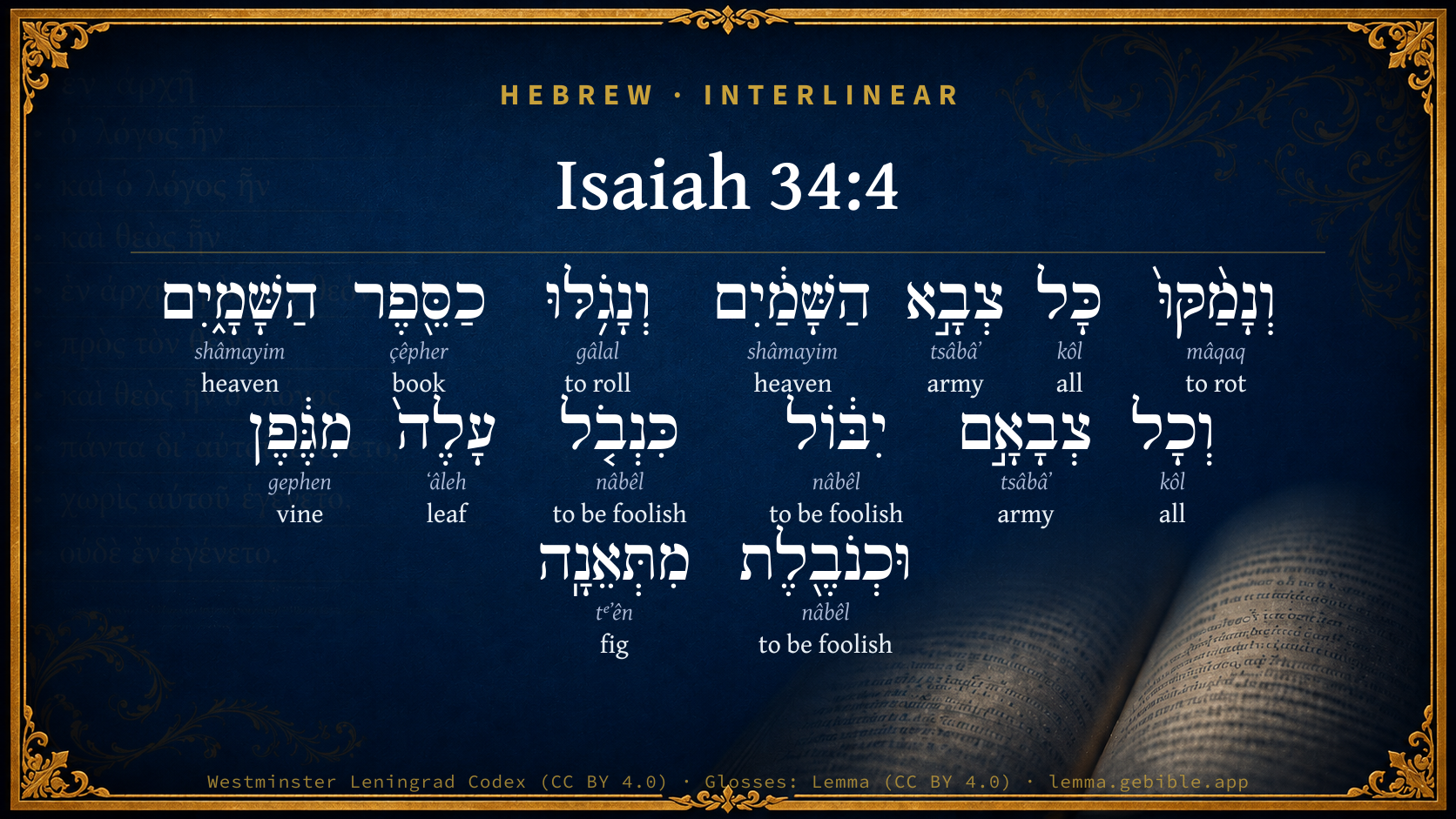
Hebrew (Westminster Leningrad Codex) Isaiah 34:4 appears in the Hebrew Old Testament. The text above is from the Westminster Leningrad Codex. Each word links to its Strong’s number, a concise gloss, and parsing drawn from the Open Scriptures Hebrew Bible morphology. Click any word for its full Brown-Driver-Briggs (BDB) entry.
Download image
Cite this verse

Isaiah 34:4 (World English Bible). Public Domain. Lemma interlinear Bible study tool, https://lemma.gebible.app/v/isaiah/34/4.

Show BibTeX & RIS
BibTeX
RIS
English Translation
All the host of the sky shall be dissolved, and the heavens shall be rolled together as a scroll; and all their host shall fade away, as the leaf fades from off the vine, and as a fading [leaf] from the fig tree.
World English Bible · Public Domain
Download a study sheet

One document with this verse’s original text, its word-by-word gloss line, the meaning frame, cross-references with their text, attributed commentary, and full source and license credits — printable, and it pastes into notes with its structure intact.

This verse Autodidact and up

Study sheet (.html) Plain text (.txt)

A passage Seminary Student

Up to 50 verses in one chapter. A passage sheet keeps up to 6 commentary sources and 12 cross-references per verse, in the order this page ranks them, and says so on the sheet whenever that leaves anything out. Ask for a single verse and you get the Autodidact verse sheet above.

Everything on this page stays free to read, with no account — the sheet is a download of what is already on screen, not access to it.

Want to remove ads? Support Godless Engineer
Compare translations 3

The same verse in 3 English versions, stacked beneath the original-language interlinear above. Click any original word for its lexicon entry.

Each is an independent rendering of the whole verse — the interlinear is not word-aligned to these translations.

Highlighted words mark where these versions differ — a whole-verse word diff, not a word-by-word alignment.

  • World English Bible Public Domain
    All the host of the sky shall be dissolved, and the heavens shall be rolled together as a scroll; and all their host shall fade away, as the leaf fades from off the vine, and as a fading [leaf] from the fig tree.
  • King James Version Public Domain
    And all the host of heaven shall be dissolved, and the heavens shall be rolled together as a scroll: and all their host shall fall down, as the leaf falleth off from the vine, and as a falling fig from the fig tree.
  • unfoldingWord Literal Text CC BY-SA 4.0
    And all of the army of the heavens will be dissolved, and the heavens will be rolled up like a scroll, and all of their army will wither as a leaf withers from a vine and like the withering from a fig tree. q1

unfoldingWord Literal Text — © unfoldingWord, licensed CC BY-SA 4.0. Word-aligned USFM3 via Door43 (git.door43.org/unfoldingWord/en_ult).

Versions to compare (up to 4)

3 of 4 selected

Show all 18 translations

Every available English version of this verse, each an independent rendering of the whole verse.

  • World English Bible Public Domain
    All the host of the sky shall be dissolved, and the heavens shall be rolled together as a scroll; and all their host shall fade away, as the leaf fades from off the vine, and as a fading [leaf] from the fig tree.
  • Berean Standard Bible Public Domain
    All the stars of heaven will be dissolved. The skies will be rolled up like a scroll, and all their stars will fall like withered leaves from the vine, like foliage from the fig tree.
  • Majority Standard Bible Public Domain
    All the stars of heaven will be dissolved. The skies will be rolled up like a scroll, and all their stars will fall like withered leaves from the vine, like foliage from the fig tree.
  • King James Version Public Domain
    And all the host of heaven shall be dissolved, and the heavens shall be rolled together as a scroll: and all their host shall fall down, as the leaf falleth off from the vine, and as a falling fig from the fig tree.
  • American Standard Version (1901) Public Domain
    And all the host of heaven shall be dissolved, and the heavens shall be rolled together as a scroll; and all their host shall fade away, as the leaf fadeth from off the vine, and as a fading `leaf' from the fig-tree.
  • Revised Version (1885) Public Domain
    And all the host of heaven shall be dissolved, and the heavens shall be rolled together as a scroll: and all their host shall fade away, as the leaf fadeth from off the vine, and as a fading leaf from the fig tree.
  • Geneva Bible (1599) Public Domain
    And all the hoste of heauen shalbe dissolued, and the heauens shall be folden like a booke: and all their hostes shall fall as the leafe falleth from the vine, and as it falleth from the figtree.
  • Douay-Rheims (1899) Public Domain
    And all the host of the heavens shall pine away, and the heavens shall be folded together as a book: and all their host shall fall down as the leaf falleth from the vine, and from the fig tree.
  • Young's Literal Translation Public Domain
    And consumed have been all the host of the heavens, And rolled together as a book have been the heavens, And all their hosts do fade, As the fading of a leaf of a vine, And as the fading one of a fig-tree.
  • Literal Standard Version CC BY-SA 4.0
    And all the host of the heavens have been consumed, || And the heavens have been rolled together as a scroll, || And all their hosts fade, || As the fading of a leaf of a vine, || And as the fading one of a fig tree.
  • Unlocked Literal Bible CC BY-SA 4.0
    All the stars of the sky will fade away, and the sky will be rolled up like a scroll; and all their stars will fade away, as the leaf fades from off the vine, and as the overripe figs from the fig tree.
  • unfoldingWord Literal Text CC BY-SA 4.0
    And all of the army of the heavens will be dissolved, and the heavens will be rolled up like a scroll, and all of their army will wither as a leaf withers from a vine and like the withering from a fig tree. q1
  • Darby Bible Public Domain
    And all the host of the heavens shall be dissolved, and the heavens shall be rolled together as a scroll; and all their host shall fade away, as a leaf fadeth from off the vine, and as the withered [fruit] from the fig-tree.
  • World Messianic Bible Public Domain
    All of the army of the sky will be dissolved. The sky will be rolled up like a scroll, and all its armies will fade away, as a leaf fades from off a vine or a fig tree.
  • Webster's Bible Public Domain
    And all the host of heaven shall be dissolved, and the heavens shall be rolled together as a scroll: and all their hosts shall fall down, as the leaf falleth from the vine, and as a falling fig from the fig-tree.
  • Free Bible Version CC BY-SA 4.0
    The sun, moon, and stars of heaven will fade away, and the skies will be rolled up like a scroll. All the stars will fall like dried-up leaves from a vine, like dried-up figs from a fig tree.
  • Bible in Basic English Public Domain
    And the heavens will be rolled together like the roll of a book: and all their army will be gone, like a dead leaf from the vine, or a dry fruit from the fig-tree.
  • JPS Tanakh (1917) Public Domain
    And all the host of heaven shall moulder away, and the heavens shall be rolled together as a scroll; and all their host shall fall down, as the leaf falleth off from the vine, and as a falling fig from the fig-tree.

Literal Standard Version (2020), Covenant Press — licensed CC BY-SA 4.0. Text via the HelloAO Bible API (eBible.org). Unlocked Literal Bible (unfoldingWord) — licensed CC BY-SA 4.0. Text via the HelloAO Bible API (eBible.org). unfoldingWord Literal Text — © unfoldingWord, licensed CC BY-SA 4.0. Word-aligned USFM3 via Door43 (git.door43.org/unfoldingWord/en_ult). Free Bible Version, Dr. Jonathan Gallagher — licensed CC BY-SA 4.0. Text via the HelloAO Bible API (eBible.org).

Word by word

More ways to search: Search by grammar → Find every occurrence → Compare this word →

Practice this passage: Drill this verse → Learn its vocabulary →

וְנָמַ֨קּוּ֙
mâqaq
H4743
“and · to rot”
Conjunction + Verb, Niphal, Sequential Perfect, 3rd Person, Common, Plural
Part of Speech
Conjunction + Verb
Stem
Niphal
Form
Sequential Perfect
Person
3rd Person
Gender
Common
Number
Plural
Full BDB Definition

Origin: a primitive root

TWOT: 1237

to decay, pine away, rot, fester - (Niphal) - to fester (of wounds) - to rot, rot away - to moulder away - to pine away - (Hiphil) to cause to rot
  1. כָּל kôl H3605 “all of” Noun, Common, Masculine, Singular, Construct
  2. צְבָ֣א tsâbâʼ H6635 “army of” Noun, Common, Both, Singular, Construct
  3. הַשָּׁמַ֔יִם shâmayim H8064 “the · heaven(s)” Particle, Definite Article + Noun, Common, Masculine, Plural, Absolute
  4. וְנָגֹ֥לּוּ gâlal H1556 “and · to roll” Conjunction + Verb, Niphal, Sequential Perfect, 3rd Person, Common, Plural
  5. כַסֵּ֖פֶר çêpher H5612 “like/as the · book” Preposition, Determined + Noun, Common, Masculine, Singular, Absolute
  6. הַשָּׁמָ֑יִם shâmayim H8064 “the · heaven(s)” Particle, Definite Article + Noun, Common, Masculine, Plural, Absolute
  7. וְכָל kôl H3605 “and · all of” Conjunction + Noun, Common, Masculine, Singular, Construct
  8. צְבָאָ֣ם tsâbâʼ H6635 “army · their” Noun, Common, Both, Singular, Construct + Suffix, Personal, 3rd Person, Masculine, Plural
  9. יִבּ֔וֹל nâbêl H5034 “to be foolish” Verb, Qal, Imperfect, 3rd Person, Masculine, Singular
  10. כִּנְבֹ֤ל nâbêl H5034 “like/as · to be foolish” Preposition + Verb, Qal, Infinitive Construct
  11. עָלֶה֙ ʻâleh H5929 “leaf” Noun, Common, Masculine, Singular, Absolute
  12. מִגֶּ֔פֶן gephen H1612 “from · vine” Preposition + Noun, Common, Both, Singular, Absolute
  13. וּכְנֹבֶ֖לֶת nâbêl H5034 “and · like/as · being foolish” Conjunction + Preposition + Verb, Qal, Participle Active, Feminine, Singular, Absolute
  14. מִתְּאֵנָֽה tᵉʼên H8384 “from · fig” Preposition + Noun, Common, Feminine, Singular, Absolute

About this verse

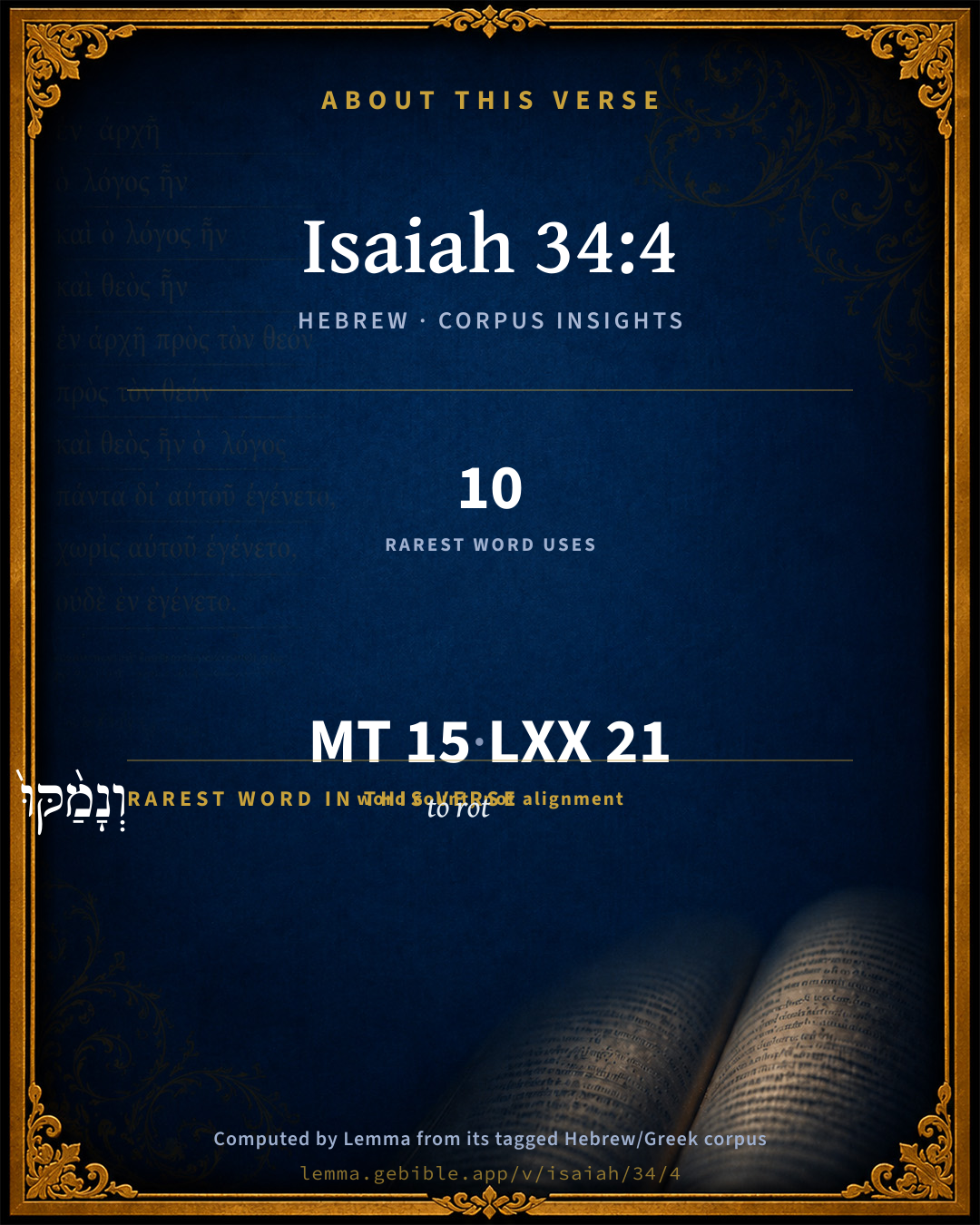
These counts appear in no published source. They are computed here, from the morphology-tagged text and Lemma’s own curated glosses. What Lemma adds →

15
words
10
distinct lemmas
Prophets
section

Notable vocabulary

The rarest word here is וְנָמַ֨קּוּ֙ to rot H4743 — appearing just 10 times in the whole Hebrew Bible.

Shared distinctive vocabulary

וְנָמַ֨קּוּ֙ to rot H4743 occurs in 7 verses of the Hebrew Bible. Also found in:

Grammatical profile

  • 5 verbs
  • 10 nouns

Verb forms

  • וְנָמַ֨קּוּ֙ Niphal · Sequential Perfect
  • וְנָגֹ֥לּוּ Niphal · Sequential Perfect
  • יִבּ֔וֹל Qal · Imperfect
  • כִּנְבֹ֤ל Qal · Infinitive Construct
  • וּכְנֹבֶ֖לֶת Qal · Participle Active

Repetition

Words recur within this verse — often emphatic in Hebrew:

  • יִבּ֔וֹל to be foolish H5034 ×3
  • כָּל all H3605 ×2
  • צְבָ֣א army H6635 ×2
  • הַשָּׁמַ֔יִם heaven H8064 ×2

Hebrew & Septuagint length

In English translation the verse runs 43 words from the Hebrew and 38 from the Septuagint (LXX English) — closely comparable.

A rough comparison of the two English renderings, which tokenize alike — not a word-level alignment.

Word counts can differ between the Hebrew and the Greek without any difference in meaning — e.g. the Hebrew direct-object marker אֵת has no separate Greek word, and Greek often adds the article ὁ.

In the original languages it is 15 Hebrew tokens and 21 Greek tokens — but the two are counted differently (Hebrew bundles its prefixes and suffixes into one token; the Greek is in lemma form), so that isn’t a like-for-like length.

Cross-references

15

Topical passages linked to Isaiah 34:4 in the Treasury of Scripture Knowledge — connected by theme and wording, ordered by reader-vote popularity; previews shown in the World English Bible.

  • Revelation 6:13–14 The stars of the sky fell to the earth, like a fig tree dropping its unripe figs when it is shaken by a great wind.
  • Matthew 24:29 But immediately after the oppression of those days, the sun will be darkened, the moon will not give its light, the stars will fall from the sky, and the powers of the heavens will be shaken;
  • Ezekiel 32:7–8 When I shall extinguish you, I will cover the heavens, and make the stars of it dark; I will cover the sun with a cloud, and the moon shall not give its light.
  • Joel 3:15 The sun and the moon are darkened, And the stars withdraw their shining."
  • Psalms 102:25–26 Of old, you laid the foundation of the earth. The heavens are the work of your hands.
  • Mark 13:24–25 But in those days, after that oppression, the sun will be darkened, the moon will not give its light,
  • 2 Peter 3:7–12 But the heavens that now are, and the earth, by the same word have been stored up for fire, being reserved against the day of judgment and destruction of ungodly men.
  • Jeremiah 4:23–24 I saw the earth, and, behold, it was waste and void; and the heavens, and they had no light.
  • Joel 2:30–31 I will show wonders in the heavens and in the earth: Blood, fire, and pillars of smoke.
  • Matthew 24:35 Heaven and earth will pass away, but my words will not pass away.
  • Revelation 8:12 The fourth angel sounded, and one third of the sun was struck, and one third of the moon, and one third of the stars; so that one third of them would be darkened, and the day wouldn't shine for one third of it, and the night in the same way.
  • Isaiah 13:10 For the stars of the sky and the constellations of it shall not give their light; the sun shall be darkened in its going forth, and the moon shall not cause its light to shine.
  • Acts 2:19–20 I will show wonders in the sky above, And signs on the earth beneath; Blood, and fire, and billows of smoke.
  • Revelation 20:11 I saw a great white throne, and him who sat on it, from whose face the earth and the heaven fled away. There was found no place for them.
  • Isaiah 13:13 Therefore I will make the heavens to tremble, and the earth shall be shaken out of its place, in the wrath of Yahweh of hosts, and in the day of his fierce anger.

Cross-references courtesy of OpenBible.info (CC BY 4.0).

Hebrew and Greek witnesses Masoretic Hebrew ↔ Greek Septuagint

The same verse in the two great witnesses to the Old Testament, shown verse-for-verse.

These are two independent witnesses, not word-aligned to each other, and the Septuagint is shown in lemma (dictionary) form.

Hebrew Isaiah 34:4 Masoretic · Westminster Leningrad Codex

וְנָמַ֨קּוּ֙ כָּל צְבָ֣א הַשָּׁמַ֔יִם וְנָגֹ֥לּוּ כַסֵּ֖פֶר הַשָּׁמָ֑יִם וְכָל צְבָאָ֣ם יִבּ֔וֹל כִּנְבֹ֤ל עָלֶה֙ מִגֶּ֔פֶן וּכְנֹבֶ֖לֶת מִתְּאֵנָֽה

All the host of the sky shall be dissolved, and the heavens shall be rolled together as a scroll; and all their host shall fade away, as the leaf fades from off the vine, and as a fading [leaf] from the fig tree.

World English Bible · Public Domain

Greek LXX Isaiah 34:4 Septuagint · lemma form

καί ἑλίσσω ὁ οὐρανός ὡς βιβλίον καί πᾶς ὁ ἄστρον πίπτω ὡς φύλλον ἐκ ἄμπελος καί ὡς πίπτω φύλλον ἀπό συκῆ

And all the powers of the heavens shall melt, and the sky shall be rolled up like a scroll: and all the stars shall fall like leaves from a vine, and as leaves fall from a fig tree.

LXX2012 (modern English Septuagint) · Public Domain

Hebrew: Westminster Leningrad Codex (CC BY 4.0). Greek: Septuagint (public domain); English from LXX2012 (modern English Septuagint) (Public Domain). How the Septuagint differs from the Hebrew →

Targum (Aramaic paraphrase)

1

The Targum is the ancient Jewish Aramaic paraphrase of the Hebrew Scriptures — an interpretive translation, not the Hebrew text itself. Onkelos (literal) and Pseudo-Jonathan (expansive) render the Torah, and Jonathan the Prophets. Coverage is partial: where no permissively-licensed English translation exists for a verse, only the Aramaic is shown. This is verse-level text, not a word-by-word alignment to the Hebrew.

  1. Targum Jonathan Prophets (Joshua–Malachi)
    וְיִתְיַמְסוּן כָּל חֵילֵי שְׁמַיָא וְיִתְמְחוּן מִתְּחוֹת שְׁמַיָא כְּמָא דַאֲמִיר עֲלֵיהוֹן בְּסִפְרָא וְכָל מַשִׁירְיָתְהוֹן יְסוּפוּן כְמִיתַר טְרַף מִגֶפֶן וּכְנִבְלָא מִתְּאֵנָה:

    And all the pleasant host of heaven shall be dissolved, and they shall be blotted out from beneath the heavens, as it is said concerning them in this book; and all their armies shall come to an end, as the fading leaf from the vine, and as the withering fig from the fig-tree.

    Targum Jonathan — Aramaic: “Mikraot Gedolot” (public domain). English: “Sefaria Community Translation” (CC0 1.0 (public-domain dedication)); “London "Chaldee Paraphrase," 1871” (public domain). Text via Sefaria.

Commentary

Notes on Isaiah 34:4 from classic Christian and Jewish commentators (each source and its license shown beneath its notes). The classic Christian expositions comment on the surrounding passage and are grouped to its opening verse, so a note may address several verses; the Jewish commentaries on the Tanakh (Rashi and others) are per-verse, so they appear only where the commentator wrote on this verse.

Lemma curates 59 commentaries, every one of them public domain or Creative Commons licensed, each selected and text-cleaned for this edition rather than reprinted as found. About our sources →

Trapp's Complete Commentary

John Trapp

Isa 34:4 And all the host of heaven shall be dissolved, and the heavens shall be rolled together as a scroll: and all their host shall fall down, as the leaf falleth off from the vine, and as a falling [fig] from the fig tree.

Ver. 4. And all the host of heaven shall be dissolved.] Inusitati supplicii atrocitas sic designatur. So great shall be the slaughter of the nations, that the heavenly bodies shall seem to be sensible of it, and amazed at it, and the whole heaven to be rolled together as a scroll, lest it should be forced to behold it. In a bloody fight between Amurath III, King of Turks, and Lazarus, Despot of Servia, many thousands fell on both sides; the Turkish histories, to express the terror of the day, vainly say that the angels in heaven, amazed with that hideous noise, for that time forgot the heavenly hymns wherewith they always glorify God.

John Trapp, A Commentary or Exposition upon All the Books of the Old and New Testament (1647–1656) — public domain. Text from a community e-Sword module.

Joseph Benson's Commentary

Isa 34:4. And all the host of heaven — The sun, moon, and stars; shall be dissolved — We have frequently had occasion to observe, that, in the prophetic language, the heavenly luminaries represent kings, empires, and states: see note on Isa 13:10. The prophet here foretels the overthrow and dissolution of such states and kingdoms as were hostile to his church, whether under the Jewish or Christian dispensation. Or, alluding to a horrid tempest raging furiously, during which the heavens grow black, the sun disappears, and the stars seem to fall to the earth, and it appears as if the whole body of the heavens were about to be utterly dissolved, he intends to signify, that, during these destructive judgments, of which he speaks, the confusion and consternation of mankind would be as great as if all the frame of the creation were broken into pieces. Some, indeed, understand the words as intended of the day of general and final judgment, but the context preceding and following will not agree with such an interpretation. And it is very usual for the prophetic writers, both of the Old and New Testaments, to represent great and general changes and calamities in such words and phrases as properly agree to the day of judgment, and the dissolution of all things: as, on the contrary, they often set forth the glorious deliverances of God’s people by such expressions as properly and literally belong to the resurrection from the dead.

Joseph Benson's Commentary on the Old and New Testaments (1811–1818) — public domain. Text from a community e-Sword module.

Tyndale Open Study Notes

Tyndale Open Resources

34:4 The heavens . . . stars: See also 13:10; Joel 2:30-31; Matt 24:29; Mark 13:24-25; 2 Pet 3:10-13; Rev 6:13-14.

Tyndale Open Study Notes — © Tyndale Open Resources, licensed CC BY-SA 4.0. Text via the HelloAO Bible API.

Geneva Bible (1599)

Geneva Bible translators

He speaketh this in respect of man’s judgment, who in great fear and horrible troubles, thinketh that heaven and earth perisheth.

Geneva Bible (1599) marginal notes — public domain. Text via Bolls.life.

Jamieson, Fausset & Brown

Robert Jamieson, A. R. Fausset & David Brown

(Psa 102:26; Joe 2:31; Joe 3:15; Mat 24:29).

dissolved-- (Pe2 3:10-12). Violent convulsions of nature are in Scripture made the images of great changes in the human world (Isa 24:19-21), and shall literally accompany them at the winding up of the present dispensation.

scroll--Books were in those days sheets of parchment rolled together (Rev 6:14).

fall down--The stars shall fall when the heavens in which they are fixed pass away.

fig tree-- (Rev 6:13).

Jamieson, Fausset & Brown — Commentary Critical and Explanatory on the Whole Bible (1871) — public domain (CC PDM 1.0). Text via the HelloAO Bible API.

Adam Clarke's Commentary

Verse 4. And all the host of heaven] See Clarke on Isa 24:21, and De Sacra Poesi Hebraeorum, Prael. ix.

Adam Clarke's Commentary on the Bible (1810–1826) — public domain. Text from a community e-Sword/MySword module.

Ellicott's Commentary for English Readers

(4) And all the host of heaven shall be dissolved . . .—No prophetic picture of a “day of the Lord” was complete without this symbolism (see Isa_13:10-11), probably written about this period. Like the psalmist (Psa_102:26), Isaiah contrasts the transitoriness of sun, moon, and stars, with the eternity of Jehovah. The Greek poets sing that the “life of the generations of men is as the life of the leaves of the trees” (Homer, Il. vi. 146). To Isaiah’s sublime thoughts there came the vision of a time when even the host of heaven would fall as “a leaf from the vine, and as a fig from the fig-tree.”

A Bible Commentary for English Readers, edited by Charles John Ellicott (1878–1897) — public domain. Text from a community e-Sword module.

The Cambridge Bible for Schools and Colleges

gen. ed. J. J. S. Perowne

4. The representation seems somewhat confused. Bickell acutely observes that “the host of heaven” is probably a marginal gloss to “their host” later in the verse, and that the original subject of the first clause (“the hills”) has been displaced by it. The first line then supplies the parallel to the last line of Isa_34:3 :—

“And the mountains shall melt with their blood

(4.) And all [the hills] shall be dissolved.”

and the heavens … as a scrole] Cf. ch. Isa_51:6; Psa_102:26; Mat_24:29; Rev_6:13-14.

fall dawn … falleth off from … fallen fig] R.V. fade away … fadeth from off … fading leaf.

The Cambridge Bible for Schools and Colleges (gen. ed. J. J. S. Perowne; Cambridge University Press, 1878–1918) — public domain. Text from a community e-Sword module.

John Gill's Exposition

And all the hosts of heaven shall be dissolved,.... "Pine away" (i), as with sickness, grow languid, become obscure, lose their light, and be turned into blood and darkness; this figure is used to express the horror of this calamity, as if the very heavens themselves, and the sun, and moon, and stars, were affected with it; see Isa 13:10.

and the heavens shall be rolled gether as a scroll; a book, or volume, which when rolled up, one letter of it could not be read; and it was the manner formerly of making and writing books in the form of a roll; hence the word volume; and here it signifies that there should be such a change in the heavens, as that not a star should be seen, much less the sun or moon; and may signify the utter removal and abolition of all dignities and offices, supreme and subordinate, civil and ecclesiastical, in the whole Roman jurisdiction; thus the destruction of Rome Pagan is described in Rev 6:14 as the destruction of Rome Papal is here; from whence the language seems to be borrowed:

and all their host shall fall down, as the leaf falleth off from the vine, and as a falling fig from the fig tree; that is, the stars should fall down: by whom may be meant persons in office, that made a considerable figure; who shall fall from their stations, in which they shone with much splendour and grandeur, as leaves fall from trees in autumn, particularly the vine; or as unripe and rotten figs fall from the fig tree when shaken by a violent wind; the same metaphor is used in Rev 6:13.

(i) "tabescet", Vatablus; "centabescet", Junius & Tremellius, Piscator; "contabescent", Cocceius, Gataker.

John Gill's Exposition of the Whole Bible (1746–1763) — public domain (CC PDM 1.0). Text via the HelloAO Bible API.

Albert Barnes' Notes on the Bible

And all the host of heaven - On the word ‘host’ (צבא tsâbâ'), see the note at Isa 1:9. The heavenly bodies often represent kings and princes (compare the note at Isa 24:21).

Shall be dissolved - (ינמקוּ venâmaqqû. This figure Vitringa supposes to be taken from the common prejudice by which the stars appear to be crystals, or gems, set in the azure vault of heaven, which may melt and flow down by the application of heat. The sense is, that the princes and nobles who had opposed God and his people would be destroyed, as if the sparkling stars, like gems, should melt in the heavens, and flow down to the earth.

And the heavens shall be rolled together as a scroll - The word ‘scroll’ here (ספר sêpher) means a roll, or a book. Books were made of parchment, leaves, etc., and were rolled together instead of being bound, as they are with us. The figure here is taken from what strikes the eye, that the heaven above us is “an expanse” (רקיע râqı̂ya‛) Gen 1:8; Psa 104:2,) which is spread out; and which might be rolled together, and thus pass away. It is possible that there may be a reference also to the fact, that in a storm, when the sky is filled with dark rolling clouds, the heavens seem to be rolled together, and to be passing away. The sense is, that there would be great destruction among those high in office and in power - a destruction that would be well represented by the rolling up of the firmament, and the destruction of the visible heavens and their host, and by leaving the world to ruin and to night.

And all their host shall fall down - That is, their stars; either by being as it were melted, or by the fact that the expanse in which they are apparently located would be rolled up and removed, and there being no fixtures for them they would fall. The same image occurs in Rev 6:13. One somewhat similar occurs in Virgil, Georg. i. 365ff.

As the leaf falleth off from the vine ... - That is, in a storm, or when violently shaken.

Albert Barnes' Notes on the Bible (1834–1885) — public domain. Text from a community e-Sword/MySword module.

Haydock's Catholic Bible Commentary

Away. These strong expressions denote great misery, chap. xiii., and Joel ii. 10., and Ezechiel xxxii. 27. (Calmet) --- Book. Hebrew, "roll." (Haydock) --- Some thence foolishly inferred that the destiny of every one might be read in the heavens. (Huet.; Eusebius, præp. vi. 11.; Philoo. xxiii.; Pic. Astrol. viii. 5.) --- The prophet only means that the heavens shall be devoid of beauty, (Calmet) and covered with darkness. (Haydock)

George Leo Haydock (1774–1849), Haydock's Catholic Family Bible and Commentary, 1859 edition — public domain. Excludes Psalms (Douay-Rheims chapter numbering differs from Protestant) and Deuterocanonical books (Catholic canon only).

Matthew Poole's English Annotations

All the host of heaven; the sun, and moon, and stars. which frequently come under this name in Scripture, as Deu 4:19; 17:3, and elsewhere.

Shall be dissolved; shall seem to be dissolved. So great shall be the confusion and consternation of mankind, as if all the frame of the creation were broken into pieces. Some understand this of the general judgment; which some passages here following will not permit. But it is a very usual thing for prophetical writers, both in the Old and New Testament, to represent great and general calamities in such words and phrases as properly agree to the day of judgment; as, on the contrary, the glorious deliverances of God’s people are set forth in such expressions as properly agree to the resurrection from the dead. See Eze 37:7; Joe 2:31; 3:15; Rev 6:12,13.

The heavens shall be rolled together as a scroll, Heb. as a book; for books were then written in scrolls, which they usually rolled up together; and when they were so, no man could read any word in it; and no more shall any man be able to see those goodly lights of heaven, for they shall all be obscured and confounded. This phrase is used also Isa 8:1; Rev 6:14.

As the leaf that falleth off from the vine, when it is withered.

As a falling fig; which falleth, either through great maturity, or being thrust out by green figs coming forth, or by any other accident.

Matthew Poole's English Annotations on the Holy Bible (1683–1685) — public domain. Text from a community e-Sword/MySword module.

Whedon's Commentary on the Bible

Daniel D. Whedon

4. The language here relates to the last things in the wicked human world. It is not symbolic, for symbol relates to an idea; it is not typical, for type relates to an antitype in persons or things; it is simply poetical, intended to indicate terrific revolution; sudden, total, appalling change. In the same way is the reference 2Pe_3:10-12, to be understood. Also, Rev_6:14. The dissolving of the stars of heaven may come from the idea of their burning out like a lamp wick, and all becoming suddenly dark. The rolling up of the expanse of the heavens is easily conceived from the scroll, or ancient book, (like our map,) being rolled up and removed out of sight.

Daniel D. Whedon (gen. ed.), Commentary on the Old and New Testaments (1874–1909) — public domain. Text from a community e-Sword module.

The Pulpit Commentary

All the host of heaven shall be dissolved. A dissolution of the material frame of the heavens, in which the moon and stars are regarded as set, seems to be intended. (comp. Mat_24:29 2Pe_3:10) The slaughter of God"s enemies is here connected with the cud of the world, as in the Book of Revelation. (Rev_19:11-21) The heavens shall be rolled together as a scroll; literally, as a book. Ancient books were written on long strips of paper or parchment, which, when unrolled, extended to many yards in length, but which might be rolled together "by means of one or two smooth round sticks into a very small compass." Such a rolling together of the widely extended heavens is here intended, not a shriveling by means of heat. (comp. Rev_6:14) All their host shall fall. (comp. Mat_24:29, "The stars shall fall from heaven

The Pulpit Commentary (1880–1919), ed. H.D.M. Spence-Jones & Joseph S. Exell — public domain. Text from a community e-Sword module.

John Wesley's Explanatory Notes

Dissolved - The sun, moon, and stars. So great shall be the confusion and consternation of mankind, as if all the frame of the creation were broken into pieces. It is usual for prophetic writers, both in the Old and New Testament, to represent great and general calamities, in such words and phrases, as properly agree to the day of judgment; as on the contrary, the glorious deliverances of God's people, in such expressions, as properly agree to the resurrection from the dead.

John Wesley, Explanatory Notes Upon the Whole Bible (1754–1765) — public domain. Text via the GEBible commentary corpus.

Keil & Delitzsch

C. F. Keil & F. Delitzsch

The judgment foretold by Isaiah also belongs to the last things; for it takes place in connection with the simultaneous destruction of the present heaven and the present earth."And all the host of the heavens moulder away, and the heavens are rolled up like a scroll, and all their host withers as a leaf withers away from the vine, and like withered leaves from the fig-tree" (Nâmaq, to be dissolved into powdered mother (Isa 3:24; Isa 5:24); nâgōl (for nâgal, like nâzōl in Isa 63:19; Isa 64:2, and nârōts in Ecc 12:6), to be rolled up - a term applied to the cylindrical book-scroll. The heaven, that is to say, the present system of the universe, breaks up into atoms, and is rolled up like a book that has been read through; and the stars fall down as a withered leaf falls from a vine, when it is moved by even the lightest breeze, or like the withered leaves shaken from the fig-tree. The expressions are so strong, that they cannot be understood in any other sense than as relating to the end of the world (Isa 65:17; Isa 66:22; compare Mat 24:29). It is not sufficient to say that "the stars appear to fall to the earth," though even Vitringa gives this explanation.

When we look, however, at the following kı̄ (for), it undoubtedly appears strange that the prophet should foretell the passing away of the heavens, simply because Jehovah judges Edom. But Edom stands here as the representative of all powers that are hostile to the church of God as such, and therefore expresses an idea of the deepest and widest cosmical signification (as Isa 24:21 clearly shows). And it is not only a doctrine of Isaiah himself, but a biblical doctrine universally, that God will destroy the present world as soon as the measure of the sin which culminates in unbelief, and in the persecution of the congregation of the faithful, shall be really full.

Keil & Delitzsch — Biblical Commentary on the Old Testament (1861–1891) — public domain (CC PDM 1.0). Text via the HelloAO Bible API. (Old Testament only.)

J. A. Alexander on Isaiah

Joseph Addison Alexander

“And all the host of heaven (or heavenly bodies) shall consume away.” This verb is commonly applied to the pining or consumption occasioned by disease. In Psa 38:5 it means to run as a sore. The ideas of sickly lights and dying lights are not unknown to modern poetry. “And the heavens shall be rolled up (or together) like a scroll,” (i.e., like an ancient volume (volumen from volvo) or a modern map). As God is elsewhere described as having stretched out the heavens like a curtain, their destruction or any total change in their appearance would be naturally represented as a rolling up of the expanse. “And all their host (referring to the heavens) shall fade (or fall away) like the fading of a leaf from a vine.” This beautiful comparison with the decay of plants makes it the more probable that the preceding clause alludes to that of animal life. “And like the fading (leaf) or a withered (fig) from a fig-tree.” The context clearly shows that the terms used are poetical, and that here, as in Isa 13:10, the idea which they are all intended to convey is that of revolution, sudden, total, and appalling change. The imagery of the passage has been partially adopted in Mat 24:29 and Rev 6:13, neither of which however is to be regarded either as a repetition or an explanation of the one before us.

Joseph Addison Alexander, The Prophecies of Isaiah (1846–1847; New York: Scribner, 1870–1878) — public domain. Text from a community e-Sword module.

Rashi

Rabbi Shlomo Yitzchaki (Rashi)

And all the host of heaven shall melt They shall be frightened when I cast down the princes of the heathens.([Mss. yield:] the princes of the nations.) ([Warsaw edition:] of Assyria and Babylon.)

shall be rolled (וְנָגֹלּוּ) an expression of rolling. And the heavens shall be rolled like a scroll. Jonathan renders: And they shall be erased from beneath the heavens, as it is stated about them in the Book. But I explain it according to the context, for now, the kingdoms of the Ishmaelites (the nations [ms.]) (the wicked [Warsaw ed.]) have fortune and light. When they are erased and destroyed, it will be as though the world has darkened for them, as though the sun and the light are rolled up like the rolling of a scroll.

withers (יִבּוֹל) withers.

and as a withered [fig] from a fig tree The withered fruit of a tree is called נוֹבְלוֹת. This is what our Rabbis (Ber. 40b) explained: What are ‘noveloth’? Fruit ripened in the heater, that become ripe in the heater. After they are picked, he gathers them and they become heated and ripen.

Rashi on the Tanakh — English translations: “The Judaica Press complete Tanach with Rashi, translated by A. J. Rosenberg” (CC BY 4.0); “Pentateuch with Rashi's commentary by M. Rosenbaum and A.M. Silbermann, 1929-1934” (public domain); “The Metsudah Tanach series, Lakewood, N.J” (CC BY 4.0); and “The Book of Joshua, Metsudah Publications, 1997” (CC BY 4.0). Text via Sefaria.

Ibn Ezra

Rabbi Abraham ibn Ezra

And all the host of heaven, etc. When the fatal day approaches to man, the sun darkens to him, as it is said in the description of the approaching death (Koh. 12:2). I think, that by these words the support is to be understood which each nation receives from its representative above; comp. Dan. 10:20.

ונמקו And shall be dissolved. Niphal of מקק to dissolve. ונגלו And shall be rolled together. Niphal of גלל to roll; comp. מגלה roll (Jer. 36:28)

Ibn Ezra on the Tanakh — English translations: “Sefaria Community Translation” (CC0 1.0 (public-domain dedication)); “Yalkut, Sifsei Chachomim Chumash, Metsudah Publications, 2009” (CC BY 4.0); and “Commentary of Ibn Ezra on Isaiah - trans. by M. Friedlander, 1873” (public domain). Text via Sefaria.

Lesson kit

Teaching starters — assembled from the data on this page, not authored interpretation. Every prompt links to the verse data it draws on. Edit before teaching.

Isaiah, in the Prophets, opens this verse with 15 words (10 distinct Hebrew lemmas). Its most distinctive word is mâqaq (“to rot”). A historical commentator’s framing appears above. Read the whole chapter for the surrounding context.

Discussion questions

  1. How does “to rot” (mâqaq) shape what this verse is saying?
  2. Leviticus 26:39 shares the word «to rot» with this verse. How do the two illuminate each other?
  3. “to be foolish” occurs 3× in this one verse. What is the effect of the repetition?
  4. The translations on this page render this verse differently — a whole-verse word diff, not a word-by-word alignment. What might account for the different wordings?
  5. The verb «וְנָמַ֨קּוּ֙» is Niphal Sequential Perfect. How does its form color the action?
  6. Reading how Trapp's Complete Commentary and Joseph Benson's Commentary read this verse, where do the two commentators agree and where do they part?

Things to notice

Reading settings

Reading text

Shown beneath each verse's original-language words.

Old Testament
Old Testament edition

Read the OT as the Masoretic Hebrew (MT) or the Greek Septuagint (LXX).

English shown for the Greek Septuagint (in the Hebrew ↔ Greek comparison).

Comparing translations? Open the Compare panel on any verse page to stack up to four side by side.