
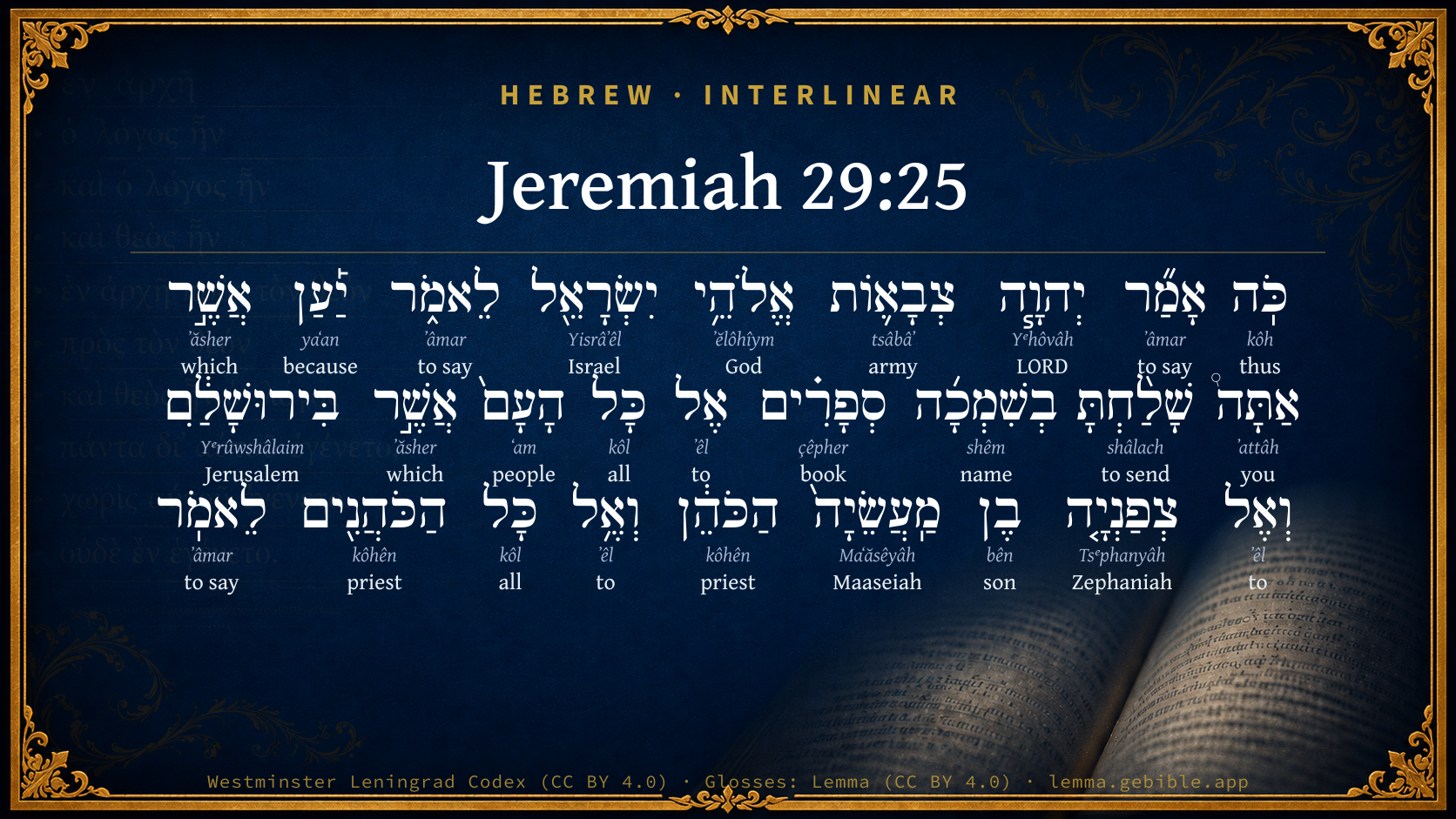
Jeremiah 29:25

Hebrew (Westminster Leningrad Codex) Jeremiah 29:25 appears in the Hebrew Old Testament. The text above is from the Westminster Leningrad Codex. Each word links to its Strong’s number, a concise gloss, and parsing drawn from the Open Scriptures Hebrew Bible morphology. Click any word for its full Brown-Driver-Briggs (BDB) entry.
Download image
Cite this verse

Jeremiah 29:25 (World English Bible). Public Domain. Lemma interlinear Bible study tool, https://lemma.gebible.app/v/jeremiah/29/25.

Show BibTeX & RIS
BibTeX
RIS
English Translation
Thus speaks Yahweh of Hosts, the God of Israel, saying, Because you have sent letters in your own name to all the people who are at Jerusalem, and to Zephaniah the son of Maaseiah, the priest, and to all the priests, saying,
World English Bible · Public Domain
Download a study sheet

One document with this verse’s original text, its word-by-word gloss line, the meaning frame, cross-references with their text, attributed commentary, and full source and license credits — printable, and it pastes into notes with its structure intact.

This verse Autodidact and up

Study sheet (.html) Plain text (.txt)

A passage Seminary Student

Up to 50 verses in one chapter. A passage sheet keeps up to 6 commentary sources and 12 cross-references per verse, in the order this page ranks them, and says so on the sheet whenever that leaves anything out. Ask for a single verse and you get the Autodidact verse sheet above.

Everything on this page stays free to read, with no account — the sheet is a download of what is already on screen, not access to it.

Want to remove ads? Support Godless Engineer
Compare translations 3

The same verse in 3 English versions, stacked beneath the original-language interlinear above. Click any original word for its lexicon entry.

Each is an independent rendering of the whole verse — the interlinear is not word-aligned to these translations.

Highlighted words mark where these versions differ — a whole-verse word diff, not a word-by-word alignment.

  • World English Bible Public Domain
    Thus speaks Yahweh of Hosts, the God of Israel, saying, Because you have sent letters in your own name to all the people who are at Jerusalem, and to Zephaniah the son of Maaseiah, the priest, and to all the priests, saying,
  • King James Version Public Domain
    Thus speaketh the LORD of hosts, the God of Israel, saying, Because thou hast sent letters in thy name unto all the people that are at Jerusalem, and to Zephaniah the son of Maaseiah the priest, and to all the priests, saying,
  • unfoldingWord Literal Text CC BY-SA 4.0
    ‘Yahweh of hosts, God of Israel, says this: Because you sent out letters in your own name to all the people in Jerusalem, to Zephaniah son of Maaseiah the priest, and to all the priests, and said,

unfoldingWord Literal Text — © unfoldingWord, licensed CC BY-SA 4.0. Word-aligned USFM3 via Door43 (git.door43.org/unfoldingWord/en_ult).

Versions to compare (up to 4)

3 of 4 selected

Show all 18 translations

Every available English version of this verse, each an independent rendering of the whole verse.

  • World English Bible Public Domain
    Thus speaks Yahweh of Hosts, the God of Israel, saying, Because you have sent letters in your own name to all the people who are at Jerusalem, and to Zephaniah the son of Maaseiah, the priest, and to all the priests, saying,
  • Berean Standard Bible Public Domain
    this is what the LORD of Hosts, the God of Israel, says: “In your own name you have sent out letters to all the people of Jerusalem, to the priest Zephaniah son of Maaseiah, and to all the priests. You said to Zephaniah:
  • Majority Standard Bible Public Domain
    this is what the LORD of Hosts, the God of Israel, says: “In your own name you have sent out letters to all the people of Jerusalem, to the priest Zephaniah son of Maaseiah, and to all the priests. You said to Zephaniah:
  • King James Version Public Domain
    Thus speaketh the LORD of hosts, the God of Israel, saying, Because thou hast sent letters in thy name unto all the people that are at Jerusalem, and to Zephaniah the son of Maaseiah the priest, and to all the priests, saying,
  • American Standard Version (1901) Public Domain
    Thus speaketh Jehovah of hosts, the God of Israel, saying, Because thou hast sent letters in thine own name unto all the people that are at Jerusalem, and to Zephaniah the son of Maaseiah, the priest, and to all the priests, saying,
  • Revised Version (1885) Public Domain
    Thus speaketh the LORD of hosts, the God of Israel, saying, Because thou hast sent letters in thine own name unto all the people that are at Jerusalem, and to Zephaniah the son of Maaseiah the priest, and to all the priests, saying,
  • Geneva Bible (1599) Public Domain
    Thus speaketh the Lord of hostes, the God of Israel, saying, Because thou hast sent letters in thy Name vnto all the people, that are at Ierusalem, and to Zephaniah the sonne of Maaseiah the Priest, and to all the Priests, saying,
  • Douay-Rheims (1899) Public Domain
    Thus saith the Lord of hosts the God of Israel: Because thou hast sent letters in thy name to all the people that are in Jerusalem, and to Sophonias the son of Maasias the priest, and to all the priests, saying:
  • Young's Literal Translation Public Domain
    Thus said Jehovah of Hosts, God of Israel, saying, Because that thou hast sent in thy name letters unto all the people who `are' in Jerusalem, and unto Zephaniah son of Maaseiah the priest, and unto all the priests, saying,
  • Literal Standard Version CC BY-SA 4.0
    Thus said YHWH of Hosts, God of Israel, saying, Because that you have sent letters in your name to all the people who [are] in Jerusalem, and to Zephaniah son of Maaseiah the priest, and to all the priests, saying,
  • Unlocked Literal Bible CC BY-SA 4.0
    'Yahweh of hosts, God of Israel, says this: Because you sent out letters in your own name to all the people in Jerusalem, to Zephaniah son of Maaseiah the priest, and to all the priests, and said,
  • unfoldingWord Literal Text CC BY-SA 4.0
    ‘Yahweh of hosts, God of Israel, says this: Because you sent out letters in your own name to all the people in Jerusalem, to Zephaniah son of Maaseiah the priest, and to all the priests, and said,
  • Darby Bible Public Domain
    Thus speaketh Jehovah of hosts, the God of Israel, saying, Because thou hast sent letters in thy name unto all the people that are at Jerusalem, and to Zephaniah the son of Maaseiah the priest, and to all the priests, saying,
  • World Messianic Bible Public Domain
    “The LORD of Hosts, the God of Israel, says, ‘Because you have sent letters in your own name to all the people who are at Jerusalem, and to Zephaniah the son of Maaseiah, the priest, and to all the priests, saying,
  • Webster's Bible Public Domain
    Thus speaketh the LORD of hosts, the God of Israel, saying, Because thou hast sent letters in thy name to all the people that are at Jerusalem, and to Zephaniah the son of Maaseiah the priest, and to all the priests, saying,
  • Free Bible Version CC BY-SA 4.0
    that this is what the Lord Almighty, the God of Israel, says: On your own authority you sent out letters to all the people of Jerusalem, to the priest Zephaniah, son of Maaseiah, and to all the priests, saying,
  • Bible in Basic English Public Domain
    Shemaiah the Nehelamite sent a letter in his name to Zephaniah, the son of Maaseiah the priest, saying,
  • JPS Tanakh (1917) Public Domain
    Thus speaketh the LORD of hosts, the God of Israel, saying: Because thou hast sent letters in thine own name unto all the people that are at Jerusalem, and to Zephaniah the son of Maaseiah the priest, and to all the priests, saying:

Literal Standard Version (2020), Covenant Press — licensed CC BY-SA 4.0. Text via the HelloAO Bible API (eBible.org). Unlocked Literal Bible (unfoldingWord) — licensed CC BY-SA 4.0. Text via the HelloAO Bible API (eBible.org). unfoldingWord Literal Text — © unfoldingWord, licensed CC BY-SA 4.0. Word-aligned USFM3 via Door43 (git.door43.org/unfoldingWord/en_ult). Free Bible Version, Dr. Jonathan Gallagher — licensed CC BY-SA 4.0. Text via the HelloAO Bible API (eBible.org).

Word by word

More ways to search: Search by grammar → Find every occurrence → Compare this word →

Practice this passage: Drill this verse → Learn its vocabulary →

צְפַנְיָ֤ה
Tsᵉphanyâh
H6846
“Zephaniah”
Noun, Proper
Part of Speech
Noun
Type
Proper
Full BDB Definition

Origin: from H6845 and H3050

TWOT: None

Zephaniah = "Jehovah has treasured" - the 9th in order of the 12 minor prophets; descendant of king Hezekiah of Judah and prophet in the time of king Josiah of Judah - son of Maaseiah and second priest in the reign of king Zedekiah of Judah; succeeded Jehoiada and an officer of the temple; slain at Riblah on the capture of Jerusalem - father of Josiah and Hen in the time of the prophet Zechariah - a Levite
  1. כֹּֽה kôh H3541 “thus” Adverb
  2. אָמַ֞ר ʼâmar H559 “to say” Verb, Qal, Perfect, 3rd Person, Masculine, Singular
  3. יְהוָ֧ה Yᵉhôvâh H3068 “LORD” Noun, Proper
  4. צְבָא֛וֹת tsâbâʼ H6635 “armies” Noun, Common, Both, Plural, Absolute
  5. אֱלֹהֵ֥י ʼĕlôhîym H430 “God(s) of” Noun, Common, Masculine, Plural, Construct
  6. יִשְׂרָאֵ֖ל Yisrâʼêl H3478 “Israel” Noun, Proper
  7. לֵאמֹ֑ר ʼâmar H559 “to say” Preposition + Verb, Qal, Infinitive Construct
  8. יַ֡עַן yaʻan H3282 “because” Conjunction
  9. אֲשֶׁ֣ר ʼăsher H834 “which” Particle, Relative
  10. אַתָּה֩ ʼattâh H859 “you” Pronoun, Personal, 2nd Person, Masculine, Singular
  11. שָׁלַ֨חְתָּ shâlach H7971 “to send” Verb, Qal, Perfect, 2nd Person, Masculine, Singular
  12. בְשִׁמְכָ֜ה shêm H8034 “in/at · name · your” Preposition + Noun, Common, Masculine, Singular, Construct + Suffix, Personal, 2nd Person, Masculine, Singular
  13. סְפָרִ֗ים çêpher H5612 “books” Noun, Common, Masculine, Plural, Absolute
  14. אֶל ʼêl H413 “to” Preposition
  15. כָּל kôl H3605 “all of” Noun, Common, Masculine, Singular, Construct
  16. הָעָם֙ ʻam H5971 “the · people” Particle, Definite Article + Noun, Common, Masculine, Singular, Absolute
  17. אֲשֶׁ֣ר ʼăsher H834 “which” Particle, Relative
  18. בִּירוּשָׁלִַ֔ם Yᵉrûwshâlaim H3389 “in/at · Jerusalem” Preposition + Noun, Proper
  19. וְאֶל ʼêl H413 “and · to” Conjunction + Preposition
  20. בֶן bên H1121 “son of” Noun, Common, Masculine, Singular, Construct
  21. מַֽעֲשֵׂיָה֙ Maʻăsêyâh H4641 “Maaseiah” Noun, Proper
  22. הַכֹּהֵ֔ן kôhên H3548 “the · priest” Particle, Definite Article + Noun, Common, Masculine, Singular, Absolute
  23. וְאֶ֥ל ʼêl H413 “and · to” Conjunction + Preposition
  24. כָּל kôl H3605 “all of” Noun, Common, Masculine, Singular, Construct
  25. הַכֹּהֲנִ֖ים kôhên H3548 “the · priests” Particle, Definite Article + Noun, Common, Masculine, Plural, Absolute
  26. לֵאמֹֽר ʼâmar H559 “to say” Preposition + Verb, Qal, Infinitive Construct

About this verse

These counts appear in no published source. They are computed here, from the morphology-tagged text and Lemma’s own curated glosses. What Lemma adds →

27
words
20
distinct lemmas
Prophets
section

Notable vocabulary

The rarest word here is צְפַנְיָ֤ה Zephaniah H6846 — appearing just 10 times in the whole Hebrew Bible.

Shared distinctive vocabulary

צְפַנְיָ֤ה Zephaniah H6846 occurs in 10 verses of the Hebrew Bible. Also found in:

Grammatical profile

  • 4 verbs
  • 15 nouns
  • 1 pronoun
  • 3 prepositions
  • 1 conjunction
  • 1 adverb
  • 2 particles

Verb forms

  • אָמַ֞ר Qal · Perfect
  • לֵאמֹ֑ר Qal · Infinitive Construct
  • שָׁלַ֨חְתָּ Qal · Perfect
  • לֵאמֹֽר Qal · Infinitive Construct

Repetition

Words recur within this verse — often emphatic in Hebrew:

  • אָמַ֞ר to say H559 ×3
  • כָּל all H3605 ×2
  • הַכֹּהֵ֔ן priest H3548 ×2
  • אֶל to H413 ×3
  • אֲשֶׁ֣ר which H834 ×2

Cross-references

15

Topical passages linked to Jeremiah 29:25 in the Treasury of Scripture Knowledge — connected by theme and wording, ordered by reader-vote popularity; previews shown in the World English Bible.

  • Jeremiah 29:29 Zephaniah the priest read this letter in the ears of Jeremiah the prophet.
  • Jeremiah 37:3 Zedekiah the king sent Jehucal the son of Shelemiah, and Zephaniah the son of Maaseiah, the priest, to the prophet Jeremiah, saying, Pray now to Yahweh our God for us.
  • Jeremiah 52:24 The captain of the guard took Seraiah the chief priest, and Zephaniah the second priest, and the three keepers of the threshold:
  • 1 Kings 21:8–13 So she wrote letters in Ahab's name, and sealed them with his seal, and sent the letters to the elders and to the nobles who were in his city, [and] who lived with Naboth.
  • 2 Kings 10:1–7 Now Ahab had seventy sons in Samaria. Jehu wrote letters, and sent to Samaria, to the rulers of Jezreel, even the elders, and to those who brought up [the sons of] Ahab, saying,
  • 2 Kings 19:9 When he heard say of Tirhakah king of Ethiopia, Behold, he is come out to fight against you, he sent messengers again to Hezekiah, saying,
  • 2 Kings 19:14 Hezekiah received the letter from the hand of the messengers, and read it; and Hezekiah went up to the house of Yahweh, and spread it before Yahweh.
  • 2 Kings 25:18–21 The captain of the guard took Seraiah the chief priest, and Zephaniah the second priest, and the three keepers of the threshold:
  • 2 Chronicles 32:17 He wrote also letters, to rail on Yahweh, the God of Israel, and to speak against him, saying, As the gods of the nations of the lands, which have not delivered their people out of my hand, so shall the God of Hezekiah not deliver his people out of my hand.
  • Ezra 4:7–16 In the days of Artaxerxes wrote Bishlam, Mithredath, Tabeel, and the rest of his companions, to Artaxerxes king of Persia; and the writing of the letter was written in the Syrian [character], and set forth in the Syrian [language].
  • Nehemiah 6:5 Then sent Sanballat his servant to me in like manner the fifth time with an open letter in his hand,
  • Nehemiah 6:17 Moreover in those days the nobles of Judah sent many letters to Tobiah, and [the letters] of Tobiah came to them.
  • Nehemiah 6:19 Also they spoke of his good deeds before me, and reported my words to him. Tobiah sent letters to put me in fear.
  • Jeremiah 21:1–2 The word which came to Jeremiah from Yahweh, when king Zedekiah sent to him Pashhur the son of Malchijah, and Zephaniah the son of Maaseiah, the priest, saying,
  • Acts 9:2 and asked for letters from him to the synagogues of Damascus, that if he found any who were of the Way, whether men or women, he might bring them bound to Jerusalem.

Cross-references courtesy of OpenBible.info (CC BY 4.0).

Hebrew and Greek witnesses Masoretic Hebrew ↔ Greek Septuagint

The same verse in the two great witnesses to the Old Testament, shown verse-for-verse.

These are two independent witnesses, not word-aligned to each other, and the Septuagint is shown in lemma (dictionary) form.

Hebrew Jeremiah 29:25 Masoretic · Westminster Leningrad Codex

כֹּֽה אָמַ֞ר יְהוָ֧ה צְבָא֛וֹת אֱלֹהֵ֥י יִשְׂרָאֵ֖ל לֵאמֹ֑ר יַ֡עַן אֲשֶׁ֣ר אַתָּה֩ שָׁלַ֨חְתָּ בְשִׁמְכָ֜ה סְפָרִ֗ים אֶל כָּל הָעָם֙ אֲשֶׁ֣ר בִּירוּשָׁלִַ֔ם וְאֶל צְפַנְיָ֤ה בֶן מַֽעֲשֵׂיָה֙ הַכֹּהֵ֔ן וְאֶ֥ל כָּל הַכֹּהֲנִ֖ים לֵאמֹֽר

Thus speaks Yahweh of Hosts, the God of Israel, saying, Because you have sent letters in your own name to all the people who are at Jerusalem, and to Zephaniah the son of Maaseiah, the priest, and to all the priests, saying,

World English Bible · Public Domain

Greek LXX Structure differs

In the Septuagint, Jeremiah is about an eighth shorter than the Hebrew and arranges its material differently — the Oracles Against the Nations (Hebrew chapters 46–51) appear in the middle of the Greek book, after 25:13. Because the chapter and verse boundaries do not line up, a verse-for-verse comparison with the Hebrew is not shown.

A verse-for-verse comparison isn’t shown here because the chapters and verses don’t line up. Switch to the LXX edition with the MT / LXX toggle above to read the Greek directly.

On this verse, The Cambridge Bible for Schools and Colleges discusses the Septuagint’s reading. Read the note in Commentary ↓

Hebrew: Westminster Leningrad Codex (CC BY 4.0). Greek: Septuagint (public domain); English from a public-domain English Septuagint. How the Septuagint differs from the Hebrew →

Targum (Aramaic paraphrase)

1

The Targum is the ancient Jewish Aramaic paraphrase of the Hebrew Scriptures — an interpretive translation, not the Hebrew text itself. Onkelos (literal) and Pseudo-Jonathan (expansive) render the Torah, and Jonathan the Prophets. Coverage is partial: where no permissively-licensed English translation exists for a verse, only the Aramaic is shown. This is verse-level text, not a word-by-word alignment to the Hebrew.

  1. Targum Jonathan Prophets (Joshua–Malachi)
    כִּדְנַן אֲמַר יְיָ צְבָאוֹת אֱלָהָא דְיִשְׂרָאֵל לְמֵימָר חֲלַף דִשְׁלַחְתָּא בִשְׁמָךְ אִגְרַן לְוַת כָּל עַמָא דִי בִירוּשְׁלֵם וּלְוַת צְפַנְיָה בַר מַעֲשֵׂיָה כַּהֲנָא וּלְוַת כָּל כַּהֲנַיָא לְמֵימָר:

    (no public-domain English translation for this verse)

    Targum Jonathan — Aramaic: “Mikraot Gedolot” (public domain). English: “Sefaria Community Translation” (CC0 1.0 (public-domain dedication)); “London "Chaldee Paraphrase," 1871” (public domain). Text via Sefaria.

Commentary

Notes on Jeremiah 29:25 from classic Christian and Jewish commentators (each source and its license shown beneath its notes). The classic Christian expositions comment on the surrounding passage and are grouped to its opening verse, so a note may address several verses; the Jewish commentaries on the Tanakh (Rashi and others) are per-verse, so they appear only where the commentator wrote on this verse.

Lemma curates 59 commentaries, every one of them public domain or Creative Commons licensed, each selected and text-cleaned for this edition rather than reprinted as found. About our sources →

Trapp's Complete Commentary

John Trapp

Jer 29:25 Thus speaketh the LORD of hosts, the God of Israel, saying, Because thou hast sent letters in thy name unto all the people that [are] at Jerusalem, and to Zephaniah the son of Maaseiah the priest, and to all the priests, saying,

Ver. 25. Because thou hast sent letters in thy name.] Such as Sadoletus, a Popish bishop, sent to Geneva in Calvin’s absence, to bring them back again to the obedience of the see of Rome; and as we have many from the Romish factors sent hither, to the seducing of not a few, a subtle and shrewd way of deceiving the simple.

And to Zephaniah.] The second under the high priest Seraiah, and successor likely to that Pashur {Jer 20:1} who was deposed for some misdemeanour, like as Dr Weston was here in Queen Mary’s days, put by all his Church dignities for being taken in bed with a harlot. {a} Of this Zephaniah, see 2Ki 25:18, his office was to judge of prophecies, and to punish such as he found to be false prophets.

And to all the priests.] Who were much too forward of themselves to bandy against God’s true prophets, {Jer 26:8} and did as little need by letter to be excited thereunto, as Bishop Bonner did to be stirred up to persecute Protestants; and yet to him were letters sent from King Philip and Queen Mary, complaining that heretics were not so reformed as they should be, and exhorting him to more diligence, {b} &c.

{a} Acts and Mon.

{b} Clarke’s Martyrol., 136.

John Trapp, A Commentary or Exposition upon All the Books of the Old and New Testament (1647–1656) — public domain. Text from a community e-Sword module.

Jamieson, Fausset & Brown

Robert Jamieson, A. R. Fausset & David Brown

in thy name--without sanction of "the Lord of hosts, the God of Israel," which words stand in antithesis to "thy name" (Joh 5:43).

Zephaniah--the second priest, or substitute (Sagan) of the high priest. He was one of those sent to consult Jeremiah by Zedekiah (Jer 21:1). Slain by Nebuchadnezzar at the capture of Jerusalem (Kg2 25:18-21). Zephaniah was in particular addressed, as being likely to take up against Jeremiah the prophet's prediction against his brother Zedekiah at Babylon (Jer 29:21). Zephaniah was to read it to the priests, and in the presence of all the people, in the temple.

Jamieson, Fausset & Brown — Commentary Critical and Explanatory on the Whole Bible (1871) — public domain (CC PDM 1.0). Text via the HelloAO Bible API.

John Calvin's Commentaries

He afterwards mentioned the priest and all the priests The word priest, in the singular number, meant the high-priest: then the priests were not only those descended from Aaron, but all the Levites. There was the high-priest, and then the descendants of Aaron were the chief, and, as it were, the colleagues of the high priest; but the Levites were an inferior order, though here by the priests he means also the Levites.

John Calvin's Commentaries (1540-1563) — public domain. Text from the Calvin Translation Society English edition (1840s-50s) via the Christian Classics Ethereal Library (ccel.org). Calvin's coverage is partial (roughly two-thirds of the Bible); uncommented books and verses are honest gaps, never fabricated. The 19th-century editor's footnotes and remarks are omitted so the notes are faithfully Calvin's own voice.

Ellicott's Commentary for English Readers

(25) Because thou hast sent letters in thy name . . .—The letters were probably sent through the envoys named in Jer_29:3 on their return from Babylon. Their object was to urge Zephaniah, who appears in 2Ki_25:18 as the Sagan, or second priest, to exercise his authority to restrain Jeremiah from prophesying, and to punish him as a false prophet. It was an attempt to turn the tables on him for the manner in which he had thwarted the plans of the party of revolt at Babylon. The part taken by Zephaniah in acting for the king when he wished to consult Jeremiah (Jer_21:1), and imploring his intercession (Jer_37:3), makes it probable that he endeavoured to maintain a neutral Gamaliel-like position between the two parties, and had seemed so lukewarm and temporising that he was open to the influence of threats. On the capture of Jerusalem by Nebuzaradan he was taken prisoner and slain (Jer_52:24-27).

A Bible Commentary for English Readers, edited by Charles John Ellicott (1878–1897) — public domain. Text from a community e-Sword module.

The Cambridge Bible for Schools and Colleges

gen. ed. J. J. S. Perowne

25. in thine own name] not, as Jeremiah spoke, in the name of the Lord.

unto all the people that are at Jerusalem] LXX rightly omit.

Zephaniah] See on Jer_21:1 (which however belongs to a somewhat later time than this). In ch. Jer_52:24 = 2Ki_25:18 he is called “second priest,” i.e. next in rank to the high-priest.

and to all the priests] LXX rightly omit.

The Cambridge Bible for Schools and Colleges (gen. ed. J. J. S. Perowne; Cambridge University Press, 1878–1918) — public domain. Text from a community e-Sword module.

John Gill's Exposition

Thus speaketh the Lord of hosts, the God of Israel, saying,.... See Gill on Jer 29:4;

because thou hast sent letters in thy name unto all the people that are at Jerusalem; not in the name of the captives, whom he consulted not; nor with Ezekiel the prophet of the Lord, who was of the captivity; but in his own name, taking upon him to direct and order what should be done in Jerusalem. These letters were sent, very probably, by the hands of the king's messengers, when they returned, whose names are mentioned, Jer 29:3; some of them were sent to the people, to set them against the prophet of the Lord, Jeremiah, that they might not give any heed and credit to him; and others to the priests, as follows:

and to Zephaniah the son of Maaseiah the priest; not the high, priest, but his sagan or deputy; the second priest, as he is called, Jer 52:24; for Seraiah was high priest, unless he was now become high priest in his room. This Maaseiah was either his immediate parent, or else the head of that course to which Zephaniah belonged, as a common priest, which was the twenty fourth in order, Ch1 24:18;

saying: as follows:

John Gill's Exposition of the Whole Bible (1746–1763) — public domain (CC PDM 1.0). Text via the HelloAO Bible API.

Haydock's Catholic Bible Commentary

The second priest, (4 Kings xxv. 18.) a chief officer of the temple, chap. xxi. 1.

George Leo Haydock (1774–1849), Haydock's Catholic Family Bible and Commentary, 1859 edition — public domain. Excludes Psalms (Douay-Rheims chapter numbering differs from Protestant) and Deuterocanonical books (Catholic canon only).

Lesson kit

Teaching starters — assembled from the data on this page, not authored interpretation. Every prompt links to the verse data it draws on. Edit before teaching.

Jeremiah, in the Prophets, opens this verse with 27 words (20 distinct Hebrew lemmas). Its most distinctive word is Tsᵉphanyâh (“Zephaniah”). A historical commentator’s framing appears above. Read the whole chapter for the surrounding context.

Discussion questions

  1. How does “Zephaniah” (Tsᵉphanyâh) shape what this verse is saying?
  2. How does 2 Kings 25:18, which shares the word «Zephaniah», read alongside this verse?
  3. What does the repetition of “to say” (3× in this one verse) do in this verse?
  4. These translations render this verse differently. What is at stake in choosing one wording over another?
  5. «אָמַ֞ר» is a Qal Perfect verb. How does that grammatical form shape the action described?
  6. Compare how Trapp's Complete Commentary and Jamieson, Fausset & Brown read this verse. Where do they agree or differ?

Things to notice

Reading settings

Reading text

Shown beneath each verse's original-language words.

Old Testament
Old Testament edition

Read the OT as the Masoretic Hebrew (MT) or the Greek Septuagint (LXX).

English shown for the Greek Septuagint (in the Hebrew ↔ Greek comparison).

Comparing translations? Open the Compare panel on any verse page to stack up to four side by side.