
2 Kings 10:2

Hebrew (Westminster Leningrad Codex) 2 Kings 10:2 appears in the Hebrew Old Testament. The text above is from the Westminster Leningrad Codex. Each word links to its Strong’s number, a concise gloss, and parsing drawn from the Open Scriptures Hebrew Bible morphology. Click any word for its full Brown-Driver-Briggs (BDB) entry.
Download image
Cite this verse

2 Kings 10:2 (World English Bible). Public Domain. Lemma interlinear Bible study tool, https://lemma.gebible.app/v/2-kings/10/2.

Show BibTeX & RIS
BibTeX
RIS
English Translation
Now as soon as this letter comes to you, seeing your master's sons are with you, and there are with you chariots and horses, a fortified city also, and armor;
World English Bible · Public Domain
Download a study sheet

One document with this verse’s original text, its word-by-word gloss line, the meaning frame, cross-references with their text, attributed commentary, and full source and license credits — printable, and it pastes into notes with its structure intact.

This verse Autodidact and up

Study sheet (.html) Plain text (.txt)

A passage Seminary Student

Up to 50 verses in one chapter. A passage sheet keeps up to 6 commentary sources and 12 cross-references per verse, in the order this page ranks them, and says so on the sheet whenever that leaves anything out. Ask for a single verse and you get the Autodidact verse sheet above.

Everything on this page stays free to read, with no account — the sheet is a download of what is already on screen, not access to it.

Want to remove ads? Support Godless Engineer
Compare translations 3

The same verse in 3 English versions, stacked beneath the original-language interlinear above. Click any original word for its lexicon entry.

Each is an independent rendering of the whole verse — the interlinear is not word-aligned to these translations.

Highlighted words mark where these versions differ — a whole-verse word diff, not a word-by-word alignment.

  • World English Bible Public Domain
    Now as soon as this letter comes to you, seeing your master's sons are with you, and there are with you chariots and horses, a fortified city also, and armor;
  • King James Version Public Domain
    Now as soon as this letter cometh to you, seeing your master's sons are with you, and there are with you chariots and horses, a fenced city also, and armor;
  • unfoldingWord Literal Text CC BY-SA 4.0
    “And now, when this letter comes to you, and the sons of your master with you, and chariotry and horses and a fortified city and weapon with you,

unfoldingWord Literal Text — © unfoldingWord, licensed CC BY-SA 4.0. Word-aligned USFM3 via Door43 (git.door43.org/unfoldingWord/en_ult).

Versions to compare (up to 4)

3 of 4 selected

Show all 18 translations

Every available English version of this verse, each an independent rendering of the whole verse.

  • World English Bible Public Domain
    Now as soon as this letter comes to you, seeing your master's sons are with you, and there are with you chariots and horses, a fortified city also, and armor;
  • Berean Standard Bible Public Domain
    “When this letter arrives, since your master’s sons are with you and you have chariots and horses, a fortified city and weaponry,
  • Majority Standard Bible Public Domain
    “When this letter arrives, since your master’s sons are with you and you have chariots and horses, a fortified city and weaponry,
  • King James Version Public Domain
    Now as soon as this letter cometh to you, seeing your master's sons are with you, and there are with you chariots and horses, a fenced city also, and armor;
  • American Standard Version (1901) Public Domain
    And now as soon as this letter cometh to you, seeing your master's sons are with you, and there are with you chariots and horses, a fortified city also, and armor;
  • Revised Version (1885) Public Domain
    And now as soon as this letter cometh to you, seeing your master’s sons are with you, and there are with you chariots and horses, a fenced city also, and armour;
  • Geneva Bible (1599) Public Domain
    Nowe when this letter commeth to you, (for ye haue with you your masters sonnes, yee haue with you both charets and horses, and a defenced citie, and armour)
  • Douay-Rheims (1899) Public Domain
    As soon as you receive these letters, ye that have your master's sons, and chariots, and horses, and fenced cities, and armour,
  • Young's Literal Translation Public Domain
    `And now, at the coming in of this letter unto you, and with you `are' sons of your lord, and with you `are' the chariots and the horses, and a fenced city, and the armour,
  • Literal Standard Version CC BY-SA 4.0
    “And now, at the coming in of this letter to you, and sons of your lord [are] with you, and the chariots and the horses, and a fortified city, and the armor, [are] with you,
  • Unlocked Literal Bible CC BY-SA 4.0
    “Your master's descendants are with you, and you also have chariots and horses and a fortified city and armor. So then, as soon as this letter comes to you,
  • unfoldingWord Literal Text CC BY-SA 4.0
    “And now, when this letter comes to you, and the sons of your master with you, and chariotry and horses and a fortified city and weapon with you,
  • Darby Bible Public Domain
    And now, when this letter comes to you, seeing your master's sons are with you, and there are with you chariots, and horses, and a fortified city, and armour,
  • World Messianic Bible Public Domain
    “Now as soon as this letter comes to you, since your master’s sons are with you, and you have chariots and horses, a fortified city also, and armor,
  • Webster's Bible Public Domain
    Now as soon as this letter cometh to you, seeing your master's sons are with you, and there are with you chariots and horses, a fortified city also, and armor;
  • Free Bible Version CC BY-SA 4.0
    “Since your master's sons are with you, and you have at your disposal chariots, horses, a fortified city, and weapons, when you receive this letter,
  • Bible in Basic English Public Domain
    Straight away, when you get this letter, seeing that your master's sons are with you, and that you have carriages and horses and a walled town and arms;
  • JPS Tanakh (1917) Public Domain
    'And now as soon as this letter cometh to you, seeing your master's sons are with you, and there are with you chariots and horses, fortified cities also, and armour;

Literal Standard Version (2020), Covenant Press — licensed CC BY-SA 4.0. Text via the HelloAO Bible API (eBible.org). Unlocked Literal Bible (unfoldingWord) — licensed CC BY-SA 4.0. Text via the HelloAO Bible API (eBible.org). unfoldingWord Literal Text — © unfoldingWord, licensed CC BY-SA 4.0. Word-aligned USFM3 via Door43 (git.door43.org/unfoldingWord/en_ult). Free Bible Version, Dr. Jonathan Gallagher — licensed CC BY-SA 4.0. Text via the HelloAO Bible API (eBible.org).

Word by word

More ways to search: Search by grammar → Find every occurrence → Compare this word →

Practice this passage: Drill this verse → Learn its vocabulary →

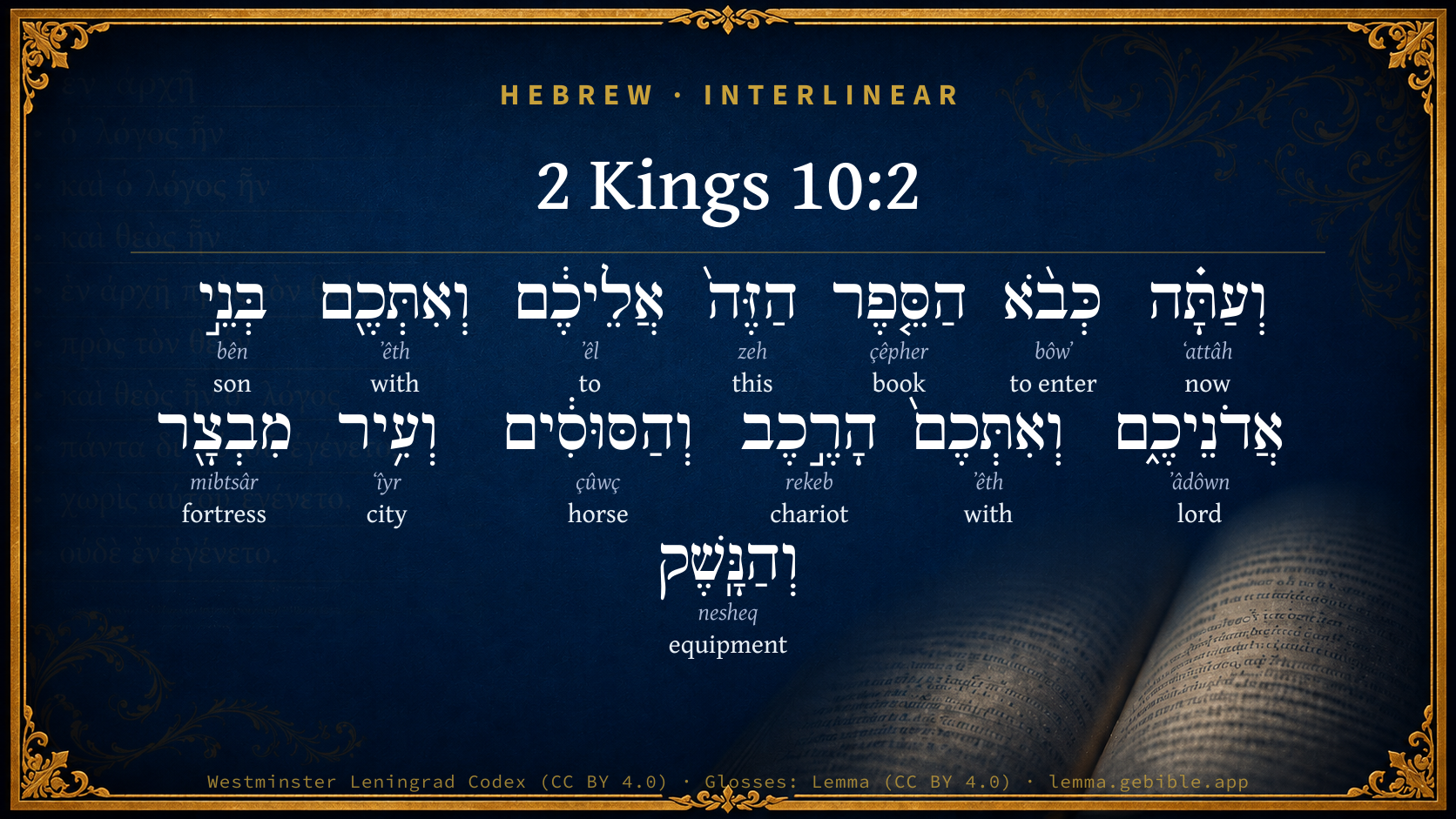
וְהַנָּֽשֶׁק
nesheq
H5402
“and · the · equipment”
Conjunction + Particle, Definite Article + Noun, Common, Masculine, Singular, Absolute
Part of Speech
Conjunction + Particle + Noun
Type
Common
Gender
Masculine
Number
Singular
State
Absolute
Full BDB Definition

Origin: from H5401

TWOT: 1436a

equipment, weapons, armoury - equipment, weapons - armoury
  1. וְעַתָּ֗ה ʻattâh H6258 “and · now” Conjunction + Adverb
  2. כְּבֹ֨א bôwʼ H935 “like/as · to enter” Preposition + Verb, Qal, Infinitive Construct
  3. הַסֵּ֤פֶר çêpher H5612 “the · book” Particle, Definite Article + Noun, Common, Masculine, Singular, Absolute
  4. הַזֶּה֙ zeh H2088 “the · this” Particle, Definite Article + Pronoun, Demonstrative, Masculine, Singular
  5. אֲלֵיכֶ֔ם ʼêl H413 “to · you” Preposition + Suffix, Personal, 2nd Person, Masculine, Plural
  6. וְאִתְּכֶ֖ם ʼêth H854 “and · with · you” Conjunction + Preposition + Suffix, Personal, 2nd Person, Masculine, Plural
  7. בְּנֵ֣י bên H1121 “sons of” Noun, Common, Masculine, Plural, Construct
  8. אֲדֹנֵיכֶ֑ם ʼâdôwn H113 “lords · your” Noun, Common, Masculine, Plural, Construct + Suffix, Personal, 2nd Person, Masculine, Plural
  9. וְאִתְּכֶם֙ ʼêth H854 “and · with · you” Conjunction + Preposition + Suffix, Personal, 2nd Person, Masculine, Plural
  10. הָרֶ֣כֶב rekeb H7393 “the · chariot” Particle, Definite Article + Noun, Common, Masculine, Singular, Absolute
  11. וְהַסּוּסִ֔ים çûwç H5483 “and · the · horses” Conjunction + Particle, Definite Article + Noun, Common, Masculine, Plural, Absolute
  12. וְעִ֥יר ʻîyr H5892 “and · city of” Conjunction + Noun, Common, Feminine, Singular, Construct
  13. מִבְצָ֖ר mibtsâr H4013 “fortress” Noun, Common, Masculine, Singular, Absolute

About this verse

These counts appear in no published source. They are computed here, from the morphology-tagged text and Lemma’s own curated glosses. What Lemma adds →

14
words
13
distinct lemmas
Historical
section

Notable vocabulary

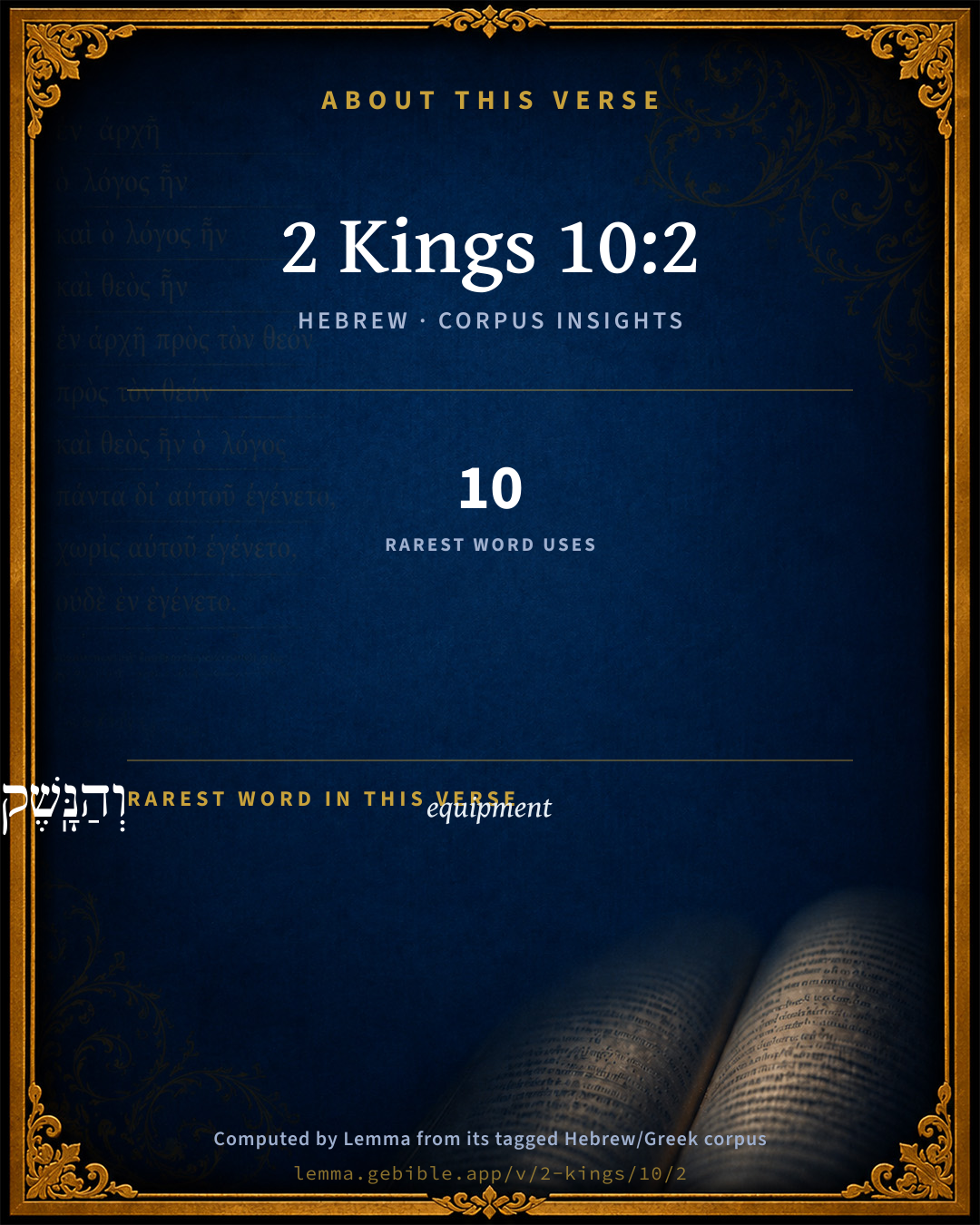
The rarest word here is וְהַנָּֽשֶׁק equipment H5402 — appearing just 10 times in the whole Hebrew Bible.

Shared distinctive vocabulary

וְהַנָּֽשֶׁק equipment H5402 occurs in 10 verses of the Hebrew Bible. Also found in:

Grammatical profile

  • 1 verb
  • 8 nouns
  • 1 pronoun
  • 3 prepositions
  • 1 adverb

Verb forms

  • כְּבֹ֨א Qal · Infinitive Construct

Repetition

A word recurs within this verse — often emphatic in Hebrew:

  • וְאִתְּכֶ֖ם with H854 ×2

Hebrew & Septuagint length

In English translation the verse runs 30 words from the Hebrew and 32 from the Septuagint (LXX English) — closely comparable.

A rough comparison of the two English renderings, which tokenize alike — not a word-level alignment.

Word counts can differ between the Hebrew and the Greek without any difference in meaning — e.g. the Hebrew direct-object marker אֵת has no separate Greek word, and Greek often adds the article ὁ.

Cross-references

1

Topical passages linked to 2 Kings 10:2 in the Treasury of Scripture Knowledge — connected by theme and wording, ordered by reader-vote popularity; previews shown in the World English Bible.

  • 2 Kings 5:6 He brought the letter to the king of Israel, saying, Now when this letter is come to you, behold, I have sent Naaman my servant to you, that you may recover him of his leprosy.

Cross-references courtesy of OpenBible.info (CC BY 4.0).

Hebrew and Greek witnesses Masoretic Hebrew ↔ Greek Septuagint

The same verse in the two great witnesses to the Old Testament, shown verse-for-verse.

These are two independent witnesses, not word-aligned to each other, and the Septuagint is shown in lemma (dictionary) form.

Hebrew 2 Kings 10:2 Masoretic · Westminster Leningrad Codex

וְעַתָּ֗ה כְּבֹ֨א הַסֵּ֤פֶר הַזֶּה֙ אֲלֵיכֶ֔ם וְאִתְּכֶ֖ם בְּנֵ֣י אֲדֹנֵיכֶ֑ם וְאִתְּכֶם֙ הָרֶ֣כֶב וְהַסּוּסִ֔ים וְעִ֥יר מִבְצָ֖ר וְהַנָּֽשֶׁק

Now as soon as this letter comes to you, seeing your master's sons are with you, and there are with you chariots and horses, a fortified city also, and armor;

World English Bible · Public Domain

Greek LXX 2 Kings 10:2 Septuagint · lemma form

καί νῦν ὡς ἐάν ἔρχομαι ὁ βιβλίον οὗτος πρός σύ μετά σύ ὁ υἱός ὁ κύριος σύ καί μετά σύ ὁ ἅρμα καί ὁ ἵππος καί πόλις ὀχυρός καί ὁ ὅπλον

Now then, as soon as this letter shall have reached you, whereas there are with you the sons of your master, and with you chariots and horses, and strong cities, and arms,

LXX2012 (modern English Septuagint) · Public Domain

On this verse, The Pulpit Commentary discusses the Septuagint’s reading. Read the note in Commentary ↓

Hebrew: Westminster Leningrad Codex (CC BY 4.0). Greek: Septuagint (public domain); English from LXX2012 (modern English Septuagint) (Public Domain). How the Septuagint differs from the Hebrew →

Targum (Aramaic paraphrase)

1

The Targum is the ancient Jewish Aramaic paraphrase of the Hebrew Scriptures — an interpretive translation, not the Hebrew text itself. Onkelos (literal) and Pseudo-Jonathan (expansive) render the Torah, and Jonathan the Prophets. Coverage is partial: where no permissively-licensed English translation exists for a verse, only the Aramaic is shown. This is verse-level text, not a word-by-word alignment to the Hebrew.

  1. Targum Jonathan Prophets (Joshua–Malachi)
    וּכְעַן כְּמֵיתָא אִגַרְתָּא הָדֵין לְוַתְכוֹן וְעִמְכוֹן בְּנֵי רִבּוֹנֵיכוֹן וְעִמְכוֹן רְתִיכִין וְסוּסְוָן וְקִרְוִין כְּרִיכָן וּמָאנֵי זְיָנָא:

    (no public-domain English translation for this verse)

    Targum Jonathan — Aramaic: “Mikraot Gedolot” (public domain). English: “Sefaria Community Translation” (CC0 1.0 (public-domain dedication)); “London "Chaldee Paraphrase," 1871” (public domain). Text via Sefaria.

Commentary

Notes on 2 Kings 10:2 from classic Christian and Jewish commentators (each source and its license shown beneath its notes). The classic Christian expositions comment on the surrounding passage and are grouped to its opening verse, so a note may address several verses; the Jewish commentaries on the Tanakh (Rashi and others) are per-verse, so they appear only where the commentator wrote on this verse.

Lemma curates 59 commentaries, every one of them public domain or Creative Commons licensed, each selected and text-cleaned for this edition rather than reprinted as found. About our sources →

Trapp's Complete Commentary

John Trapp

2Ki 10:2 Now as soon as this letter cometh to you, seeing your master’s sons [are] with you, and [there are] with you chariots and horses, a fenced city also, and armour;

Ver. 2. Now as soon as this letter cometh to you.] A concise and stately kind of writing, much like that of the king of Syria to the king of Israel. {2Ki 5:6} So the Hebrews note of Esau, in his meeting with Jacob, {Gen 33:4-15} that he uttereth his mind in few words, whenas Jacob is more full and fuse in his expressions. But ornamentum epistolae est ornamentis carere, saith a master of rhetoric, {a} Plainness is the greatest grace of an epistle.

{a} Politian.

John Trapp, A Commentary or Exposition upon All the Books of the Old and New Testament (1647–1656) — public domain. Text from a community e-Sword module.

Tyndale Open Study Notes

Tyndale Open Resources

10:2-5 Jehu’s message pointing out the city’s military capacity to protect the surviving members of Ahab’s dynasty was actually a declaration of war, and the leaders of Samaria understood it as such. Jehu commanded the main armed forces of Israel, and at Jezreel he had already demonstrated his military power and ruthlessness. The leaders were paralyzed with fear and agreed to do anything Jehu instructed them to do.

Tyndale Open Study Notes — © Tyndale Open Resources, licensed CC BY-SA 4.0. Text via the HelloAO Bible API.

Adam Clarke's Commentary

Verse 2. A fenced city also] All here seems to refer to Samaria alone; in it were the magazines and implements of war, c. No reader need be told that these letters were all ironical. It was the same as if he had said, "Ye have no means of defence Israel is with me: if you yield not up yourselves and the city, I will put you all to the sword."

Adam Clarke's Commentary on the Bible (1810–1826) — public domain. Text from a community e-Sword/MySword module.

Ellicott's Commentary for English Readers

(2) Now as soon as this letter cometh.—Rather, And now when this letter cometh. Only the conclusion of the letter, containing the gist of it, is reported here. (Comp. 2Ki_5:6.)

Seeing your master’s sons . . . look even out (2Ki_10:3).—Rather, there are with you both your master’s sons, and the chariots and the horses,and a fenced city, and the armoury: so look out the best, &c.

A fenced city.—All the versions but the Arabic have “fenced cities;” and so Josephus. There is a tone of mocking irony in Jehu’s challenge to the nobles of Samaria, who were probably as luxurious and cowardly now as in the days of Amos, a few years later (Amo_3:12; Amo_6:3-6). (Comp. also Isa_28:1-10.) By his careful enumeration of their resources, he as good as says that his defiance is not the fruit of ignorance.

A Bible Commentary for English Readers, edited by Charles John Ellicott (1878–1897) — public domain. Text from a community e-Sword module.

The Cambridge Bible for Schools and Colleges

gen. ed. J. J. S. Perowne

2. Now [R.V. And now] as soon as this letter cometh to you] Only an extract from the letter is here given, which the Hebrew correctly represents, and which R.V. has shewn by its translation. See a similar instance before, chap. 2Ki_5:6.

a fenced city] This must refer to the city of Samaria, which probably was better fortified than Jezreel, and which had been especially cared for by the family of Omri by whom it was built.

The Cambridge Bible for Schools and Colleges (gen. ed. J. J. S. Perowne; Cambridge University Press, 1878–1918) — public domain. Text from a community e-Sword module.

John Gill's Exposition

Now as soon as this letter cometh to you, seeing your master's sons are with you,.... Sons of Ahab, and some of Joram, and all either the sons or grandsons of Ahab:

and there are with you chariots and horses; military ones:

a fenced city also: as Samaria was, well walled and fortified, and able to hold out a long siege:

and armour; of all sorts, to arm themselves and people with in their defence.

John Gill's Exposition of the Whole Bible (1746–1763) — public domain (CC PDM 1.0). Text via the HelloAO Bible API.

Albert Barnes' Notes on the Bible

A fenced city - Or, “fenced cities.” If Samaria had refused to acknowledge Jehu, many other Israelite towns would have been sure to follow the example.

Albert Barnes' Notes on the Bible (1834–1885) — public domain. Text from a community e-Sword/MySword module.

Whedon's Commentary on the Bible

Daniel D. Whedon

2, 3.

As soon as this letter cometh — Most expositors have regarded this letter of Jehu as ironical. Thus Kitto: “There was a latent irony in this letter, for the writer must well have known the real state of the case, and how little likely it was that they would take up the cause of a fallen house, known to have been doomed of God.” But whatever Jehu may have known or thought of their probable feeling and action in the case, the language of this epistle, particularly the closing challenge — fight for your master’s house — is that of bold and menacing defiance rather than of irony, and involves an order for them either to surrender or else prepare for war. Bahr paraphrases it thus: “I am king; but if ye, who have in your possession the chariots, and horses, and arms, are desirous of placing a prince of the house of Ahab on the throne, you thereby begin a war with me.” Very likely he expected to intimidate them, and bring them to submission by this threat.

Daniel D. Whedon (gen. ed.), Commentary on the Old and New Testaments (1874–1909) — public domain. Text from a community e-Sword module.

The Pulpit Commentary

Now as soon as this letter cometh to you. In the East at this time, and in most parts of it to the present day, letters can only be sent by special messengers. There is no public post. Kings and private individuals must equally find persons who will undertake to carry and deliver their despatches. Even the post organized by Darius Hystaspis was not one that went daily, but only one kept ready for the king to use when he had occasion for it. Seeing your master"s sons are with you. "Your master"s sons" must mean Joram"s sons; by which we learn that, unlike his brother Ahaziah, (2Ki_1:17) Joram had male offspring who survived him, and were now with the rest of Ahab"s descendants, at Samaria. And there are with you chariots and horses, a fenced city also, and armor; literally, the chariots, and the horses, a fenced city also, and the armor. The main chariot force of the country, and the chief arsenal, containing both armor and arms, were naturally at Samaria, the capital, and might thus be regarded as at the disposition of the Samaritan municipality. Jehu scornfully challenges them to make use of their resources against him. He is quite ready for a contest. Let them do their worst. The LXX have "fenced cities" (poleiv ojcurai) instead of "a fenced city;" but the existing Hebrew text is probably right Samaria was the only fortified town in their possession.

The Pulpit Commentary (1880–1919), ed. H.D.M. Spence-Jones & Joseph S. Exell — public domain. Text from a community e-Sword module.

Rashi

Rabbi Shlomo Yitzchaki (Rashi)

And with you are the chariot[s] and the horses. And they have strength to wage war.

Rashi on the Tanakh — English translations: “The Judaica Press complete Tanach with Rashi, translated by A. J. Rosenberg” (CC BY 4.0); “Pentateuch with Rashi's commentary by M. Rosenbaum and A.M. Silbermann, 1929-1934” (public domain); “The Metsudah Tanach series, Lakewood, N.J” (CC BY 4.0); and “The Book of Joshua, Metsudah Publications, 1997” (CC BY 4.0). Text via Sefaria.

Lesson kit

Teaching starters — assembled from the data on this page, not authored interpretation. Every prompt links to the verse data it draws on. Edit before teaching.

2 Kings, in the Historical, opens this verse with 14 words (13 distinct Hebrew lemmas). Its most distinctive word is nesheq (“equipment”). A historical commentator’s framing appears above. Read the whole chapter for the surrounding context.

Discussion questions

  1. How does “equipment” (nesheq) shape what this verse is saying?
  2. How does 1 Kings 10:25, which shares the word «equipment», read alongside this verse?
  3. What does the repetition of “with” (2× in this one verse) do in this verse?
  4. The translations on this page render this verse differently — a whole-verse word diff, not a word-by-word alignment. What might account for the different wordings?
  5. «כְּבֹ֨א» is a Qal Infinitive Construct verb. How does that grammatical form shape the action described?
  6. Compare how Trapp's Complete Commentary and Tyndale Open Study Notes read this verse. Where do they agree or differ?

Things to notice

Reading settings

Reading text

Shown beneath each verse's original-language words.

Old Testament
Old Testament edition

Read the OT as the Masoretic Hebrew (MT) or the Greek Septuagint (LXX).

English shown for the Greek Septuagint (in the Hebrew ↔ Greek comparison).

Comparing translations? Open the Compare panel on any verse page to stack up to four side by side.