
Isaiah 34:16

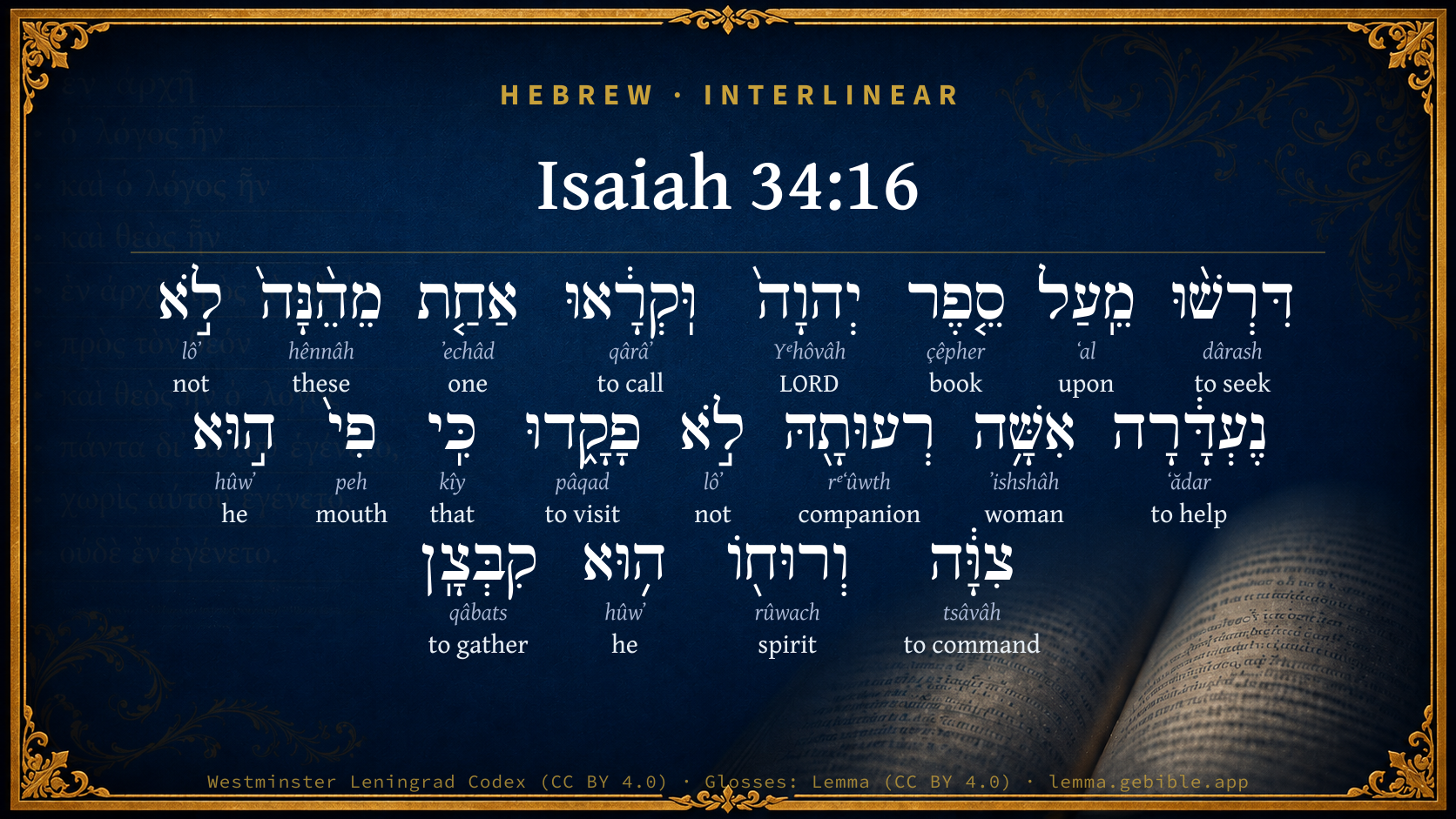
Hebrew (Westminster Leningrad Codex) Isaiah 34:16 appears in the Hebrew Old Testament. The text above is from the Westminster Leningrad Codex. Each word links to its Strong’s number, a concise gloss, and parsing drawn from the Open Scriptures Hebrew Bible morphology. Click any word for its full Brown-Driver-Briggs (BDB) entry.
Download image
Cite this verse

Isaiah 34:16 (World English Bible). Public Domain. Lemma interlinear Bible study tool, https://lemma.gebible.app/v/isaiah/34/16.

Show BibTeX & RIS
BibTeX
RIS
English Translation
Seek you out of the book of Yahweh, and read: no one of these shall be missing, none shall want her mate; for my mouth, it has commanded, and his Spirit, it has gathered them.
World English Bible · Public Domain
Download a study sheet

One document with this verse’s original text, its word-by-word gloss line, the meaning frame, cross-references with their text, attributed commentary, and full source and license credits — printable, and it pastes into notes with its structure intact.

This verse Autodidact and up

Study sheet (.html) Plain text (.txt)

A passage Seminary Student

Up to 50 verses in one chapter. A passage sheet keeps up to 6 commentary sources and 12 cross-references per verse, in the order this page ranks them, and says so on the sheet whenever that leaves anything out. Ask for a single verse and you get the Autodidact verse sheet above.

Everything on this page stays free to read, with no account — the sheet is a download of what is already on screen, not access to it.

Want to remove ads? Support Godless Engineer
Compare translations 3

The same verse in 3 English versions, stacked beneath the original-language interlinear above. Click any original word for its lexicon entry.

Each is an independent rendering of the whole verse — the interlinear is not word-aligned to these translations.

Highlighted words mark where these versions differ — a whole-verse word diff, not a word-by-word alignment.

  • World English Bible Public Domain
    Seek you out of the book of Yahweh, and read: no one of these shall be missing, none shall want her mate; for my mouth, it has commanded, and his Spirit, it has gathered them.
  • King James Version Public Domain
    Seek ye out of the book of the LORD, and read: no one of these shall fail, none shall want her mate: for my mouth it hath commanded, and his spirit it hath gathered them.
  • unfoldingWord Literal Text CC BY-SA 4.0
    Seek from upon the scroll of Yahweh and read: not one of these will be missing; each, its companion, they will not lack, for my mouth, it, it has commanded, and his Spirit, he, he has gathered.

unfoldingWord Literal Text — © unfoldingWord, licensed CC BY-SA 4.0. Word-aligned USFM3 via Door43 (git.door43.org/unfoldingWord/en_ult).

Versions to compare (up to 4)

3 of 4 selected

Show all 18 translations

Every available English version of this verse, each an independent rendering of the whole verse.

  • World English Bible Public Domain
    Seek you out of the book of Yahweh, and read: no one of these shall be missing, none shall want her mate; for my mouth, it has commanded, and his Spirit, it has gathered them.
  • Berean Standard Bible Public Domain
    Search and read the scroll of the LORD: Not one of these will go missing, not one will lack her mate, because He has ordered it by His mouth, and He will gather them by His Spirit.
  • Majority Standard Bible Public Domain
    Search and read the scroll of the LORD: Not one of these will go missing, not one will lack her mate, because He has ordered it by His mouth, and He will gather them by His Spirit.
  • King James Version Public Domain
    Seek ye out of the book of the LORD, and read: no one of these shall fail, none shall want her mate: for my mouth it hath commanded, and his spirit it hath gathered them.
  • American Standard Version (1901) Public Domain
    Seek ye out of the book of Jehovah, and read: no one of these shall be missing, none shall want her mate; for my mouth, it hath commanded, and his Spirit, it hath gathered them.
  • Revised Version (1885) Public Domain
    Seek ye out of the book of the LORD, and read: no one of these shall be missing, none shall want her mate: for my mouth it hath commanded, and his spirit it hath gathered them.
  • Geneva Bible (1599) Public Domain
    Seeke in the booke of the Lord, and reade: none of these shall fayle, none shall want her make: for his mouth hath commanded, and his very Spirit hath gathered them.
  • Douay-Rheims (1899) Public Domain
    Search ye diligently in the book of the Lord, and read: not one of them was wanting, one hath not sought for the other: for that which proceedeth out of my mouth, he hath commanded, and his spirit it hath gathered them.
  • Young's Literal Translation Public Domain
    Seek out of the book of Jehovah, and read, One of these hath not been lacking, None hath missed its companion, For My mouth -- it hath commanded, And His spirit -- He hath gathered them.
  • Literal Standard Version CC BY-SA 4.0
    Seek out of the scroll of YHWH, and read, || One of these has not been lacking, || None has missed its companion, || For My mouth—it has commanded, || And His Spirit—He has gathered them.
  • Unlocked Literal Bible CC BY-SA 4.0
    Search through the scroll of Yahweh; not one of these will be missing. None will lack for a mate; for his mouth has commanded it, and his spirit has gathered them.
  • unfoldingWord Literal Text CC BY-SA 4.0
    Seek from upon the scroll of Yahweh and read: not one of these will be missing; each, its companion, they will not lack, for my mouth, it, it has commanded, and his Spirit, he, he has gathered.
  • Darby Bible Public Domain
    Search ye in the book of Jehovah and read: not one of these shall fail, one shall not have to seek for the other; for my mouth, it hath commanded, and his Spirit, it hath gathered them.
  • World Messianic Bible Public Domain
    Search in the book of the LORD, and read: not one of these will be missing. None will lack her mate. For my mouth has commanded, and his Spirit has gathered them.
  • Webster's Bible Public Domain
    Seek ye out of the book of the LORD, and read: no one of these shall fail, none shall want her mate: for my mouth it hath commanded, and his spirit it hath gathered them.
  • Free Bible Version CC BY-SA 4.0
    Look in the scroll of the Lord and read what it says: Not a single one of these will be missing its mate, for the Lord has ordered this to happen, and his Spirit has gathered them together.
  • Bible in Basic English Public Domain
    See what is recorded in the book of the Lord: all these will be there, not one without the other: the mouth of the Lord has given the order, and his spirit has made them come together.
  • JPS Tanakh (1917) Public Domain
    Seek ye out of the book of the LORD, and read; no one of these shall be missing, none shall want her mate; for My mouth it hath commanded, and the breath thereof it hath gathered them.

Literal Standard Version (2020), Covenant Press — licensed CC BY-SA 4.0. Text via the HelloAO Bible API (eBible.org). Unlocked Literal Bible (unfoldingWord) — licensed CC BY-SA 4.0. Text via the HelloAO Bible API (eBible.org). unfoldingWord Literal Text — © unfoldingWord, licensed CC BY-SA 4.0. Word-aligned USFM3 via Door43 (git.door43.org/unfoldingWord/en_ult). Free Bible Version, Dr. Jonathan Gallagher — licensed CC BY-SA 4.0. Text via the HelloAO Bible API (eBible.org).

Word by word

More ways to search: Search by grammar → Find every occurrence → Compare this word →

Practice this passage: Drill this verse → Learn its vocabulary →

רְעוּתָ֖הּ
rᵉʻûwth
H7468
“companion · her”
Noun, Common, Feminine, Singular, Construct + Suffix, Personal, 3rd Person, Feminine, Singular
Part of Speech
Noun
Type
Common
Gender
Feminine
Number
Singular
State
Construct
Full BDB Definition

Origin: from H7462 in the sense of H7453

TWOT: 2186e

female companion, mate, neighbour woman
  1. דִּרְשׁ֨וּ dârash H1875 “seek” Verb, Qal, Imperative, 2nd Person, Masculine, Plural
  2. מֵֽעַל ʻal H5921 “from · upon” Preposition + Preposition
  3. סֵ֤פֶר çêpher H5612 “book of” Noun, Common, Masculine, Singular, Construct
  4. יְהוָה֙ Yᵉhôvâh H3068 “LORD” Noun, Proper
  5. וּֽקְרָ֔אוּ qârâʼ H7121 “and · call” Conjunction + Verb, Qal, Imperative, 2nd Person, Masculine, Plural
  6. אַחַ֤ת ʼechâd H259 “one” Adjective, Cardinal number, Feminine, Singular, Absolute
  7. מֵהֵ֨נָּה֙ hênnâh H2007 “from · these” Preposition + Pronoun, Personal, 3rd Person, Feminine, Plural
  8. לֹ֣א lôʼ H3808 “not” Particle, Negative
  9. נֶעְדָּ֔רָה ʻădar H5737 “to help” Verb, Niphal, Perfect, 3rd Person, Feminine, Singular
  10. אִשָּׁ֥ה ʼishshâh H802 “woman” Noun, Common, Feminine, Singular, Absolute
  11. לֹ֣א lôʼ H3808 “not” Particle, Negative
  12. פָקָ֑דוּ pâqad H6485 “to visit” Verb, Qal, Perfect, 3rd Person, Common, Plural
  13. כִּֽי kîy H3588 “that” Conjunction
  14. פִי֙ peh H6310 “mouth · my” Noun, Common, Masculine, Singular, Construct + Suffix, Personal, 1st Person, Common, Singular
  15. ה֣וּא hûwʼ H1931 “he” Pronoun, Personal, 3rd Person, Masculine, Singular
  16. צִוָּ֔ה tsâvâh H6680 “to command” Verb, Piel, Perfect, 3rd Person, Masculine, Singular
  17. וְרוּח֖וֹ rûwach H7307 “and · spirit · his” Conjunction + Noun, Common, Both, Singular, Construct + Suffix, Personal, 3rd Person, Masculine, Singular
  18. ה֥וּא hûwʼ H1931 “he” Pronoun, Personal, 3rd Person, Masculine, Singular
  19. קִבְּצָֽן qâbats H6908 “to gather” Verb, Piel, Perfect, 3rd Person, Masculine, Singular + Suffix, n

About this verse

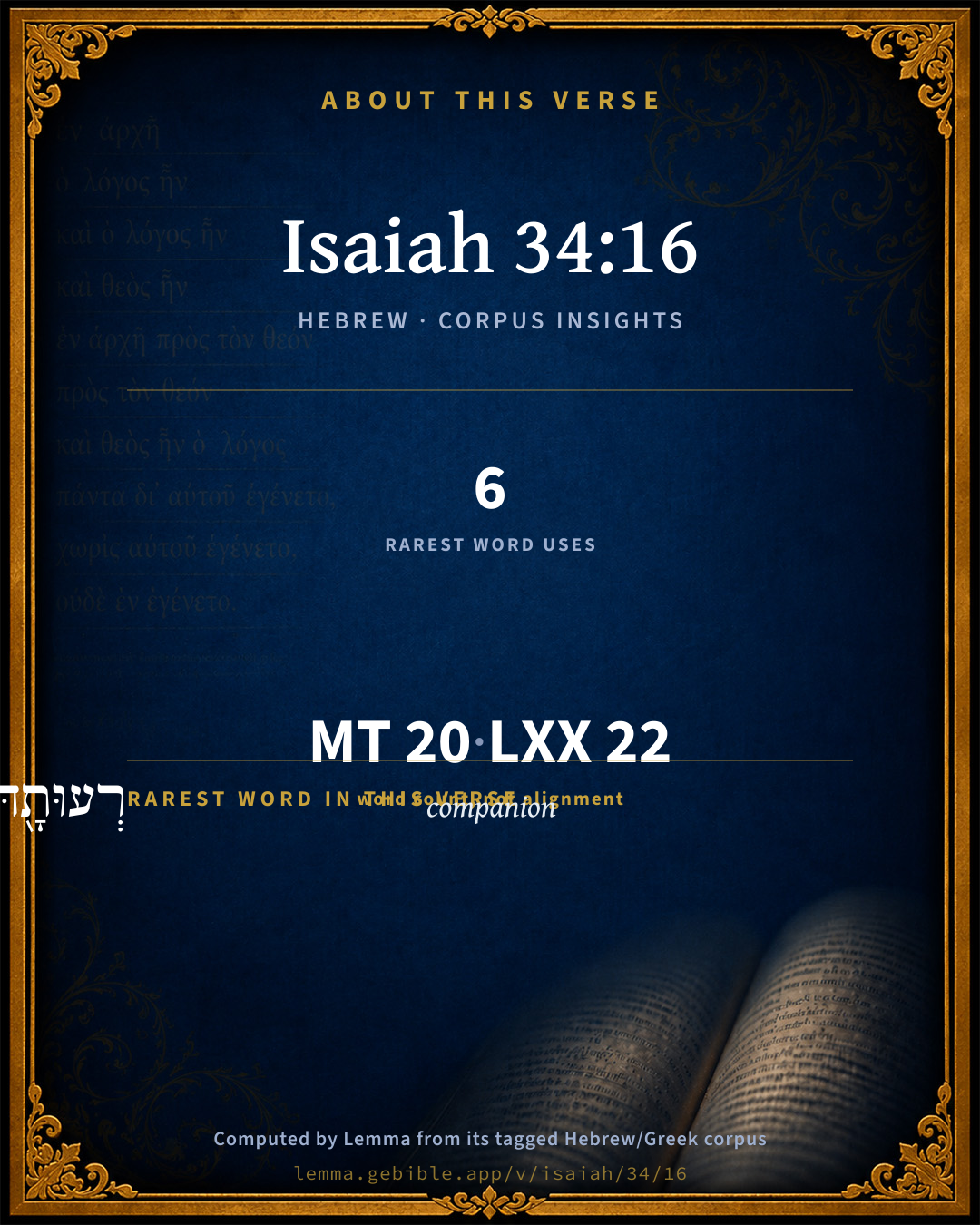
These counts appear in no published source. They are computed here, from the morphology-tagged text and Lemma’s own curated glosses. What Lemma adds →

20
words
18
distinct lemmas
Prophets
section

Notable vocabulary

The rarest word here is רְעוּתָ֖הּ companion H7468 — appearing just 6 times in the whole Hebrew Bible.

Shared distinctive vocabulary

רְעוּתָ֖הּ companion H7468 occurs in 6 verses of the Hebrew Bible. Also found in:

Grammatical profile

  • 6 verbs
  • 6 nouns
  • 1 adjective
  • 3 pronouns
  • 1 preposition
  • 1 conjunction
  • 2 particles

Verb forms

  • דִּרְשׁ֨וּ Qal · Imperative
  • וּֽקְרָ֔אוּ Qal · Imperative
  • נֶעְדָּ֔רָה Niphal · Perfect
  • פָקָ֑דוּ Qal · Perfect
  • צִוָּ֔ה Piel · Perfect
  • קִבְּצָֽן Piel · Perfect

Repetition

Words recur within this verse — often emphatic in Hebrew:

Hebrew & Septuagint length

In English translation the verse runs 35 words from the Hebrew and 27 from the Septuagint (LXX English) — closely comparable.

A rough comparison of the two English renderings, which tokenize alike — not a word-level alignment.

Word counts can differ between the Hebrew and the Greek without any difference in meaning — e.g. the Hebrew direct-object marker אֵת has no separate Greek word, and Greek often adds the article ὁ.

In the original languages it is 20 Hebrew tokens and 22 Greek tokens — but the two are counted differently (Hebrew bundles its prefixes and suffixes into one token; the Greek is in lemma form), so that isn’t a like-for-like length.

Cross-references

17

Topical passages linked to Isaiah 34:16 in the Treasury of Scripture Knowledge — connected by theme and wording, ordered by reader-vote popularity; previews shown in the World English Bible.

  • Psalms 33:9 For he spoke, and it was done. He commanded, and it stood firm.
  • Joshua 1:8 This book of the law shall not depart out of your mouth, but you shall meditate thereon day and night, that you may observe to do according to all that is written therein: for then you shall make your way prosperous, and then you shall have good success.
  • Matthew 5:18 For most assuredly, I tell you, until heaven and earth pass away, not even one smallest letter or one tiny pen stroke shall in any way pass away from the law, until all things are accomplished.
  • Isaiah 30:8 Now go, write it before them on a tablet, and inscribe it in a book, that it may be for the time to come forever and ever.
  • Psalms 33:6 By Yahweh's word the heavens were made; All their host by the breath of his mouth.
  • Proverbs 23:12 Apply your heart to instruction, And your ears to the words of knowledge.
  • Luke 21:33 Heaven and earth will pass away, but my words will by no means pass away.
  • John 10:35 If he called them gods, to whom the word of God came (and the Scripture can't be broken),
  • Daniel 10:21 But I will tell you that which is inscribed in the writing of truth: and there is none who holds with me against these, but Michael your prince."
  • Malachi 3:16 Then those who feared Yahweh spoke one with another; and Yahweh listened, and heard, and a book of memory was written before him, for those who feared Yahweh, and who honored his name.
  • Isaiah 58:14 then shall you delight yourself in Yahweh; and I will make you to ride on the high places of the earth; and I will feed you with the heritage of Jacob your father: for the mouth of Yahweh has spoken it.
  • Amos 3:7 Surely the Lord Yahweh will do nothing, Unless he reveals his secret to his servants the prophets.
  • 2 Peter 1:19 We have the more sure word of prophecy; whereunto you do well that you take heed, as to a lamp shining in a dark place, until the day dawns, and the day star arises in your hearts:
  • Isaiah 1:20 But if you refuse and rebel, you shall be devoured with the sword; For the mouth of Yahweh has spoken it."
  • Genesis 6:17 I, even, I do bring the flood of waters on this earth, to destroy all flesh having the breath of life from under the sky. Everything that is in the earth will die.
  • Deuteronomy 31:21 It shall happen, when many evils and troubles are come on them, that this song shall testify before them as a witness; for it shall not be forgotten out of the mouths of their seed: for I know their imagination which they frame this day, before I have brought them into the land which I swore.
  • John 5:39 "You search the Scriptures, because you think that in them you have eternal life; and these are they which testify about me.

Cross-references courtesy of OpenBible.info (CC BY 4.0).

Hebrew and Greek witnesses Masoretic Hebrew ↔ Greek Septuagint

The same verse in the two great witnesses to the Old Testament, shown verse-for-verse.

These are two independent witnesses, not word-aligned to each other, and the Septuagint is shown in lemma (dictionary) form.

Hebrew Isaiah 34:16 Masoretic · Westminster Leningrad Codex

דִּרְשׁ֨וּ מֵֽעַל סֵ֤פֶר יְהוָה֙ וּֽקְרָ֔אוּ אַחַ֤ת מֵהֵ֨נָּה֙ לֹ֣א נֶעְדָּ֔רָה אִשָּׁ֥ה רְעוּתָ֖הּ לֹ֣א פָקָ֑דוּ כִּֽי פִי֙ ה֣וּא צִוָּ֔ה וְרוּח֖וֹ ה֥וּא קִבְּצָֽן

Seek you out of the book of Yahweh, and read: no one of these shall be missing, none shall want her mate; for my mouth, it has commanded, and his Spirit, it has gathered them.

World English Bible · Public Domain

Greek LXX Isaiah 34:16 Septuagint · lemma form

ἀριθμός παραἔρχομαι καί εἷς αὐτός οὐ ἀποὀλλύω ἕτερος ὁ ἕτερος οὐ ζητέω ὅτι κύριος ἐντέλλομαι αὐτός καί ὁ πνεῦμα αὐτός συνἄγω αὐτός

They passed by in full number, and not one of them perished: they sought not one another; for the Lord commanded them, and his Spirit gathered them.

LXX2012 (modern English Septuagint) · Public Domain

On this verse, Lange's Commentary on the Holy Scriptures discusses the Septuagint’s reading. Read the note in Commentary ↓

Hebrew: Westminster Leningrad Codex (CC BY 4.0). Greek: Septuagint (public domain); English from LXX2012 (modern English Septuagint) (Public Domain). How the Septuagint differs from the Hebrew →

Targum (Aramaic paraphrase)

1

The Targum is the ancient Jewish Aramaic paraphrase of the Hebrew Scriptures — an interpretive translation, not the Hebrew text itself. Onkelos (literal) and Pseudo-Jonathan (expansive) render the Torah, and Jonathan the Prophets. Coverage is partial: where no permissively-licensed English translation exists for a verse, only the Aramaic is shown. This is verse-level text, not a word-by-word alignment to the Hebrew.

  1. Targum Jonathan Prophets (Joshua–Malachi)
    תְּבָעוּ מֵעַל סִפְרָא דַייָ וּבְעוֹ חֲדָא מִנְהוֹן לָא שְׁנָת וְאִתְּתָא לַחֲבֶרְתָּהּ לָא עַכִּיבַת אֲרֵי בְּמֵימְרֵהּ יִתְכַּנְשִׁן וּבִרְעוּתֵהּ יִתְקָרְבָן:

    Search ye out of the book of the Lord, and seek: no one of them shall fail, none shall tarry for her mate, for by His WORD they shall be gathered together, and by His pleasure they shall be brought together.

    Targum Jonathan — Aramaic: “Mikraot Gedolot” (public domain). English: “Sefaria Community Translation” (CC0 1.0 (public-domain dedication)); “London "Chaldee Paraphrase," 1871” (public domain). Text via Sefaria.

Commentary

Notes on Isaiah 34:16 from classic Christian and Jewish commentators (each source and its license shown beneath its notes). The classic Christian expositions comment on the surrounding passage and are grouped to its opening verse, so a note may address several verses; the Jewish commentaries on the Tanakh (Rashi and others) are per-verse, so they appear only where the commentator wrote on this verse.

Lemma curates 59 commentaries, every one of them public domain or Creative Commons licensed, each selected and text-cleaned for this edition rather than reprinted as found. About our sources →

Trapp's Complete Commentary

John Trapp

Isa 34:16 Seek ye out of the book of the LORD, and read: no one of these shall fail, none shall want her mate: for my mouth it hath commanded, and his spirit it hath gathered them.

Ver. 16. Seek ye out of the book of the Lord.] Sciscitamini ex libro Domini, the Holy Bible, which Bishop Bonner’s chaplain called, in scorn of the martyrs, Your little pretty God’s book. Another Bohemian blasphemer for Biblia called it Vitlia, which in the Bohemian language signifieth vomit. But let us search the Scriptures - and particularly this prophecy commanded to be written in a book {Isa 30:8} - and compare the truth of these predictions with the events.

None shall want her mate.] Some write of the asp, he never wandereth alone without his companion; and none of these birds of desolation want their mate; so craft and cruelty do ever go together in the Church’s enemies.

John Trapp, A Commentary or Exposition upon All the Books of the Old and New Testament (1647–1656) — public domain. Text from a community e-Sword module.

The Biblical Illustrator

Joseph S. Exell

Isa_34:16

Seek ye out of the Book of the Lord

The Scriptures the Book of the Lord, to be diligently studied

I.

THE HOLY SCRIPTURE IS THE BOOK OF THE LORD.

II. THE SCRIPTURE IS A BOOK TO BE READ; carefully and diligently searched, consulted and sought unto. (T. Watson, D. D.)

The Holy Scripture is the Book of the Lord

1. This Book discovers what no mortal could ever have done, and nowise could be had but by Divine revelation.

2. The perfect holiness of the doctrine.

3. The efficacy of the doctrine in its searching and convincing the conscience (Heb_4:12); converting souls from their most beloved lusts, even when nothing can be expected from the world for such a change Psa_19:7); rejoicing the heart under the deepest distresses (verse 8). This is not from any virtue in the letters or syllables, but from the Spirit, whose instrument it is.

4. The miracles wherewith it has been confirmed.

5. There is an inward sensation of this in the spirits of those that have their senses exercised. (T. Watson, D. D.)

Seeking out of the Book of the Lord

What is presupposed in this seeking out of the Book of the Lord?

1. That man has lost his way, and needs direction to find it.

2. That man is in hazard of being led further and further wrong.

3. That men are slow of heart to understand the mind of God in His Word.

4. That the Book of the Lord has its difficulties which are not to be easily solved.

5. That we need highly to understand it; otherwise we would not be bidden search into it.

6. That we may gain from it by diligent inquiry. (T. Watson, D. D.)

Reasons for searching the Book of the Lord

1. Because the way of salvation is to be found only therein (Joh_5:39).

2. It is the only rule of our faith and lives (Isa_8:20). The lawyer studies his law books, the physician his medical books; and shall not a Christian study the Book of the Lord?

3. The Lord Himself dictated it and gave it us for that very end (2Ti_3:16-17; Rom_15:4).

4. We must be judged by the Scriptures at the great day (Joh_12:48). (T. Watson, D. D.)

The systematic investigation of Christianity

I. UNLESS THE GOSPEL BE MADE THE SUBJECT OF MUCH REFLECTION AND EARNEST INVESTIGATION IT CANNOT BE RIGHTLY UNDERSTOOD. Are those truths which have a reference to the grandest objects in existence so very easily to be comprehended as to require less attention than the ordinary facts and principles which are connected with business or literature?

II. Universally human nature is in a state of moral disorder and rebellion against God; and AS CHRISTIANITY HAS BEEN SENT FROM HEAVEN WITH THE EXPRESS DESIGN OF REMOVING THAT DISORDER AND EFFECTING A RECONCILIATION BETWEEN GOD AND MAN, IT IS INDISPENSABLY REQUISITE THAT ALL SHOULD KNOW IN WHAT IT CONSISTS. (W. Keith)

Reading the Scriptures

I. The Scriptures should be read with A SERIOUS MIND. The argument by which Moses urged the Jews to attend to the laws of God may be applied to Scripture at large--It is not a vain thing: it is your life. When we read our Bible we stand in the presence of God: we are receiving His communications.

II. The Scriptures should be read with EARNEST PRAYER. Divine influence is needful to impress them upon our understandings and hearts.

III. Scripture should be read with PURE INTENTIONS. If any man will do His will, &c. Nothing resists the evidence or dislikes the principles of the Bible but sin.

IV. The Bible should be read with EXPECTATIONS AND DESIRES. We cannot place too much confidence in its authority, or anticipate too much comfort from its influence. All that may be expected from God may be expected from His Word. There He opens His resources and declares His will; there we read what He is, and what He can do, and what He intends to do. To read the Bible and expect nothing from its influence is to reflect dishonour upon it.

V. The Bible should be read with RETENTIVE MEMORIES. It is intended not so much for present entertainment, as for future wisdom and holiness: its contents, therefore, should be stored and classed in the memory, to be drawn forth and applied as the different circumstances of life require. This study of the Scriptures produces incalculable advantages; it will afford--

1. The most valuable instruction.

2. The best impressions. There is an energy in the Bible which no man of feeling can withstand. The words which it contains are spirit and life. Under Divine influence it has counteracted carnal affections and vicious propensities; it has raised mens minds to God: it has filled them with love to mankind. So as Scripture makes men holy it makes them happy. In the midst of trouble they have an unfailing refuge. (Homilist.)

.

The recurrence of the figures of Isa_35:1-10.

Many of the figures in this beautiful prophecy of Israels restoration recur in the course of chaps, 40-66.,-- Isa_35:10, for instance, is repeated verbatim in Isa_51:11.(Prof. S. R. Driver, D. D.)

The manifold application of Isa_35:1-10.

Without any change of its essential meaning it may be applied to the restoration of the Jews from Babylon, to the vocation of the Gentiles, to the whole Christian dispensation, to the course of every individual believer, and to the whole blessedness of heaven. The ground of this manifold application is not that the language of the passage is unmeaning or indefinite, but that there is a real and designed analogy between the various changes mentioned which brings them all within the natural scope of the same inspired description. (J. A. Alexander.)

A joyous chapter

This chapter contains thirty-five distinct promises, among them twenty-two shalls--nine shalls of blessing and comfort; eight shalls of deliverance; five shahs of joy. It begins and ends with joy. (E. J. Banks.)

The Biblical Illustrator, edited by Joseph S. Exell (c. 1880s–1900s) — public domain. Text from a community e-Sword module.

Joseph Benson's Commentary

Isa 34:16-17. Seek ye out of the book of the Lord — Here the prophet confirms the preceding prediction; and, “to convict hypocrites, and confirm the pious, assures them of the certain completion of his prophecy.” He terms it, and his other prophecies, The book of the Lord. as being a part of divine revelation; and he supposes they would be extant at the time of the completion of their contents, and therefore invites all men to seek into and consider them in all their parts, in order that, comparing the events with the predictions, they might be fully satisfied of the truth of them, and thereby might find their faith in them, and all the other parts of God’s book, confirmed. Not one of these shall fail — No, not so much as the minutest circumstance, even respecting the impure beasts now mentioned. None shall want her mate — As I have said that the vultures should all have their mates, so it shall be: for my mouth — The mouth of the Lord; it hath commanded — The direful muster of the beasts and fowls; these marks and evidences of desolation; and his Spirit — That is, his power; it hath gathered — Shall gather all his creatures together, as he formerly brought the creatures to Adam and to Noah, by an instinct which he put into them. And he hath cast the lot for them, &c. — He hath divided the land to them, as it were, by lot and line, as Canaan was divided among the Israelites.

Joseph Benson's Commentary on the Old and New Testaments (1811–1818) — public domain. Text from a community e-Sword module.

The Preacher's Complete Homiletical Commentary

Joseph S. Exell (gen. ed.)

A CALL TO STUDY

Isa_34:16. Seek ye out of the Book of the Lord, and read, &c.

On the supposition that a Divine revelation is given to man, its most convenient method will be that of a permanent written record, thus available for the use of successive generations. Disparagement of a book revelation proceeds from misconception of its nature and ends. Out of its existence flows the universal right to its perusal, unless it is restricted in terms. Not only the right, but the duty. By personal study every one should know it (Joh_5:39). Our Lord appealed to the conscience of the people, combined with their knowledge of the Word of God.

The duty is here urged in reference to the prediction of the downfall of Idumea. It was to become a desolation. Those into whose hands the prophecy falls are to search and read in the Book of the Lord, and compare the event. Nothing shall fail. Everything said shall find its mate, its corresponding fact; for God’s Spirit is the Author of the prediction. Idumea to-day is its confirmation.

We use the text in order to urge the study of Scripture as a Christian duty—

I. BECAUSE THE BOOK IS DIVINE.

2Ti_3:16; 2Ti_1:13. It is the Book of the Lord. The Bible is a collection of the records of Divine revelations made at various times, but bearing on its great design. The inducement to read a book often depends on the author. We believe him to be endowed with literary skill, or an authority on the subject of the book. And if God is, in some way, through the various writers, the Author of the Book, the authorship is an important reason for reading it (H. E. I. 522, 523). Consider who and what He is, and the solemn relations in which He stands to us (H. E. I. 561). Its subjects will be worthy of Him and important to us. It will be authoritative. From the uncertainties of human thought we find in the Lord’s Book a safe resting-place.

II. BECAUSE THE BOOK IS INTERESTING.

In its form, apart from its subject-matter. Some form it must have. It might have been in the form of didactic statement only, without illustrative facts or poetic beauties. It would not have been read with interest. Or it might have been in the catechetical form. However useful this method in fastening definite notions in carefully chosen words, it would have failed to be a book to which men and women would return with delight as they return to the Bible after the period of youth has passed away. It is made interesting by the varied forms in which truth is communicated. It is poetic, historical, biographical. Its teaching is usually so connected with events and persons as to present points of interest always fresh. The man finds a solution of the profoundest problems of time and eternity. The child finds in its narratives of persons and events a charm that never fails. To its interesting form is owing, in a large degree, its hold on those who read it from day to day (H. E. I. 607–609, 3860).

III. BECAUSE THE BOOK IS INSTRUCTIVE.

It contains a large amount of information, not only with regard to the Jewish nation, but also other nations of the ancient world. But this is not its main design. It is subordinate to the revelation of man as a sinner and of God as a Saviour. God’s character, man’s relation to Him, human duty, the future state, are all instructively treated; but they all find their place in relation to God’s great plan for man’s recovery, through the mediation of Christ, from misery and sin. And is not this the most important of all instruction? What would all history be, all science, all philosophy, if no voice from Heaven was heard respecting the most vital of all questions? Do you desire instruction respecting salvation? Search and read in the Book of the Lord.

IV. BECAUSE THE BOOK IS DIRECTIVE.

Is not the course of human life like that of a vessel exposed to winds that may drive her leagues out of her proper course? Does not man need careful guidance? Conscience is the captain, but conscience untaught and unguided will manage the ship uncertainly and erroneously (H. E. I. 1299–1307). The Book of the Lord is the directory for the conscience. No position demanding moral action can ever occur in which adherence to its direction will not issue safely. How pure its principles! How righteous its commands! How wise its directions! They touch our life at every point.

V. BECAUSE THE BOOK IS CONSOLATORY.

Sorrows are incident to human life. There are present troubles. Some are heart-breaking. We need help and comfort. The world does not contain it. Here is the balm that can heal every wound.

And there is the future. The prospect of death and eternity. Without the Book of the Lord men are uncertain and hopeless. It sheds clear light on both. How many, in the prospect, are delivered from fear and filled with hope! What comfort it affords under the bereaving stroke!

For all these reasons “seek ye out the Book of the Lord.” Bring every question to it. Read it daily, thoughtfully, for yourself, for others. In your youth. In your active manhood. In your old age.—J. Rawlinson.

THE BOOK THAT WILL ENDURE TESTING

Isa_34:16. Seek ye out of the Book of the Lord, and read, &c.

We may be sure that God would not give a revelation without affixing His seal to it; otherwise, it would be useless, there being no evidence of its Divine origin. Supposing a revelation given, what would constitute a satisfactory proof of its divinity? Evidently it must be some sign not capable of being counterfeited, some unmistakable indication that GOD has spoken to us. This might be given by some exertion of Divine power or some manifestation of Divine knowledge. As such, miracles and prophecy would furnish indubitable proof that a revelation was from God, and those which attest the Bible are its proper seals. Along with the internal evidence and the argument drawn from the success of the Gospel, they are so many buttresses supporting the edifice of revealed truth; but each is a distinct and sufficient support by itself. The Scriptures themselves appeal to the evidence of fulfilled prophecy in support of their reception as the Word of God, and one of the most pointed of these appeals is that before us. In this chapter Isaiah predicts the desolations that were to come upon the chief city of Edom. Placing himself forward in time amid the scenes he predicts, he challenges any one to compare the predictions in the Book of the Lord with the actual condition of the city; he is confident that “the Book” will bear that test, and will come out of it triumphantly.

I. Read the prophecy before us in the light of its fulfilment. The apologetic value of prophecy has often been discredited. Attempts have been made to explain it on natural grounds, as a sagacious forecast, a shrewd prognostication. But what natural sagacity could have foreseen that Edom, so powerful and prosperous in Isaiah’s time, would become a desolate waste? It has been well remarked that prophecy possesses as a proof of Divine revelation some advantages that are peculiar. Its fulfilment may fall under our own observation, or may be conveyed to us by living witnesses. The evidence from miracles can never be stronger than it was at first; but that of prophecy is increasing, and will go on increasing until the whole scheme of perdition is fulfilled. It is the accomplishment, and not the mere publication of a prophecy, which supplies a proof of the Divine origin of the Bible; and this evidence is constantly accumulating. The prophets themselves did not understand some of their oracles (1Pe_1:11-12). They were like documents written in colourless ink, to which some chemical preparation must be applied to make their characters legible. Their meaning could be seen only in their fulfilment. But all the prophetic writings are not thus obscure: many are clear and definite; more like the details of a historical narrative than the visions of prophecy. Nothing can be plainer than the description here given of the state to which Edom would be reduced. The wards of this lock are too intricate to be opened by any key which we choose to apply to it; but the fitting key has been found. “The whole,” says Alexander, “is a magnificent prophetic picture, the fidelity of which, so far as it relates to ancient Edom, is notoriously attested by its desolation for a course of ages.” The chief city in the region of Mount Seir was Selah or Petra, the Rock City. It was long unknown till it was discovered by Robinson, and since then it has been visited by successive travellers. It lay embedded among the hills. So nestled was it in its rocks “that it could only be approached by two narrow defiles. Dwellings cut out of the solid stone line the face of the cliffs, and the central space indicates that a large city once stood upon it.” Malachi speaks of its utter desolation (Mal_1:2-3), but afterwards it recovered for a time. Its condition for centuries as described by unbiased witnesses is a standing evidence of the truth of the prophetic Word.

II. We may test “the Book” in other fields. As a tourist verifies his guide-book and finds it trustworthy at every step, so in many regions do we find the prophetic Word made sure (2Pe_1:19-21). Babylon, Tyre, and the fortunes of the Jewish people, all bear witness to the truth of the prophecies. But especially in the career of our Lord and Saviour do we meet with remarkable fulfilments of Scripture. What could be more minute than some of the prophecies concerning Him? His miracles, His submission to unmerited suffering, His riding upon an ass, His being pierced, His being sold for thirty pieces of silver which should be applied for the purchase of the Potter’s Field, the lots cast on His vesture, and the vinegar given Him to drink, were all the subject of definite prediction.

III. The Bible will bear testing in its declarations concerning human nature. No book so unveils us to ourselves. We feel its truth in what it says about our noble origin, our lamentable fall, our sinfulness, and the strife within us between the flesh and the spirit. Because it tells us all that ever we did, we feel that it must be Divine.

IV. From all this two sound and important conclusions follow:—

1. We may put equal confidence in its declarations concerning God. Nothing but Divine knowledge and insight can so disclose the future and the hidden; and if we have found the Bible reliable when it tells us of earthly things, may we not believe it when it tells us of heavenly things?

2. We may be sure that its prophecies concerning the future of Christ’s kingdom and the destiny of the human race will in like manner be fulfilled to the letter (Psa_72:11; Psa_72:17; Rom_8:19; Rom_8:23). So many of the prophecies of God’s Word have already been accomplished, that we should feel confident that those not yet fulfilled are surely marching on to their fulfilment. The prospects of success in the mission-field are brighter in our day than ever they were. The Church is taking an interest in the enterprise quite unknown to former generations, and openings have been made into lands before closed alike against commerce and Christianity. But even if our hopes of success were less cheering, we would not despair. With so many Bible predictions behind us in the past now become history, we cannot but be encouraged to look for the fulfilment of those glowing promises concerning the future coming of the Redeemer’s kingdom which stand on the inspired page. Let us never lose sight of those grand predictions; let us cherish a hopeful and expectant spirit, and in the confidence of success descend to the spiritual harvest of the world (H. E. I. 1166–1168).—William Guthrie, M.A.

THE CERTAINTY OF GOD’S JUDGMENTS

Isa_34:16-17. Seek ye out of the Book of the Lord, &c.

The text occurs midway between a series of predicted judgments pronounced on Edom as the representative of the wicked world, and another series of blessings foretold concerning the Church of God, but it is evidently retrospective.

While a minute verification of these predictions of vengeance might form a solid, convincing argument for the validity of trust in the Bible as the rule of faith and practice, there is another and more general way of regarding the text. Search into a certain book is enjoined because it is the Book of JEHOVAH.

Human faith finds its ultimate basis in God Himself. The certainty of the Divine judgments may therefore be inferred from—

I. THE NATURE OF THE DIVINE BEING.

If the Bible be not merely a revelation from God, but a revelation of God, too much attention cannot be paid to those aspects of the Divine nature afforded by it which man may apprehend although he cannot comprehend them. “Canst thou by searching find out God?” &c. No; but enough may be learned of God to make us sure that it is madness to disobey Him or trifle with His commands.

1. The long-hidden Name of God. Proper names were made very expressive among the Jews. The name JEHOVAH was sacred above all others; they treated it with a superstitious reverence, not daring to pronounce it, &c. Doubtless they referred with awe to the time and circumstances of its communication to Moses (Exo_6:1-2). And so may we in thinking of the Divine judgments. JEHOVAH, it is said, “remembered His covenant,” and was about to redeem the Israelites from their bondage in Egypt “with a stretched-out arm, and with great judgments” (Exo_6:1-8). JEHOVAH: what does the Name mean? Being—unconditioned, absolute, immutable, eternal Being. If, then, God changes not, but is JEHOVAH, to sin against Him is inevitably to call down judgment; for JEHOVAH’S will must be done on earth as it is in heaven.

2. Some of the attributes by the use of which we try to compass the Divine nature.

(1.) God is just. But sin, in all its forms, is a crying injustice, and affronts God so that the Divine majesty must assert itself in punishment.

(2.) God is good. But sin, as selfishness, is radically opposed to goodness in God, who has might, as well as right, on His side, and, therefore, pursues selfishness to its last resort.

(3.) God is holy. Separateness from all sin distinguishes Him in the midst of His relations to man. How, then, can sinners go unpunished? (H. E. I. 2281, 2282, 4478–4479, 4603–4610).

II. THE CHARACTER OF DIVINE LAW.

Law is a transcript of the Divine nature; the Divine character or handwriting making Him known to us; the far-reaching Hand of the Eternal. God reveals Himself in its sanctions, reward, and punishment. To obey is to reap reward; to disobey is to be laid hold of instantly by the outraged majesty of law. There is no human way of escape. Visible judgment may be deferred, but the Divine law is cognisant of all transgression. In the matter of the first sin, the formerly existing potentiality of punishment became an actually. The character of the Divine law may be seen—

1. In the physical world. The designer of a ship or bridge diverges from mathematical truth only to produce disaster.

2. In Providence.

3. In the Word of God.

APPLICATION.—If the righteous scarcely be saved, where shall the ungodly and the sinner appear? The Divine judgments cannot be evaded. “God is love;” but what love! God is “a consuming fire;” not sentimentally weak; not given to winking at transgression.

4. God’s grace magnifies His name and law. He condemned Christ as the Sin-Bearer to death. Thank God! the sinner may be pardoned, but the impenitent are surely handed over to punishment.—J. Macrae Simcock.

The Preacher's Complete Homiletical Commentary (gen. ed. Joseph S. Exell; Funk & Wagnalls, c. 1892) — public domain (pre-1929). A full-Bible homiletical/sermon-outline anthology covering 65 of 66 books (2 John is absent from the source module). Text from a community e-Sword module.

Keil & Delitzsch

C. F. Keil & F. Delitzsch

Whenever any one compared the prophecy with the fulfilment, they would be found to coincide. "Search in the book of Jehovah, and read! Not one of the creatures fails, not one misses the other: for my mouth - it has commanded it; and His breath - it has brought them together. And He has cast the lot for them, and His hand has assigned it (this land) to them by measure: they will possess it for ever; to generation and generation they will dwell therein." The phrase על כּתב is used for entering in a book, inasmuch as what is written there is placed upon the page; and מעל דּרשׁ for searching in a book, inasmuch as a person leans over the book when searching in it, and gets the object of his search out of it. The prophet applied the title "The Book of Jehovah" to his collection of the prophecies with which Jehovah had inspired him, and which He had commanded him to write down. Whoever lived to see the time when the judgment should come upon Edom, would have only to look inquiringly into this holy scripture; and if he compared what was predicted there with what had been actually realized, he would find the most exact agreement between them. The creatures named, which loved to frequent the marshes and solitary places, and ruins, would all really make their homes in what had once been Edom. But the satyrs and the lı̄lı̄th, which were only the offspring of the popular belief - what of them? They, too, would be there; for in the sense intended by the prophet they were actual devils, which he merely calls by well-known popular names to produce a spectral impression. Edom would really become a rendezvous for all the animals mentioned, as well as for such unearthly spirits as those which he refers to here. The prophet, or rather Jehovah, whose temporary organ he was, still further confirms this by saying, "My mouth hath commanded it, and His breath has brought them (all these creatures) together." As the first creating word proceeded from the mouth of Jehovah, so also does the word of prophecy, which resembles such a word; and the breath of the mouth of Jehovah, i.e., His Spirit, is the power which accomplishes the fiat of prophecy, as it did that of creation, and moulds all creatures and their history according to the will and counsel of God (Psa 33:6). In the second part of Isa 34:16 the prophet is speaking of Jehovah; whereas in the first Jehovah speaks through him - a variation which vanishes indeed if we read פּיו (Olshausen on Job 9:2), or, what would be better, פּיהוּ, but which may be sustained by a hundred cases of a similar kind. There is a shadow, as it were, of this change in the להם, which alternates with להן in connection with the animals named. The suffix of chilleqattâh (without mappik, as in Sa1 1:6) refers to the land of Edom. Edom is, as it were, given up by a divine lot, and measured off with a divine measure, to be for ever the horrible abode of beasts and demons such as those described. A prelude of the fulfilment of this swept over the mountainous land of Edom immediately after the destruction of Jerusalem (see Khler on Mal 1:2-5); and it has never risen to its previous state of cultivation again. It swarms with snakes, and the desolate mountain heights and barren table-lands are only inhabited by wild crows and eagles, and great flocks of birds. But the ultimate fulfilment, to which the appeal in Isa 34:16 refers, is still in the future, and will eventually fall upon the abodes of those who spiritually belong to that circle of hostility to Jehovah (Jesus) and His church, of which ancient Edom was merely the centre fixed by the prophet.

Keil & Delitzsch — Biblical Commentary on the Old Testament (1861–1891) — public domain (CC PDM 1.0). Text via the HelloAO Bible API. (Old Testament only.)

Lange's Commentary on the Holy Scriptures

3. CONCLUDING REMARK: SUMMONS TO COMPARE THE PROPHECY WITH ITS FULFILMENT

Isa_34:16-17

16          Seek ye out of the book of the Lord, and read,

No one of these 24shall fail,

None shall want her mate:

For my mouth it hath commanded, and bhis spirit it hath gathered them,

17     And he hath cast the lot for them,

And his hand hath divided it unto them by line:

They shall possess it for ever,

From generation to generation shall they dwell therein.

TEXTUAL AND GRAMMATICAL

Isa_34:16. Comp. כָּתַב with על Isa_30:8; Jer_36:29; Deu_27:3; Deu_27:8, etc.——וקראו comp. Isa_29:11-12.——The LXX. reads דָרָֽשׁוּ instead of דִּרְשׁוּ and refer the word to what goes before. Moreover it has somehow confounded מעל־ספר with מִסְפָר, and derived קְרָאוּ from קָרָא occurrere, for it reads thus: ἐκεῖ ἔλαφοι συνήντησαν καὶ ἴδον τὰ πρόσωπα ἀλλήλων· ἀριθμῷ παρῆλθον. In the παρῆλθον is doubtless a reference to Gen_2:19. Strangely enough late expositors (Knobel, Meier) adopt this rendering through misconception of the passage.—I do not believe that the feminines in אחת מהנה and אשׁה רעותה Hate relate only to the living beings enumerated in vers, 5–15. For why are not other traits of the prophecy, murder, burning, etc, to be fulfilled? And why conceive of all the living beings as feminine? The Prophet changes the gender ver, 17. I agree with those that take these feminines in a neuter sense, and as relating to all the traits of the predicted judgment, which is grammatically quite justifiable (comp. Isa_41:22).——נעדר is used Isa_40:26, as here, in the sense of desiderari, deesse.——As אִשָּׁה אֲחוֹתָהּ is said of inanimate things (Exo_26:3; Exo_26:5-6, etc.) so the same is possible of אשה רעותה (asyndeton like Isa_34:15). פקדו is=“to miss,” (properly: to verify by inspection the non-existence, comp. 1Sa_20:6; 1Sa_25:15). The 3d pers. plur. denotes the impersonal subject=“one.”—פִי occasions great difficulty. Some (as Drechsler) would refer the suffix in פי to the Prophet and in רוחו to God. But could the Prophet say: my mouth has commanded it? He could only say “announced,” (הִגִיד or the like). Thus the Vulg. translates: quod ex ore meo procedit, ille mandavit. But the LXX. has simply, ὅτι κύριος ἐνετείλατο αὑτοῖς. It is better, with several Rabbis and Delitzsch, to refer both suffixes to God: “ my mouth has commanded it and its spirit, i. e., the spirit of my mouth has gathered them.” Still this is a strange form of expression. For it appears as if the Lord distinguished between His spirit and the spirit of His mouth, as if the latter were not His spirit; a distinction that does not appear Psa_33:6; Job_15:30. More over the explanation of Gesenius, who would take הוא for the nomen regens belonging to כּי (comp. מימי היא Nah_2:9), is not satisfactory. This construction is quite abnormal; for Nah_2:9 is not similar. With the exception of the clause “for my mouth—hath gathered them,” not only the entire preceding part of the chapt. but also verses 16, 17 are spoken only by the Prophet. A corruption of the text was very possible, in as much as כִּיהוּ, by reason of the הוּא after רוּחוֹ, could easily change to כּי הוּא. Hence I think that we must simply translate “his mouth.”—קבצן (Piel, see list) is to be referred to the same objects as the fem. suffixes preceding.

Isa_34:17. הכּיל גורל only here in Isaiah; comp. Psa_22:19; Eze_24:6, etc. גורל alone and חִלֵק see list.—קַו and ײרשׁוה and ישׁכנו בה comp. on verse 11.—לדור ודור see verse 11.

EXEGETICAL AND CRITICAL

1. The Prophet translates himself in spirit into the time when his prophecy shall have been fulfilled. As a pledge to his present readers of the reliability of his predictions he, so to speak, stakes his own and God’s honor on the fulfilment, which must be compromised by the non-fulfilment. For what the mouth of the Lord has announced, that the Spirit of the Lord will bring to pass. Though the immediate reference of these words is to the prophecy against Edom, it lies in the nature of things that the present summons concerns in the same way all predictions of the Prophet. It is hard to see why only the prophecy against Edom should be provided with such a postscript as the present. It is therefore a natural conjecture that this postscript stands connected with the position, and general significance of this prophecy against Edom. The latter concludes part first: for with 36 the historical pieces begin. We have found, too, this prophecy against Edom to be an exemplification in one nation of what is to happen to all (Isa_34:1-4). We may then take this postscript as pertaining to all the preceding threatening prophecies, because all of them are, so to speak, comprehended in this last one against Edom. Now as chap 34 is certainly more recent than most of the foregoing pieces, it is probable that this postscript was first added when the collection was made, to which perhaps the expression “Book of the Lord” refers. But, one may ask, why is this postscript put at the end of 35.? The verses 16, 17 are by their contents most intimately connected with Isa_34:5-15. But why such an appeal to the written word only after a threatening prophecy? Christ, too, speaks the significant words “behold I have told you before” (Mat_24:25; Mar_13:23) after announcing judgments. God’s salvation comes to the pious, and they know from whose hand it comes. But the wicked will not hear of God’s sending judgments. They ascribe them to accident or fatalistic necessity. Therefore it specially concerns them to prove, that the judgment is something announced beforehand, and thus is something previously known and determined, that it is therefore the act of Him who knows all His works from the beginning of the world (Act_15:18). Added to this, 35, points forwards more than backwards. It is the bridge to chapters 40–66, as it were, the morning twilight of the day of salvation, which dawns with chap. 40.

2. Seek ye—dwell therein. Isa_34:16-17. The summons to read in the written book seems to me to indicate that the Prophet has just been busy with a book and finished it, which he calls “the book of the Lord.” Gesen., and Drechsl., explain this to mean that the Prophet “had in mind the insertion of his oracle in a collection of holy Scriptures;” that he “knew it to be a part of a greater whole, into which, in its time, it must be adopted.” But then why does he think this only of this prophecy? Even though elsewhere there is mention of recording single prophecies for the purpose of appealing to them afterwards (Isa_8:1; Isa_30:8), still there is nowhere, beside the present, any mention of an entire book that deserved to be called “the book of the Lord.” But we evidently stand here at a boundary. The prophecies of part first conclude. Chapters 36–39, form an historical supplement. With 40, the second part begins. And at this significant point a “book of the Lord” is mentioned. This is certainly not to be explained by saying that in closing his prophecy the Prophet happened here to mention the future book of which it was to become a part. It is much more likely that the Prophet provided this prophecy with such a conclusion, when he put this prophecy at the end of a great book, that he called Jehovah-book, as containing the entire Jehovah-word announced by him. The expression סכּר יהוה occurs only here. Only a work in which Jehovah had space to give an all-sided revelation of His nature and will, deserved this name. And only a Prophet that was conscious of having been God’s faithful instrument in all he had said and written, could set such a title to his book.

The prophecy must he fulfilled because God is author of it. This is the general sense. But as to particulars כִּי occasions difficulty, on which see Text. and Gram. The Spirit of God, or perhaps more correctly the breath of God drives, or rather blows together, from all quarters what God needs in one place for the accomplishment of His counsel. Compare an analogous use of קִבֵּץMic_1:7. The various beings or powers mentioned in Isa_34:5-15 are partly masculine, partly feminine. The Prophet repeats with emphasis that the total of them, i.e., the representatives of both genders are endowed with the land of Edom in eternal possession. He has similarly expressed the difference in gender by the different gender terminations, Isa_3:1.

[On Isa_34:17. “An evident allusion to the division of the land of Canaan, both by lot and measuring line. (See Num_26:55-56; Jos_18:4-6). As Canaan was allotted to Israel, so Edom is allotted to these doleful creatures.”—J. A. Alexander.].

DOCTRINAL AND ETHICAL

1. On Isa_34:1-4. Because Rev_6:12-17 has express reference to this passage, some would conclude that the Prophet here has in view only that special event of the world’s judgment (the opening of the sixth seal). But that is not justified. For other passages of the New Testament that do not specially relate to the opening of the sixth seal are based on this passage (Mat_24:29; 2Pe_3:7 sqq.; Rev_14:11; Rev_19:11 sqq.). It appears from this that the present passage is, as it were, a magazine from which New Testament prophecy has drawn its material for more than one event of fulfilment.

2. On Isa_34:16. The word of God can bear the closest scrutiny. Indeed it desires and demands it. If men would only examine the Scriptures diligently and with an unclouded mind and love of truth, “whether these things are so,” as did the Bereans (Act_17:11; Joh_5:39)!

3. On Isa_35:3. “The Christian church is the true Lazaretto in which may be found a crowd of weary, sick, lame and wretched people. Therefore, Christ is the Physician Himself (Mat_9:12) who binds up and heals those suffering from neglect (Eze_34:16; Isa_61:1). And His word cures all (Wis_16:12). His servants, too, are commissioned officially to admonish the rude, to comfort the timid, to bear the weak, and be patient with all (1Th_5:14). Therefore, whoever feels weak, let him betake himself to this Bethania; there he will find counsel for his soul,” Cramer.

4. [On Isa_35:8-9. “They who enter the path that leads to life, find there no cause of alarm. Their fears subside; their apprehensions of punishment on account of their sins die away, and they walk that path with security and confidence. There is nothing in that way to alarm them; and though there are many foes—fitly represented by lions and wild beasts—lying about the way, yet no one is permitted to ‘go up thereon.’ This is a most beautiful image of the safety of the people of God, and of their freedom from all enemies that could annoy them.” “The path here referred to is appropriately designed only for the redeemed of the Lord. It is not for the profane, the polluted, the hypocrite. It is not for those who live for this world, or for those who love pleasure more than they love God. The church should not be entered except by those, who have evidence that they are redeemed. None should make a profession of religion who have no evidence that they belong to “the redeemed,” and who are not disposed to walk in the way of holiness. But for all such it is a highway on which they are to travel. It is made by leveling hills and elevating valleys; across the sandy desert and through the wilderness of this world, infested with the enemies of God and His people. It is made straight and plain, so that none need err; it is defended from enemies, so that all may be safe; because ‘He,’ their Leader and Redeemer, shall go with them and guard that way.” Barnes in loc.]

Footnotes:

[24]fails, Neither one nor the other does one miss,

Lange's Commentary on the Holy Scriptures (Critical, Doctrinal, and Homiletical), ed. John Peter Lange, English translation edited by Philip Schaff (1864–1880) — public domain. Text from a community e-Sword module.

Tyndale Open Study Notes

Tyndale Open Resources

34:16 Search the book of the Lord: Isaiah’s prophecy was God’s witness to the truthfulness of his word. • The power of the Spirit enacts the Lord’s decrees, assuring that all prophecy comes together to be fulfilled as God promised.

Tyndale Open Study Notes — © Tyndale Open Resources, licensed CC BY-SA 4.0. Text via the HelloAO Bible API.

Geneva Bible (1599)

Geneva Bible translators

That is, the mouth of the Lord.

That is, in the Law where such curses are threatened against the wicked.

To wit, beasts and souls.

Geneva Bible (1599) marginal notes — public domain. Text via Bolls.life.

Jamieson, Fausset & Brown

Robert Jamieson, A. R. Fausset & David Brown

book of the Lord--the volume in which the various prophecies and other parts of Scripture began henceforward to be collected together (Isa 30:8; Dan 9:2).

Seek--(so Isa 8:16, Isa 8:20; Joh 5:39; Joh 7:52).

no one . . . fail--of these prophecies (Mat 5:18).

none shall want . . . mate--image from pairing of animals mentioned, Isa 34:15 ("mate"); no prediction shall want a fulfilment as its companion. Or rather, "none of these wild animals (just spoken of) shall be wanting: none shall be without its mate" to pair and breed with, in desolate Idumea.

my . . . his--Such changes of person are frequent in Hebrew poetry.

them--the wild beasts.

Jamieson, Fausset & Brown — Commentary Critical and Explanatory on the Whole Bible (1871) — public domain (CC PDM 1.0). Text via the HelloAO Bible API.

Adam Clarke's Commentary

Verse 16. My mouth - "For the mouth of JEHOVAH"] For הוא hu, five MSS., (three ancient,) read יהוה Jehovah, and another is so corrected; so likewise the Septuagint. Two editions have צום tsivam; and so the Septuagint, Vulgate, and Arabic, with the edition of 1486, and a MS. has קבצם kebatsam, with the masculine pronoun instead of the feminine: and so in the next verses it is להם lahem, instead of להן lahen, in fourteen MSS., six of them ancient. - L. To see the importance of these various readings, the Hebrew Bible must be consulted.

Adam Clarke's Commentary on the Bible (1810–1826) — public domain. Text from a community e-Sword/MySword module.

Ellicott's Commentary for English Readers

(16) Seek ye out of the book of the Lord . . .—The phrase is an exceptional one. Isaiah applies that title either to this particular section, or to the volume of his collected writings. When the time of the fulfilment comes, men are invited to compare what they shall then find with the picture which Isaiah had drawn. Keith and others have brought together from the descriptions of modern travellers, illustrations of the condition of Edom as it is well summed up by Delitzsch in loc. “It swarms with snakes, and the desolate heights and barren table-lands are only inherited by wild crows and eagles; and great flocks of birds.” It has to be remembered, however, that the decay was very gradual. The ruins of Petra and other Idumæan cities are of Roman origin, and indicate a period of culture and prosperity stretching far into the history of the Empire.

His spirit.—In the sense of the creative Breath of the Almighty working in Nature (Psa_104:30).

A Bible Commentary for English Readers, edited by Charles John Ellicott (1878–1897) — public domain. Text from a community e-Sword module.

The Cambridge Bible for Schools and Colleges

gen. ed. J. J. S. Perowne

16. The verse is remarkable in several respects. It seems to be a solemn assurance that the foregoing prediction shall be fulfilled literally and down to the smallest details; and must therefore be addressed to a future generation of readers. This implies a view of the scope and functions of prophecy, which is not that of the older prophets. Further, the expression “book of Jehovah” appears to point to the existence of a prophetic canon; and the opening exhortation presupposes a habit of searching for evidences of the fulfilment of prophecy. All these circumstances would indicate a late date for the composition of this oracle. Some commentators, however, have sought to evade this interpretation by amending the text with the help of the LXX.; reading: “According to their number Jehovah calls them, &c.” But the received text excites no suspicion.

the book of the Lord] The immediate reference must be to the present prophecy, since there is no other which speaks of the desert creatures that are to possess the land of Edom. But the phrase is too pregnant to be used of a detached oracle; we must therefore conclude that it was destined to be incorporated in a collection of sacred writings.

my mouth … his spirit] The change of person is harsh. Read either “his mouth” or (better) “the mouth of Jehovah” (LXX. has “Jehovah” alone).

The Cambridge Bible for Schools and Colleges (gen. ed. J. J. S. Perowne; Cambridge University Press, 1878–1918) — public domain. Text from a community e-Sword module.

John Gill's Exposition

Seek ye out of the book of the Lord, and read,.... Joseph Kimchi interprets this of the book of the law of Moses; which being consulted, it will appear that punishment was threatened to be inflicted on the enemies of God's people, particularly the Edomites. Jarchi thinks the book of Genesis is intended; in which we may read how every creature, with its mate, at the time of the flood, was gathered to Noah in the ark. Aben Ezra supposes the book of God's decrees is meant; in which, could it be seen, might be read all the particulars of this prophecy. But it seems best to understand it of this book of the prophecy of Isaiah; which being sought to, and read at the time when these predictions will be fulfilled, it will be easily seen, by comparing events with prophecies, how everything will be exactly accomplished; from whence may be concluded, this book being called the book of the Lord, that it was written by divine inspiration, as all other parts of the Bible are; which is a recommendation of them, and is a reason why they should be constantly applied unto, and diligently read. It may deserve some consideration, whether the book of the Revelation may not be designed; which, at the destruction of Babylon or Rome, will be proper to be looked into afresh, to see the agreement between the prophecies in it, and the then state of things respecting it, when it will be an habitation of devils and unclean birds:

not one of these shall fail: not one of these beasts or birds before mentioned shall be wanting here, or be "deprived" of its prey:

none shall want her mate; the satyr, or vulture, or any other, which will engage their continuance, and by which means there will be a fresh brood of them in succession for after ages:

for my mouth, it hath commanded them; these beasts and birds, to assemble in the above mentioned place:

and his spirit, it hath gathered them; the Spirit of the mouth of the Lord, his power, and his providence; as he gathered all creatures to Adam, to give them names; and to Noah, to be preserved with him in the ark; so, by a secret instinct; will he gather together these creatures, to inhabit the desolate places of Edom or Rome. The Targum is,

"for by his word they shall be gathered, and by his will they shall draw near.''

So Ben Melech interprets it of his will and pleasure.

John Gill's Exposition of the Whole Bible (1746–1763) — public domain (CC PDM 1.0). Text via the HelloAO Bible API.

Albert Barnes' Notes on the Bible

Seek ye out - Lock carefully at the prediction, and its fulfillment. This seems to be addressed to the inhabitants of that land, or to any who might doubt, or be disposed to examine. They were invited to compare the prediction with the fulfillment, and see how literally all would be fulfilled - an examination which may be made now, and the prediction will be seen to have been accomplished with most surprising particularity and accuracy.

The book of the Lord - The book of Yahweh, which he has caused to be written, referring, perhaps, especially to what Isaiah has here recorded; including also what had been uttered by the other prophets in regard to Edom. The main reference is, however, doubtless, to what Isaiah has written; and the invitation is to compare his predictions with the certain and remarkable evidence of the fulfillment. ‘The prophet evidently contemplated the insertion of his prophecy among the sacred books of the Jews, from which those that followed him might judge of the correctness of the prophecy’ (Noyes). That a collection of the various prophetic books was made, constituting one book or volume, and regarded as the work of inspiration, is well known, and is referred to during the captivity in Babylon by Daniel Isa 9:2. The direction to search that book accords with the command of the Saviour Joh 5:39, and the direction of Nicodemus Joh 7:32, to search the Scriptures.

No one of these shall fail - Not one of these predictions, or these things which have been spoken.

None shall want her mate - That is, none of the things which I have spoken shall want a fulfillment as its companion. The language is here evidently taken from the pairing of animals, and denotes that all that is spoken shall be entirely fulfilled. Some have understood tilts as referring to the wild animals of which he had spoken, and as meaning that in desolate Idumea they should be appropriately paired, and should breed and increase in abundance. But the more natural interpretation is to refer it to the predictions of the prophet, as meaning that no one thing which he had uttered should want a complete fulfillment.

For my mouth - The word ‘my’ is not in the Hebrew. The Hebrew phrase is הוא כי־פי kı̂y-pı̂y hû', ‘For the mouth, he hath commanded.’ The word הוא hû' stands for “He,” that is, Yahweh, and the phrase means the same as his mouth, that is, the mouth of God. The Septuagint renders it, ‘For the Lord hath commanded them.’ Lowth renders it, ‘For the mouth of Jehovah,’ changing הוא hû' into יהוה yehovâh in accordance with five manuscripts and the translation of the Septuagint.

And his spirit - The Spirit of God; that is, Yahweh himself.

Hath gathered them - Will collect, or assemble; that is, the wild beasts spoken of in the previous verses that shall occupy desolate Idumea. It shall be the agency of God that shall bring them up upon the land to occupy it forever.

Albert Barnes' Notes on the Bible (1834–1885) — public domain. Text from a community e-Sword/MySword module.

Haydock's Catholic Bible Commentary

Read what I have written. --- The other. All these beasts will be there, (Calmet) or all these declarations will be verified. (Haydock)

George Leo Haydock (1774–1849), Haydock's Catholic Family Bible and Commentary, 1859 edition — public domain. Excludes Psalms (Douay-Rheims chapter numbering differs from Protestant) and Deuterocanonical books (Catholic canon only).

Matthew Poole's English Annotations

Seek ye out of the book of the Lord, and read; when this judgment is executed, if you peruse this book of holy writ, and particularly this prophecy of mine, you will find that all things shall exactly come to pass as I have told you.

No one of these shall fail, none shall want her mate: as I have said, that the vultures should each have their mate, so shall it be; and this prophecy shall be exactly fulfilled, even in its smallest circumstances. His Spirit; my Spirit; such sudden changes of persons being frequent here. And God’s Spirit may be put for his might and power, as it is in many places of Scripture. Hath gathered them; hath brought all these creatures together, as he formerly brought the creatures to Adam and to Noah, by an instinct which he put into them.

Matthew Poole's English Annotations on the Holy Bible (1683–1685) — public domain. Text from a community e-Sword/MySword module.

Whedon's Commentary on the Bible

Daniel D. Whedon

16, 17. Seek ye out of the book — From the recorded prophecies delivered by Isaiah from Jehovah many a time heretofore, declaring judgments the like unto this one, and read, ponder. Not one of the creatures here alluded to shall fail; not one shall “want,” nor be without, its mate; not one shall miss the other: for, commanded by Jehovah, the prophet assuredly believed what he had declared. He also is to write it down, for other prophets after him to attest its truth by observing its fulfilment in the due time. The creatures named shall surely be gathered by the breath or command, the providence, of Jehovah, into that doomed land, and the “satyr” and the “screech owl,” names used by the prophet for poetic, spectral expression of effect, but which he endorsed not as fact, they too shall be there, fit place for the gathering of devils — as the popular belief would have it — and as a seclusion truly most appropriate for them in point of fact.

He hath cast the lot — Such an allotment Jehovah has accurately, as by a measuring line, laid out for them. It is their legitimate home for ever.

The desolateness of this so graphically described region is also emblematic of the spiritual desolations that shall yet sweep over all nations, and peoples, and individuals who, like ancient Edom, join themselves in hostilities to the overthrow of the truth and kingdom of God. All these shall fall, never to rise again. But the next chapter — the contrast to this — and the closing part of the prophecy commencing with this, presents an opposite destiny for all who are the friends of God. They pass, as through a dark and sad desert of tribulations, to an entirely new change of scene, when Messiah is fully come, and God’s foes are overthrown.

Daniel D. Whedon (gen. ed.), Commentary on the Old and New Testaments (1874–1909) — public domain. Text from a community e-Sword module.

The Pulpit Commentary

Seek ye out of the book of the Lord. By "the book of the Lord" some understand a collected volume of Moses and the prophets, psalmists, etc., previous to Isaiah"s time, which they suppose to have existed in his day. But there is no evidence of any such collection. It is better to understand the expression of Isaiah"s own prophecies, or of such a collection of them as he had made previously to the composition of the present chapter. Nothing contained in the entire book should, he says, fail of its accomplishment. Even the minutiae of the present chapter should, each and all, have their fulfillment, though not, perhaps, in every case a literal one. My mouth... his Spirit. The "mouth" of the prophet and the "Spirit" of God, which dictates to him what he is to write, are in accord; and the Spirit will bring to pass what the mouth inspired by him has "commanded.

Vers. 16, 17. The Divine Word and human woe.

These words are called forth by

I ANTICIPATED INCREDULITY. The prophet thinks that the solemn threatenings he has uttered will not be credited. He seems to say, "You heard these awful utterances, but you will not heed them; you will indulge the thought that they are nothing more than a fanatic"s dream; you think in your hearts that they will never be fulfilled; you imagine that you can afford to disregard them; but you are mistaken, there will be the closest correspondence between what is written in "the book of the Lord" and what shall one day be witnessed in the experiences of Edom." There is a great deal of unwarranted incredulity in the hearts of men respecting the penal purposes of God. He has spoken, has warned men, has clearly intimated what will be the consequences of crime, of vice, of ungodliness, of the rejection of the gospel of Christ, of unfaithfulness and disloyalty in the Christian life. But men"s hearts are hard, their understanding is veiled so that they do not see.

1. They delude themselves with the thought that, though other men suffer the penalty of their sin or folly, they will, in some way, escape.

2. Or they deceive themselves by holding up before their minds one-half only of the truth; they dwell on the graciousness and mercy of God, and act as if he were not as righteous as he is tender, as pure as he is pitiful.

3. Or they misrepresent the character of their misdeeds to their own minds, persuading themselves that they are slight and venial, however serious they may be in the sight of God. It is a melancholy fact, calling for utmost vigilance, that the frequent repetition of sin and ultimate familiarity with it reduce its apparent guiltiness to the smallest fraction.

II THE PROPHETIC ASSURANCE. The prophet says, "Compare what is written in the "book of the Lord" with the facts, and they shall tally with one another not one shall fail; for the command shall go from heaven, and these wild beasts, whose presence has been threatened as a dire scourge and as the mark of saddest degeneracy, shall possess the holy land, and "from generation to generation shall dwell therein;" the very worst that has been foretold shall happen, and what the Divine Word has predicted shall be endured in its most grievous form." They who now speak for God have to give similar assurance: they have to warn men that the worst must be expected if they remain impenitent and disobedient; they have to insist upon it, sorrowfully but emphatically, that everything threatened in the "book of the Lord" will compare with the experiences of the persistently obdurate and disloyal. It is their duty to show:

1. That, sooner or later, men may expect the righteous retribution of God to overtake them; "the sword of heaven is not in haste to smite, nor yet doth linger;" that, though God keeps silence long, he will reprove men, and set their sins in order before their eyes. (Ps 1)

2. That, if not here, yet hereafter, the judgments of God will reach the guilty, and then, if not now, "every one will receive the things done in his body, according to that he hath done, whether it be good or bad.

3. That Divine retribution will take some other form if it come not in the one men have expected. There are other "wild beasts," and worse, than those which are here referred to (vers. 14, 15). There are other evils, and worse, than the poverty, the diseases, the mortality, from which sinners shrink and from which they may long escape. There are evils which haunt the heart, calamities which afflict the soul, ruin which reaches the character, death which overtakes the man himself, judgments which God in righteousness "hath commanded," and which more than fulfill the saddest and strongest word he has instructed his spokesmen to employ. C.

Appeal to the Word.

"Seek ye out of the book of the Lord, and read." Literally, the word is "from upon the book," meaning, "Search it from the top to the bottom; and in so doing you will find abundant illustrations of Divine threatenings faithfully executed." "Be sure that the desolation which is here preannounced to the literal Edom, and which is foretold in other parts of Scripture, as the doom of God"s enemies, will be exactly fulfilled in all those who imitate their temper, in rebellion against God, and in cruelty and treachery to Israel.

I ALL GOD"S WRITTEN WORD WILL BE FOUND TO AGREE TOGETHER. It is the exceeding marvel of it, the best evidence of Divine inspiration, that, though written by different men, at different times, and in different lands, on all main points of revelation it is at absolute agreement; and contradictions, which men may fancy they find, gain easy solution. Moral principles, religious teachings, representations of Divine dealings, are the same throughout. This may be illustrated in specific eases. Take the idea of God as One, and as a Spirit; or take the Divine relation to idolatry; or take the response of God to penitence; in each instance search the book, and you will surely find a uniform and harmonious testimony. Or take the case of the text, and show the certainty that judgment will follow threatening, if penitence do not intervene.

II ALL GOD"S WRITTEN WORD IS IN HARMONY WITH HIS SPOKEN WORD. This seems to be the point of Isaiah"s appeal, tie spoke this denunciation of Edom by word of mouth; it had not yet been written down, so he pleads thus: "Test it as much as you please by the written Word that you possess: it is all one; God spoke then; God speaks by me. The vision is true. The judgment is sure." The condition of listening to any one who professes to have a message and revelation from God is that they shall speak in harmony with the Word of God which we possess. "If they speak not according to this Word, it is because there is no light in them." Distinction may wisely be made between the mere details of the Word, and the great truths and principles of the Word. These latter alone can be used as tests; and very much of the sect-separation of Christianity has come through overvaluing, and unskillfully using, mere biblical details. All doctrine, all morals but no science can be, and should ever be, fully tested by scriptural principles. R.T.

The Pulpit Commentary (1880–1919), ed. H.D.M. Spence-Jones & Joseph S. Exell — public domain. Text from a community e-Sword module.

John Wesley's Explanatory Notes

Seek - When this judgment is executed, if you pursue this prophecy, you will find, that all things exactly come to pass, as I have told you. His - My spirit, (such sudden changes of persons being frequent here) hath brought all these creatures together, as he formerly brought the creatures to Adam, and to Noah, by an instinct which he put into them.

John Wesley, Explanatory Notes Upon the Whole Bible (1754–1765) — public domain. Text via the GEBible commentary corpus.

J. A. Alexander on Isaiah

Joseph Addison Alexander

“Seek ye out of the book of Jehovah and read.” The most natural interpretation seems to be that which makes this an exhortation to compare the prophecy with the event, and which is strongly recommended by the fact that all the verbs are in the past tense, implying that the Prophet here takes his stand at a point of time posterior to the event. The book may then be this particular prophecy, or the whole prophetic volume, or the entire Scripture, without material change of sense. The persons addressed are the future witnesses of the event. “One of them has not failed.” This refers to the animals mentioned in the preceding verses, as signs of desolation. As if he had said, I predicted that Edom should be occupied by such and such creatures, and behold they are all here, not one of them is wanting. This is a lively and impressive mode of saying, the prediction is fulfilled. “One another they miss not.” The verb has here the sense of mustering or reviewing to discover who is absent, as in 1Sa 20:6; 1Sa 25:15. “For my mouth, it has commanded; and his spirit, it has gathered them,” (i.e., the animals aforesaid). The last phrase is a more specific explanation of the general expression has commanded. The sudden change of person from my mouth to his spirit has led to various explanations. The simplest course is either to suppose that Jehovah speaks in one clause and the Prophet in the next, or that the Prophet really refers the command to his own mouth instrumentally, but then immediately names the Divine Spirit as the efficient agent. This is the less improbable because the first clause of the verse, as we have seen, contains an appeal to his own written prediction. The Spirit of God is not merely His power but Himself, with special reference to the Holy Spirit, as being both the author and fulfiller of the prophecies.

Joseph Addison Alexander, The Prophecies of Isaiah (1846–1847; New York: Scribner, 1870–1878) — public domain. Text from a community e-Sword module.

unfoldingWord translationNotes

Door43 World Missions Community

Search through the scroll of Yahweh

The phrase "the scroll of Yahweh" means that it contains the messages spoken by Yahweh. AT: "Read carefully what is written in this scroll that contains the messages of Yahweh" (See: Possession)

not one of these

"not one of the animals"

None will lack for a mate

This can be written as a positive statement. AT: "Each animal will have a mate" (See: Double Negatives)

for his mouth has commanded it

Yahweh is referred to by his "mouth" to emphasize what he has said. AT: "for Yahweh has commanded it" (See: Synecdoche)

He has cast lots for their places

This speaks of Yahweh deciding where to cause the animals to live as if he actually cast lots for their places. AT: "He has determined where they will live" (See: Metaphor)

his hand has measured it out for them by a cord

This refers to the way that people measured things in biblical times. AT: "he has given the animals their places" (See: Metaphor)

from generation to generation they will

The phrase "generation to generation" refers to all generations of people who will live in the future. See how you translated the phrase "from generation to generation" in Isaiah 13:20. AT: "forever they will" or "they will always" (See: Idiom)

translationWords

scroll

Yahweh

command

spirit

lots

hand

generation

unfoldingWord translationNotes — © Distant Shores Media and the Door43 World Missions Community, licensed CC BY-SA 4.0. Source: git.door43.org/Door43/en_tn.

Rashi

Rabbi Shlomo Yitzchaki (Rashi)

Seek out of the Book of the Lord Read out of the Book of Genesis; when He brought the Flood, He decreed that all the creatures gather in the Ark, male and female, and none of them was missing. How much more will this be so when He decrees this upon them, to gather to drink blood and to eat flesh and fat!

did not miss (פָקָדוּ) Comp. (Num. 31:49) “Not a man was missing (נִפְקַד) of us.”

for My mouth it has commanded that they come.

and the breath of My mouth it gathered them. The antecedent of ‘its breath’ is ‘My mouth.’ Comp. (Ps. 33:6) “And with the breath of His mouth all their host.” Here too, the breath of My mouth it gathered them.

Rashi on the Tanakh — English translations: “The Judaica Press complete Tanach with Rashi, translated by A. J. Rosenberg” (CC BY 4.0); “Pentateuch with Rashi's commentary by M. Rosenbaum and A.M. Silbermann, 1929-1934” (public domain); “The Metsudah Tanach series, Lakewood, N.J” (CC BY 4.0); and “The Book of Joshua, Metsudah Publications, 1997” (CC BY 4.0). Text via Sefaria.

Ibn Ezra

Rabbi Abraham ibn Ezra

Seek ye out of the book of the Lord and read: none of these shall fail, etc. None of the divine decrees, which are written down with the finger of God, shall fail; all of them will be fulfilled in Edom. Or: None of those, for which Edom is said (ver. 13, 14) to become the habitation, shall fail.

My mouth. The decrees that come from the mouth of the Lord.

ורוחו And its breath, that is, the breath of His mouth. It is a repetition of the same idea.

Ibn Ezra on the Tanakh — English translations: “Sefaria Community Translation” (CC0 1.0 (public-domain dedication)); “Yalkut, Sifsei Chachomim Chumash, Metsudah Publications, 2009” (CC BY 4.0); and “Commentary of Ibn Ezra on Isaiah - trans. by M. Friedlander, 1873” (public domain). Text via Sefaria.

Lesson kit

Teaching starters — assembled from the data on this page, not authored interpretation. Every prompt links to the verse data it draws on. Edit before teaching.

Isaiah, in the Prophets, opens this verse with 20 words (18 distinct Hebrew lemmas). Its most distinctive word is rᵉʻûwth (“companion”). A historical commentator’s framing appears above. Read the whole chapter for the surrounding context.

Discussion questions

  1. How does “companion” (rᵉʻûwth) shape what this verse is saying?
  2. How does Exodus 11:2, which shares the word «companion», read alongside this verse?
  3. What does the repetition of “not” (2× in this one verse) do in this verse?
  4. These translations render this verse differently; the difference is in the English rendering, not the original. What questions does that raise?
  5. «דִּרְשׁ֨וּ» is a Qal Imperative verb. How does that grammatical form shape the action described?
  6. Compare how Trapp's Complete Commentary and The Biblical Illustrator read this verse. Where do they agree or differ?

Things to notice

Reading settings

Reading text

Shown beneath each verse's original-language words.

Old Testament
Old Testament edition

Read the OT as the Masoretic Hebrew (MT) or the Greek Septuagint (LXX).

English shown for the Greek Septuagint (in the Hebrew ↔ Greek comparison).

Comparing translations? Open the Compare panel on any verse page to stack up to four side by side.