Numbers 21:14

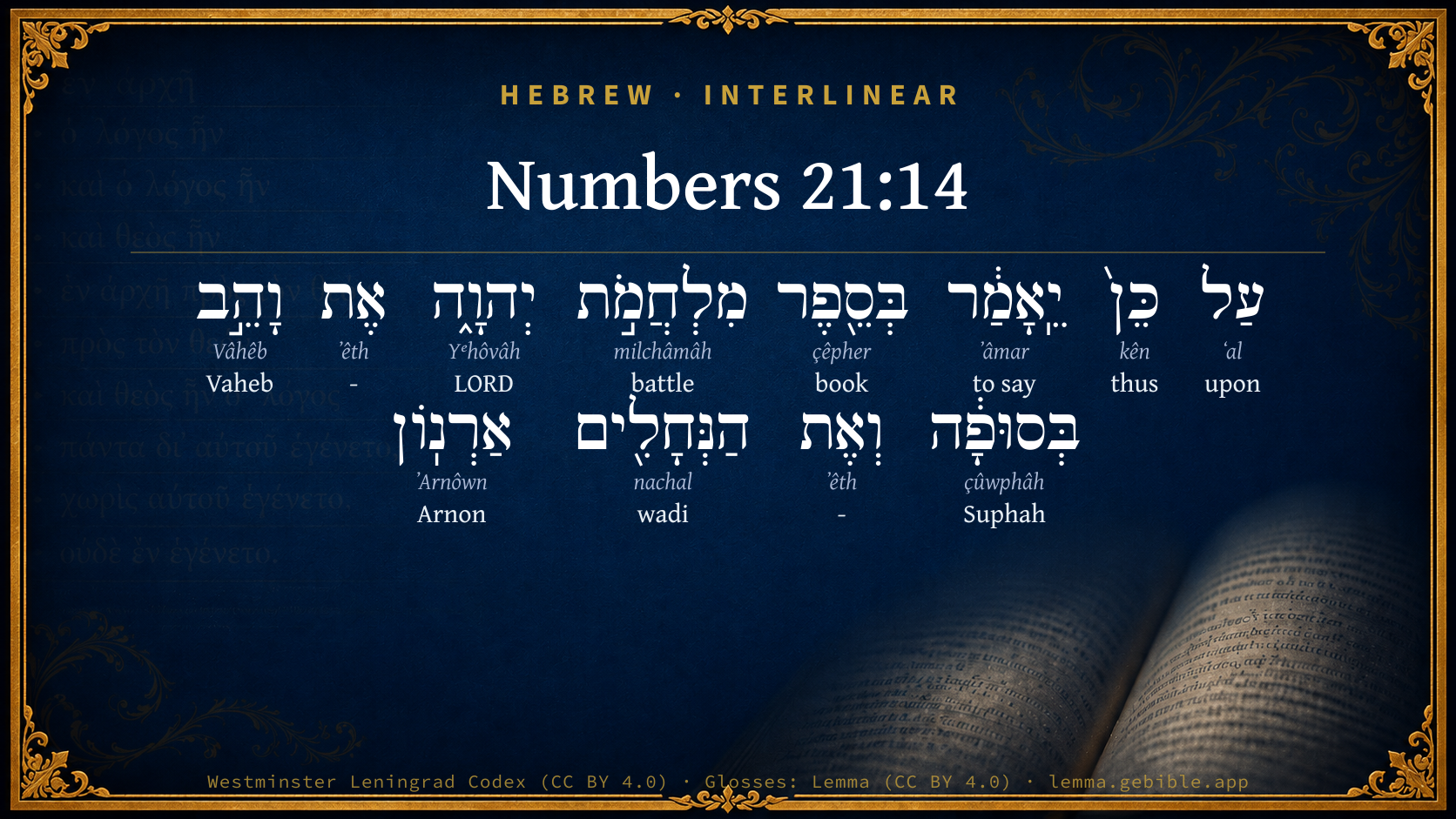
Hebrew (Westminster Leningrad Codex) Numbers 21:14 appears in the Hebrew Old Testament. The text above is from the Westminster Leningrad Codex. Each word links to its Strong’s number, a concise gloss, and parsing drawn from the Open Scriptures Hebrew Bible morphology. Click any word for its full Brown-Driver-Briggs (BDB) entry.
Download image
Cite this verse

Numbers 21:14 (World English Bible). Public Domain. Lemma interlinear Bible study tool, https://lemma.gebible.app/v/numbers/21/14.

Show BibTeX & RIS
BibTeX
RIS
English Translation
Therefore it is said in the book of the Wars of Yahweh, Vaheb in Suphah, The valleys of the Arnon,
World English Bible · Public Domain
Highlights
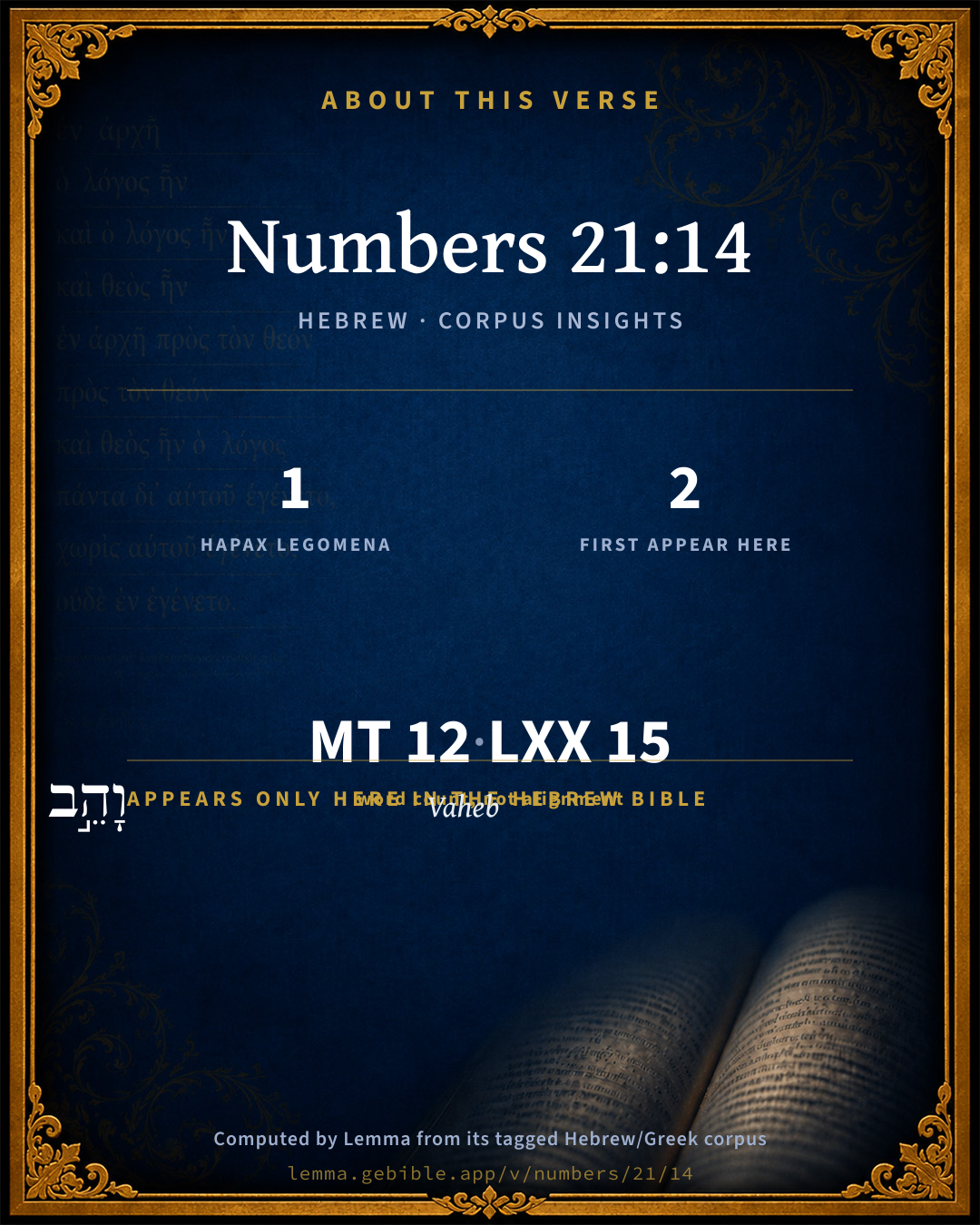
  • 1 hapax legomenon — only here in the Hebrew Bible
  • 2 first appearances in the Hebrew Bible
Full analysis ↓
Download a study sheet

One document with this verse’s original text, its word-by-word gloss line, the meaning frame, cross-references with their text, attributed commentary, and full source and license credits — printable, and it pastes into notes with its structure intact.

This verse Autodidact and up

Study sheet (.html) Plain text (.txt)

A passage Seminary Student

Up to 50 verses in one chapter. A passage sheet keeps up to 6 commentary sources and 12 cross-references per verse, in the order this page ranks them, and says so on the sheet whenever that leaves anything out. Ask for a single verse and you get the Autodidact verse sheet above.

Everything on this page stays free to read, with no account — the sheet is a download of what is already on screen, not access to it.

Want to remove ads? Support Godless Engineer
Compare translations 3

The same verse in 3 English versions, stacked beneath the original-language interlinear above. Click any original word for its lexicon entry.

Each is an independent rendering of the whole verse — the interlinear is not word-aligned to these translations.

Highlighted words mark where these versions differ — a whole-verse word diff, not a word-by-word alignment.

  • World English Bible Public Domain
    Therefore it is said in the book of the Wars of Yahweh, Vaheb in Suphah, The valleys of the Arnon,
  • King James Version Public Domain
    Wherefore it is said in the book of the wars of the LORD, What he did in the Red sea, and in the brooks of Arnon,
  • unfoldingWord Literal Text CC BY-SA 4.0
    Therefore it is said in the Book of the Wars of Yahweh, “Waheb in Suphah and the wadis of the Arnon,

unfoldingWord Literal Text — © unfoldingWord, licensed CC BY-SA 4.0. Word-aligned USFM3 via Door43 (git.door43.org/unfoldingWord/en_ult).

Versions to compare (up to 4)

3 of 4 selected

Show all 18 translations

Every available English version of this verse, each an independent rendering of the whole verse.

  • World English Bible Public Domain
    Therefore it is said in the book of the Wars of Yahweh, Vaheb in Suphah, The valleys of the Arnon,
  • Berean Standard Bible Public Domain
    Therefore it is stated in the Book of the Wars of the LORD: “Waheb in Suphah and the wadis of the Arnon,
  • Majority Standard Bible Public Domain
    Therefore it is stated in the Book of the Wars of the LORD: “Waheb in Suphah and the wadis of the Arnon,
  • King James Version Public Domain
    Wherefore it is said in the book of the wars of the LORD, What he did in the Red sea, and in the brooks of Arnon,
  • American Standard Version (1901) Public Domain
    Wherefore it is said in the book of the Wars of Jehovah, Vaheb in Suphah, And the valleys of the Arnon,
  • Revised Version (1885) Public Domain
    Wherefore it is said in the book of the Wars of the LORD, Vaheb in Suphah, And the valleys of Arnon,
  • Geneva Bible (1599) Public Domain
    Wherefore it shall be spoken in the booke of the battels of the Lord, what thing he did in the red sea, and in the riuers of Arnon,
  • Douay-Rheims (1899) Public Domain
    Wherefore it is said in the book of the wars of the Lord: As he did in the Red Sea, so will he do in the streams of Amen.
  • Young's Literal Translation Public Domain
    therefore it is said in a book, `The wars of Jehovah,' -- `Waheb in Suphah, And the brooks of Arnon;
  • Literal Standard Version CC BY-SA 4.0
    therefore it is said in [the] scroll of the Wars of YHWH: “Waheb in Suphah, || And the brooks of Arnon;
  • Unlocked Literal Bible CC BY-SA 4.0
    That is why it says in the scroll of the Wars of Yahweh, “... Waheb in Suphah, and the valleys of the Arnon,
  • unfoldingWord Literal Text CC BY-SA 4.0
    Therefore it is said in the Book of the Wars of Yahweh, “Waheb in Suphah and the wadis of the Arnon,
  • Darby Bible Public Domain
    Therefore it is said in the book of the wars of Jehovah, Vaheb in Suphah, and the brooks of Arnon;
  • World Messianic Bible Public Domain
    Therefore it is said in The Book of the Wars of the LORD, “Vaheb in Suphah, the valleys of the Arnon,
  • Webster's Bible Public Domain
    Wherefore it is said in the book of the wars of the LORD, What he did in the Red sea, and in the brooks of Arnon,
  • Free Bible Version CC BY-SA 4.0
    That's why the Book of the Wars of the Lord refers to “the town of Waheb in Suphah and the canyon of the Arnon,
  • Bible in Basic English Public Domain
    As it says in the book of the Wars of the Lord, Vaheb in Suphah, and the valley of the Amon;
  • JPS Tanakh (1917) Public Domain
    wherefore it is said in the book of the Wars of the LORD: Vaheb in Suphah, and the valleys of Arnon,

Literal Standard Version (2020), Covenant Press — licensed CC BY-SA 4.0. Text via the HelloAO Bible API (eBible.org). Unlocked Literal Bible (unfoldingWord) — licensed CC BY-SA 4.0. Text via the HelloAO Bible API (eBible.org). unfoldingWord Literal Text — © unfoldingWord, licensed CC BY-SA 4.0. Word-aligned USFM3 via Door43 (git.door43.org/unfoldingWord/en_ult). Free Bible Version, Dr. Jonathan Gallagher — licensed CC BY-SA 4.0. Text via the HelloAO Bible API (eBible.org).

Word by word

More ways to search: Search by grammar → Find every occurrence → Compare this word →

Practice this passage: Drill this verse → Learn its vocabulary →

About this verse

These counts appear in no published source. They are computed here, from the morphology-tagged text and Lemma’s own curated glosses. What Lemma adds →

12
words
11
distinct lemmas
Pentateuch
section

Notable vocabulary

1 hapax legomenon — a word that appears only here in the entire Hebrew Bible:

  • וָהֵ֣ב Vaheb H2052

First appearance in Scripture

These words make their first canonical appearance in the Hebrew Bible here:

  • וָהֵ֣ב Vaheb H2052
  • בְּסוּפָ֔ה Suphah H5492

Shared distinctive vocabulary

בְּסוּפָ֔ה Suphah H5492 occurs in 16 verses of the Hebrew Bible. Also found in:

Grammatical profile

  • 1 verb
  • 7 nouns
  • 1 preposition
  • 3 particles

Verb forms

  • יֵֽאָמַ֔ר Niphal · Imperfect

Hebrew & Septuagint length

In English translation the verse runs 20 words from the Hebrew and 22 from the Septuagint (LXX English) — closely comparable.

A rough comparison of the two English renderings, which tokenize alike — not a word-level alignment.

Word counts can differ between the Hebrew and the Greek without any difference in meaning — e.g. the Hebrew direct-object marker אֵת has no separate Greek word, and Greek often adds the article ὁ.

In the original languages it is 12 Hebrew tokens and 15 Greek tokens — but the two are counted differently (Hebrew bundles its prefixes and suffixes into one token; the Greek is in lemma form), so that isn’t a like-for-like length.

Cross-references

2

Topical passages linked to Numbers 21:14 in the Treasury of Scripture Knowledge — connected by theme and wording, ordered by reader-vote popularity; previews shown in the World English Bible.

  • Joshua 10:13 The sun stood still, and the moon stayed, Until the nation had avenged themselves of their enemies. Isn't this written in the book of Jashar? The sun stayed in the midst of the sky, and didn't hurry to go down about a whole day.
  • 2 Samuel 1:18 (and he bade them teach the children of Judah [the song of] the bow: behold, it is written in the book of Jashar):

Cross-references courtesy of OpenBible.info (CC BY 4.0).

Hebrew and Greek witnesses Masoretic Hebrew ↔ Greek Septuagint

The same verse in the two great witnesses to the Old Testament, shown verse-for-verse.

These are two independent witnesses, not word-aligned to each other, and the Septuagint is shown in lemma (dictionary) form.

Hebrew Numbers 21:14 Masoretic · Westminster Leningrad Codex

עַל כֵּן֙ יֵֽאָמַ֔ר בְּסֵ֖פֶר מִלְחֲמֹ֣ת יְהוָ֑ה אֶת וָהֵ֣ב בְּסוּפָ֔ה וְאֶת הַנְּחָלִ֖ים אַרְנֽוֹן

Therefore it is said in the book of the Wars of Yahweh, Vaheb in Suphah, The valleys of the Arnon,

World English Bible · Public Domain

Greek LXX Numbers 21:14 Septuagint · lemma form

διά οὗτος λέγω ἐν βιβλίον πόλεμος ὁ κύριος ὁ ζωοβ φλογίζω καί ὁ χειμάρρους αρνων

Therefore it is said in a book, A war of the Lord has set on fire Zoob, and the brooks of Arnon.

LXX2012 (modern English Septuagint) · Public Domain

Hebrew: Westminster Leningrad Codex (CC BY 4.0). Greek: Septuagint (public domain); English from LXX2012 (modern English Septuagint) (Public Domain). How the Septuagint differs from the Hebrew →

Targum (Aramaic paraphrase)

2

The Targum is the ancient Jewish Aramaic paraphrase of the Hebrew Scriptures — an interpretive translation, not the Hebrew text itself. Onkelos (literal) and Pseudo-Jonathan (expansive) render the Torah, and Jonathan the Prophets. Coverage is partial: where no permissively-licensed English translation exists for a verse, only the Aramaic is shown. This is verse-level text, not a word-by-word alignment to the Hebrew.

  1. Targum Onkelos Torah (Genesis–Deuteronomy)
    עַל כֵּן יִתְאַמַר בְּסִפְרָא קְרָבִין דַעֲבַד יְיָ עַל יַמָא דְסוּף וּגְבוּרָן דְעַל נַחֲלֵי אַרְנוֹן

    (no public-domain English translation for this verse)

    Targum Onkelos — Aramaic: “Onkelos Genesis” (public domain); “Onkelos Exodus” (public domain); “Onkelos Leviticus” (public domain); “Onkelos Numbers” (public domain); “Onkelos Deuteronomy” (public domain). English: “Sefaria Community Translation” (CC0 1.0 (public-domain dedication)); “J.W. Etheridge. The Targums of Onkelos and Jonathan Ben Uzziel on the Pentateuch. London: Longmans, Green, 1862” (public domain). Text via Sefaria.

  2. Targum Pseudo-Jonathan Torah (Genesis–Deuteronomy)
    עַל כֵּן יִּתְאַמַר בְּסֵפֶר אוֹרַיְיתָא דְתַמָן כְּתִיבִין קְרָבַיָא דַיְיָ אֶת וָהֵב דַהֲווֹן בְּעִלְעוּלָא דִסְגִירוּתָא וּטְרִידוּן בְּסוֹף מַשְׁרִיתָא הִינוּן בִּשְרוּ יַת יִשְרָאֵל דֶאֱדוֹם וּמוֹאָב אִיטְמָרוּ בֵּינֵי טַוְרַיָא לְמִכְמַן וּלְשֵׁיצָאָה עַמָא בֵּית יִשְרָאֵל וּמָארֵי עַלְמָא רָמַז לְטַוְרַיָא וְקָרִיבוּ דֵין לְדֵין וּמִיתוּ וַאֲרַמְהוֹן הֲוָה נְגִיד בְּנַחֲלָא סְמִיךְ לְאַרְנוֹן

    Therefore it is said in the book of the Law, where are recorded the wars of the Lord: Eth and Heb, who had been smitten with the blast of the leprosy, and had been banished beyond the confine of the camp, made known. to Israel that Edom and Moab were concealed among the mountains in ambush, to destroy the people of the house of Israel. But the Lord of the world made a sign to the mountains, which pressed one to another so that they died: and their blood flowed through a valley on the brink of the Arnon (or, a valley adjoining Arnon).

    Targum Pseudo-Jonathan — Aramaic: “Targum Jonathan on Genesis” (public domain); “Targum Jonathan on Exodus” (public domain); “Targum Jonathan on Leviticus” (public domain); “Targum Jonathan on Numbers” (public domain); “Targum Jonathan on Deuteronomy” (public domain). English: “The Targum of Jonathan ben Uzziel, trans. J. W. Etheridge, London, 1862” (public domain). Text via Sefaria.

Commentary

Notes on Numbers 21:14 from classic Christian and Jewish commentators (each source and its license shown beneath its notes). The classic Christian expositions comment on the surrounding passage and are grouped to its opening verse, so a note may address several verses; the Jewish commentaries on the Tanakh (Rashi and others) are per-verse, so they appear only where the commentator wrote on this verse.

Lemma curates 59 commentaries, every one of them public domain or Creative Commons licensed, each selected and text-cleaned for this edition rather than reprinted as found. About our sources →

Trapp's Complete Commentary

John Trapp

Num 21:14 Wherefore it is said in the book of the wars of the LORD, What he did in the Red sea, and in the brooks of Arnon,

Ver. 14. In the book of the wars of the Lord.] This book here cited by Moses, is now either lost, or at least latent. It was not any part of the Canon, - for God hath provided, that not one hair of that sacred head is diminished, - but as the chronicles of England, or some famous poem.

John Trapp, A Commentary or Exposition upon All the Books of the Old and New Testament (1647–1656) — public domain. Text from a community e-Sword module.

Joseph Benson's Commentary

Num 21:14. The book of the wars of the Lord — This seems to have been some poem or narration of the wars and victories of the Lord, either by, or relating to the Israelites: which may be asserted without any prejudice to the integrity of the holy Scripture, because this book doth not appear to have been written by a prophet, or designed for a part of the canon, but which Moses might quote, as St. Paul doth some of the heathen poets. And, as St. Luke assures us that many did write a history of the things done and said by Christ, (Luk 1:1,) whose writings were never received as canonical, the like may be conceived concerning this and some few other books mentioned in the Old Testament. The brooks — The brook, the plural number for the singular, as the plural number, rivers, is used concerning Jordan, (Psa 74:15,) and concerning Tigris, (Nah 2:6,) and concerning Euphrates, (Psa 137:1,) all which may be so called because of the several little streams into which they were divided.

Joseph Benson's Commentary on the Old and New Testaments (1811–1818) — public domain. Text from a community e-Sword module.

Tyndale Open Study Notes

Tyndale Open Resources

21:14-15 The Book of the Wars of the Lord, analogous to The Book of Jashar (Josh 10:13; 2 Sam 1:18), is otherwise unknown. • Waheb (a town) and Suphah (a region) are otherwise unknown. Ar was one of the major Moabite settlements of that day (cp. 21:28; Deut 2:18; Isa 15:1).

Tyndale Open Study Notes — © Tyndale Open Resources, licensed CC BY-SA 4.0. Text via the HelloAO Bible API.

Geneva Bible (1599)

Geneva Bible translators

Which seemeth to be the book of the Judges, or as some think, a book which is lost.

Or, (How God destroyed) Waheb (the city) with a whirlwind and the valley of Arnon.

Geneva Bible (1599) marginal notes — public domain. Text via Bolls.life.

Jamieson, Fausset & Brown

Robert Jamieson, A. R. Fausset & David Brown

book of the wars of the Lord--A fragment or passage is here quoted from a poem or history of the wars of the Israelites, principally with a view to decide the position of Arnon.

Jamieson, Fausset & Brown — Commentary Critical and Explanatory on the Whole Bible (1871) — public domain (CC PDM 1.0). Text via the HelloAO Bible API.

Adam Clarke's Commentary

Verse 14. The book of the wars of the Lord] There are endless conjectures about this book, both among ancients and moderns. Dr. Lightfoot's opinion is the most simple, and to me bears the greatest appearance of being the true one. "This book seems to have been some book of remembrances and directions, written by Moses for Joshua's private instruction for the management of the wars after him. See Ex 17:14-16. It may be that this was the same book which is called the book of Jasher, i. e., the book of the upright, or a directory for Joshua, from Moses, what to do and what to expect in his wars; and in this book it seems as if Moses directed the setting up of archery, see 2Sa 1:18, and warrants Joshua to command the sun, and expect its obedience, Jos 10:13."

What he did in the Red Sea, and in the brooks of Arnon] This clause is impenetrably obscure. All the versions, all the translators, and all the commentators, have been puzzled with it. Scarcely any two agree. The original is את והב בסופה eth vaheb besuphah, which our translators render, what he did in the Red Sea, following here the Chaldee Targum; but not satisfied with this version, they have put the most difficult words in English letters in the margin, Vaheb in Suphah. Calmet's conjecture here is ingenious, and is adopted by Houbigant; instead of והב vaheb, he reads זרד zared. Now a ז zain may be easily mistaken for a ו vau, and vice versa; and a ה he for a ר, resh, if the left limb happened to be a little obliterated, which frequently occurs, not only in MSS., but in printed books; the ב beth also might be mistaken for a ד daleth, if the ruled line on which it stood happened in that place to be a little thicker or blacker than usual. Thus then והב vaheb might be easily formed out of זרד zared, mentioned Nu 21:12; the whole might then be read, They encamped at the brook Zared, and they came to Suphah, and thence to the brook Arnon. Take the passage as we may, it is evidently defective. As I judge the whole clause to have been a common proverb in those days, and Vaheb to be a proper name, I therefore propose the following translation, which I believe to be the best: From Vaheb unto Suph, and unto the streams of Arnon. If we allow it to have been a proverbial expression, used to point out extensive distance, then it was similar to that well known phrase, From Dan even unto Beersheba.

Adam Clarke's Commentary on the Bible (1810–1826) — public domain. Text from a community e-Sword/MySword module.

Ellicott's Commentary for English Readers

(14, 15) The book of the wars of the Lord.—Nothing is known about this book. The last days of Moses, as Baumgarten has observed, may have been a suitable time for the commencement of such a work. The history of the journey from Kadesh to the Arboth Moab was not written by Moses until after the defeat of the two kings of the Amorites, and the subjugation of the land on the east of the Jordan.

What he did in the Red Sea . . . —The original is very obscure. It is probable that some such verb as They conquered (or, subdued) is understood, and that the words may be rendered Vaheb in Suphah and the valleys (by) Arnon, and the bed (or, ravine) of the valleys which inclines towards the dwelling of Ar, and leans upon the border of Moab. Vaheb was probably the name of a town, and Suphah the district in which that town was situated, so called from its reeds and rushes. Some, however, think that Suphah here denotes a storm or hurricane, as in other places. Ar is supposed to be the same as Areopolis.

A Bible Commentary for English Readers, edited by Charles John Ellicott (1878–1897) — public domain. Text from a community e-Sword module.

The Cambridge Bible for Schools and Colleges

gen. ed. J. J. S. Perowne

14. the book of the Wars of Jehovah] It may be gathered from the title that the songs celebrated the battles which Jehovah ‘the God of hosts’ had helped His people to win against His enemies. A similar collection of songs (which were probably handed down orally and not committed to writing till a later time) was called ‘the book of the Yâshâr (‘Upright’),’ Jos_10:13, 2Sa_1:18; and Gray compares it with the Ḥamasa and similar collections of the Arabs.

Vaheb in Suphah] The former apparently a town, and the latter a district; both are unknown; but the latter is possibly the same as Suph (Deu_1:1). In the original song Vaheb (as the Heb. shews) must have been governed by a verb, perhaps relating that Israel captured the town. But the writer here begins his quotation in the middle of the sentence, since the point of it for him lay only in the closing words. The rendering of Suphah as a substantive ‘storm’ (R.V. marg.) is improbable. The A.V. follows the Vulg. , which, in turn, is dependent upon the Targum.

the valleys of Arnon] ‘Valley,’ Heb. naḥal, is a torrent-ravine or wady; see on Num_21:12. The expression stands for all the streams which unite to form the Arnon. Some of these have been mentioned in Num_21:12-13. Others are the Wady Babr‘a, W. es-Sulṭân, W. Butmeh, W. Themed. ‘The whole plateau up to the desert is thus not only cut across, but up and down, by deep ravines, and a very difficult frontier is formed’ (G. A. Smith, H. G. [Note: . G. Historical Geography of the Holy Land.] 558).

14, 15. The writer here inserts a fragment of poetry from an ancient collection of songs, the last clause of which supports the above statement that Arnon was the border of Moab.

The Cambridge Bible for Schools and Colleges (gen. ed. J. J. S. Perowne; Cambridge University Press, 1878–1918) — public domain. Text from a community e-Sword module.

John Gill's Exposition

And at the stream of the brooks that goeth down to the dwelling of Ar,.... All that part of the country which lay upon the stream, as far as the city of Ar, the metropolis of Moab, called Ar of Moab, Isa 15:1,

and lieth upon the border of Moab; as that city did; so far goes the quotation out of the aforesaid book, as a proof of what was taken by the Amorites from the Moabites, and were not in their possession when Israel were upon their borders; and therefore, in taking them from the Amorites, did no wrong to Moab.

John Gill's Exposition of the Whole Bible (1746–1763) — public domain (CC PDM 1.0). Text via the HelloAO Bible API.

Albert Barnes' Notes on the Bible

Of “the book of the wars of the Lord” nothing is known except what may be gathered from the passage before us. It was apparently a collection of sacred odes commemorative of that triumphant progress of God’s people which this chapter records. From it is taken the ensuing fragment of ancient poetry relating to the passage of the Arnon River, and probably also the Song of the Well, and the Ode on the Conquest of the Kingdom of Sihon Num 21:17-18, Num 21:27-30.

What he did ... - The words which follow to the end of the next verse are a reference rather than a quotation. Contemporaries who had “the Book” at hand, could supply the context. We can only conjecture the sense of the words; which in the original are grammatically incomplete. The marg. is adopted by many, and suggests a better sense: supplying some such verb as “conquered,” the words would run “He” (i. e. the Lord) “conquered Vaheb in Suphah, and the brooks, etc.” Suphah would thus be the name of a district remarkable for its reeds and water-flags in which Vaheb was situated.

Albert Barnes' Notes on the Bible (1834–1885) — public domain. Text from a community e-Sword/MySword module.

Haydock's Catholic Bible Commentary

The book of the wars, &c. An ancient book, which, like several others quoted in Scripture, has been lost. (Challoner) --- St. Augustine (q. 42) thinks this book was written by one of that country. Others believe that Moses wrote a more detailed account of the wars which he had to wage with the Amalecites, (Exodus xvii. 14,) and these other nations, out of which he has only inserted some of the heads in the Pentateuch. But whether these two verses were taken from another work of Moses, or from the history of some other person, they are now of divine authority. Saul says to David, (1 Kings xviii. 17,) fight the battles of the Lord,....and the children of God and of Ruben pass all armed for war before the Lord, (chap xxxii. 29.; Calmet) whence it appears, that the wars of the Hebrews were attributed to God. Tostat is of opinion, that the Book of the Just, is the same with that to which Moses here refers. See Josue x. 13., and 2 Kings i. 18. But Theodoret thinks rather, that the former was a more extensive account of the transactions of Josue, out of which the book which bears his name was compiled. Such records certainly existed, to which the sacred historians frequently refer: and it is very probable, that a work of this nature was compiled in the days of Moses, or perhaps before his time. (St. Augustine, City of God xviii.) As it contained a prediction, respecting the future wars, in which the Hebrews were about to engage, it could not but make a suitable impression upon them. It might already be in every one’s mouth, and the Hebrew may insinuate, that it would be handed down to the latest posterity: "Wherefore in the history, or account of the wars of the Lord, this also shall be mentioned," jamor, dicetur. According to this interpretation, it would not be necessary to suppose, that Moses refers to any more ancient book, as sepher means also, "a narration" by word of mouth; and Rabbi Menachem believes, that God had revealed this event to Moses, encouraging him with the assurance, that he would give him the victory over the nations bordering upon the Arnon, as he had done over the Egyptians and Amalecites at the Red Sea. See Sixt. Senens. (Haydock) --- Of Arnon, the waters of which are supposed to have given the Hebrews a passage, as the Chaldean asserts on the authority of Psalm lxxiii. 15. Habacuc (iii. 13) also mentions that several rivers were dried up by God. The Hebrew text is almost unintelligible, "From, or against, Vahab to Supha." As there is no verb, some translate, "he (Sehon) fought against Vaheb (Grotius reads Moab) at Supha, or he came to Veb." But Calmet would substitute Zared instead of Vaheb: "The encamped at the torrent of Zared, and came to Supha, (Deuteronomy i. 1, where we read the Red Sea) to the torrent of Arnon." Protestants translate, "What he did in the Red Sea, and in the brooks of Arnon, (16) and at the stream of the brooks that goeth down to the dwelling or Ar, and lieth upon the border of Moab." (Haydock)

George Leo Haydock (1774–1849), Haydock's Catholic Family Bible and Commentary, 1859 edition — public domain. Excludes Psalms (Douay-Rheims chapter numbering differs from Protestant) and Deuterocanonical books (Catholic canon only).

Matthew Poole's English Annotations

The book of the wars of the Lord seems to have been some poem or narration of the wars and victories of the Lord, either by or relating to the Israelites; which may be asserted without any prejudice to the integrity of the Holy Scripture, because this book doth not appear to have been written by a prophet, or to be designed for a part of the canon, but by some other ingenious person, who intended only to write an historical relation of these matters, which yet Moses might quote, as St. Paul doth some of the heathen poets. And as St. Luke assures us that many did write a history of the things done and said by Christ, Luk 1:1, whose writings were never received as canonical, the like may be justly conceived concerning this and some few other books mentioned in the Old Testament; though the words may be thus rendered, Wherefore it shall be said in the relation, or narration (for so the Hebrew sepher is confessed to signify)

of the wars of the Lord. In the Red Sea; or, at Vaheb in Suphah, or in the land of Suph. Vaheb seems to be the name not of a man, but of a city or place, and Suphah the name of the country where it was; and the Hebrew particle eth is oft rendered at. And whereas the sense seems to be imperfect, it must be noted, that he quotes only a fragment or piece of the book, and that principally to prove the situation of Arnon, which he had asserted Num 21:13, from which end the passage quoted is sufficient. And the sense is easily to be understood, for it is plain enough that this poet or writer is describing the wars and works of God by the several places where they were done; and having begun the sentence before, and mentioned other places, he comes to these here mentioned, at Vaheb in Suphah, and at the brooks of Arnon, &c. And it seems probable that the war here designed was that of Sihon against the Moabites, mentioned below, Num 21:26, which is fitly ascribed to the Lord, because it was undertaken and perfected by the singular direction and assistance of God, and that for the sake of the Israelites, that by this means that country might be invaded and possessed by them, without taking it away from the Moabites, which they were forbidden to meddle with or to disturb, Deu 2:9, and so their title to it might be more just and unquestionable. See Jdg 11:12,13,27.

In the brooks of Arnon, i.e. the brook, the plural number for the singular, as the plural number rivers is used concerning Jordan, Psa 74:15, and concerning Tigris, Nah 2:6, and concerning Euphrates, Psa 137:1, and concerning Thermodoon in Virgil, all which may be so called because of the several little streams into which they were divided.

Matthew Poole's English Annotations on the Holy Bible (1683–1685) — public domain. Text from a community e-Sword/MySword module.

Whedon's Commentary on the Bible

Daniel D. Whedon

14. Book of the wars of the Lord — This was probably a collection of ballads composed beside the watchfires of the camp in commemoration of the victories of the Israelites over their enemies. From the title we infer that religious inspiration mingled largely with the poetic. In the spirit of true piety the victories are ascribed, not to the prowess of Israel, but to the might of Jehovah. Possibly this book is referred to in Exo_17:14-16. The fragment here quoted is obscure because it is sundered from the context. It is quoted simply to confirm the statement that the Arnon is the boundary of Moab.

What he did — This is an erroneous translation of והב, Vaheb, the name of a place on the border of the Amorite and Moabite territories where Israel conquered in battle.

In the Red Sea — This is another erroneous translation of Suphah, mistaken for Suph, the Red Sea. The exact location of Suphah is as little known as is that of Vaheb, both being found in no other place than in the following fragment of the old song:

“Vaheb in Suphah.

And the valleys of Arnon,

And the slope of the valleys

That inclineth toward the dwelling of Ar,

And leaneth upon the border of Moab.”

Daniel D. Whedon (gen. ed.), Commentary on the Old and New Testaments (1874–1909) — public domain. Text from a community e-Sword module.

The Pulpit Commentary

Wherefore, i.e., because the Amorites had wrested from Moab all to the north of Arnon. In the book of the wars of the Lord. Nothing is known of this book but what appears here. If it should seem strange that a book of this description should be already in existence, we must remember that amongst the multitude of Israel there must in the nature of things have been some "poets" in the then acceptation of the word. Some songs there must have been, and those songs would be mainly inspired by the excitement and triumph of the final marches. The first flush of a new national life achieving its first victories over the national foe always finds expression in songs and odes. It is abundantly evident from the foregoing narrative that writing of some sort was in common use at least among the leaders of Israel, (see on Num_11:26) and they would not have thought it beneath them to collect these spontaneous effusions of a nation just awaking to the poetry of its own existence. The archaic character of the fragments preserved in this chapter, which makes them sound so foreign to our ears, is a strong testimony to their genuineness. It is hardly credible that any one of a later generation should have cared either to compose or to quote snatches of song which, like dried flowers, have lost everything but scientific value in being detached from the soil which gave them birth. What he did in the Red Sea, and in the brooks of Arnon. Rather, "Vaheb in whirlwind, and the brooks of Arnon." The strophe as cited here has neither nominative nor verb, and the sense can only be conjecturally restored. bhew is almost certainly a proper name, although of an unknown place hpWsB is also considered by many as the name of a locality "in Suphah;" it occurs, however, in Nah_1:3 in the sense given above, and indeed it is not at all a rare word in Job, Proverbs, and the Prophets; it seems best, therefore, to give it the same meaning here.

The Pulpit Commentary (1880–1919), ed. H.D.M. Spence-Jones & Joseph S. Exell — public domain. Text from a community e-Sword module.

John Wesley's Explanatory Notes

The book of the wars of the Lord - This seems to have been some poem or narration of the wars and victories of the Lord, either by: or relating to the Israelites: which may be asserted without any prejudice to the integrity of the holy scripture, because this book doth not appear to have been written by a prophet, er to be designed for a part of the canon, which yet Moses might quote, as St. Paul doth some of the heathen poets. And as St. Luke assures us, that many did write an history of the things done, and said by Christ, Luke i, 1, whose writings were never received as canonical, the like may be conceived concerning this and some few other books mentioned in the old testament. The brooks - The brook, the plural number for the singular, as the plural number rivers is used concerning Jordan, Psalm 7iv, 15, and concerning Tigris, Nahum ii, 6, and concerning Euphrates, Psalm 1xxxvii, 1, all which may be to called because of the several little streams into which they were divided.

John Wesley, Explanatory Notes Upon the Whole Bible (1754–1765) — public domain. Text via the GEBible commentary corpus.

unfoldingWord translationNotes

Door43 World Missions Community

Waheb in Suphah

These are both names of places. (See: How to Translate Names)

the slope of the valleys that lead toward the town of Ar and lie along the border of Moab

"the valleys that go downhill to the town of Ar and lie along the border of Moab"

translationWords

scroll

Yahweh

unfoldingWord translationNotes — © Distant Shores Media and the Door43 World Missions Community, licensed CC BY-SA 4.0. Source: git.door43.org/Door43/en_tn.

Rashi

Rabbi Shlomo Yitzchaki (Rashi)

על כן יאמר WHEREFORE IT IS SAID (more lit., about this it will be said) — About this encampment and the miracles that were wrought at it, it will be told בספר מלחמות ה׳ IN THE NARRATIVE (lit., THE BOOK) OF THE WARS OF THE LORD — whenever people narrate the miracles that were wrought for our fathers they will declare את והב.

את והב — is equivalent to את יהב; just as from the root יעד one may say וָעֵד, so from יהב, "to give” one may say והב: the ו is a root-letter. It means to say: they will relate what (את) He gave (והב) to them (i.e. what boons He gave to them) and how He did many miracles at the Red Sea (בים סוף being the equivalent of בסופה in the text).

ואת הנחלים ארנון AND THE VALLEYS AT ARNON — Just as they relate the miracles at the Red Sea, so there should be related, too, the miracles at the valleys of Arnon, for here, also, great miracles were wrought (Midrash Tanchuma, Chukat 20). And what were those miracles? (the reply is given in the next passage).

Rashi on the Tanakh — English translations: “The Judaica Press complete Tanach with Rashi, translated by A. J. Rosenberg” (CC BY 4.0); “Pentateuch with Rashi's commentary by M. Rosenbaum and A.M. Silbermann, 1929-1934” (public domain); “The Metsudah Tanach series, Lakewood, N.J” (CC BY 4.0); and “The Book of Joshua, Metsudah Publications, 1997” (CC BY 4.0). Text via Sefaria.

Ramban (Nachmanides)

Rabbi Moshe ben Nachman (Ramban / Nachmanides)

The simple meaning of [the expression] in the book of the wars of the Eternal. is that there were wise men in those generations who used to write down the history of great wars, for such was [the custom] in all generations. These authors were called moshlim (they that speak in parables), because they wrote in them [their books] by means of proverbs and figures of speech, and when there were victories which they considered wonderful, they ascribed those wars to G-d, to Whom they are in truth [to be attributed]. Now the victory of Sihon over Moab was marvellous in their eyes, therefore they wrote it down in a book, speaking of it in figurative language, Eth Vahev b’suphah etc., and writing about it in a proverb — Come ye to Heshbon etc. Now the name of one city of those that belonged to Moab was Vahev. And the pouring forth of the brooks — [this refers to] the slope of the brook, because the streams [of water] flow down continuously from the slopes of Pisgah. Similarly, in the hill-country, and in the lowland, and in the Arabah, and in ‘the slopes.’ B’suphah, [this word is] of [the root] ‘b’suphah’ (in the whirlwind) and in the storm. Thus when Sihon captured the cities of Moab, those who wrote in parables recorded in the book which they called “the Wars of the Eternal”: Eth Vahev b’suphah [meaning: “The city of Vahev He destroyed in a whirlwind”], or they wrote: “G-d warred against Vahev in a whirlwind.” And the slope of the brooks which belonged to Arnon, and the downpour of the brooks that inclineth toward the seat of Ar, and the slope that leaneth upon the border of Moab — all these the Eternal destroyed in the whirlwind and in the storm, for Sihon came upon them [the Moabites] suddenly, his horses’ hoofs were counted like flint, and his wheels like a whirlwind. Similarly those [who spoke in parables] said: For a fire is gone out from Heshbon, a flame from the city of Sihon etc. Thus Scripture is bringing a proof from the book of “the Wars [of the Eternal”] that Arnon is on the border of Moab, and was forbidden to Israel [to capture], whereas the brooks and all the slopes as far as Arnon they were allowed [to take], for Sihon had captured from the king of Moab all his land until Arnon, but not Arnon itself. Thus Arnon remained part of Moab, and constituted its border, as it is written, And unto the Reubenites and unto the Gadites I gave from Gilead even unto the valley of Arnon, the middle of the valley for a border., 3:16. And so also did Jephthah say, and they [the Israelites] pitched on the other side of the Arnon, but they came not within the border of Moab, for Arnon was the border of Moab.

Ramban (Nachmanides) on the Tanakh — English translation: “Commentary on the Torah by Ramban (Nachmanides). Translated and annotated by Charles B. Chavel. New York, Shilo Pub. House, 1971-1976” (CC BY 4.0). Text via Sefaria.

Ibn Ezra

Rabbi Abraham ibn Ezra

In the Book of the Wars of Adonoy. This was a separate Book, in which the Wars of Hashem on behalf of those who fear Him were written. Possibly, it existed in the days of Avraham, for many books were lost and are not extant anymore, such as the words of Nasan and Ido, the Divrei HaYamim of the Kings of Yisroel, the Songs of Shlomo and his Proverbs.

Ibn Ezra on the Tanakh — English translations: “Sefaria Community Translation” (CC0 1.0 (public-domain dedication)); “Yalkut, Sifsei Chachomim Chumash, Metsudah Publications, 2009” (CC BY 4.0); and “Commentary of Ibn Ezra on Isaiah - trans. by M. Friedlander, 1873” (public domain). Text via Sefaria.

Lesson kit

Teaching starters — assembled from the data on this page, not authored interpretation. Every prompt links to the verse data it draws on. Edit before teaching.

Numbers, in the Pentateuch, opens this verse with 12 words (11 distinct Hebrew lemmas). Its most distinctive word is Vâhêb (“Vaheb”). A historical commentator’s framing appears above. Read the whole chapter for the surrounding context.

Discussion questions

  1. The word Vâhêb carries the sense “Vaheb.” How does it shape the verse?
  2. This verse holds 1 word here found nowhere else in the Hebrew Bible. What might the rare word draw attention to?
  3. 2 words here appear for the first time in Scripture. What is being introduced at this debut?
  4. Job 21:18 shares the word «Suphah» with this verse. How do the two illuminate each other?
  5. The translations on this page render this verse differently — a whole-verse word diff, not a word-by-word alignment. What might account for the different wordings?
  6. The verb «יֵֽאָמַ֔ר» is Niphal Imperfect. How does its form color the action?
  7. Reading how Trapp's Complete Commentary and Joseph Benson's Commentary read this verse, where do the two commentators agree and where do they part?

Things to notice

Reading settings

Reading text

Shown beneath each verse's original-language words.

Old Testament
Old Testament edition

Read the OT as the Masoretic Hebrew (MT) or the Greek Septuagint (LXX).

English shown for the Greek Septuagint (in the Hebrew ↔ Greek comparison).

Comparing translations? Open the Compare panel on any verse page to stack up to four side by side.