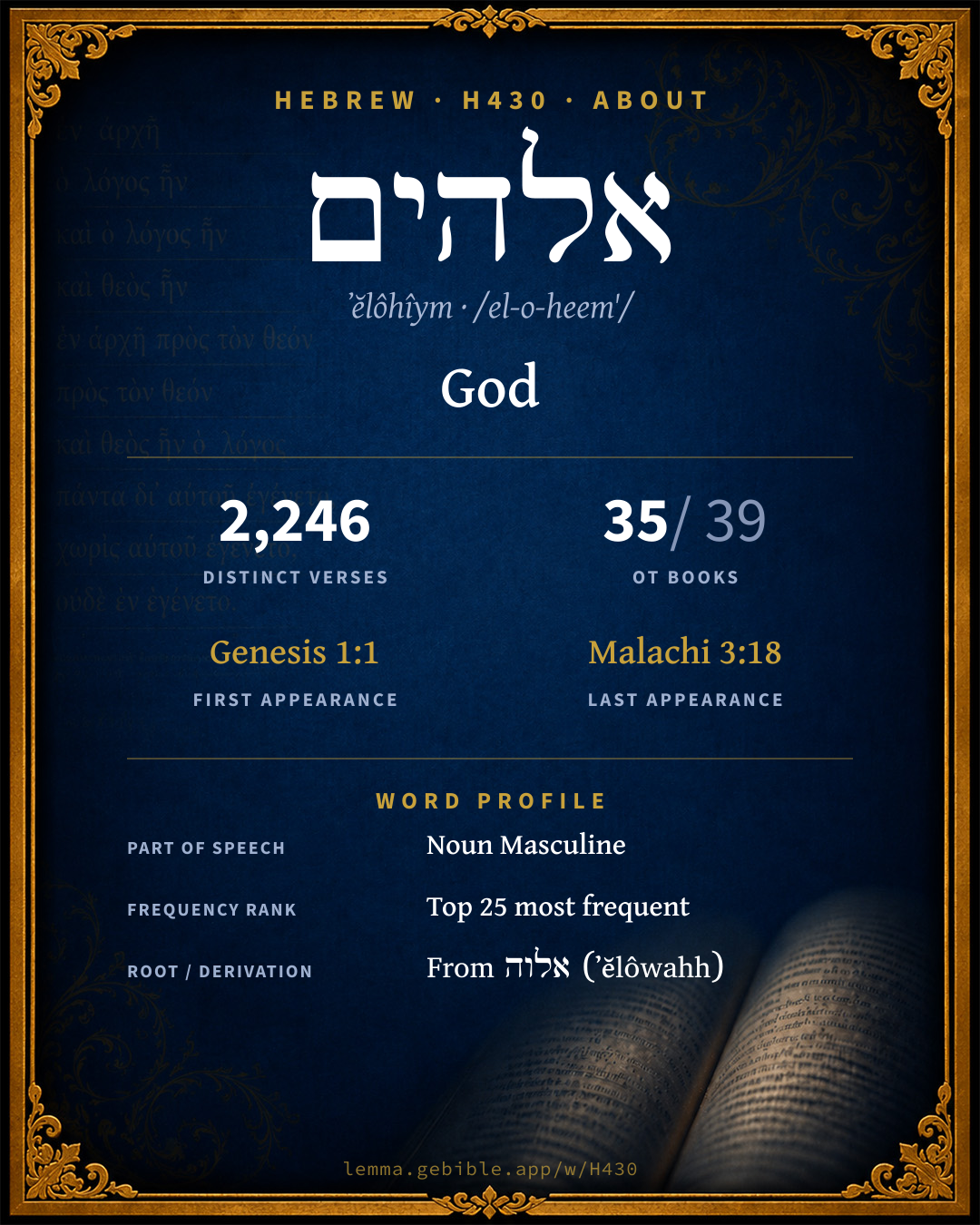
אֱלֹהִים
God
‘God’ is one of 9 main senses fuller range ↓
Full lexicon entry — Brown-Driver-Briggs (BDB)
From Brown-Driver-Briggs (BDB)
Where this word appears
See every Absolute-state word in the Hebrew Bible →
Grammar key — what these labels mean
Part of speech
- Noun
- A naming word — a person, place, thing, or idea.
Noun type
- Common
- A common noun — a general class of person, place, or thing (“king,” “city,” “water”), not a specific name.
State
- Absolute
- The independent form of a noun, not bound to a following word.
- Construct
- A noun bound to a following noun in a possessive / “of” relationship (the construct chain).
Gender
- Masculine
- Grammatically masculine.
Number
- Plural
- More than one (in Hebrew, generally three or more).
- Singular
- One.
Every verse where H430 appears in the Book of 1 Samuel — 90 distinct verses. Click any verse to open its interlinear word-by-word view. Verse text shown in the World English Bible for context — . Each verse’s Hebrew form is shown with its reference; the English is not keyword-highlighted, since the data carries no word-level English alignment. Use “Compare translations” on any verse to read it across multiple English versions. This concordance covers the Hebrew Bible; Septuagint (Greek Old Testament) occurrences are not indexed here.
1 Samuel
- 1 Samuel 1:17 וֵ/אלֹהֵ֣י conj + n c mp cs Then Eli answered, Go in peace; and the God of Israel grant your petition that you have asked of him.
- 1 Samuel 2:2 כֵּ/אלֹהֵֽי/נוּ prep + n c mp cs + sfx pers 1cp There is none holy as Yahweh; For there is none besides you, Neither is there any rock like our God.
- 1 Samuel 2:25 אֱלֹהִ֔ים n c mp If one man sin against another, God shall judge him; but if a man sin against Yahweh, who shall entreat for him? Notwithstanding, they didn't listen to the voice of their father, because Yahweh was minded to kill them.
- 1 Samuel 2:27 אֱלֹהִ֖ים n c mp There came a man of God to Eli, and said to him, Thus says Yahweh, Did I reveal myself to the house of your father, when they were in Egypt [in bondage] to Pharaoh's house?
- 1 Samuel 2:30 אֱלֹהֵ֣י n c mp cs Therefore Yahweh, the God of Israel, says, I said indeed that your house, and the house of your father, should walk before me forever: but now Yahweh says, Be it far from me; for those who honor me I will honor, and those who despise me shall be lightly esteemed.
- 1 Samuel 3:3 אֱלֹהִים֙ אֱלֹהִֽים n c mp n c mp and the lamp of God hadn't yet gone out, and Samuel had laid down [to sleep], in the temple of Yahweh, where the ark of God was;
- 1 Samuel 3:17 אֱלֹהִים֙ n c mp He said, "What is the thing that [Yahweh] has spoken to you? Please don't hide it from me. God do so to you, and more also, if you hide anything from me of all the things that he spoke to you."
- 1 Samuel 4:4 הָ/אֱלֹהִ֔ים ptcl def.art + n c mp So the people sent to Shiloh; and they brought from there the ark of the covenant of Yahweh of Hosts, who sits [above] the cherubim: and the two sons of Eli, Hophni and Phinehas, were there with the ark of the covenant of God.
- 1 Samuel 4:7 אֱלֹהִ֖ים n c mp The Philistines were afraid, for they said, God is come into the camp. They said, Woe to us! for there has not been such a thing heretofore.
- 1 Samuel 4:8 הָ/אֱלֹהִ֥ים הָ/אֱלֹהִ֗ים ptcl def.art + n c mp ptcl def.art + n c mp Woe to us! who shall deliver us out of the hand of these mighty gods? these are the gods that struck the Egyptians with all manner of plagues in the wilderness.
- 1 Samuel 4:11 אֱלֹהִ֖ים n c mp The ark of God was taken; and the two sons of Eli, Hophni and Phinehas, were slain.
- 1 Samuel 4:13 הָ/אֱלֹהִ֑ים ptcl def.art + n c mp When he came, behold, Eli was sitting on his seat by the road watching; for his heart trembled for the ark of God. When the man came into the city, and told it, all the city cried out.
- 1 Samuel 4:17 הָ/אֱלֹהִ֖ים ptcl def.art + n c mp He who brought the news answered, Israel is fled before the Philistines, and there has been also a great slaughter among the people, and your two sons also, Hophni and Phinehas, are dead, and the ark of God is taken.
- 1 Samuel 4:18 הָ/אֱלֹהִ֗ים ptcl def.art + n c mp It happened, when he made mention of the ark of God, that [Eli] fell from off his seat backward by the side of the gate; and his neck broke, and he died: for he was an old man, and heavy. He had judged Israel forty years.
- 1 Samuel 4:19 הָ/אֱלֹהִ֔ים ptcl def.art + n c mp His daughter-in-law, Phinehas' wife, was with child, near to be delivered: and when she heard the news that the ark of God was taken, and that her father-in-law and her husband were dead, she bowed herself and brought forth; for her pains came on her.
- 1 Samuel 4:21 הָ/אֱלֹהִ֔ים ptcl def.art + n c mp She named the child Ichabod, saying, The glory is departed from Israel; because the ark of God was taken, and because of her father-in-law and her husband.
- 1 Samuel 4:22 הָ/אֱלֹהִֽים ptcl def.art + n c mp She said, The glory is departed from Israel; for the ark of God is taken.
- 1 Samuel 5:1 הָ/אֱלֹהִ֑ים ptcl def.art + n c mp Now the Philistines had taken the ark of God, and they brought it from Ebenezer to Ashdod.
- 1 Samuel 5:2 הָ/אֱלֹהִ֔ים ptcl def.art + n c mp The Philistines took the ark of God, and brought it into the house of Dagon, and set it by Dagon.
- 1 Samuel 5:7 אֱלֹהֵ֤י אֱלֹהֵֽי/נוּ n c mp cs n c mp cs + sfx pers 1cp When the men of Ashdod saw that it was so, they said, The ark of the God of Israel shall not abide with us; for his hand is sore on us, and on Dagon our god.
- 1 Samuel 5:8 אֱלֹהֵ֣י אֱלֹהֵ֣י אֱלֹהֵ֥י n c mp cs n c mp cs n c mp cs They sent therefore and gathered all the lords of the Philistines to them, and said, What shall we do with the ark of the God of Israel? They answered, Let the ark of the God of Israel be carried about to Gath. They carried the ark of the God of Israel [there].
- 1 Samuel 5:10 הָ/אֱלֹהִ֖ים הָ/אֱלֹהִים֙ אֱלֹהֵ֣י ptcl def.art + n c mp ptcl def.art + n c mp n c mp cs So they sent the ark of God to Ekron. It happened, as the ark of God came to Ekron, that the Ekronites cried out, saying, They have brought about the ark of the God of Israel to us, to kill us and our people.
- 1 Samuel 5:11 אֱלֹהֵ֤י הָ/אֱלֹהִ֖ים n c mp cs ptcl def.art + n c mp They sent therefore and gathered together all the lords of the Philistines, and they said, Send away the ark of the God of Israel, and let it go again to its own place, that it not kill us and our people. For there was a deadly confusion throughout all the city; the hand of God was very heavy there.
- 1 Samuel 6:3 אֱלֹהֵ֤י n c mp cs They said, "If you send away the ark of the God of Israel, don't send it empty; but by all means return him a trespass-offering: then you shall be healed, and it shall be known to you why his hand is not removed from you."
- 1 Samuel 6:5 לֵ/אלֹהֵ֥י אֱלֹהֵי/כֶ֖ם prep + n c mp cs n c mp cs + sfx pers 2mp Therefore you shall make images of your tumors, and images of your mice that mar the land; and you shall give glory to the God of Israel: peradventure he will lighten his hand from off you, and from off your gods, and from off your land.
- 1 Samuel 6:20 הָ/אֱלֹהִ֛ים ptcl def.art + n c mp The men of Beth-shemesh said, Who is able to stand before Yahweh, this holy God? and to whom shall he go up from us?
- 1 Samuel 7:3 אֱלֹהֵ֧י n c mp cs Samuel spoke to all the house of Israel, saying, If you do return to Yahweh with all your heart, then put away the foreign gods and the Ashtaroth from among you, and direct your hearts to Yahweh, and serve him only; and he will deliver you out of the hand of the Philistines.
- 1 Samuel 7:8 אֱלֹהֵ֑י/נוּ n c mp cs + sfx pers 1cp The children of Israel said to Samuel, "Don't cease to cry to Yahweh our God for us, that he will save us out of the hand of the Philistines."
- 1 Samuel 8:8 אֱלֹהִ֣ים n c mp According to all the works which they have done since the day that I brought them up out of Egypt even to this day, in that they have forsaken me, and served other gods, so do they also to you.
- 1 Samuel 9:6 אֱלֹהִים֙ n c mp He said to him, See now, there is in this city a man of God, and he is a man who is held in honor; all that he says comes surely to pass: now let us go there; peradventure he can tell us concerning our journey whereon we go.
- 1 Samuel 9:7 הָ/אֱלֹהִ֑ים ptcl def.art + n c mp Then said Saul to his servant, But, behold, if we go, what shall we bring the man? for the bread is spent in our vessels, and there is not a present to bring to the man of God: what have we?
- 1 Samuel 9:8 הָ/אֱלֹהִ֔ים ptcl def.art + n c mp The servant answered Saul again, and said, Behold, I have in my hand the fourth part of a shekel of silver: that will I give to the man of God, to tell us our way.
- 1 Samuel 9:9 אֱלֹהִ֔ים n c mp (In earlier times in Israel, when a man went to inquire of God, thus he said, Come, and let us go to the seer; for he who is now called a Prophet was before called a Seer.)
- 1 Samuel 9:10 הָ/אֱלֹהִֽים ptcl def.art + n c mp Then said Saul to his servant, Well said; come, let us go. So they went to the city where the man of God was.
- 1 Samuel 9:27 אֱלֹהִֽים n c mp As they were going down at the end of the city, Samuel said to Saul, Bid the servant pass on before us (and he passed on), but stand you still first, that I may cause you to hear the word of God.
- 1 Samuel 10:3 הָ/אֱלֹהִ֖ים ptcl def.art + n c mp Then shall you go on forward from there, and you shall come to the oak of Tabor; and there shall meet you there three men going up to God to Bethel, one carrying three kids, and another carrying three loaves of bread, and another carrying a bottle of wine:
- 1 Samuel 10:5 הָ/אֱלֹהִ֔ים ptcl def.art + n c mp After that you shall come to the hill of God, where is the garrison of the Philistines: and it shall happen, when you are come there to the city, that you shall meet a band of prophets coming down from the high place with a psaltery, and a tambourine, and a pipe, and a harp, before them; and they will be prophesying:
- 1 Samuel 10:7 הָ/אֱלֹהִ֖ים ptcl def.art + n c mp Let it be, when these signs are come to you, that you do as occasion shall serve you; for God is with you.
- 1 Samuel 10:9 אֱלֹהִ֖ים n c mp It was so, that when he had turned his back to go from Samuel, God gave him another heart: and all those signs happened that day.
- 1 Samuel 10:10 אֱלֹהִ֔ים n c mp When they came there to the hill, behold, a band of prophets met him; and the Spirit of God came mightily on him, and he prophesied among them.
- 1 Samuel 10:18 אֱלֹהֵ֣י n c mp cs and he said to the children of Israel, Thus says Yahweh, the God of Israel, I brought up Israel out of Egypt, and I delivered you out of the hand of the Egyptians, and out of the hand of all the kingdoms that oppressed you:
- 1 Samuel 10:19 אֱלֹהֵי/כֶ֗ם n c mp cs + sfx pers 2mp but you have this day rejected your God, who himself saves you out of all your calamities and your distresses; and you have said to him, [No], but set a king over us. Now therefore present yourselves before Yahweh by your tribes, and by your thousands.
- 1 Samuel 10:26 אֱלֹהִ֖ים n c mp Saul also went to his house to Gibeah; and there went with him the host, whose hearts God had touched.
- 1 Samuel 11:6 אֱלֹהִים֙ n c mp The Spirit of God came mightily on Saul when he heard those words, and his anger was kindled greatly.
- 1 Samuel 12:9 אֱלֹהֵי/הֶ֑ם n c mp cs + sfx pers 3mp But they forgot Yahweh their God; and he sold them into the hand of Sisera, captain of the host of Hazor, and into the hand of the Philistines, and into the hand of the king of Moab; and they fought against them.
- 1 Samuel 12:12 אֱלֹהֵי/כֶ֖ם n c mp cs + sfx pers 2mp When you saw that Nahash the king of the children of Ammon came against you, you said to me, No, but a king shall reign over us; when Yahweh your God was your king.
- 1 Samuel 12:14 אֱלֹהֵי/כֶֽם n c mp cs + sfx pers 2mp If you will fear Yahweh, and serve him, and listen to his voice, and not rebel against the commandment of Yahweh, and both you and also the king who reigns over you are followers of Yahweh your God, [well]:
- 1 Samuel 12:19 אֱלֹהֶ֖י/ךָ n c mp cs + sfx pers 2ms All the people said to Samuel, Pray for your servants to Yahweh your God, that we not die; for we have added to all our sins [this] evil, to ask us a king.
- 1 Samuel 13:13 אֱלֹהֶ֨י/ךָ֙ n c mp cs + sfx pers 2ms Samuel said to Saul, You have done foolishly; you have not kept the commandment of Yahweh your God, which he commanded you: for now would Yahweh have established your kingdom on Israel forever.
- 1 Samuel 14:15 אֱלֹהִֽים n c mp There was a trembling in the camp, in the field, and among all the people; the garrison, and the spoilers, they also trembled; and the earth quaked: so there was an exceeding great trembling.
- 1 Samuel 14:18 הָ/אֱלֹהִ֑ים הָ/אֱלֹהִ֛ים ptcl def.art + n c mp ptcl def.art + n c mp Saul said to Ahijah, Bring here the ark of God. For the ark of God was [there] at that time with the children of Israel.
- 1 Samuel 14:36 הָ/אֱלֹהִֽים ptcl def.art + n c mp Saul said, Let us go down after the Philistines by night, and take spoil among them until the morning light, and let us not leave a man of them. They said, Do whatever seems good to you. Then said the priest, Let us draw near here to God.
- 1 Samuel 14:37 בֵּֽ/אלֹהִ֔ים prep + n c mp Saul asked counsel of God, Shall I go down after the Philistines? will you deliver them into the hand of Israel? But he didn't answer him that day.
- 1 Samuel 14:41 אֱלֹהֵ֥י n c mp cs Therefore Saul said to Yahweh, the God of Israel, Show the right. Jonathan and Saul were taken [by lot]; but the people escaped.
- 1 Samuel 14:44 אֱלֹהִ֖ים n c mp Saul said, God do so and more also; for you shall surely die, Jonathan.
- 1 Samuel 14:45 אֱלֹהִ֥ים n c mp The people said to Saul, Shall Jonathan die, who has worked this great salvation in Israel? Far from it: as Yahweh lives, there shall not one hair of his head fall to the ground; for he has worked with God this day. So the people rescued Jonathan, that he didn't die.
- 1 Samuel 15:15 אֱלֹהֶ֑י/ךָ n c mp cs + sfx pers 2ms Saul said, They have brought them from the Amalekites: for the people spared the best of the sheep and of the oxen, to sacrifice to Yahweh your God; and the rest we have utterly destroyed.
- 1 Samuel 15:21 אֱלֹהֶ֖י/ךָ n c mp cs + sfx pers 2ms But the people took of the spoil, sheep and oxen, the chief of the devoted things, to sacrifice to Yahweh your God in Gilgal.
- 1 Samuel 15:30 אֱלֹהֶֽי/ךָ n c mp cs + sfx pers 2ms Then he said, I have sinned: yet honor me now, Please, before the elders of my people, and before Israel, and turn again with me, that I may worship Yahweh your God.
- 1 Samuel 16:15 אֱלֹהִ֛ים n c mp Saul's servants said to him, See now, an evil spirit from God troubles you.
- 1 Samuel 16:16 אֱלֹהִים֙ n c mp Let our lord now command your servants who are before you, to seek out a man who is a skillful player on the harp: and it shall happen, when the evil spirit from God is on you, that he shall play with his hand, and you shall be well.
- 1 Samuel 16:23 אֱלֹהִים֙ n c mp It happened, when the [evil] spirit from God was on Saul, that David took the harp, and played with his hand: so Saul was refreshed, and was well, and the evil spirit departed from him.
- 1 Samuel 17:26 אֱלֹהִ֥ים n c mp David spoke to the men who stood by him, saying, What shall be done to the man who kills this Philistine, and takes away the reproach from Israel? for who is this uncircumcised Philistine, that he should defy the armies of the living God?
- 1 Samuel 17:36 אֱלֹהִ֥ים n c mp Your servant struck both the lion and the bear: and this uncircumcised Philistine shall be as one of them, seeing he has defied the armies of the living God.
- 1 Samuel 17:43 בֵּ/אלֹהָֽי/ו prep + n c mp cs + sfx pers 3ms The Philistine said to David, Am I a dog, that you come to me with sticks? The Philistine cursed David by his gods.
- 1 Samuel 17:45 אֱלֹהֵ֛י n c mp cs Then said David to the Philistine, You come to me with a sword, and with a spear, and with a javelin: but I come to you in the name of Yahweh of hosts, the God of the armies of Israel, whom you have defied.
- 1 Samuel 17:46 אֱלֹהִ֖ים n c mp This day will Yahweh deliver you into my hand; and I will strike you, and take your head from off you; and I will give the dead bodies of the host of the Philistines this day to the birds of the sky, and to the wild animals of the earth; that all the earth may know that there is a God in Israel,
- 1 Samuel 18:10 אֱלֹהִ֨ים n c mp It happened on the next day, that an evil spirit from God came mightily on Saul, and he prophesied in the midst of the house: and David played with his hand, as he did day by day. Saul had his spear in his hand;
- 1 Samuel 19:20 אֱלֹהִ֔ים n c mp Saul sent messengers to take David: and when they saw the company of the prophets prophesying, and Samuel standing as head over them, the Spirit of God came on the messengers of Saul, and they also prophesied.
- 1 Samuel 19:23 אֱלֹהִ֗ים n c mp He went there to Naioth in Ramah: and the Spirit of God came on him also, and he went on, and prophesied, until he came to Naioth in Ramah.
- 1 Samuel 20:12 אֱלֹהֵ֤י n c mp cs Jonathan said to David, Yahweh, the God of Israel, [be witness]: when I have sounded my father about this time tomorrow, [or] the third day, behold, if there be good toward David, shall I not then send to you, and disclose it to you?
- 1 Samuel 22:3 אֱלֹהִֽים n c mp David went there to Mizpeh of Moab: and he said to the king of Moab, Please let my father and my mother come forth, [and be] with you, until I know what God will do for me.
- 1 Samuel 22:13 בֵּֽ/אלֹהִ֔ים prep + n c mp Saul said to him, Why have you conspired against me, you and the son of Jesse, in that you have given him bread, and a sword, and have inquired of God for him, that he should rise against me, to lie in wait, as at this day?
- 1 Samuel 22:15 בֵ/אלֹהִ֖ים prep + n c mp Have I today begun to inquire of God for him? be it far from me: don't let the king impute anything to his servant, nor to all the house of my father; for your servant knows nothing of all this, less or more.
- 1 Samuel 23:7 אֱלֹהִים֙ n c mp It was told Saul that David was come to Keilah. Saul said, God has delivered him into my hand; for he is shut in, by entering into a town that has gates and bars.
- 1 Samuel 23:10 אֱלֹהֵ֣י n c mp cs Then said David, O Yahweh, the God of Israel, your servant has surely heard that Saul seeks to come to Keilah, to destroy the city for my sake.
- 1 Samuel 23:11 אֱלֹהֵ֣י n c mp cs Will the men of Keilah deliver me up into his hand? will Saul come down, as your servant has heard? Yahweh, the God of Israel, I beg you, tell your servant. Yahweh said, He will come down.
- 1 Samuel 23:14 אֱלֹהִ֖ים n c mp David abode in the wilderness in the strongholds, and remained in the hill-country in the wilderness of Ziph. Saul sought him every day, but God didn't deliver him into his hand.
- 1 Samuel 23:16 בֵּ/אלֹהִֽים prep + n c mp Jonathan, Saul's son, arose, and went to David into the wood, and strengthened his hand in God.
- 1 Samuel 25:22 אֱלֹהִ֛ים n c mp God do so to the enemies of David, and more also, if I leave of all that belongs to him by the morning light so much as one man-child.
- 1 Samuel 25:29 אֱלֹהֶ֔י/ךָ n c mp cs + sfx pers 2ms Though men be risen up to pursue you, and to seek your soul, yet the soul of my lord shall be bound in the bundle of life with Yahweh your God; and the souls of your enemies, them shall he sling out, as from the hollow of a sling.
- 1 Samuel 25:32 אֱלֹהֵ֣י n c mp cs David said to Abigail, Blessed be Yahweh, the God of Israel, who sent you this day to meet me:
- 1 Samuel 25:34 אֱלֹהֵ֣י n c mp cs For in very deed, as Yahweh, the God of Israel, lives, who has withheld me from hurting you, except you had hurried and come to meet me, surely there wouldn't have been left to Nabal by the morning light so much as one man-child.
- 1 Samuel 26:8 אֱלֹהִ֥ים n c mp Then said Abishai to David, God has delivered up your enemy into your hand this day: now therefore please let me strike him with the spear to the earth at one stroke, and I will not strike him the second time.
- 1 Samuel 26:19 אֱלֹהִ֥ים n c mp Now therefore, please let my lord the king hear the words of his servant. If it be Yahweh that has stirred you up against me, let him accept an offering: but if it be the children of men, cursed be they before Yahweh: for they have driven me out this day that I shouldn't cling to Yahweh's inheritance, saying, Go, serve other gods.
- 1 Samuel 28:13 אֱלֹהִ֥ים n c mp The king said to her, Don't be afraid: for what do you see? The woman said to Saul, I see a god coming up out of the earth.
- 1 Samuel 28:15 וֵֽ/אלֹהִ֞ים conj + n c mp Samuel said to Saul, Why have you disquieted me, to bring me up? Saul answered, I am sore distressed; for the Philistines make war against me, and God is departed from me, and answers me no more, neither by prophets, nor by dreams: therefore I have called you, that you may make known to me what I shall do.
- 1 Samuel 29:9 אֱלֹהִ֑ים n c mp Achish answered David, I know that you are good in my sight, as an angel of God: notwithstanding the princes of the Philistines have said, He shall not go up with us to the battle.
- 1 Samuel 30:6 אֱלֹהָֽי/ו n c mp cs + sfx pers 3ms David was greatly distressed; for the people spoke of stoning him, because the soul of all the people was grieved, every man for his sons and for his daughters: but David strengthened himself in Yahweh his God.
- 1 Samuel 30:15 בֵֽ/אלֹהִ֜ים prep + n c mp David said to him, Will you bring me down to this troop? He said, Swear to me by God, that you will neither kill me, nor deliver me up into the hands of my master, and I will bring you down to this troop.
About this entry
At a glance — auto-summarized from this page’s data, not written by a person. Every figure links to its source below. This summary describes the numbers; it doesn’t interpret them.
אלהים — transliterated ʼĕlôhîym — is a Hebrew name carrying the sense “God.” It first appears in Genesis 1:1. The Hebrew Bible uses it across 2,246 verses — among the most common. Each statement above links to its evidence; the full detail follows below.
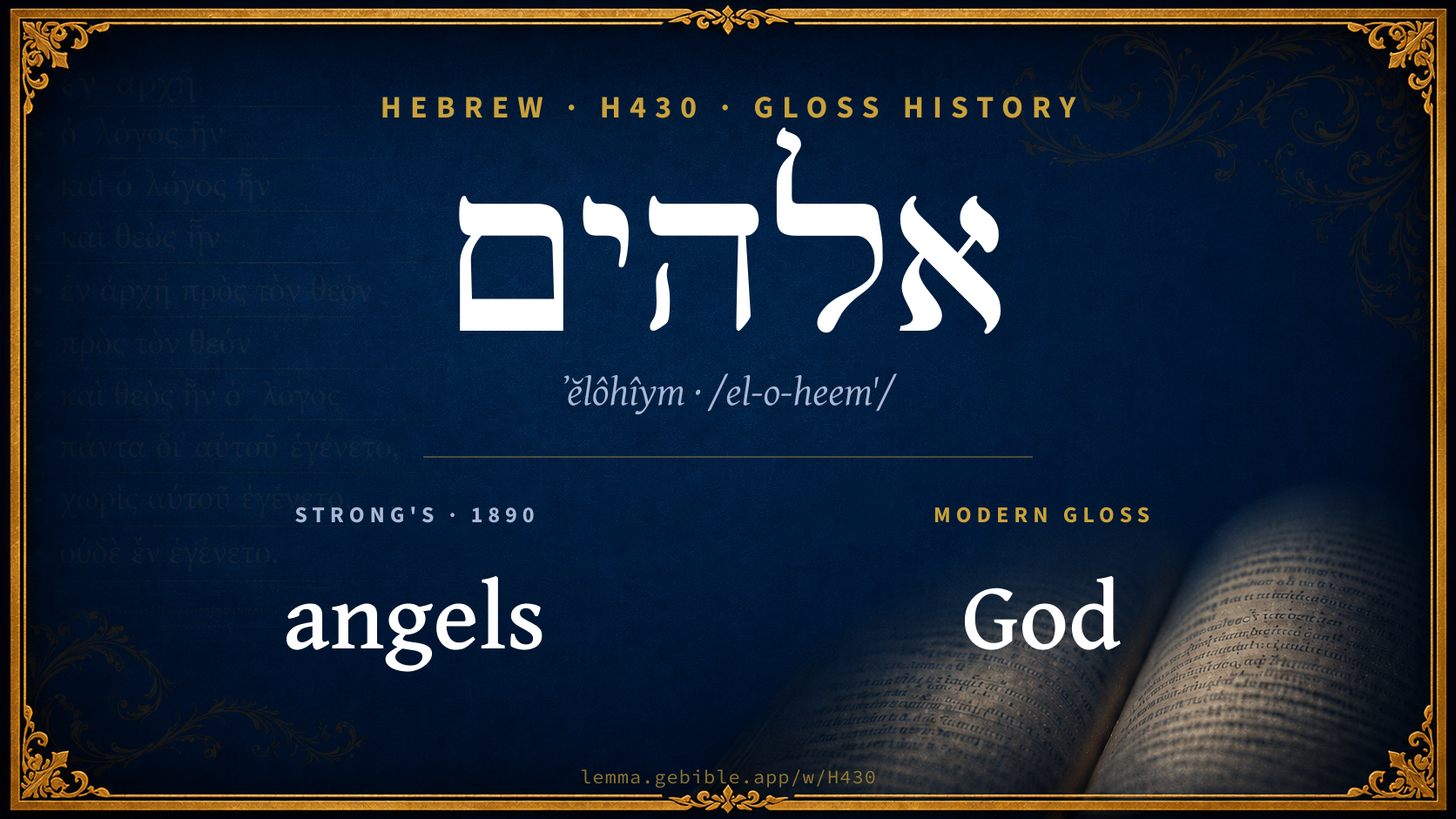
Gloss history
Strong's 1890 vs modern scholarship
About this word
Strong's H430 catalogs a Hebrew word from the Hebrew Old Testament.
These counts are not copied from any lexicon or concordance. They are computed here, from the morphology-tagged Hebrew Old Testament. What Lemma adds →
- 2,246
- distinct verses
- The word appears in 2,246 distinct verses.
- 35 / 39
- OT books
- The word appears in 35 of 39 Old Testament books.
- #13
- by frequency
- Top 25 most frequent Hebrew words (rank 13 of 8,640 Hebrew words by occurrence).
View all 2,246 occurrences in the concordance →
Most concentrated in
- Psalms 322 verses 14%
- Deuteronomy 312 verses 14%
- Genesis 190 verses 8%
By section of the Old Testament
By traditional corpus
Conventional, traditional groupings — biblical authorship is debated, so this is a traditional corpus grouping, not an authorship claim. Each share is this word’s portion of its verses in that division of the Hebrew canon. Each figure is a share of the word’s 2,246 distinct verses.
- Prophets (Nevi'im) 784 verses · 35%
- Writings (Ketuvim) 779 verses · 35%
- Torah (Pentateuch) 683 verses · 30%
How translations render this word
Counts come from each version’s own published word-to-Strong’s tagging or interlinear alignment — an approximate guide to how each version renders this word, not a word-level alignment the data otherwise carries. Because each total is that version’s own tagged count, the per-version totals vary from one another and need not match the appearance or distinct-verse counts above. These counts may also differ from a printed concordance because Lemma counts each distinctly tagged rendering and does not collapse phrase taggings into a single head-word total. This is a fixed set of word-tagged versions (KJV, ASV, BSB, ULT) and does not change with the reading translation you choose elsewhere. Each version’s license is shown beside its name below (and on Sources).
- King James Version: God 2,100×, Gods 160×, Is no god 7×
- American Standard Version: God 1,915×, Gods 141×, Jehovah thy god 20×
- Berean Standard Bible: God 2,183×, Gods 176×, May god 17×
- unfoldingWord Literal Text: God 1,924×, God of 307×, Gods 148×
King James Version Public Domain
Renders H430 across 2,605 tagged occurrences — most commonly:
Plus other, less common renderings. Plus 173 renderings that appear only once — usually multi-word phrases or single function words the recovered tagging swept in, not distinct renderings. Not rendered by a distinct English word in 1 further occurrence.
American Standard Version Public Domain
Renders H430 across 2,605 tagged occurrences — most commonly:
Plus other, less common renderings. Plus 248 renderings that appear only once — usually multi-word phrases or single function words the recovered tagging swept in, not distinct renderings. Not rendered by a distinct English word in 2 further occurrences.
Berean Standard Bible Public Domain
Renders H430 across 2,560 tagged occurrences — most commonly:
Plus other, less common renderings. Plus 60 renderings that appear only once — usually multi-word phrases or single function words the recovered tagging swept in, not distinct renderings. Not rendered by a distinct English word in 40 further occurrences.
unfoldingWord Literal Text CC BY-SA 4.0
Renders H430 across 2,584 tagged occurrences — most commonly:
Plus other, less common renderings. Plus 48 renderings that appear only once — usually multi-word phrases or single function words the recovered tagging swept in, not distinct renderings.
15 senses and sub-senses in the full BDB
What do BDB’s symbols mean?
BDB uses these scholarly abbreviations:
| Symbol | Meaning |
|---|---|
| 𝔊 | the Septuagint (the ancient Greek translation, LXX) |
| 𝔙 | the Vulgate (the Latin translation) |
| 𝔖 | the Syriac version (the Peshitta) |
| 𝔗 | the Targum (the Aramaic translation) |
| ψ | the Psalms |
| √ | root (the underlying root or stem) |
| ‖ | parallel passage (a synonymous or contrasted parallel) |
| † | the dagger: every passage where the word occurs is cited |
The 15 senses and sub-senses the full Brown-Driver-Briggs lexicon distinguishes for this word, in lexicon order (not ranked by frequency), with BDB’s own verbatim wording and sub-sense lettering. Shown in Hebrew script with BDB’s own scholarly abbreviations. The condensed entry is in the Lexicon Entry tab. See also the Forms in the corpus table below.
- 1. pl. in number.
- a. rulers, judges, either as divine representatives at sacred places or as reflecting divine majesty and power: האלהים Ex 21:6 (Onk 𝔖, but τὸ κριτήριον τοῦ Θεοῦ 𝔊) 22:7, 8; אלהים 22:8, 27 (𝔗 Ra AE Ew RVm; but gods, 𝔊 Josephus Philo AV; God, Di RV; all Covt. code of E) cf. 1 S 2:25 v. Dr.; Ju 5:8 (Ew, but gods 𝔊; God 𝔖 BarHeb.; יהוה 𝔙 Be) ψ 82:1, 6 (De Ew Pe; but angels Bl Hup) 138:1 (𝔖 𝔗 Rab Ki De; but angels 𝔊 Calv; God, Ew; gods, Hup Pe Che). e.g. Exodus 21:6
- b. divine ones, superhuman beings including God and angels ψ 8:6 (De Che Br; but angels 𝔊 𝔖 𝔗 Ew; God, RV and most moderns) Gn 1:27 (if with Philo 𝔗 Jer De Che we interpret נעשה as God’s consultation with angels; cf. Jb 38:7). e.g. Psalms 8:6
- c. angels ψ 97:7 (𝔊 𝔖 Calv; but gods, Hup De Pe Che); cf. בני (ה)אלהים = (the) sons of God, or sons of gods = angels Jb 1:6; 2:1; 38:7 Gn 6:2, 4 (J; so 𝔊 Bks. of Enoch & Jubilees Philo Jude v 6; 2 Pet 2:4 JosAnt. i, 3, 1, most ancient fathers and modern critics; against usage are sons of princes, mighty men, Onk and Rab.; sons of God, the pious, Theod Chrys Jer Augustine Luther Calv Hengst; 𝔊L read οἱ υἱοὶ τοῦ Θεοῦ), cf. בני אלים. e.g. Psalms 97:7
- d. gods האלהים Ex 18:11; 22:19 (E) 1 S 4:3; 2 Ch 2:4 ψ 86:3; אלהי האלהים the God of gods, supreme God Dt 10:17 ψ 136:2; אלהים Ex 32:1, 23 (JE) Ju 9:13; אלהים אחרים other gods Ex 20:3; 23:13 Jos 24:2, 16 (E) Dt 31:18, 20 (JE) 5:7 + (17 times in D, not P) Ju 2:12, 17, 19; 10:13 1 S 8:8; 26:19 1 K 9:6, 9 (= 2 Ch 7:19, 22) 11:4, 10; 14:9 2 K 5:17; 17:35, 37, 38; 22:17 (= 2 Ch 34:25) 2 Ch 28:25 Je 1:16 + (18 times Je) Ho 3:1; אלהי (ה)נכר foreign gods Gn 35:2, 4 Jos 24:20, 23 (E) Dt 31:16 (JE) Ju 10:16 1 S 7:3 2 Ch 33:15 Je 5:19; א׳ נחור (v. 4 b); א׳ מצרים Ex 12:12 (P) Je 43:12, 13; א׳ האמרי Jos 24:15 (E) Ju 6:10; א׳ ארם etc. Ju 10:6; אלהים מעשה ידי Dt 4:28; א׳ הגוים gods of the nations 2 K 18:33; 19:12 Dt 29:17; 2 Ch 32:17, 19 Is 36:18; 37:12; א׳ העמים Dt 6:14; 13:8 Ju 2:12 ψ 96:5 1 Ch 5:25; 16:26; 2 Ch 32:13, 14; א׳ כסף Ex 20:23 (E); א׳ זהב Ex 20:23 (E) 32:31 (JE); א׳ מַסֵּכָה Ex 34:17 (J) Lv 19:4 (H). e.g. Exodus 18:11
- 2. Pl. intensive.
- a. god or goddess, always with sf. 1 S 5:7 (Dagon), Ju 11:24 (Chemosh), 1 K 18:24 (Baal), Ju 9:27 Dn 1:2(×2); or cstr. לעשתרת א׳ צדנים לכמוש א׳ מואב to Ashtoreth goddess of the Zidonians, Chemosh god of Moab, etc. 1 K 11:33; א׳ הארץ god of the land 2 K 17:26(×2), 27, and so the Syrians suppose that Yahweh is a mountain-god and not a god of valleys 1 K 20:28. e.g. 1 Samuel 5:7
- b. godlike one Ex 4:16 (J; Moses in relation to Aaron), Ex 7:1 (P; in relation to Pharaoh), 1 S 28:13 (the shade of Samuel), ψ 45:7 (the Messianic king, O God, 𝔊 𝔖 Jer, most scholars ancient and modern, but thy throne is God’s = God’s throne AE Ki Thes Ew Hup, cf. 1 Ch 28:5). e.g. Exodus 4:16
- c. works of God, or things specially belonging to him (vid. אֵל 5) הר אלהים ψ 68:16; Ez 28:14, 16; אש אלהים Jb 1:16; גן (ה)אלהים Ez 28:13; 31:8, 9. e.g. Psalms 68:16
- d. God (vid. 3 & 4).
- 3. הָאֱלֹהִים the (true) God, י׳ הוא האלהים Yahweh is (the) God Dt 4:35, 39; 7:9 1 K 8:60; 18:39(×2) 2 Ch 33:13 הוא האלהים 1 K 18:24 Is 45:18; י׳ האלהים Jos 22:34 (P?) 1 K 18:21; 2 Ch 32:16; אתה הוא האלהים 2 S 7:28; 1 K 18:37; 2 K 19:15; 1 Ch 17:26; Is 37:16; Ne 9:7; האלהים as subj. or obj. is used in E 33 times, Chr 38 times, Ec 31 times, Jon 5 times, elsewhere Gn 5:22, 24; 6:9, 11 (sources of P) 17:18 (P) Jos 22:34 (P?) Gn 44:16 (J) Dt 4:35, 39; 7:9; Ju 6:36, 39; 7:14; 10:14; 16:28; 21:2 1 S 10:3, 7; 14:36; 2 S 2:27; 6:7; 7:28; 12:16 1 K 8:60; 18:21, 24(×2), 37, 39(×2) 2 K 19:15 (Ephr) Jb 2:10 Je 11:12 Is 37:16; 45:18 ψ 108:14 Dn 1:9, 17; י׳ הא׳ הקדוש 1 S 6:20; י׳ הא׳ הגדול Ne 8:6; הא׳ אשר בירושלם Ezr 1:3; אדני האלהים Dn 9:3; in many phrases, as איש האלהים the man of God, acting under divine authority and influence: = (a) angel Ju 13:6, 8, (b) prophet (the term coming into use in the Northern kingdom in the age of Elijah 1 S 9:6–10, cf. אִישׁ הָרוּחַ Hos 9:7): of Moses Dt 33:1 Jos 14:6 (E) 1 Ch 23:14 2 Ch 30:16 Ezr 3:2 ψ 90:1; of Samuel 1 S 9:6–10; of David 2 Ch 8:14 Ne 12:24, 36; Shemaiah 1 K 12:22 (= 2 Ch 11:2); Elijah, Elisha, and others of their time 1 K 13:1–31; 17:18–24; 20:28 2 K 1:9–13; 4:7–42; 5:8–20; 6:6–15; 7:2, 17; 8:2–11; 13:19; 23:16–17 (Ephr.) 2 Ch 25:7, 9; unnamed prophet 1 S 2:27; Hanan Je 35:4; a later title of prophet was עֶבֶד האלהים the servant of God, used of Moses 1 Ch 6:34 2 Ch 24:9 Ne 10:30 Dn 9:11. בית האלהים the house of God, Ju 18:31, especially late, Chr (52 times) Ec 4:17 Dn 1:2; בית י׳ הא׳ 1 Ch 22:1; האלהים (ברית) ארון the ark (of the covenant) of God Ju 20:27 1 S 4–5. 14, 2 S 6–7. 15 (23 times) 1 Ch 13. 15. 16, 2 Ch 1:4 (13 times); מטה האלהים the rod of God Ex 4:20; 17:9 (E); הר האלהים the mount of God (Horeb) Ex 3:1; 4:27; 18:5; 24:13 (E) 1 K 19:8 (Ephr.); מלאך האלהים the (theophanic) angel of God Gn 31:11 Ex 14:19 (E) Ju 6:20; 13:6, 9 2 S 14:17, 20; 19:28; in other combinations Ex 18:16 Nu 23:27 (E) Ju 20:2 1 S 4:8; 5:11; 10:5 2 S 16:23 1 K 12:22 1 Ch 21:7 + ψ 87:3 Ec 9:1. e.g. Deuteronomy 4:35
- 4. אֱלֹהִים = God י׳ אֱלֹהִים אֱמֶת = Yahweh is God in truth Je 10:10. e.g. Jeremiah 10:10
- a. אלהים (as subj. obj. direct or indirect) is used by P (50 times in story of creation and deluge, elsewhere 28 times), by E (91 times), J chiefly in poetic sources Gn 3:1, 3, 5(×2); 9:27; 39:9 Dt 32:17, 39, by D (11 times) Ju (21 times) S (50 times) K (29 times) Chr (45 times); in ψ 42–86 (180 times often by editorial change for an original יהוה), elsewhere ψ 3:3; 5:11; 7:11, 12; 9:18; 10:4, 13; 14:1, 2, 5; 25:22; 36:2, 8; 77:14; 100:3; 108:2, 6, 8, 12(×2), 14 Jb 5:8; 20:29; 28:23; 32:2; 34:9 (& in Prologue 6 times) Pr 2:5; 3:4; 25:2 Ec (7 times) Hos (5 times) Am 4:11 (כמהפכת אלהים את סדם as God overthrew Sodom = Je 50:40 = Is 13:19) Zc 8:23; 12:8 Mi 3:7 (but אליהם 𝔊 𝔖) Is 35:4 Is 2 (9 times) Je 10:10 Ez (13 times) Mal (5 times) Jon (4 times); the phrase היה ל׳ לאלהים Gn 28:21 (ER) 17:7, 8 Ex 6:7; 29:45 Lv 11:45; 22:33; 25:38; 26:12, 45 Nu 15:41 (P) Dt 26:17; 29:13 2 S 7:24 (= 1 Ch 17:22) Zc 8:8 Je (6 times) Ez (6 times); אלהים צדיק righteous God ψ 7:10; א׳ קדשים holy God Jos 24:19 (E); א׳ חיים living God Dt 5:23 1 S 17:26, 36 Je 10:10; 23:36; א׳ חי 2 K 19:4, 16 (= Is 37:4, 17). For the phrases יהוה א׳, י׳ א׳ צבאות, א׳ צבאות, אל א׳ י׳, יה א׳, י׳ צבאות א׳, י׳ אלהי צבאות, אדני א׳ vid. יהוה, יה, צבאות & אדני. e.g. Genesis 3:1
- b. cstr. אֱלֹהֵי (α) with persons אֱלֹהֵי אַבְרָהָם = God of Abraham, a phrase of J, Gn 26:24; 28:13; 31:53, Gn 31:42 (ε) Ex 3:6 ψ 47:10 1 K 18:36 1 Ch 29:18 2 Ch 30:6; א׳ אדני אברהם Gn 24:12, 27, 42, 48 (J); אלהי אב father’s God (various sf. & names), a phrase of E, Gn 31:5, 29, 42; 46:3; 50:17 Ex 3:6, 13, 15, 16; 15:2; 18:4 Jos 18:3, elsewhere Gn 32:10; 43:23 (J) Ex 4:5 (J?) Dt (8 times) Ju 2:12 2 K 21:22 Chr (31 times) Dn 11:37; אֱלֹהֵי יִשְׂרָאֵל Israel’s God, phrase of E, Gn 33:20 Ex 5:1; 24:10; 32:27 Jos 8:30; 14:14; 22:16; 24:2, 23, elsewhere Ex 34:23 Jos 7:13, 19, 20 (JE) Nu 16:9 Jos 9:18, 19; 22:24; 10:40, 42; 13:14, 33 (R vid. Di Jos 7:13) Ju 4:6; 5:3, 5; 6:8; 11:21, 23; 21:3 1 S 1:17 + (20 times) K (26 times) Chr (45 times) ψ 41:14; 106:48 (doxol.) 59:6; 69:7 Is 17:6; 21:10, 17; 29:23 Is 3; 24:15; 37:16, 21 Is 2; 41:17 + (6 times) Je 35:17 + (48 times), Ez 8:4 + (7 times) Zp 2:9 Mal 2:16 Ru 2:12; א׳ מערכות ישראל God of the battle array of Israel 1 S 17:45; א׳ יַעֲקֹב 2 S 23:1 (poet.) ψ 20:2; 46:8, 12; 75:10; 76:7; 81:2, 5; 84:9; 94:7 Is 2:3 (= Mi 4:2); א׳ העבריים God of the Hebrews Ex 3:18; 5:3; 7:16; 9:1, 13 (JE); it is used with other proper names, Nahor Gn 31:53 (E), Shem Gn 9:26 (J), David 2 K 20:5 2 Ch 21:12; 34:3 Is 38:5, Hezekiah 2 Ch 32:17, Elijah 2 K 2:14; א׳ אדני המלך the God of my lord the king 1 K 1:36. (β) with nouns of attributes or relationships, א׳ קֶדֶם ancient God Dt 33:27; א׳ עולם everlasting God Is 40:28; א׳ אֱמֶת true God 2 Ch 15:3; א׳ אָמֵן Is 65:16 (vid. אָמֵן); א׳ משפט Is 30:18 Mal 2:17; א׳ מרום Mi 6:6; א׳ כָל בָשָׂר God of all flesh Je 32:27; cf. א׳ הרוחת לכל בשר Nu 16:22; 27:16 (P); א׳ השמים God of heaven Gn 24:7 (JR) 2 Ch 36:23 Ezr 1:2 Ne 1:4, 5; 2:4, 20; cf. א׳ כל הארץ Is 54:5; י׳ א׳ השמים וא׳ הארץ Gn 24:3 (JR); א׳ מִקָּרֹב a God at hand opp. א׳ מֵרָחֹק Je 23:23, א׳ ישועתי, א׳ יִשְׁעִי God of my salvation ψ 18:47 (= 2 S 22:47) 24:5; 25:5; 27:9; 65:6; 79:9; 85:5 Is 17:10 Mi 7:7 Hb 3:18 1 Ch 16:35; א׳ ישועתי ψ 88:2; א׳ תשועתי ψ 51:16; א׳ צִדְקִי God of my righteousness ψ 4:2; א׳ חַסְדִּי ψ 59:11, 18; א׳ צוּרִי God who is my rock 2 S 22:3 (cf. ψ 18:3); א׳ מָעוּזִּי֯ God who is my stronghold ψ 43:2; א׳ תְהִלָּתִי God who is my praise ψ 109:1. e.g. Genesis 26:24
- c. with sf. in P (22 times incl. phr. ויראת מאלהיך) Lv 19:14, 32; 25:17, 36, 43 (H) Ex 8:21 Jos 24:27 (E) Dt 32:37 (poet.) Jos 9:23 (JE) Dt 10:21; 31:17 Ju 10:10; 16:23, 24 1 S 10:19 2 S 10:12; 22:32 + (4 times poet.) 1 K 12:28; 20:23 2 K 19:10 Chr (83 times) ψ (62 times) Pr 2:17; 30:9 Ru 1:15, 16(×2) Is 1:10; 7:13; 8:19, 21 Is 2 (29 times) Je 5:4, 5; 23:36; 51:5 Ez 34:31 Dn (5 times) Ho (12 times) Am 2:8; 4:12 Jo 1:13(×2), 16; 2:17 Mi 6:8; 7:7 Jon 1:5, 6 Zp 3:2 Na 1:14 Zc 9:7; 12:5; אלהים with sf. is also used with יהוה several hundred times (vid. יהוה). e.g. Leviticus 19:14
Senses from the full Brown-Driver-Briggs lexicon (Brown, Driver, Briggs; Oxford 1906 — public domain), digitized via Sefaria, supplemented by the OpenScriptures HebrewLexicon (CC BY 4.0). Full attribution on Sources.
Word origin
n.m.pl. (f. 1 K 11:33; on number of occurrences of אֵל, אֱלוֹהַּ, אֱלֹהִים cf. also Nesl.c.)
— Brown-Driver-Briggs (Oxford 1906, public domain), digitized via Sefaria, supplemented by the OpenScriptures HebrewLexicon (CC BY 4.0). See Sources.
Derived from אלוה (ʼĕlôwahh) (H433) — God.
Jastrow Dictionary
A second Hebrew/Aramaic lexicon for comparison, covering Aramaic and post-biblical (Talmudic, Targumic, Midrashic) usage that the biblical-Hebrew BDB does not. Matched by lemma rather than by Strong’s number, so a lemma may carry more than one Jastrow headword (shown separately below), and the entries cover usage well beyond the Bible.
אֱלֹהִים
- , v. אֱלוֹהַּ
A Dictionary of the Targumim, the Talmud Babli and Yerushalmi, and the Midrashic Literature (Marcus Jastrow; London, Luzac, 1903) — Public Domain. Digitized via Sefaria. Digitized via Sefaria. Full attribution on Sources.
Forms in the corpus
The 348 distinct written forms H430 takes in the Hebrew Bible, most frequent first — each parse links to that state’s occurrences in the concordance. Hebrew forms include their vowel points and cantillation, so a single lemma takes many written forms.
The 60 most common forms are shown; 288 rarer forms follow in the full concordance.
Same root — word family
Other BDB entries built from the same root as H430, grouped by Strong’s listed origin. These share a root / origin per the lexicon — not necessarily a shared meaning. Each links to that word’s own entry.
Derives from
Proper names from this root
People and places named from this root — a name, not an additional meaning of the word.
Compare all same-root words → 2 of the same-root words are proper names (people or places). They share a root, not necessarily a meaning.
Bible dictionary
Public-domain dictionary articles matched to this entry by name (God). A biblical name can be shared by more than one person or place, so an article may treat several.
Easton's Bible Dictionary · M. G. Easton, 1897
(A.S. and Dutch God; Dan. Gud; Ger. Gott), the name of the Divine Being. It is the rendering (1) of the Hebrew 'El, from a word meaning to be strong; (2) of 'Eloah_, plural _'Elohim. The singular form, Eloah, is used only in poetry. The plural form is more commonly used in all parts of the Bible, The Hebrew word Jehovah (q.v.), the only other word generally employed to denote the Supreme Being, is uniformly rendered in the Authorized Version by "LORD," printed in small capitals. The existence of God is taken for granted in the Bible. There is nowhere any argument to prove it. He who disbelieves this truth is spoken of as one devoid of understanding (Ps. 14:1).
The arguments generally adduced by theologians in proof of the being of God are:
(1.) The a priori argument, which is the testimony afforded by reason.
(2.) The a posteriori argument, by which we proceed logically from the facts of experience to causes. These arguments are,
(a) The cosmological, by which it is proved that there must be a First Cause of all things, for every effect must have a cause.
(b) The teleological, or the argument from design. We see everywhere the operations of an intelligent Cause in nature.
(c) The moral argument, called also the anthropological argument, based on the moral consciousness and the history of mankind, which exhibits a moral order and purpose which can only be explained on the supposition of the existence of God. Conscience and human history testify that "verily there is a God that judgeth in the earth."
The attributes of God are set forth in order by Moses in Ex. 34:6, 7. (see also Deut. 6:4; 10:17; Num. 16:22; Ex. 15:11; 33:19; Isa. 44:6; Hab. 3:6; Ps. 102:26; Job 34:12.) They are also systematically classified in Rev. 5:12 and 7:12.
God's attributes are spoken of by some as absolute, i.e., such as belong to his essence as Jehovah, Jah, etc.; and relative, i.e., such as are ascribed to him with relation to his creatures. Others distinguish them into communicable, i.e., those which can be imparted in degree to his creatures: goodness, holiness, wisdom, etc.; and incommunicable, which cannot be so imparted: independence, immutability, immensity, and eternity. They are by some also divided into natural attributes, eternity, immensity, etc.; and moral, holiness, goodness, etc.
Smith's Bible Dictionary · William Smith, 1863
(good). Throughout the Hebrew Scriptures two chief names are used for the one true divine Being--ELOHIM, commonly translated God in our version, and Jehovah, translated Lord . Elohim is the plural of Eloah (in Arabic Allah); it is often used in the short form EL (a word signifying strength, as in EL-SHADDAI, God Almighty, the name by which God was specially known to the patriarchs. (Genesis 17:1; 28:3; Exodus 6:3) The etymology is uncertain, but it is generally agreed that the primary idea is that of strength, power of effect, and that it properly describes God in that character in which he is exhibited to all men in his works, as the creator, sustainer and supreme governor of the world. The plural form of Elohim has given rise to much discussion. The fanciful idea that it referred to the trinity of persons in the Godhead hardly finds now a supporter among scholars. It is either what grammarians call the plural of majesty, or it denotes the fullness of divine strength, the sum of the powers displayed by God. Jehovah denotes specifically the one true God, whose people the Jews were, and who made them the guardians of his truth. The name is never applied to a false god, nor to any other being except one, the ANGEL-JEHOVAH who is thereby marked as one with God, and who appears again in the New Covenant as "God manifested in the flesh." Thus much is clear; but all else is beset with difficulties. At a time too early to be traced, the Jews abstained from pronouncing the name, for fear of its irreverent use. The custom is said to have been founded on a strained interpretation of (Leviticus 24:16) and the phrase there used, "THE NAME" (Shema), is substituted by the rabbis for the unutterable word. In reading the Scriptures they substituted for it the word ADONAI (Lord), from the translation of which by Kurios in the LXX., followed by the Vulgate, which uses Dominus, we have the Lord of our version. The substitution of the word Lord is most unhappy, for it in no way represents the meaning of the sacred name. The key to the meaning of the name is unquestionably given in God's revelation of himself to Moses by the phrase "I AM THAT I AM," (Exodus 3:14; 6:3) We must connect the name Jehovah with the Hebrew substantive verb to be, with the inference that it expresses the essential, eternal, unchangeable being of Jehovah. But more, it is not the expression only, or chiefly, of an absolute truth: it is a practical revelation of God, in his essential, unchangeable relation to this chosen people, the basis of his covenant.
Classic public-domain reference works; full attribution on Sources.
Septuagint verse parallels
This word appears in 2,078 verses that also exist in the Greek Old Testament (Septuagint), out of the 2,246 Hebrew verses it occurs in. You can read those verses in Greek by switching the Old Testament edition to the Septuagint.
Read these verses in the Septuagint
- Genesis 1:1
- Exodus 1:17
- Leviticus 2:13
- Numbers 6:7
- Deuteronomy 1:6
- Joshua 1:9
- Judges 1:7
- Ruth 1:15
- 1 Samuel 1:17
- 2 Samuel 2:27
- 1 Kings 1:17
- 2 Kings 1:2
This is a verse-level parallel only — the same verses exist in both the Hebrew and Greek Old Testaments. No word-level Hebrew↔Greek correspondence is claimed: the data carries no such alignment, so no Greek word is shown as this Hebrew word’s translation. Coverage is not total — the Septuagint omits the deuterocanon and renumbers the Psalms, so some Hebrew verses have no direct Greek parallel.