1 Samuel 17:43

Hebrew (Westminster Leningrad Codex) 1 Samuel 17:43 appears in the Hebrew Old Testament. The text above is from the Westminster Leningrad Codex. Each word links to its Strong’s number, a concise gloss, and parsing drawn from the Open Scriptures Hebrew Bible morphology. Click any word for its full Brown-Driver-Briggs (BDB) entry.
Download image
Cite this verse

1 Samuel 17:43 (World English Bible). Public Domain. Lemma interlinear Bible study tool, https://lemma.gebible.app/v/1-samuel/17/43.

Show BibTeX & RIS
BibTeX
RIS
English Translation
The Philistine said to David, Am I a dog, that you come to me with sticks? The Philistine cursed David by his gods.
World English Bible · Public Domain
Download a study sheet

One document with this verse’s original text, its word-by-word gloss line, the meaning frame, cross-references with their text, attributed commentary, and full source and license credits — printable, and it pastes into notes with its structure intact.

This verse Autodidact and up

Study sheet (.html) Plain text (.txt)

A passage Seminary Student

Up to 50 verses in one chapter. A passage sheet keeps up to 6 commentary sources and 12 cross-references per verse, in the order this page ranks them, and says so on the sheet whenever that leaves anything out. Ask for a single verse and you get the Autodidact verse sheet above.

Everything on this page stays free to read, with no account — the sheet is a download of what is already on screen, not access to it.

Want to remove ads? Support Godless Engineer
Compare translations 3

The same verse in 3 English versions, stacked beneath the original-language interlinear above. Click any original word for its lexicon entry.

Each is an independent rendering of the whole verse — the interlinear is not word-aligned to these translations.

Highlighted words mark where these versions differ — a whole-verse word diff, not a word-by-word alignment.

  • World English Bible Public Domain
    The Philistine said to David, Am I a dog, that you come to me with sticks? The Philistine cursed David by his gods.
  • King James Version Public Domain
    And the Philistine said unto David, Am I a dog, that thou comest to me with staves? And the Philistine cursed David by his gods.
  • unfoldingWord Literal Text CC BY-SA 4.0
    And the Philistine said to David, “ I a dog, that you are coming to me with sticks?” And the Philistine cursed David by his gods.

unfoldingWord Literal Text — © unfoldingWord, licensed CC BY-SA 4.0. Word-aligned USFM3 via Door43 (git.door43.org/unfoldingWord/en_ult).

Versions to compare (up to 4)

3 of 4 selected

Show all 18 translations

Every available English version of this verse, each an independent rendering of the whole verse.

  • World English Bible Public Domain
    The Philistine said to David, Am I a dog, that you come to me with sticks? The Philistine cursed David by his gods.
  • Berean Standard Bible Public Domain
    “Am I a dog,” he said to David, “that you come at me with sticks?” And the Philistine cursed David by his gods.
  • Majority Standard Bible Public Domain
    “Am I a dog,” he said to David, “that you come at me with sticks?” And the Philistine cursed David by his gods.
  • King James Version Public Domain
    And the Philistine said unto David, Am I a dog, that thou comest to me with staves? And the Philistine cursed David by his gods.
  • American Standard Version (1901) Public Domain
    And the Philistine said unto David, Am I a dog, that thou comest to me with staves? And the Philistine cursed David by his gods.
  • Revised Version (1885) Public Domain
    And the Philistine said unto David, Am I a dog, that thou comest to me with staves? And the Philistine cursed David by his gods.
  • Geneva Bible (1599) Public Domain
    And the Philistim sayde vnto Dauid, Am I a dog, that thou commest to me with staues? And the Philistim cursed Dauid by his gods.
  • Douay-Rheims (1899) Public Domain
    And the Philistine said to David: Am I a dog, that thou comest to me with a staff? And the Philistine cursed David by his gods.
  • Young's Literal Translation Public Domain
    And the Philistine saith unto David, `Am I a dog that thou art coming unto me with staves?' and the Philistine revileth David by his gods,
  • Literal Standard Version CC BY-SA 4.0
    And the Philistine says to David, “Am I a dog that you are coming to me with sticks?” And the Philistine reviles David by his gods,
  • Unlocked Literal Bible CC BY-SA 4.0
    Then the Philistine said to David, “Am I a dog, that you come to me with sticks?,” and the Philistine cursed David by his gods.
  • unfoldingWord Literal Text CC BY-SA 4.0
    And the Philistine said to David, “ I a dog, that you are coming to me with sticks?” And the Philistine cursed David by his gods.
  • Darby Bible Public Domain
    And the Philistine said to David, Am I a dog, that thou comest to me with staves? And the Philistine cursed David by his gods.
  • World Messianic Bible Public Domain
    The Philistine said to David, “Am I a dog, that you come to me with sticks?” The Philistine cursed David by his gods.
  • Webster's Bible Public Domain
    And the Philistine said to David, Am I a dog, that thou comest to me with staffs? and the Philistine cursed David by his gods.
  • Free Bible Version CC BY-SA 4.0
    “Do you think I'm a dog, coming to fight me with a stick?” the Philistine asked David, and he cursed David by his gods.
  • Bible in Basic English Public Domain
    And the Philistine said to David, Am I a dog, that you come out to me with sticks? And the Philistine put curses on David by all his gods.
  • JPS Tanakh (1917) Public Domain
    And the Philistine said unto David: 'Am I a dog, that thou comest to me with staves?' And the Philistine cursed David by his god.

Literal Standard Version (2020), Covenant Press — licensed CC BY-SA 4.0. Text via the HelloAO Bible API (eBible.org). Unlocked Literal Bible (unfoldingWord) — licensed CC BY-SA 4.0. Text via the HelloAO Bible API (eBible.org). unfoldingWord Literal Text — © unfoldingWord, licensed CC BY-SA 4.0. Word-aligned USFM3 via Door43 (git.door43.org/unfoldingWord/en_ult). Free Bible Version, Dr. Jonathan Gallagher — licensed CC BY-SA 4.0. Text via the HelloAO Bible API (eBible.org).

Word by word

More ways to search: Search by grammar → Find every occurrence → Compare this word →

Practice this passage: Drill this verse → Learn its vocabulary →

בַּמַּקְל֑וֹת
maqqêl
H4731
“in/at the · staves”
Preposition, Determined + Noun, Common, Masculine, Plural, Absolute
Part of Speech
Preposition + Noun
Type
Common
Gender
Masculine
Number
Plural
State
Absolute
Full BDB Definition

Origin: from an unused root meaning apparently to germinate

TWOT: 1236

rod, staff - rod, stick - staff (in travel) - wand (of diviner)
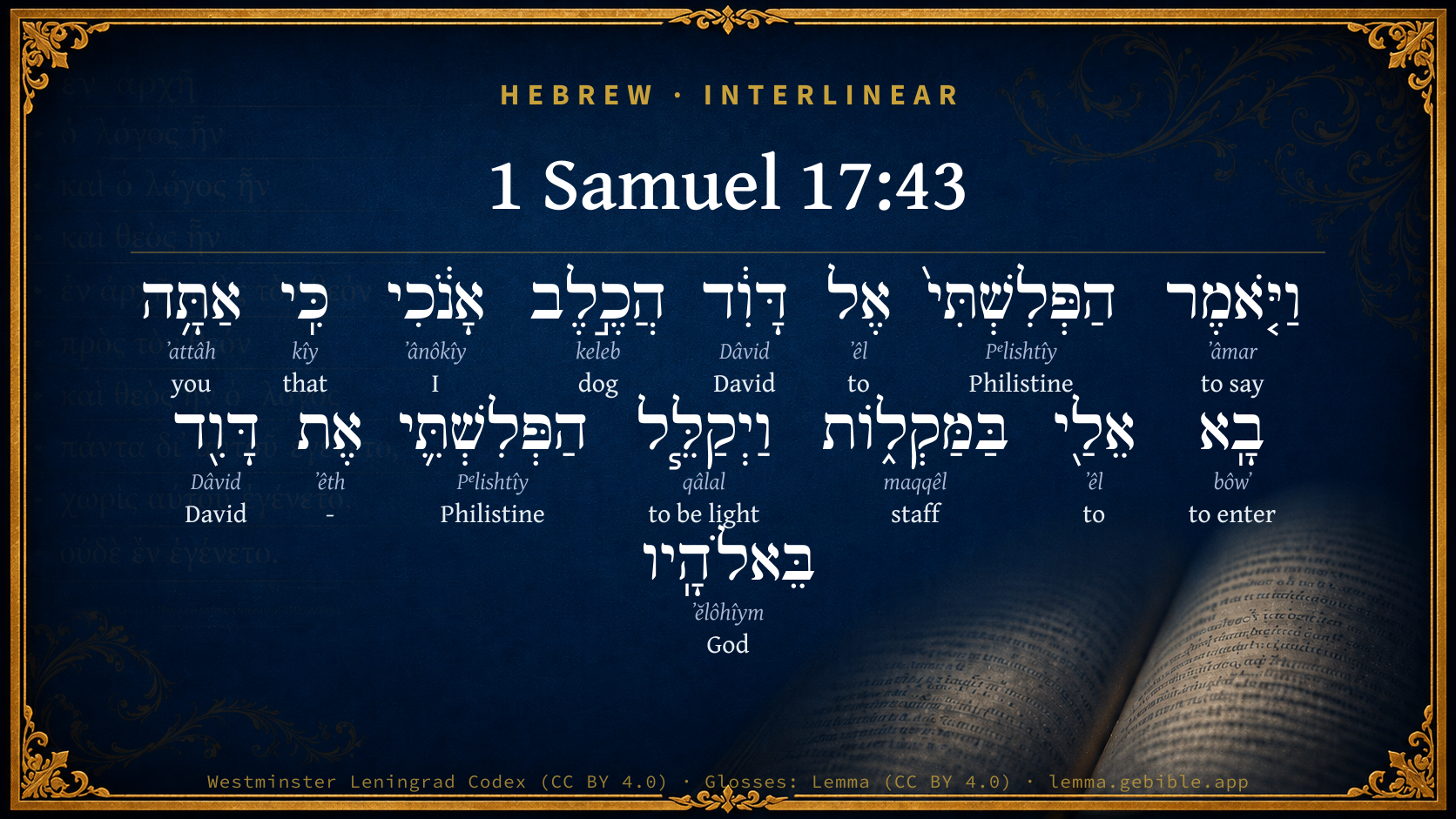
  1. וַיֹּ֤אמֶר ʼâmar H559 “and · to say” Conjunction + Verb, Qal, Sequential Imperfect, 3rd Person, Masculine, Singular
  2. הַפְּלִשְׁתִּי֙ Pᵉlishtîy H6430 “the · Philistine” Particle, Definite Article + Noun, Gentilic, Masculine, Singular, Absolute
  3. אֶל ʼêl H413 “to” Preposition
  4. דָּוִ֔ד Dâvid H1732 “David” Noun, Proper
  5. הֲכֶ֣לֶב keleb H3611 “dog” Particle, Interrogative + Noun, Common, Masculine, Singular, Absolute
  6. אָנֹ֔כִי ʼânôkîy H595 “I” Pronoun, Personal, 1st Person, Common, Singular
  7. כִּֽי kîy H3588 “that” Conjunction
  8. אַתָּ֥ה ʼattâh H859 “you” Pronoun, Personal, 2nd Person, Masculine, Singular
  9. בָֽא bôwʼ H935 “entering” Verb, Qal, Participle Active, Masculine, Singular, Absolute
  10. אֵלַ֖י ʼêl H413 “to · me” Preposition + Suffix, Personal, 1st Person, Common, Singular
  11. וַיְקַלֵּ֧ל qâlal H7043 “and · to be light” Conjunction + Verb, Piel, Sequential Imperfect, 3rd Person, Masculine, Singular
  12. הַפְּלִשְׁתִּ֛י Pᵉlishtîy H6430 “the · Philistine” Particle, Definite Article + Noun, Gentilic, Masculine, Singular, Absolute
  13. אֶת ʼêth H853 “-” Particle, Direct Object
  14. דָּוִ֖ד Dâvid H1732 “David” Noun, Proper
  15. בֵּאלֹהָֽיו ʼĕlôhîym H430 “in/at · God(s) · his” Preposition + Noun, Common, Masculine, Plural, Construct + Suffix, Personal, 3rd Person, Masculine, Singular

About this verse

These counts appear in no published source. They are computed here, from the morphology-tagged text and Lemma’s own curated glosses. What Lemma adds →

16
words
13
distinct lemmas
Historical
section

Notable vocabulary

The rarest word here is בַּמַּקְל֑וֹת staff H4731 — appearing just 18 times in the whole Hebrew Bible.

Shared distinctive vocabulary

בַּמַּקְל֑וֹת staff H4731 occurs in 16 verses of the Hebrew Bible. Also found in:

Grammatical profile

  • 3 verbs
  • 7 nouns
  • 2 pronouns
  • 2 prepositions
  • 1 conjunction
  • 1 particle

Verb forms

  • וַיֹּ֤אמֶר Qal · Sequential Imperfect
  • בָֽא Qal · Participle Active
  • וַיְקַלֵּ֧ל Piel · Sequential Imperfect

Repetition

Words recur within this verse — often emphatic in Hebrew:

  • הַפְּלִשְׁתִּי֙ Philistine H6430 ×2
  • דָּוִ֔ד David H1732 ×2
  • אֶל to H413 ×2

Hebrew & Septuagint length

In English translation the verse runs 23 words from the Hebrew and 38 from the Septuagint (LXX English) — the Septuagint runs noticeably longer here. See the side-by-side →

A rough comparison of the two English renderings, which tokenize alike — not a word-level alignment.

Word counts can differ between the Hebrew and the Greek without any difference in meaning — e.g. the Hebrew direct-object marker אֵת has no separate Greek word, and Greek often adds the article ὁ.

Cross-references

10

Topical passages linked to 1 Samuel 17:43 in the Treasury of Scripture Knowledge — connected by theme and wording, ordered by reader-vote popularity; previews shown in the World English Bible.

  • 1 Samuel 24:14 After whom is the king of Israel come out? after whom do you pursue? after a dead dog, after a flea.
  • 2 Samuel 3:8 Then was Abner very angry for the words of Ish-bosheth, and said, Am I a dog's head that belongs to Judah? This day do I show kindness to the house of Saul your father, to his brothers, and to his friends, and have not delivered you into the hand of David; and yet you charge me this day with a fault concerning this woman.
  • 2 Samuel 9:8 He did obeisance, and said, "What is your servant, that you should look on such a dead dog as I am?"
  • Genesis 27:29 Let peoples serve you, Nations bow down to you. Be lord over your brothers, Let your mother's sons bow down to you. Cursed be everyone who curses you, Blessed be everyone who blesses you."
  • 2 Samuel 16:9 Then said Abishai the son of Zeruiah to the king, "Why should this dead dog curse my lord the king? Please let me go over and take off his head."
  • 2 Kings 8:13 Hazael said, But what is your servant, who is but a dog, that he should do this great thing? Elisha answered, Yahweh has shown me that you shall be king over Syria.
  • Proverbs 26:2 Like a fluttering sparrow, Like a darting swallow, So the undeserved curse doesn't come to rest.
  • Numbers 22:6 Please come now therefore curse me this people; for they are too mighty for me: peradventure I shall prevail, that we may strike them, and that I may drive them out of the land; for I know that he whom you bless is blessed, and he whom you curse is cursed.
  • Judges 9:27 They went out into the field, and gathered their vineyards, and trod [the grapes], and held festival, and went into the house of their god, and did eat and drink, and cursed Abimelech.
  • Numbers 22:11–12 Behold, the people that is come out of Egypt, it covers the surface of the earth: now, come curse me them; peradventure I shall be able to fight against them, and shall drive them out.

Cross-references courtesy of OpenBible.info (CC BY 4.0).

Hebrew and Greek witnesses Masoretic Hebrew ↔ Greek Septuagint

The same verse in the two great witnesses to the Old Testament, shown verse-for-verse.

Here the Septuagint runs noticeably longer than the Hebrew — LXX2012 (modern English Septuagint) 38 words vs World English Bible 23. A rough length comparison of the two English translations, not a word-level alignment — read both below.

These are two independent witnesses, not word-aligned to each other, and the Septuagint is shown in lemma (dictionary) form.

Hebrew 1 Samuel 17:43 Masoretic · Westminster Leningrad Codex

וַיֹּ֤אמֶר הַפְּלִשְׁתִּי֙ אֶל דָּוִ֔ד הֲכֶ֣לֶב אָנֹ֔כִי כִּֽי אַתָּ֥ה בָֽא אֵלַ֖י בַּמַּקְל֑וֹת וַיְקַלֵּ֧ל הַפְּלִשְׁתִּ֛י אֶת דָּוִ֖ד בֵּאלֹהָֽיו

The Philistine said to David, Am I a dog, that you come to me with sticks? The Philistine cursed David by his gods.

World English Bible · Public Domain

Greek LXX 1 Samuel 17:43 Septuagint · lemma form
And the Philistine said to David, Am I as a dog, that you come against me with a staff and stones? and David said, Nay, but worse than a dog. And the Philistine cursed David by his gods.

LXX2012 (modern English Septuagint) · Public Domain

On this verse, Ellicott's Commentary for English Readers discusses the Septuagint’s reading. Read the note in Commentary ↓

Hebrew: Westminster Leningrad Codex (CC BY 4.0). Greek: Septuagint (public domain); English from LXX2012 (modern English Septuagint) (Public Domain). How the Septuagint differs from the Hebrew →

Targum (Aramaic paraphrase)

1

The Targum is the ancient Jewish Aramaic paraphrase of the Hebrew Scriptures — an interpretive translation, not the Hebrew text itself. Onkelos (literal) and Pseudo-Jonathan (expansive) render the Torah, and Jonathan the Prophets. Coverage is partial: where no permissively-licensed English translation exists for a verse, only the Aramaic is shown. This is verse-level text, not a word-by-word alignment to the Hebrew.

  1. Targum Jonathan Prophets (Joshua–Malachi)
    וַאֲמַר פְּלִשְׁתָּאָה לְדָוִד הֲכַלְבָּא שָׁטֵי אֲנָא דְאַתְּ אָתֵי עָלַי בְּחוּטְרַיָא וְלַיִט פְּלִשְׁתָּאָה יַת דָוִד בְּטַעֲוָתֵיהּ:

    (no public-domain English translation for this verse)

    Targum Jonathan — Aramaic: “Mikraot Gedolot” (public domain). English: “Sefaria Community Translation” (CC0 1.0 (public-domain dedication)); “London "Chaldee Paraphrase," 1871” (public domain). Text via Sefaria.

Commentary

Notes on 1 Samuel 17:43 from classic Christian and Jewish commentators (each source and its license shown beneath its notes). The classic Christian expositions comment on the surrounding passage and are grouped to its opening verse, so a note may address several verses; the Jewish commentaries on the Tanakh (Rashi and others) are per-verse, so they appear only where the commentator wrote on this verse.

Lemma curates 59 commentaries, every one of them public domain or Creative Commons licensed, each selected and text-cleaned for this edition rather than reprinted as found. About our sources →

Trapp's Complete Commentary

John Trapp

1Sa 17:43 And the Philistine said unto David, [Am] I a dog, that thou comest to me with staves? And the Philistine cursed David by his gods.

Ver. 43. Am I a dog?] {a} No, not so good as a dog, said David, very stoutly and sternly, if Josephus may be believed; and this so maddened the Philistine, that he cursed him, saying, Dagon destroy thee, or, The devil take thee: but David knew that cursing men are cursed men. He remembered likely the promise made to Abraham, "I will bless them that bless thee, and I will curse him that curseth thee." Basil {b} of Selencia bringeth in David hereupon, saying, Maledicam inimici linguam victoriae pignus teneo, I take Goliath’s curse for a pledge of victory. "Let him curse, Lord, but do thou bless," &c. {Psa 109:28}

{a} Had David taken him for any better, he would never have come out with a staff and a stone.

{b} Orat. 15.

John Trapp, A Commentary or Exposition upon All the Books of the Old and New Testament (1647–1656) — public domain. Text from a community e-Sword module.

Tyndale Open Study Notes

Tyndale Open Resources

17:43 a dog: A metaphor for a compliant, bowing servant (cp. 2 Sam 9:8). • a stick: David had concealed his sling, and Goliath could see only his staff. • by the names of his gods: Since Goliath appealed to his gods, David’s victory over Goliath would also symbolize God’s victory over Dagon, the chief god of the Philistines (1 Sam 5:2, 5).

Tyndale Open Study Notes — © Tyndale Open Resources, licensed CC BY-SA 4.0. Text via the HelloAO Bible API.

Geneva Bible (1599)

Geneva Bible translators

He sware by his gods that he would destroy him.

Geneva Bible (1599) marginal notes — public domain. Text via Bolls.life.

Adam Clarke's Commentary

Verse 43. Am I a dog, that thou comest to me with staves?] It is very likely that Goliath did not perceive the sling, which David might have kept coiled up within his hand.

Cursed David by his gods.] Prayed his gods to curse him. This long parley between David and Goliath is quite in the style of those times. A Hindoo sometimes in a fit of anger says to his enemy, The goddess Kalee shall devour thee! May Doorga destroy thee! Homer's heroes have generally an altercation before they engage; and sometimes enter into geographical and genealogical discussions, and vaunt and scold most contemptibly.

Adam Clarke's Commentary on the Bible (1810–1826) — public domain. Text from a community e-Sword/MySword module.

Ellicott's Commentary for English Readers

(43) Am I a dog?—The Philistine warrior—as the shepherd boy, all unarmed, drew near—rose apparently, for he was seated, as was often the custom with these heavily-clad warriors of antiquity when not actually engaged in combat, and coming towards David, taunted him and his cause with the most contemptuous expressions. “Am I a dog,” he asked—and dogs are animals held in many parts of the East in great contempt—“that you come against me with sticks and staves?” The LXX. missed the force of this plural “of contempt,” and altering the text, translates “with staff and with stones.”

By his gods.—This should be rendered by his God. No doubt the idolator here made use of the sacred Name, so dear to every believing Israelite, thus defying the Eternal of Hosts.

A Bible Commentary for English Readers, edited by Charles John Ellicott (1878–1897) — public domain. Text from a community e-Sword module.

The Cambridge Bible for Schools and Colleges

gen. ed. J. J. S. Perowne

43. Am I a dog] The Sept. (B) reads: “Am I a dog that thou comest to me with a staff and stones? And David said, Nay but worse than a dog.”

The Cambridge Bible for Schools and Colleges (gen. ed. J. J. S. Perowne; Cambridge University Press, 1878–1918) — public domain. Text from a community e-Sword module.

John Gill's Exposition

And the Philistine said unto David, am I a dog?.... Truly David did not think him much better, because of his impudence, impurity, and barking blasphemy against God, and the armies of Israel; the Targum is,"am I a despised dog?''

verily he was by David:

that thou comest to me with staves? or with a staff, the plural for the singular, to beat him with it as a dog is beaten, and as David used to beat his dog with, while keeping his father's sheep, when the dog he had with him did not do his business as he should; he says nothing of his sling and stones, they being out of sight:

and the Philistine cursed David by his gods: by Dagon and others; he made an imprecation by them, and wished the greatest evils might befall him from them; he devoted him to them, and doubted not to make a sacrifice of him.

John Gill's Exposition of the Whole Bible (1746–1763) — public domain (CC PDM 1.0). Text via the HelloAO Bible API.

Haydock's Catholic Bible Commentary

Gods. Dagon or Baalim. (Menochius) -- Septuagint (Alexandrian) has, "idols." The beauty and accoutrements of David, made the rough warrior suppose that he was not coming to fight, but only to laugh at him and run away. (Haydock)

George Leo Haydock (1774–1849), Haydock's Catholic Family Bible and Commentary, 1859 edition — public domain. Excludes Psalms (Douay-Rheims chapter numbering differs from Protestant) and Deuterocanonical books (Catholic canon only).

Matthew Poole's English Annotations

With staves, i.e. with a staff; the plural number for the singular; as Gen 21:7; 46:7.

The Philistine cursed David; he prayed that his god Dagon, and Ashtaroth, &c., would destroy him.

Matthew Poole's English Annotations on the Holy Bible (1683–1685) — public domain. Text from a community e-Sword/MySword module.

Whedon's Commentary on the Bible

Daniel D. Whedon

43-47. Such parleying and threats as these verses record were common in ancient times between contending heroes. Numerous examples may be found in Homer.

Daniel D. Whedon (gen. ed.), Commentary on the Old and New Testaments (1874–1909) — public domain. Text from a community e-Sword module.

John Wesley's Explanatory Notes

Dog - Dost thou think to beat me as easily as thou wouldst thy dog?

John Wesley, Explanatory Notes Upon the Whole Bible (1754–1765) — public domain. Text via the GEBible commentary corpus.

Lesson kit

Teaching starters — assembled from the data on this page, not authored interpretation. Every prompt links to the verse data it draws on. Edit before teaching.

1 Samuel, in the Historical, opens this verse with 16 words (13 distinct Hebrew lemmas). Its most distinctive word is maqqêl (“staff”). The Greek Septuagint runs longer here. A historical commentator’s framing appears above. Read the whole chapter for the surrounding context.

Discussion questions

  1. The word maqqêl carries the sense “staff.” How does it shape the verse?
  2. How does Genesis 30:37, which shares the word «staff», read alongside this verse?
  3. What does the repetition of “Philistine” (2× in this one verse) do in this verse?
  4. The Septuagint runs longer here than the Hebrew. What might account for the difference?
  5. These translations render this verse differently. What is at stake in choosing one wording over another?
  6. «וַיֹּ֤אמֶר» is a Qal Sequential Imperfect verb. How does that grammatical form shape the action described?
  7. Compare how Trapp's Complete Commentary and Tyndale Open Study Notes read this verse. Where do they agree or differ?

Things to notice

  • These translations choose different wording for 7 words in this verse.
  • “Philistine” occurs 2× in this single verse.
  • 13 distinct Hebrew lemmas span 16 words in this verse.

Reading settings

Reading text

Shown beneath each verse's original-language words.

Old Testament
Old Testament edition

Read the OT as the Masoretic Hebrew (MT) or the Greek Septuagint (LXX).

English shown for the Greek Septuagint (in the Hebrew ↔ Greek comparison).

Comparing translations? Open the Compare panel on any verse page to stack up to four side by side.