1 Samuel 14:37

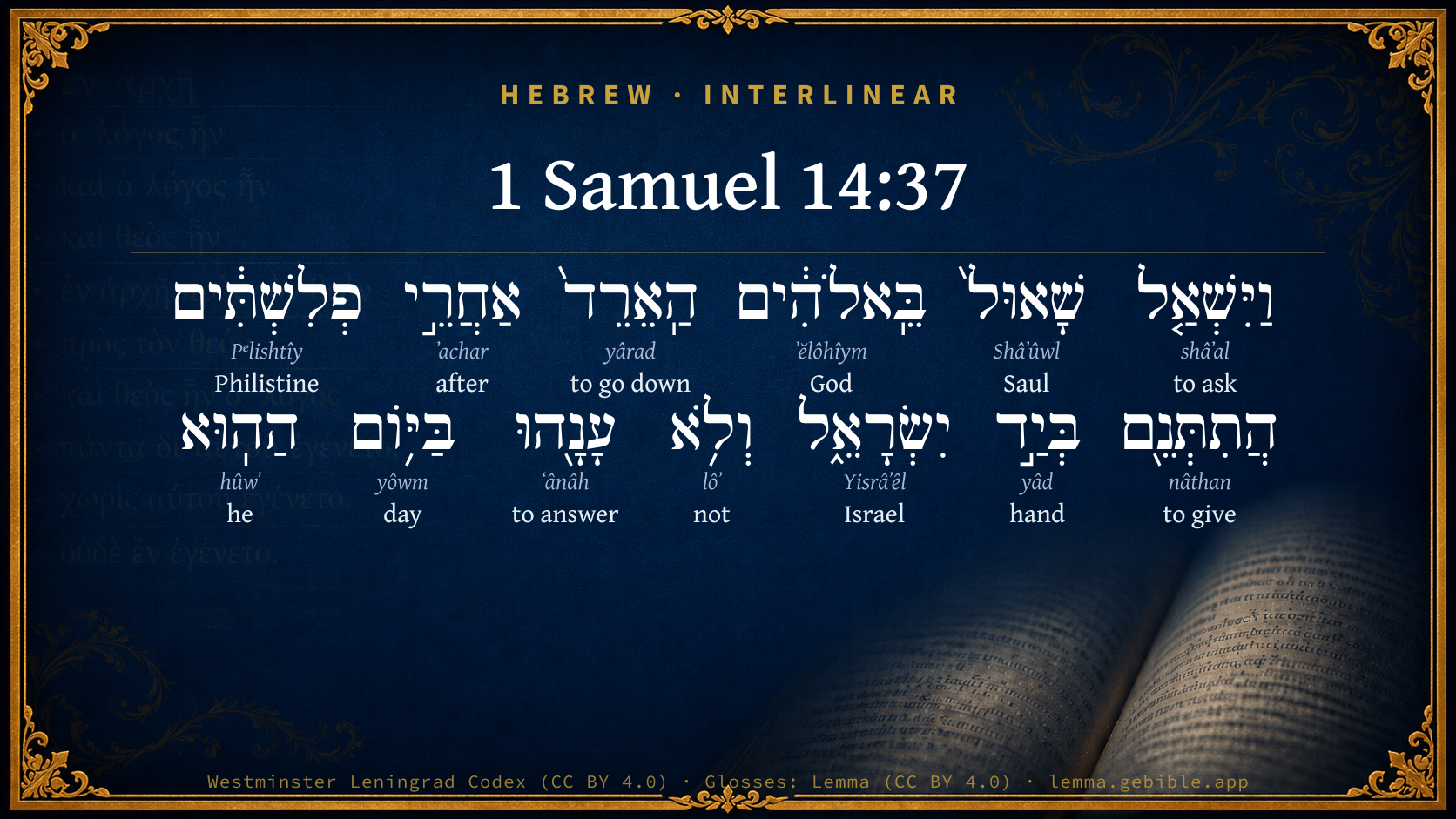
Hebrew (Westminster Leningrad Codex) 1 Samuel 14:37 appears in the Hebrew Old Testament. The text above is from the Westminster Leningrad Codex. Each word links to its Strong’s number, a concise gloss, and parsing drawn from the Open Scriptures Hebrew Bible morphology. Click any word for its full Brown-Driver-Briggs (BDB) entry.
Download image
Cite this verse

1 Samuel 14:37 (World English Bible). Public Domain. Lemma interlinear Bible study tool, https://lemma.gebible.app/v/1-samuel/14/37.

Show BibTeX & RIS
BibTeX
RIS
English Translation
Saul asked counsel of God, Shall I go down after the Philistines? will you deliver them into the hand of Israel? But he didn't answer him that day.
World English Bible · Public Domain
Download a study sheet

One document with this verse’s original text, its word-by-word gloss line, the meaning frame, cross-references with their text, attributed commentary, and full source and license credits — printable, and it pastes into notes with its structure intact.

This verse Autodidact and up

Study sheet (.html) Plain text (.txt)

A passage Seminary Student

Up to 50 verses in one chapter. A passage sheet keeps up to 6 commentary sources and 12 cross-references per verse, in the order this page ranks them, and says so on the sheet whenever that leaves anything out. Ask for a single verse and you get the Autodidact verse sheet above.

Everything on this page stays free to read, with no account — the sheet is a download of what is already on screen, not access to it.

Want to remove ads? Support Godless Engineer
Compare translations 3

The same verse in 3 English versions, stacked beneath the original-language interlinear above. Click any original word for its lexicon entry.

Each is an independent rendering of the whole verse — the interlinear is not word-aligned to these translations.

Highlighted words mark where these versions differ — a whole-verse word diff, not a word-by-word alignment.

  • World English Bible Public Domain
    Saul asked counsel of God, Shall I go down after the Philistines? will you deliver them into the hand of Israel? But he didn't answer him that day.
  • King James Version Public Domain
    And Saul asked counsel of God, Shall I go down after the Philistines? wilt thou deliver them into the hand of Israel? But he answered him not that day.
  • unfoldingWord Literal Text CC BY-SA 4.0
    And Saul inquired of God, “Shall I go down after the Philistines? Will you give them into the hand of Israel?” But he did not answer him on that day.

unfoldingWord Literal Text — © unfoldingWord, licensed CC BY-SA 4.0. Word-aligned USFM3 via Door43 (git.door43.org/unfoldingWord/en_ult).

Versions to compare (up to 4)

3 of 4 selected

Show all 18 translations

Every available English version of this verse, each an independent rendering of the whole verse.

  • World English Bible Public Domain
    Saul asked counsel of God, Shall I go down after the Philistines? will you deliver them into the hand of Israel? But he didn't answer him that day.
  • Berean Standard Bible Public Domain
    So Saul inquired of God, “Shall I go down after the Philistines? Will You give them into the hand of Israel?” But God did not answer him that day.
  • Majority Standard Bible Public Domain
    So Saul inquired of God, “Shall I go down after the Philistines? Will You give them into the hand of Israel?” But God did not answer him that day.
  • King James Version Public Domain
    And Saul asked counsel of God, Shall I go down after the Philistines? wilt thou deliver them into the hand of Israel? But he answered him not that day.
  • American Standard Version (1901) Public Domain
    And Saul asked counsel of God, Shall I go down after the Philistines? wilt thou deliver them into the hand of Israel? But he answered him not that day.
  • Revised Version (1885) Public Domain
    And Saul asked counsel of God, Shall I go down after the Philistines? wilt thou deliver them into the hand of Israel? But he answered him not that day.
  • Geneva Bible (1599) Public Domain
    So Saul asked of God, saying, Shall I goe downe after ye Philistims? wilt thou deliuer them into the hands of Israel? But he answered him not at that time.
  • Douay-Rheims (1899) Public Domain
    And Saul consulted the Lord: Shall I pursue after the Philistines? wilt thou deliver them into the hands of Israel? And he answered him not that day.
  • Young's Literal Translation Public Domain
    And Saul asketh of God, `Do I go down after the Philistines? dost Thou give them into the hand of Israel?' and He hath not answered him on that day.
  • Literal Standard Version CC BY-SA 4.0
    And Saul asks of God, “Do I go down after the Philistines? Do You give them into the hand of Israel?” And He has not answered him on that day.
  • Unlocked Literal Bible CC BY-SA 4.0
    Saul asked God, “Should I pursue the Philistines? Will you give them into the hand of Israel?” But God did not answer him that day.
  • unfoldingWord Literal Text CC BY-SA 4.0
    And Saul inquired of God, “Shall I go down after the Philistines? Will you give them into the hand of Israel?” But he did not answer him on that day.
  • Darby Bible Public Domain
    And Saul inquired of God, Shall I go down after the Philistines? wilt thou give them into the hand of Israel? But he did not answer him that day.
  • World Messianic Bible Public Domain
    Saul asked counsel of God: “Shall I go down after the Philistines? Will you deliver them into the hand of Israel?” But he didn’t answer him that day.
  • Webster's Bible Public Domain
    And Saul asked counsel of God, Shall I go down after the Philistines? wilt thou deliver them into the hand of Israel? But he answered him not that day.
  • Free Bible Version CC BY-SA 4.0
    Saul asked God, “Shall I go down and chase down the Philistines? Will you hand them over to Israel?” But that day God didn't answer him.
  • Bible in Basic English Public Domain
    And Saul, desiring directions from God, said, Am I to go down after the Philistines? will you give them up into the hands of Israel? But he gave him no answer that day.
  • JPS Tanakh (1917) Public Domain
    And Saul asked counsel of God: 'Shall I go down after the Philistines? wilt Thou deliver them into the hand of Israel?' But He answered him not that day.

Literal Standard Version (2020), Covenant Press — licensed CC BY-SA 4.0. Text via the HelloAO Bible API (eBible.org). Unlocked Literal Bible (unfoldingWord) — licensed CC BY-SA 4.0. Text via the HelloAO Bible API (eBible.org). unfoldingWord Literal Text — © unfoldingWord, licensed CC BY-SA 4.0. Word-aligned USFM3 via Door43 (git.door43.org/unfoldingWord/en_ult). Free Bible Version, Dr. Jonathan Gallagher — licensed CC BY-SA 4.0. Text via the HelloAO Bible API (eBible.org).

Word by word

More ways to search: Search by grammar → Find every occurrence → Compare this word →

Practice this passage: Drill this verse → Learn its vocabulary →

וַיִּשְׁאַ֤ל
shâʼal
H7592
“and · to ask”
Conjunction + Verb, Qal, Sequential Imperfect, 3rd Person, Masculine, Singular
Part of Speech
Conjunction + Verb
Stem
Qal
Form
Sequential Imperfect
Person
3rd Person
Gender
Masculine
Number
Singular
Full BDB Definition

Origin: a primitive root

TWOT: 2303

to ask, enquire, borrow, beg - (Qal) - to ask, ask for - to ask (as a favour), borrow - to enquire, enquire of - to enquire of, consult (of deity, oracle) - to seek - (Niphal) to ask for oneself, ask leave of absence - (Piel) - to enquire, enquire carefully - to beg, practise beggary - (Hiphil) - to be given on request - to grant, make over to, let (one) ask (successfully) or give or lend on request (then) grant or make over to
  1. שָׁאוּל֙ Shâʼûwl H7586 “Saul” Noun, Proper
  2. בֵּֽאלֹהִ֔ים ʼĕlôhîym H430 “in/at · God(s)” Preposition + Noun, Common, Masculine, Plural, Absolute
  3. הַֽאֵרֵד֙ yârad H3381 “to go down” Particle, Interrogative + Verb, Qal, Imperfect, 1st Person, Common, Singular
  4. אַחֲרֵ֣י ʼachar H310 “after” Preposition
  5. פְלִשְׁתִּ֔ים Pᵉlishtîy H6430 “Philistines” Noun, Gentilic, Masculine, Plural, Absolute
  6. הֲתִתְּנֵ֖ם nâthan H5414 “to give · them” Particle, Interrogative + Verb, Qal, Imperfect, 2nd Person, Masculine, Singular + Suffix, Personal, 3rd Person, Masculine, Plural
  7. בְּיַ֣ד yâd H3027 “in/at · hand of” Preposition + Noun, Common, Both, Singular, Construct
  8. יִשְׂרָאֵ֑ל Yisrâʼêl H3478 “Israel” Noun, Proper
  9. וְלֹ֥א lôʼ H3808 “and · not” Conjunction + Particle, Negative
  10. עָנָ֖הוּ ʻânâh H6030 “to answer · him” Verb, Qal, Perfect, 3rd Person, Masculine, Singular + Suffix, Personal, 3rd Person, Masculine, Singular
  11. בַּיּ֥וֹם yôwm H3117 “in/at the · day” Preposition, Determined + Noun, Common, Masculine, Singular, Absolute
  12. הַהֽוּא hûwʼ H1931 “the · he” Particle, Definite Article + Pronoun, Personal, 3rd Person, Masculine, Singular

About this verse

These counts appear in no published source. They are computed here, from the morphology-tagged text and Lemma’s own curated glosses. What Lemma adds →

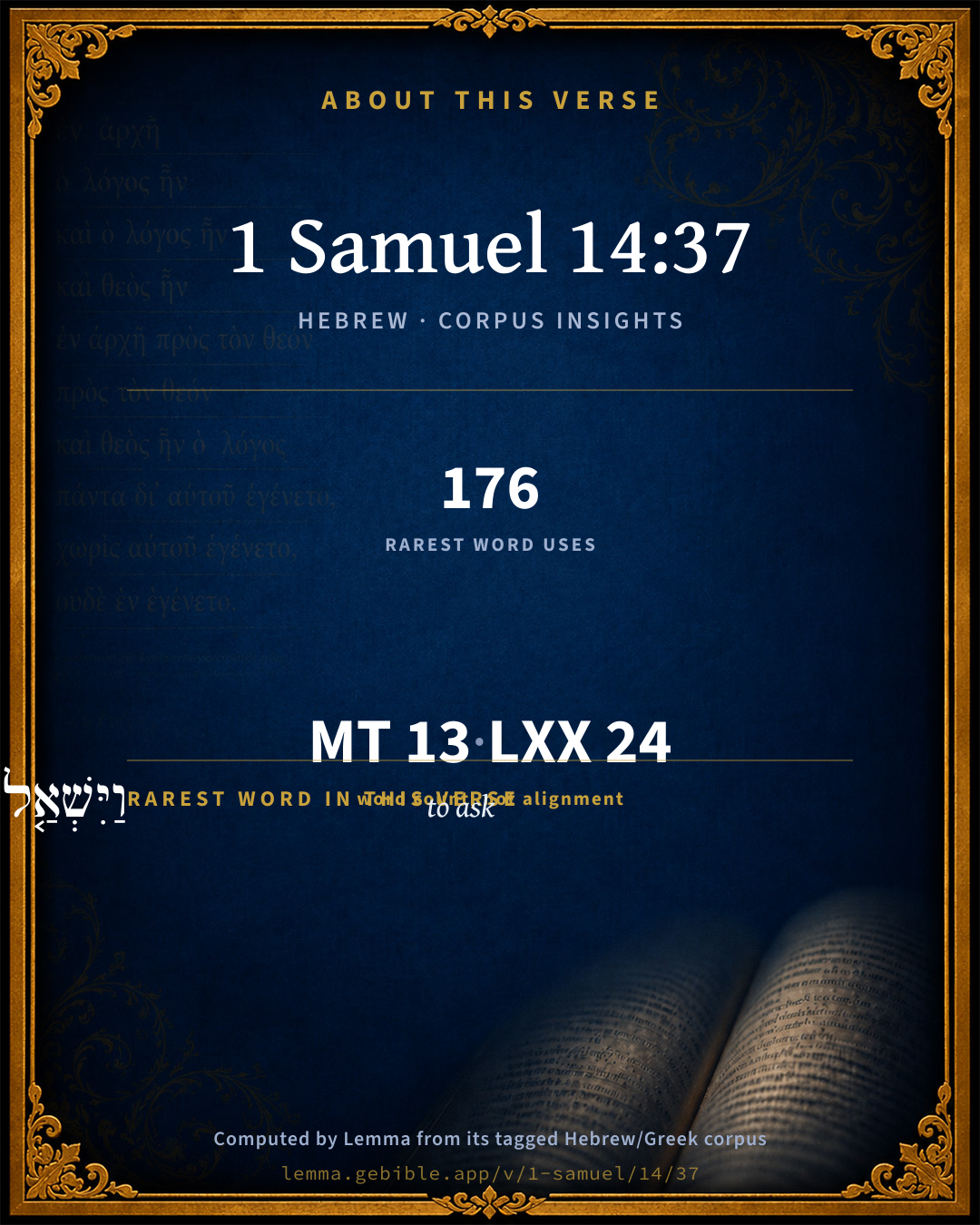
13
words
13
distinct lemmas
Historical
section

Grammatical profile

  • 4 verbs
  • 6 nouns
  • 1 pronoun
  • 1 preposition
  • 1 particle

Verb forms

  • וַיִּשְׁאַ֤ל Qal · Sequential Imperfect
  • הַֽאֵרֵד֙ Qal · Imperfect
  • הֲתִתְּנֵ֖ם Qal · Imperfect
  • עָנָ֖הוּ Qal · Perfect

Hebrew & Septuagint length

In English translation the verse runs 28 words from the Hebrew and 29 from the Septuagint (LXX English) — closely comparable.

A rough comparison of the two English renderings, which tokenize alike — not a word-level alignment.

Word counts can differ between the Hebrew and the Greek without any difference in meaning — e.g. the Hebrew direct-object marker אֵת has no separate Greek word, and Greek often adds the article ὁ.

In the original languages it is 13 Hebrew tokens and 24 Greek tokens — but the two are counted differently (Hebrew bundles its prefixes and suffixes into one token; the Greek is in lemma form), so that isn’t a like-for-like length.

Cross-references

14

Topical passages linked to 1 Samuel 14:37 in the Treasury of Scripture Knowledge — connected by theme and wording, ordered by reader-vote popularity; previews shown in the World English Bible.

  • 1 Samuel 28:6 When Saul inquired of Yahweh, Yahweh didn't answer him, neither by dreams, nor by Urim, nor by prophets.
  • 1 Samuel 23:4 Then David inquired of Yahweh yet again. Yahweh answered him, and said, Arise, go down to Keilah; for I will deliver the Philistines into your hand.
  • 1 Samuel 23:9–12 David knew that Saul was devising mischief against him; and he said to Abiathar the priest, Bring here the ephod.
  • 1 Samuel 30:7–8 David said to Abiathar the priest, the son of Ahimelech, Please bring me here the ephod. Abiathar brought there the ephod to David.
  • 2 Samuel 5:19 David inquired of Yahweh, saying, Shall I go up against the Philistines? will you deliver them into my hand? Yahweh said to David, Go up; for I will certainly deliver the Philistines into your hand.
  • 2 Samuel 5:23 When David inquired of Yahweh, he said, You shall not go up: make a circuit behind them, and come on them over against the mulberry trees.
  • 1 Kings 22:5 Jehoshaphat said to the king of Israel, Please inquire first for the word of Yahweh.
  • 1 Kings 22:15 When he was come to the king, the king said to him, Micaiah, shall we go to Ramoth-gilead to battle, or shall we forbear? He answered him, Go up and prosper; and Yahweh will deliver it into the hand of the king.
  • Ezekiel 14:3–5 Son of man, these men have taken their idols into their heart, and put the stumbling block of their iniquity before their face: should I be inquired of at all by them?
  • Judges 1:1 It happened after the death of Joshua, the children of Israel asked of Yahweh, saying, Who shall go up for us first against the Canaanites, to fight against them?
  • Judges 20:18 The children of Israel arose, and went up to Bethel, and asked counsel of God; and they said, Who shall go up for us first to battle against the children of Benjamin? Yahweh said, Judah [shall go up] first.
  • Judges 20:28 and Phinehas, the son of Eleazar, the son of Aaron, stood before it in those days), saying, Shall I yet again go out to battle against the children of Benjamin my brother, or shall I cease? Yahweh said, Go up; for tomorrow I will deliver him into your hand.
  • 1 Samuel 10:22 Therefore they asked of Yahweh further, Is there yet a man to come here? Yahweh answered, Behold, he has hid himself among the baggage.
  • Ezekiel 20:3 Son of man, speak to the elders of Israel, and tell them, Thus says the Lord Yahweh: Is it to inquire of me that you have come? As I live, says the Lord Yahweh, I will not be inquired of by you.

Cross-references courtesy of OpenBible.info (CC BY 4.0).

Hebrew and Greek witnesses Masoretic Hebrew ↔ Greek Septuagint

The same verse in the two great witnesses to the Old Testament, shown verse-for-verse.

These are two independent witnesses, not word-aligned to each other, and the Septuagint is shown in lemma (dictionary) form.

Hebrew 1 Samuel 14:37 Masoretic · Westminster Leningrad Codex

וַיִּשְׁאַ֤ל שָׁאוּל֙ בֵּֽאלֹהִ֔ים הַֽאֵרֵד֙ אַחֲרֵ֣י פְלִשְׁתִּ֔ים הֲתִתְּנֵ֖ם בְּיַ֣ד יִשְׂרָאֵ֑ל וְלֹ֥א עָנָ֖הוּ בַּיּ֥וֹם הַהֽוּא

Saul asked counsel of God, Shall I go down after the Philistines? will you deliver them into the hand of Israel? But he didn't answer him that day.

World English Bible · Public Domain

Greek LXX 1 Samuel 14:37 Septuagint · lemma form

καί ἐπιἐρωτάω σαούλ ὁ θεός εἰ καταβαίνω ὀπίσω ὁ ἀλλόφυλος εἰ παραδίδωμι αὐτός εἰς χείρ ἰσραήλ καί οὐ ἀποκρίνω αὐτός ἐν ὁ ἡμέρα ἐκεῖνος

And Saul enquired of God, If I go down after the Philistines, will you deliver them into the hands of Israel? And he answered him not in that day.

LXX2012 (modern English Septuagint) · Public Domain

Hebrew: Westminster Leningrad Codex (CC BY 4.0). Greek: Septuagint (public domain); English from LXX2012 (modern English Septuagint) (Public Domain). How the Septuagint differs from the Hebrew →

Targum (Aramaic paraphrase)

1

The Targum is the ancient Jewish Aramaic paraphrase of the Hebrew Scriptures — an interpretive translation, not the Hebrew text itself. Onkelos (literal) and Pseudo-Jonathan (expansive) render the Torah, and Jonathan the Prophets. Coverage is partial: where no permissively-licensed English translation exists for a verse, only the Aramaic is shown. This is verse-level text, not a word-by-word alignment to the Hebrew.

  1. Targum Jonathan Prophets (Joshua–Malachi)
    וּשְׁאַל שָׁאוּל בְּמֵימְרָא דַייָ הַאֵיחוֹת בָּתַר פְּלִשְׁתָּאֵי הֲתִמְסְרִינוּן בְּיַד יִשְׂרָאֵל וְלָא קַבֵּיל צְלוֹתֵיהּ בְּיוֹמָא הַהוּא:

    (no public-domain English translation for this verse)

    Targum Jonathan — Aramaic: “Mikraot Gedolot” (public domain). English: “Sefaria Community Translation” (CC0 1.0 (public-domain dedication)); “London "Chaldee Paraphrase," 1871” (public domain). Text via Sefaria.

Commentary

Notes on 1 Samuel 14:37 from classic Christian and Jewish commentators (each source and its license shown beneath its notes). The classic Christian expositions comment on the surrounding passage and are grouped to its opening verse, so a note may address several verses; the Jewish commentaries on the Tanakh (Rashi and others) are per-verse, so they appear only where the commentator wrote on this verse.

Lemma curates 59 commentaries, every one of them public domain or Creative Commons licensed, each selected and text-cleaned for this edition rather than reprinted as found. About our sources →

Trapp's Complete Commentary

John Trapp

1Sa 14:37 And Saul asked counsel of God, Shall I go down after the Philistines? wilt thou deliver them into the hand of Israel? But he answered him not that day.

Ver. 37. And Saul asked counsel of God.] Since the high priest would needs have it so. See 1Sa 14:34.

But he answered him not that day.] A sure sign of his displeasure, as 1Sa 28:6. God either answereth not wicked men at all, {Eze 20:2-3} or else he answereth them according to the idols of their hearts, with bitter answers: {Eze 14:20} sending them to the gods whom they had chosen, as Jdg 10:13-14.

John Trapp, A Commentary or Exposition upon All the Books of the Old and New Testament (1647–1656) — public domain. Text from a community e-Sword module.

The Biblical Illustrator

Joseph S. Exell

1Sa_14:37

And dipped it in an honeycomb and put his hand to his mouth.

The honey of Gods Word

There were three kinds of honey:

1. That which was made by bees.

2. That which was distilled from the trees.

3. That which was made from grape juice, and largely exported.

The kind Jonathan ate, was doubtless the product of the honey bee. This honey had a marvellous effect upon Jonathan. It enlightened his eyes; it strengthened his body so that the faintness which produced dimness of vision disappeared. Gods Word is our honey. The provision is abundant, like as was the honey in wild profusion in the woods which Jonathan entered. It is sweet. It gives strength. Above all, it has an enlightening power.

1. The Word of God enlightens the intellect. The Bible is Gods great school book to man.

2. It enlightens the moral sense. The needle of the compass must be magnetised if it is to point always to the north; the watch must be set by the sun, if it is to give correct time; so the conscience, to point always heavenward, must be brought under the influence of the Scriptures.

3. It brings light to the eye which has grown dim with sorrow.

4. It reveals the world in its true light.

5. It reveals the true nature of sin.

6. It reveals the sinners Saviour--the living, the crucified, the resurrected, the interceding, the justifying Saviour. Let us gather up three or four practical suggestions:--The honey of Gods Word is free, and is adapted to everybody. It never loses its sweetness or refreshing power. It is good to begin every day with a taste of it. It is wasted honey if you do not partake of it. (T. L. Cuyler, D. D.)

The Biblical Illustrator, edited by Joseph S. Exell (c. 1880s–1900s) — public domain. Text from a community e-Sword module.

Tyndale Open Study Notes

Tyndale Open Resources

14:37-38 God made no reply: Neither the “no” lot nor the “yes” lot of the Urim and Thummim appeared.

Tyndale Open Study Notes — © Tyndale Open Resources, licensed CC BY-SA 4.0. Text via the HelloAO Bible API.

Adam Clarke's Commentary

Verse 37. He answered him not that day.] Why was this answer delayed? Surely Jonathan's eating the honey was no sin. This could not have excited God's displeasure. And yet the lot found out Jonathan! But did this argue that he had incurred guilt in the sight of God? I answer: It did not; for Jonathan was delivered, by the authority of the people, from his father's rash curse; no propitiation is offered for his supposed transgression to induce God to pardon it; nor do we find any displeasure of God manifested on the occasion. See below.

Adam Clarke's Commentary on the Bible (1810–1826) — public domain. Text from a community e-Sword/MySword module.

Ellicott's Commentary for English Readers

(37) And Saul asked counsel of God.—The same phrase is always used in the many passages in the Books of Judges, 1 Sam., 2 Sam., 1 Chron., Hosea, &c. when God was inquired of by the Urim and Thummim. It may be styled the technical term of inquiry of the Oracle of the Most High; there are, however, slight. variations in the English translations of this phrase.

But he answered him not . . .—When the mysterious gems refused to shine, or in any way to signify the Divine approbation or disapproval, the high-priestly questioner seems, as in this instance, to have concluded that some public transgression had been committed, and that special atonement must be made before the desired answer could be expected. The sacred gems probably remained dull and lightless the night was wearing on, and Saul chafed at the unexpected delay, and in his impetuous anger uttered the wild words on which we are about to comment.

A Bible Commentary for English Readers, edited by Charles John Ellicott (1878–1897) — public domain. Text from a community e-Sword module.

The Cambridge Bible for Schools and Colleges

gen. ed. J. J. S. Perowne

37. asked counsel of God] Inquired of God, the same verb as in 1Sa_10:22, See note there.

The Cambridge Bible for Schools and Colleges (gen. ed. J. J. S. Perowne; Cambridge University Press, 1878–1918) — public domain. Text from a community e-Sword module.

John Gill's Exposition

And Saul asked counsel of God,.... He agreed to the motion of the high priest, and asked counsel by Urim and Thummim; the Targum is, as before,"inquired by the Word of the Lord:"

shall I go down after the Philistines? pursue after them in their flight to their own country, which, lying to the sea, was a descent:

wilt thou deliver them into the hand of Israel? what remain of them, otherwise a victory over them was obtained:

but he answered him not that day; no answer was returned by Urim and Thummim, so that he was left in suspense whether he should pursue or no; the Targum is,"he received not his prayer that day;''this was treating him in a righteous manner; since he would not stay for an answer from the Lord, Sa1 14:19, the Lord now will not give him any; though the principal view was, that he might take the step he did.

John Gill's Exposition of the Whole Bible (1746–1763) — public domain (CC PDM 1.0). Text via the HelloAO Bible API.

Albert Barnes' Notes on the Bible

Asked counsel - The technical phrase for inquiring of God by Urim and Thummim, and applied also to inquiry of other oracles.

Albert Barnes' Notes on the Bible (1834–1885) — public domain. Text from a community e-Sword/MySword module.

Matthew Poole's English Annotations

Either,

1. Because he was displeased with Saul for his former neglect, 1Sa 14:18,19, where he began to ask advice of God, but was so rude and impious as not to tarry for an answer; and therefore it was but a just retaliation, if when Saul did ask, God would not vouchsafe him an answer. Or,

2. To manifest his dislike of the violation of oaths. For although Jonathan might have a fair excuse from his invincible ignorance and urgent necessity; and though Saul had done foolishly in making this oath (which also God would this way discover); yet when once it was made, God would hereby teach them that it should be observed, and that they should abstain even from all appearance of the breach of it.

Matthew Poole's English Annotations on the Holy Bible (1683–1685) — public domain. Text from a community e-Sword/MySword module.

Whedon's Commentary on the Bible

Daniel D. Whedon

37. Saul asked counsel of God — By urim and thummin.

He answered him not — Thereby indicating that he or the people had in some way incurred the Divine displeasure.

Daniel D. Whedon (gen. ed.), Commentary on the Old and New Testaments (1874–1909) — public domain. Text from a community e-Sword module.

The Pulpit Commentary

Vers. 37, 38. He answered him not. From this silence Saul concludes that some sin has been committed, and therefore calls together all the chief of the people literally, "the corner stones" (Jud_1:20:2) to inquire who was the guilty person, and wherein he had sinned.

The Pulpit Commentary (1880–1919), ed. H.D.M. Spence-Jones & Joseph S. Exell — public domain. Text from a community e-Sword module.

Lesson kit

Teaching starters — assembled from the data on this page, not authored interpretation. Every prompt links to the verse data it draws on. Edit before teaching.

1 Samuel, in the Historical, opens this verse with 13 words (13 distinct Hebrew lemmas). Its most distinctive word is shâʼal (“to ask”). A historical commentator’s framing appears above. Read the whole chapter for the surrounding context.

Discussion questions

  1. How does “to ask” (shâʼal) shape what this verse is saying?
  2. How does 1 Samuel 28:6, which shares this passage’s theme, read alongside this verse?
  3. These translations render this verse differently. What is at stake in choosing one wording over another?
  4. «וַיִּשְׁאַ֤ל» is a Qal Sequential Imperfect verb. How does that grammatical form shape the action described?
  5. Compare how Trapp's Complete Commentary and The Biblical Illustrator read this verse. Where do they agree or differ?

Things to notice

Reading settings

Reading text

Shown beneath each verse's original-language words.

Old Testament
Old Testament edition

Read the OT as the Masoretic Hebrew (MT) or the Greek Septuagint (LXX).

English shown for the Greek Septuagint (in the Hebrew ↔ Greek comparison).

Comparing translations? Open the Compare panel on any verse page to stack up to four side by side.