Exodus 4:16

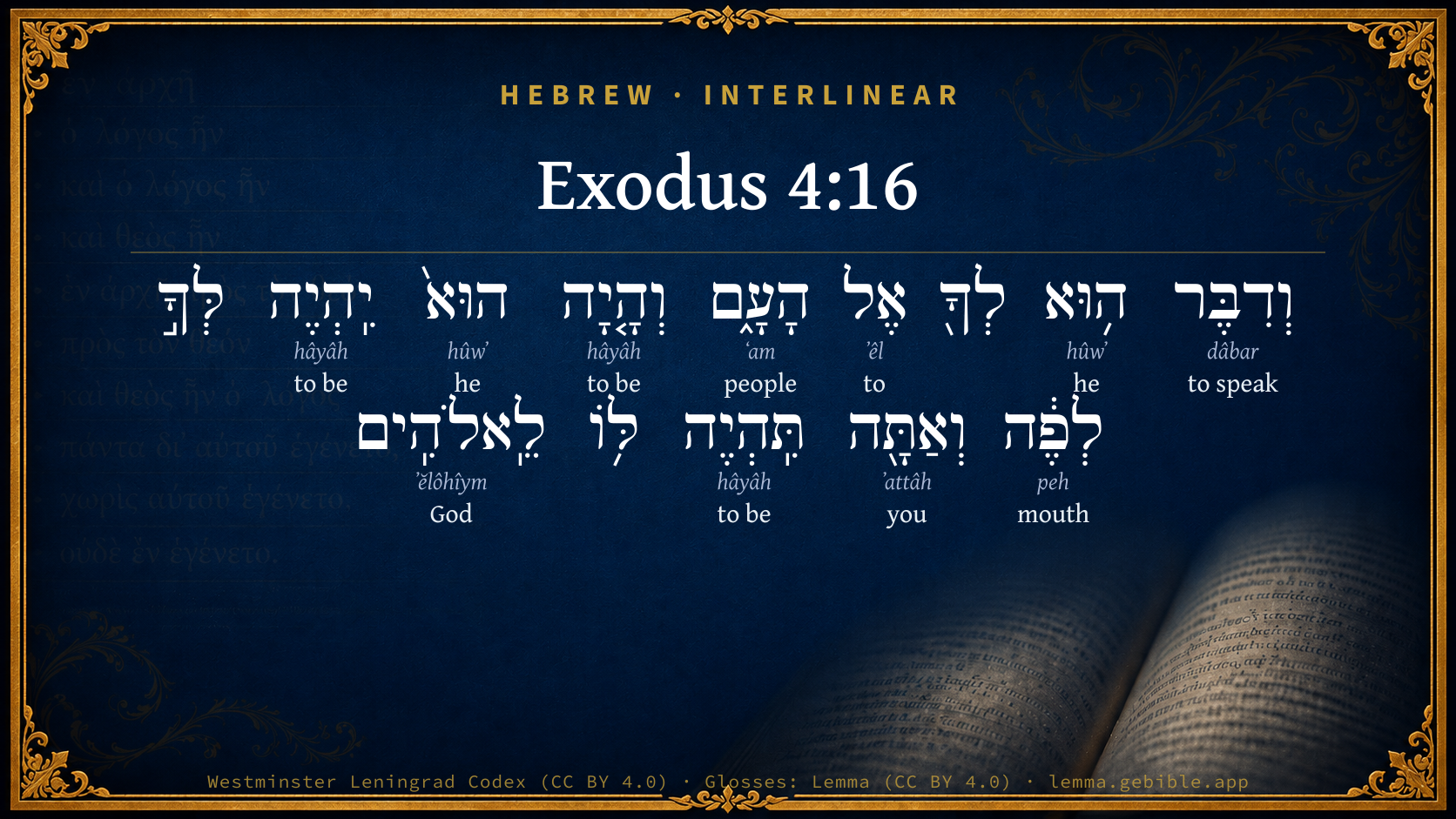
Hebrew (Westminster Leningrad Codex) Exodus 4:16 appears in the Hebrew Old Testament. The text above is from the Westminster Leningrad Codex. Each word links to its Strong’s number, a concise gloss, and parsing drawn from the Open Scriptures Hebrew Bible morphology. Click any word for its full Brown-Driver-Briggs (BDB) entry.
Download image
Cite this verse

Exodus 4:16 (World English Bible). Public Domain. Lemma interlinear Bible study tool, https://lemma.gebible.app/v/exodus/4/16.

Show BibTeX & RIS
BibTeX
RIS
English Translation
He will be your spokesman to the people; and it will happen, that he will be to you a mouth, and you will be to him as God.
World English Bible · Public Domain
Download a study sheet

One document with this verse’s original text, its word-by-word gloss line, the meaning frame, cross-references with their text, attributed commentary, and full source and license credits — printable, and it pastes into notes with its structure intact.

This verse Autodidact and up

Study sheet (.html) Plain text (.txt)

A passage Seminary Student

Up to 50 verses in one chapter. A passage sheet keeps up to 6 commentary sources and 12 cross-references per verse, in the order this page ranks them, and says so on the sheet whenever that leaves anything out. Ask for a single verse and you get the Autodidact verse sheet above.

Everything on this page stays free to read, with no account — the sheet is a download of what is already on screen, not access to it.

Want to remove ads? Support Godless Engineer
Compare translations 3

The same verse in 3 English versions, stacked beneath the original-language interlinear above. Click any original word for its lexicon entry.

Each is an independent rendering of the whole verse — the interlinear is not word-aligned to these translations.

Highlighted words mark where these versions differ — a whole-verse word diff, not a word-by-word alignment.

  • World English Bible Public Domain
    He will be your spokesman to the people; and it will happen, that he will be to you a mouth, and you will be to him as God.
  • King James Version Public Domain
    And he shall be thy spokesman unto the people: and he shall be, even he shall be to thee instead of a mouth, and thou shalt be to him instead of God.
  • unfoldingWord Literal Text CC BY-SA 4.0
    And he will speak to the people for you. So it will be, he will be like a mouth for you, and you will be like God to him.

unfoldingWord Literal Text — © unfoldingWord, licensed CC BY-SA 4.0. Word-aligned USFM3 via Door43 (git.door43.org/unfoldingWord/en_ult).

Versions to compare (up to 4)

3 of 4 selected

Show all 18 translations

Every available English version of this verse, each an independent rendering of the whole verse.

  • World English Bible Public Domain
    He will be your spokesman to the people; and it will happen, that he will be to you a mouth, and you will be to him as God.
  • Berean Standard Bible Public Domain
    He will speak to the people for you. He will be your spokesman, and it will be as if you were God to him.
  • Majority Standard Bible Public Domain
    He will speak to the people for you. He will be your spokesman, and it will be as if you were God to him.
  • King James Version Public Domain
    And he shall be thy spokesman unto the people: and he shall be, even he shall be to thee instead of a mouth, and thou shalt be to him instead of God.
  • American Standard Version (1901) Public Domain
    And he shall be thy spokesman unto the people; and it shall come to pass, that he shall be to thee a mouth, and thou shalt be to him as God.
  • Revised Version (1885) Public Domain
    And he shall be thy spokesman unto the people: and it shall come to pass, that he shall be to thee a mouth, and thou shalt be to him as God.
  • Geneva Bible (1599) Public Domain
    And he shall be thy spokesman vnto the people: and he shall be, euen he shall be as thy mouth, and thou shalt be to him as God.
  • Douay-Rheims (1899) Public Domain
    He shall speak in thy stead to the people, and shall be thy mouth: but thou shalt be to him in those things that pertain to God.
  • Young's Literal Translation Public Domain
    and he, he hath spoken for thee unto the people, and it hath come to pass, he -- he is to thee for a mouth, and thou -- thou art to him for God;
  • Literal Standard Version CC BY-SA 4.0
    and he, he has spoken to the people for you, and it has come to pass, he is to you for a mouth, and you are to him for God;
  • Unlocked Literal Bible CC BY-SA 4.0
    He will speak to the people for you. He will be your mouth, and you will be to him like me, God.
  • unfoldingWord Literal Text CC BY-SA 4.0
    And he will speak to the people for you. So it will be, he will be like a mouth for you, and you will be like God to him.
  • Darby Bible Public Domain
    And he shall speak for thee unto the people; and it shall come to pass that he shall be to thee for a mouth, and thou shalt be to him for God.
  • World Messianic Bible Public Domain
    He will be your spokesman to the people. It will happen that he will be to you a mouth, and you will be to him as God.
  • Webster's Bible Public Domain
    And he shall speak for thee to the people: and he shall be, even he shall be to thee instead of a mouth, and thou shalt be to him instead of God.
  • Free Bible Version CC BY-SA 4.0
    Aaron will speak on your behalf to the people, as if he was your mouth, and you will be in the place of God to him.
  • Bible in Basic English Public Domain
    And he will do the talking for you to the people: he will be to you as a mouth and you will be to him as God.
  • JPS Tanakh (1917) Public Domain
    And he shall be thy spokesman unto the people; and it shall come to pass, that he shall be to thee a mouth, and thou shalt be to him in God's stead.

Literal Standard Version (2020), Covenant Press — licensed CC BY-SA 4.0. Text via the HelloAO Bible API (eBible.org). Unlocked Literal Bible (unfoldingWord) — licensed CC BY-SA 4.0. Text via the HelloAO Bible API (eBible.org). unfoldingWord Literal Text — © unfoldingWord, licensed CC BY-SA 4.0. Word-aligned USFM3 via Door43 (git.door43.org/unfoldingWord/en_ult). Free Bible Version, Dr. Jonathan Gallagher — licensed CC BY-SA 4.0. Text via the HelloAO Bible API (eBible.org).

Word by word

More ways to search: Search by grammar → Find every occurrence → Compare this word →

Practice this passage: Drill this verse → Learn its vocabulary →

לְפֶ֔ה
peh
H6310
“to/for · mouth”
Preposition + Noun, Common, Masculine, Singular, Absolute
Part of Speech
Preposition + Noun
Type
Common
Gender
Masculine
Number
Singular
State
Absolute
Full BDB Definition

Origin: from H6284

TWOT: 1738

mouth - mouth (of man) - mouth (as organ of speech) - mouth (of animals) - mouth, opening, orifice (of a well, river, etc) - extremity, end - a weight equal to one third of a shekel, occurs only in 1Sa 13:21
  1. וְדִבֶּר dâbar H1696 “and · to speak” Conjunction + Verb, Piel, Sequential Perfect, 3rd Person, Masculine, Singular
  2. ה֥וּא hûwʼ H1931 “he” Pronoun, Personal, 3rd Person, Masculine, Singular
  3. אֶל ʼêl H413 “to” Preposition
  4. הָעָ֑ם ʻam H5971 “the · people” Particle, Definite Article + Noun, Common, Masculine, Singular, Absolute
  5. וְהָ֤יָה hâyâh H1961 “and · to be” Conjunction + Verb, Qal, Sequential Perfect, 3rd Person, Masculine, Singular
  6. הוּא֙ hûwʼ H1931 “he” Pronoun, Personal, 3rd Person, Masculine, Singular
  7. יִֽהְיֶה hâyâh H1961 “to be” Verb, Qal, Imperfect, 3rd Person, Masculine, Singular
  8. וְאַתָּ֖ה ʼattâh H859 “and · you” Conjunction + Pronoun, Personal, 2nd Person, Masculine, Singular
  9. תִּֽהְיֶה hâyâh H1961 “to be” Verb, Qal, Imperfect, 2nd Person, Masculine, Singular
  10. לֵֽאלֹהִֽים ʼĕlôhîym H430 “to/for · God(s)” Preposition + Noun, Common, Masculine, Plural, Absolute

About this verse

These counts appear in no published source. They are computed here, from the morphology-tagged text and Lemma’s own curated glosses. What Lemma adds →

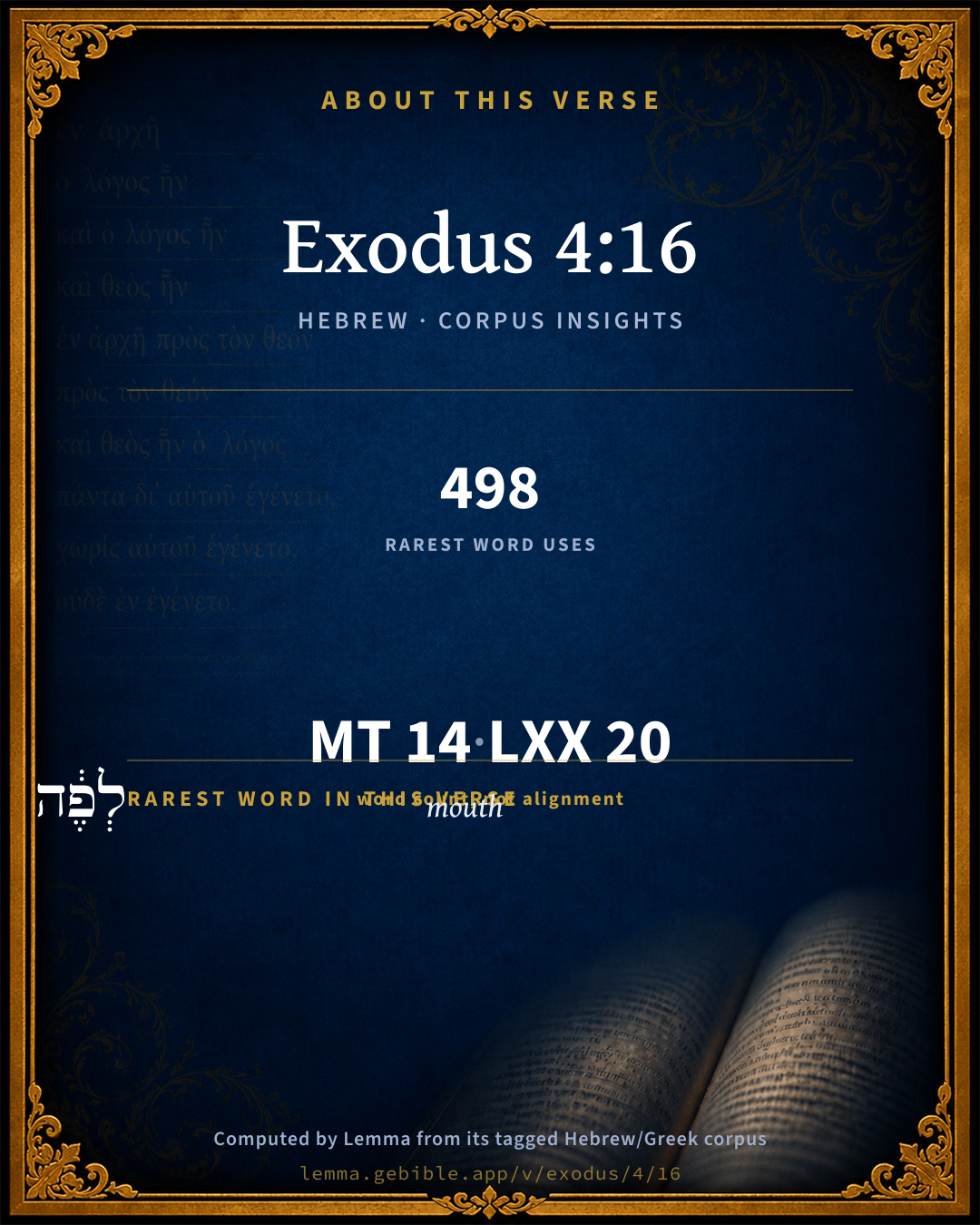
14
words
8
distinct lemmas
Pentateuch
section

Grammatical profile

  • 4 verbs
  • 3 nouns
  • 3 pronouns
  • 4 prepositions

Verb forms

  • וְדִבֶּר Piel · Sequential Perfect
  • וְהָ֤יָה Qal · Sequential Perfect
  • יִֽהְיֶה Qal · Imperfect
  • תִּֽהְיֶה Qal · Imperfect

Repetition

Words recur within this verse — often emphatic in Hebrew:

  • וְהָ֤יָה to be H1961 ×3
  • ה֥וּא he H1931 ×2

Hebrew & Septuagint length

In English translation the verse runs 28 words from the Hebrew and 26 from the Septuagint (LXX English) — closely comparable.

A rough comparison of the two English renderings, which tokenize alike — not a word-level alignment.

Word counts can differ between the Hebrew and the Greek without any difference in meaning — e.g. the Hebrew direct-object marker אֵת has no separate Greek word, and Greek often adds the article ὁ.

In the original languages it is 14 Hebrew tokens and 20 Greek tokens — but the two are counted differently (Hebrew bundles its prefixes and suffixes into one token; the Greek is in lemma form), so that isn’t a like-for-like length.

Cross-references

4

Topical passages linked to Exodus 4:16 in the Treasury of Scripture Knowledge — connected by theme and wording, ordered by reader-vote popularity; previews shown in the World English Bible.

  • Exodus 7:1–2 Yahweh said to Moses, "Behold, I have made you as God to Pharaoh; and Aaron your brother shall be your prophet.
  • Psalms 82:6 I said, "You are gods, All of you are sons of the Most High.
  • John 10:34–35 Jesus answered them, "Isn't it written in your law, 'I said, you are gods?'
  • Exodus 18:19 Listen now to my voice. I will give you counsel, and God be with you. You represent the people before God, and bring the causes to God.

Cross-references courtesy of OpenBible.info (CC BY 4.0).

Hebrew and Greek witnesses Masoretic Hebrew ↔ Greek Septuagint

The same verse in the two great witnesses to the Old Testament, shown verse-for-verse.

These are two independent witnesses, not word-aligned to each other, and the Septuagint is shown in lemma (dictionary) form.

Hebrew Exodus 4:16 Masoretic · Westminster Leningrad Codex

וְדִבֶּר ה֥וּא לְךָ֖ אֶל הָעָ֑ם וְהָ֤יָה הוּא֙ יִֽהְיֶה לְּךָ֣ לְפֶ֔ה וְאַתָּ֖ה תִּֽהְיֶה לּ֥וֹ לֵֽאלֹהִֽים

He will be your spokesman to the people; and it will happen, that he will be to you a mouth, and you will be to him as God.

World English Bible · Public Domain

Greek LXX Exodus 4:16 Septuagint · lemma form

καί αὐτός σύ προςλαλέω πρός ὁ λαός καί αὐτός εἰμί σύ στόμα σύ δέ αὐτός εἰμί ὁ πρός ὁ θεός

And he shall speak for you to the people, and he shall be your mouth, and you shall be for him in things pertaining to God.

LXX2012 (modern English Septuagint) · Public Domain

Hebrew: Westminster Leningrad Codex (CC BY 4.0). Greek: Septuagint (public domain); English from LXX2012 (modern English Septuagint) (Public Domain). How the Septuagint differs from the Hebrew →

Targum (Aramaic paraphrase)

2

The Targum is the ancient Jewish Aramaic paraphrase of the Hebrew Scriptures — an interpretive translation, not the Hebrew text itself. Onkelos (literal) and Pseudo-Jonathan (expansive) render the Torah, and Jonathan the Prophets. Coverage is partial: where no permissively-licensed English translation exists for a verse, only the Aramaic is shown. This is verse-level text, not a word-by-word alignment to the Hebrew.

  1. Targum Onkelos Torah (Genesis–Deuteronomy)
    וִימַלֵל הוּא לָךְ לְעַמָא וִיהֵי הוּא יְהֵי לָךְ לִמְתֻרְגְמָן וְאַתְּ תְּהֵי לֵהּ לְרָב:

    (no public-domain English translation for this verse)

    Targum Onkelos — Aramaic: “Onkelos Genesis” (public domain); “Onkelos Exodus” (public domain); “Onkelos Leviticus” (public domain); “Onkelos Numbers” (public domain); “Onkelos Deuteronomy” (public domain). English: “Sefaria Community Translation” (CC0 1.0 (public-domain dedication)); “J.W. Etheridge. The Targums of Onkelos and Jonathan Ben Uzziel on the Pentateuch. London: Longmans, Green, 1862” (public domain). Text via Sefaria.

  2. Targum Pseudo-Jonathan Torah (Genesis–Deuteronomy)
    וִימַלֵיל הוּא לָךְ עִם עַמָא וִיהֵי הוּא יֶהֱוֵי לָךְ לִמְתֻּרְגְמִין וְאַנְתְּ תֶּהֱוֵי לֵיהּ לְרַב תְּבוֹעַ אוּלְפַן מִן קֳדָם יְיָ

    And he shall speak for thee with the people, and be to thee an interpreter, and thou to him the principal, seeking instruction from before the Lord.

    Targum Pseudo-Jonathan — Aramaic: “Targum Jonathan on Genesis” (public domain); “Targum Jonathan on Exodus” (public domain); “Targum Jonathan on Leviticus” (public domain); “Targum Jonathan on Numbers” (public domain); “Targum Jonathan on Deuteronomy” (public domain). English: “The Targum of Jonathan ben Uzziel, trans. J. W. Etheridge, London, 1862” (public domain). Text via Sefaria.

Commentary

Notes on Exodus 4:16 from classic Christian and Jewish commentators (each source and its license shown beneath its notes). The classic Christian expositions comment on the surrounding passage and are grouped to its opening verse, so a note may address several verses; the Jewish commentaries on the Tanakh (Rashi and others) are per-verse, so they appear only where the commentator wrote on this verse.

Lemma curates 59 commentaries, every one of them public domain or Creative Commons licensed, each selected and text-cleaned for this edition rather than reprinted as found. About our sources →

Trapp's Complete Commentary

John Trapp

Exo 4:16 And he shall be thy spokesman unto the people: and he shall be, [even] he shall be to thee instead of a mouth, and thou shalt be to him instead of God.

Ver. 16. And he shall be thy spokesman.] God hath made me ill-favoured in this world, and without grace in the sight of men, said Tyndale to Frith, {a} speechless and rude, dull and slow witted: your part shall be to supply that which lacketh in me: remembering, that as lowliness of heart shall make you high with God, even so meekness of words shall make you sink into the hearts of men.

Instead of God.] To dictate unto him my mind and counsel. Such a god to every Christian is his sanctified conscience.

{a} Act. and Mon., fol. 988.

John Trapp, A Commentary or Exposition upon All the Books of the Old and New Testament (1647–1656) — public domain. Text from a community e-Sword module.

Geneva Bible (1599)

Geneva Bible translators

Meaning, as a wise counselor and full of God’s spirit.

Geneva Bible (1599) marginal notes — public domain. Text via Bolls.life.

Adam Clarke's Commentary

Verse 16. He shall be thy spokesman] Literally, He shall speak for thee (or in thy stead) to the people.

He shall be to thee instead of a mouth] He shall convey every message to the people; and thou shalt be to him instead of God - thou shalt deliver to him what I communicate to thee.

Adam Clarke's Commentary on the Bible (1810–1826) — public domain. Text from a community e-Sword/MySword module.

Ellicott's Commentary for English Readers

(16) He shall be thy spokesman.—Heb.,He shall speak for thee.

He shall be, even he shall be.—Rather, it shall come to pass that he shall be, &c.

Instead of God.—God did not speak to Aaron directly, but only through Moses. Aaron was to recognise in Moses God’s mouthpiece, and to consider what Moses told him as coming from God. Moses had still, therefore, the higher position.

A Bible Commentary for English Readers, edited by Charles John Ellicott (1878–1897) — public domain. Text from a community e-Sword module.

The Cambridge Bible for Schools and Colleges

gen. ed. J. J. S. Perowne

16. And he (emph.) shall be thy spokesman] Heb. shall speak for thee.

as God] or as a god,—inspiring him, as God (or a god) inspired (or was supposed to inspire) a prophet.

The Cambridge Bible for Schools and Colleges (gen. ed. J. J. S. Perowne; Cambridge University Press, 1878–1918) — public domain. Text from a community e-Sword module.

John Gill's Exposition

And he shall be thy spokesman unto the people,.... And open to them Moses's commission from God, and the end of his mission into Egypt, and to them, and declare what signs had been, and would be done, in confirmation of it:

and he shall be, even he shall be to thee instead of a mouth; or an interpreter, as all the Targums explain it, and so Jarchi; as he was an orator and master of language, he should speak to the people for Moses, and explain his sense and meaning, and put it into plain, proper, easy language, to be understood by the people; and this may be done where a different language is not spoken, but the same in plainer words, in more pertinent expressions, and better pronounced, and this is repeated for the certainty of it:

and thou shall be to him instead of God; Aaron was to stand between Moses and the people, and speak for him; and Moses was to stand between God and Aaron, and in God's stead, and tell him what orders he had received from him, and which he should communicate; and so some Jewish writers (a) interpret it of his being to him instead of a master or teacher, one that received doctrine from the Lord, and instructed him in it, and taught him the mind and will of God: or, as Onkelos paraphrases it; "for a prince", and so Jarchi, a civil magistrate, one that had the power of life and death; the administration of civil affairs belonged to Moses, and Aaron, though the elder brother, was subject to him; and in this sense Moses was a god to him; and so in after times, the judges of Israel, they that sat in Moses's chair, were called gods, Psa 82:1.

(a) Targum Jon. Jerus. & Abendana in loc.

John Gill's Exposition of the Whole Bible (1746–1763) — public domain (CC PDM 1.0). Text via the HelloAO Bible API.

Albert Barnes' Notes on the Bible

Instead of a mouth - We may bear in mind Aaron’s unbroken habitude of speaking Hebrew and his probable familiarity with Egyptian.

Instead of God - The word “God” is used of persons who represent the Deity, as kings or judges, and it is understood in this sense here: “Thou shalt be to him a master.”

Albert Barnes' Notes on the Bible (1834–1885) — public domain. Text from a community e-Sword/MySword module.

Haydock's Catholic Bible Commentary

To God. Hebrew, "thou shalt be to him in the place of God." He shall hear and obey thee, explaining to the people the instructions thou shalt give him. I have established thee the god of Pharao, and Aaron shall be thy prophet, chap. vii. 1. (Calmet) --- I will address myself immediately to thee. (Tirinus)

George Leo Haydock (1774–1849), Haydock's Catholic Family Bible and Commentary, 1859 edition — public domain. Excludes Psalms (Douay-Rheims chapter numbering differs from Protestant) and Deuterocanonical books (Catholic canon only).

Matthew Poole's English Annotations

To teach and command him. See Exo 7:1.

Matthew Poole's English Annotations on the Holy Bible (1683–1685) — public domain. Text from a community e-Sword/MySword module.

The Pulpit Commentary

He shall be thy spokesman. Literally, "He shall speak for thee." He shall be, even he. It is the verb that is repeated, not the pronoun. Probably the meaning is, "he shall surely be." There is no comparison between Aaron and anyone else. Thou shalt be to him instead of God. Divine inspiration, that is, shall rest on thee; and it shall be his duty to accept thy words as Divine words, and to do all that thou biddest him.

The Pulpit Commentary (1880–1919), ed. H.D.M. Spence-Jones & Joseph S. Exell — public domain. Text from a community e-Sword module.

John Wesley's Explanatory Notes

Instead of God - To teach and to command him.

John Wesley, Explanatory Notes Upon the Whole Bible (1754–1765) — public domain. Text via the GEBible commentary corpus.

Rashi

Rabbi Shlomo Yitzchaki (Rashi)

ודבר הוא לך means HE WILL SPEAK to the people ON THY ACCOUNT (לְךָ). This passage is proof, regarding every usage of לך and לי and לו and לכם and להם that follow after the verb דבר, that they all have the meaning of על “on account of”.

יהיה לך לפה HE SHALL BE TO THEE INSTEAD OF A MOUTH — he will be to thee as a spokesman because thou art slow of speech (Exodus Rabbah 3:17).

לאלהים means a superior and chief (cf. Onkelos).

Rashi on the Tanakh — English translations: “The Judaica Press complete Tanach with Rashi, translated by A. J. Rosenberg” (CC BY 4.0); “Pentateuch with Rashi's commentary by M. Rosenbaum and A.M. Silbermann, 1929-1934” (public domain); “The Metsudah Tanach series, Lakewood, N.J” (CC BY 4.0); and “The Book of Joshua, Metsudah Publications, 1997” (CC BY 4.0). Text via Sefaria.

Lesson kit

Teaching starters — assembled from the data on this page, not authored interpretation. Every prompt links to the verse data it draws on. Edit before teaching.

Exodus, in the Pentateuch, opens this verse with 14 words (8 distinct Hebrew lemmas). Its most distinctive word is peh (“mouth”). A historical commentator’s framing appears above. Read the whole chapter for the surrounding context.

Discussion questions

  1. What does “mouth” (peh) contribute to the verse as a whole?
  2. How does Exodus 7:1–2, which shares this passage’s theme, read alongside this verse?
  3. What does the repetition of “to be” (3× in this one verse) do in this verse?
  4. These translations render this verse differently; the difference is in the English rendering, not the original. What questions does that raise?
  5. «וְדִבֶּר» is a Piel Sequential Perfect verb. How does that grammatical form shape the action described?
  6. Compare how Trapp's Complete Commentary and Geneva Bible (1599) read this verse. Where do they agree or differ?

Things to notice

Reading settings

Reading text

Shown beneath each verse's original-language words.

Old Testament
Old Testament edition

Read the OT as the Masoretic Hebrew (MT) or the Greek Septuagint (LXX).

English shown for the Greek Septuagint (in the Hebrew ↔ Greek comparison).

Comparing translations? Open the Compare panel on any verse page to stack up to four side by side.