1 Samuel 10:7

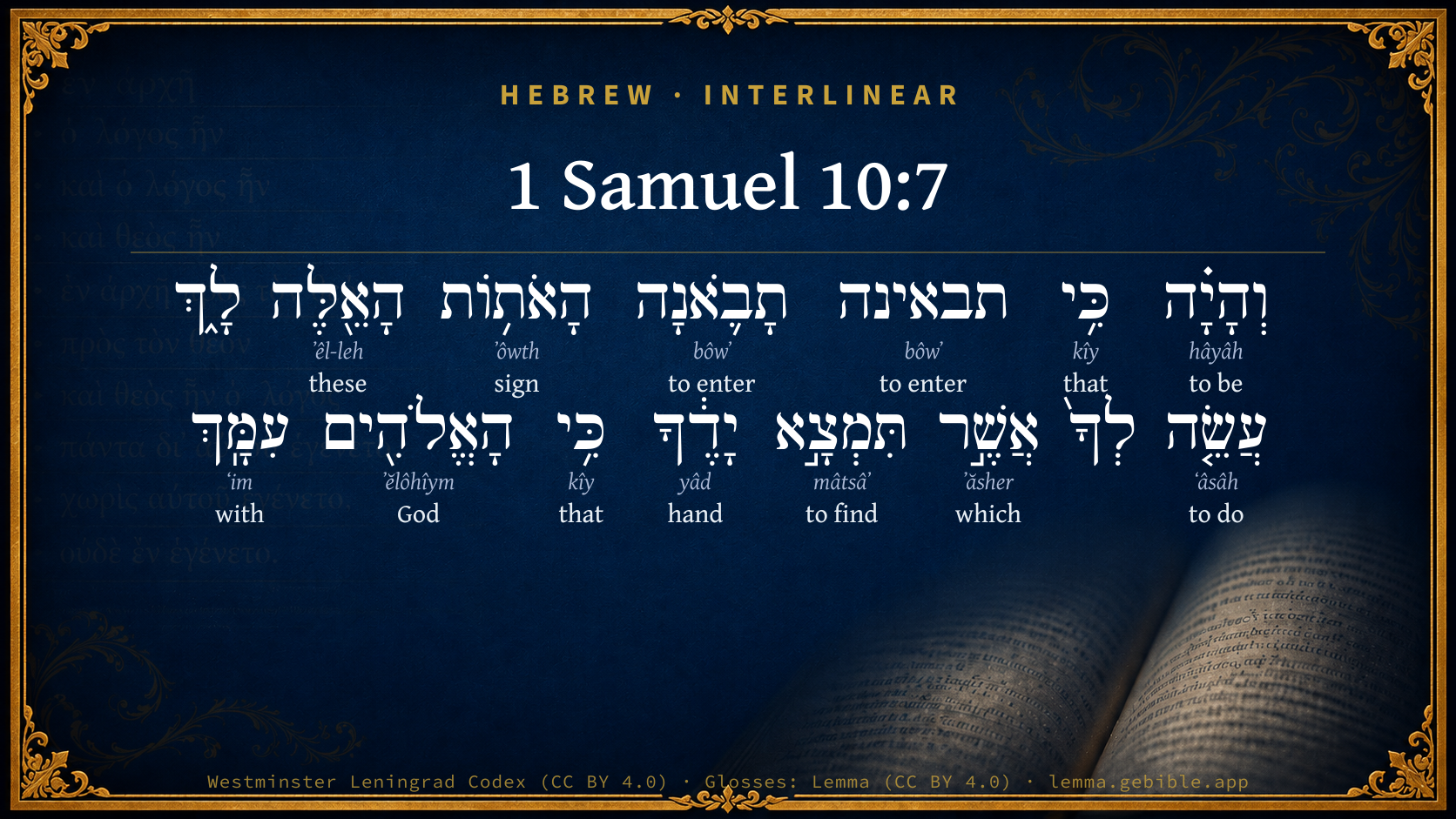
Hebrew (Westminster Leningrad Codex) 1 Samuel 10:7 appears in the Hebrew Old Testament. The text above is from the Westminster Leningrad Codex. Each word links to its Strong’s number, a concise gloss, and parsing drawn from the Open Scriptures Hebrew Bible morphology. Click any word for its full Brown-Driver-Briggs (BDB) entry.
Download image
Cite this verse

1 Samuel 10:7 (World English Bible). Public Domain. Lemma interlinear Bible study tool, https://lemma.gebible.app/v/1-samuel/10/7.

Show BibTeX & RIS
BibTeX
RIS
English Translation
Let it be, when these signs are come to you, that you do as occasion shall serve you; for God is with you.
World English Bible · Public Domain
Download a study sheet

One document with this verse’s original text, its word-by-word gloss line, the meaning frame, cross-references with their text, attributed commentary, and full source and license credits — printable, and it pastes into notes with its structure intact.

This verse Autodidact and up

Study sheet (.html) Plain text (.txt)

A passage Seminary Student

Up to 50 verses in one chapter. A passage sheet keeps up to 6 commentary sources and 12 cross-references per verse, in the order this page ranks them, and says so on the sheet whenever that leaves anything out. Ask for a single verse and you get the Autodidact verse sheet above.

Everything on this page stays free to read, with no account — the sheet is a download of what is already on screen, not access to it.

Want to remove ads? Support Godless Engineer
Compare translations 3

The same verse in 3 English versions, stacked beneath the original-language interlinear above. Click any original word for its lexicon entry.

Each is an independent rendering of the whole verse — the interlinear is not word-aligned to these translations.

Highlighted words mark where these versions differ — a whole-verse word diff, not a word-by-word alignment.

  • World English Bible Public Domain
    Let it be, when these signs are come to you, that you do as occasion shall serve you; for God is with you.
  • King James Version Public Domain
    And let it be, when these signs are come unto thee, that thou do as occasion serve thee; for God is with thee.
  • unfoldingWord Literal Text CC BY-SA 4.0
    And let it be, when these signs come to you, do for yourself what your hand finds, for God is with you.

unfoldingWord Literal Text — © unfoldingWord, licensed CC BY-SA 4.0. Word-aligned USFM3 via Door43 (git.door43.org/unfoldingWord/en_ult).

Versions to compare (up to 4)

3 of 4 selected

Show all 18 translations

Every available English version of this verse, each an independent rendering of the whole verse.

  • World English Bible Public Domain
    Let it be, when these signs are come to you, that you do as occasion shall serve you; for God is with you.
  • Berean Standard Bible Public Domain
    When these signs have come, do as the occasion demands, for God is with you.
  • Majority Standard Bible Public Domain
    When these signs have come, do as the occasion demands, for God is with you.
  • King James Version Public Domain
    And let it be, when these signs are come unto thee, that thou do as occasion serve thee; for God is with thee.
  • American Standard Version (1901) Public Domain
    And let it be, when these signs are come unto thee, that thou do as occasion shall serve thee; for God is with thee.
  • Revised Version (1885) Public Domain
    And let it be, when these signs are come unto thee, that thou do as occasion serve thee; for God is with thee.
  • Geneva Bible (1599) Public Domain
    Therefore when these signes shall come vnto to thee, doe as occasion shall serue: for God is with thee.
  • Douay-Rheims (1899) Public Domain
    When therefore these signs shall happen to thee, do whatsoever thy hand shall find, for the Lord is with thee.
  • Young's Literal Translation Public Domain
    and it hath been, when these signs come to thee -- do for thyself as thy hand findeth, for God `is' with thee.
  • Literal Standard Version CC BY-SA 4.0
    and it has been, when these signs come to you—do for yourself as your hand finds, for God [is] with you.
  • Unlocked Literal Bible CC BY-SA 4.0
    Now, when these signs come to you, do whatever your hand finds to do, for God is with you.
  • unfoldingWord Literal Text CC BY-SA 4.0
    And let it be, when these signs come to you, do for yourself what your hand finds, for God is with you.
  • Darby Bible Public Domain
    And it shall be, when these signs shall come to thee, thou shalt do as thy hand shall find; for God is with thee.
  • World Messianic Bible Public Domain
    Let it be, when these signs have come to you, that you do what is appropriate for the occasion; for God is with you.
  • Webster's Bible Public Domain
    And let it be, when these signs have come to thee, that thou do as occasion shall serve thee; for God is with thee.
  • Free Bible Version CC BY-SA 4.0
    After these signs have happened, do what you need to do, for God is with you.
  • Bible in Basic English Public Domain
    And when these signs come to you, see that you take the chance which is offered you; for God is with you.
  • JPS Tanakh (1917) Public Domain
    And let it be, when these signs are come unto thee, that thou do as thy hand shall find; for God is with thee.

Literal Standard Version (2020), Covenant Press — licensed CC BY-SA 4.0. Text via the HelloAO Bible API (eBible.org). Unlocked Literal Bible (unfoldingWord) — licensed CC BY-SA 4.0. Text via the HelloAO Bible API (eBible.org). unfoldingWord Literal Text — © unfoldingWord, licensed CC BY-SA 4.0. Word-aligned USFM3 via Door43 (git.door43.org/unfoldingWord/en_ult). Free Bible Version, Dr. Jonathan Gallagher — licensed CC BY-SA 4.0. Text via the HelloAO Bible API (eBible.org).

Word by word

More ways to search: Search by grammar → Find every occurrence → Compare this word →

Practice this passage: Drill this verse → Learn its vocabulary →

הָאֹת֥וֹת
ʼôwth
H226
“the · signs”
Particle, Definite Article + Noun, Common, Both, Plural, Absolute
Part of Speech
Particle + Noun
Type
Common
Gender
Both
Number
Plural
State
Absolute
Full BDB Definition

Origin: probably from H225 (in the sense of appearing)

TWOT: 41a

sign, signal - a distinguishing mark - banner - remembrance - miraculous sign - omen - warning - token, ensign, standard, miracle, proof
  1. וְהָיָ֗ה hâyâh H1961 “and · to be” Conjunction + Verb, Qal, Sequential Perfect, 3rd Person, Masculine, Singular
  2. כִּ֥י kîy H3588 “that” Conjunction
  3. תבאינה bôwʼ H935 “to enter” Verb, Qal, Imperfect, 3rd Person, Feminine, Plural
  4. תָבֹ֛אנָה bôwʼ H935 “to enter” Verb, Qal, Imperfect, 3rd Person, Feminine, Plural
  5. הָאֵ֖לֶּה ʼêl-leh H428 “the · these” Particle, Definite Article + Pronoun, Demonstrative, Common, Plural
  6. עֲשֵׂ֤ה ʻâsâh H6213 “do” Verb, Qal, Imperative, 2nd Person, Masculine, Singular
  7. אֲשֶׁ֣ר ʼăsher H834 “which” Particle, Relative
  8. תִּמְצָ֣א mâtsâʼ H4672 “to find” Verb, Qal, Imperfect, 3rd Person, Feminine, Singular
  9. יָדֶ֔ךָ yâd H3027 “hand · your” Noun, Common, Both, Singular, Construct + Suffix, Personal, 2nd Person, Masculine, Singular
  10. כִּ֥י kîy H3588 “that” Conjunction
  11. הָאֱלֹהִ֖ים ʼĕlôhîym H430 “the · God(s)” Particle, Definite Article + Noun, Common, Masculine, Plural, Absolute
  12. עִמָּֽךְ ʻim H5973 “with · you” Preposition + Suffix, Personal, 2nd Person, Feminine, Singular

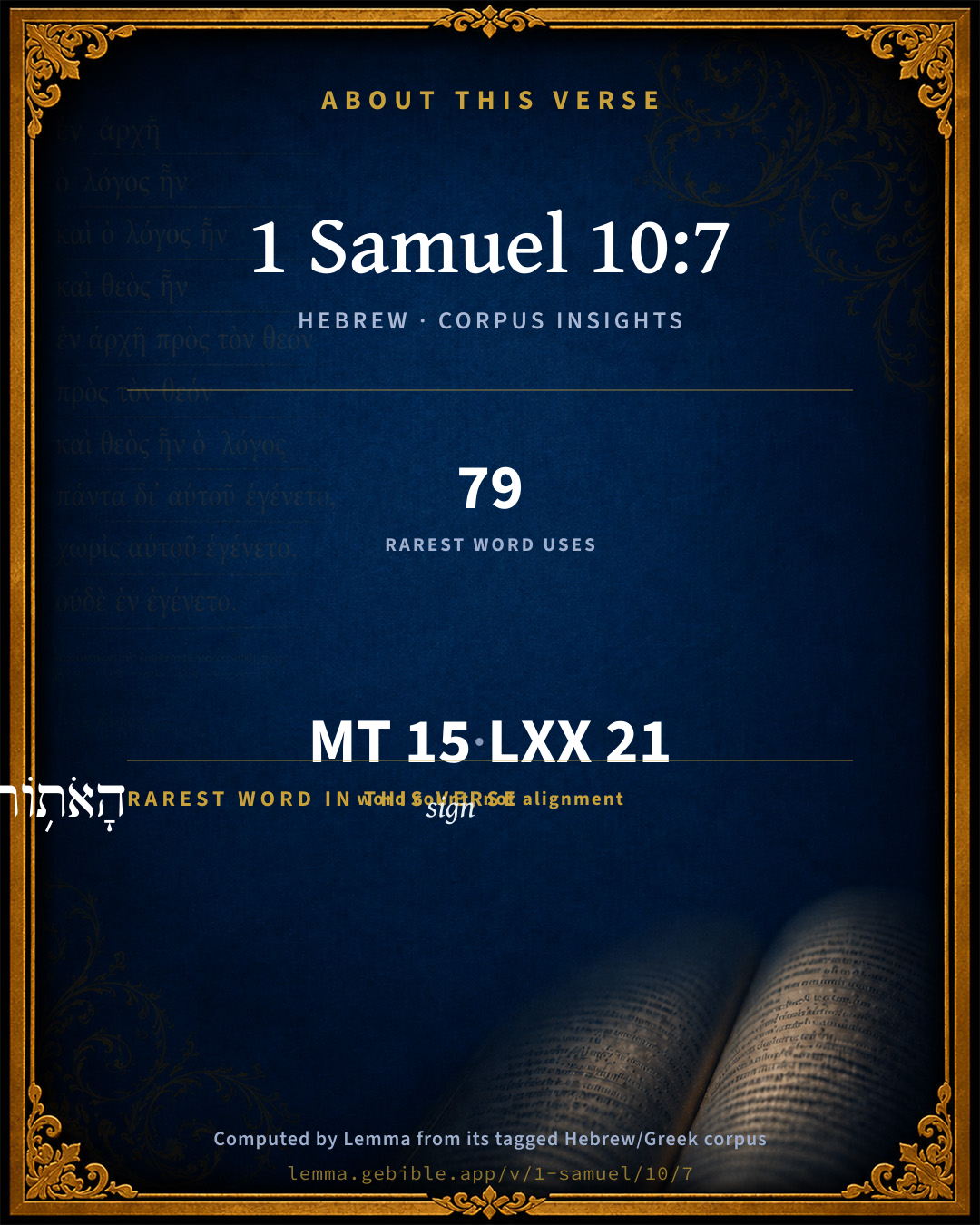
About this verse

These counts appear in no published source. They are computed here, from the morphology-tagged text and Lemma’s own curated glosses. What Lemma adds →

15
words
11
distinct lemmas
Historical
section

Grammatical profile

  • 5 verbs
  • 3 nouns
  • 1 pronoun
  • 3 prepositions
  • 2 conjunctions
  • 1 particle

Verb forms

  • וְהָיָ֗ה Qal · Sequential Perfect
  • תבאינה Qal · Imperfect
  • תָבֹ֛אנָה Qal · Imperfect
  • עֲשֵׂ֤ה Qal · Imperative
  • תִּמְצָ֣א Qal · Imperfect

Repetition

Words recur within this verse — often emphatic in Hebrew:

  • תבאינה to enter H935 ×2
  • כִּ֥י that H3588 ×2

Hebrew & Septuagint length

In English translation the verse runs 23 words from the Hebrew and 26 from the Septuagint (LXX English) — closely comparable.

A rough comparison of the two English renderings, which tokenize alike — not a word-level alignment.

Word counts can differ between the Hebrew and the Greek without any difference in meaning — e.g. the Hebrew direct-object marker אֵת has no separate Greek word, and Greek often adds the article ὁ.

In the original languages it is 15 Hebrew tokens and 21 Greek tokens — but the two are counted differently (Hebrew bundles its prefixes and suffixes into one token; the Greek is in lemma form), so that isn’t a like-for-like length.

Cross-references

14

Topical passages linked to 1 Samuel 10:7 in the Treasury of Scripture Knowledge — connected by theme and wording, ordered by reader-vote popularity; previews shown in the World English Bible.

  • Judges 6:12 The angel of Yahweh appeared to him, and said to him, Yahweh is with you, you mighty man of valor.
  • Joshua 1:5 There shall not any man be able to stand before you all the days of your life. As I was with Moses, so I will be with you; I will not fail you, nor forsake you.
  • Exodus 4:8 "It will happen, if they will neither believe you nor listen to the voice of the first sign, that they will believe the voice of the latter sign.
  • Isaiah 7:14 Therefore the Lord himself will give you a sign. Behold, the virgin will conceive, and bear a son, and shall call his name Immanuel.
  • Hebrews 13:5 Be free from the love of money, content with such things as you have, for he has said, "I will in no way leave you, neither will I in any way forsake you."
  • Genesis 21:20 God was with the boy, and he grew. He lived in the wilderness, and became, as he grew up, an archer.
  • Deuteronomy 20:1 When you go forth to battle against your enemies, and see horses, and chariots, [and] a people more than you, you shall not be afraid of them; for Yahweh your God is with you, who brought you up out of the land of Egypt.
  • Judges 9:33 and it shall be, that in the morning, as soon as the sun is up, you shall rise early, and rush on the city; and, behold, when he and the people who are with him come out against you, then may you do to them as you shall find occasion.
  • Ecclesiastes 9:10 Whatever your hand finds to do, do it with your might; for there is no work, nor device, nor knowledge, nor wisdom, in Sheol, where you are going.
  • Matthew 28:20 teaching them to observe all things that I commanded you. Behold, I am with you always, even to the end of the age." Amen.
  • Luke 2:12 This is the sign to you: you will find a baby wrapped in strips of cloth, lying in a feeding trough."
  • Isaiah 45:1–2 Thus says Yahweh to his anointed, to Cyrus, whose right hand I have held, to subdue nations before him, and I will loose the loins of kings; to open the doors before him, and the gates shall not be shut:
  • Matthew 1:23 "Behold, the virgin shall be with child, And shall bring forth a son. They shall call his name Immanuel;" Which is, being interpreted, "God with us."
  • John 6:14 When therefore the people saw the sign which Jesus did, they said, "This is truly the prophet who comes into the world."

Cross-references courtesy of OpenBible.info (CC BY 4.0).

Hebrew and Greek witnesses Masoretic Hebrew ↔ Greek Septuagint

The same verse in the two great witnesses to the Old Testament, shown verse-for-verse.

These are two independent witnesses, not word-aligned to each other, and the Septuagint is shown in lemma (dictionary) form.

Hebrew 1 Samuel 10:7 Masoretic · Westminster Leningrad Codex

וְהָיָ֗ה כִּ֥י תבאינה תָבֹ֛אנָה הָאֹת֥וֹת הָאֵ֖לֶּה לָ֑ךְ עֲשֵׂ֤ה לְךָ֙ אֲשֶׁ֣ר תִּמְצָ֣א יָדֶ֔ךָ כִּ֥י הָאֱלֹהִ֖ים עִמָּֽךְ

Let it be, when these signs are come to you, that you do as occasion shall serve you; for God is with you.

World English Bible · Public Domain

Greek LXX 1 Samuel 10:7 Septuagint · lemma form

καί εἰμί ὅταν ἥκω ὁ σημεῖον οὗτος ἐπί σύ ποιέω πᾶς ὅσος ἐάν εὑρίσκω ὁ χείρ σύ ὅτι θεός μετά σύ

And it shall come to pass when these signs shall come upon you, —then do you whatever your hand shall find, because God is with you.

LXX2012 (modern English Septuagint) · Public Domain

Hebrew: Westminster Leningrad Codex (CC BY 4.0). Greek: Septuagint (public domain); English from LXX2012 (modern English Septuagint) (Public Domain). How the Septuagint differs from the Hebrew →

Targum (Aramaic paraphrase)

1

The Targum is the ancient Jewish Aramaic paraphrase of the Hebrew Scriptures — an interpretive translation, not the Hebrew text itself. Onkelos (literal) and Pseudo-Jonathan (expansive) render the Torah, and Jonathan the Prophets. Coverage is partial: where no permissively-licensed English translation exists for a verse, only the Aramaic is shown. This is verse-level text, not a word-by-word alignment to the Hebrew.

  1. Targum Jonathan Prophets (Joshua–Malachi)
    וִיהֵי אֲרֵי יֵיתוּן אָתַיָא הָאִלֵן לָךְ עֲבֵיד לָךְ מָנֵי מַלְכוּתָא אֲרֵי מֵימְרָא דַייָ בְּסַעֲדָךְ:

    (no public-domain English translation for this verse)

    Targum Jonathan — Aramaic: “Mikraot Gedolot” (public domain). English: “Sefaria Community Translation” (CC0 1.0 (public-domain dedication)); “London "Chaldee Paraphrase," 1871” (public domain). Text via Sefaria.

Commentary

Notes on 1 Samuel 10:7 from classic Christian and Jewish commentators (each source and its license shown beneath its notes). The classic Christian expositions comment on the surrounding passage and are grouped to its opening verse, so a note may address several verses; the Jewish commentaries on the Tanakh (Rashi and others) are per-verse, so they appear only where the commentator wrote on this verse.

Lemma curates 59 commentaries, every one of them public domain or Creative Commons licensed, each selected and text-cleaned for this edition rather than reprinted as found. About our sources →

Trapp's Complete Commentary

John Trapp

1Sa 10:7 And let it be, when these signs are come unto thee, [that] thou do as occasion serve thee; for God [is] with thee.

Ver. 7. That thou do as occasion serve thee.] Dispone te quantum potueris ad decenter et potenter regnandum. {a} Quit thee like a king; {b} "deal courageously, and the Lord shall be with the good." {2Ch 19:11} "Whatever thine hand findeth to do, do it with all thy might," depending upon God for direction and success.

{a} Lyra.

{b} Regaliter age. - Jerome.

John Trapp, A Commentary or Exposition upon All the Books of the Old and New Testament (1647–1656) — public domain. Text from a community e-Sword module.

Joseph Benson's Commentary

1Sa 10:7. Do as occasion shall serve thee — Hebrew, Do what thy hand findeth to do; that is, as thou shalt have a call and opportunity. As if he had said, I cannot give thee particular directions about every thing that is to be done by thee: but God’s Spirit shall guide thee to do that which the present occasion requires. He does not intend that he should take the kingly government upon him, before his call to it was owned by the people, but that he should dispose his mind to a readiness of undertaking any public service when he should be called to his office.

Joseph Benson's Commentary on the Old and New Testaments (1811–1818) — public domain. Text from a community e-Sword module.

Tyndale Open Study Notes

Tyndale Open Resources

10:7 for God is with you: God’s presence empowered Saul to carry out his responsibilities.

Tyndale Open Study Notes — © Tyndale Open Resources, licensed CC BY-SA 4.0. Text via the HelloAO Bible API.

Adam Clarke's Commentary

Verse 7. Thou do as occasion serve thee] After God has shown thee all these signs that thou art under his especial guidance, fear not to undertake any thing that belongs to thy office, for God is with thee.

What a number of circumstances thus precisely foretold! Does not this prove that Samuel was under the continual inspiration of the Almighty?

Adam Clarke's Commentary on the Bible (1810–1826) — public domain. Text from a community e-Sword/MySword module.

Ellicott's Commentary for English Readers

(7) When these signs are come unto thee.—When these varied circumstances have happened to thee, then be sure that the splendid and glorious life which I have foretold as thy lot will assuredly lie before thee in the immediate future. I will give thee no imperious directions by which thou art to shape thy course. Go bravely on; do well and truly whatever thy hand findeth to do, being confident that God will be with thee, and that His glorious Arm shall be thy guide along that road of honour and of peril which thou art destined to travel.

A Bible Commentary for English Readers, edited by Charles John Ellicott (1878–1897) — public domain. Text from a community e-Sword module.

The Cambridge Bible for Schools and Colleges

gen. ed. J. J. S. Perowne

7. do as occasion serve thee] Lit. “do what thine hand shall find;” undertake boldly whatever presents itself. Cp. Jdg_9:33; Ecc_9:10.

The Cambridge Bible for Schools and Colleges (gen. ed. J. J. S. Perowne; Cambridge University Press, 1878–1918) — public domain. Text from a community e-Sword module.

John Gill's Exposition

And let it be, when these signs are come unto thee,.... And are all fulfilled, especially the last:

that thou do as occasion shall serve thee: as his circumstances would require, and as he in his great wisdom and prudence, with which he should now be furnished, would see necessary to prepare for his taking upon him the kingdom he was anointed to, and would be in a little time openly chosen to, and invested with. Some understand this of royal ornaments befitting a king, or of preparing arms for the defence of the kingdom:

for God is with thee; or the Word of the Lord is thy help, as the Targum, and therefore he need not fear engaging in any enterprise that might be for the glory of God, and good of the kingdom.

John Gill's Exposition of the Whole Bible (1746–1763) — public domain (CC PDM 1.0). Text via the HelloAO Bible API.

Haydock's Catholic Bible Commentary

Find. Undertake any enterprise, how difficult soever, which God may propose to thee. (Calmet)

George Leo Haydock (1774–1849), Haydock's Catholic Family Bible and Commentary, 1859 edition — public domain. Excludes Psalms (Douay-Rheims chapter numbering differs from Protestant) and Deuterocanonical books (Catholic canon only).

Matthew Poole's English Annotations

These signs were certain evidences of God’s calling of him to the kingdom, because they were all future contingencies, which none but God could infallibly know or foretell.

Do as occasion shall serve thee, Heb. do what thy hand findeth to do, i.e. as thou shalt have a call and opportunity. He doth not intend that he should take the kingly government upon him, before his call to it was known to and owned by the people, which had been preposterous and dangerous; but that he should dispose his mind to a readiness of undertaking any public service when necessity required it, and he should be called to his office.

Matthew Poole's English Annotations on the Holy Bible (1683–1685) — public domain. Text from a community e-Sword/MySword module.

Whedon's Commentary on the Bible

Daniel D. Whedon

7. Do as occasion serve thee — Literally, as in the margin, do for thee as thine hand shall find. That is, when thou seest all these signs come to pass, know that the Lord confirms thee as captain over his inheritance, and afterward act as circumstances seem to require. Boldly enter the openings of Providence.

Daniel D. Whedon (gen. ed.), Commentary on the Old and New Testaments (1874–1909) — public domain. Text from a community e-Sword module.

The Pulpit Commentary

Do as occasion serve thee. Literally, "do for thyself as thy hand shall find," i.e. follow the lead of circumstances, and do thy best. This is the flood time of thy fortunes; press onward, and the kingdom is thine own, for God is with thee, and success is sure.

The Pulpit Commentary (1880–1919), ed. H.D.M. Spence-Jones & Joseph S. Exell — public domain. Text from a community e-Sword module.

John Wesley's Explanatory Notes

Thou do - Hebrew. do what they hand findeth to do; that is, as thou shalt have a call and opportunity. He doth not intend that he should take the kingly government upon him, before his call to it was owned by the people, but that he should dispose his mind to a readiness of undertaking any public service when he should be called to his office.

John Wesley, Explanatory Notes Upon the Whole Bible (1754–1765) — public domain. Text via the GEBible commentary corpus.

unfoldingWord translationNotes

Door43 World Missions Community

do whatever your hand finds to do

Here Samuel speaks of Saul's hand as if it were a person trying to find things. AT: "do whatever you think is right to do" (See: Personification)

translationWords

sign

hand

God

Gilgal

burnt offering

sacrifice

peace offering

unfoldingWord translationNotes — © Distant Shores Media and the Door43 World Missions Community, licensed CC BY-SA 4.0. Source: git.door43.org/Door43/en_tn.

Rashi

Rabbi Shlomo Yitzchaki (Rashi)

And when these signs come upon you. And you will realize that my words are true; for just as these signs will come to you, so will the matter of the kingship be fulfilled.

Prepare yourself as well as you can. [Targum renders,] 'prepare for yourself regal garments, and make ready for yourself the court ritual,' as well as you can.

Rashi on the Tanakh — English translations: “The Judaica Press complete Tanach with Rashi, translated by A. J. Rosenberg” (CC BY 4.0); “Pentateuch with Rashi's commentary by M. Rosenbaum and A.M. Silbermann, 1929-1934” (public domain); “The Metsudah Tanach series, Lakewood, N.J” (CC BY 4.0); and “The Book of Joshua, Metsudah Publications, 1997” (CC BY 4.0). Text via Sefaria.

Lesson kit

Teaching starters — assembled from the data on this page, not authored interpretation. Every prompt links to the verse data it draws on. Edit before teaching.

1 Samuel, in the Historical, opens this verse with 15 words (11 distinct Hebrew lemmas). Its most distinctive word is ʼôwth (“sign”). A historical commentator’s framing appears above. Read the whole chapter for the surrounding context.

Discussion questions

  1. The word ʼôwth carries the sense “sign.” How does it shape the verse?
  2. Judges 6:12 shares this passage’s theme. How do the two illuminate each other?
  3. “to enter” occurs 2× in this one verse. What is the effect of the repetition?
  4. These translations render this verse differently; the difference is in the English rendering, not the original. What questions does that raise?
  5. The verb «וְהָיָ֗ה» is Qal Sequential Perfect. How does its form color the action?
  6. Reading how Trapp's Complete Commentary and Joseph Benson's Commentary read this verse, where do the two commentators agree and where do they part?

Things to notice

Reading settings

Reading text

Shown beneath each verse's original-language words.

Old Testament
Old Testament edition

Read the OT as the Masoretic Hebrew (MT) or the Greek Septuagint (LXX).

English shown for the Greek Septuagint (in the Hebrew ↔ Greek comparison).

Comparing translations? Open the Compare panel on any verse page to stack up to four side by side.