
1 Samuel 30:15

Hebrew (Westminster Leningrad Codex) 1 Samuel 30:15 appears in the Hebrew Old Testament. The text above is from the Westminster Leningrad Codex. Each word links to its Strong’s number, a concise gloss, and parsing drawn from the Open Scriptures Hebrew Bible morphology. Click any word for its full Brown-Driver-Briggs (BDB) entry.
Download image
Cite this verse

1 Samuel 30:15 (World English Bible). Public Domain. Lemma interlinear Bible study tool, https://lemma.gebible.app/v/1-samuel/30/15.

Show BibTeX & RIS
BibTeX
RIS
English Translation
David said to him, Will you bring me down to this troop? He said, Swear to me by God, that you will neither kill me, nor deliver me up into the hands of my master, and I will bring you down to this troop.
World English Bible · Public Domain
Download a study sheet

One document with this verse’s original text, its word-by-word gloss line, the meaning frame, cross-references with their text, attributed commentary, and full source and license credits — printable, and it pastes into notes with its structure intact.

This verse Autodidact and up

Study sheet (.html) Plain text (.txt)

A passage Seminary Student

Up to 50 verses in one chapter. A passage sheet keeps up to 6 commentary sources and 12 cross-references per verse, in the order this page ranks them, and says so on the sheet whenever that leaves anything out. Ask for a single verse and you get the Autodidact verse sheet above.

Everything on this page stays free to read, with no account — the sheet is a download of what is already on screen, not access to it.

Want to remove ads? Support Godless Engineer
Compare translations 3

The same verse in 3 English versions, stacked beneath the original-language interlinear above. Click any original word for its lexicon entry.

Each is an independent rendering of the whole verse — the interlinear is not word-aligned to these translations.

Highlighted words mark where these versions differ — a whole-verse word diff, not a word-by-word alignment.

  • World English Bible Public Domain
    David said to him, Will you bring me down to this troop? He said, Swear to me by God, that you will neither kill me, nor deliver me up into the hands of my master, and I will bring you down to this troop.
  • King James Version Public Domain
    And David said to him, Canst thou bring me down to this company? And he said, Swear unto me by God, that thou wilt neither kill me, nor deliver me into the hands of my master, and I will bring thee down to this company.
  • unfoldingWord Literal Text CC BY-SA 4.0
    And David said to him, “Will you bring me down to this band?” And he said, “Swear to me by God, if you will cause me to die and if you will enclose me in the hand of my master, and I will bring you down to this band.”

unfoldingWord Literal Text — © unfoldingWord, licensed CC BY-SA 4.0. Word-aligned USFM3 via Door43 (git.door43.org/unfoldingWord/en_ult).

Versions to compare (up to 4)

3 of 4 selected

Show all 18 translations

Every available English version of this verse, each an independent rendering of the whole verse.

  • World English Bible Public Domain
    David said to him, Will you bring me down to this troop? He said, Swear to me by God, that you will neither kill me, nor deliver me up into the hands of my master, and I will bring you down to this troop.
  • Berean Standard Bible Public Domain
    “Will you lead me to these raiders?” David asked. And the man replied, “Swear to me by God that you will not kill me or deliver me into the hand of my master, and I will lead you to them.”
  • Majority Standard Bible Public Domain
    “Will you lead me to these raiders?” David asked. And the man replied, “Swear to me by God that you will not kill me or deliver me into the hand of my master, and I will lead you to them.”
  • King James Version Public Domain
    And David said to him, Canst thou bring me down to this company? And he said, Swear unto me by God, that thou wilt neither kill me, nor deliver me into the hands of my master, and I will bring thee down to this company.
  • American Standard Version (1901) Public Domain
    And David said to him, Wilt thou bring me down to this troop? And he said, Swear unto me by God, that thou wilt neither kill me, nor deliver me up into the hands of my master, and I will bring thee down to this troop.
  • Revised Version (1885) Public Domain
    And David said to him, Wilt thou bring me down to this troop? And he said, Swear unto me by God, that thou wilt neither kill me, nor deliver me up into the hands of my master, and I will bring thee down to this troop.
  • Geneva Bible (1599) Public Domain
    And Dauid saide vnto him, Canst thou bring me to this companie? And he said, Sweare vnto me by God, that thou wilt neither kill me, nor deliuer me into the handes of my master, and I will bring thee to this companie.
  • Douay-Rheims (1899) Public Domain
    And David said to him: Canst thou bring me to this company? And he said: Swear to me by God, that thou wilt not kill me, nor deliver me into the hands of my master, and I will bring thee to this company. And David swore to him.
  • Young's Literal Translation Public Domain
    And David saith unto him, `Dost thou bring me down unto this troop?' and he saith, `Swear to me by God -- thou dost not put me to death, nor dost thou shut me up into the hand of my lord -- and I bring thee down unto this troop.'
  • Literal Standard Version CC BY-SA 4.0
    And David says to him, “Do you bring me down to this troop?” And he says, “Swear to me by God [that] you do not put me to death, nor do you shut me up into the hand of my lord, and I bring you down to this troop.”
  • Unlocked Literal Bible CC BY-SA 4.0
    David said to him, “Will you bring me down to this raiding party?” The Egyptian said, “Swear to me by God that you will not kill me or betray me up into the hands of my master, and I will bring you down to this raiding party.”
  • unfoldingWord Literal Text CC BY-SA 4.0
    And David said to him, “Will you bring me down to this band?” And he said, “Swear to me by God, if you will cause me to die and if you will enclose me in the hand of my master, and I will bring you down to this band.”
  • Darby Bible Public Domain
    And David said to him, Canst thou bring me down to this troop? And he said, Swear to me by God, that thou wilt neither put me to death nor deliver me up into the hand of my master, and I will bring thee down to this troop.
  • World Messianic Bible Public Domain
    David said to him, “Will you bring me down to this troop?” He said, “Swear to me by God that you will not kill me and not deliver me up into the hands of my master, and I will bring you down to this troop.”
  • Webster's Bible Public Domain
    And David said to him, Canst thou conduct me down to this company? And he said, Swear to me by God, that thou wilt neither kill me, nor deliver me into the hands of my master, and I will lead thee down to this company.
  • Free Bible Version CC BY-SA 4.0
    “Can you lead me to these raiders?” David asked. “If you swear to me by God that you won't kill me or hand me over to my master, then I'll take you to them,” the man replied.
  • Bible in Basic English Public Domain
    And David said to him, Will you take me down to this band? And he said, If you give me your oath that you will not put me to death or give me up to my master, I will take you to them.
  • JPS Tanakh (1917) Public Domain
    And David said to him: 'Wilt thou bring me down to this troop?' And he said: 'Swear unto me by God, that thou wilt neither kill me, nor deliver me up into the hands of my master, and I will bring thee down to this troop.'

Literal Standard Version (2020), Covenant Press — licensed CC BY-SA 4.0. Text via the HelloAO Bible API (eBible.org). Unlocked Literal Bible (unfoldingWord) — licensed CC BY-SA 4.0. Text via the HelloAO Bible API (eBible.org). unfoldingWord Literal Text — © unfoldingWord, licensed CC BY-SA 4.0. Word-aligned USFM3 via Door43 (git.door43.org/unfoldingWord/en_ult). Free Bible Version, Dr. Jonathan Gallagher — licensed CC BY-SA 4.0. Text via the HelloAO Bible API (eBible.org).

Word by word

More ways to search: Search by grammar → Find every occurrence → Compare this word →

Practice this passage: Drill this verse → Learn its vocabulary →

הַגְּד֣וּד
gᵉdûwd
H1416
“the · troop”
Particle, Definite Article + Noun, Common, Masculine, Singular, Absolute
Part of Speech
Particle + Noun
Type
Common
Gender
Masculine
Number
Singular
State
Absolute
Full BDB Definition

Origin: from H1413

TWOT: 313a

a band, troop, marauding band - marauding band, raiding band - troop, band (of divisions of army) - foray, raid
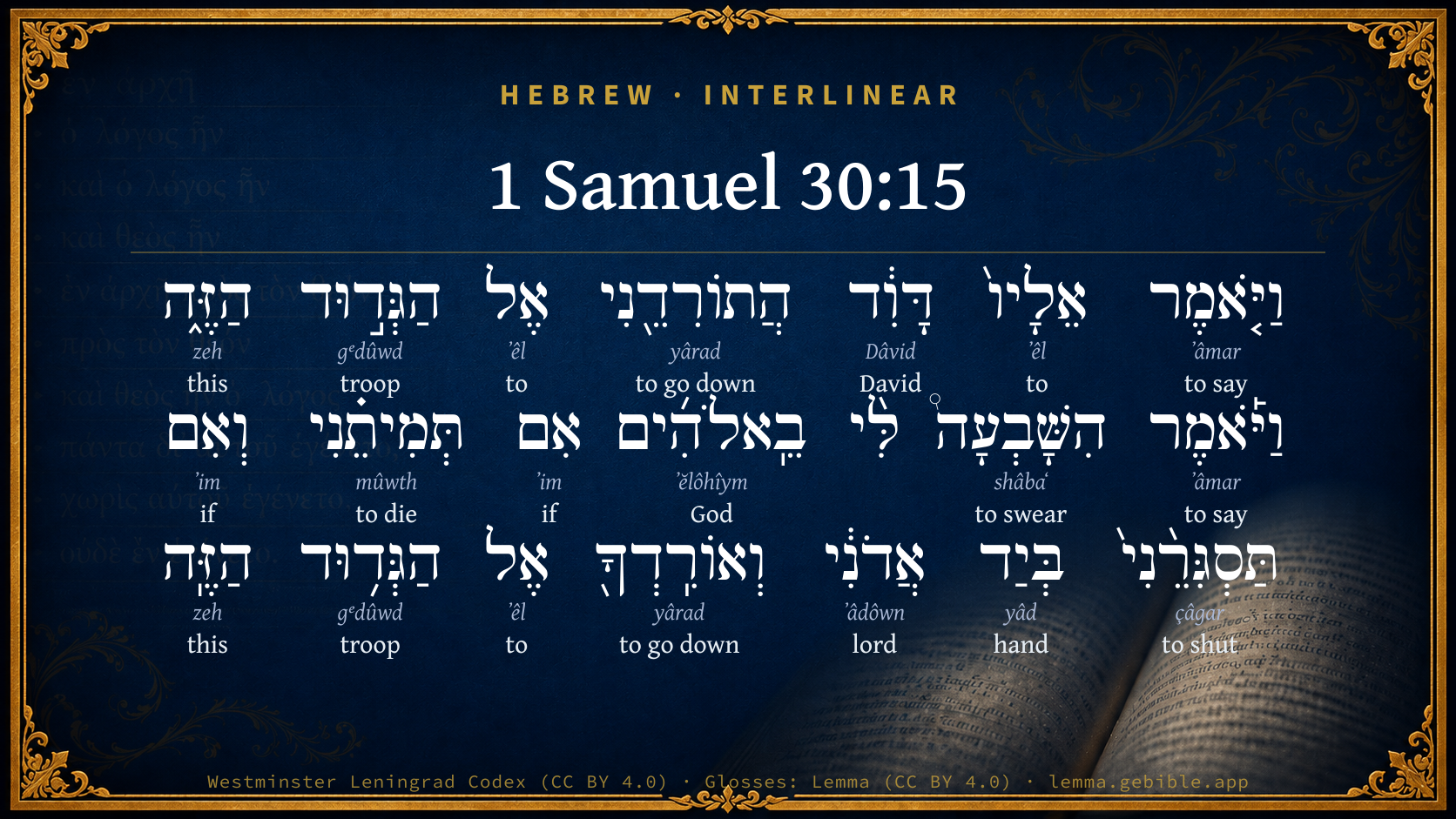
  1. וַיֹּ֤אמֶר ʼâmar H559 “and · to say” Conjunction + Verb, Qal, Sequential Imperfect, 3rd Person, Masculine, Singular
  2. אֵלָיו֙ ʼêl H413 “to · him” Preposition + Suffix, Personal, 3rd Person, Masculine, Singular
  3. דָּוִ֔ד Dâvid H1732 “David” Noun, Proper
  4. הֲתוֹרִדֵ֖נִי yârad H3381 “to go down · me” Particle, Interrogative + Verb, Hiphil, Imperfect, 2nd Person, Masculine, Singular + Suffix, Personal, 1st Person, Common, Singular
  5. אֶל ʼêl H413 “to” Preposition
  6. הַזֶּ֑ה zeh H2088 “the · this” Particle, Definite Article + Pronoun, Demonstrative, Masculine, Singular
  7. וַיֹּ֡אמֶר ʼâmar H559 “and · to say” Conjunction + Verb, Qal, Sequential Imperfect, 3rd Person, Masculine, Singular
  8. הִשָּׁבְעָה֩ shâbaʻ H7650 “swear” Verb, Niphal, Imperative, 2nd Person, Masculine, Singular + Suffix, h
  9. בֵֽאלֹהִ֜ים ʼĕlôhîym H430 “in/at · God(s)” Preposition + Noun, Common, Masculine, Plural, Absolute
  10. אִם ʼim H518 “if” Conjunction
  11. תְּמִיתֵ֗נִי mûwth H4191 “to die · me” Verb, Hiphil, Imperfect, 2nd Person, Masculine, Singular + Suffix, Personal, 1st Person, Common, Singular
  12. וְאִם ʼim H518 “and · if” Conjunction + Conjunction
  13. תַּסְגִּרֵ֨נִי֙ çâgar H5462 “to shut · me” Verb, Hiphil, Imperfect, 2nd Person, Masculine, Singular + Suffix, Personal, 1st Person, Common, Singular
  14. בְּיַד yâd H3027 “in/at · hand of” Preposition + Noun, Common, Both, Singular, Construct
  15. אֲדֹנִ֔י ʼâdôwn H113 “lord · my” Noun, Common, Masculine, Singular, Construct + Suffix, Personal, 1st Person, Common, Singular
  16. וְאוֹרִֽדְךָ֖ yârad H3381 “and · to go down · you” Conjunction + Verb, Hiphil, Imperfect, 1st Person, Common, Singular + Suffix, Personal, 2nd Person, Masculine, Singular
  17. אֶל ʼêl H413 “to” Preposition
  18. הַגְּד֥וּד gᵉdûwd H1416 “the · troop” Particle, Definite Article + Noun, Common, Masculine, Singular, Absolute
  19. הַזֶּֽה zeh H2088 “the · this” Particle, Definite Article + Pronoun, Demonstrative, Masculine, Singular

About this verse

These counts appear in no published source. They are computed here, from the morphology-tagged text and Lemma’s own curated glosses. What Lemma adds →

21
words
13
distinct lemmas
Historical
section

Shared distinctive vocabulary

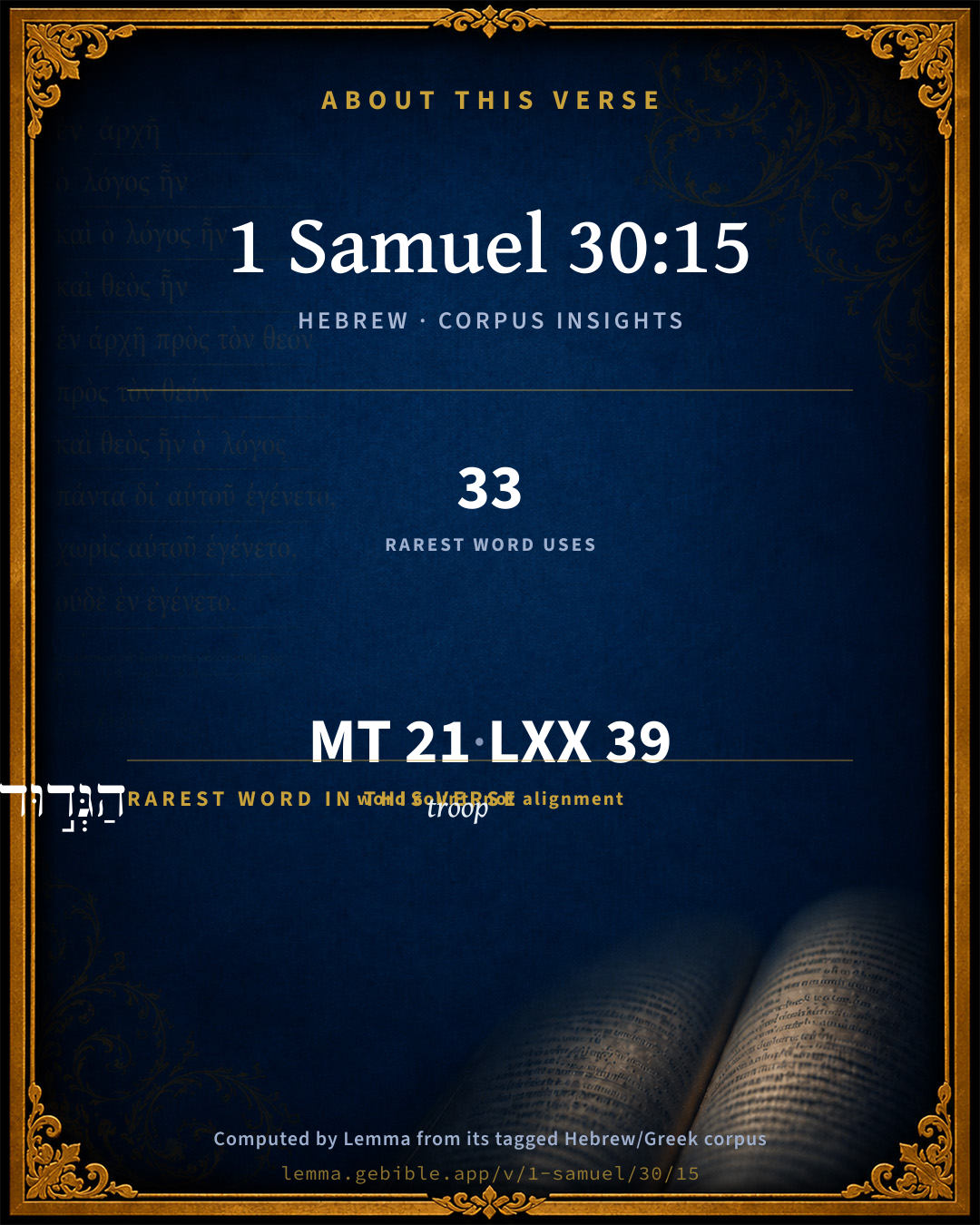
הַגְּד֣וּד troop H1416 occurs in 29 verses of the Hebrew Bible. Also found in:

Grammatical profile

  • 7 verbs
  • 6 nouns
  • 2 pronouns
  • 4 prepositions
  • 2 conjunctions

Verb forms

  • וַיֹּ֤אמֶר Qal · Sequential Imperfect
  • הֲתוֹרִדֵ֖נִי Hiphil · Imperfect
  • וַיֹּ֡אמֶר Qal · Sequential Imperfect
  • הִשָּׁבְעָה֩ Niphal · Imperative
  • תְּמִיתֵ֗נִי Hiphil · Imperfect
  • תַּסְגִּרֵ֨נִי֙ Hiphil · Imperfect
  • וְאוֹרִֽדְךָ֖ Hiphil · Imperfect

Repetition

Words recur within this verse — often emphatic in Hebrew:

  • וַיֹּ֤אמֶר to say H559 ×2
  • הֲתוֹרִדֵ֖נִי to go down H3381 ×2
  • הַגְּד֣וּד troop H1416 ×2
  • אֵלָיו֙ to H413 ×3
  • הַזֶּ֑ה this H2088 ×2
  • אִם if H518 ×2

Hebrew & Septuagint length

In English translation the verse runs 44 words from the Hebrew and 50 from the Septuagint (LXX English) — closely comparable.

A rough comparison of the two English renderings, which tokenize alike — not a word-level alignment.

Word counts can differ between the Hebrew and the Greek without any difference in meaning — e.g. the Hebrew direct-object marker אֵת has no separate Greek word, and Greek often adds the article ὁ.

In the original languages it is 21 Hebrew tokens and 39 Greek tokens — but the two are counted differently (Hebrew bundles its prefixes and suffixes into one token; the Greek is in lemma form), so that isn’t a like-for-like length.

Cross-references

8

Topical passages linked to 1 Samuel 30:15 in the Treasury of Scripture Knowledge — connected by theme and wording, ordered by reader-vote popularity; previews shown in the World English Bible.

  • Deuteronomy 23:15–16 You shall not deliver to his master a servant who is escaped from his master to you:
  • Joshua 2:12 Now therefore, please swear to me by Yahweh, since I have dealt kindly with you, that you also will deal kindly with my father's house, and give me a true token;
  • Joshua 9:15 Joshua made peace with them, and made a covenant with them, to let them live: and the princes of the congregation swore to them.
  • Joshua 9:19–20 But all the princes said to all the congregation, We have sworn to them by Yahweh, the God of Israel: now therefore we may not touch them.
  • 1 Samuel 29:6 Then Achish called David, and said to him, As Yahweh lives, you have been upright, and your going out and your coming in with me in the host is good in my sight; for I have not found evil in you since the day of your coming to me to this day: nevertheless the lords don't favor you.
  • Ezekiel 17:13 and he took of the seed royal, and made a covenant with him; he also brought him under an oath, and took away the mighty of the land;
  • Ezekiel 17:16 As I live, says the Lord Yahweh, surely in the place where the king dwells who made him king, whose oath he despised, and whose covenant he broke, even with him in the midst of Babylon he shall die.
  • Ezekiel 17:19 Therefore thus says the Lord Yahweh: As I live, surely my oath that he has despised, and my covenant that he has broken, I will even bring it on his own head.

Cross-references courtesy of OpenBible.info (CC BY 4.0).

Hebrew and Greek witnesses Masoretic Hebrew ↔ Greek Septuagint

The same verse in the two great witnesses to the Old Testament, shown verse-for-verse.

These are two independent witnesses, not word-aligned to each other, and the Septuagint is shown in lemma (dictionary) form.

Hebrew 1 Samuel 30:15 Masoretic · Westminster Leningrad Codex

וַיֹּ֤אמֶר אֵלָיו֙ דָּוִ֔ד הֲתוֹרִדֵ֖נִי אֶל הַגְּד֣וּד הַזֶּ֑ה וַיֹּ֡אמֶר הִשָּׁבְעָה֩ לִּ֨י בֵֽאלֹהִ֜ים אִם תְּמִיתֵ֗נִי וְאִם תַּסְגִּרֵ֨נִי֙ בְּיַד אֲדֹנִ֔י וְאוֹרִֽדְךָ֖ אֶל הַגְּד֥וּד הַזֶּֽה

David said to him, Will you bring me down to this troop? He said, Swear to me by God, that you will neither kill me, nor deliver me up into the hands of my master, and I will bring you down to this troop.

World English Bible · Public Domain

Greek LXX 1 Samuel 30:15 Septuagint · lemma form

καί εἶπον πρός αὐτός δαυίδ εἰ καταἄγω ἐγώ ἐπί ὁ γεδδουρ οὗτος καί εἶπον ὄμνυμι δή ἐγώ κατά ὁ θεός μή θανατόω ἐγώ καί μή παραδίδωμι ἐγώ εἰς χείρ ὁ κύριος ἐγώ καί καταἄγω σύ ἐπί ὁ γεδδουρ οὗτος

And David said to him, Will you bring me down to this troop? And he said, Swear now to me by God, that you will not kill me, and that you will not deliver me into the hands of my master, and I will bring you down upon this troop.

LXX2012 (modern English Septuagint) · Public Domain

Hebrew: Westminster Leningrad Codex (CC BY 4.0). Greek: Septuagint (public domain); English from LXX2012 (modern English Septuagint) (Public Domain). How the Septuagint differs from the Hebrew →

Targum (Aramaic paraphrase)

1

The Targum is the ancient Jewish Aramaic paraphrase of the Hebrew Scriptures — an interpretive translation, not the Hebrew text itself. Onkelos (literal) and Pseudo-Jonathan (expansive) render the Torah, and Jonathan the Prophets. Coverage is partial: where no permissively-licensed English translation exists for a verse, only the Aramaic is shown. This is verse-level text, not a word-by-word alignment to the Hebrew.

  1. Targum Jonathan Prophets (Joshua–Malachi)
    וַאֲמַר לֵיהּ דָוִד הֲתַחְתִּינַנִי לְמַשְׁרִיתָא הָדָא וַאֲמַר קַיָם לִי בְּמֵימְרָא דַייָ דְלָא תִקְטְלִינַנִי וְלָא תִמְסְרִינַנִי בִּידָא דְרִבּוֹנִי וְאַחְתִינָךְ לְמַשְׁרִיתָא הָדָא:

    (no public-domain English translation for this verse)

    Targum Jonathan — Aramaic: “Mikraot Gedolot” (public domain). English: “Sefaria Community Translation” (CC0 1.0 (public-domain dedication)); “London "Chaldee Paraphrase," 1871” (public domain). Text via Sefaria.

Commentary

Notes on 1 Samuel 30:15 from classic Christian and Jewish commentators (each source and its license shown beneath its notes). The classic Christian expositions comment on the surrounding passage and are grouped to its opening verse, so a note may address several verses; the Jewish commentaries on the Tanakh (Rashi and others) are per-verse, so they appear only where the commentator wrote on this verse.

Lemma curates 59 commentaries, every one of them public domain or Creative Commons licensed, each selected and text-cleaned for this edition rather than reprinted as found. About our sources →

Trapp's Complete Commentary

John Trapp

1Sa 30:15 And David said to him, Canst thou bring me down to this company? And he said, Swear unto me by God, that thou wilt neither kill me, nor deliver me into the hands of my master, and I will bring thee down to this company.

Ver. 15. That thou wilt neither kill me.] For a traitor to mine own company, and therefore not fit to live. How the Turkish Basha punished him that betrayed the Rhodes to him, is well known. Men hate the traitor, though they love the treason: the traitor is odious, though the treason may be commodious.

John Trapp, A Commentary or Exposition upon All the Books of the Old and New Testament (1647–1656) — public domain. Text from a community e-Sword module.

Joseph Benson's Commentary

1Sa 30:15. Nor deliver me into the hand of my master — It is likely his master had been cruel to him, and therefore he had no mind to serve him any longer. I will bring thee down to this company — For, it is probable, his master had told him whither they intended to go, that he might come after them as soon as he could.

Joseph Benson's Commentary on the Old and New Testaments (1811–1818) — public domain. Text from a community e-Sword module.

Geneva Bible (1599)

Geneva Bible translators

For oaths were in all ages had in most reverence, even among the heathen.

Geneva Bible (1599) marginal notes — public domain. Text via Bolls.life.

Jamieson, Fausset & Brown

Robert Jamieson, A. R. Fausset & David Brown

Swear unto me by God--Whether there was still among these idolatrous tribes a lingering belief in one God, or this Egyptian wished to bind David by the God whom the Hebrews worshipped, the solemn sanction of an oath was mutually recognized.

Jamieson, Fausset & Brown — Commentary Critical and Explanatory on the Whole Bible (1871) — public domain (CC PDM 1.0). Text via the HelloAO Bible API.

Adam Clarke's Commentary

Verse 15. Swear unto me] At the conclusion of this verse, the Vulgate, Syriac, and Arabic add, that David swore to him. This is not expressed in the Hebrew, but is necessarily implied.

Adam Clarke's Commentary on the Bible (1810–1826) — public domain. Text from a community e-Sword/MySword module.

Ellicott's Commentary for English Readers

(15) By God.—The oath was to be by “Elohim,” not by Jehovah, of whom the Egyptian knew nothing.

And I will bring thee down.—His accurate knowledge of the route taken by the Amalekites, and his clear account of the late raid, show that he was a person of no ordinary ability; he was probably an Egyptian merchant or wealthy trader captured in some border fray.

A Bible Commentary for English Readers, edited by Charles John Ellicott (1878–1897) — public domain. Text from a community e-Sword module.

The Cambridge Bible for Schools and Colleges

gen. ed. J. J. S. Perowne

15. company] Troop, as in 1Sa_30:8, and again in 1Sa_30:23. It is the regular word for a band of roving plunderers. Cp. Psa_18:29. Is it fanciful to think that David there refers to this successful pursuit of the Amalekites? He must always have remembered it as one of the signal mercies of his life.

The Cambridge Bible for Schools and Colleges (gen. ed. J. J. S. Perowne; Cambridge University Press, 1878–1918) — public domain. Text from a community e-Sword module.

John Gill's Exposition

And David said unto him, canst thou me down to this company?.... That is, show him, or direct him where they were:

and he said, swear unto me by God; the Targum is, by the Word of the Lord; but it is highly probable this man had no notion of Jehovah, and his Word, or of the true God; only that there was a God, and that an oath taken by him was solemn, sacred, and inviolable, and might be trusted to and depended on:

that thou wilt neither kill me; for he found now he was in the hands of those whose city he had been concerned in plundering and burning, and so might fear his life was in danger:

nor deliver me into the hands of my master; who had been a cruel one to him, and therefore would gladly be clear of him; and if he had nothing else against him, his late usage of him was sufficient to raise his resentment of him:

and I will bring thee down to this company; or show him where they were, having heard them say where they would stop, and make merry, and divide their spoil; and perhaps his master might tell him they would be at such a place at such a time, where, if he was better, he might come to them; the Vulgate Latin version adds, "and David swore to him": which, though not expressed in the original text, was no doubt done by him; and the Syriac and Arabic versions begin Sa1 30:16 thus, "when David had sworn to him".

John Gill's Exposition of the Whole Bible (1746–1763) — public domain (CC PDM 1.0). Text via the HelloAO Bible API.

Haydock's Catholic Bible Commentary

Him. David did not require this slave to betray his master, for the latter had lost all his claim, and David had acquired it by relieving the distressed. Si herus negaverit servo suo alimenta, & alius suppeditet, sit occupantis. See Martyr. and the Roman laws. The Amalecites dwelt in tents, and the slave knew where they commonly lodged. (Calmet) --- Perhaps his master had told him where to meet him, in case he recovered.

George Leo Haydock (1774–1849), Haydock's Catholic Family Bible and Commentary, 1859 edition — public domain. Excludes Psalms (Douay-Rheims chapter numbering differs from Protestant) and Deuterocanonical books (Catholic canon only).

Matthew Poole's English Annotations

For his master had told him whither they intended to go, that he might come after them as soon as he could.

Matthew Poole's English Annotations on the Holy Bible (1683–1685) — public domain. Text from a community e-Sword/MySword module.

The Pulpit Commentary

To this company. Better, "troop." The word signifies a band of soldiers, robbers, or the like. Required by David to act as his guide, the Egyptian consents upon condition that David bind himself neither to kill him, it being one of the unscrupulous customs of ancient warfare to put deserters, persons forced to act as guides, and even noncombatants, to death to save trouble; nor give him up to his master, who would treat him in the same way.

The Pulpit Commentary (1880–1919), ed. H.D.M. Spence-Jones & Joseph S. Exell — public domain. Text from a community e-Sword module.

John Wesley's Explanatory Notes

Will bring thee - For his master had told him whither they intended to go, that he might come after them, as soon as he could.

John Wesley, Explanatory Notes Upon the Whole Bible (1754–1765) — public domain. Text via the GEBible commentary corpus.

Keil & Delitzsch

C. F. Keil & F. Delitzsch

This Egyptian then conducted David, at his request, when he had sworn that he would neither kill him nor deliver him up to his master, down to the hostile troops, who were spread over the whole land, eating, drinking, and making merry, on account of all the great booty which they had brought out of the land of the Philistines and Judah.

Keil & Delitzsch — Biblical Commentary on the Old Testament (1861–1891) — public domain (CC PDM 1.0). Text via the HelloAO Bible API. (Old Testament only.)

unfoldingWord translationNotes

Door43 World Missions Community

raiding party

a group of armed warriors who attack people or places unexpectedly

you will not ... betray me up into the hands of my master

Here "hands" refers to control. AT: "you will not ... violate the trust I have in you by allowing my master to control me again" (See: Metonymy)

translationWords

David

Egypt

oath

God

hand

lord

unfoldingWord translationNotes — © Distant Shores Media and the Door43 World Missions Community, licensed CC BY-SA 4.0. Source: git.door43.org/Door43/en_tn.

Lesson kit

Teaching starters — assembled from the data on this page, not authored interpretation. Every prompt links to the verse data it draws on. Edit before teaching.

1 Samuel, in the Historical, opens this verse with 21 words (13 distinct Hebrew lemmas). Its most distinctive word is gᵉdûwd (“troop”). A historical commentator’s framing appears above. Read the whole chapter for the surrounding context.

Discussion questions

  1. The word gᵉdûwd carries the sense “troop.” How does it shape the verse?
  2. How does Genesis 49:19, which shares the word «troop», read alongside this verse?
  3. What does the repetition of “to say” (2× in this one verse) do in this verse?
  4. These translations render this verse differently. What is at stake in choosing one wording over another?
  5. «וַיֹּ֤אמֶר» is a Qal Sequential Imperfect verb. How does that grammatical form shape the action described?
  6. Compare how Trapp's Complete Commentary and Joseph Benson's Commentary read this verse. Where do they agree or differ?

Things to notice

Reading settings

Reading text

Shown beneath each verse's original-language words.

Old Testament
Old Testament edition

Read the OT as the Masoretic Hebrew (MT) or the Greek Septuagint (LXX).

English shown for the Greek Septuagint (in the Hebrew ↔ Greek comparison).

Comparing translations? Open the Compare panel on any verse page to stack up to four side by side.