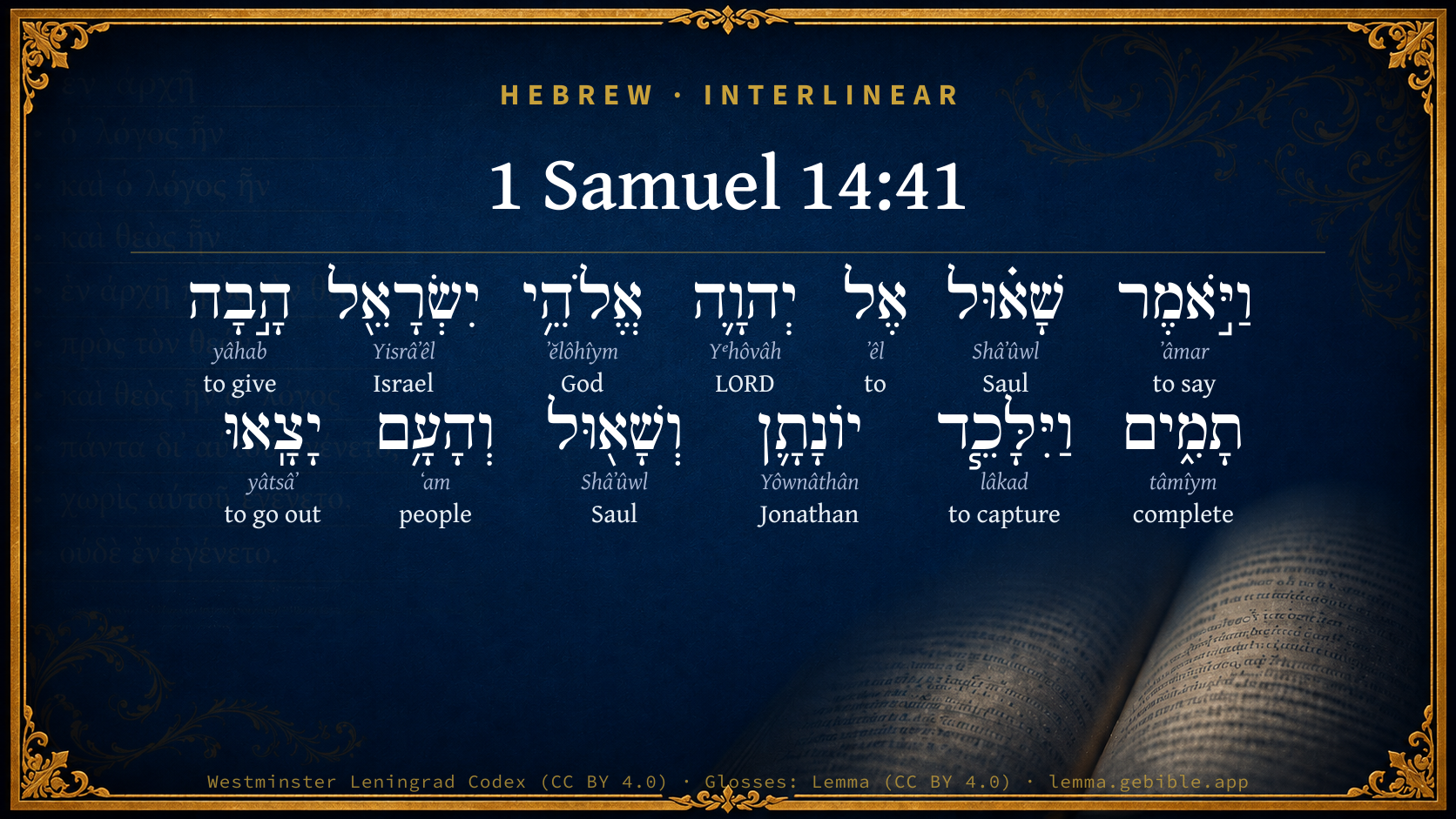
1 Samuel 14:41

Hebrew (Westminster Leningrad Codex) 1 Samuel 14:41 appears in the Hebrew Old Testament. The text above is from the Westminster Leningrad Codex. Each word links to its Strong’s number, a concise gloss, and parsing drawn from the Open Scriptures Hebrew Bible morphology. Click any word for its full Brown-Driver-Briggs (BDB) entry.
Download image
Cite this verse

1 Samuel 14:41 (World English Bible). Public Domain. Lemma interlinear Bible study tool, https://lemma.gebible.app/v/1-samuel/14/41.

Show BibTeX & RIS
BibTeX
RIS
English Translation
Therefore Saul said to Yahweh, the God of Israel, Show the right. Jonathan and Saul were taken [by lot]; but the people escaped.
World English Bible · Public Domain
Download a study sheet

One document with this verse’s original text, its word-by-word gloss line, the meaning frame, cross-references with their text, attributed commentary, and full source and license credits — printable, and it pastes into notes with its structure intact.

This verse Autodidact and up

Study sheet (.html) Plain text (.txt)

A passage Seminary Student

Up to 50 verses in one chapter. A passage sheet keeps up to 6 commentary sources and 12 cross-references per verse, in the order this page ranks them, and says so on the sheet whenever that leaves anything out. Ask for a single verse and you get the Autodidact verse sheet above.

Everything on this page stays free to read, with no account — the sheet is a download of what is already on screen, not access to it.

Want to remove ads? Support Godless Engineer
Compare translations 3

The same verse in 3 English versions, stacked beneath the original-language interlinear above. Click any original word for its lexicon entry.

Each is an independent rendering of the whole verse — the interlinear is not word-aligned to these translations.

Highlighted words mark where these versions differ — a whole-verse word diff, not a word-by-word alignment.

  • World English Bible Public Domain
    Therefore Saul said to Yahweh, the God of Israel, Show the right. Jonathan and Saul were taken [by lot]; but the people escaped.
  • King James Version Public Domain
    Therefore Saul said unto the LORD God of Israel, Give a perfect lot. And Saul and Jonathan were taken: but the people escaped.
  • unfoldingWord Literal Text CC BY-SA 4.0
    Then Saul said to Yahweh, the God of Israel, “Give a perfect!” And Jonathan and Saul were taken, but the people went out.

unfoldingWord Literal Text — © unfoldingWord, licensed CC BY-SA 4.0. Word-aligned USFM3 via Door43 (git.door43.org/unfoldingWord/en_ult).

Versions to compare (up to 4)

3 of 4 selected

Show all 18 translations

Every available English version of this verse, each an independent rendering of the whole verse.

  • World English Bible Public Domain
    Therefore Saul said to Yahweh, the God of Israel, Show the right. Jonathan and Saul were taken [by lot]; but the people escaped.
  • Berean Standard Bible Public Domain
    So Saul said to the LORD, the God of Israel, “Why have You not answered Your servant this day? If the fault is with me or my son Jonathan, respond with Urim; but if the fault is with the men of Israel, respond with Thummim.” And Jonathan and Saul were selected, but the people were cleared of the charge.
  • Majority Standard Bible Public Domain
    So Saul said to the LORD, the God of Israel, “Why have You not answered Your servant this day? If the fault is with me or my son Jonathan, respond with Urim, but if the fault is with the men of Israel, respond with Thummim.” And Jonathan and Saul were selected, but the people were cleared of the charge.
  • King James Version Public Domain
    Therefore Saul said unto the LORD God of Israel, Give a perfect lot. And Saul and Jonathan were taken: but the people escaped.
  • American Standard Version (1901) Public Domain
    Therefore Saul said unto Jehovah, the God of Israel, Show the right. And Jonathan and Saul were taken `by lot'; but the people escaped.
  • Revised Version (1885) Public Domain
    Therefore Saul said unto the LORD, the God of Israel, Shew the right. And Jonathan and Saul were taken by lot: but the people escaped.
  • Geneva Bible (1599) Public Domain
    Then Saul said vnto the Lord God of Israel, Giue a perfite lot. And Ionathan and Saul were taken, but the people escaped.
  • Douay-Rheims (1899) Public Domain
    And Saul said to the Lord: O Lord God of Israel, give a sign, by which we may know, what the meaning is, that thou answerest not thy servant to day. If this iniquity be in me, or in my son Jonathan, give a proof: or if this iniquity be in thy people, give holiness. And Jonathan and Saul were taken, and the people escaped.
  • Young's Literal Translation Public Domain
    And Saul saith unto Jehovah, God of Israel, `Give perfection;' and Jonathan and Saul are captured, and the people went out.
  • Literal Standard Version CC BY-SA 4.0
    And Saul says to YHWH, God of Israel, “Give perfection”; and Jonathan and Saul are captured, and the people went out.
  • Unlocked Literal Bible CC BY-SA 4.0
    Saul said, “Yahweh, God of Israel! If this sin has been committed by me or by my son Jonathan, then, Yahweh, God of Israel, give the Urim. But if this sin has been committed by your people Israel, give the Thummim.” Then Jonathan and Saul were taken by lot, but the army was exonerated.
  • unfoldingWord Literal Text CC BY-SA 4.0
    Then Saul said to Yahweh, the God of Israel, “Give a perfect!” And Jonathan and Saul were taken, but the people went out.
  • Darby Bible Public Domain
    And Saul said to Jehovah the God of Israel, Give a perfect [testimony]! And Jonathan and Saul were taken, and the people escaped.
  • World Messianic Bible Public Domain
    Therefore Saul said to the LORD, the God of Israel, “Show the right.” Jonathan and Saul were chosen, but the people escaped.
  • Webster's Bible Public Domain
    Therefore Saul said to the LORD God of Israel, Give a perfect lot. And Saul and Jonathan were taken: but the people escaped.
  • Free Bible Version CC BY-SA 4.0
    Saul prayed to the Lord, the God of Israel, “Let the Thummin show.” Jonathan and Saul were identified, while everyone else was cleared.
  • Bible in Basic English Public Domain
    Then Saul said to the Lord, the God of Israel, Why have you not given me an answer today? If the sin is in me or in Jonathan my son, O Lord God of Israel, give Urim, and if it is in your people Israel, give Thummim. And by the decision of the Lord, Saul and Jonathan were marked out, and the people went free.
  • JPS Tanakh (1917) Public Domain
    Therefore Saul said unto the LORD, the God of Israel: 'Declare the right.' And Jonathan and Saul were taken by lot; but the people escaped.

Literal Standard Version (2020), Covenant Press — licensed CC BY-SA 4.0. Text via the HelloAO Bible API (eBible.org). Unlocked Literal Bible (unfoldingWord) — licensed CC BY-SA 4.0. Text via the HelloAO Bible API (eBible.org). unfoldingWord Literal Text — © unfoldingWord, licensed CC BY-SA 4.0. Word-aligned USFM3 via Door43 (git.door43.org/unfoldingWord/en_ult). Free Bible Version, Dr. Jonathan Gallagher — licensed CC BY-SA 4.0. Text via the HelloAO Bible API (eBible.org).

Word by word

More ways to search: Search by grammar → Find every occurrence → Compare this word →

Practice this passage: Drill this verse → Learn its vocabulary →

הָ֣בָה
yâhab
H3051
“give”
Verb, Qal, Imperative, 2nd Person, Masculine, Singular + Suffix, h
Part of Speech
Verb
Stem
Qal
Form
Imperative
Person
2nd Person
Gender
Masculine
Number
Singular
Full BDB Definition

Origin: a primitive root

TWOT: 849

to give, provide, ascribe, come - (Qal) - to give - to set, place - to provide (with reflexive) - to ascribe (glory) - to grant, permit, come now
  1. וַיֹּ֣אמֶר ʼâmar H559 “and · to say” Conjunction + Verb, Qal, Sequential Imperfect, 3rd Person, Masculine, Singular
  2. שָׁא֗וּל Shâʼûwl H7586 “Saul” Noun, Proper
  3. אֶל ʼêl H413 “to” Preposition
  4. יְהוָ֛ה Yᵉhôvâh H3068 “LORD” Noun, Proper
  5. אֱלֹהֵ֥י ʼĕlôhîym H430 “God(s) of” Noun, Common, Masculine, Plural, Construct
  6. יִשְׂרָאֵ֖ל Yisrâʼêl H3478 “Israel” Noun, Proper
  7. תָמִ֑ים tâmîym H8549 “complete” Adjective, Adjective, Masculine, Singular, Absolute
  8. וַיִּלָּכֵ֧ד lâkad H3920 “and · to capture” Conjunction + Verb, Niphal, Sequential Imperfect, 3rd Person, Masculine, Singular
  9. יוֹנָתָ֛ן Yôwnâthân H3129 “Jonathan” Noun, Proper
  10. וְשָׁא֖וּל Shâʼûwl H7586 “and · Saul” Conjunction + Noun, Proper
  11. וְהָעָ֥ם ʻam H5971 “and · the · people” Conjunction + Particle, Definite Article + Noun, Common, Masculine, Singular, Absolute
  12. יָצָֽאוּ yâtsâʼ H3318 “to go out” Verb, Qal, Perfect, 3rd Person, Common, Plural

About this verse

These counts appear in no published source. They are computed here, from the morphology-tagged text and Lemma’s own curated glosses. What Lemma adds →

13
words
12
distinct lemmas
Historical
section

Shared distinctive vocabulary

הָ֣בָה to give H3051 occurs in 29 verses of the Hebrew Bible. Also found in:

Grammatical profile

  • 4 verbs
  • 7 nouns
  • 1 adjective
  • 1 preposition

Verb forms

  • וַיֹּ֣אמֶר Qal · Sequential Imperfect
  • הָ֣בָה Qal · Imperative
  • וַיִּלָּכֵ֧ד Niphal · Sequential Imperfect
  • יָצָֽאוּ Qal · Perfect

Repetition

A word recurs within this verse — often emphatic in Hebrew:

  • שָׁא֗וּל Saul H7586 ×2

Hebrew & Septuagint length

In English translation the verse runs 23 words from the Hebrew and 64 from the Septuagint (LXX English) — the Septuagint runs noticeably longer here. See the side-by-side →

A rough comparison of the two English renderings, which tokenize alike — not a word-level alignment.

Word counts can differ between the Hebrew and the Greek without any difference in meaning — e.g. the Hebrew direct-object marker אֵת has no separate Greek word, and Greek often adds the article ὁ.

Cross-references

5

Topical passages linked to 1 Samuel 14:41 in the Treasury of Scripture Knowledge — connected by theme and wording, ordered by reader-vote popularity; previews shown in the World English Bible.

  • Acts 1:24 They prayed, and said, "You, Lord, who know the hearts of all men, show which one of these two you have chosen
  • Joshua 7:16–18 So Joshua rose up early in the morning, and brought Israel near by their tribes; and the tribe of Judah was taken:
  • 1 Samuel 10:20–21 So Samuel brought all the tribes of Israel near, and the tribe of Benjamin was taken.
  • Proverbs 16:33 The lot is cast into the lap, But its every decision is from Yahweh.
  • Jonah 1:7 They all said to each other, "Come, let us cast lots, that we may know for whose cause this evil is on us." So they cast lots, and the lot fell on Jonah.

Cross-references courtesy of OpenBible.info (CC BY 4.0).

Hebrew and Greek witnesses Masoretic Hebrew ↔ Greek Septuagint

The same verse in the two great witnesses to the Old Testament, shown verse-for-verse.

Here the Septuagint runs noticeably longer than the Hebrew — LXX2012 (modern English Septuagint) 64 words vs World English Bible 23. A rough length comparison of the two English translations, not a word-level alignment — read both below.

These are two independent witnesses, not word-aligned to each other, and the Septuagint is shown in lemma (dictionary) form.

Hebrew 1 Samuel 14:41 Masoretic · Westminster Leningrad Codex

וַיֹּ֣אמֶר שָׁא֗וּל אֶל יְהוָ֛ה אֱלֹהֵ֥י יִשְׂרָאֵ֖ל הָ֣בָה תָמִ֑ים וַיִּלָּכֵ֧ד יוֹנָתָ֛ן וְשָׁא֖וּל וְהָעָ֥ם יָצָֽאוּ

Therefore Saul said to Yahweh, the God of Israel, Show the right. Jonathan and Saul were taken [by lot]; but the people escaped.

World English Bible · Public Domain

Greek LXX 1 Samuel 14:41 Septuagint · lemma form

καί εἶπον σαούλ κύριος ὁ θεός ἰσραήλ τίς ὅτι οὐ ἀποκρίνω ὁ δοῦλος σύ σήμερον εἰ ἐν ἐγώ ἤ ἐν ιωναθαν ὁ υἱός ἐγώ ὁ ἀδικία κύριος ὁ θεός ἰσραήλ δίδωμι δῆλος καί ἐάν ὅδε εἶπον ἐν ὁ λαός σύ ἰσραήλ δίδωμι δή ὁσιότης καί κληρόω ιωναθαν καί σαούλ καί ὁ λαός ἐκἔρχομαι

And Saul said, O Lord God of Israel, why have you not answered your servant this day? is the iniquity in me, or in Jonathan my son? Lord God of Israel, give clear manifestations; and if the lot should declare this, give, I pray you, to your people of Israel, give, I pray, holiness. And Jonathan and Saul are taken, and the people escaped.

LXX2012 (modern English Septuagint) · Public Domain

On this verse, Adam Clarke's Commentary discusses the Septuagint’s reading. Read the note in Commentary ↓

Hebrew: Westminster Leningrad Codex (CC BY 4.0). Greek: Septuagint (public domain); English from LXX2012 (modern English Septuagint) (Public Domain). How the Septuagint differs from the Hebrew →

Targum (Aramaic paraphrase)

1

The Targum is the ancient Jewish Aramaic paraphrase of the Hebrew Scriptures — an interpretive translation, not the Hebrew text itself. Onkelos (literal) and Pseudo-Jonathan (expansive) render the Torah, and Jonathan the Prophets. Coverage is partial: where no permissively-licensed English translation exists for a verse, only the Aramaic is shown. This is verse-level text, not a word-by-word alignment to the Hebrew.

  1. Targum Jonathan Prophets (Joshua–Malachi)
    וַאֲמַר שָׁאוּל קֳדָם יְיָ אֱלָהָא דְיִשְׂרָאֵל אַיְתִנֵיהּ בִּקְשׁוֹט וְאִיתְאָחַד יוֹנָתָן וְשָׁאוּל וְעַמָא נְפָקוּ:

    (no public-domain English translation for this verse)

    Targum Jonathan — Aramaic: “Mikraot Gedolot” (public domain). English: “Sefaria Community Translation” (CC0 1.0 (public-domain dedication)); “London "Chaldee Paraphrase," 1871” (public domain). Text via Sefaria.

Commentary

Notes on 1 Samuel 14:41 from classic Christian and Jewish commentators (each source and its license shown beneath its notes). The classic Christian expositions comment on the surrounding passage and are grouped to its opening verse, so a note may address several verses; the Jewish commentaries on the Tanakh (Rashi and others) are per-verse, so they appear only where the commentator wrote on this verse.

Lemma curates 59 commentaries, every one of them public domain or Creative Commons licensed, each selected and text-cleaned for this edition rather than reprinted as found. About our sources →

Trapp's Complete Commentary

John Trapp

1Sa 14:41 Therefore Saul said unto the LORD God of Israel, Give a perfect [lot]. And Saul and Jonathan were taken: but the people escaped.

Ver. 41. Give a perfect lot.] Or, Show the innocent, as Tremelius rendereth it. Saul was so scrupulous, that he would not so much as name a guilty man, or sinner, but in casting of lots, instead of saying, Show the innocent or guilty, he said, Show the upright or innocent person. Wherein, saith Piscator, God overruled his tongue, Et ita per sortem Ionathan innocens declaratas est a Deo.

John Trapp, A Commentary or Exposition upon All the Books of the Old and New Testament (1647–1656) — public domain. Text from a community e-Sword module.

Joseph Benson's Commentary

1Sa 14:41-42. Give a perfect lot — Or, Declare the perfect, or guiltless person. That is, O Lord, so guide the lot, that it may discover who is guilty in this matter, and who innocent. The people escaped — They were pronounced guiltless. Jonathan was taken — God so ordered the lot; not that he approved Saul’s execration, (1Sa 14:24,) or his oath that the transgressor should die, (1Sa 14:39,) nor that he would expose Jonathan to death; but that Saul’s folly might be chastised, when he saw what danger it had brought upon his eldest and most excellent son; and that Jonathan’s innocence might be cleared.

Joseph Benson's Commentary on the Old and New Testaments (1811–1818) — public domain. Text from a community e-Sword module.

Tyndale Open Study Notes

Tyndale Open Resources

14:41 Casting sacred lots involved the Urim and Thummim (Exod 28:30; Lev 8:8), which David also used when soliciting God’s guidance (1 Sam 23:2; 30:8; 2 Sam 2:1). The Urim and Thummim were two small objects (perhaps flat stones, sticks, or arrows) that may have been cast like dice. They would provide a positive answer, a neutral response, or a negative answer.

Tyndale Open Study Notes — © Tyndale Open Resources, licensed CC BY-SA 4.0. Text via the HelloAO Bible API.

Geneva Bible (1599)

Geneva Bible translators

Cause the lot to fall on him that hath broken the oath: but he doth not consider his presumption in commanding the same oath.

Geneva Bible (1599) marginal notes — public domain. Text via Bolls.life.

Adam Clarke's Commentary

Verse 41. Lord God of Israel, Give a perfect lot.] Both the Vulgate and Septuagint add much to this verse: And Saul said to the Lord God of Israel, Lord God of Israel, give judgment. Why is it that thou hast not answered thy servant to-day? If the iniquity be in me, or Jonathan my son, make it manifest. Or if this iniquity be in thy people, give sanctification.

Adam Clarke's Commentary on the Bible (1810–1826) — public domain. Text from a community e-Sword/MySword module.

Ellicott's Commentary for English Readers

(41) Give a perfect lot.—The rendering in the margin, “show the innocent,” is a better and more accurate rendering of the Hebrew. “Give a perfect lot” is the translation given by Rabbi D. Kimchi. Dean Payne Smith observes that “there are few mistakes of the English Version which have not some good authority for them, as King James’ translators were singularly well versed in Jewish literature, while they seem strangely to have neglected the still higher authority of the ancient versions.”

In the forty-first and in the following verse the LXX. version is lengthened out with a long paraphrase, which, however, contains no fact of additional interest.

A Bible Commentary for English Readers, edited by Charles John Ellicott (1878–1897) — public domain. Text from a community e-Sword module.

The Cambridge Bible for Schools and Colleges

gen. ed. J. J. S. Perowne

41. Give a perfect lot] This and not the marginal rendering “Shew the innocent” is the best explanation of an obscure phrase which occurs nowhere else.

The Sept. however has a very different reading, which with some emendation may be rendered, “And Saul said, O Lord God of Israel, why hast thou not answered thy servant to day? If the iniquity be in me or in Jonathan my son, O Lord God of Israel, give Urim: and if it be in thy people Israel, give Thummim.” If this reading is correct, it points to the conclusion that the “judgment of Urim and Thummim” was obtained by a special method of casting lots, which was employed on the present occasion. See further on 1Sa_28:6. The Heb. text implies that the ordinary lot only was used.

The Cambridge Bible for Schools and Colleges (gen. ed. J. J. S. Perowne; Cambridge University Press, 1878–1918) — public domain. Text from a community e-Sword module.

John Gill's Exposition

Therefore Saul said to the Lord God of Israel,.... After the division was made between him and his son on one side, and the people of Israel on the other, and everything was ready for the drawing of the lot; Saul put up to God the following petition, as knowing that though the lot is cast into the lap, the disposing of it is of the Lord:

give a perfect lot; or man, let it fall upon the guilty person, and let the innocent go free; the Targum is,"cause it to come in truth;''

let truth and righteousness take place; let the right man be found out, and taken; the petition seems to be too arrogant and presumptuous, and insinuates as if the Lord did not always dispose the lot aright:

and Saul and Jonathan were taken; the lot being cast, it fell upon them:

but the people escaped; from the lot, and appeared to be innocent, clear of any blame; so that it was not the sin they had been guilty of, in eating flesh with the blood, which was the cause that no answer was returned.

John Gill's Exposition of the Whole Bible (1746–1763) — public domain (CC PDM 1.0). Text via the HelloAO Bible API.

Albert Barnes' Notes on the Bible

Give a perfect lot - The phrase is obscure, but the meaning is probably as in the margin.

Albert Barnes' Notes on the Bible (1834–1885) — public domain. Text from a community e-Sword/MySword module.

Haydock's Catholic Bible Commentary

A sign, (judicium;) "pass sentence;" declare why, &c. (Haydock) --- Hebrew, "give purity." Shew who is innocent. (Calmet) --- Septuagint, "give the proofs" by the Thummim, which they seem to have read. (Calmet)

George Leo Haydock (1774–1849), Haydock's Catholic Family Bible and Commentary, 1859 edition — public domain. Excludes Psalms (Douay-Rheims chapter numbering differs from Protestant) and Deuterocanonical books (Catholic canon only).

Matthew Poole's English Annotations

Give a perfect lot, or declare (for giving is oft put for declaring or pronouncing, as Deu 11:29; 13:1,2; Pr 9:9) the perfect or guiltless person; i.e. O Lord, so guide the lot, that it may discover who is guilty in this matter, and that it may clear the innocent.

The people escaped, to wit, the danger; they were pronounced guiltless.

Matthew Poole's English Annotations on the Holy Bible (1683–1685) — public domain. Text from a community e-Sword/MySword module.

John Wesley's Explanatory Notes

Perfect lot - Or, declare the perfect, or guiltless person. That is, O Lord, so guide the lot, that it may discover who is guilty in his matter, and who innocent. Escaped - They were pronounced guiltless.

John Wesley, Explanatory Notes Upon the Whole Bible (1754–1765) — public domain. Text via the GEBible commentary corpus.

Rashi

Rabbi Shlomo Yitzchaki (Rashi)

Make it truthful. Give a true lot.

And the people were excluded. Innocent, from the lot.

Rashi on the Tanakh — English translations: “The Judaica Press complete Tanach with Rashi, translated by A. J. Rosenberg” (CC BY 4.0); “Pentateuch with Rashi's commentary by M. Rosenbaum and A.M. Silbermann, 1929-1934” (public domain); “The Metsudah Tanach series, Lakewood, N.J” (CC BY 4.0); and “The Book of Joshua, Metsudah Publications, 1997” (CC BY 4.0). Text via Sefaria.

Lesson kit

Teaching starters — assembled from the data on this page, not authored interpretation. Every prompt links to the verse data it draws on. Edit before teaching.

1 Samuel, in the Historical, opens this verse with 13 words (12 distinct Hebrew lemmas). Its most distinctive word is yâhab (“to give”). The Greek Septuagint runs longer here. A historical commentator’s framing appears above. Read the whole chapter for the surrounding context.

Discussion questions

  1. The word yâhab carries the sense “to give.” How does it shape the verse?
  2. Genesis 11:3 shares the word «to give» with this verse. How do the two illuminate each other?
  3. “Saul” occurs 2× in this one verse. What is the effect of the repetition?
  4. Compared with the Hebrew, the Septuagint runs longer here. What questions does that raise?
  5. The translations on this page render this verse differently — a whole-verse word diff, not a word-by-word alignment. What might account for the different wordings?
  6. The verb «וַיֹּ֣אמֶר» is Qal Sequential Imperfect. How does its form color the action?
  7. Reading how Trapp's Complete Commentary and Joseph Benson's Commentary read this verse, where do the two commentators agree and where do they part?

Things to notice

Reading settings

Reading text

Shown beneath each verse's original-language words.

Old Testament
Old Testament edition

Read the OT as the Masoretic Hebrew (MT) or the Greek Septuagint (LXX).

English shown for the Greek Septuagint (in the Hebrew ↔ Greek comparison).

Comparing translations? Open the Compare panel on any verse page to stack up to four side by side.